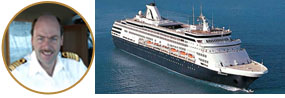
Today we had a quiet day at sea. The weather was good and we were going at a slow speed. The distance between Bar Harbor and Newport is too long to make it in one night and if we would go full speed we would arrive there in the course of the evening and after sunset. So we happily trundled along with 13 knots, giving the guests the chance to enjoy a day at sea and to enjoy all that the Veendam had to offer. This is the day in the middle of the cruise, where nothing special is happening, no welcome on board, no farewell, so the Cruise director can pull out all the stops and offer a great diversified program. For me it was a chance to catch up with paperwork and to review the coming cruises. We have not been to the Caribbean since March and that means checking up on what has changed since then. The big thing is that the docks have been washed away in Costa Maya by one of the visiting hurricanes. Repairs will not be ready until mid 2008 and so the good ship Veendam will deviate to Cozumel. It is really the only option, as there is no other port within steaming distance.
A sea day for the deck and engine department gives time for training. Big maintenance projects take place in port, when the guests are ashore, and a sea day is ideal for small training courses as all the crew is on board anyway. Those who are in permanent training are the cadets. We normally carry four of them. Two upstairs and two downstairs. We are the “British” ship in the company as we have British cadets; the other Holland America Line ships carry Dutch cadets. Since 1996 we have British officers and cadets in the fleet as the Maritime Academies in Holland do not deliver sufficient Dutch officers to satisfy the needs of the company. Great Britain was chosen very carefully as a second supplier of officers. Both the British and the Dutch are from the Anglo Saxon seafaring tradition and have the same way of thinking. We fought some wars against each other in the 17th and 18th century and as both won and both lost, there is no animosity. Plus the Dutch speak fluent English so there is no problem with communication. (Although we have issues sometimes with the Scottish and Welsh officers………..)
The British cadets have a training program that is totally different to the Dutch. While the Dutch do two years at school, then a year at sea and then a final year at school, the British do it in steps. Also Dutch cadets get trained both as Navigator and Engineer, the British are mono disciplined. The British cadets go to school for three months and are then assigned to a ship for four months. The advantage is that if they do not like the sea, they only loose a few months of their lives in going the wrong way. The disadvantage for the ship is that they know absolutely nothing yet. They just observe and try to understand shipboard life. Most of the time, however, they get the hang of “shipboard life” in the Officer Bar quite quickly. After the first four months, they return to school for four, return to the ship for four, etc. etc. until they have accumulated 12 months of sailing time and can finish their studies. Upon completion they receive a 3rd Mates license and will have to go back to school two years later for their 2nd mates and then for their 1st mates and finally their Masters.
The British method has been the same for a long long time. The Dutch system has been varying through the years. Until the 1970’s we did the same as the British. When my generation came along they tried something new. You did three years at school, at year at sea and then a year back at school. When finished you had your Masters license in theory and a Bsc. in Nautical Science.Then you only had to accumulate sailing days to validate your next rank. This was great if you did not want to sail forever, your Master license and Bsc. opened many doors but quite a few students, who would have made excellent seafarers dropped out as it was very hard to complete. From my intake of 87 about 25 made it and only 6 are still at sea. All having their own command now.
Next idea was to have a combined training. Qualifying for both a bridge and an engine license. Many Dutch container and tanker ships started to sail with integrated crews, who stood a watch on the bridge and did work in the engine room. These engine rooms were so automated that they could run un-supervised during the night with had the Engine control panels on the bridge. That system is still in place, except that Holland America does not take part and has the cadets make a choice when they have obtained their license. Either upstairs or down stairs. The work on a cruise ship is too different and to extensive to effectively being able to master both disciplines to the required standards.
At the moment they are thinking in Holland to go back to the mono discipline schooling system as some cargo company’s do not seem to be too happy with the ships integrated system. What goes around, comes around I suppose.
Tomorrow we are in Newport and it is going to be an early arrival.
October 16, 2007 at 4:42 pm
I so enjoy reading your posts. I was glad to read that you are getting ready for your next cruise to the western carribean as we will be joining you. I will miss reading your posts, but I will catch up when we get back.
I have followed the hurrican season this year and when Hurrican Dean hit Costa Maya we knew we would not be going there.
That same week, when Dean hit, there was another hurricane headed towards the Belize area and we wondered if we would get to ANY of the ports we had hope to visist. But the forcast at this time does not have any tropical depressions and I hope it stays that way.
We can not wait to get on your DAM ship.
October 17, 2007 at 4:10 am
Thank you for the explanation about the British and Dutch training regimens. I recall reading that it has become more of a challenge to find officers and seamen for the various shipping companies because not so many people choose a seafaring life these days. I think the cruise lines are very fortunate to have so many exceptional captains. It is certainly not a life that everyone could manage.
Good luck with your move to the Caribbean. I’ll be following along as you head south!