- Captain Albert's Website and Blog -

Ocean Liner History and Stories from the Sea, Past and Present. With an In Depth focus on Holland America Line

Page 220 of 241

03 May 2008, The Inside Passage.

We made the early tide of the Seymour Narrows with some time to spare and as there were no other cruise ships yet, nor tug or barge traffic, we could just swing through without having to adjust speed for others or to wait.

While sailing in the Inside passage there is a traffic reporting system that advises, all those who participate, of where to expect traffic so you can avoid meeting each other at corners or in a narrow passage. All larger commercial traffic participates, it is compulsory for 300 tons over, and sometimes private yachts and fishermen as well. Although the later depends a mostly on the professionalism of the skipper in regards to his/her pre voyage planning and the familiarization with the local rules and customs.

There are several traffic control stations along the BC coast. There is Victoria, Vancouver, Comox and Prince Rupert Traffic and the coastal waterways are divided accordingly. Victoria together with Seattle Traffic controls Strait Juan de Fuca and the Puget Sound. Vancouver Traffic controls the stretch between Victoria and Vancouver, plus the waters approaching Vancouver such as the Strait of Georgia. From roughly, Seymour Narrows to the tip of Vancouver island it is Comox traffic and when past Vancouver island, Prince Rupert looks after the area up to the Alaskan border.

In Alaska there is no traffic control system and the pilots there have to rely solely on their security messages when approaching a tight corner or narrow passage. There is not much traffic going up and down to Alaska and the water ways are on average wider than in British Columbia so there is less of a need for it. But the traffic system is very useful in the BC waters as there is a lot of barge traffic all year around and during the summer time there is the extensive Cruise ship traffic.

So when the Veendam approached the Seymour Narrows, we already knew what there is waiting at the other side and if necessary we could have sped up or slowed down, depending on the arrangements needed. Ships that travel with the tide have the right of way, simply because it is much more difficult to regulate speed if the water is pushing you forward, than it is to buck into it and stay in position. An un-pleasant situation is always the presence of a log tow that has to go through. Their floats do not make much more than 6 knots at the best and thus they have to wait until complete slack tide, or maybe go with the end of a following tide. With that speed come very slowly through the hole, while we are basically sitting there and wasting time.

Thus the pilots try to go through when there is still a bit of tide running and the log tows are waiting for the turn of the tide. For those sort of things the Traffic System is invaluable. As said, we did not have any traffic at all this time so we breezed through on the end of the ebb tide. Once through, we kept a no-wake speed until we passed Brown Bay, which is a marina on the island side. In order not to damage the moored yachts, which are not always tied up properly and then we sped up again.

After Seymour Narrows there are two more narrow passages with a lot of current and that is Race Passage in Johnstone Strait and Blackney Passage just east of Alert bay.

For me it meant that I was on the bridge all night long. This time it lasted from 21.45 to 05.30 and then it was a few hours sleep until my day job started again, running the ship.
We had horrible weather going through Johnstone Strait as a big squall came over with 50 knot winds but it was a good day for the guests as the wind died down in the morning and sun came out. It was just a little bit rocky as there was a long ocean swell running into Hecate Strait. A swell caused by very bad weather in the North Pacific.
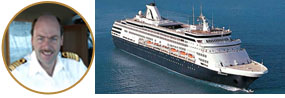
02 May 2008, Vancouver.

After sailing north from Victoria during the night, we arrived at 06.15 under the Lions Gate bridge which connects Vancouver with Vancouver north. Behind it is Vancouver harbor, which official name is Burrard Inlet. The Lions Gate Bridge derives its name from a double mountain top in Vancouver North. Some say that it resembles two watching lions, guarding the entrance to Vancouver. For me they look more like a pronounced part of the female anatomy.

However you look at it, sailing into Vancouver harbor is always nice. This morning was no exception. The sun was coloring the skies bright red and there sea was as smooth as a mirror. By 0645 we were off the dock and I took over from the pilot and swung the ship around to dock starboard side alongside, on the West side of Canada Place. Normally ships dock here with their noses into the city but that means that the guests have to walk further to get into the centre of the terminal. Thus there was the request from shore operations to park the ship the other way around, to improve the flow of traffic.

Vancouver will be our home port for the summer season and after two 7 day cruises, we will call at Vancouver every other Friday. Being a home port means that it is the port were we load supplies and provisions, bunker fuel oil and offload recyclables. The latter becomes more and more important as the company has adopted an aggressive policy of increasing the amount of recycled waste by 15% this year. I am all for it, as a thrifty Dutchman it goes against the grain anyway to throw anything away and secondly the money that we save, apart from the environmental gain, goes into the crew welfare fund on board. So all the more reason to separate, contain and sort out everything that in the past would have been shoved off to a landfill.

As we are a Friday ship, we were the only cruise ship in port during this call and later in the season we will be joined by one more ship, the Celebrity Infinity. On Saturdays and Sundays there are normally four of five cruise ships in port and that makes things a little bit more hectic, especially during arrival and departure. Being a Friday ship has another advantage, namely that all the shops are open, which is great for the crew, and that it is a normal working day. That means that repairmen and suppliers are all available and servicing the ship, while on a Saturday and Sunday, they do not always show up. Especially on a sunny day, if there is the choice is to go to the beach with the children or to tinker on a ship with a piece of malfunctioning equipment.

In a change over port I am always intensely interested in the timely arrival of the guests. That is the case in Tampa but even more in Vancouver. Although we sail on a regular schedule to Alaska, there is an issue that can gravely affect the whole operation and that is the tide at Seymour Narrows. This is a narrow passage about 100 miles North of Vancouver, where Vancouver Island almost touches the mainland. As a result the water is squeezed through a relatively small opening and thus a strong current is present. Depending on the monthly cycle of the tide the currents can go up to 16 knots during a spring tide. Needless to say, that we do not go through the Narrows when such a tide is running. It is either slack tide, when the current is zero and goes from Ebb to Flood or the other way around, or there is a window when the current is not yet too strong. However the slack tide time changes each day and that can play havoc with the schedule. If the tide is too early in relation to our departure time, then we have to go slow until the next tide, and after the passage go flat out to try and make up the lost time.

That brings then for me the question, if guests are late, do I wait, or do I go and have them fly up to the next port. If I sail late, I might endanger a timely arrival in the next port and thus inconvenience 1200 guests because I waited for a few.

This time everybody was on board, we pulled out just before 5 pm. and went pedal to the metal for making the Seymour Narrows tide window by 11 pm. That means that after the Narrows, I should have some time in hand for a timely arrival in Juneau, the day after tomorrow. How much I will only know by tomorrow 6 am., when we are out of the first part of the inside passage and out of the current that will have been most of the time against us.

01 May 2008, Victoria BC.

With the movement towards cooler weather there comes the moment that we change from white to blue uniform. This is a decision that is solely made by the captain and nobody else and is based on his personal take on the matter. If a captain favors a particular uniform he might hang to Whites but in general the moment is gets too chilly for the white material to keep warm in, the switch is made.

So after looking a few days ago at the 10 day weather forecast for Victoria, it was easy enough to see that it was going to be chilly, very chilly. While the ship is at sea the sort of uniform is not as important as most of the time is spent in air-conditioned spaces but when in port it becomes an issue. Therefore at 6 am. this morning it was time to change to blue uniform. The 6 am time is chosen so that the coming watch and the hotel day shift shows up in blue at 8 am. and the off going shift, still in white, is gone by 8 am. The two hours between 6 and 8 are a bit of a muddle as nobody is on exactly on the same time schedule for starting work but as there are hardly any guests around at that time, it is not much of a problem.

By 9 am. we turned into Strait Juan de Fuca. I was expecting a predicted ebb-current, slowing us down but as the wind and swell had been westerly in the past days, the whole current pattern was out of kilter and we had 1.5 knots with us instead of 1 knot against us. Thus we arrived nice and timely at the Victoria pilot station and the pilot stepped on board exactly at the requested time of 2 pm.

It is only a short distance to the dock but an ignorant fisherman had decided to run his nets right across the fairway. I am saying ignorant as he probably did not realize the cost he might incur to damaged nets if a ship would plow through it. We do try to avoid cutting through nets but it is not always possible to go around them, due to traffic, water depths or other circumstances.

This time the fisherman was in luck, the pilot wanted to make a wide approach to the dock anyway and thus we could sail around the nets with a wide curve. If we hit a net it is more of a problem for the fisherman than for us, as we have knives on the propellers that will cut all the netting apart.

There were two other cruise ships in port, the Oosterdam in the berth next to us and the Celebration Infinity in the berth opposite the Oosterdam. The Volendam could be heard making noises on the VHF as they were in drydock in Esquimalt which is a mile to the West of Victoria. As the two big boys occupied the middle pier, the Veendam had to dock at Ogden Point South which is the most difficult berth to get into. Especially when it is windy. Today we had only 10 knots on the sb beam and I was not unduly concerned about that. So a 1000 feet from the pier, the pilot handed the conn back to me and with a slow speed we floated into the dock space, keeping the breakwater about 200 feet to the starboard of the ship and the dock about 15 feet to the port until we were in position.

We were supposed to dock at 15.00 and we had at 14.59 the gangway out. How about that for timing. Two minutes later a steady stream of eager shoppers and sightseers swarmed ashore to enjoy Victoria on a chilly but sunny day.

The ship was scheduled to sail at midnight heading for our final port of call Vancouver and at 11.45 pm we raised the gangway and let go the lines. We will be docking at Vancouver Canada place West at 07.00 hours tomorrow.

30 April 2008, At Sea.

This was our second day at sea and during the early morning the wind finally started to abate and came down to about 15 knots. The ships movement however continued, as a long rolling swell kept coming in from the North-mid Pacific. There was a lower, 2nd swell running as well, more from the West, and that made the Veendam both pitch (bow going up and down) and roll (sideways movement). The latter kept the hips stabilizers nicely occupied. The pitching we just have to live with. Thus far nobody has been able to invent a satisfactory system that stops the ship from doing that.

Although it is being studied. Especially Japanese scientists have been working through the years on bow and stern fins with the idea to dampen the vertical movement of the ship. The last I heard was that they managed, with a smaller ship, to reduce the vertical movement measured in G force (that is basically what you feel in your stomach when the ships deck suddenly falls away from under your feet) from 0.25 to 0.20G, thus a reduction of 20%. If you take into consideration that stabilizers on average reduce the ships roll by about 90%, you can see that anti-pitching devices still have a long way to go before becoming effective.

However it did not seem to affect the guests very much, the sea-sick bags hanging in the ships where looked at with disdain and all the shipboard activities were well attended; as far as possible with only 70% of the ships capacity filled. We passed the California –Oregon border at noon time and we should reach the entrance to Strait Juan de Fuca by 9 am tomorrow morning.

Today was also the Official Birthday of Her Majesty Queen Beatrix of the Netherlands. In reality she was born on 31 January but she kept her mothers birthday (the late Queen Juliana) to officially celebrate it with the nation. In Dutch we call it Queen’s day (Koninginne dag) and big parties are thrown all over the country. Standard item is to wear something orange. This color comes from the fact that the Queen is from the house of Orange which is originally an area in the South of France. In the bigger cities, street parties and parades are organized and orange is then the predominant color. If the ship is in port we hoists all sorts of flags, there is an official protocol for that even to the extend of which flag should go up and down first, but with this wind there was little I could do at sea. Maybe next year.

As we are coming closer to Alaska there are a few things that the guests will notice while on board. That is apart from the outside temperature of course, which dipped below 50oF today. Through the years, American States and Canadian provinces have passed legislation that extends to onboard the cruise ships. The first one we will notice is tomorrow morning. When we are sailing in Washington State waters (e.g. three miles or closer to the shore) we are not allowed to have the Casino open. Now technically it is just possible to stay out of the 3 miles when in the Strait of Juan de Fuca but the moment you have to change course for a fisherman, you are inside. And fishermen always tend to be in the way. Thus to avoid violation of this rule, the Casino will be shut tomorrow.

Canada, read British Columbia, has a different rule. Here it is 5 miles from the port. So when we leave Vancouver on 2 May, we have to wait until we are five miles from the harbor limit before we can open. Not a difficult rule but it is one that needs remembering and so the Casino Manager calls the bridge to verify that the ship is passed the magic five mile line before eager gamblers can attack the slot machines and gaming tables.

In the course of the evening the swell became slowly become less prominent and by the tomorrow morning it should be gone completely. Weather for Victoria looks good, at least for seasonal standards. Mid fifties and partly cloudy.

29 April 2008, at Sea.

Today we spent the whole day sailing along the West Coast of the USA. The wind was blowing up to 40 knots full on the bow and the swell increased during the day, resulting in a lively ride. It is supposed to get better in the early hours of tomorrow morning when we move out of this frontal system. This evening around 9 pm. we passed San Francisco. Too far away from the shore to see anything but we sailed by two ships who were killing time before entering the port. I assume that their berths were not available yet otherwise it did not make sense to be out here in the ocean floating with the current weather conditions.

Apart from rocking and rolling along it was a quiet day and as the ship only has 800 guests on board it is also quiet in the lounges and during the shows. The Veendam has a space ration of 43.5 and that means that with a full house it still does not feel crowded. Thus now with 400 guests less on board it feels almost empty. The only advantage is I presume, that there is no line at the ice cream parlor.

I have very little else to report apart from the fact that I am still digging through the Alaska manuals to become fully aware of the latest developments in the Great Land. Today I took also all the crew, in two sessions, through an Alaska indoctrination program. We showed a video with guidelines of how to respect nature and I explained a few things in regards of way of operating during the coming season. The guests can see the same video on their cabin TV’s during the cruise.

Time to answer some questions submitted during the past period:
1. Stabilizers when deployed. My normal policy is to leave it to the discretion of the Officer of the watch. This normally means that when the ship starts to move, they are put out, by operating them from the bridge. As they slow the ship down by about 0.75 knots in the hour, I might sometimes leave orders that I have to be consulted first, if we are on a very tight schedule or when I expect that the rolling might only last a short time because we are about to change course and the ship will go from rolling to pitching. It takes about 3 minutes to pump them in or out.
2. Spouse policy. The higher the rank, the better the arrangement. All Staff, officers and petty officers, who have single cabins, have the option to have a spouse, fiancée or close friend on board for a certain amount of time. It goes from unlimited down to two months a year.
3. Late arrival penalties. Not in the ports. Pilots will board a ship when it arrives and linesmen/longshoremen are paid for a fixed period of time. Docks are paid for by the day. However it can cost the ship a considerable amount of revenue if tours have to be cancelled because of the time frame. In the home port there can be a severe impact on guests missing flights and the necessary rebookings, which might be a lot dearer than the original price.
4. Ships log. It is half half. We have a black box system that automatically stores radar picture, gps position, course speed, and bridge audio (captain singing) on a hard disk. The paper ships log is still filled out for positions and occurrences during the watch such as course changes, drills, drafts, meetings and other legal requirements. We still plot on paper charts but it is expected that we will go fully digital in the near future when legal approval in the USA is finalized.
5. Bsc. Nowadays all Dutch officers that graduate from an Academy level have a Bsc. It is not necessary for Short Sea licenses and neither for promotion from there to deep Sea. Neither does a Bsc make you a better sailor but it gives you a wider horizon to work from. A Bsc does give you faster access to higher certification as your basic school level is more extensive.
6. Veendam sailing from Ft. Lauderdale. No we are not; we stay for the winter in Tampa. There is an oopsy in one of the cruise brochures.
7. The tent will not go up in Alaska, it would help against the rain but it would block out watching wild life flying overhead.
8. The training facility MSR at the Wilhelmina kade does not do regular tours, but they have open days for the general public and schools at certain times in the year.

Tomorrow we have another day at sea, and hopefully the wobbling will get less. However there is a collusion of 3 frontal systems in the North Pacific going on and that might send some waves our way.

28 April, 2008, San Diego

San Diego is a port that every Holland America Line navigator knows even without ever having been there. Reason is that it is one of the standard ports that we get trained on during our Simulator courses. We call those BRM trainings, which stands for Bridge Resource Management. Every 5 years or less each navigator undergoes a weekly training. During that week several scenarios are played out on a ships simulator and marine accidents are scrutinized to learn lessons from.

A simulator is basically a fully operational bridge on dry land. The bigger ones look a bit like an Imax theatre. We train normally in Rotterdam where they have several units available and the biggest bridge can also roll and pitch as a ship in real life does. Using a simulator gives the option to try things without the danger of it going wrong with disastrous consequences and it is a great tool for building up routine. Normally there are two groups during a week and while one group is preparing an exercise the other group is doing it. Each group is accompanied by a captain who acts as an assessor to evaluate the performance of the juniors. That takes half the day; the rest is spent on discussing accidents and incidents that took place in the industry. Almost 80% of incidents in the maritime industry are connected to human mistakes. By using case studies we train ourselves to recognize where an error chain started and how to break it so that the incident does not occur.

Approaching the Port of San Diego is one of the exercises. It is not a difficult port so the sailing in does not take all the focus of the bridge team, but it is a navy port and the navy does not always play according to the normal rules. As they are almost constantly in training, they are not always part of the “normal” world of shipping. The simulator exercise is based on having to take action when suddenly a navy convoy comes down to sea and has to be met in a narrow part of the fairway, with wind and current adding to the difficulty. Together with “navy speak” on the VHF it is enough to distract a bridge team and mistakes are starting to be made. The idea is that the team is so aware of each others actions and responsibilities that they recognize where the pattern of making mistakes starts and that it get instantly corrected.

So when we arrived in the early morning it was as if the whole exercise was played out in front of us in real life, only difference we now had a pilot on board. We had a navy ship (Nbr 4) coming down to sea and Navy ship (Nbr 100) was making noise on the VHF while conducting exercises off the sea buoy. The exercise turned into real life.

The weather turned out to be a lot warmer than predicted, as the Santa Ana was blowing. This is a wind that comes from the desert and brings hot air and a lot of dust to the sea. Thus it was not 73oF and sunny but about 95oF and also sunny, while a brown cloud of dust was hanging over the port. We docked next to the Carnival Elation but we had the terminal while they had to make do with an open pier and some tents. San Diego still has some ways to go with getting proper cruise facilities. The good thing is that the terminal is located in the middle of the city with a shopping centre nearby. The moment the ship had been cleared, there was a wave of crew rolling ashore straight for the shops to stack up for Alaska. Alaska prices there are a lot dearer and the crew knows where the best deals are to be gotten.

We disembarked over 700 guests here who preferred not to do the last three, maybe wobbly days, and fly home from Vancouver. 300+ guests came on board for these few days. Some of them long time mariner repeat guests, some of them new to the company and here to sample the HAL product, without having to commit to a longer cruise to do so. We pulled out on time and indeed it will be wobbly tomorrow. There is a gale blowing off San Francisco and we are going to meet it had on.

27 April 2008, at sea

Today we had a quiet sea day while on our way to San Diego where about 700 of our guests will be disembarking. We were sailing around 12 to 20 miles from the Mexican shore line and the weather remained good but the outside air temperature was slowly dropping.

We are in full swing with the preparation for the Alaska season. Due to environmentally sensitive area’s that we will be sailing in for the whole summer, there are numerous rules to comply with and to prepare for, plus a lot of local protocol. The navigation officer has to prepare all the charts, as although we will be sailing nearly constantly under pilotage, we have to have our courses and distances in place, to check on what the pilot is doing.

Most of the cruise is inside territorial waters and that means that for the first day and a half we have a Canadian pilot on board, then for 3 days an American pilot in Alaska and then for one and a half day a Canadian pilot again for getting back to Vancouver. It is also not one pilot but two, who relieve each other while we are under way. British Columbia has different rules as Alaska in relation to navigation and all of this has to be planned.

Same goes for the ports. Apart from the regular navigational rules, the Captains of the port in Alaska (USCG) have made special rulings for the interaction of local craft and the big cruise ships, while in the port. To have a successful season without incidents and accidents all navigators have to be aware of all these issues and thus we have started to do extra training sessions.

In the coming blogs you will read about the various peculiarities of the Alaskan ports.
Apart from the navigators, there is also work going on in the engine room as we have to comply with very strict emission regulations. So the chief engineer is busy with fine tuning all the machinery that emits any form of exhaust. In the hotel department it is the same. There are a few different procedures in regards to custom and border protection as the (small) Alaska ports can not muster as many officials as on the mainland. Furtheron special licenses have to be applied for so the purser is also a busy man.

To get this all properly prepared we get help from our agent in Alaska. All the cruise ship companies use one agent called Cruise Lines Agencies of Alaska (in the old days South East Stevedoring) and they have been there for years. During the winter in Alaska they prepare all the information that is needed for a successful season and send it by April to each ship in the fleet. Information about clearance procedures, Medivacs and hospitals, docking arrangements and dock layout, which ships are calling each day in which port,
Etc. Etc Etc.

Thus I spent most of the day perusing the information that the agent had forwarded to the ship and in the coming days I will be checking if everybody is fully aware of what is needed to know and if all is ready by Vancouver.

San Diego is supposed to be bring us a sunny day with temperatures in the mid seventies. Perfect for the guests to travel home and with the airport minutes away from the ship.

26 April 2008, Cabo San Lucas.

With the whole deck department orchestra in tune, as mentioned yesterday, we managed to anchor the ship in a nice position by 7 am. and sent the first tender ashore to collect the authorities. By 8 am. we were up and running and the guests were streaming ashore. We were together with the Elation and they came in at 9 am. But as that ships sails on ships = read San Diego time, it was for them still 8 am. They were going to leave at their 3 pm. time which was thus an hour later than ours.

I am saying Elation but officially it is now called the Carnival Elation. As part of the rebranding process of the fleet, Carnival has now added the prefix Carnival to all its ships. A tradition that began with the Carnival Victory which was baptized as such. Celebrity is doing a similar thing and now all their ships have the prefix Celebrity in front of the name. All meant to more easily recognize not only the ship but also the company who operates it. Luckily with our Dam names HAL does not have to go that way. Our name company relation is so distinctive that everybody knows who operates the “Dam” ships.

The weather was indeed cooler than predicted in the weather forecast and gentle 77oF topped the thermometer for the day with this breeze coming from the Pacific Ocean. It resulted in a very pleasant day in Cabo san Lucas and no doubt all the guests must have enjoyed the stay. We left nicely on time and as the water becomes very deep as soon as you are off the anchorage, I could sail by Los Arcos, which comprises the “Cabo of San Lucas” at a distance of about 1700 feet without fear of shallow waters.

Just around the corner to the West is a beautiful stretch of white beach that was named sometime in the past by Playboy magazine one of the most seven beautiful beaches in the world. As we all know that Playboy magazine is known for its authorative and in-depth articles, we have to assume that they know what they are talking about. However that title was given when there was only one Hotel on that whole beach but now the whole coastal stretch has been developed with hotels and condominiums. No doubt a lot of people are very happily living there but I still prefer what I saw back in 1982, with that one hotel, and a little fishing port with a single restaurant and flea market.

At the end of this white stretch of beach is another cape. Cabo Falso. This is the western corner of the southern tip of California. It is also called the “Cold Cape” because as soon as you come around the cape, the water temperature starts dropping from 26oC to 17oC in a few hours. The whole weather pattern changes due to the convergence of the different water currents and it is one reason for the abundant sea life in the area. The meeting of cold and warmer waters brings a lot of krill to the surface. Whales like to come and feed here in the summer and there was a whole fleet of Tuna fishermen floating off the Cape waiting for the fish to arrive. Tomorrow will be a sea day and the temperature will be a lot lower than in the past days but it is expected to be sunny.

25 April 2008, At Sea.

Finally after all these warm days we had a bit of a cool breeze. There was a moderate North Westerly breeze blowing caused by a disturbance off San Francisco. This brought cooler air from that area and thus the temperature dropped from the high 80’s to the mid seventies. For tomorrow in Cabo San Lucas the prediction is temperatures in the high 90’s but if this wind keeps blowing than it might be there a lot more comfortable.

For most of the night we sailed close to the Mexican coast and passed Manzanillo at 8 am. From there the course line diverged from the coast as we started crossing the waters of the Baja California. By mid day we were 80 miles to the South of Puerto Vallarta, as the crow flies, heading on one straight course for the Cabo San Lucas anchorage.

We had to maintain quite a high average speed to make it on time and so I was very much interested in what the Ocean current was doing. The predominant current here is about 0.5 knot to the South East so directly against us. 0.5 x 24 hrs. is 12 miles and that sets the schedule back 40 minutes. Either you arrive 40 minutes later than planned or you have to go faster to make up for it. However the for some unknown reason the current was most of the time absent and sometimes even a little bit with us. Maybe the wind-still period in the last few days had some influence and I was certainly not the person to complain. Thus tomorrow morning, we will be on time. I hope to arrive even ahead of schedule to be able to set up the tender service in good time, so all is ready when the first guests want to go ashore.

The Veendam has not been to Cabo for awhile and for most of the officers and sailors it is a new port. That means that extensive instruction is given to all about the operational specifics for this port. All the tender drivers receive instruction from the 3rd officer in the route to follow from ship to shore and all dangers are pointed out. Shallows, other traffic, where to wait before coming to the dock etc etc. Cabo San Lucas is full of marine tourism and boats, jet skies and canoe’s are hired by tourists, who are, let’s say are less than qualified to operate them properly. So when they do something wrong it is for us the professionals to make sure that their mistakes do not turn into our disasters.

Apart from the sailors also the security guards are instructed; by the security officer. Each port in the world adheres to the ISPS code which regulates ships and port security worldwide. However within this legal frame work there is room for local interpretation and thus every port is different. A few days before we come to a port, the port security officer is in contact with the ships security officer to exchange information about what is needed to comply with the local rules and for the shore to know under what level of security the ship operates.

Finally for the navigators there is a morning session during which I discuss how I am going to approach the anchorage, where I will park the ship and we review each officer’s role in the evolution. While I park the ship, the chief officer communicates my orders to the bow, where a 3rd officer is standby to let the anchor go. On deck another 3rd officer is standby to start lowering the ships tenders when the ship is almost stopped. Then there is a second officer on the bridge who has the watch and answers telephones and he is assisted by a 4th officer for filling out the ships log and the checklists. Finally there is an officer standby at the gangway for pumping out the tender platforms when the ship has come to a standstill. The more each officer understands the parts the other officers play, the better the operation works. It is like an orchestra where everybody plays the same tune in the correct tempo.

24 April 2008, Acapulco.

Acapulco is still one of my favorite ports on the Pacific West coast. It is nice to sail in and out of; and the town is located right on top of the terminal so there is no fuss with shuttle busses and taxi’s to take to get somewhere. The only thing that can spoil the fun is a swell running into the bay that makes the ship rock alongside the dock.

We approached the pilot station around 06.30 with an official pilot boarding time of 07.00 hrs. I had built in a bit of lee way as you never know where the Acapulco pilot boards. It depends mainly on the fact if the boat is working or not. I have seen them coming out in regular pilot boats, in fishing boats and once in a real canoe. The latter one happened when a hurricane put the regular pilot boat and the senior pilot’s private boat on the beach. It was a bit of an unusual sight to see a regular canoe coming out peddled by two people and the pilot standing in the middle waving a big Mexican flag to attract our attention.

This time the pilot was in his regular boat and came all the way out of the bay as it was nice weather. I have known the senior pilot here for years and he has the good grace to let me continue to navigate the ship and assists with guiding the lines men on the dock and keeping fishing boats out of the way. For the rest he likes our coffee and drinks a lot of it. “Strong coffee for a strong pilot”, the whole deck department knows the saying and the quartermaster concocts a coffee potion in the morning that only he likes to drink. I have a strong suspicion that the bo’sun is using the rest of the coffee to grease the lifeboat wires as the stuff is really thick.

He also solved the mystery of a cruise ship at the cargo pier and a car ship at the passenger pier. The cargo ship, a car carrier was not there yet but they had started parking new cars on the passenger dock. There are two Nissan car plants close to Acapulco, one in the city of Pueblo and in Cuernavaca. The finished cars are then transported to Japan. Sounds to me as if they are carrying water to the sea but it seems to make economical sense to do so. The carrier was coming after the weekend to pick up 2000 cars and to get those on board quickly the new cars were already arriving at the dock. Thus I had more or less the whole pier for myself but as there was a little bit of well running alongside the dock, I decided to go in as far as possible. That meant for the guest a longer distance to walk but at least there would be no accidents due to a moving gangway.

So we sailed into the bay during sunrise and docked accordingly. By 8 am. the gangway went out and a stream of eager shoppers rolled ashore. It was another very warm day as the sea breeze that was blowing, came from the North West and was stopped by the mountain range around the city. We did not stay for the evening as the schedule to the next port, Cabo San Lucas was too tight and sailed out of the port at 5 pm. The pilot preferred to leave inside the bay, as the swell was increasing near the entrance and that give me the chance to build up some speed before the ship came outside. For the ships stabilizers top operate properly you need a ships speed over 10 knots and now I could switch them on before the Veendam came in open waters.

For the next 36 hours we will sail along the coast of Mexico and will cross the Baja California. Arriving at Cabo San Lucas the day after tomorrow. That will be the final port for most of our guests as about 700 are leaving in San Diego.

« Older posts Newer posts »