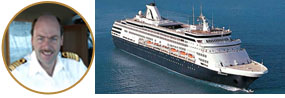
- Captain Albert's Website and Blog -

Ocean Liner History and Stories from the Sea, Past and Present. With an In Depth focus on Holland America Line

Page 219 of 241

13 May 2008, Glacier Bay.

Glacier Bay is located just West of Skagway with only a mountain range in between and that means that the weather is similar to that of Skagway with only a different wind pattern. The latter, because Skagway has this Lynn Canal funnel effect that increases the wind velocity while blowing up the canal. There is however a big difference between the weather in the lower bay, similar to Skagway, and the weather in the upper bay, close to the glaciers. In the upper bay with all its ice there is a sort of micro climate that only follows the weather in the rest of the area if that weather is very pronounced. It means that I can never predict what the weather off the Glaciers is exactly going to be.

The Rangers were on time and so was the Veendam and by 7 am. we had the complete group onboard. Apart from the two Rangers, the bird watcher and the Native interpreter we also had a Ranger Coach on board with two trainees’ to follow the proceedings of the day. All in all a group of seven to show us the sights of the day. This is also the last call of the Veendam to Glacier Bay until September. Next week we start our cruises to Seward and then we call at Hubbard Glacier.

Indeed the micro climate was apparent again and while we sailed up the bay, the weather got better and better. By the time we arrived at the glacier the sun was shining through the clouds and lit up the top of Marjorie Glacier. It was going to be a good day.

Sailing in Glacier Bay is an exercise of close cooperation between the ship and the Rangers. In order to get our yearly entry permits, we have to live up to the Rangers expectations of being good custodians of nature. Holland America has always obtained the maximum number of permits available for Glacier Bay entry’s so we are doing well but we have to work hard to keep our record up. The Glacier Bay National Park organization sets a number of requirements that we have to comply with in the bay to ensure a maximum enjoyment for the guests. It is up to the Captain to juggle all the requirements, both Rangers and company, and balance them into a perfect day.

The time spent in the bay in accordance with the company’s schedule is from 7 am to 4 pm. In that time I have to get up the bay to the Glaciers and back to the Ranger station. For the Rangers I have spent a minimum of 5 hours in the Upper Bay and at least 1 full hour in front of a Glacier. When there are a lot of whales around in the lower bay, speed restrictions are imposed so we can stop quicker in case a whale would cross our bow. This all requires different speeds and at the same time I have to make sure that the funnel emissions are kept to an absolute minimum. Further on the tidal currents change every day, so one cruise I can have 4 knots against me and the next week 3 knots with me.

Finally I have to take into account that I might not be able to make the speed that I calculated, based on all the requirements listed above, as I do not know how much ice there will be until we reach the glaciers. If there is a lot of ice, I have to go much slower in order not to damage the ships hull, than otherwise would be the case.

Every captain has to deal with this “Glacier Bay puzzle” and nearly all the time the pieces come together exactly and we all have a great day and we had one today. Sun on Marjorie Glacier, we managed to have a peek into John Hopkins although there was quite a bit of ice and we did all exactly on schedule. The Rangers disembarked just after 4 pm. and by 4.30 pm the bingo could start for those who were “natured out”. While sailing out of the bay we saw a lot of whales so those still intently watching on the outside decks were not disappointed. Even the sea lions were out on the rock when we exited North Inian Pass for open sea.

Tomorrow we are in Ketchikan and according to weather forecast it is going to be a windy and rainy day.

( Note: There is a map of Glacier bay on the blog of 6 May)

12 May 2008, Skagway.

Those who operate the ships have a hate/love relation with Skagway. It is a nice place to call at and easy accessible for all guests but not always that easy for docking a ship. Today was one of those days. Overcast, rainy and about 25 knots of following wind funneling up the Lynn Canal.

The Veendam was scheduled to dock at the Rail Road Dock all the way forward with the Dawn Princess behind us. The latter one we overtook while entering the southern part of Lynn Canal, just below Haines. When docked at the Railroad dock the ship is in the shelter from southerly winds but while approaching, the winds buffets off the mountain range with ever changing and unpredictable angles. So the approach looks a bit as that one of a drunken sailor navigating towards the entrance door of the pub. The wind pushes one way, and the captain corrects the ship the other way.

Apart from the wind there was also a current coming from the inlet to the West of Skagway and its direction changes constantly in the bay and is even less predictable. Thus I made my approach slowly and watched intently where wind and current where pushing the Veendam to. By the time the ship was half up the pier it came in the shelter of the mountain and then it was just a matter of adjusting for the current which changed from a set off the pier to one towards the pier while moving forward to our position.

In the meantime the chief officer was keeping an eagle eye on his sailors to make sure that no line was thrown ashore before 0600 otherwise he would have to pay extra overtime for the linesmen. By 06.15 we were happily docked with the bulb about 50 feet away from the rocks at the end of the dock and the gangway hooked in. The Dawn Princess came alongside behind us about 20 minutes later as they use the same linesmen as we do. Therefore she was scheduled for first line at 06.30

The weather remained very un-settled during the day with intermittent periods of rain and it continued to blow from the south side of the Lynn Canal. While the guests where ashore, the ships crew went through a General Drill which comprised of a fire drill and an abandoned ship drill. Today we had a simulated fire in a passenger area. Accommodation fires are, apart from engine room fires, the greatest worry on cruise ships and we rehearse scenarios for it on a regular basis. To be successful in fighting a fire you need basically two things. One; your teams have to be on the scene quickly so that the fire can not spread and secondly; control the smoke so that it does not affect the rest of the ship.

As soon as a fire is reported somewhere, all the fire screen doors are closed to contain everything in one area. Then the fire squads will approach from behind the nearest door and move forward step by step towards the “hotspot”. While a hose handler team moves forward, there is a second team behind them for backup and a third group who checks each cabin in the closed off area. The success of the fire squad relies on its timely arrival. As soon as the fire alarm has been raised, the team has about 5 minutes to dress up and to get going towards the scene. Ideally we want to have the attack teams in position within 8 minutes after the alarm was raised and from them they advance within 10 minutes towards the fire. By the time they arrive at the scene, the first responders, those are people who close doors and clear areas, have rigged up fire hoses so that the fire team is not delayed by having to do this.

When we simulate these fires, we use a smoke machine that gives off dense white smoke and reduces the visibility to zero. It is the same sort of smoke, or dry ice, which is being used during a show in the theatre.

If fighting the fire would have been un-successful than you have to progress to abandon ship and that involves all the crew on board in one function or the other. That was what we rehearsed to this morning and apart from the weekly training drills, a full abandon ship drill is a monthly requirement. Unfortunately the weather did not make it very pleasant for the crew to stand on deck for 20 minutes, while undergoing Q&A, but Safety comes first.

By the time we left Skagway, the wind had increased to nearly 40 knots, so while going south again through Lynn Canal we had a relative wind on the bow of about 50 knots. Luckily the wind is supposed to die away so it should be better tomorrow in Glacier Bay. Maybe the wind will also blow the rain clouds away.

11 May 2008, Juneau.

I could only fool Mother Nature partially. By going inside I did manage to give all our guests a quiet night without the ship moving. However the currents were all the way against us from the moment we neared the Pilot Station at Ketchikan until we docked at Juneau. That meant loosing one to two knots each hour. Apart from that, the slow down for transversing Snow Passage cost me time as well. Thus in the end we docked 1.5 hours late in Juneau.

Even on this inside run, I had to dip into the Pacific Ocean for about an hour and between 6 and 7 am in the morning, the ship started to pitch and move about while we made the turn into Chatham strait. During the night the waves had abated a little bit, instead of 18 feet waves it was now down to about 14 feet but that was still very unpleasant even for the short spell that we felt it. Arriving late in Juneau is not too much of a problem as it gets dark quite late and we could simply move all our tours up in time and everything that the guests wanted to do was still possible including shopping as the shops do not close until about 10 pm.

Still it was better to be late and not to be sea sick than to be late and to be sea sick. I think all the guests agreed with me on this one as not a single complaint was received. Especially our large Aussie contingent on board was quite happy as “they had not come to Alaska all the way, just to puke all over it”. At least that was the way one of the gents described it.

The docking was one of the more interesting ones as the cruise terminal dock was occupied by the Celebrity Millennium and that meant that there was just enough room left for me to park the Veendam at the Alaska Steamship dock. Normally arrival times are arranged in such a way that the ship that has to go the deepest into the port goes first and then the rest follows. With an afternoon arrival that does not work of course and so I had about 800 feet of room to park a 720 feet ship.

Where ships dock depend on various issues. First of all there is the number of passengers onboard. The Millennium being the biggest one was thus allocated the Cruise terminal as then most passengers could enjoy the floating ramp and did not have to be involved in steps, steep ramps and changing gangway locations. The Dawn Princess was docked at the Franklin terminal. This is a 10 minute walk to down town. All Princess ships go there, as Princess paid (partly as far as I know) for the construction of this dock. They also have the gangway hassle there. Ships less then 800 feet in length go to the Alaska Steam dock, which is the best dock for access to the town but there is also the hassle with the gangways because of the tides.

There is one more dock, the A.J dock, which was constructed about 4 years ago. It is meant to accommodate the mega liners but is a long ways from town and most guests use a shuttle service to get to town. It has a floating pontoon in the middle and so there is no hassle with the gangway because of the tide but it is a long ways out. On average most guests are quite happy with having to wait for a relocation of a gangway while the ship is docked at Alaska Steam as the main shopping area and the Red Dog Saloon are straight across from the gangway.

I extended the port stay in Juneau so that the guests had the option to still spend the lost time of the late arrival in the town after dinner. About 200 did so. The crew was very happy about this as well, as it gave most of the cabin and dining room stewards the option to run ashore for an a hour after service finished.

We departed by following the Dawn Princess out, who had an earlier departure time. The Millennium was already long gone. During the night we will overtake the Dawn Princess as tomorrow we are scheduled to dock ahead of the Dawn at the same dock in Skagway. She will be leaving earlier that evening and thus will dock behind us, facilitating an easier departure.

For those who asked who is who in the photos yesterday and last cruise Glacier Bay: Captions have been added with the names.

10 May 2008, The Inside Passage going North.

After our delay we breezed through the Narrows just after 3 am. and soon I had the Veendam flying through Johnstone Strait. As there was no other traffic of concern we could keep up the speed and quite quickly started to gain the lost time back. However dark clouds were gathering at the horizon. It is early in the season and the North Pacific is still producing low pressure systems and during the previous night a very low one moved towards the Alaskan Coast.

The weather radio started to squack and squeek about gale and storm warnings and I knew I was going to be in for a good bit of fun. The afternoon and evening part of this stretch of the voyage takes us through the North Pacific Ocean for about 10 hours. That route ensures that we can make Juneau on time in case the Seymour Narrows tide is earlier than average and we cannot make the tide, as happened last night. The weather reports were soon talking about storm force winds up to 50 knots and swells building up to 18 feet off shore. Not a pleasant place to be with a ship full of guests who do not have their sea legs yet. Plus that such a high swell slows the ship down considerably, as the bow starts to slam on the waves. At full speed you loose up to 6 knots and if you slow down for a more comfortable ride, you loose that speed as well.

I was just doing well in making up the lost time from last night and here was the next challenge: a very bouncy ride towards Juneau. There was one alternative available that I could take and did. Going the other way; more inside and sheltered from the ocean but it is a longer route. However if the situation is that you are going to be late due to the swell anyway and with a ship full of sick people or that you are maybe going to be late but with a ship full of “happy campers” then the decision it not that difficult. The ships agent managed to contact the pilots on time before they flew to Kake and they will now board at midnight near Ketchikan. From there we will sail through Clarence Strait and Snow Passage, the normal route between Glacier Bay/Juneau to Ketchikan the Southbound way.

In the course of the day the wind started to abate and the passage through Queen Charlotte Sound was quite pleasant with the ship just moving a little bit. The navigators were on high alert with extra lookouts posted as there were a lot of whales around. Around 7 pm. we saw a shoal of around 50 at the same time. As whales do their own thing, uninterested in any surface traffic, we change course away from them as much as we can but everybody has to keep a sharp look out to catch their location on time.

The second night on board is formal night, during which we hold the Captain’s welcome Champagne toast, which is the replacement of the old Captain’s ships staff introduction. Tonight I had something special with honoring an employee who had spent 35 years with the company. So instead of the Employee of the Month we put him in the spot light. Mr. Prijotomo joined Holland America in 1973 with the second group of Indonesians who came to the company. He started out as a GPA cooks mate and through the years worked himself up to Assistant Dining room Manager. He has been sailing now on the Veendam for the last seven years. I think it is important to give as much exposure as possible to such a milestone and therefore I like to do the presentation of the company gift during the welcome on board party as it has the biggest audience of any gathering on board.


Mr. “Tommy” Prijotomo asst. dining room manager receives the company clock and congratulatory letter from the President of the company for his 35 years of dedicated service to the company.
On the photo
HM. Kees Streuding, CE, Gerard Mensink, Captain Albert J. Schoonderbeek, CO Marcel van Zwol, Mr. Tommy Prijotomo, EO Joe Parks, Future Cruise Consultant Leslie Hockett, Cruise director Chris Butcher and Bell Boy Mr. Ronni Rohmawan carrying the 35 year clock

In the late evening the wind started to pick up again but is was a following wind. It smoothed out the waves a bit and it also meant an additional push to the ships speed. I am keeping my fingers crossed but at the moment it looks like there is not going to be too much of a delay in arriving. Most important of course is that the guests can enjoy a pleasant evening and a good rest on a stable ship.

09 May 2008, Vancouver.

We had a bit of consternation on arrival. The sudden appearance of the Golden Princess in the schedule did not much good for our preplanning. During the first call the plans had been made up for the season, with where to dock and how to have the optimum guest flow through the terminal and now suddenly we had to shift docks. For the whole season the Veendam was supposed to dock at Canada Place West and the Norwegian Sun at Canada Place East, leaving the north berth empty. Now the golden Princess, which is one of the shopping trolley class, was assigned the East berth for one call and the Norwegian Sun moved to the West berth. Thus the Veendam ended up at the North berth.

It does not look much of a change but while you dock starboard alongside at the West berth for an optimum traffic flow, it is portside alongside at the North berth. That means that on board the luggage preparation, the off loading of recyclables and the planned loading of provisions has to be turned around 180o. Not a big problem but it needs some reorganizing. It took our Bo ‘sun most of the day to get it all lined up as he is with the sailors in charge of aligning the luggage bins in the Marshalling area, so that the off loading takes place in the proper sequence.

Today was a beautiful day which hopefully lifted everybody’s spirit a bit as the terminal was a place of stress for a lot of people. In total 6,300 guests had to go off the ships and back on again. That meant long lines for cabs for going home and even longer lines for guests waiting to go through American passport control before boarding. As the Alaskan ports do not have the facilities to process larger number of persons entering the country, the American entry requirements by Customs and Border Protection are done in Canada in the cruise terminal. Not a perfect way to start a cruise, standing in line but at least it does not take any time away from going ashore in the first Alaskan port.

I was in a hurry again as the Seymour Narrows tide was early. In the coming weeks it will be later but this time I would be able to just make it if I was able to pull out early. We did pull away from the dock early but not as early as I had hoped for as at the last moment two vans with luggage arrived. So instead of gaining an hour I only gained 30 minutes and I could only hope that it was sufficient. Also the fact that I was now docked portside alongside, did not help, as it meant loosing another 15 minutes by having to back away from the dock and having to turn in the harbor. However by 1700 we sailed under the Lions Gate Bridge, going full out with hopes in our hearts.

Schedule wise we did make it because traffic started to interfere. We are of course not the only ship that goes for slack tide. There are also tugboats with barges heading North and similar traffic coming South. The big problem this time was a log tow that went through at exact slack tide and was taking a long long time. So we had to slow down and that meant by the time we would be in Seymour Narrows the current would have picked up to over 5 knots and that is a no no. The chance to be caught by such a current, that was also rapidly building up to 8 knots, is too great a risk going through. The Passage is not that wide and we go through with a maneuvering speed of about 12 knots. 5 knots of current gives then a side ways set of nearly 40% when making the turn and that is too close for comfort. So we had to abort and wait for 3 hours before the current had reduced its self again sufficiently to go through. That means that tomorrow morning I will have to go full out with the Veendam to catch up. A little comfort was that next to our ship, two tug-and-tows were in the same predicament and their skippers vented their flustration loudly over the VHF. With their slow speed they had hoped to sail North on a following tide and now it was going be the other way around.

08 May 2008, sailing the Inside Passage.

This is the last day of the cruise and once again, as with going Northbound, everything was focused on the slack tide, the passage time, of Seymour Narrows. For today the early tide was around 21.00 and that was what I aimed for. It also meant that I could do a little bit of sightseeing was well as I did not have to sail too fast.

At the far north end of Vancouver Island there is the option to divert to Comorant Island via Pulteney point. It is the more scenic route with several villages on either side of the water. After passing Pulteney Point lighthouse you can see on the North side the village of Sointula. This is a predominantly Finnish settlement from the late 19th century. I found out about this in the 1980’s when we had to do a Medivac and it was arranged to land there and have the patient transported by ambulance via the local ferry to Vancouver Island. A cruise ship tender coming into Sointula was of course not a daily occurrence and thus most of the town was present to observe the proceedings. Great was my amazement when I docked the tender that there were a lot of blond haired, blue eyed girls standing at the tender dock. So while the medical department fussed over the patient and the ambulance I had the chance to find out how these girls ended up here. My Finnish was never that good, but then, they did not speak Dutch either. But as the only Dutchman ashore I was a major focus point of all those blue eyes and I was not in a hurry at all to return to the ship. Unfortunately the captain was in a hurry so it was a very short visit.

Next scenic point is Hadington Island on the starboard side. This is a small round island that acts as a sort of round-about for shipping traffic, separating North and South bound traffic. The island was for sale a number of years ago and the latest I heard is that a mining company wants to re-open the quarry on the island. It supplied the stones for the BC parliament building in Victoria but was later closed.

Next is Alert bay and the reason that I diverted the Veendam. Alert Bay features the highest totem pole in the world and it is clearly visible from the ship. Secondly it has a Common with a whole collection of smaller totem poles. Some of these poles were collected from other area’s to protect them against souvenir hunters but some are new, and at least two have been erected in the last 5 years. We sail by here on slow speed so the guests can have a good look and to stop the ships wake from hitting the shore line at the town. While we sail this passage our Cruise Tour Specialist (formerly the Naturalist) gives a running commentary about what is out there.

The sun was shining and that meant that it was beautiful scenic cruising all the way through Johnstone Strait to Seymour Narrows. By 9 pm. we where in the middle of it while the sun was setting, so all the guests could see the narrowest passage of our whole trip. A nice treat as normally we sail through here in the dark in order to keep the schedule by taking the earliest slack tide after leaving Vancouver. Just past Seymour Narrows is the village of Campbell River with a big pulp mill on the edge of the town.

By 21.30 we were in the Strait of Georgia going slow speed to aim for a timely arrival in Vancouver. The pilot and officers on the bridge will be looking all night long at the Celebrity Infinity just ahead. Because of the arrival sequence in Vancouver she will go in first, so we stayed behind her for the whole night. Always nice to have somebody show us where to go. The weather for Vancouver looks good and thus it will be a good ending of a very nice cruise.

07 May 2008, Ketchikan.

After the spectacle of Glacier Bay yesterday, Ketchikan could only offer less excitement. However we still had every reason to be happy. It did not rain. It rains in Ketchikan about 332 days of the year and thus the chance that it does not rain is very small. Even if a dry day is predicted there is most of the time a little drizzle somewhere during the day. But today it was dry. Chilly, but dry. It is turning out to be a very good first cruise of the season.

The route between Glacier Bay and Ketchikan goes through Chatham Strait and then dips briefly into the Pacific Ocean near Cape Decision. Here we could feel the Ocean swell for a little while before we were back inside again, sailing through Sumner Strait. At the end of Sumner Strait is Snow Passage, a narrow passage between Bushy Island and the much larger Zarembo Island. You can avoid Snow Passage by sailing around Zarembo Island but it is an hour longer, so we go through the passage.

Snow Passage is not named after snow, although there was still plenty around after last winter, but after Commander Snow of the English Navy, who wanted to be remembered for posterity, so this passage was named after him. Due to the current I have to be on the bridge as the current might push the ship off the track and if the pilot then makes a mistake we end up on the rocks. Thus I watch carefully what the pilot is doing with his course changes, ready to take over in case I do not like it. That has not happened yet in my career as a captain but in accordance with Murphy’s Law it will happen the one time that I do not expect it to happen.

After Snow Passage it is a straight shot for Ketchikan which is located in the middle of Tongass Narrows. Tongass Narrows is also a fairly narrow stretch of water and here again it is standby time for me. Not because of the current but because of the no-wake zones. Slow downs with the ships speed are required to avoid damage to properties and tied up boats along the shore line. The approach to the dock is fairly straight forward although a bit tricky due to the wind and the current. The trick is here to find a balance between the influence of the wind and the current and then let the ship float towards the dock and only correct the ships angle in relation to the dock In the past winter Ketchikan has spruced up its docks and is on the verge of completing a new one. That means room for another mega liner to park.

The Veendam docked in downtown at berth 2, which is as close to downtown as it gets. We will have this berth for the whole season, although on our southbound trips we will have to wait until the Amsterdam departs at 13.00 hrs. We are scheduled for at 14.00 hrs arrival so that should work. We had the same situation in 2006 and then we got it down to such a fine art that the Veendam slowed down with the same speed as the Amsterdam sped up. It looked two cars given each other a parking space, only in this case with lengths of over 700 feet. Sometimes it is really fun to play with ships.

We had large tide today, so the gangway had to be shifted a few times and platforms put under and removed. It basically means that all afternoon a forklift was on standby to be called as soon as the gangway was getting to steep, due to the tide coming in, and when the break door threshold was almost going under pier level due to the tide going out.

I spent most of the afternoon inspecting the new dock to see if there were any peculiarities incase I would have to dock there in the future. But the newest dock, which has been privately built by our ships agent, has been designed by people who understand cruise ships and their constant tussle with gangways and therefore it will do its job very well.

We pulled out from Ketchikan right on time and sailed East through the second part of Tongass Narrows, heading South for Canada. The weather looks good for tomorrow and if we make good speed we will go sightseeing.

06 May 2008, Glacier Bay.

The morning was bright and clear and it looked like a great day for glacier viewing. We sailed into the bay around 06.30 to be off Bartlett Cove at 07.00 hrs. This is the ranger station and the Rangers come out with their boat and board the ship via the pilot ladder. Apart from two Rangers we also had two members of the local Indian tribe and a bird watcher coming on board. For the rest they loaded a whole pile of luggage on board, consisting of books, DVD’s and other items for sale to the guests. The same boat comes back at 16.00 hrs, to collect the Rangers when we return to the mouth of the Bay.

Even before heading up the bay, I saw that this was going to be a very special day. The snow reached all the way down to the water line. They have had a very severe winter in Alaska with a lot more snow than normal and that snow was still there. I have now been coming to Alaska to 26 years and have seen a lot of beautiful days but never that the snow was still covering everything all the way down to the tide water line. It looked magnificent. With the Rangers safely on board we headed up the bay to cover a distance of about 50 miles to get to the glaciers. The first part went rather slow as we had about five miles of current going against us in the narrow passage abeam of Strawberry Island, but when the bay widened we made good speed. The Veendam was the first ship of the season to go up to Glacier Bay and thus also for the Rangers who were very eager to see what had changed during the winter months.

Overview of Glacier Bay. Courtesy -from somewhere on the Web-

The Rangers provide a full program in Glacier Bay and all regular ships activities are suspended during that period. It starts upon boarding with a meet and greet with the captain when the program for the day is discussed as the Ranger bridge narration is run in sync with my schedule of going up and down the bay. For the guests it starts with a “Meet the Ranger” chat in the crows nest which is also their home base for selling merchandise and answering guest’s questions. During the day we have one ranger on the bridge for the narration and one in the ship for Q&A.

While we are sailing up the bay, there is a presentation by the members of Huna tribe about how their ancestors lived in and near Glacier Bay and there is a get together with the children on board as part of the Club Hal program. The narration on the outside decks starts around 09.30 when the ship reaches the upper bay, near Russell Island. Quite often we see mountain goats here and there are always the chance of bears. Here we start to slow the ship down as the first bits of floating ice tend to show up. These pieces of ice, really too small to be called icebergs, come down from the Glaciers and melt while floating down the bay. Near Russell Island most of it is melted away.

Also this is where the bay splits into two parts, Tarr Inlet and John Hopkins Inlet. We go to the right first to visit Tarr inlet with the Marjorie and Grand Pacific Glacier. We floated in front of Majorie Glacier for an hour and saw indeed some calving. From there we moved to the entrance of John Hopkins inlet. We can not go inside the bay as the pupping season for the seals going on but then John Hopkins glacier is best view from a distance anyway as it climbs all the way up to the Fairweather mountain range. The glacial ice was completely covered with snow and it looked spectacular. From there we did a sail by, by Lamplough glacier which is a blue ice glacier and then it was time for the Ranger lecture in the main lounge. Before the guests knew, it was 4 pm. and time to say good bye to Glacier Bay. To top things off we had porpoises and Whales playing around the ship near the entrance. As said, it was a magnificent day.


John Hopkins Glacier, covered by snow. Courtesy 3rd officer Symen van der Veen

Tomorrow we are in our last port of call, Ketchikan. Final stop to please the shoppers. We are again the only cruise ship in port, so I will park the Veendam straight across from the visitor centre. It is supposed to be dry and that is very special for Ketchikan where it rains normally 332 days out of the year.

The first Bridge team to enter Glacierbay in 2008. Courtesy Ships Photographer.

The boys (and girl) from the bridge who navigated the ship safely towards it’s destination: left to right
4/O Rens de Kouter, 3/0 Steven Macbeth, A/O Simon Mitchinson, A/O Nathan Ferris, 2/O Jan Westerbeek, 4/0 Rebecca Hillier, Capt. Albert J. Schoonderbeek, Chief Officer Marcel van Zwol, 3/O symen van der Veen, 2/O Sr Steve Nevey, S/O JohnCabalde, E/O Joe Parks.

05 May 2008, Skagway.

The run from Juneau to Skagway is one of going “around the houses” as the town is just to the North of Juneau, but we have to go around a mountain ridge to get there by sailing through the Lynn Canal. In the 1980’s Holland America did not go to Skagway at all but ran their own sightseeing boat, the Fairweather, from Juneau to Skagway. With the growth of the tourist industry in Skagway we started calling there after 1994.

Skagway derives its fame from the Klondike Gold rush of 1898 which transformed a sleepy valley with a single homestead into a bustling entry port for gold prospectors. Main attraction nowadays is the train that runs from Skagway up the interior all the way into Canada. However many other tours have since been developed including helicopter tours. In the summer Skagway is a town of commerce with the whole of Front Street devoted to shops. The normal town occupancy of 400 doubles to 800, with the influx of summertime shop attendants. Most of them are accommodated at a camping site at the end of the valley. As quite a few of them are students who have to return to university at the end of the summer, a lot of shops tend to close when the students have to leave. By mid September the main street is almost a ghost town with all the shop windows boarded up for the winter.

Apart from cruise ships occupying the dock, there is also an ore dock, and on a regular basis ore ships still come in to load ore, coming from the Canadian interior. It is brought down by train and then transported by conveyor belt over the dock to the ship. In high season that dock is also used for cruise ships as I have seen four cruise ships in port at the same time plus and Alaska state Ferry.

We were alone today, which is also the last time as the season fully kicks in next week. Then there will be 3 or 4 cruise ships each call. But today we enjoyed our solitude and docked at 6 am. in the morning. It was wind still and only a little drizzle present. That dried away later as well, so we had much less rain than yesterday in Juneau. We docked at the Rail road dock under the shelter of the mountain ride that forms the Eastern side of the Valley in which Skagway is located. I prefer this dock, as it is more sheltered from the North of Southerly winds that can blow through the valley or through Lynn Canal with considerable force.

On the rock face there a lot of ships graffiti can be seen, although in this case I would prefer to call it Ships Art. Ships names, company logo’s and Captain’s names are painted on each bit of flat surface there is. The highest one is from the Royal Viking Line, almost at the top of the Cliff and not accessible by foot or ladder. I wondered for a while how they managed to do it and then found out that they had hired a helicopter for the day.
My name is on the wall as well, dating back to 6 September 1994, when the Nieuw Amsterdam under the command of Captain P. Kievit made the first call to Skagway since the demise of the ill fated Prinsendam(1). The funny thing was, the Bo ‘sun had spent all day, painting the ships name, the captain’s name, my name and the ships logo on the rock and then went back on board as sailing time was nearing close. Suddenly out ran the ships plumber, called Ben Bamba and he quickly pasted his name under the sign as well.
Ship, Captain, CO and Plumber are all still immortalized on the rocks of Skagway.

Since then several Hal ships have been added to the list starting with the Prinsendam in 1975. The oldest sign I could find was from the Princess Alicia from 1928, a Canadian Pacific Railroad steamer that used to call on a regular service at Skagway in the summer. The latest one is from a celebrity ship which name it could not read, as the sign was too far forward of the bridge, but the paint looked very fresh.

After the last tour was back on board, we pulled out from the dock, sailing down scenic Lynn Canal on the way to our highlight of our cruise, Majestic Glacier Bay.

04 May 2008, Juneau.

After a bit of a rocky night with a long ocean swell rolling in from the deep Pacific we re-entered the Inside Passage but now the Alaskan one. The guests had had a nice and sunny day and the pitching of the ship just stopped by the time everybody went to bed. The Veendam charged as a race horse up the coast, backed by the current and the following wind. As a result we picked up the pilot at Cornwallis point by 06.20 instead of 07.00 as had been planned. This pilot station is located near the town of Kake and is only in operation in the summer. Mainly for the cruise ships that come directly from Vancouver or Seattle and are heading to Juneau. Most ships, as we will in 14 days, call at Ketchikan first.

With the steady stream of cruise ships coming to Alaska, the pilots there have been expanding their numbers steadily each year. At the same time a number of old timers has retired and means that they now have an extensive training program going. So we had two pilots on board that were qualified for all tonnage and a deputy pilot who still had training to do for his next step up. Pilot qualifications in Alaska go by the tonnage mark, as on average the larger the tonnage, the bigger the boat. The deputy pilot knew his job already but he still had to do a number of approaches to a port and dockings with a larger ship, under the eye of a senior pilot, before he will qualifie for his next license. I am saying he, but the Alaskan pilots have two female pilots as well, who are qualified for all ships since a number of years.

With the pilots on board the Veendam galloped further up the coast towards Alaska, still pushed by wind and current. We saw quite a few whales, although it is still early in the season and sailed by Tracy Arm but no ice to be seen. The whole inlet is still clogged up, and it will be a while before it starts releasing its ice. The weather was typically Alaska today, rainy and chilly, but not too much wind. In Alaska they do not talk about rain, as they have it all the time, it is called liquid sunshine…………always think positive.

With all this current and following wind we ended up 45 minutes ahead of schedule at Marmion Island. This is the beginning of Gastineau Channel, the gateway to Juneau, our stop for the day. The last part of the voyage goes very slowly as we have to operate under reduced speed. Since a number of years the USCG has a “Voluntary Waterway Guide” which HAL subscribes to, so for me it is compulsory to comply. It means that when coming closer to the port the ship is reduced in steps to avoid danger or damage to other boats and floats in the area. It comes down in steps from 16 to 14 to 10 to 7 to 5 knots at the edge of Juneau harbor and from there we gently float to the dock. All cruise ships companies participate and so do most other commercial operators.

Today we were the only ship in the port; next cruise there will be three more. Biggies as well. With no other ships calling, I could pick my favorite dock, the cruise terminal. This one has the advantage that the gangway goes up and down with the tide as it rests on a floating pontoon, so we do not have to switch the gangway location when the gangway become to steep to climb or the break door disappears under the dock. Next week we will be at Alaska Steam dock again, where we have the switch gangways but here the advantage is that is about 500 yards closer to down town. The Red Dog Saloon is just across the road from the gangway. For some people an important advantage.

It remained rainy for the whole of the day but it did not seem to deter our guests. The tours were well booked and all the shops were open. In the evening the wind died down and the rain was no more than a bit of drizzle. As it is still fairly dark at this time of the year, sail away was quite romantic with the lights of Juneau in the background and with still a lot of snow on the mountain tops. Tomorrow we are in Skagway, also all by ourselves.
Sail away looked a bit like this from the bridge wing. Photo courtesy of the State of Alaska.

« Older posts Newer posts »