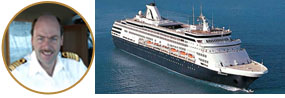
Today was the big day; The transit of the Panama Canal. An exciting day for the guests as it is really a once in a lifetime experience and thus something very much to look forward to. On board the ship it is a long, long day for most of us but even if you have been through the canal many times, there is always something new to discover. In my books this crossing will be written down as a very good one. The weather was perfect for the Canal. Sunny but also overcast and slightly hazy, taking some of the heat away. The transit went more or less according to the published schedule and that helps the on board operation.
The arrival started off on the wrong foot. I had been advised to be at the Cristobal Breakwater at 05.00 hrs. which made it very tight in the schedule from Cartagena but when approaching the entrance of the canal, we were told that we had to wait half an hour. Of course we were advised about that, while only 10 miles away. Had I known earlier, we could have slowed down more sedately, instead of putting the brakes on “just in time”. So we dropped speed from 19 knots down to three and slowly progressed towards the breakwaters which we passed at 05.27. Luckily we did not have to anchor for clearance. The pilot boarded just after the breakwater and we could proceed directly but slowly towards the Gatun locks while the paperwork was done for the clearance.
This clearance is a whole ritual. First the launch with the Clearance Officer and Fumigation officer arrives. The next launch is the agent with more clearance papers, the mail and various supplies. Then the Panama Canal technician pops up, who installs on the bridge a lap top computer that shows the pilot the exact track through the canal with the help of GPS. He also checks if we have a magnetic compass (and if it works) and if the gyro compass has no faults. Is this all done, then we get the clearance and we can proceed. The ship is assigned a transit number, in our case S6Z denoting that we are number six in the Southbound convoy, and off we went.
Next to arrive were two additional pilots. Now we had three pilots on board. Two for on the bridge and one for the mooring deck aft. The latter is here because the Veendam has overhanging lifeboats so we cannot see the side of the ship. This pilot on the aft deck, directs the locomotives when going into the locks to avoid the ship from bumping into the lock walls. While sailing through the canal, the two pilots on the bridge relieve each other half way and each stands on a bridge wing side keeping an eye on the locomotives when going in and out of the locks. They also brought a narrator with them for the commentary during the day time.
When coming closer to the locks the Panama Canal crew comes on board and is escorted by the security guards to their stations fore and aft. While in the locks, they handle the wires of the locomotives and the mooring ropes if needed. Plus they secure the tugboats if necessary. As the Panama Canal crew tends to be very inquisitive and good at souvenir collecting, they are escorted everywhere by the security guards. A normal crew consists out of 20 men. 10 crew go forward, 8 crew go aft and each team has a bo’sun. They work one set of locks, so after the Gatun locks they left again by launch and the next group boarded before the Miguel locks and left again after the Miraflores locks.
The ship crew was busy as well. I had a sun-shade-tent made for the Veendam, by the ships upholsterers, as during the last crossing in Sept. 2007 it had irritated me greatly that all the guests had to stand in the sun all day on the forward observation deck. So I had a sort of tent or canopy made that covered about half of the observation deck above the bow. It showed rather prominently on the web-cams. There was a second tent also on the observation deck to cover the drinks and pastry stand. That tent is normally used as our security tent at the gangway but no reason why not to use it here as well. As it was sunny most of the day, the canopy did work very well.

Gatun locks Webcam. Courtesy of Captain Leo Lanschot
When the Veendam is in the locks, there is a maximum of 4 feet clearance on either side of the hull on the water line while the lifeboats overhanging the lock walls. When going in and out it is less as there is a big car tire or wheel at the knuckle to protect the lock doors. Quite often a wide ship like the Veendam touches that car tire while the pilot lines up the mules and the wires are hooked up. The ship is kept in the middle of the locks by the locomotives or mules on each side of the ship. During the connecting of the mules I keep the ship in position with the thrusters until the pilot has lined up all the six locomotives. After that I keep standby with the thrusters in case the mule-drivers are not reacting quickly enough to the orders of the pilots and the ships hull moves towards one of the lock sides. Then I try to thruster the ship away again. Unfortunately this is sometimes necessary as the mule drivers are not always alert. The problem for me is that I cannot see the side of the ships hull from the bridge so I have to work on the relative movement of the lifeboats above the dock wall.

Mules waiting to service the ship. Courtesy of my wife
Most ships get six locomotives. Two forward, two near the bridge wing and two aft. Although the pilot uses them for various movements, basically the two front ones are used for pulling, the two near the bridge wings are to keep the ship centered in the locks and the two aft ones are for braking and also keeping the ship centered. I help with the main ships propellers to move the ship forward through the locks to keep a good momentum going.
A critical moment is always when the locomotives have to go up or down the slope of the dock wall and when they connect and disconnect. When going up or down the slope, it is difficult for the locomotive driver to keep the wires taut and when connecting or disconnecting the pull of the wires is suddenly put on or released and that all can unbalance the alignment of the ships hull in relation to the dock wall. Thus the thrusters are at the ready for me to use, to counter act the ships movement on time.

Mule going down the slope. Courtesy of my wife
After the first set of locks, we sailed with a slow speed through the canal as we had to wait for the North bound convoy to clear the narrow part of the canal near the Culebra Cut. The pilots can see the movement of all the ships on their laptop computer, as each ship has a transponder called an AIS that is fed into these laptops. With it they can also predict the best passing location and speed the ship up, or slow it down, to reach that rendez-vous point at the right time. There was a lot of excitement in the air today, as the last number in the North convoy was an “un-identified ship”. That normally means Navy but as this was not formally announced because of security reasons, the pilots did not know whether it was a small ship, that could be passed anywhere in the canal, or a big one, that we had to meet before passing Gamboa. In the end we had to sit for 10 minutes abeam Gamboa until we found out that it was a submarine. Rumor had advised everybody about that already but officially we did not know, so we had to wait. Gamboa is the little village about halfway through canal, which is home to the Canal department that maintains the waterway itself, with buoys, dredgers and other aids.

Miraflores Locks Webcam. Courtesy of Mrs J. Parks
From Gamboa everything went like clockwork and by 1700 hrs, we had disembarked the last pilot, (here the ritual from the early morning, now went the other way around) and the Veendam pasted the sea buoy for open sea. The whole operation had taken exactly 14 hours from early End of Sea Voyage near the Cristobal Sea buoy to Commence Sea Voyage near the Balboa sea buoy. It is not very often that I am on the bridge when the sun rises and am still on the bridge when the sun sets, but this was one of them.

In the last lock. Courtesy of my wife
Tomorrow more scenic cruising in Golfo Dulce only this time without locks and without pilots.