- Captain Albert's Website and Blog -

Ocean Liner History and Stories from the Sea, Past and Present. With an In Depth focus on Holland America Line

Page 203 of 242

Captain Albert: 06 May 2009, Crossing the North Atlantic

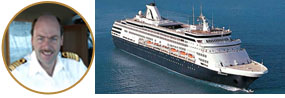
Captain Albert SchoonderbeekCaptain Albert Schoonderbeek

This is our last day at sea before we arrive at Punta Delgada in the Azores. The weather is still holding, overcast as predicted and with a low to moderate swell (4 to 5 feet), which makes the Prinsendam gently pitch. It does not look like this weather will change very much in the coming period and that will mean that we have had a very good crossing, especially for the time of year, as summer has not arrived yet. As mentioned before, we have made up the time lost from our crew medivac in Bermuda and that means that we will arrive on time. I am even planning to be a little bit early so that we have time to clear the ship and set everything up before our official arrival time.

We had a bit of excitement today as we were first hailed by a French warship and then later on buzzed by a surveillance plane of unknown registry, although we think that it was a Portuguese one, as it came and went back directly in the direction of the Azores. We were not surprised that we were encountering navy in this area. The Europeans have stepped up their surveillance against ships polluting the oceans and at the same time are casting a forever watchful eye against drug trafficking. Although the latter is not so significant here, as we are in the middle of nowhere. Most drugs are transported over the oceans in regular containers.

However pollution is a major issue and navy ships work together with air planes to monitor traffic and to catch offenders. There are still ships out there who want to save some money by not off loading waste oil and think that they can dump it overboard without a problem. Although every waste stream onboard has to be recorded and thus also each amount of waste oil generated; cooking the books still happens and money is being saved by pumping engine waste directly over board. With an airplane these violations are easily spotted as a clearly visible trail can be seen from the air. From the surface it is much more difficult as the ships propellers disturb the ocean surface by their turning and that makes it very difficult to see for an observer if anything is being dumped. Thus the reason that there are surveillance planes around.

The French navy ship called us with a whole list of questions, I suppose to satisfy its own reporting needs and my watch officer was quite occupied with providing the correct answers. The moment supreme (most appropriate word I think when dealing with the French) came when the captain’s name had to be given. Thus was a hurdle for my English navigator, so I decided to answer myself and started spelling my full name. After the 22 letters there was a brief silence and then…………….Thank you have a nice voyage; end of questioning. Either my name did not fit in the check list that had to be filled out, or the operator was not in the mood to repeat it all or try to pronounce it. Anyway we continued happily on our way, leaving the French behind in the distance.

Continue reading

04 May 2009, Crossing the Atlantic Ocean.

We were blessed with yet another day of good weather. Due to the new wave field coming in from the North the ship was moving a little bit more compared to yesterday but it is still a very smooth crossing. Also the light Northerly Breeze brings cooler air to the ship and thus the temperatures are about a degree less at noon time than they were yesterday. All and all it is fabulous weather for a spring crossing. Continue reading

Captain Albert: 05 May 2009, Crossing the North Atlantic

Captain Albert SchoonderbeekCaptain Albert Schoonderbeek

We continued our crossing with good weather. Partly Cloudy skies with a little swell that kept the ship just pitching a little bit. The weather is supposed to remain good but a broad band of clouds is coming over the North Atlantic so it is expected that from this evening until Lisbon we will have cloudy skies. No rain is expected although we see on the radar occasional small rain showers in the vicinity. Rain does reflect on the radar. Especially a dense rain down pour acts as a reflector to a normal radar beam. We can boost the radar waves so that they penetrate rain clouds. However most of the time we keep the radars on a nice weather setting as that setting gives a better reflection of normal targets. However, with seeing the rain clouds on the radar comes the option (if they are not too large) to sail around the clouds and in that way keep the ship dry.

While the weather remains very good, there is more swell predicted on the last stretch of our crossing to Punta Delgada. To the north of us, roughly on the line Halifax, Greenland, Scotland, the weather is not so good. Weather fronts with considerable wind are crossing the North Atlantic and these winds generate waves. If that lasts for some time then the waves become swell and a wave field, that can travel a considerable distance away from the area from where they were generated. Generally a wave field will travel in the direction of the path of the weather front and that is mostly North East or East. Thus in our case, sailing further to the South we do not notice that much. However some waves/swell will travel in other directions, basically in the same way as when you throw a stone in the water and see the ripples going in all directions. If you throw the stone under an angle the ripples will be stronger to one direction than towards another but still some ripples will go another way. It is the same with wave and swell generated by wind, and of course the stronger the wind, the higher the waves are whipped up and the more we will notice it eventually.

I have included a wave chart this time; a chart that I check each morning on the internet. It is of course important to know for the guests if we get wobbly weather but also how high the waves will be. This to see if they will affect the ships speed. The ships movement called pitching (up and down movement of the bow) can result in a significant reduction in speed if it goes from just a gentle movement to a more severe form. By the time the bow is slamming into the waves you can loose up to 25% of your speed.

wave-field-web-300x252
The lighter the color; the higher the waves. As you can see the Prinsendam has been travelling through fairly dark blue area’s so we have had very little to content with.

Continue reading

03 May 2009, Crossing the North Atlantic.

This is the 3rd day of our crossing and the weather is holding fine. The sun is shining and with the temperatures in the low seventies it is very pleasant on deck but not too warm. The waves have changed direction again today thus the ship is riding very steady. Tomorrow there is another wave field coming from the north and then the ship will move again a little bit. This is relative as we only talk about waves varying between 2 and 3 feet instead of 4 or 5 feet. It is expected that the weather will remain nice for the foreseeable future. Continue reading

Captain Albert: 04 May 2009, Crossing the Atlantic Ocean

Captain Albert SchoonderbeekCaptain Albert Schoonderbeek

We were blessed with yet another day of good weather. Due to the new wave field coming in from the North the ship was moving a little bit more compared to yesterday but it is still a very smooth crossing. Also the light Northerly Breeze brings cooler air to the ship and thus the temperatures are about a degree less at noon time than they were yesterday. All and all it is fabulous weather for a spring crossing.

Today we also celebrated the middle of our crossing (more or less….. so it fitted in the entertainment schedule) and our cruise director marked the occasion by organizing a North Atlantic swim in the aft pool. This was a well attended affair and enjoyed to general acclaim; especially when the Cruise Director, startled by the ships whistle, fell fully clothed into the pool.

For the navigators a crossing is a peaceful affair with ships being far and wide in between. Yesterday we only sighted one bulk carrier but that ship came fairly close to us. So even on a crossing with hardly any traffic there is no room for complacency as one ship out there is enough to collide with.

One of the chores of the navigator on duty is to send a weather report ashore every six hours. There are now weather satellites that are so sensitive that they can measure everything from a great distance and with the internet the results are instantly accessible. There are weather sites you can log on to and see real time cloud formations moving over the globe. Huge computers are used to refine the prediction models upon which the Meteorologists base their next weather forecast and the predictions get more and more accurate all the time. However as we all know; the weather forecast is not always right and sometimes even completely wrong. It would not be the first time that we have been forecast partly cloudy skies and the next morning you can scoop 6 inches of that “partly cloudy sky” from your front porch.

Thus the meteorologists are very keen to get constant input from local observations. On land this is done by official agencies such as Airports and Coast guards but also by regular people. I know of one gentleman in my home county in England who has been doing this for 40 years without missing a single day. At sea it is done by the ships that participate in the program. This can be done in conjunction with the national weather service, which for the Dutch is the KNMI, or with the American side which is called the VOS project. (Vessel Observation) All Holland America ships are part of the VOS system as we mainly sail off the USA coast with only a few ships away for the summer in Europe.

And so every six hours, the navigator on duty or his assistant fills out a standard number of observations. Wind, waves, height, temperatures, etc.etc. If there is anything special observed, like water spouts etc. that can be added as well. The end report, we call this an OBS (coming from the word observation), is sent by email or satellite radio to a shore station. All the receiving shore stations are linked and the observations from all those ships that participate are shared. The observations are plotted in a chart and also become part of the enormous databank that is being used to create weather models for predicting the weather.

obs-doc-version-300x238
The circled position indicates where the Prinsendam sent in an OBS during May 04, 0600 GMT.

The nice thing is that we can see on the internet each day the result of our own observations, as they are plotted in a chart that is accessible in the public domain. Thus we can use our own observation together with those of all the other ships to get a picture of the actual weather around us. The observation of the Prinsendam is plotted in the chart shown above and we can recognize it as the ships call sign PBGH is printed next to it. As each ship has a unique call sign, it is easy to see how many ships have been sending in their OBS.

(Each country or flag state has an allocated number of call signs for their ships and the Dutch ones all start with a P. That P comes from the word Pays-Bays. Or Low Lands, the name Netherlands in the French language)

Tomorrow we have should have another peaceful day at sea.

02 May 2009, Crossing the North Atlantic.

This was the second full day at sea and again we had glorious weather. A gentle breeze was blowing from the southeast, a low swell was running from the northeast and there were just a few clouds to the North of us. As we were heading into the wind with 20 knots (that is a wind force 5) it was a bit breezy in the bow area but it was perfect at the stern. Everybody was settling down in a nice routine, enjoying the ship and its amenities, and I was hoping for a “boring” day so I could deal with the last of the hand over paperwork. However sailing a cruise ship is never boring, even when you hope for it. Murphy is always around and as we sail with people things will always happen un-expectedly. Continue reading

Captain Albert: 03 May 2009, Crossing the North Atlantic

Captain Albert SchoonderbeekCaptain Albert Schoonderbeek

This is the 3rd day of our crossing and the weather is holding fine. The sun is shining and with the temperatures in the low seventies it is very pleasant on deck but not too warm. The waves have changed direction again today thus the ship is riding very steady. Tomorrow there is another wave field coming from the north and then the ship will move again a little bit. This is relative as we only talk about waves varying between 2 and 3 feet instead of 4 or 5 feet. It is expected that the weather will remain nice for the foreseeable future. I promised yesterday to tell you something about the time changes on board the ship and why we are doing it on board the Prinsendam during the day time. There are options galore for when to give a time change and there can be heated discussions about which option is the best. Most of the time it all depends on what issue on board is affected the most by the moment of the time change.

Due to the fact that the earth is round and circles around the sun; we have to deal with the phenomena of day and night. And it is day or night at different times in different places, all depending on when the earth turns a part of its globe in the direction of the sun. If the world was flat and did not move than we would have either sun all day or night all day (unless we made the sun move of course) As a result of it all we have different times at different locations in the world. The standard measurement for the world time, at least for us sea farers, is Greenwich Mean Time (GMT), which is English time without the adjustment for winter time. Greenwich has been chosen to be the zero point. From there we count time differences in minus when going west from Greenwich and in plus when going East of Greenwich.

When we left Fort Lauderdale we were on GMT – 4 hours and the Azores with Punta Delgada are on GMT +/- 0 hours. So they are sitting on the Greenwich zero meridian or at least close to it; in the same time zone. Thus to get from -4 to 0 we have put the clocks forward by 4 hours. We could do that in one go. Say at 8 am, we put all the clocks forward by 4 hours, which makes it noon time. Apart from losing a whole morning (no lectures, no bingo, no coffee time and breakfast and lunch would be combined in a brunch) it would play havoc with the sunrise and sunset, because the ships time would jump four hours towards the sun but the sun would still be rising at its own time. Thus it would be dark until quite late in the (ships) morning.

Therefore the routine is to do it in steps. If you would be on a slow ship, taking 8 days for a crossing, you could do 30 minutes each day. On a faster ship you have to do one hour each day to make it a gradual happening. It also makes it easier for your body to accept it. (Airplane flights have a large time change in just a few hours and those result in jet lag)

Hours forward take time away. If we have to do it between ports, then it is done early in the morning, when everybody is asleep, but you will loose an hour of night rest. With an ocean crossing, people come for rest and relaxation and then loosing an hour’s sleep nearly every night is not pleasant. If you do it in the middle of the day, you hardly miss that hour. It is around lunch time anyway. So you still go to lunch around noon time, you finish lunch instead of 12.45 at 13.45 but you still have the whole afternoon ahead of you. Also you are less inclined to go to bed early than otherwise would be the case when it feels like 10 pm. new time already at 9 pm. in the evening.

My experience is that lunch time clock changes have less of an impact on shipboard life than multiple night time changes during a crossing. Thus I do my Voice from the Bridge each day starting at 12.00 hrs and ending it at 13.05 hrs.

Tomorrow is another sea day and then I will explain something about weather monitoring that we do onboard. In the meantime our medivac crew member is still in Hamilton hospital. He is doing better but still needs to undergo a plethora of tests as it is still not certain what his medical problem is.

01 May 2009, Crossing the North Atlantic.

This morning at 6 am., we left North West Providence Channel in the Bahamian chain of islands and entered the North Atlantic on our way to Punta Delgada in the Azores. We are supposed to arrive there on 7 May, so we have six beautiful sea days ahead of us. The weather is cooperating with partly cloudy skies and a gentle breeze and the North Atlantic is letting its presence known with only a very low swell. It just makes the Prinsendam move a little bit. Just enough to let everybody know that they are on a ship but not so much that it is really noticeable when you go around. Continue reading

Captain Albert: 02 May 2009, Crossing the North Atlantic

Captain Albert SchoonderbeekCaptain Albert Schoonderbeek

This was the second full day at sea and again we had glorious weather. A gentle breeze was blowing from the southeast, a low swell was running from the northeast and there were just a few clouds to the North of us. As we were heading into the wind with 20 knots (that is a wind force 5) it was a bit breezy in the bow area but it was perfect at the stern. Everybody was settling down in a nice routine, enjoying the ship and its amenities, and I was hoping for a “boring” day so I could deal with the last of the hand over paperwork. However sailing a cruise ship is never boring, even when you hope for it. Murphy is always around and as we sail with people things will always happen un-expectedly.

So it was no different today and suddenly I had a medivac (shipboard medical evacuation) on my hands. In the course of the afternoon a crewmember had been submitted to the ships hospital and his situation was so serious that the doctor requested to have him disembarked as soon as possible. That is not so easy in the North Atlantic when you are far away from land. You cannot just request a helicopter to coming flying over. If you need a helicopter you will have to be inside its acti-radius and that normally means changing course. This is called “deviating” at sea and that might even mean sailing the opposite way, back to where you came from, until you come to a port or are within helicopter reach. Thus a decision to approve a medivac is sometimes difficult to make as it quite often has a big impact on the cruise schedule. However a captain will always agree with the doctor’s request and arrange a medivac unless it would endanger the ship itself or it occupants. If this danger is not present then the medivac will take place even if it means that one or more future ports of call have to be cancelled because of the delays caused by it. Human life takes precedent over all.

However in this case I was in luck as we were passing by Bermuda in the course of the evening. As explained yesterday I had chosen the Great Circle route to Punta Delgada to save time and fuel and that route was taking the ship just South of Bermuda. So I only had to change course a bit to the North and head for St Georges sea buoy. The local agent was called and he set all things in motion. The pilot boat was arranged to come out and take the patient off. Only thing I had to do was to get as quickly as possible to the sea buoy which was our rendezvous point. With the pedal-to-the-metal we arrived there at 10.30 hrs. in the evening. I had advised the guests early in the evening about what was going to happen as it would have been a bit strange to suddenly see a fully lit up island passing on the portside while you are convinced that you are in the middle of the ocean; miles way from civilization.

Also Bermuda had beautiful weather and by keeping the wind on the beam of the portside of the ship; the sea was as smooth as a mirror on the starboard side, making it perfectly calm for the pilot boat to come alongside and do the transfer of the stretcher. Everything, clearing the ship, the ships doctors discussion with the shore doctor and the transfer was done within 20 minutes and before 23.00 hrs, the Prinsendam was on the way again. I lost in total about 2 hours of steaming time, so 40 miles to make good due to the deviation but with more than 4 days of sailing still to come, I will be able to make that up. We have a bit of Gulf Stream current pushing us in the back and with the very smooth weather that we have, I will be able to compensate for the lost time/mileage very quickly and thus I expect to arrive on time in the Azores.

Now we are all keeping our fingers crossed that everything will go well with our crewmember. We should get an update tomorrow, when the hospital in Bermuda has had time to evaluate the patient.

Tomorrow is again a sea day with expected good weather and we have now started loosing an hour each day due to the time difference between the USA and Europe. We do those time changes at noon time, clocks going forward, and I will explain the why behind that tomorrow.

30 April 2009, Port Everglades a.q Fort Lauderdale.

After nearly 4 months of vacation, in order to fit into the captain schedule of the Prinsendam, I am back onboard.
I spent a week on the Prinsendam near the end of March to get the feeling for maneuvering the ship. It is a company policy, when an officer moves to a new class of ship, or gets promoted, or both, that there is an overlap period. During that period the officer can acclimatize to the new situation and does not have to find his or her way around while having to do the new job at the same time. Continue reading

« Older posts Newer posts »