It is roughly 150 miles up river to Buenos Aires and with having to maintain a slow speed because of the squat it was all night affair to get there. The wind had some sort of funnel effect on the river and blew at times with over 40 miles an hour but it helped with giving us a bit of extra speed and to counteract the strong Ebb current against the ship. As mentioned yesterday we had picked up the pilot at 21.30 and then faced a 30 minute delay due to traffic coming down river. With ships going ahead of us, it was not possible to make up that time. The opposite was the case. When coming closer to the port there was a containership the Monte Rosa of the Hamburg Sud., which had to go to the same port as us and that cost me another 30 minutes. In the end I docked right on the scheduled arrival time of 0800 hrs. Not too late but my little plan of being earlier to help with immigration did not work out. Luckily the authorities worked with us this time and 5 minutes later they pre cleared the ship so that the flight tour could leave on time. Continue reading
Page 180 of 241
Our second day at sea was sunny but very windy. However as it was a following wind it did not affect the situation for the ship very much. Most guests were busy in the ship anyway with their daily activities, or for about 150 of them, getting ready to go home. Both in Buenos Aires tomorrow and in Rio de Janeiro guests will be disembarking. About the same number of guests will board and we will then continue our voyage with a full house again. For these leaving guests there was a farewell meeting in the Queen’s lounge followed by a farewell cocktail party in the Crows nest. Some of these guests had joined us in Valparaiso and were only onboard for the Antarctic segment. Others had joined in Fort Lauderdale and were leaving because they had already visited the Amazon. Of those leaving a few took the opportunity to stay behind in Buenos Aires for a few days to see the sights. Especially when coming from Australia or Europe it makes sense to do that as you only have to make the long flight once. Continue reading
South America is a continent that is sharply tapered towards its south point with Cape Horn at the very end. That meant for us that when we sailed from the Falklands we could set a straight northerly course (002o) and that one course will bring us to the entrance of the Rio de la Plata. Going straight up also means that we travel very quickly away from the bad weather band that lies just north of Antarctica and what makes the Cape Horn area so notorious. That band of bad weather was for once in our favor as the latest weather system produced Southerly winds and thus it was all blowing with us. It at once created much milder conditions on deck compared to the cold days when sailing in the ice. When coming further north we will come under the influence of more regular weather patterns as Buenos Aires is located in what we call the temperate zones. That means that you can still have extreme weather but it is more predictable. Continue reading
During the night I was called twice for standby on the bridge due to reduced visibility caused by some sort of drizzling rain clouds. That gave me a good feeling as it meant that the last of the weather front was passing over us. Also the Barometer was climbing and that indicated a turn for the good as well. The weather forecast that I pulled from the internet at 05.30 coincided with that of the agent and that meant that I could try to stop in the Falklands. Outside there was a wind force five to six blowing from the South West and that meant that inside the bay (called Port Williams) there would be only about a wind force four. That is about as good as it gets in the Falklands. So at 06.30 I dropped the anchor in the middle of the bay and by 8 am. our tender service was in full swing under cloudy skies but with the sun peaking through on occasion. After the Amsterdam and the Veendam having missed their last calls to the island I had a lot of apprehensive guests onboard who were keeping their fingers crossed that at least we would make it. Two people who were very anxious about today were a couple from Australia that had made arrangements to get married here onboard today. A bit of a gamble but we made it. Continue reading
After all the excitement of Antarctica we had today a quiet day at sea. Last night at 9 pm. we pasted the 60oSouth and that meant that we were officially out of the treaty waters. That also meant that we were entering “depression alley” again, the zone between Antarctica and the South American continent where storm after storm passes by. As a result the weather in the Falklands can often be very bad and a call here has to be cancelled quite frequently. Hence reason enough for me to check the weather forecasts all day long. At the moment it does not looks too bad. Bad weather predicted the day before yesterday is going over today and that might mean that we are lucky tomorrow. We are now sailing in a sort of tail of the weather system going over the Falklands and it is hazy and sometimes really foggy. I expect in the course of the late afternoon or evening that the rainy quarter of the weather front will come over and then behind it, it should clear up. If that happens, then the Prinsendam and the sunshine will arrive at the Falklands at the same time. Continue reading
It is wonderful and fascinating sailing here in Antarctica. I spent long hours on the bridge but it was all very worthwhile and there was never a dull moment. Due to the long day light periods we did constant scenic cruising and as a result we could cover a lot of territory. Some of our guests were making the same amount of hours as I did. Sitting in the crows nest from sun rise until sun set and loathing it to go for lunch or dinner as somebody else would pinch their seat. The temperature has been near freezing all the time with the occasionally wind making it even colder. The seawater temperature has been on average 1 to 2 degrees below zero (Celsius) but the surface does not freeze over because of the salinity of the water. Yesterday I did not have the time to sit down for my daily 30 minutes to write my blog as we had quite an adventure which you will read about at the end of this blog. Today (18th.); I am taking it easy, as I made too many hours in the last few days and thus time for an expanded blog with a bit more about the 16th. Continue reading
During the night the wind picked up, while it was supposed to die off under the influence of the Antarctic continent but with the wind came and with it some more swell. That made me loose a knot of speed each hour and hence I had to put back the arrival time at Palmer Research Station to 1 pm instead of noon time. So at 1 pm we entered the bay by that time the wind had indeed died down,. The sun was coming out and we saw the Antarctic continent in front of us in all its white glory. In the early morning we had already seen some ice bergs floating in the distance and by 10 am we had the first penguins diving around the ship. Their movements while swimming are not unlike small dolphins when they skim over the waves before they dive again for food. At Palmer station, which is a USA research station, we pick up a few scientists who gave a talk onboard about what they exactly do there. Normally there is a whole group of them coming, as it gives them access to a good lunch, hair dresser, pedicures and a few other things that are not available at the station. Continue reading
Today we visited Paradise Bay looking at one of the Research Stations (Argentinian one), from there to Cuverville (Penguins) and Deception Island (Volcano crater) via Croker channel and Bransfield Strait.
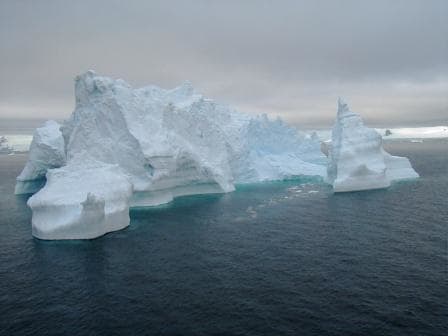
More blogging tomorrow. Today was an 18 hour day with standby from 05.00 a until almost midnight. I was a bit busy with dodging icebergs.
Note: you might find February 15, missing. It was uploaded but HAL upgraded their Blog servers today, so I think it fell of the “hard drive” during the process. I will upload again tomorrow.
Today was of course Valentine’s days where the Ladies onboard receive a red rose from the ship as a present. However we all received a present by means of very good weather at Cape Horn. Most of the time it storms here, hence the notorious reputation of this place, but today we did not have more wind than a force four and the occasional shower with a bit of sleet. Good conditions indeed. The cruise schedule called for scenic cruising and the good weather gave a nice opportunity to do so. It just had to be early to be able to continue our voyage timely to Antarctica. Thus we arrived as early as possible and that was at daybreak. Sunrise was at 06.15 and at the same time the Prinsendam sailed at a mile distance past Cape Horn. Continue reading
From Punta Arenas we had to travel back the route that we had come in on and once out of the fjord sail South and East towards Ushuaia. There is the option to go North, but it is longer, more exposed to the open Ocean and we would miss the chance to look at the glaciers just to the West of Ushuaia. From a navigational point of view the north route is an easier option as the passages are much wider but there is not much to see. So we took the regular scenic route and during the night while all guests were happily asleep we sailed through some narrow passages with the most narrow one being less then 3000 feet wide but also a 1000 feet deep. These areas are very well marked by the Chilean Navy with buoys and light houses which is a real necessity as with foul weather the islands are not that well visible on the radar and the pilots rely on the strong lights to come in view on time, to make the next course change. By the early morning we were through and I had a chance to have a rest, leaving the scenic cruising past the glaciers under the supervision of the chief officer. Continue reading
Captain Albert
© 2026 – Captain Albert's Website and Blog –
Theme by Anders Noren — Up ↑