- Captain Albert's Website and Blog -

Ocean Liner History and Stories from the Sea, Past and Present. With an In Depth focus on Holland America Line

Page 109 of 241

15 Oct. 2014; Philadelphia, USA.

Philadelphia has a long standing connection with Holland America. It goes back for well over a 100 years. Once the company had established itself on the Trans-Atlantic service to New York it started to look around for expansion possibilities. The East coast of the USA was the most logical choice as it was nearby the New York head office. In 1891 the first tentative steps were made with having the P.C Caland and Zaandam (I) call at Baltimore. This being successful this port became a regular call in the intermediate service for the next two years. Intermediate is the name for a Trans-Atlantic route that is a bit more elaborate, calls at more ports than the express route which goes straight from Rotterdam to New York.
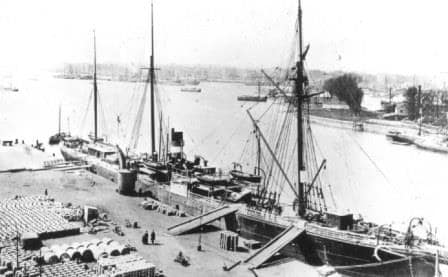
The P Caland named after the man who designed the sea way entrance to Rotterdam was the 4th. ship of the company

The P Caland, named after the man who designed the sea way entrance to Rotterdam, was the 4th ship of the company


By 1894 it stopped again mainly due to the fact that all our ships were a combination of passenger and cargo and there was not enough business to make both components viable. The next step was to try a cargo service. Holland America did not have its own cargo – only ships yet but were in the process of building them. Thus in 1899 a number of cargo ships were chartered to run a service from Newport News to Rotterdam.
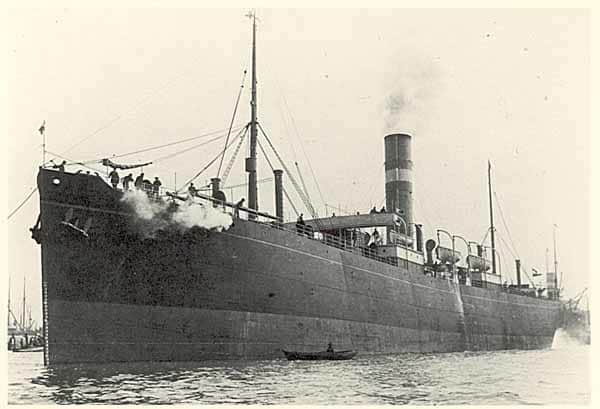
The Soestdijk of 1901 was the first cargo - ship of the company

The Soestdijk of 1901 was the first cargo – only ship of the company

This was considered quite successful and in 1901 the company’s first cargo – only ship the Soestdijk (I) was scheduled on the route Newport News – Amsterdam – Rotterdam – Newport News. In 1902 a second ship joined in, the Amsteldijk (I) and a regular schedule could be maintained by using additional charter ships. In 1903 the Sloterdijk (I) followed and those three ships must have been deemed sufficient as the number of charter ships then dwindled considerably. On the 9th. of march 1907 the Sloterdijk (I) made the first call for the company at Philadelphia. The city became a regular port of call in the schedule for the three ships. Things were going well, the company was doing extremely well, to such an extent that it took over a similar route from Furness & Withy.

This was a British company which ran a similar service in direct competition. As there was not enough for both of them and HAL wanted to stay, it came to a hand over agreement. Ships were taken over as well and a full-fledged branch line was now established. While this was in progress, the company started to experiment with an all-cargo route to Quebec and Montreal. Again the same pattern was followed: first charter ships and then slowly moving their own ships in.

By 1910 there was a weekly departure from Rotterdam – Newport News – Philadelphia – Baltimore – Rotterdam. A round trip took roughly 6 weeks. 15 days were spent on crossing the North Atlantic and the remaining 30 days were taken up by loading and discharging cargo in the three ports. The average time in port was about 7 days. Nowadays it is already considered a long stay if a cargo (read container) ship is in port for 24 hours but in those days the loading depended on the speed of the longshoremen and the cargo gear that was being used and thus it look time. In 1914 Boston was added to the service and then the East Coast service was more or less complete. After the war Norfolk became a port of call as well when the Poeldijk (I) made the first call.
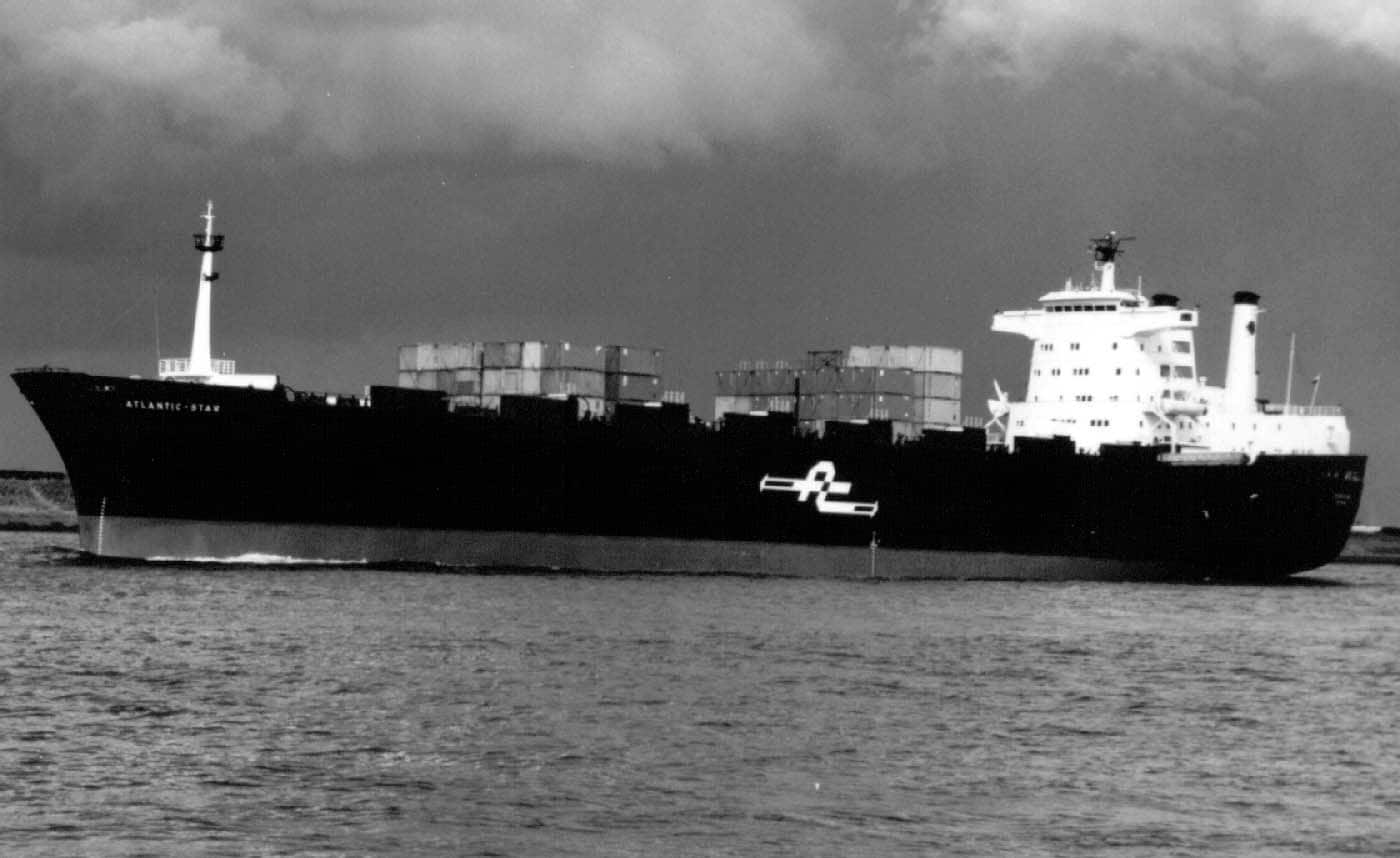
The Atlantic Star of 1967. Yours truly was cadet on this ship in 19179

The Atlantic Star of 1967. Yours truly was cadet on this ship in 1979

The service continued well into the 60’s but then it fell victim to containerization. Holland America recognized this and took part in a new company called the Atlantic Container Line (ACL) with two ships, the Atlantic star and the Atlantic Crown. But containerships need special docks and thus the terminals were concentrated in only a few ports. ACL opted for New York (Port Elizabeth) and the regular East Coast service ceased to exist.

Unfortunately due to this containerization many of the old docks have disappeared and I have not been able to find many traces back from the days “from before the box boats”.
14 Oct; 2014; Philadelphia, USA.

Today’s topic is Pyrotechnics, or the fireworks that we have in the lifeboats. I never thought that it would be an interesting topic but I am starting to find out that the crew, especially the non- nautical crew, find it fascinating. Although pyrotechnics are in general deeply frowned upon on board and if used they are very strictly regulated. Holland America used to have them for a while in the show lounge but currently the shows that we feature do not have that aspect in them anymore.

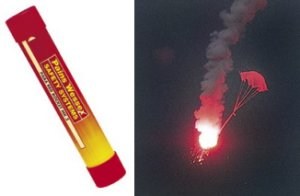
That leaves the pyrotechnics that we still have, only in the lifeboats for lifesaving. Ever since pyrotechnics could be constructed in such a way that they could be used safely and simply and could survive the climatic conditions at sea we have them in the lifeboats. Ready for us, nicely stowed away in a waterproof /plastic drum. Solas specifies what we should have on board and that comprises out of 4 parachute flares, 6 hand flares and 2 smoke bombs. The flares can be used during day and night, although night is better of course but the smoke bombs are for day use only. All the three items are meant to attract attention: when in the water and help is nearby.

Some of you might have seen the movie Captain Philips and there is a scene where he is also shooting off flares from the bridge wing. During day time if I recall correctly and thus less effective than during the night but it worked. If I would have been him, I would have aimed the flares into the boat of the pirates; the effect would have been quite spectacular.

As pyrotechnics are dangerous in principle, and what we have on board, is the real stuff, much time and care goes into training the lifeboat crews in how to use them safely if and when needed. Each training always starts with the Mantra; read the instructions. Whatever we have in the lifeboats it comes with clear and detailed instructions. Partly to remind a crewmember what he/she has learned in the past, partly as different ships can have different equipment in the lifeboats. Each pyrotechnic comes with a series of pictograms so basic that whether you come from the USA, Holland, Russia, China or Timboektoe, you will be able to understand how to operate the thing safely.

blog flareMost of the training then revolves on when to use them. There have been instances in the past, when pyrotechnics were shot off, when help was already there; and helicopter pilots do not like it very much when somebody sets of a rocket flare right under them. Also in that particular case they did not like it very much. The person concerned had forgotten that small word in the sentence: when help is nearby, that is different to when help is already there. So the basic rule, make sure that you are standing on the outside the lifeboat, check if nothing is nearby or above you, aim away from you, look away and then pull. The rocket flare goes about 1000 feet in the sky and gives off a very bright red light. Then it slowly descends back to earth, brightly burning so there is maximum time for anybody who might be in the neighborhood to see it.

Hand flares burn the same way but are there to be waved with, to direct a rescue team towards you.

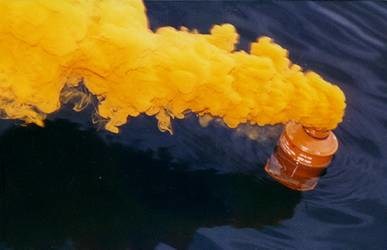
blog smokeMy greatest scare is the smoke bomb. These give off a bright orange color smoke-cloud while it floats in the water. The problem is that the stuff used for this orange smoke is very messy. It clings to everything and if you inhale it or get it in your eyes then you are not a happy camper.

Thus the mantra is drilled in: Always be sure to have the wind in the back, following wind, pull the plug and then throw the can as far away from you as possible, as shown by the pictograms. For about 3 minutes a large cloud of orange smoke issues from the canister and a wise lifeboat commander tries to get his boat at a safe distance from the smoke while is still billowing out or hanging above the water.

The pyrotechnics are for saving life at sea, and the important fact is to ensure that the life of the user is not endangered either and stays safe while handling them.


13 Oct; Philadelphia; USA.

I just realized that there is a name for my generation: baby boomers, for Generation X, for Generation Y, and for the Millennials, but no names for the earlier generations. Were those generations all similar to each other, or were there no psychiatrists and psychologists? The latter I doubt as we already had Sigmund Freund milling around long time ago. Still it is peculiar.

A big difference between the generations is the way they keep and kept in touch. With the modern media and connectivity everybody can keep in touch with each other 24 hours a day. During the 1986 world cruise, the only time I reached my mother at home, was when I went to a calling station in Hong Kong. Calling from the ship was also possible – most of the time – but cost prohibitive for a poor 3rd officer and for the rest it was writing letters.  The person who went home in the middle of the cruise was at once promoted to postman with the order to mail postcards and letters upon arrival Schiphol airport. That saved money in foreign stamps and because of this system everybody always carried a good supply of Dutch stamps with them.

Technology goes faster than the ships are renewed and that means that we are retro fitting the ships all the time with new capabilities. The problem is, is the moment we have a new system installed, it is already going out of date as the usage required has increased again by an  X amount percentage. But for the current generation, being in constant contact is a regular way of life and it is not always understood that a seafaring career might not always make that possible.

Everybody goes to sea for all sorts of reasons but one reason seems to be less and less important, is the one to see the world.  As air travel has become cheaper and cheaper it is not an overpowering reason anymore to leave everybody behind for 4 months in order to finally get to Sri Lanka or Hong Kong.  I believe there are already package flights for approx. 500 euro’s to Sri Lanka from Amsterdam.

Interest in Technology and the chance to gain a lot of experience in a very short time have become more important reasons to choose a career at sea. Nowhere in the world are you put in charge of a watch – of a piece of equipment worth $ 500 mln. other than at sea. I do not know of anybody who is 21 years old and supervises a completely factory by him/herself and has to make immediate decisions when something happens. At sea you do and on a cruise ship even more so.

As a result it is fairly easy to find a job ashore after a number of years at sea and not only in pilotage. The name Holland America still has a magic sound to it and it can still open many doors. That brings the challenge to the company to retain people because there are so many possibilities for a change in career path.

With it a new word came into our cruise world. Career Path. In the past we just joined a company and eventually we got to the top. Now the whole career of an officer is managed, step by step and each officer has a fairly good idea where he/she will be on the promotion ladder in the coming years.  As the company is not decreasing, it is something that can also be managed quite well.

Basically the Human Factor has become much more complex in the last 20 years and this will only continue to evolve further. To stay in tune with what is going on, our Human Resources department keeps close tabs on what is going on out there, and although I work for Nautical I can still forward and advise about the latest concerns and thoughts that emerge.


12 Oct; Philadelphia, USA.

After a few internet wobbles we are back on the blog. My current function is really far ranging and encompasses everything that is in the realm of the Captain and Staff Captain. That means it is not related just Navigation, more or less everything that might come under the captain’s purview is linked to it.

One of the more fascinating parts of this is the human factor. As time progresses the human attitude changes, the way people live changes and what people find important changes. That all has its effect on the way we man the ships. Ships have to sail and thus we have to attract new Officers and Crew all the time and that means that we have to find them. Once found we have to entice them to join Holland America and once they are there, we have to try and keep them.

Thus I am trying to find out all the time what makes the younger officers tick. What are their interests, what makes it worth while for them to stay?  The Human Resources world out there has identified several groups of people and that links in with the changes that happen from generation to generation. And all generations all different. When I was young, I saw my grandfather as a sort of stately person from a bygone age and not really relevant to my current life; he was old. That did not mean that he was not hugely important though, as he augmented my weekly pocket money considerably.

Then there were my parents and with them came a period of time that you are absolutely convinced that they absolutely do not know what they are doing and that there must be something completely wrong with them as they cannot understand what your life and your friends life are all about.  Now I am even past my parents, parental years and now I have to figure out what the new generations are doing.

I remember that the first captain whom I sailed with, Capt. Van Noordt. in 1981, was greatly puzzled about the way we as 4th. Officers behaved. He had children himself but he did not think that the (normal) behavior of his children should in anyway be reflected by us. He expected that we would behave as he did, when he was a 4th. Officer back in the 1950’s. Luckily he was a very quiet and understanding man, so he let us “carry on” as he called it. The next two captains, Hoenderdos and Hess had more outspoken opinions and thus we reduced our presence on the bridge to the absolute minimum.

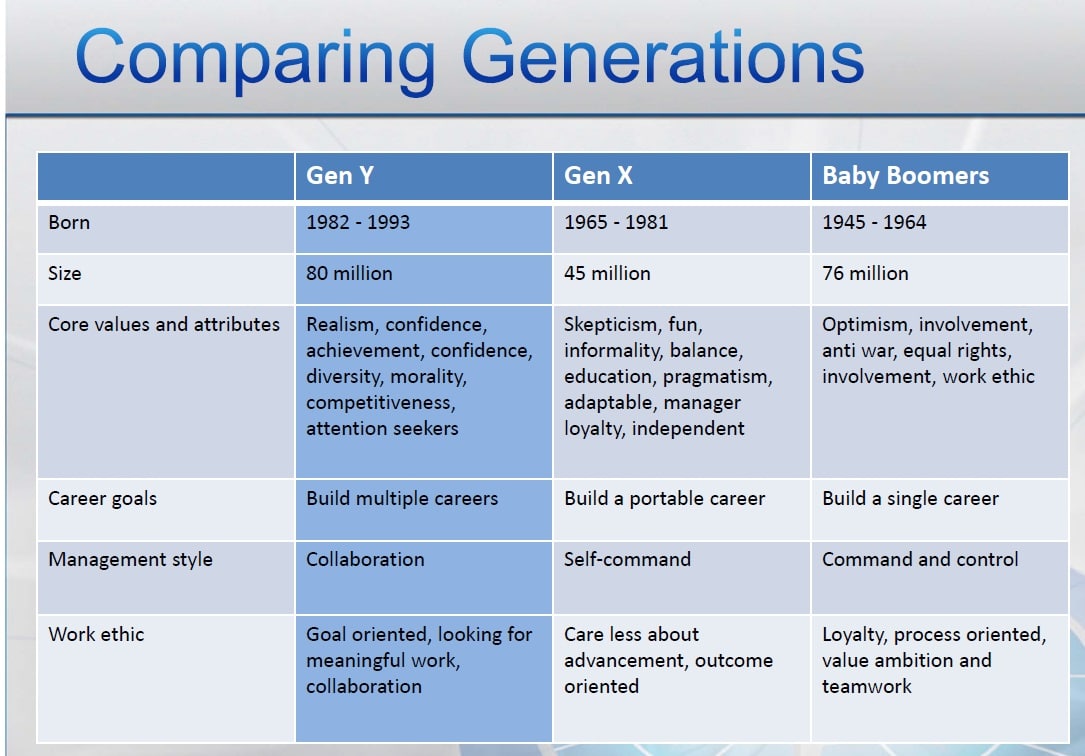
Now I am in a similar position but we have more science available to understand this better. As we all have to deal now with Generation Y, which will be shortly followed by the Millennials. Me as a baby boomer is the outgoing group.

millenials

If you look at the table, the various generations greatly differ; there is only one common denominator:  they will have to have a career as well, to earn money some way or another. Thus a career at sea is a possibility. However to get another generation into that career means that the framework of that career has to be adapted.  In what way, is very much open for discussion as there are many ways to sail a ship safely.

Generations have always been different from one to the other and thus the world has slowly involved as well, including the shipping world. However it seems that this evolving goes faster and faster compared to before 1960. There was not so much difference between the ways a navigator in 1900 did his work compared to 1960/65. Then technology started to make a big impact on the industry, starting with the Container revolution. Since then everything has gone into overdrive both ashore and at sea and that reflects on the vastly different outlook on life between the last few generations.


30 September 2014; Quebec.

So today something that relates to the function of the Master. The “Ships Articles”. This is an old phrase from the early days when seafarers would sign on, on a ship.  They would sign a contract and were then bound by the “articles” the rules under which they had to do their jobs. Some of them could not even read what was in those “articles” but as they were a law, it was accepted that they were what they were.

The phrase still exists and it still covers the same basic idea. A crewmember has to sign on, sign a contract, before he or she can work on a ship.  That procedure has not changed very much as far as the motions are concerned. What has changed is the enormous increase in requirements, training and preparation that takes place before “The Ships Articles” can be signed.

In the early beginning, you could directly sign on with the Captain. He was the owner’s representative, or he had his own ship and thus he ensured that his ship was manned with the necessary people. Out of necessity as crews were not always signed on in the most respectably ways, this was moved shore side and officially regulated.  You now reported to an office which ensured that you were signed on properly not just by signing the papers but that the “ships articles” were also properly applied. Especially where pay was concerned.

About 25 years ago the responsibility was returned to the captain. Protection against a Captain who had you drunk and press ganged into service were by then long and truly gone. To make sure that you arrived on board in compliance with all the requirement was now the full responsibility of the company’s office.  Thus when you first joined a company you had to go through a sort of pre-signing on program to ensure that you had all what is needed to be a real crewmember.

When you then finally arrive on board the captain will sign you on. On our cruise ships, there is the crew clerk who takes all your papers and by using a checklist, verifies that all is complete. A checklist is needed as nearly each function has different requirements.  What is required?

For all crew:

a. A Labor contract. (A written and signed agreement between the Owner and You)

b. A valid Physical. (So it can be expected that will be able to sail in good health)

For most crew

c. A valid Seaman’s book issued by the Flag State or the Home Country.

If one of them is missing, you cannot be signed on. If you are not signed on, you are not allowed to work. Thus you cannot come on board, or if on board already have to wait with working until the omission has been dealt with.

For certain functions such as entertainers, regular hotel staff and concessionaires a seaman’s book is not directly required. But some countries such as Russia require one if you want to go ashore as a crewmember. No seaman’s book and it must mean that you are a passenger and then you need a Visa. If have neither, then you are stuck on board.

Then going up the ranks, it becomes more and more complicated. Everybody (Deck and Engine) involved in watches have to have

d. A Certificate of Competency or C.O.C.

A C.O.C. which states that you can do the job that you are hired for. Mine states Master unlimited, which means I am basically allowed to captain any sort of merchant ship anywhere in the world (give or take local rules or extra training for a special type of ship).

Those 4 items, the captain always has to verify before he/she can sign the crewmember on. Contract, start date and function are entered into the Seaman’s book and the end dates are checked on the Labor Contract and on the Physical Certificate (Medical as we call it) and then you are legally on board.

Once you are on board, a whole plethora of indoctrination classes, trainings and other course taking starts but that is another story.


28 September 2014; Quebec, 3rd day.

Another beautiful day, a glorious Sunday. Again the whole town was out and it looked like that those who were not in church were all out on the sea front.  Although embarkation was yesterday; during the day guests  still trickled in. Some of them delayed by transport issues and some because they lived in the area and did not see the use of staying a night on board as the ship was not sailing. I have seen that before, either with boarding guests or disembarking guests and I have a hard time understanding it. You paid for the night so you are wasting money and while on board you can enjoy an elaborate meal and a show but instead you opt for a quick sandwich when coming home. (As you first have to go shopping, to stock up the fridge)

Training continued today with the Sweep Teams. This is another addition to our safety plans. Sweep Teams are not required under SOLAS and as a result most company’s including HAL only had impromptu procedures in place; to be executed if somebody was missing during a mustering. SOLAS only requires that a Full Muster shall be held. It does not say exactly what you should do if you do not get a 100% count. It only says that there should be a 100% count.  Thus if a 100% count was not achieved the captain would dispatch crew, the security guards, cabin stewards etc. to find the missing persons. That worked, as has been proven during drills but it was not formulized.

Thus now we have a complete and official “Sweep Operation Policy” which ensures that for each area in the ship a group of crew members is allocated to start searching incase a Full Muster reveals that people are missing.

So what do we have now as Sweep Teams?

  1. The Passenger Assist Team. These are the cabin stewards. They were already there and they search – sweep — cabins to ensure that all guests are going to the Muster.
  2. The Passenger Area Sweep Team. These are Dining Room Stewards who will walk all the public areas – sweep – from stern to bow and back and search for missing persons.
  3. The Crew Area Sweep Team. These are Kitchen Staff who will – sweep – search all crew areas, cabins, workshops, mess rooms etc. section by section for missing persons.


Group 2 and 3 will only come into action when during the Mustering the count does not come to 100%. In principle all guests and crew always will go to Boat drill or a mustering during an emergency at sea. The problem is that they do not always stay. We come across some “experienced” guests who try to sneak off when they have been checked off.  That is most of the time noted and then you get the angry voice of the Master over the P.A. system, but not always and they manage to get back into the warmth of the ship, and now they will come across a Sweep Team.

It is really useful of course, as there could be guests or crew alike who could be injured or dis-orientated in an emergency. Not everybody reacts rationally during an emergency when stress and anxiety levels go up.

The crew has to learn the basic physical reactions to Emergency News

The crew has to learn the basic physical reactions to Emergency News

These crew, who will be assigned to these teams need training. First of all for what they have to do and how, but then also in Crowd Management for the case when they come across upset, disorientated, belligerent, erratic, stressed out, panicking or fearful persons.

The basic rules to handle these people are quite simple and thus we can do the lessons on board by teaching the right state of mind and a number of tricks to get these people to do, what you want them to do. Most of my audience has never dealt with this before and they all find it fascinating.

Just before departure the Captain announced that there was a technical issue and we were sailing a little bit later.  It will be a good thing that we are not in Quebec tomorrow. The wind is expected to breeze up in the early morning to about 40 – 50 knots. We will be sailing down the St. Lawrence River and that means it will not affect us that much.

27 September 2014; Quebec 2nd day.

Again a wonderful day in Quebec. For most guests it was change over day, I believe that only a handful are doing a back – to – back and those are lucky. Having a hotel parked in the center of the City with such nice weather, what else can you ask for?

The city itself saw it the same way and all day long there was a never ending stream of Quebecois walking past the ship. The ship is shielded from the rest of the town by a Gate but it is close enough to have everybody wandering by and having a good look at the ship. To not endanger this boulevard experience, the Guest terminal is set further inland and Guests walk through a Sky-Bridge over this public right of way to the ship when coming and going. In this way the security gurus are satisfied and their checklists filled out to general approval and the locals can still enjoy the water front.

It was however interesting to see how it went with the luggage. The luggage is loaded in the terminal in bins and then transported by a forklift to the ship. There is a moment of a tense security situation every time when a forklift has to cross the foot and bike path. In order to stay within ISPS (International Ship and Port Security) requirements two security guards were in attendance to stop the traffic by means of two ropes which block off the traffic, and thus create a pathway for the forklift to safely drive through. It seemed that this was advanced Security in progress as a more senior security guard was providing training on how to handle the ropes. I had a hard time understanding this but he managed to get it wrong one time and a bike was stuck between the two ropes right in the way of the oncoming forklift. I was phoning my wife at the time from the outside deck and could give a running commentary all the way to England.

With a combined bike and foot path, there are other dangers. Roller skaters, tandem bikes, extended bikes (the ones you can hook up your child to the back part to teach them how to bike) and motorized wheel chairs. It did not take long before a pedestrian had to jump aside for a bike who was evading a rollerblader. A mobility scooter then had to break for the pedestrian and behind there was another scooter and yes we had a bump. Nothing serious , no damage, no injuries, but two upset seniors providing entertainment free of charge. A pity that there was nobody on the ship to watch all this as well.  I could not stay very long as I as had to move cabins. The office blocks cabins for people like me but the one assigned had such a small desk that I did not even have room for my two laptops.  Thus I had arranged for an empty Guest cabin last week. However they get sold and thus I had to move. It seems there was a no-show today so another cabin was available.

Training today included the people from Club HAL our Youth Program Coordinators. In our safety procedures children take up a special position.  They create more panic among the guests than anything else. So our procedures are geared towards:

  1. Keeping the parents calm when little Johnny is missing.  — Yes, we have a search protocol.
  2. Avoid that Parents start looking themselves. —- No, you will never find him.
  3. Ensure that when little Johnny is found, that he remains under the control of a crewmember until he can be re-united with his parents or legal guardian.

As the Club HAL team is of course the ”prime target” when a child is missing; we spend time on how to deal with that.  The children themselves are not a “panic” issue. They tend to view everything as one big adventure. They only get apprehensive, emotional and start to cry when they sense vibes of Fear or Anxiousness coming from surrounding adults.

Today we had the Silver Whisper in port with us and we were docked stern to stern. She will sail at 1800 hrs. and then be replaced tomorrow morning by the Crystal Serenity. There is also a Celebrity ship expected which will go to the side dock but I have not found her name yet.


26 Sept. 2014; Quebec, First Day.

By 7am I woke up due to the starting of the stern thruster as I am parked in a Guest cabin near the stern of the ship. The ship has a number of staff and service engineer’s cabins for people who have to travel with the ship but they were full with entertainers and maintenance men and thus I was parked in a Guest Cabin. I am not that bothered about where they put me as long as I have a good bed, a good shower and a decent desk to work from. I am carrying two laptops with me and thus I need a little bit of space to work on.  The stern thruster woke me up and that indicated that we were indeed arriving on time and as per schedule.

While I was with the Maasdam last week in Quebec we were docked in the side harbor; this time we were back at the main berth of the Cruise Terminal. Behind us arrived the Regatta but they were only staying until 1800 hrs. We will be in port for three days. Today is the final day of this cruise and the official port visit day for Quebec, tomorrow is change over day, and then the last day is the official Quebec visit day for the next cruise.

My day was filled with training again and today was also the All Crew Indoctrination for the new alarm system. In two sessions all the crew was made aware of the coming change in our alarm procedures. Although they are all extremely busy and can hardly miss the 45 minutes that it takes, they all seem to be very eager to attend. A sort of outing without leaving the ship. For some it will be the first and also the last time during their contract that they visit and sit in the Show lounge and maybe that is the reason for their eagerness.

There is even a pattern in their behavior.  The engine department normally moves from area to area until they realize that they can sit on the upper level as well, and they happily park themselves there. The kitchen always tries to sit in a corner where they then try to get 25 people in an area that sits 15. That does not work so they have to move and in-variably end up somewhere where they cannot see the screen and then they have to move again. The Caucasian crew, Concessionaires (shops, Casino etc.), Entertainment and Officers sit for some reason always in the 2nd ring of the lower level.  The front of the sitting area, where there are the loose tables on the dance floor, remain empty until there is no more room in the rest of the lounge. It almost seems as if they are afraid that I will ask those questions if they sit very close to the stage.

No doubt a Psychiatrist would have a good explanation for this typical behavior of groups but I do not have that knowledge so I am just amazed.  I have been doing a lot of Full Crew presentations in the past as well and the pattern is still the same. It is understandable that groups that work together, like to sit together and those related (or in the process of trying to get related to each other) sit together but it is this sitting in specific locations is something that amazes me.

Another thing that is always the same is that we never start on time. The Caucasians arrive ahead of time. The motto being, being on time is being 5 minutes early, but the Asians start walking towards the lounge at the time that the presentation is supposed to start. As we cannot get everybody checked off at the same time, we invariably run 10 minutes late. It is just something that you have get to get used to. Nobody seems to mind as the lounge is one noisy area with 500 crewmembers chatting away in earnest.

The 2nd meeting for those who could not attend in the morning is always a lot quieter. Most crew try to get in, in the morning as they either have their rest in the afternoon, or want to go ashore and thus the balance is always 80% in the morning and 20% in the afternoon.

Tomorrow will be the 2nd day in Quebec and the weather promises to be great. Windy but sunny. As it is a Saturday we will have a lot of people looking at the ship as there is a sort of promenade with a double bicycle path right in front of the ship.  I will have to pack up tomorrow as I will have to move cabins. Mine has been sold for next cruise, so I will be parked somewhere else.


25 September 2014; St. Lawrence Seaway.

To maintain the schedule the ship has to maintain about 16 knots of speed for a timely arrival in Quebec. That is without taking current and wind into consideration. The current could even itself out as it changes every 6 hours. It does not really work that way as the strength of the current varies depending where you are on the river. If you are lucky you are in an area of the river where you will benefit from the full flood behind you and hopefully you are a little bit out of the center of the current when the ebb is coming down the river.  Today the big spoiler for not needing extra speed and thus saving fuel was the wind. It decided to blow from the WNW and that is more or less in line with the direction of the estuary of the St. Lawrence.  Blowing a steady 35 knots did not help for making good speed either and thus the ship had to make over 18 knots to keep schedule. A secondary occurrence was that the wind was blowing at certain times against the Flood current. This created a sort of very sharp sort of swell which can make the ship behave quite unpleasantly. Plus if you are at nearly full speed to compensate for the adverse wind and swell, the ship can start to pitch and you get a rather abrupt an unpleasant movement. It feels as if the ship gets slapped on the nose every minute or so.

To avoid this, the captain approached the top of the estuary under an angle so the waves were causing more of a roll than a pitch. And rolling we can deal with by means of stabilizers. The St. Lawrence then goes for a short while almost straight in a direction of North to East and then it bends to the south, which is basically the end of the estuary and where the regular river begins.

This whole estuary river area is considered open waters and no pilotage is required here. The river has a Vessel Traffic Separation System a sort highway at sea that keeps the inbound and outbound flow of ships separated and for the rest it is still so wide that there is plenty of room to avoid each other. It will take from departure Charlottetown yesterday at 17.00 hrs. until 22.00 tonight to travel so far up the St. Lawrence that one could really say; we are on a river now. The lights of various villages became visible on both sides and buoys started to appear indicating the sailing route.

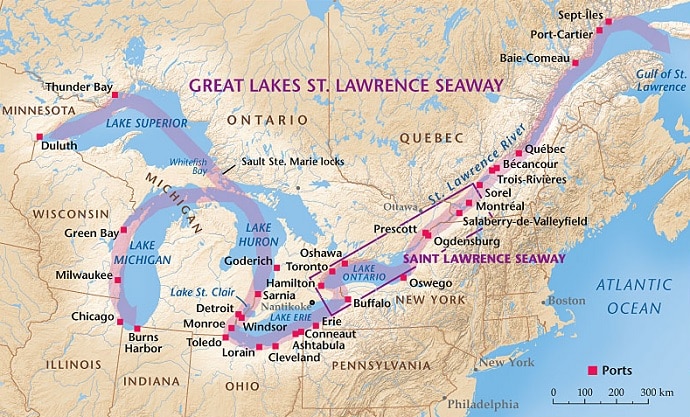
The map shows the whole St. Lawrence pilotage system. due to the length of the river is has been sub-divided in several sections

The map shows the whole St. Lawrence pilotage system. Due to the length of the river is has been sub-divided in several sections.

When going to Quebec, you need two sets of pilots. One from the beginning of the –real – river and one for the final part of the approach about 5 miles below the berth; where the ship enters a different pilotage area. That pilotage area lasts until Trois Rivieres, a village approx. 2/3 of the way to Montreal. Here another set of pilots join to bring the ship all the way to Montreal. If you go from the mouth of the river directly to Montreal you get three times a River – pilot change in a straight row. The Veendam is not going further than Quebec and thus there are only two changes.

For the stretch from Les Escomins to  the Quebec boundary two pilots will come on board as the total time to travel the distance goes over the 8 hours. You always want to have a restful pilot and alert pilot on the bridge and thus you will not hear us complaining about that. As the distance to the dock from pilot border line is only five miles, these 2 will be replaced by only one.  But if the ship would have continued directly up to Montreal, there would have been two again, due to the duration of the journey.

Our big challenge here is the fact that these pilots converse with each other and with traffic control which governs the river, in French and not the regular French that some of us can understand and speak but Quebecois French. This is considered a sort of original 17th century French when the area was a colony but I cannot make head or tail of it. They of course give their orders to the helmsman in English, otherwise nothing would happen, but for the rest the navigators on the bridge depend on getting all the information they would like to be aware off on the pilots willingness to give a comprehensive translation after they had an completely incomprehensible conversation with somebody on the other side of the VHF.

We are expecting to dock around 07.00 at the Quebec cruise terminal and we should be joined by the Regatta of Oceana Cruises. The weather should be good. Sunny but windy for most of the day.


24 Sept. 2014; Charlottetown, Prince Edward Island.

It did not look very good when the ship came closer and closer to the pilot station. 40 to 50 knots of wind; not pleasant at all and once at the pilot station it was still blowing a good 35 knots.  However the pilot brought the good news that it was blowing less than 20 knots once inside the bay and thus we sailed in. It turned out to be a very nice day in the end. Sunny but with a nippy wind blowing, this time from the SE and thus mainly over the bow and it made it possible to sit outside at the aft end of the ship. We seem to have a higher number of smokers on board this cruise than on average so at least a number of people were very happy with a windless and sunny corner.  This was my 2nd day of being buried in the dungeons of the ship where we have the ships training room. Here my four groups of trainee’s went through the exciting training of how to lower a lifeboat.

gravityThe old fashioned but simple Gravity Davit System.

The challenge is that the systems are not the same for every ship in the fleet. Bring back the good old days when there was one sort of davit. A gravity davit. (Those are the arms in which a lifeboat hangs) They might have looked different; but the principle was always the same. Lift the brake and the lifeboat would descend under its own weight. As gravity is always with us, the system always worked, as long as you kept everything well-greased and rust free.

Now with the optimization of the ships interior, the lifesaving systems are built around the space in use for the Hotel operation. That means that gravity davits do not always fit in. They have to be positioned under the right angle to ensure that the lifeboat slides down and ends up exactly in line with the embarkation deck. Now we have systems that are constructed in such a way that they fit in the space left over for them.  They are as safe and as good as the simple gravity davit but they are more complex in construction and to operate.

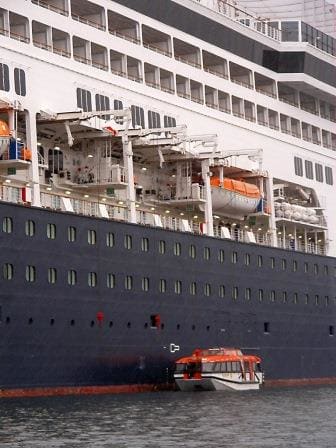
The Veendam davits project straight out of the ship.

The Veendam davits project straight out of the ship.

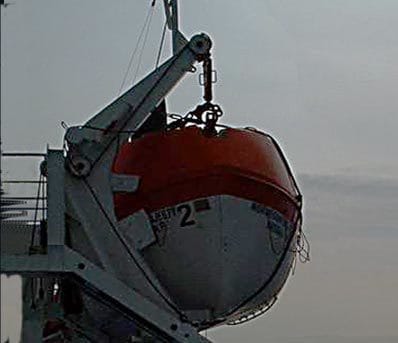
Hence, the crew has to learn more. The S- class, to which the Veendam belongs, has what is called a stored – power – telescopic davit system.  This means that two cylinders push the davit arms horizontally out of the ship until the lifeboat is clear of the hull and then it descends on gravity.  As it is mechanical –Hydraulically made  (the cylinders work on gas under pressure stored in large bottles) and thus can break; it needs a backup system and that makes it more complicated. Gravity does not need that, it is always there. For the rest it is a beautiful system as the davit operator can very easily control the exact movement of the davits and the lowering of the lifeboat, and if its lowered a little bit too far down it can be corrected very easily as it operates on power.

Then there are strict protocols for making the lifeboat ready for the embarkation of the passengers, strict protocols to ensure the boat descends safely into the water and then there is a whole list of things about survival at sea. What fascinates the trainee’s the most is the food in the lifeboats. The lifeboat rations as it is called. Rations because you are supposed to ration the handouts, so they last for as long as it takes to rescue the boat. For some reason everybody thinks that is must be horrible stuff but it is not. The rations come in the form of square tablets about the size of 4 lumps of sugar together and the taste like Scottish Shortbread.  I was told once by a man who wore a kilt, so he must have been an expert on Scotland, that Scottish Shortbread was also a sort of survival ration, made for in case that you got stuck on a mountain in the highlands waiting for the weather to get better.

Tomorrow there is one more theoretical session before we start with the practical stuff. For that I need nice weather in the ports so I am keeping my fingers crossed, as it getting late in the season. The day after tomorrow the crew indoctrination process for the new three alarm system starts. I will hold two sessions for the crew in the show lounge and they will have to attend one or the other ensuring that all 609 onboard will have gotten the message. Then there are a number of breakout sessions with in depth training for the various functions.  That entails a lot of Crowd Control and the crew immensely enjoys that as they find out that they can order the guests around.

Tomorrow we sail up the St. Lawrence River. It is supposed to be very windy again but it should die down in the afternoon. Not exactly cruise ship weather but then this is not the Caribbean either.

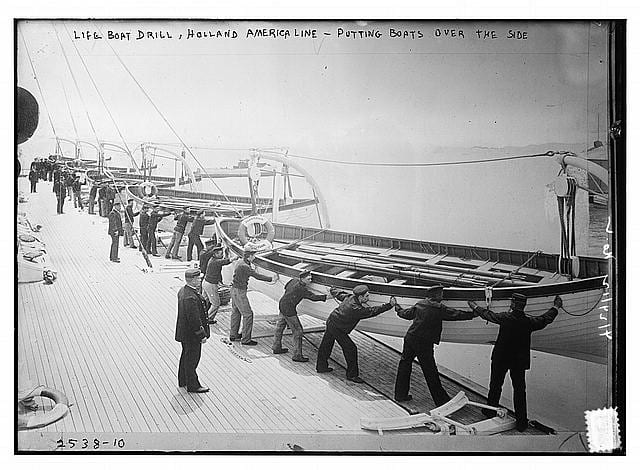
For nostalgia sakes: Lifeboat drill on board the ss Statendam in 1900.

Imagine what it must have been to do this in bad weather with a rolling ship !!!!

Imagine what it must have been to do this in bad weather with a rolling ship !!!!

« Older posts Newer posts »