- Captain Albert's Website and Blog -

Ocean Liner History and Stories from the Sea, Past and Present. With an In Depth focus on Holland America Line

Page 110 of 241

23 September 2914; At Sea.

In the early morning hours the ms Veendam departed from Halifax under the command of Captain Chris Norman. Once outside it started to move slowly on the still high swells but the wind had abated sufficiently to prevent the waves from getting higher again. Unfortunately the seas were rolling in from the SW and the ship was steering NE and that sometimes caused a very noticeable movement. If a ship rolls, then the stabilizers will take care of that. If a ship pitches then we can reduce speed to make it more comfortable. But when the swell catches the ship on the quarter it creates a sort of corkscrew motion and there is very little you can do about that, apart from sailing in another direction. As we wanted to go to Charlottetown we had to go North East and thus we had to endure this unpleasant movement. When looking around it did not seem to affect that many people as all ships activities were eagerly participated in but there were a few more people sitting on the couches in the midships area than is normally the case.

The ship followed the coast of Nova Scotia for most of the day. Tonight we will sail around Cape Breton and then head for Prince Edward Island which is located north of the bigger island of Nova Scotia. This area from New Foundland to Nova Scotia and the Grand Banks can be notorious for reduced visibility. Now the severe storm and dropping temperatures ensured that it was not happening today.  The cold water of the Labrador Current and the warm water of the Gulf Stream are meeting in this area, creating a prime cocktail of temperature variations to create very low hanging clouds.  In the winter the Labrador Current wins most of the time and the icebergs it brings down in spring are mostly clearly visible but that is not always the case later in the season and it makes this area very dangerous for shipping. Especially in the past when there was no radar.  Our own Amsterdam (I) 1884 was lost in this area in 1884 by running aground at Sable Island. Due to the pounding seas the ship had to be abandoned and left to the elements.

It is for me the first time back on the Veendam since 2008 when I left for the Prinsendam after having been here for four years. It was also on this ship that I started my blog in 2007. So we have come full –circle so to speak.  Since then the ship has mainly be sailing on the East Coast in the summer and South America in the winter but that is going to change in the coming winter season. This time no Caribbean, no South America, but she will be sailing San Diego to Hawaii for a number of voyages. Although many people complain about the sometimes very wobbly weather in the north Pacific, it remains a very popular destination and the ships are always full. A lot of guests like the number of sea days and then take the gamble of a “good wobble” occurring during the cruise.

In 2008 the ship had another refit, a so called SOE upgrade (SOE = Signature of Excellence) and that changed the ship to a certain extent. More about that in the near future when I will have taken some photos. Currently the ship is making nearly the same cruises as the Maasdam, except that it does not call at Montreal but has Quebec as a change over port. Here it stays for 3 days. Great for the crew as Quebec is a very nice port.

Tomorrow we will be in Charlottetown, Prince Edward Island. The weather for tonight calls for strong winds but it should die down near the port and inside it should be no more than about 20 knots and sunny.
 

22 September 2014; Halifax, Canada.

After a day in Halifax, I joined the Veendam. My waiting day, the 21st was beautiful during the day with the sun shining and a gentle breeze.  That gave me the chance to explore the Halifax sea front; and you can spend more than a day there.  It only turned very nasty in the evening. The citizens of Halifax, they call themselves Haligonians, are very proud of their seafaring roots and the seafront has been turned into a boardwalk with all that is there to remember of those days.

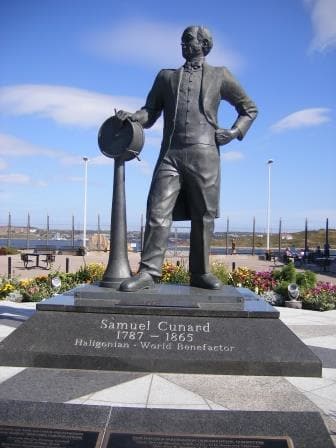
Sir Samuel Cunard founder of the Cunard Line in 1842, establishing Trans Atlantic travel with a scheduled service.

Sir Samuel Cunard founder of the Cunard Line in 1842, establishing Trans Atlantic travel with a scheduled service.

As an ocean liner historian it was very gratifying to see that there was a statue of Samuel Cunard, the man who put almost singlehandedly, North Atlantic Steam Navigation on the map in a professional way. His name still lives on in the Cunard Line, although the official name of the company is completely different and hardly ever used.


In the same way that people always spoke about the Holland America Line, while it was called the North American Steamship Company (Noord Amerikaansche Stoomvaart Maatschappij – NASM) Then there is a very nice Emigrant Museum, Pier 21, where now the cruise ships dock and a very nice Maritime Museum.


Two large ships outside, HMCS Sackville and the Arcadia and beautiful displays inside.

HMCS Sackville was a 2nd world war corvette and the only one left from all those that were built

HMCS Sackville was a 2nd world war corvette and the only one left from all those that were built

They had a travelling exposition going on about the tragedy of the St. Louis. A German passenger ship which went around half the world, trying to find a safe haven for all the Jewish passengers on board. Nobody in the new world wanted to grant them asylum, so the captain had to turn back and in the end the Netherlands and Belgium took them in. Quite a few of them then still fell into NAZI hands when the Lowlands were overrun in 1940. A very sad chapter in the history of human kind.


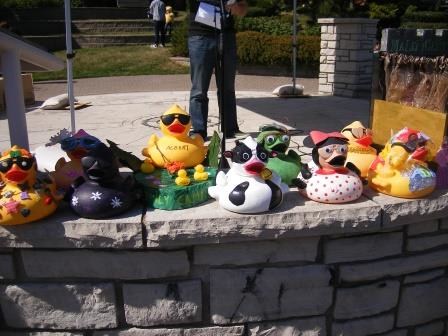
Of much more interest and gaiety was the Duck Race that was going on, yes, with rubber duckies varying from Bath tub size to the size of a house. There were cooperated sponsored races and individual sponsored races.

blog duckieMy money went on a cool looking yellow duck wearing sun glasses with the name Albert on its chest but unfortunately, once in the water,  he was more interested in a female duck floating next to him so his progress to the finish line was not to be impressed about. Then a heavy storm came over Nova Scotia with 100 km+ winds. It was going to last into the next day but if the weather followed the predictions of late Sunday night, then by 10 am. the next day it would die down sufficiently for the ship to be able to get into port.

When I woke up, I read that the port was closed but the decision would be reviewed at 10.00 hrs. So I did not worry too much. Just after 10am I got an email from the captain saying that he was coming in at 10.30 following the Norwegian Gem and followed by the Regatta. By noon time this whole cruise fleet was docked and in approx. 30 minutes over 5000 passengers flooded ashore to see the sights of Halifax. Although the wind was dying down in Halifax it was not dying down yet in the Sydney area.

So a decision had to be made about what to do next. In a case like this, it is a combination process between the ship and the office. A. do we expose the guests to a 2nd night of bad weather? B. what if the wind does not die down in time and Sydney harbor is still closed? C. What are the alternatives? It is the ultimately the decision of the Master whether he sails or not. What he does then involves the office. So after reviewing the weather maps and all sorts of alternative plans, it was decided to keep the Veendam alongside in Halifax to allow for the seas and the winds outside to settle. It would also give the guests a quiet night of sleep.

It did not look like Sydney would be feasible at all and thus the call was cancelled and the ship would sail directly to Charlottetown in the next morning, following the storm front instead of sitting in the middle of it. The Regatta also stayed in port as they were going the same way. The Norwegian Gem sailed but they were going southbound, away from the bad weather.

Unfortunately the port authorities could not make any last minute arrangements to man the terminal and thus nobody could go ashore for the evening. Since we have all this security stuff in the world, making last minute arrangements for re-opening terminals has become a lot more difficult; as the check-list culture keeps throwing up challenges against everything that is a deviation from the original plan.

So tonight the ship will stay in port and will then depart early in the morning to sail towards Prince Edward Island. It will still be very windy but the brunt of the weather will have passed. I will meet my next 4 training classes as part of the 3 alarm system change over. The Veendam is the last ship and by October 10, all 15 ships will ring the same bells in the same sequence.

21 Sept 2014; Halifax. Additions to Captains from the Past.

As it was a stormy evening with torrential rains, I decided to start tackling something that was long overdue and which I hope to spend more time on in the near future.

So, I have added to the sub part of the blog under Captains from the Past:

Photos of the following captains names:

Blokland van, HFT. — Dobbinga Sr. ,F.H. — Filippo, A. — Gaart van, J.B. —,

Graaf van de,  L. — Graaf van de,  L.J. —  Hazewinkel J.A. — Jong De, Sievert J. —

Krol, W. — Lunenburg H.J. — Moree P.J. — Rol, C. — Ruygrok, B.L.J.

Schottee de Vries, J. —Sjerp, D., Sluys van der, P.J.H. —

Aditional captains that have come to light while progressing with my digging in the archives or who passed away more or less recently:

Almekinders L. — Brouwer, P.E. — Datema, R. — Diehl, J.V. — Dijk van, A.

Driel, F.H. — Goot, H.C. — Hess, A. — Hoeven van der, P. — Janzen, J.

Kleywegt N. —  Mohr G.J. H.M. — Reifferth, M. — Verschoor van der, de Boer, W. —

Wabeke, D.C.


20 Sept 2014: On location Halifax, Canada.

And thus I left the ms Maasdam yesterday after a very pleasant 14 days, thanks to Captain Arno Jutten and his team.  As I was able to finish everything on schedule, I could even throw in My Holland America History lecture for approx. 600 guests in the show lounge. Hotel Directors and Cruise Directors always try to offer something that is not on the regular schedule and I was glad to oblige. What was unusual but very heartening, was the number of crew that popped in during the lecture. That was something I was not used to but I am glad that there is the interest among them as well for the rich history of our company.

While I was doing that the good ship Maasdam was travelling up the St. Lawrence River on the way to Quebec. It was sunny but very chilly so most guests when not taking part in activities were watching the world go by from behind the glass windows. I did the same after my lecture was finished, high up in the crow’s nest. Holland America introduced the “On Location” program about a year ago and its purpose is that the guests connect as much as possible during their cruise with the area that they are sailing through. So more local food is prepared and served on board, more local information/ lectures and if it fits in the schedule, local entertainment on board.

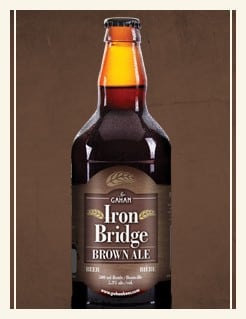
For those who enjoy beer, this is comes close to a Guiness but it is a touch lighter

For those who enjoy beer, this comes close to a Guiness but it is a touch lighter

A pleasant side effect of all this is, at least for me, that the ships now stock local beers. There are more and more Micro brewery’s and some of them produce very good stuff. In Alaska they stock in Juneau and here on the East Coast Canadian beers. Of course the regular run – of the –mill beers  but also from two local and smaller breweries. One from Prince Edward Island and one from Montreal.  Thus I managed to test them one by one, one every other day, after a full day of talking.

Some were to my taste, some were not. But this way is a great way of taking part in local culture and so I did. Most of them are produced by the Prince Edward brewing company, which brews 11 different beers of which we had 4 onboard the ship. For me the winner was Iron Bridge Brown Ale. It is quite heavy so you drink it more like a wine than as a Lager.

The next morning we were in Quebec and docked at an unusual spot. Even I had never been there. It was a busy day in Quebec with three ships in. The Norwegian Dawn, the Seabourn Quest and the Maasdam.

A not so exciting view of the cargo port of Quebec.

A not so exciting view of the cargo port  of Quebec.


A whole raft of reasons caused the Maasdam to be relegated to a side harbor. First of all there are limitations of how much the cruise terminal and dock can handle during change over day. Both the Norwegian Dawn and the Quest had change over and that mean that they took preference. A 3rd ship on the ship dock, there was room for it, was considered too much of a capacity issue, both for the terminal and for the roads leading in and out of the terminal area.

So the Maasdam was banned to a cargo dock on the side. In principle not much of a problem for docking but this dock was further out. The Port Authority lay on shuttle buses to cover the distance and the only issue was that there is a Marina inbetween with a bridge.

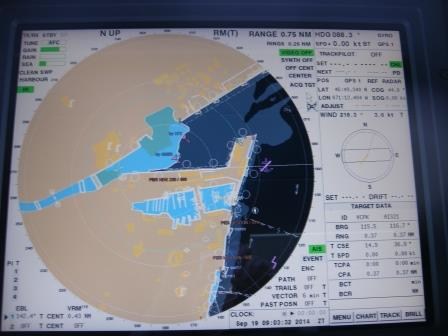
On this electronic chart capture you can see the dark blue where the ship docked in the L shape and the light blue below where the shuttle buses had to travel through the Marina

On this electronic chart capture you can see the dark blue where the ship docked in the L shape and the light blue below where the shuttle buses had to travel through the Marina

A bridge which opens every time a yacht wants to get in or out. Luckily it was Friday and thus most yachtie’s were still at work, earning the money that they then could spend on that hobby of “going nowhere at great expense”. If it had been a Saturday, the shuttle bus service would have been a challenge. A real challenge.

But all went well and again it was a sunny but very chilly day. Apart from the wind hiccup in Bar Harbor this has been a very good cruise for the guests onboard.

That cruise ended in Montreal and here it was time to say good bye to the ship and to fly to Halifax, where I will join the Veendam on the 22nd.

The Veendam is the last ship that receives the training for the new three alarm system that is being implemented and by mid-October all ships, all crew and also all guests will attend Boat drills under the new three step sequence.

17 Sept. 2014; Charlottetown, Prince Edward Island, Canada.

Another wonderful day for the guests to enjoy. For a cruise this late in the season it is shaping up to be a very good one. A pity about cancelling the first port, Bar Harbor, but wind can happen anytime of the year and is not really related to this time of the year here. But it is dry and sunny every day and that is something to be very happy with.

I did not see much of that sunshine today as I was buried deep in the dungeons of the ship, where we have a training room for the crew. Today was Examination Day for my students with a total of 33 “graduating” in the fascinating science of how to lower a lifeboat, how to keep those inside alive until being rescued, and the most recent addition to this, how to keep up the morale up of those inside that boat.  The 33 included 9 different nationalities and each nationality comes a different way of looking at exams and reacting to it. Each race, each nationality has a different way of reacting and as a teacher or in this case an examiner you have to be in tune with that.

Running a Western European style of doing an exam only works in Western Europe.  Some of the crew will freeze up completely when it comes to a formal approach, when during one session you have to show that you know-it-all.  When that happens, people will fail who in reality know everything and thus you eliminate a crewmember who would do very well but stumbles over that one exam.

What I have been doing in this situation, is to constantly run little exams during the training and test each student on the presence of the knowledge. Especially with the Asian students the knowledge is often there, it just takes a little bit of effort to get it out. I had promised them that I would not require a long and multiple question exam.  I was just going to ask 3 questions and if I saw that they would answer without delay, then I would know that they had the knowledge at their fingertips.

And that worked, the answers were spouting out, apart from the occasional stumble over some very alien words. A hydrostatic Interlocking Device is not a name that you use every day and is certainly not in your daily vocabulary if you come from Bali.  This ship was the first where they all passed and thus I could congratulate 33 brightly smiling crewmembers, who had spent most of their free time for the last 12 days reading the training manual and trying to remember how many sickness tablets there are in a lifeboat.

Tomorrow my day will be filled with teaching Crowd Management and how to deal with agitated guests during an emergency.  Psychology recognizes a number of standard forms of behavior: unpredictable, fearful, panic, or no reaction at all to name a few: and all the stages in between, including enhancements caused by alcohol, and the crew is more and more required to know at least the basics of it.  To get that across to a multicultural crew is not always easy and I am finding that 33 years of experience in the cruise business certainly helps as I can come up with real examples to illustrate what sort of behavior they might come across and how to react to it. One should not forget that an Indonesian or Pilipino crew member might have a hard time even recognizing symptoms of fear and anxiety in a Caucasian. Different races react in different ways. Apart from it being useful it is also great fun to do. Everybody likes to share memories and anecdotes, and if it happens to be educational as well then so much the better.

By that time I was done with all that, the sun was setting and the Maasdam was sailing out of Charlottetown harbor. The ship is now going towards the St. Lawrence River and has to go around Prince Edward Island. As explained recently we cannot go under the Confederation Bridge as the whole area is full of lobster and crab pots, even where they should not be.

Tomorrow is a sea day as the ship sails up the St. Lawrence towards Quebec. The weather is supposed to be sunny again but very chilly.  A temperature higher than the low 50’s would really amaze me.


16 Sept. 2014: Sydney, Nova Scotia, Canada.

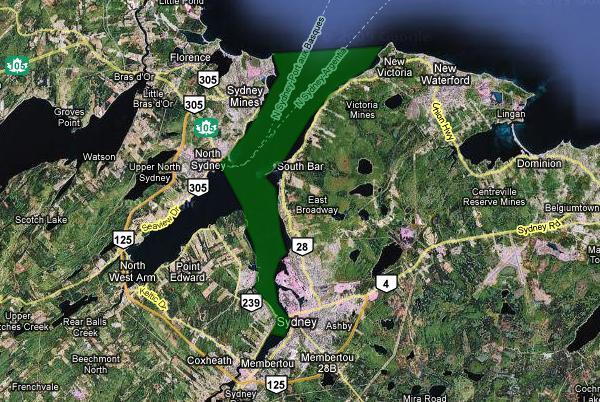
Sydney is located deep inside an L shaped bay at least if you forget the south west part of it. As a result the ship has to makes a 90 degree turn to the east when coming in. Then the  end of the L shape is getting more and more narrow until it comes to a point where the ship either has to go in Bow first or Stern first. There is no room to turn for a ship with a length of 200 meters at the dock.

The green area is where the ship sails. Courtesy of a website decribing dredging plans for Sydney Harbour

The green area is where the ship sails. Courtesy of a website  describing dredging plans for Sydney Harbour


That brings the challenge to the captain of what are we going to do? Swing on arrival or swing on departure? In Sydney, plan A is always swing on arrival and dock nose out. Thus if it is nice weather, or reasonable weather on arrival, you swing first, sail half a mile astern and dock nose out.  In case the weather takes a turn for the worse, you just give full ahead and race to open waters.

It is getting more complicated if it is windy on arrival. Then it might not be so easy to swing in the turning basin and go stern in. The thrusters are not always strong enough to cope with the strength of the wind on the side of the ship and being able to control the drift. Quite often it is then still possible to dock the ship nose in as you can keep up the speed longer, thus drift less and come alongside. At least you have made the port. The question is then do I get out again on schedule? If the weather forecast says that the winds will diminish during the day, yes you could do it. But is the weather forecast reliable in autumn? What happens if I cannot get out?? Will/Can I stay overnight and hope for the morning?

Then comes the decision that is most difficult for a captain. If the situation is clear cut: Bad weather – too dangerous – cannot safely do: –  cancel.  But what if you could do it but do not know what will happen later on and if it will, or will not, what impact will it have on the rest of the cruise? That is a decision that is hard to make. Hard because an overnight stay will affect the cruise schedule. So basically the decision is then made in favor of the first port or in favor of the next port. These things can make the job of a captain lonely, as asking advice here can result in everybody’s personal favorite port being brought forward. One will like Sydney, the other Halifax, a 3rd looks at the revenue a 4th at something else again.

Most captains then approach it with straight forward logic. If I am not certain now, I will also be not certain a few hours from now. So it is better to cancel this port and to have the next one, than to take this one and to have to hope that we can make the next one.  So if things look iffy to start with, either on the spot or maybe later on, you always play it safe.

That is of course with one exception and that is the home port. There you have to go and how you get out of it is of later worries. Most home ports are big ports with a lot of tugboats so the weather can be dealt with in nearly all situations. If not, then there is major mayhem on the horizon for Shore Operations. This happens sometimes during Hurricane season, when the Home port is in the middle of all the excitement and the ship either has to deviate or ride out the storm. The knock on effects are not pleasant for anybody.

No such thing for Sydney today. It was a beautiful, sunny and a near wind still day. Most guests were on excursion and those who were not, took great interest in the souvenir store in the terminal. It seems that we have a larger number of scooters and other mobility contraptions onboard than normal because it was the first time that I saw a whole row of them heading for the shop at the same time. A sort of motorized invasion but then in a friendly way. Although some of these 4-wheel scooters are big enough to have room for a machine gun on the front.  They also have ample room for baskets on the back, so hopefully the shop keepers took advantage of that.  I counted 9 of them rolling ashore at the same time. I felt sorry for the Security Officer as those things create havoc with the security system, necessitating extra hand searches.

At 1700 it was time to pull out of Sydney after what was one of the best days I have ever seen here. Tomorrow we are in Charlotte Town and more nice weather is expected.  My students are all excited and nervous as it is their examination day.


15 September 2014; Halifax, Nova Scotia, Canada.

The ship docked with a full house of eager guests ready to go ashore as they had not been able to do so in Bar Harbor due to the wind. It was a regular cool but nice day for Halifax and all of us onboard were very happy as a rainy day would have not been nice for the guests after missing a port. Still there were complaints galore about the weather, as there is always a group onboard who seem to think that if you go on a cruise you get sunny and warm weather, where ever you go with the ship. Even when going to the Antarctic or the Arctic there is always somebody who has not brought any warm clothing, because ……….. they were going on a cruise. So for some today did not give the cruise weather they had expected while for others used to colder weather at home it was just a pleasant day. These are sort of battles you cannot win and the only thing you can do is try to get the message across that the weather today was very good for Halifax, especially taking into consideration the lateness in the season.

Today the Bridge had something interesting on their hands, a corporate trainer/supervisor/auditor, called a Fleet Captain. Each company has one of these persons; they are regular captains from the fleet but they have been farmed out to Carnival Corporation for a Bridge Resource Implementation program. The idea is to ensure that all the ships of all the companies which are controlled by Carnival Corp. have the same bridge watch standards.  These fleet captains go around, training the crew in bridge procedures which are the standard for the whole fleet. These standards will eventually also result in having similar bridges on all the ships. So the bridge of a future HAL ship will be identical to one of a Cunard or Princess ship. Not a bad idea as it will make the familiarization with the equipment, when coming onboard a new ship, much easier.

But that is still for the future. At the moment we are still in the process of getting the routines standardized. The basic principle is that the whole bridge team is aware of what each member is doing. That means there have to be routines for sharing information, for starting and ending the watch and for calling attention if there is something the matter.  To makes things fail proof the functions in the team have to be clearly assigned.

So we have an Operations Director (OD), which is somebody with a Master License. On arrival and departure this is quite often the captain but if the captain is maneuvering it is somebody else. The OD keeps oversight and insures that nothing is missed by anybody.

Then there is the Navigator who is in charge of the watch when at sea. His/her minimum qualification is having a Chief Officers license. He/she is assisted by a Co Navigator who can have any license. This person takes care of the position, administration, telephone calls etc.

To give an example: The ship departs and the Captain is Maneuvering. The Staff Captain will then be the Operation Director; keeping an eye on the Pilot, the navigator, the helms man, the look out and the Captain. The co – navigator might be forward doing the mooring lines. When the ship is away from the dock, the Pilot will normally sail the ship to open waters. He will have the Conn., but he is not in charge. that remains with the Captain. The Captain can now fill the gap of the co- navigator, until he/she arrives, as long as the Staff Captain stays as Operations Director. Or the Captain and Staff Captain can switch.

But if possible we keep the man with the oversight the same. When the pilot leaves, he can then transfer the “conn” directly to the Navigator, without having to go through the extra step of Pilot – to Captain – to Navigator.

When the officer comes back from the mooring station, the captain will brief him/her and then he/she can take over the position of the co –navigator.

There are a lot more variations possible but the idea is that once the show gets on the road, there are as few functions changes as possible taking place. The less there are, the less chance that there is a loss of situational awareness and somebody is missing a vital piece of information.

How it goes, depends on the Captain. If it is an easy port / day, the captain might let the team run the whole show and only plays a minor roll but of course will still be in charge. The more difficult the situation, the more prominent the role of the captain will be. It is a great tool to get the juniors more and more involved.

To ensure that this is done to company standard, we have Fleet Captains going around the ships. That can be one of our own colleagues but it can also be a Costa, P & O or Cunard Captain, as all the ships have to have the same standards and you can really benefit from a pair of fresh eyes, “looking in from the outside”.

I had all my students in the lifeboats today, going through all the inventory of the boats as they are all coming close to their exams. Biggest focus point is always: “are the lifeboat rations edible and do they taste nice”, yes they are edible: they taste like Scottish Shortbread and are even more nutricious.

Tomorrow we are in Sydney and then I will hold a presentation for all the crew onboard about the new 3- alarm system we are introducing. To my utter amazement the crew is quite excited about the meeting. It is almost as if it is a school class outing.  All together to the Show lounge…………..

It is supposed to be sunny tomorrow in Sydney and that will be a good bonus as it tends to rain there are lot.


14 September 2014; Bar Harbor, Maine, USA.

With nice sunny weather and a fresh breeze we sailed into Bar Harbor. As expected the “Apartment of the Seas” was already in and being the bigger ship had been allocated the South anchorage. A bit smaller and closer to the lobster pots but also more sheltered and closer to the port. The weather forecast indicated that the wind was to abate during the day. But when the anchor had been dropped and the tender service commenced, it went the other way. The wind picked up to wind force 6 gusting 7 and that made a safe tender operation not so safe anymore.  As mentioned in my previous Bar Harbor blog, the north anchorage is wider, more room to swing but because there is more room it is also less sheltered and the wind has more free water surface to whip up the waves, and it did so. The captain suspended tender service, hoping for better weather e.g. less wind, but it was not to be.  Then the only decision was made, that could be made and that was canceling   and sail away.  Apart from disappointed Guests there was also instant panic in the kitchen as the Exe. Chef had ordered Fresh Lobster. Luckily the lobsters were delivered and brought on board by a few brave sailors who stood on the tender platform with the waves crashing around their feet.

Going to another port was really not possible within in the available time frame here and thus the only solution was to spend the day at sea and arrive at the scheduled time in Halifax tomorrow morning.

KoningsdamWith such an abrupt end to the Bar Harbor call this would be a short blog if I had not something exciting to announce. After a long waiting period the name of the new Pinnacle Class ship has been finally announced. The ship will be called Koningsdam which translates into English as Kings Dam. We have never had a ship with that name in our history and there also is no town in the Netherlands with that name. No doubt there will be a small dam in Holland somewhere with the name Koningsdam but that is normal. Give me a name and I will find you in Holland a piece of Dam or Dyke that combines it.

So now we have the name Koningsdam. I had hoped for Leerdam (III) and that was my entry in the name contest which the company ran a few months ago. But I suppose that I am too traditional and they wanted something new.  The name was chosen to reflect that the Netherlands has since 100 years a King – Koning – again and at the same time to illustrate that this ship, the biggest ever built for the company will bring out a fresh approach and new look to Holland America Cruising.


The keel section being lowered into the dock

The keel section being lowered into the dock

The ship is already under construction as on August 20, the first section of steel, the keel plate, was lowered into the Dock at Marghera which is the Fincantieri shipyard close to Venice.  Delivery date is in February 2016 and it is not yet known where the ship will sail first.  The ship is an evolution again from the Vista and Signature class and will incorporate the latest “needs” in the industry. Do not expect an ice-skating rink or a rock climbing wall, but the number of specialty restaurants will be boosted up to five. On the Nieuw Amsterdam, there are currently three; Pinnacle (Pacific Northwest cuisine), the Canaletto (Italian) and the Tamarind (Asian fusion). Now there will be two more. What they will serve is still a well-guarded secret.

Talking about food, the company recently redesigned our Hamburger Bar onboard (Terrace Grill) and renamed it the Dive In. Hamburgers and Hot dogs are now cooked fresh, a sort of designer approach, which means that you have to wait for them. Guests receive a pager so they do not have to hang around while waiting. I must say, it is VERY VERY good and the sauce that goes with the various options that you have is even better. My only problem is that it the large portions are very large and if I am going to have a hamburger for lunch I need to reduce dinner in the evening to a very small snack. But for the Burger-Aficionado, this could be Walhalla.

Tomorrow we are in Halifax. Again we are not alone. This time the Norwegian Gem is in port with us, and due to the Gangway layout, we have to dock nose in, otherwise both ships do not fit in properly.

The weather forecast is going to be partly cloudy with a chilly breeze from the North. It looks like autumn is approaching.


13 Sept. 2014; Boston, USA.

Boston offers quite a scenic ride in but as a guest you only see it once; on the way out. Early morning arrival means that it is barely twilight and then it is difficult to make anything out.

To the top right you can still see in Boston the frames used to help loading and unloading the cargo ships

To the top right you can still see in Boston the frames used to help loading and unloading the cargo ships

The Pier that we are docking at is the Black Falcon Terminal which used to be one of the larger cargo piers in the port. Holland America used to dock there already in the days of the old freighters.  You can still see the steel poles on top of the building that were used to hook up steel wires with blocks so the cargo could lifted out of the hold onto the pier and vice versa in a faster way than using the ships derricks.  Since the cruise ship boom the Pier has been spruced up to make it passenger friendly but it could do with a major overhaul to get it up to modern times, especially as in the high season there can be three cruise ships in at the same time.

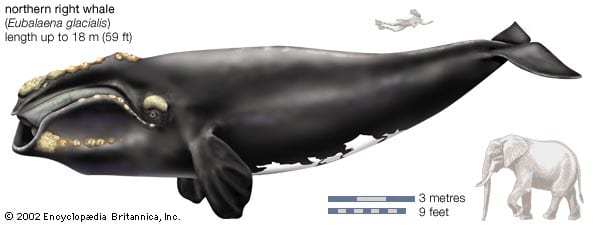
It is not the biggest whale in the world but small either

It is not the biggest whale in the world but not small either

As said the trip in or out is quite scenic. It starts with a bit of a headache for the Navigators due to the presence of the Right Whale. It has one of its major habitats just outside the port. There are only about 300 left in the world and thus they are heavy protected. The USCG maintains a traffic post especially for them  (compulsory as well) and as soon as a ship reports in that they have seen a Right Whale near the shipping lanes, all alarm buttons are being pushed and the locations reported in, are broadcast on regular intervals to the whole shipping world. There are speed restrictions and from our side we all have received “Whale avoidance” training that takes into account how various species of whales react and behave.

Mother and Calf. Most Right Whales are completely oblivious of what goes on around them.

Mother and Calf. Most Right Whales are completely oblivious of what goes on around them.

That makes it here a bit scary as the Right Whale does not behave. It does not react to ships, not to vibrations, not to movement; it does its own thing and nobody has a real clue what that is.  As a result they were easy prey in the past and nowadays they are easy to get a collision with. Hence the USCG having a sort of Traffic Control system in place to warn and guide the ships around them.


Once past that area the ship sails into Boston Harbor. On one of the hills on the south side you can see a prominent building what once was a mental hospital. It is now not in use as such, but every time I see it I have to wonder why they would build something like that on such a prominent position. It could not have been very peaceful for the patients inside to see the whole world around them and then not be able to get to it.  Then you get, also on the south side, the Fort that protects Boston Harbor. From the ship high up, you can basically look over it and see what the logic of fortification was in the 16th. and 17th. Century.

Then comes the bane of each cruise ship captains life, the container terminal. There is plenty of room to sail around the container cranes and the ships, but they for some reason tend to arrive and depart around the same time as we do. If not on arrival, then it is in the afternoon. As the Cruise Terminal is behind the container terminal it means that if one of those Container Vessels is maneuvering it effectively blocks the whole area.

Today that happened on departure. By 16:15 the ms Maasdam was all ready to go with 1,233 happy campers on board, which means a full house, and then they started moving a containership around. So we were all delayed by a good 30 minutes. Luckily Bar Harbor is not that far away, so the loss of time can easily be absorbed in the schedule.  And as sunset was later in the evening, everybody could enjoy a nice sail- away. The ships Bars were full which made the Bar Staff very happy.

Tomorrow we are in Bar Harbor again; the good thing is that there is no immigration inspection this time and thus no delay in the early clearance of the ship. The bad part is the ship has been assigned the North Anchorage which is wide and more in the open but results in a longer tender distance. The south anchorage has been given to one of the “Apartment of the Seas” of RCI which will deliver close to 4,000 guests ashore during the day.

The weather forecast calls for sunny weather but windy, with other words a regular Bar Harbor day with great sailing weather.

12 September 2014; Bar Harbor, Maine, USA.

It was sunny and that was good for the guests as it brings out the best of Bar Harbor. It was very windy which did not please the Captain as it meant that the ship was yawning like a drunken sailor behind its anchor. It also caused for a wobbly tender ride to the shore. The yawning of the ship (that is when the ship is swinging wildly behind its anchor) can be mostly controlled by using the stern thruster.  It will stop the stern from swinging and it is then possible to create a bit of a lee alongside the tender platform by keeping the wind just off the nose. But it creates a lot of strain on the anchor chain and with it comes the danger of a dragging anchor. As the ship had been allocated the south anchorage, which is the best anchorage for having the shortest tender distance, it has to drop anchor in close proximity of large numbers of lobsterpots.  If the anchor would drag then the chain might sweep through those lobsterpots, creating a lot of damage and that would result in a lot of upset locals. So for the earlier part of the morning the bridge was on high alert and watched each little movement of the ship with close attention. Later on in the morning the wind eased off and the ship settled a little bit better. Also good for the guests, as the waves are created by the wind only here in the harbor, so the moment the wind started to ease off the waves also reduced in height, making it easier to run the tender service.

While this was going on, all the guests on board had to go through US immigration by the CBP.  The USA is one of the few countries in the world that still insist of seeing everybody face to face when they come into the USA for the first time, even if there was only one foreign port in between two USA ports.  Most other countries are happy with either a passport check or scrutinizing the passenger list which is normally sent 3 or 4 days ahead of the ships arrival. The USA does both. Luckily the authorities in Bar Harbor are very much trying to make the process as painless as possible. That is not always the case as it varies from port to port in the USA as it is up to the local supervisor to decide on the process.  Here either the supervisor had a good night’s sleep or it was just a very professional person. With making it easy I mean that once the guests were through the passport check they could go ashore directly. There are some ports were the supervisor insists that everybody stays on board until the very last person has been seen. That is sometimes a very long and drawn out affair as guests who are not planning to go ashore sometimes just bluntly refuse to go. Then it takes time to get them there.

Today all the guests showed up as requested, the CBP inspectors did their work efficiently and quickly and by 09.30 the ship was fully cleared. 90 minutes to get 1230 guests through (plus me) is not bad going.

In port as well was the Seabourn Quest. Since 2011 Seabourn is a sort of subsidiary/ sister company of Holland America although the product is totally different. We share office space in Seattle, there is some integration in the operational side, but for the rest the two companies are still very much on their own. Seabourn started out with three small ships but since it is part of the HAL group, three larger ships have been added and the three small ones sold on to Windstar Cruises. A company that for a long time was also part of Holland America. The Seabourn Odyssey, the Seabourn Sojourn and the Seabourn Quest are three sister ships, roughly the size of our Prinsendam. They also have currently one ship under construction as well.

The Seabourn Quest. The newest of the 3 Seabourn ships.

The Seabourn Quest. The newest of the 3 Seabourn ships.

The Quest was anchored on the North Anchorage which is a much wider anchorage but the tender distance is much longer plus the tenders have to sail through a gap between islands and are for most of the journey out of site of the Bridge. So both anchorages have pro’s and con’s and can give rise to long discussions among the captains which anchorage is preferable.  As the decision of where the ships will anchor is made by the local authorities, it makes not much difference who wins the argument and why.

Tomorrow is the last day of the cruise and the ship will use Boston as a change over port. The change over port is an important day for me as well as it gives me the chance to call my wife and do my laundry.  I normally use the Guest Laundry as during the cruise I do not dare to go there as you are not certain of your life inside. I have seen something close to World War III erupting several times in these laundry’s over the right to have the laundry basket or the audacity of somebody having thrown somebody else laundry out.

It supposed to be partly sunny and a partly rainy day tomorrow but it will be a noisy day as the Black Falcon – now called Cruise Port Boston, terminal is located right under the flight path of Boston International airport.

« Older posts Newer posts »