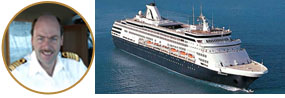
- Captain Albert's Website and Blog -

Ocean Liner History and Stories from the Sea, Past and Present. With an In Depth focus on Holland America Line

Category: Captain’s Log (page 123 of 127)

16 May, Katakolon.

We made it to the pilot station 15 minutes behind my planned time which was not too bad as we left nearly an hour late from Santorini. The people of Katakolon are working very hard to make their port a major tourist destination. The whole port is being revamped and spruced up with two new docks and a Marina. Today the pilot was very proud to announce he had been installing three yellow buoys that indicate the shallow patches near the marina side. After advising me it was better not to go on the wrong side of these buoys, we happily sailed into port.

During last call I had inspected the newest dock in the port, which consists of three platforms with gaps in between (they did not have enough money to make the whole pier straight) as they wanted me to start docking there. This pier makes it possible for the ship to almost dock with the bow in the local Taverna’s and it cuts the walking time down with about 10 minutes compared to the other dock. So the port authorities were very happy when I told them that I would be delighted to dock there.

By 08.30 the ship was safely alongside, 30 minutes before scheduled arrival time and we were looking at a beautiful day in Katakolon with temperatures in the high seventies (Fahrenheit) or mid twenties (Celsius) The one thing that was noticeable was the strong smell of rotten eggs around the ship, and for a moment I thought that I had docked right on top of the local sewage drain. However it turned out that we were smelling sulpher. The whole area is volcanic (Remember; yesterday we were inside the Santorini volcano all day) and in Katakolon harbor sulpheric gas escapes from the rocky bottom and rises to the surface. If you stand on the dock and look into the water, you can see little gas bubbles slowly drifting up to the surface and releasing this “rotten egg” smell.

The other ship in port was the Costa Mediterannea, which arrived at noon time and left again at 18.00 hrs. When cruise ships are making short stops it is always amazing to see how orchestrated a cruise call becomes. Five minutes after the ship was docked, 3000 people start to march into the little town. Approx. 800 veered off in the direction of the tour buses and the rest flooded the Taverna’s and the little shops. About 2 hours before departure the tend was reversed with everybody starting to march back and the 800 on tour coming back in the buses just before sailing time. Within a period of 5 to 6 hours 3000 people have visited a little town and then leave again without a trace. The Costa ship must have been in a hurry as the pilot requested for us to wait so that the CM could sail first. As you can see being a pilot in Katakolon is a one’ mans job. (And with his nephew driving the pilot boat, it is also a one family affair)

We were waiting for lost luggage anyway. This luggage had never made it to the ship in Venice, was to be forwarded to Piraeus and then got stuck there in some sort of un-explained confusion. Then finally some bright spark remembered that there was a regular bus service to Katakolon and decided to put the luggage on the bus. For this particular part of luggage it almost took 8 days to make it to the ship. Sometimes it seems to be easier to get a piece of luggage from Vancouver to Moscow, than to get it from Italy to Greece. But in the end we had a happy pilot who did not get screamed at by an Italian captain and a happy guest on board who finally got her formal wear.

We pulled out shortly after 6 pm. and after rounding Ak Katakolo (the cape after which Katakolon is named) we headed in a North Westerly direction for our next port of call Koper, the day after tomorrow.

15 May, Santorini.

We arrived bright and early an the north west side of the crater entrance of Santorini, only to find the Westerdam and Norwegian Jewel already in position, way ahead of the official arrival time.

Our first stop was O’Athinoi where together with the Westerdam we landed our overland tours.
The Norwegian Jewel went directly to the anchorage at Fira. There is only one anchorage in Santorini and it is given to the ship with the most guests. The Norwegian Jewel, being a high density vessel had no problem claiming this title as, while having the same volume, as the Westerdam can pack nearly double the number of guests on board. (Counted when all beds taken) That meant that Westerdam and Veendam had to float for the day where shore tenders ferried our guests to and from.

It was again a beautiful day with little or no wind, so I could bring the Veendam in between the Norwegian Jewel and the shore and reduce the tender distance. If it is windy, the ships spread themselves further out as with the large wind surfaces, cruise ships can drift considerably in a short spell of time. With over 5000 guests coming of the ship, not mentioning the crew, we knew it was going to be a crowded day ashore. To get to Fira on the top of the mountain there are only three options. 1. Walking (at least 20 minutes steeply uphill) 2. By Donkey (at least 15 minutes of a wobbly ride) 3. The cable car or Funicular (5 minute ride) as expected most guests choose the cable car ride and a long, long line formed on the dock. I think the longest waiting time was about 45 minutes. Not very pleasant, but we already had changed the schedule for this cruise to reduce the congestion in the various ports. It would have been even worse (7 ships) if we would have come on the original date.

If 5000 people go up the hill, they also have to come down again and thus we sailed almost an hour late. Again there was a long waiting time for the cable car. Normally not much of a problem but the schedule to Katakolon, our next port, was a bit tight.

Departure was very nice, as I sailed the Veendam very slowly between the Norwegian Jewel and the Westerdam, with everybody waving at each other from the Balconies and the open decks. We blew the whistle as a farewell, with the Westerdam captain being very enthusiastic in his response but unfortunately the Norwegian Jewel stayed silent. With a un- obscured sun, sailing out of the crater was spectacular with the bright white houses on the top of the mountain. If you see this from faraway you do think that it is snow of the top, as the villages are draped like glaciers over the mountain rim.

We had to pass through Steno Elafonisou again (see May 11 entry) on our way west but the traffic co-operated and we could go through at full speed. By the time we were through it was nearly midnight and when I left the bridge, I had high hopes that we would be on time at Katakolon.

14 May, Rhodos

It is becoming boring I suppose but we had another beautiful sunny day. The arrival was quite windy, with a strong breeze setting us towards the dock. So we arrived “high” which means we kept a fair distance off the dock, while sailing in. Then I stopped the ship and let the wind blow the Veendam slowly towards the dock. The speed of the sideways movement I regulated with the thrusters and in that way we made an “egg-shell landing” as the pilot called it.

Because we are on a 10 day schedule we do not follow the 7 day cycle of other cruise ships and so miss most of the congestion that can mar some ports. Rhodes being a Monday call is just too far for the ships to make it in one day from the home ports and thus we had the whole port to ourselves and the dock closest to the old town.

I spent the morning doing ship inspections. Once a week there is a crew cabin inspection, a public room inspection, a Health inspection and then there is “captain’s walkabout”. The first three are compulsory under the law and form part of the captain’s obligation to keep the ship healthy, clean and in good order. The last one is simply me walking around looking at things. With three departments (Deck, engine and hotel) looking at their own issues, there are always things that are on the borderline of responsibilities and then can be overlooked or forgotten. That is where the captain steps in and decides what has to be done and who is going to do it.

At the moment I am on a locker crusade. Each department has storage lockers and these tend to get overstocked, wrongly used, or items get stored in there that should not be there at all. Also legislation has been tightened recently with not allowing certain lockers to be used at all anymore for anything else but one exclusively designated purpose.

All crew has a penchant to put things away “for the time being” in the most convenient storage place close to the job. What goes in there should not always be there and if we do not act, then this not correct location starts to be used as a matter of routine. Further on the crew tends to be very creative in their way of storing things and they do sometimes forget, that although we are a floating hotel, the Veendam is still a ship that can wobble in bad weather. So things should also be stored safely and shipshape.

The captain has an over riding master key and no door can withstand him, making it easy during my rounds to “poke my nose in”. As lockers tend to be “locked” and only the holder of the key goes in there upkeep and maintenance can also be overlooked. Currently the project is to evaluate the contents of each locker and get it sorted out and cleaned up. Then the carpenters are called for repairs if necessary and finally the sailors move in to paint the floors.

I use a little Dictaphone to log all the observations and later type them out and forward them to the Hotel manager, Chief Engineer, Chief Officer and Environmental Officer for follow up. Because I am not involved in the daily running of departmental details, I can have a fresh look at each situation and also decide who is going to do what if an issue is at the borderline of the responsibilities of the departments. A good manager can always find a lot of “borderlines” to delegate to another department and thus I come across quite a few issues that need to be addressed. Mostly minor issues but a lot of minor issues can give an un-organized impression. I like my ship to look good and organized and thus I have “captain’s walkabouts”.

13 May Kusidasi.

As mentioned before, Kusidasi is the most organized port during our cruise, clean well prepared and ready for everything. So much ready that it sometimes looks like a bit of overkill. The docking itself is a piece of cake as there are two piers sticking out, almost perpendicular, from the shore and apart from a bit of current around the end of the piers there is not much to worry about. However the authorities make a great show out of it.

For the 1 mile approach to the dock we get: 1. the pilot in a pilot boat. 2. a tugboat whose duty it is to prevent ships from bumping into the dock. 3. A security boat to keep fishermen and yachts away 4. a protection boat (zodiac) that races to and from behind the ship. The terminal is protected by a security gate for access to the shopping centre that is part of the terminal. A second security review at the walkway to the terminal. Full security check in the terminal and then our own security inside the ship. For the guests who are less agile there are Bike- Rikshaws to take them from the gangway to the terminal. The latter had very little to do today as I managed to park the gangway of the Veendam almost inside the terminal this time. All these arrangements make it very pleasant to come to the place.

The weather was glorious and my bank account took another hit as my wife revisited the leather and jewellery shops. There must be a lot of husbands out there who will hope for their next cruise that they will have bad weather and the ship will cancel Kusidasi.

We were the only ship until 1300 hrs., when the Oceanic II came in. This is a ship from bygone days and hence it had my full -hobby- attention. It was built in 1965 as the Kungsholm for the North Atlantic service from Sweden with cruising very much in mind. With a tonnage of just under 27000 it is about half the size of the Veendam. When it came out it had some very nice lines, with a raked bow and two funnels. It was later sold to Princess who spoilt the appearance by removing one funnel. Then it became the Victoria under P&O and eventually it disappeared into the Greek Charter market with charters to German tour operators who had her renamed in Mona Lisa with a big picture of the painting on the funnel. That company went bankrupt not so long ago and the ship ended up with the Spanish operator Pullmantur who renamed her in Oceanic II. Due to the sinking of the Sea Diamond, she is currently under charter by Lois Cruise Lines until their new acquisition the (Silja) Opera comes into service.

Thus we saw a ship coming alongside with a German logo in the funnel, owned and named by a Spanish company and chartered for the Greek island cruising by a Cypriot company. There are now plans to bring the ship back to Sweden and to restore her to her former glory as a hotel in Stockholm. Similar to what the Dutch are currently doing with the old Rotterdam (V).

Our guests were all on board by 17.30 hrs so I pulled out for a slow passage to Rhodes, sailing past the islands of Samos, Patmos, Kos and finally for most of the night, north of Nissos Rhodos itself.

12 May, Pireaus.

We arrived as scheduled at Piraeus pilot station for our Athens call, only to find the Star flyer, Wind Spirit and a host of other craft floating around the entrance waiting to get in. As usual the ferries had preference for coming and going. However communication between them and port control seemed to have been even worse than normal as every time the pilot thought we could proceed another one left the dock. The Wind Spirit decided to swing around on arrival and blocked the centre of the harbor by doing so for 15 minutes and that in turn delayed two ferries, which departure then delayed our arrival again. All in all we docked 45 minutes past schedule.

The pilot was also an unhappy camper as he had been sitting on the bridge for nearly an hour doing nothing, but as it was not our fault; he waved the extra pilot charge that they add to the bill for waiting caused by the ship. We docked this time at the regular passenger berth and that made it easier for our guests to get into town. Last cruise we docked at the Olympic berth and that necessitated a 5 minute shuttle ride from that dock to the cruise terminal.

The shuttle runs all the way inside the terminal grounds and is completely screened off from the rest of the port. This setup is a left over from the Olympic Games when there were several cruise ships docked in port as floating hotels, including our own Rotterdam and the Queen Mary 2.

Another left over from that period are the under water inspections carried out by the local military. At random divers will arrive at the ship to do an underwater search. They do not announce this and the only way we find out is when the authorities suddenly call to say that we cannot turn the propellers for a certain period of time.

Departure was again a waiting game. Around 1800 which is our published departure time, all the ferries start to come in and leave again and that means that you normally do not get out until 19.30. So I try to leave as soon as all guests are on board and then pull out as quickly as possible. I just made it by 1750 hrs. and by the time I came “flying” out of the breakwater, two ferries were waiting to get in and another two were approaching.

We were blessed again with a sunny and warm day. The temperatures at the Acropolis went up to 25o C. or 78o F.
and the warm weather is supposed to hold because the wind has turned to the south. That also means we are getting Sahara sand on deck again. The sky has that familiar brown tinge to it and that in turn will result in complaints about dirty windows and decks when the sand settles on the decks.

Tomorrow we are in Kusidasi, followed by Rhodes were we are not allowed to do any outside maintenance or hosing down the decks, so we will have to live with it until we are past Santorini. The Bo‘sun is mopping were possible but it does not win the battle.

11 May, At sea

It is not often that the seas are completely flat but that was what we had today, sailing South Eastwards along the Greek coast. The sky was hazy again with the now familiar brown tinge of Sahara sand in the air but with the sun shining it was a wonderful day at sea.

The biggest “island” of Greece is the Peloponnesus and we have to sail all the way around it to get to Piraeus. The Peloponnesus is an “artificial” island as it used to be a peninsula attached to the main land until they dug the Corinth canal, which effectively severed the peninsula from the main land. The Veendam is too wide for the canal hence we sail around the island. The same goes for many other ships and thus we see a lot of shipping on this route. All the traffic from the Middle East and the Black Sea that is heading for Western Europe follows this route.

In the late evening we came to a real bottle neck of traffic. The Steno Elafonisou. This is a 3 mile wide strait south of the Peloponnesus and North of Nissos Kithiron. You can also sail around Kithiron but that is five miles longer. Most ships in this area travel at speeds of 10 to 15 knots and going around would add at least half an hour to the voyage and no captain likes to do that. I always prefer to keep my options open. About an hour before entering the strait you can see on the radar quite well how much traffic there is and how it is developing. If it does not look good, then the decision can be made to take the slightly longer route. For a ship as the Veendam is only adds about 15 minutes to the voyage.

We have nowadays a very handy gadget to track ships. At least the bigger ships. It is called the AIS. The Automated Identification System. Each larger ship has a transponder onboard and that sends and receives information. That information is displayed on the radar screen as a little triangle. By clicking on the triangle the name of the other ship is displayed, its next port of call, the course and speed and it even gives anti collision information. It is a great help to get a quick overview of a traffic situation.

One has to be careful though, as its effectiveness depends entirely on the diligence of the navigator of the ship, in entering the correct data. This does not always happen and we have seen ships sailing towards Spain while the AIS indicates Turkey, ships arriving at a port three months ago and a whole host of other mistakes. As long as it is used as another aid to the navigation it is a great help but it is not something to rely on.

This time there was little traffic in the strait but instead we had to contend with a fog bank. What started out as a sandy haze developed in a full blown thick white wall of fog. People do not associate the Mediterranean with fog but after a warm wind still day with a cold current running along the shore, fog banks can develop in the late evening. Luckily it did not take too long, as it would have spoiled my nights sleep and I needed to be fresh for the mayhem that is called arrival Piraeus.

10 May, Dubrovnik.

Once again a beautiful day to enjoy. Flat seas, no wind and clear skies. Temperatures nearly reached 80 today. Perfect day for exploring the sights of Dubrovnik. We are already planning for a next cruise in regards to this place. Two cruises from now, my regular dock will be taken by the Carnival Freedom, (see my blog of a few days ago) so the small Veendam will have to anchor and use tenders to shuttle the guests ashore. Part of the port is being refitted and of course that is just the area where we would normally park our tenders. So the chief officer was on a mission to find an alternative space.

There was one location that was workable and not such a bad place either. Right off the market square so there will be something for the guests to look at, when they are waiting for the tender to take them back. It is just a pity that the location can only accommodate one tender at the time, and thus it will all depend on the fact if all the tour buses return at the same time, whether there will be a waiting line yes or no. Trying to regulate the return of tour buses is not so easy, as their progress and schedule depends a lot on the traffic and congestion in the town.

The reconstruction of the port has to do with the increasing popularity of Dubrovnik as a cruise the port. Originally the dock followed the outline of the coast. That was fine as long as the visiting ships where not longer then 500 feet. But 500 feet is now a days only the lenght of a small (cruise) ship and angles in the dock create problems with getting the larger ships docked. Therefore there is now a project goingon in the port to take these angles out of the dock and that means that ships up to a 1000 feet can dock alongside and that gives room for two mega liners alongside with room left for a smaller ship behind them.

We left just before sunset and the sun gave a beautiful performance by sinking into the Adriatic sea in a hue of vibrant colors. Tomorrow will be asea day and again the weather forecast is great.

09 May Venice.

Although drizzle was predicted, it was a sunny day but slightly hazy. The weather here in the Med is very difficult to predict anyway. The sea is enclosed by land on all sides and that has a great influence. The Russian flatlands to the North, the Sahara in Africa to the South, the Arabian dessert countries to the East, it all makes it very difficult to discern a predictable pattern but as long as it is nice weather, you will not hear me complaining.

Today was also heavy loading day, and being Holland America Line, we procure a lot of items from Holland. They are trucked in with Dutch trucks to Venice and normally arrive the evening before, so loading can start the moment the ship is safely docked. All our supplies are palletized and once the stores are onboard we do not need the (wooden) pallets anymore. On the ship everything is stored on stainless steel racks to comply with US Public Health rules. So what to do with those 150 odd wooden pallets that we have left over every 14 days? We like to recycle as much as possible so throwing them away as garbage goes against the (Dutch) grain. If we keep them onboard they take up space and I consider them a fire hazard.

We found a solution but had to go around the houses for it a little bit. If we keep the pallets onboard, then they are considered garbage when we return for our next call. This means we have to pay for garbage containers and those perfectly good pallets go to the dump. That costs about 1200 euros’. If we want to recycle them we have to make sure that they do not go with the ship but that they are left behind when the ship sails. So we have found a local company that will come and pick them up, they charge us 300 euros’ to do so and they make their profit by selling them on. So we recycle and we save ourselves approx. 900 euros’ as well.

Today we were lucky with the fact that all flights landed on time and that the Veendam could leave on schedule. We save fuel by leaving as early as possible as it brings our average speed down, speed we have to maintain to get to the next port. For Venice I try to get out as quickly as possible as well for another reason; namely to see Venice before guest dinner starts.

I always get comments from the guests about the tugboat that hangs on our bow while sail through the port. Guests find it peculiar as they do not see a tug in other ports. The Veendam only needs a tug during very windy weather but Venice has a special reason. The local authorities require a tug as a fail safe. The thought that a big ship might miss the sharp turn off St Marks Square and plow into the houses, is too gruesome to contemplate. And thus we hook on a tug for 4 miles until we are past the old town.

Most people think about Venice as just the old historic town. But the area is quite industrial as well. Just past Venice is the town of Marghera which has petrol-chemical plants, container docks and a big shipbuilding industry. This includes the Fincantieri shipyard where the Veendam was built. As a matter of fact the Veendam was the first Holland America line ship built at Marghera. This was so successful that ever since all new HAL ships are coming from this yard.

May 08, Dubrovnik.

The weather held and our moning call at Dubrovnik was a sunny affair. This is only a short port stop, from 0700 to 13.00 hrs., as it is such a long distance to Venice. I am always in a great hurry to leave because of that, while the guests are in no hurry at all to come back. So it was also this time, all our buses pulled up next to the ship in the last 45 minutes and that meant that it was a long row lining up waiting to be processed by security.

The summer season is slowly starting and that could be seen by the fact that each call we coming to Dubrovnik there will be more and more cruise ships. During our first call we were all by ourselves, during the second call there was one, during the third call there are four. At the fourth call again four, but now the first mega liner has arrived. Fifth call: four ships (including one mega liner) and at the sixth and our final call, five other ships including two mega liners and two big ships, altogether bringing ashore an estimated 12000 guests, not counting crew. During that last call we have the advantage that we are docked, so the transportation of the guests is at least not that inconvenient but it will be a busy day within the walls of the old town.

Another sign that summer is coming is the abundance of sailing boats around the coast. On the way from Dubrovnik to Venice we sail for part of our journey between the islands of the Croatian Coast. Those are fairly sheltered waters and thus a great area for sailing. That means for us sailboat dodging. Although sailboats also have to comply with the rules of the road, this does not always happen. Sometimes the sailboat skipper has no or just rudimentary knowledge about the rules, sometimes the occupants are too occupied with sailing to pay proper attention to their surroundings and sometimes there is too much of a party going on, on board. Thus we keep a close eye on all of them, including those who are keeping a distance, as you never know what might happen the next five minutes. I always hope that the skipper apart from knowing his Rules of the Road also applies common sense and simply stays away from commercial traffic. A 25 feet sailing boat is much more maneuverable then a 1000 feet tanker, so why insist of having the right of way, even if you have it.

Arrival Venice will be the end of yet another cruise. A few of our guests are staying for next cruise, when we sail the Eastern part of the Mediterranean. Quite a few of those leaving the ship will spend some time in Venice before flying home. Holland America offers pre and post cruise packages and I think they are money well spent. You have flown all the way over to Europe anyway, so you might as well get the most out of Venice while you are there.

May 07, At Sea.

It seems that we have left the rainy weather behind us for the time being as the forecast for the coming days is only predicting sunshine. Early this morning we sailed past Stromboli again, with its top covered in clouds, so not much to see and then we headed for Messina strait. In order to make the schedule to Dubrovnik I went for an early passage and by 7 am we boarded the Messina pilot. He seemed to have had a bad night as he spoke no more then a few words during the whole sail through. As we went through at nearly slack tide (time when the tide and the current goes from Ebb to Flood or vice versa) the strait was full of fishermen. Due to the layout of the strait with its traffic zones and crossing ferries we pass these fishing boats a less then a 100 feet but they do not seem to be perturbed by it all. They are just happily sitting there in their little boats, with their back towards a vast mountain of steel rushing by at 18 or 19 knots, just going about their business as usual.

The rest of the day was spent sailing around the southern side of Italy heading for our next port of call Dubrovnik. While the guests are enjoying themselves with all the shipboard activities they see little of what goes on behind the scenes. Holland America prides itself on its training program and part of that program is to get outside trainers on board whenever possible. This cruise we have two firefighting instructors on board from the Texas A&M School of firefighting. Although the officers onboard train the crew themselves, it is very good to have people come in from the outside. Doing that brings a fresh pairs of eyes to the shipboard routine and as the instructors go around the fleet it insures consistency on all the ships.

Thus this week there were training classes for the fire teams, for the cooks in the kitchen, for the traffic directors (those who guide the guests to their lifeboat stations) and for every other group involved in our safety sequences. We did a major drill while docked alongside at Naples as it is still one of the few ports we are allowed to sound alarms and make announcements. I set the drill for 09.30 with the hope that most of our guests would be ashore by then. As it was beautiful weather that day it worked out well. By 09.25 only 50 guests were left on board of the 1248 we have on the ship. We always have a few guests who have been everywhere and have seen it all and they simply stay on board and enjoy the scenery from one of the lounges.

We try to vary all our firefighting exercises, and as the guests were ashore, we could train on a few crew cabins located in the middle passenger area of the ship. The success of on- board firefighting lays in the fast response to an emergency. When an alarm comes in on the bridge, an officer is dispatched to check it out. This is called a first responder and he/she should be on the scene within two minutes. If the fire alarm has to be raised, the teams should be able to dress up in full gear (protective clothing, breathing apparatus and tools) in under four minutes and be on the scene within 8 minutes after the alarm has been sounded.

We then “set the box” which means the area is surrounded at all sides by the fire teams, to contain and then to extinguish the fire. Evaluation of shipboard calamities through history has shown that if you get your teams on the attack within 10 minutes you have a very good chance of “winning” without it turning into a major event. When the drill is over a debriefing takes place where the whole evolution is reviewed into great detail and notes are made to improve the next drill. Even if you have a well oiled machinery as on our ships, there is always something to learn and always something to improve upon. The moment you think something is perfect, you have to be careful as that will be the moment that complacency sets in and that is the first step to disaster. Thus we keep training, evaluating and trying to come with even more refined action plans each time we have a drill.

Older posts Newer posts