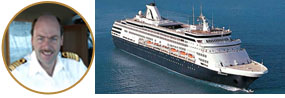
The last three days we have been under the influence of the currents on the St. Lawrence River. The down stream current of the river itself and the ocean current that pushes sea water all the way past Quebec. When we left the Saguenay fjord it was flooding and so we had the current all the way with us until docking in Quebec. On one side it is good for the fuel consumption, we got up tot three knots of speed free of charge, on the other hand it makes steering more difficult when slowing down. It is the same as if you are walking on one of these moving walk ways in the airport. You try to walk slower when it is time to step off the walk way and then somebody keeps pushing you forward. The amount of fuel that you save can be considerable. Two knots of speed given by the river can be the difference of running on 3 or 4 engines. If you can do with one engine less then you save approx. $350 an hour. Do that for a few hours and the savings mount up quite quickly.
Docking in Quebec is also regulated by the current. Unless it is slack tide, you always dock with the nose into the current, as it is much easier that way to keep the ship in position. If you dock and the current is pushing against the stern, the blunt end, then the ship is much more difficult to control. So, although we were going up river in the evening, we had to dock with the nose downstream, as the ocean current was still stronger, up to 4 knots, then the river current. Therefore we made a big turn in the river and then let the current slowly push us to the dock. Even when alongside, I had to keep the engines on 3 knots ahead to remain sitting still at the dock until the ropes were tied up. We were docking at the passenger terminal with a fixed shore gangway so it was docking on the inch with the full current running.
We had a bit of a drizzly day in Quebec but the advantage was that it took the chill out of the air, the chill that we had experienced yesterday. Whatever the weather, it did not deter our guests. While it was Canadian Thanksgiving Day, the shops in the lower town were open, so both shop-a-holic- and tour aficionado could be pleased to day.
Departure from Quebec is also dictated by the current. Just North of Quebec is a bridge, and the Veendam only fits under it at low tide. The Veendam is the tallest ship that goes under the bridge and the ships height makes for a very short time that is available for passing. That is when the water is retreating to sea and there is only the regular water level caused by the river. Thus the Quebec departure time depends on when we can and have to go under the bridge. This “bridge time window” changes on a daily basis. The strength of the incoming tide depends of a lot of factors. Apart from the regular moon/sun cycle which creates the tides, there is also the wind influence, which can help push up or help diminish the water height. Then there is the water of the river coming down stream which depends on the amount of rainfall up river.
All these things together make it impossible to calculate the bridge window very much ahead of time. As the cruise schedules are publicized in the cruise brochures two years in advance, we can not advise anybody about it any earlier. The only we can do is to put a foot note in the brochure, advising that Quebec departure times will vary. About 14 days in advance the pilots have a reasonable idea and as long as there is no storm or heavy rainfall, they have it right most of the time. But even then they can be an hour off.
That makes it very difficult to base a cruise on this with regular departure and arrival times. However most of the time the bridge window is within workable limits. We might have to leave a bit earlier from Quebec, to arrive on time in Montreal but that is about it. Last cruise we had to leave Quebec at 18.00, as the bridge window was shortly after 1900. That cut our visit to Quebec short, but we had a timely arrival in Montreal, our change over port.
This cruise it was more complicated. With the bridge window being after 23.05 it meant a 22.00 departure. Such a late departure means a later arrival in Montreal and that can affect the flights of the guests. I had informed the company ahead of time, as soon as I received the latest estimates about the bridge window, that the tentative arrival in Montreal would be. 09.00 versus 07.00. This gave the head office time to advise the guests.
When the pilots came on board, they told me that, due to not too much rain up river we could go under the bridge a little bit earlier. Good news for me, maybe I could get to Montreal a bit earlier as well. So we let go the lines as quickly as we could; I spun the Veendam around in the river so fast that the pilot said he felt dizzy and up the river we charged. We made it to the bridge 20 minutes earlier than originally planned, sailed under with a clearance of 9 feet and with having high hopes for making good time for Montreal.
During the first part of the night we made good progress. There was no traffic in the way and we could keep the pedal to the metal. Just after 3 am. we came to Trois Rivieres and changed pilots. Shortly after the fun began. The current was much stronger then normal, somewhere between 1 and 2 knots more and that did not help. There were more ships docked along the river then I had ever seen before and that required each time a no wake passage with slowing the ship down to 10 knots. Within no time, all what I had gained in time earlier in the evening was now lost.
Then the pilots came up with something new. Slow downs for erosion on the river banks. I tried to explain that the Veendam does not create much of a wake, when going very fast, or going very slow, (the worst is around 14 knots) but they opted for the slow speed. There is nothing I can do about that. If somebody along the shore complains and it is found out that I went against the pilot’s advice, the company would be in deep doo doo.
So slow speed is was. I started to run behind schedule now.
On approaching Montreal it got even worse. A ship docked alongside the river was carrying out under water repairs; thus: slow down. There was a clean up crew working on the river bank, thus, another slow down. In the end we arrived 1 hour later as planned. The turning basin is soo tight, that de docking maneuver head has to be done very slowly. I have no more then 30 feet clearance on the bow and about the same on the stern. No way I could make up time there by a fast docking. Thus we came alongside by 09.50. With one spring ashore, forward and aft, I ordered the gangway out and by 09.55 the first guests were going off the ship. By 10 am. the luggage was going and by 10.10 the ship was all fast. Until that time I kept the Veendam alongside with the thrusters.
However fun was not over yet. We also had to get back to Quebec. The bridge window now was at 01.30 in the morning. If we missed that one then we had to anchor north of the bridge until lunch time and that would mean cancelling the call at Quebec. So I set departure for 16.00 hrs. SHARP, regardless if whether al guests would be on board or not. Not a nice decision but leaving one guest behind makes more sense then cancelling a port call for 1200. The boarding of the new guests was delayed as we had to get all the disembarking guests of first. But with checking in being done both ashore and on board, we managed to get everybody on by 15.45. I had just started to let go lines, when another bus pulled up with 35 guests on board. We managed to get them on board by 16.05 and at 16.08 I was off the dock. We were only 58 guests short, but they missed the ship because their airplane broke down, so they were re-directed to Quebec regardless o my departure.
The pilots were very accommodating this time and we charged full speed down the river, with the ship slightly rolling from one side to the other, each time itwas caught by the river current. The only thing to hope for was that there was no traffic on the river that would slow the ship down. There was not.
We went all night as fast as we could, greatly helped by the river current now running with us, and we made the Quebec Bridge, 30 seconds behind schedule. Not bad planning on a 9 hour trip down river. By 02.30 we approached the dock. This time it was almost slack tide. I slowly brought the Veendam alongside; very slowly, as we did not know the exact moment that the tide would turn. It turned at 0.2.42.
Within one minute the current went from 1.5 knots of ebbing to 2 knots of flooding. That did not make it easy to “dock on the inch”, which we had to do due to the fixed shore side gangway. To add to the fun, at that moment the wind decided to pick up from 8 to 15 knots pushing the ship towards the dock with an increased momentum. But by 03.50 we were safely alongside and the two pilots could walk ashore. I was ready for bed. It had been a 19 hour day with going up and down the river and the fun in Montreal. The weather did not look that good for the day but my bed did.