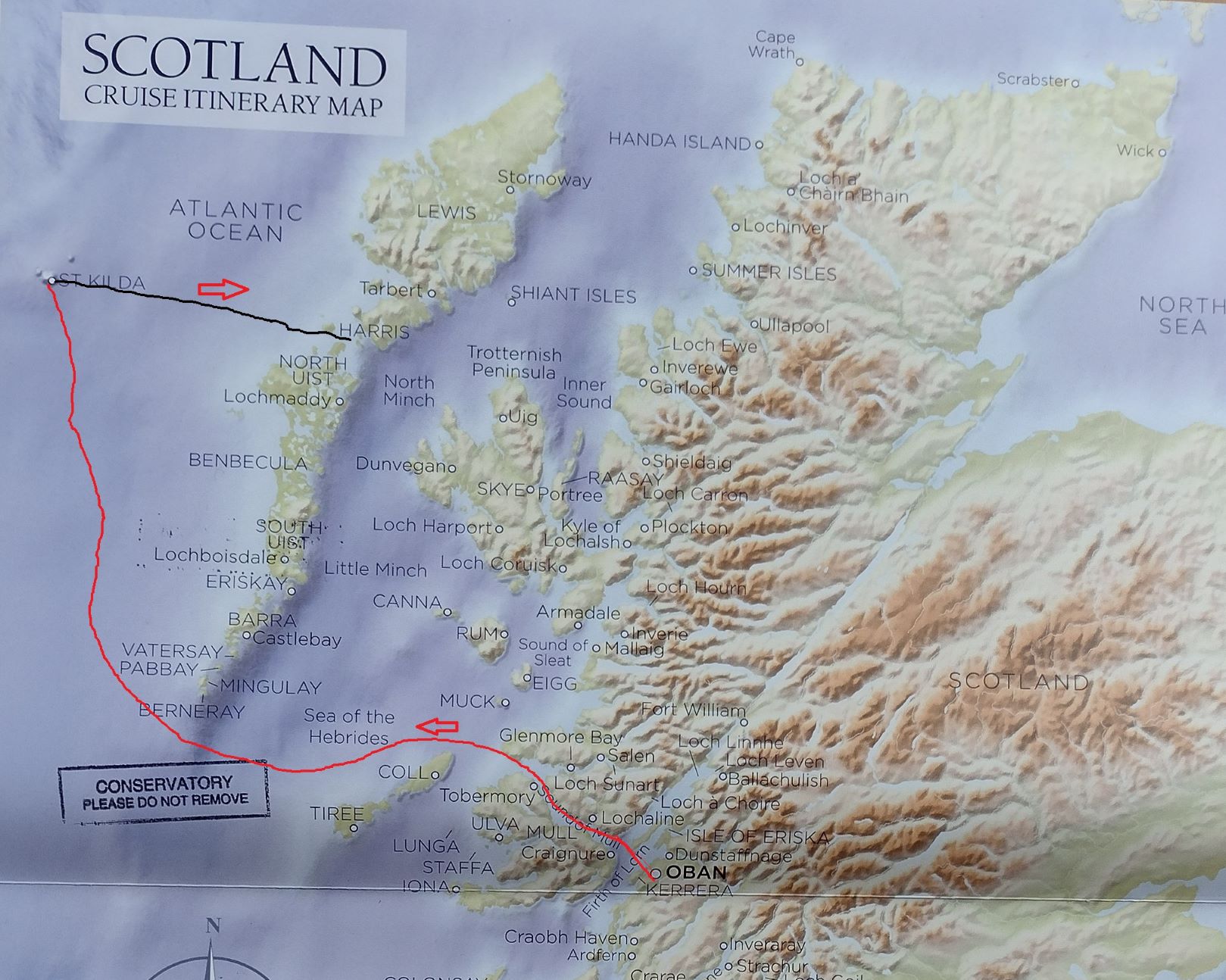
The route for the day. Because of the nice weather the Captain grabbed the opportunity to venture out in the open ocean and race to St. Kilda. See the red line. Returning to the sheltered islands was a lot easier (Black Line) as it was only a short crossing to Harris for the overnight anchorage,
By 08.00 hrs. the engines stopped and the anchor went down, so we knew that the captain had found St. Kilda and had safely anchored in the bay. of Hirta (in Scottish Gaelic: Hiort) which is the largest of four islands making up St. Kilda. In 1930 the last of the islanders left the island and since then there are only sheep (mainly a brown breed call Soay), seabirds and other protected animals, representatives of the Scottish National Trust (also protected) and a military missile tracking station on top of the mountain range.
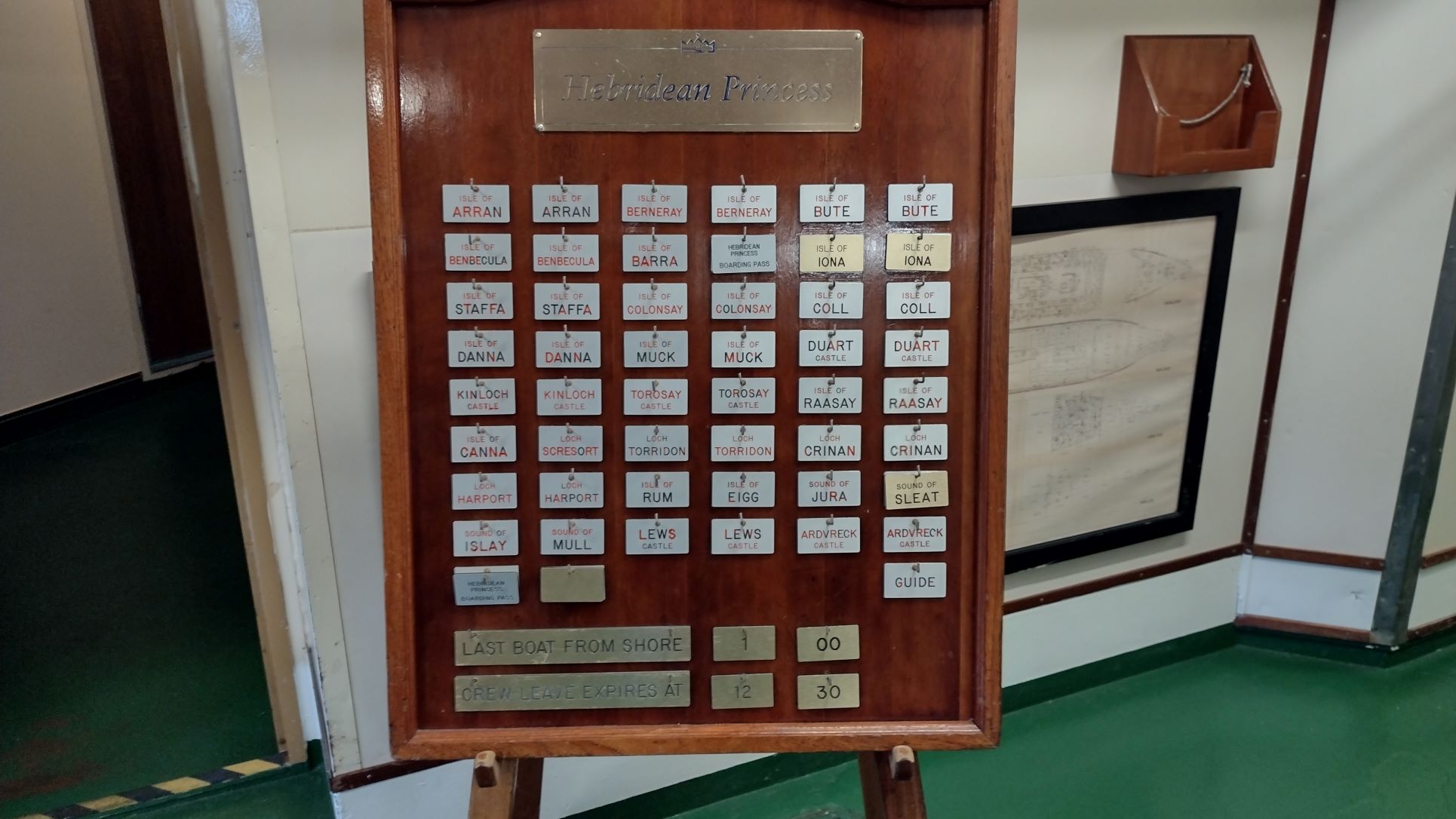
Going ashore. You pick up your brass cabin tag and put it back when you return. No bag searches, no calls for I.D. It is just to make sure that you are back before the ship sails.
We had breakfast first in the Columba Restaurant, which is made up of a small continental buffet and a full – high quality- English Breakfast that is served. There is porridge which can be served with a “wee dram” if you would like so. Todays special was: eggs- benedict which was done very well. And in a very civilised way, tender service started when breakfast closed (08.00 to 09.30). A small skiff that can handle 10 guests (of which 6 sitting outside) then ferried everybody, who wanted to go, into the small harbour. Because of the prevalent weather and this skiff, guests are advised to wear rain gear and everybody gets a lifejacket (inflatable) to wear when in the skiff.
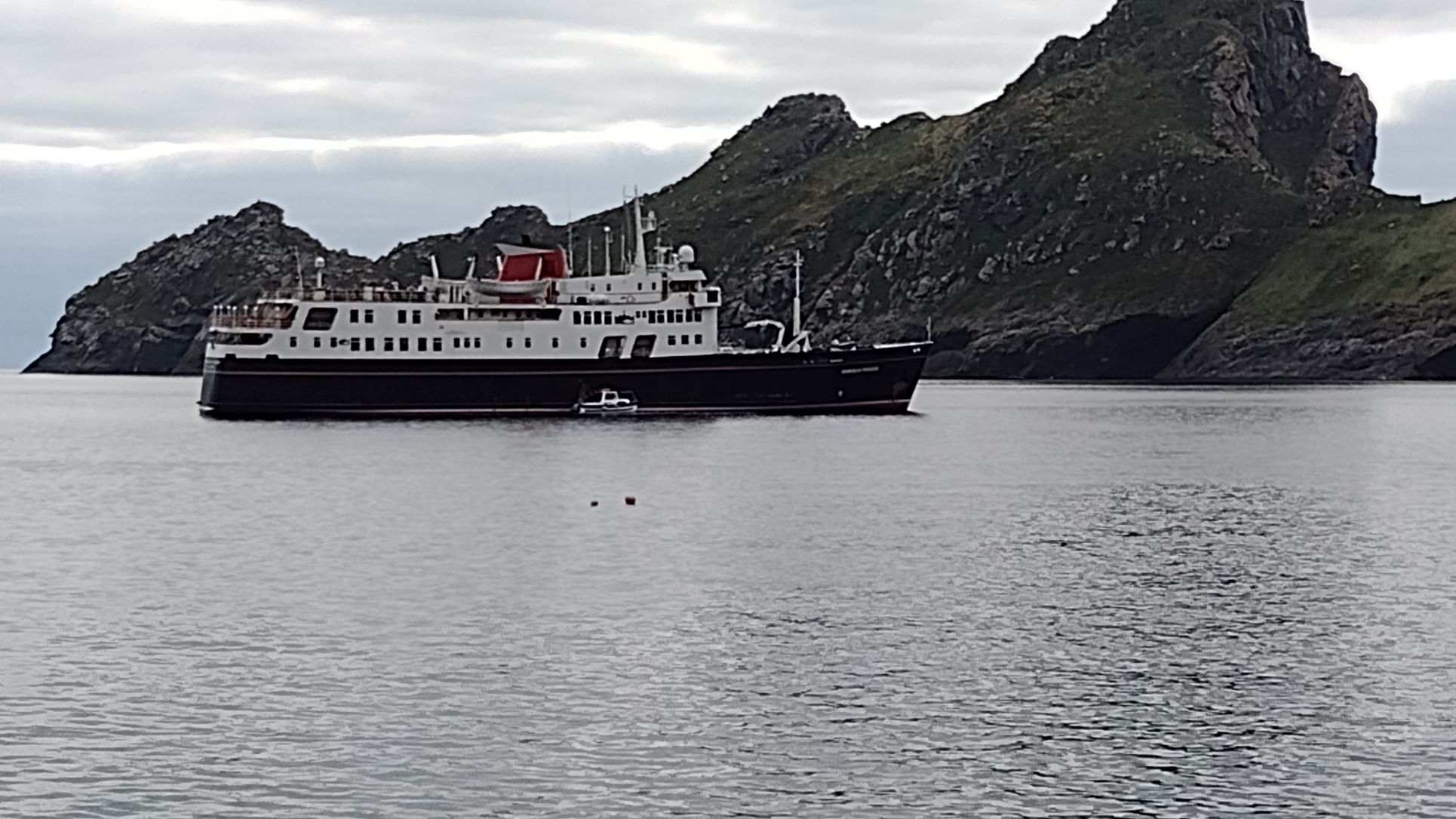
The mv Hebridean Princess at anchor in the bay of Hirta. The ships tender (normally stored on the forward deck) is alongside to ferry guests to and from the ship.
Hirta has been occupied since pre-historic days and was in more recent times (since the 13th. century) occupied by islanders who made a living harvesting birds, for feather, meat and oil. That was mainly subsidence living and by 1930 most had emigrated to the main land, so the remaining inhabitants asked to be relocated to the main land. Since then sheep are the main occupants apart from the natural wild life. Since 1957 the island is looked after by National Trust of Scotland with the RSPB (read professional twitchers) in full attendance during the summer months. Tomorrow, 16 October, is their last day and then they are evacuated by a militairy helicopter until next season.
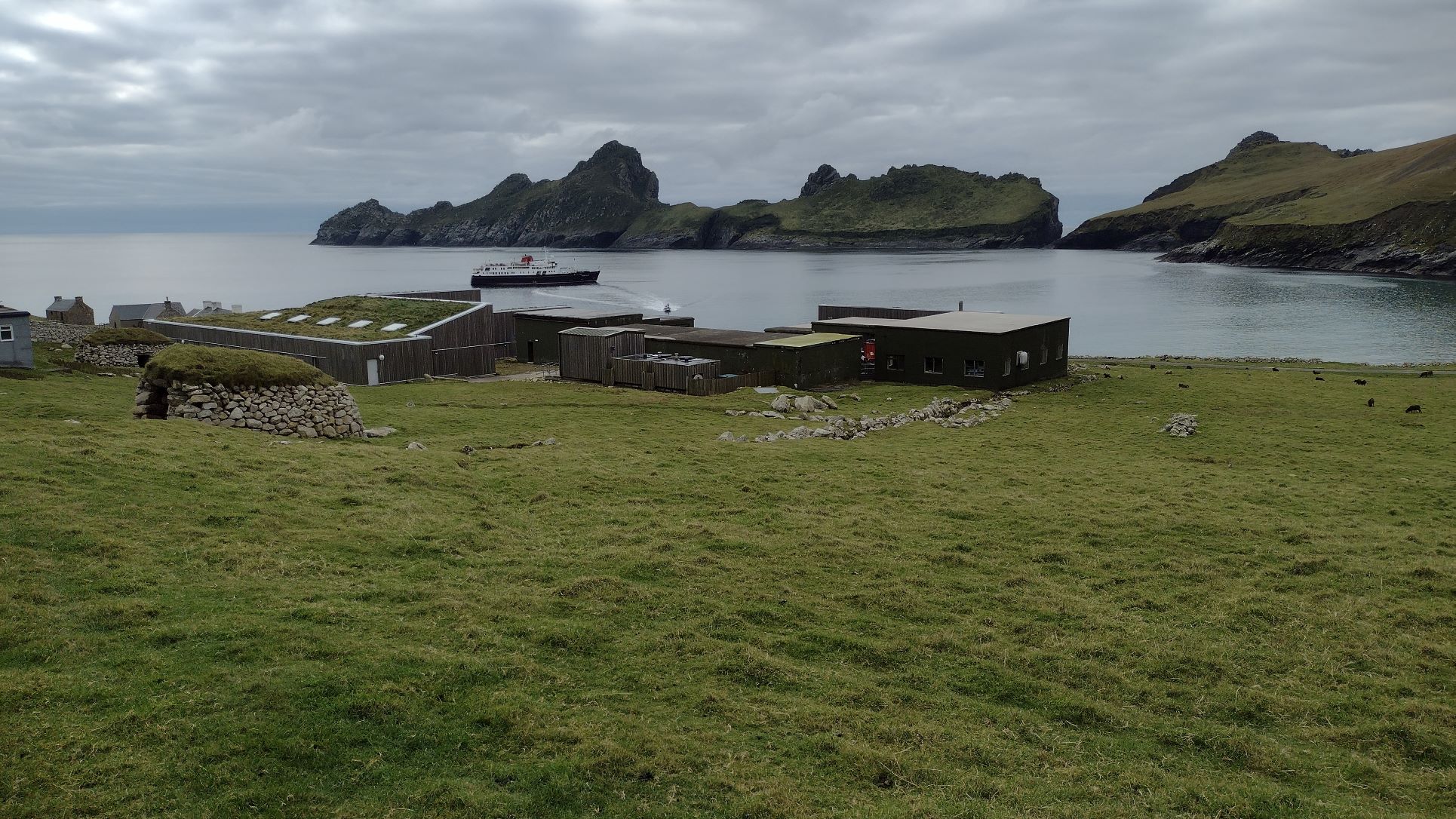
A view over the bay. In the front the military accommodation.
For the militairy there is a concrete ramp for a landing craft and for tenders and other small boats, a small sea wall which shelters a small pier with steps. As you will see during the rest of this cruise, neither navigating the ship nor going ashore is possible if you are not fit and ambulant. We have a number of quite elderly guests on board who can walk well but found getting in and out the tender quite a challenge. There is no lift on the ship so you have to climb and descend the steep staircases. Then, as today, the land is grass, moss, peat and most of the time swampy. Although currently we are lucky as it has been dry for a few days.
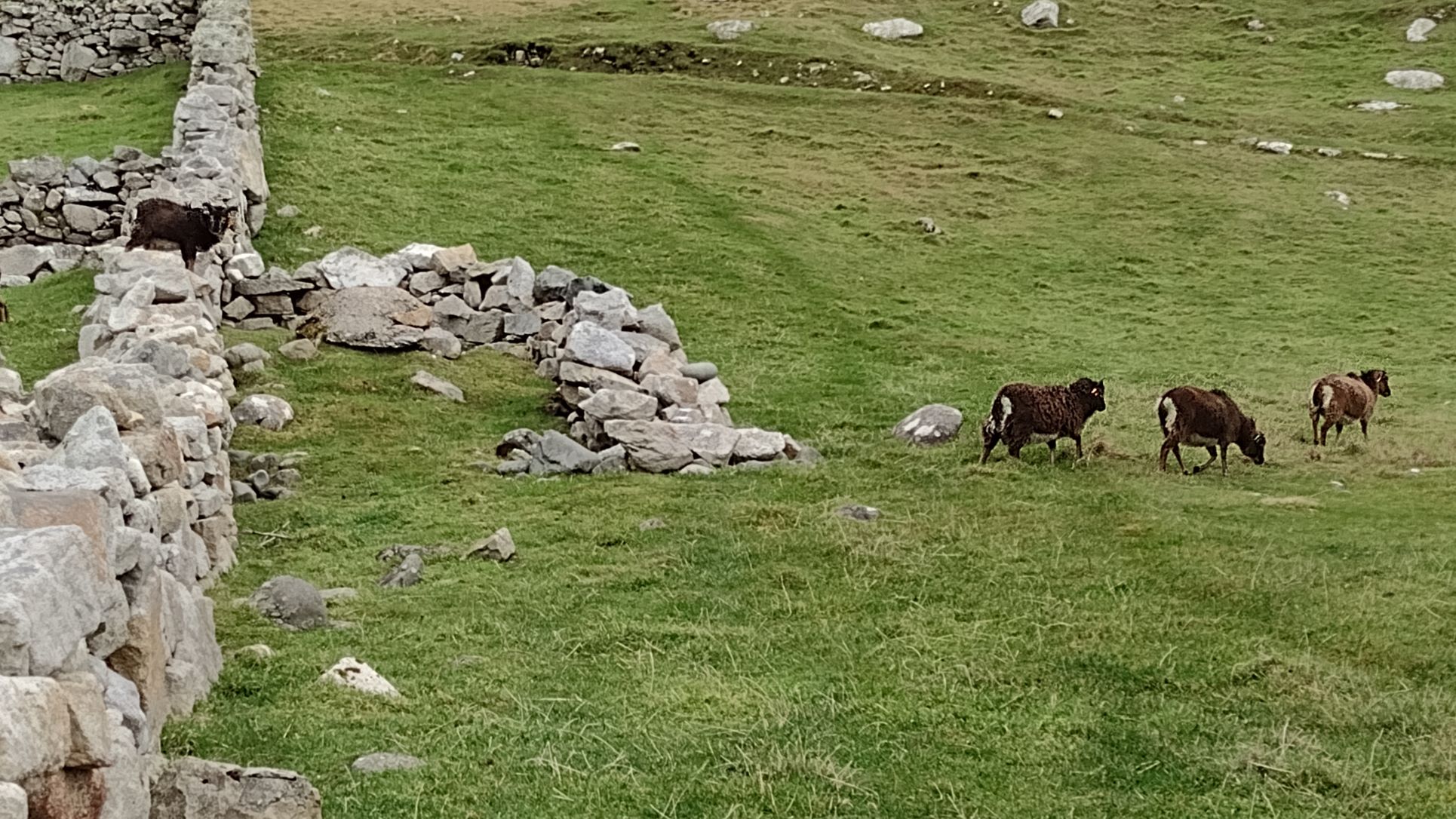
Some of the sheep that now roam freely over the island. The stone walls are the reminders of the labors of centuries of small groups of islanders.
When you step ashore, the first thing they ask, is to dip your shoes or boots in a bucket of dis-infectant to keep the danger of Foot & Mouth disease off the island. Then the first thing you see is a modern building which houses the military who operates the base on the top of the hill. They live separated from the naturalists working on the island and this building, although necessary, somewhat marrs the natural view of the island. But this is the sheltered area of the island, hence this is were the original inhabitants used to live and thus it makes sense that the Army has built here as well.
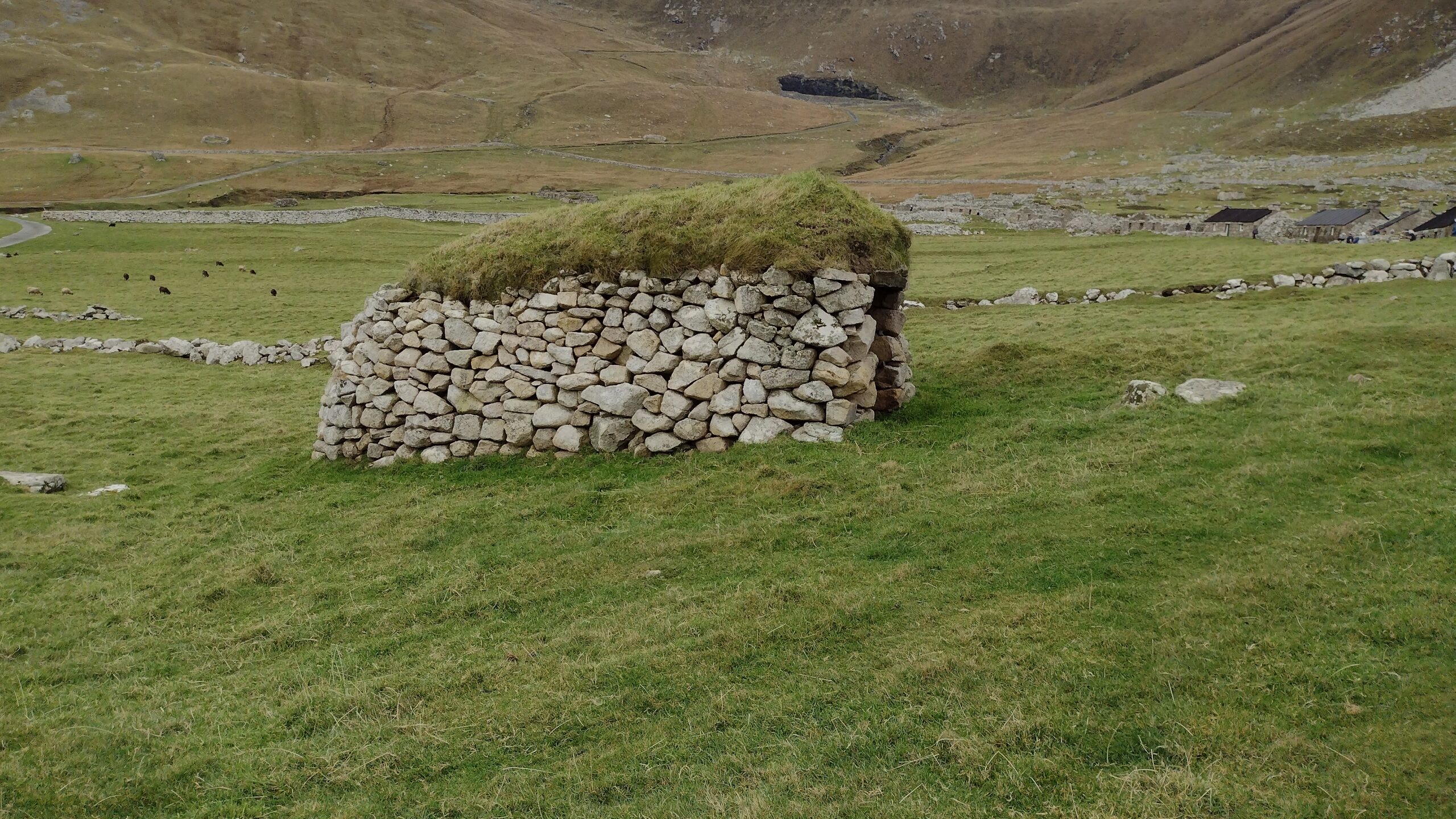
One of the Cleitean bird stores on the island. Some of them are hundreds of years old
The people of the island lived off the large bird population and collected a few thousand of them each year, and the people of the RSPB have still not been able to figure out if the large numbers “harvested”really impacted the total population or not. We did not see any of the birds (Northern Gannets, Atlantic Puffings, Terns and the Northn Fulmars) while here as they had all migrated a few weeks ago. What is left of those days for hunting and killing birds are stone storages called Cleiteans. 1260 of them have been counted so far and this is where they stored the captured birds.
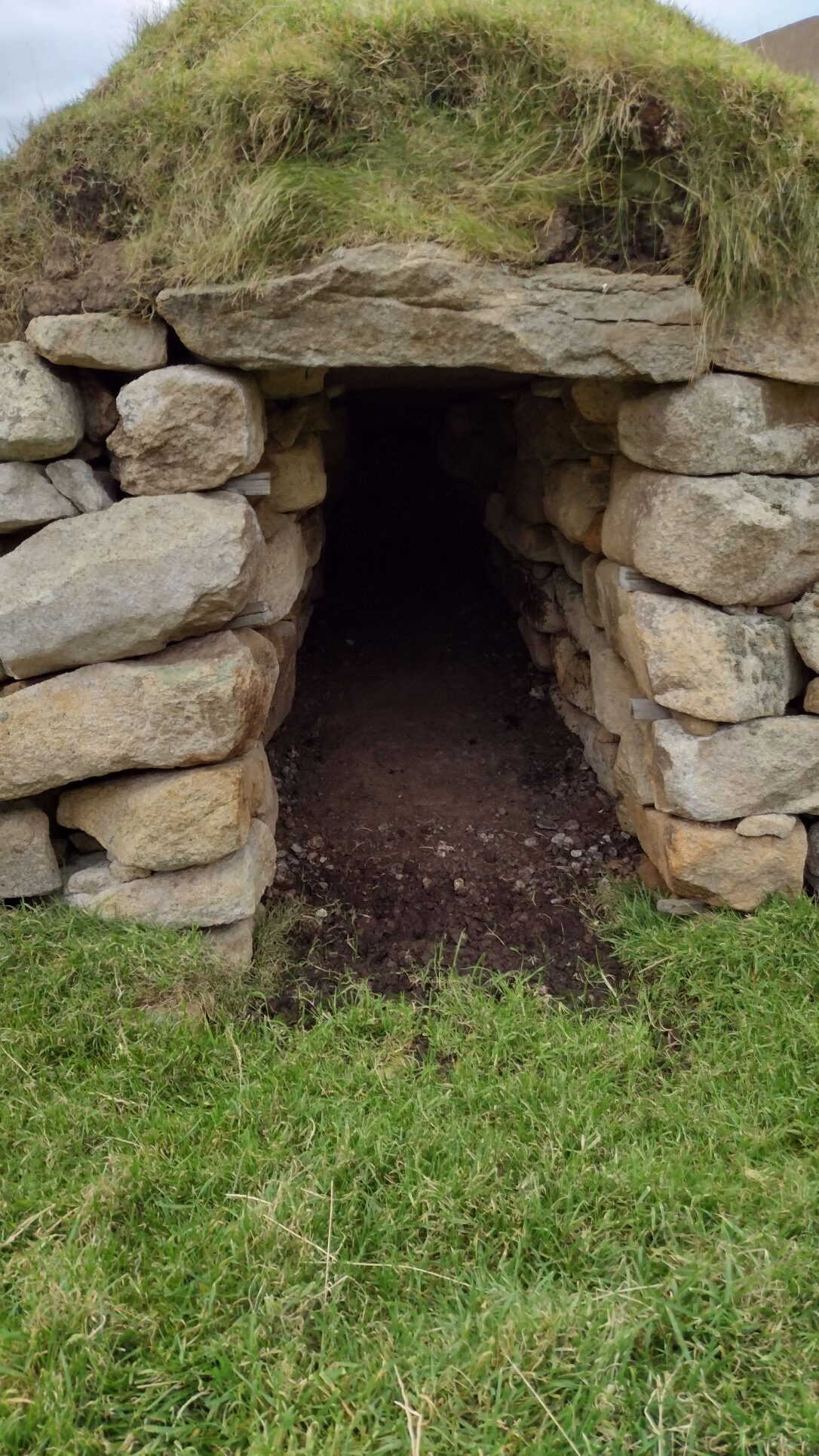
The grass roof kept the contents dry and the gaps in the stone walls let the cold wind blow through freely.
A number of cottages have been restored and some are now used by the guardians, or rangers, of the RSPB. One has been turned int o a museum and then there is the school and the church that is also open to the public. The main challenge is avoiding the sheep droppings which are everywhere as large flocks live on the lush grass on the lower slopes of the hills. The sheep are indigious here and are of a original kind that dates back to the iron age and even older. When going back to the tender, the crew had positioned cleaning buckets and brushes on the dock to make sure that whatever we had picked up was left behind.
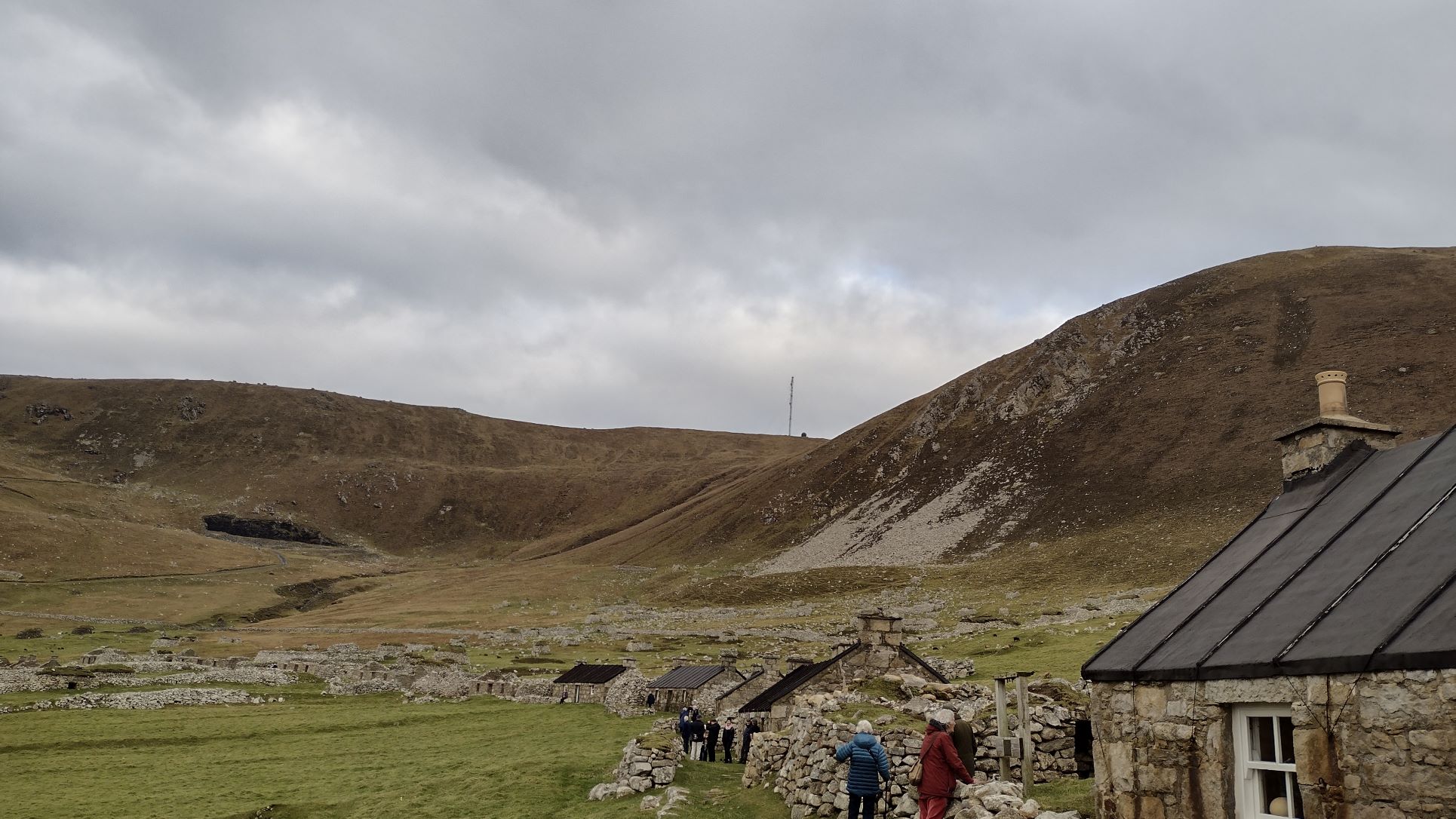
Some of the houses of the old islanders. One is now a Museum and 3 are used to house the RSPB rangers. On the top of the hill is the MOD military missile tracking system.
When descending again from the hillside, the senior hotel staff were waiting with champagne. I was impressed, bceause you do not expect that they would go through all the bother for just 40 odd passengers going ashore. But the champagne stand was there (Taitlinger = so real champagne, not sparkling wine or other cheap bubbles) So we had the opportunity to sip champagne close to the end of the world. It cannot get much better than that.
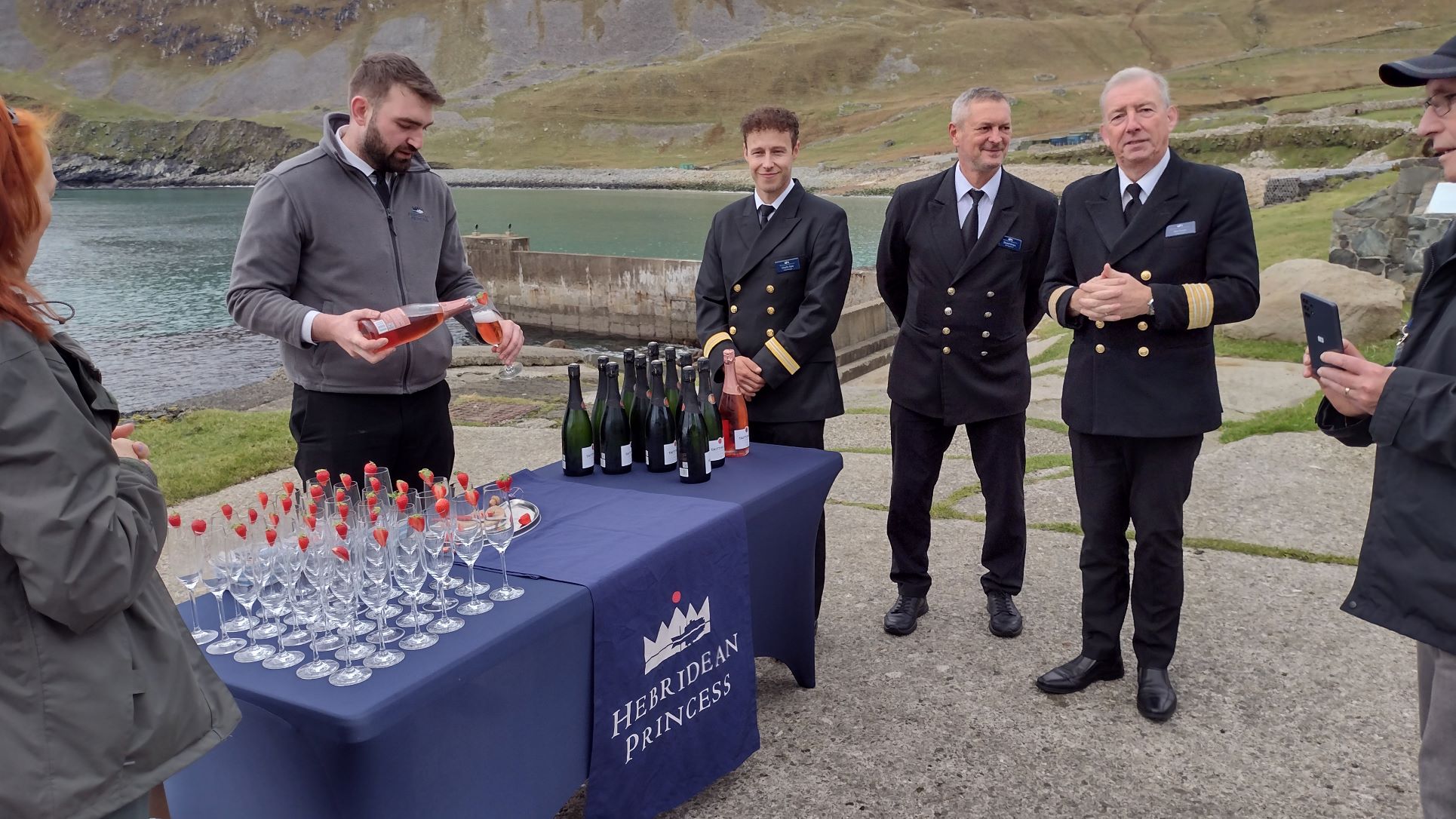
Champage at 11 am. at the top of Scotland. From left to right:Matt, the bar tender, Charlie, Hotelmanager, Daniel Grmys Beverage manager and Mr. Jim Fraser, Chief Purser. All out in force to serve 40 odd guests champgne. In good old english tradition, the Chief Purser is the head of the Hotel department and thus the focal point for the guests service.
By noon time we were back on board and after a quick change it was lunch time, which again was very good. Then it was time to go sightseeing and the captain sailed the ship passed “The Stacks”, which are tall rocks rising out of the ocean. As they rise straight up, you can sail very close to them to have a good view and the on board Naturalist was on the tannoy to advise what could be seen, which included dolphins and even humpback and Minke whales.
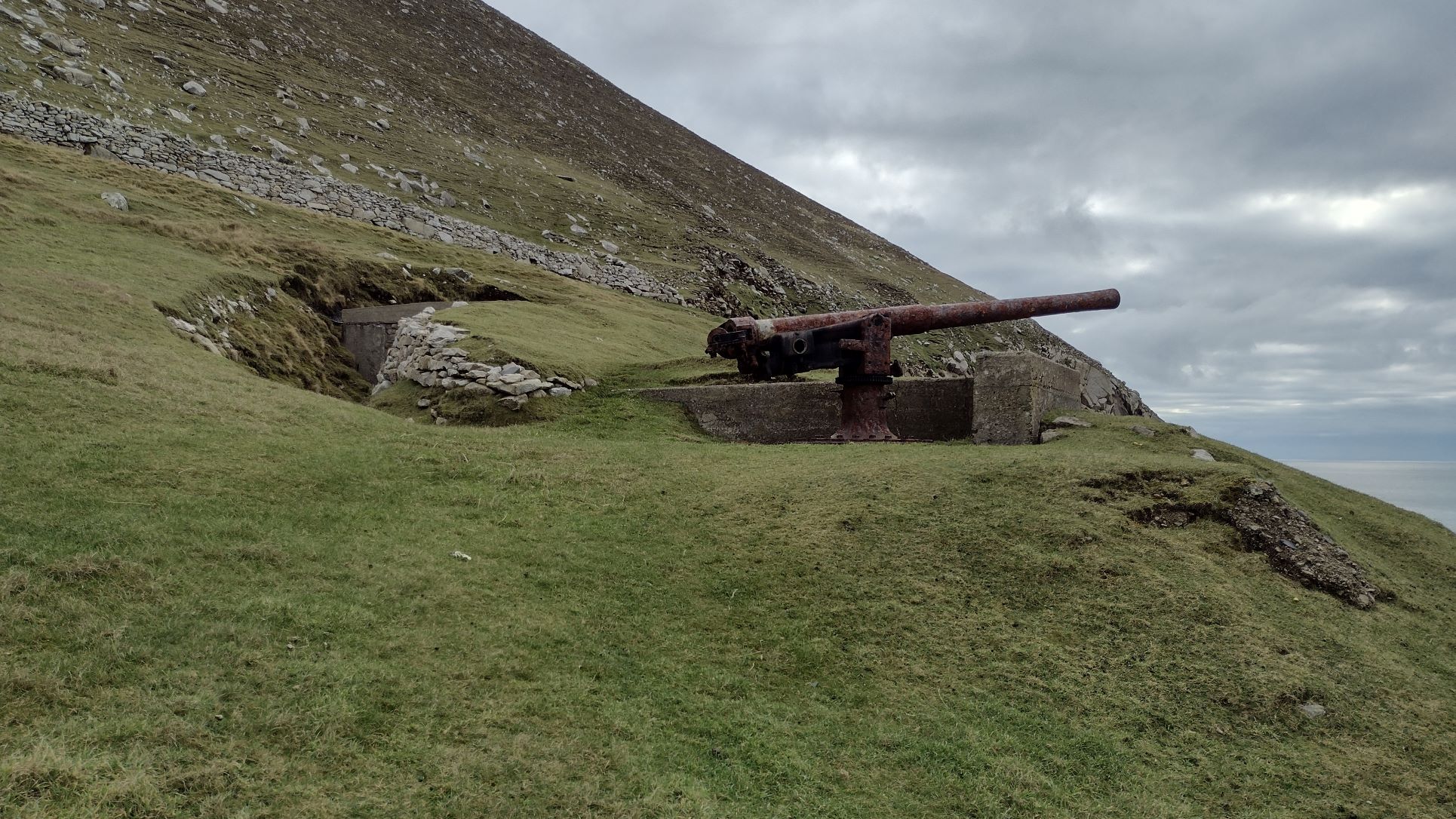
During World War II a German submarine was sighted in the bay and the army responded with installing a single & very lonely and exposed gun. I do not know if it made any difference but no more enemy was seen here for the remainder of the war.
This was formal night and I was very happy to see that everybody had dressed up and all gentlemen were all with bow tie. There is still some elegance left in the world. During pre dinner cocktails, the captain announced that he would be raising anchor around 0730 in the morning and then sail north towards Raasay, sightseeing along the way. There would be a tender stop in the afternoon.
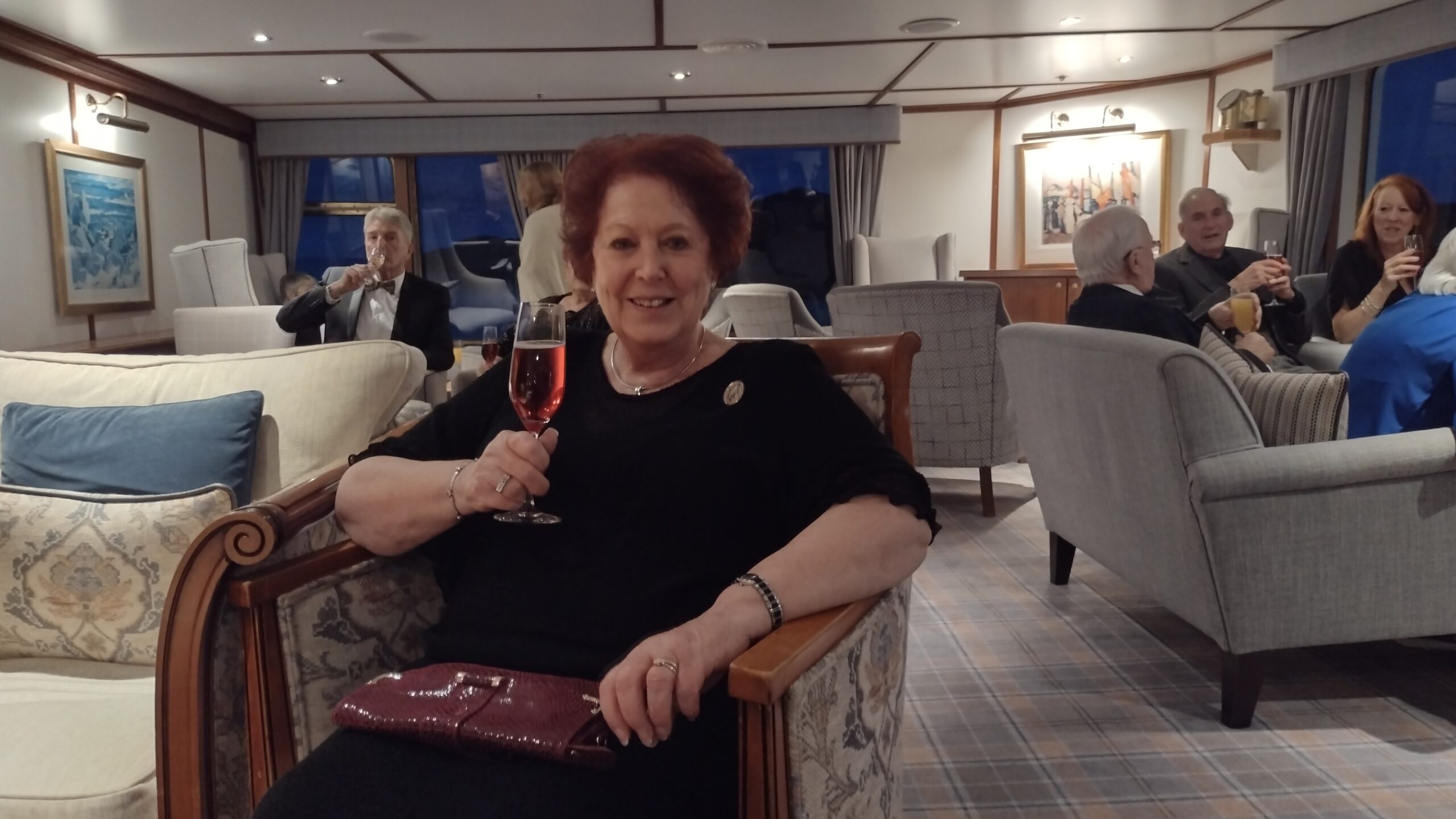
The early drinkers assembling in the day lounge, the rest soon to follow.
By 1930 dinner was served which happily lasted until 2100 hrs. With good food, good wine and good conversation. Most guests then returned to the main lounge for an after dinner drink. I had a good chat with the captain about the joys of being able to operate free of shore side office operation, and yes for him it worked. He was supported by his office, not interferred with. Then the conversation swerved to how to deal with local officials whendealing with red tape, and how to comply with the rules, while it not affecting the ships operation. I will not give any details here, but it seems that we both had applied the same sort of “creativity” during our careers to “get things done”.
Tomorrow morning we are at sea (sheltered waters between the islands of Isle of skye, Ronna and Raasay) and in the afternoon we have an option to go ashore. Weather for tomorrow: mainly overcast, little wind, smooth seas and temperatures around 12oC / 54oF. And that is very good for the North of Scotland in October.
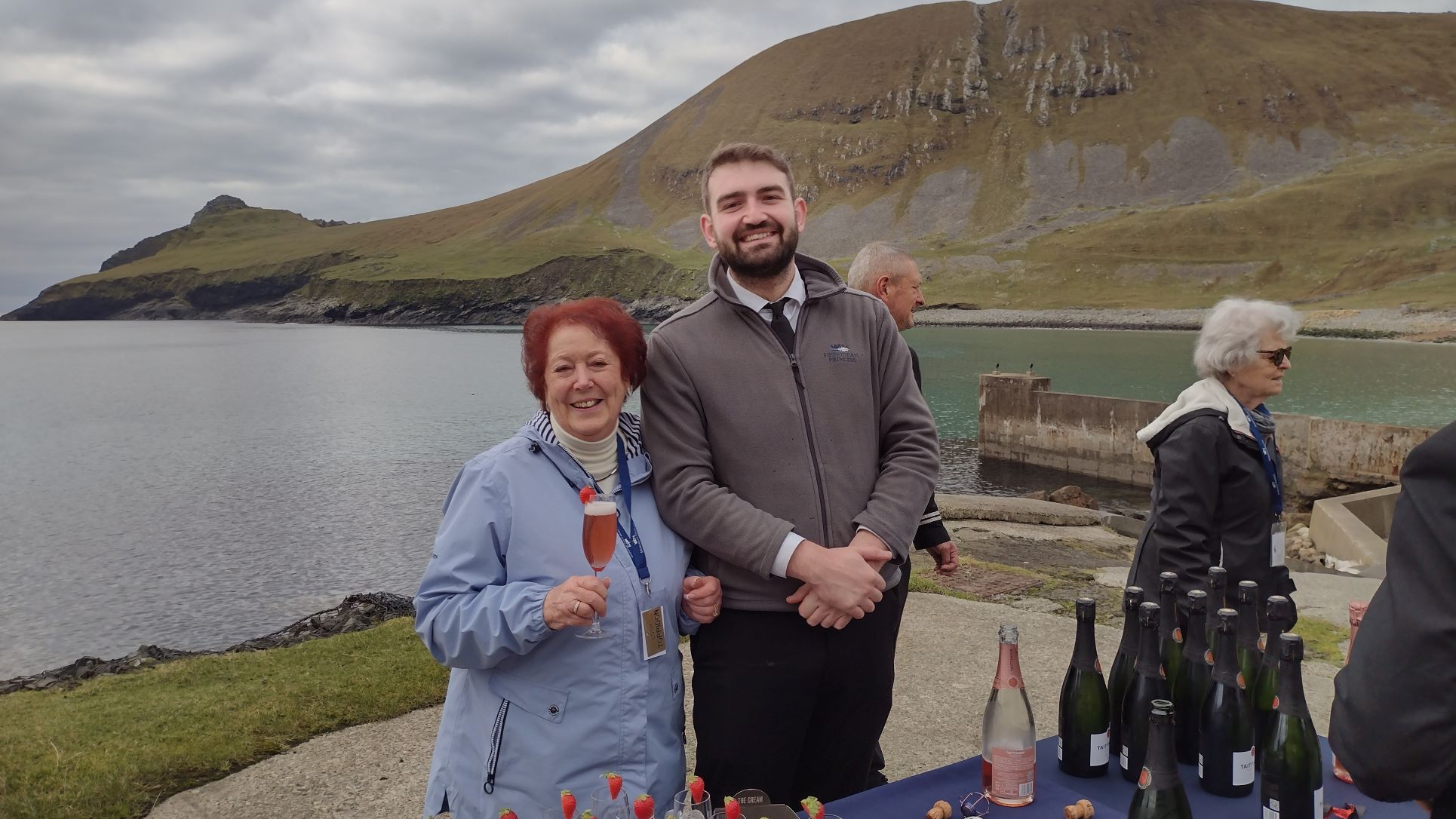
Somebody is living the good life.
October 17, 2025 at 4:10 am
It sounds like an excursion I would love to take. Quite unique
October 17, 2025 at 7:00 am
Really enjoyed this special post today about StKilda
October 17, 2025 at 9:48 am
Hello Captain Albert,
I am really enjoying “cruising along with you”. This truly seems like a very unique cruise experience.
Thank you for all the very informative details about the ship itself and Scotland.
Enjoy the rest of the cruise 🛳️🏴🍷.
Rosemarie
October 17, 2025 at 4:17 pm
Your conversation with e Captain reminded me of the old management adage “that it’s easier to obtain forgiveness than permission”. Enjoying your posts as always.