As scheduled we did arrive at 05.30 at the entrance to the Panama Canal, sailing past a large number of ships at anchor. They were either waiting for a passage time, waiting for bunkers, or waiting for orders of where to go next. Bulkcarriers and Tankers quite often sail for the spot market, e.g. going where there is cargo without having a regular long term contract. A few were just waiting until their head office had payed the transit bill. As a cruise ship we cannot afford to have to wait for that and the purser does make doubly sure that the money for the transit (about $ 249,000) has been submitted to the Panama Canal Authority. As soon as we were in the break water the whole circus started again with boat after boat coming to the ship. Agent, Boarding Officer for clearance, Canal Technician (he brings a GPS box for the pilot) First Pilot and Fumigation officer. In the meantime we moved slowly towards the first locks and while doing so the ship got cleared and two more pilots joined. One to relieve the first pilot half way through the canal and the 2nd one to be at the stern in the locks. From there he controls the last two locomotives and keeps the ship off the lock walls. As our lifeboats are overhanging we cannot see the side of the ship from the bridge wings and therefore we require a 3rd pilot. Just before the locks the Panama Canal Crew comes on board, 19 of them. 12 go forward as 4 locomotives are secured there and 7 go aft where only 2 locomotives are being made fast. That puts the whole show on the road and off we went for our southbound transit.
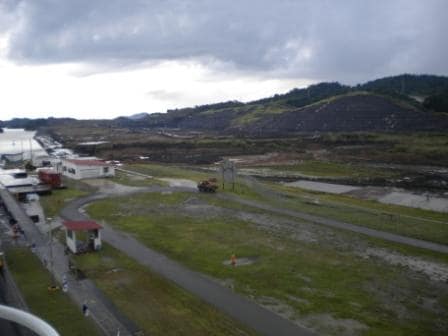
The new pacific side locks next to the old middle locks of Pedro Miguel.
The southbound transit is the best one to see the new locks being constructed as for some reason it is more open to the North. So, when you sail southbound you see the works coming towards you. Eventually it will be all the same but at the moment going south gives the better angle. We were blessed with wind still weather all the way through the canal except while going in the Pedro Miguel Locks when we had a real tropical down poor for about 15 minutes and a lot of accompanying wind, so I had a bit of a struggle keeping the ship alongside the centre wall, for the locomotives to make fast. Nowadays it is becoming more and more common for the captain of the ship to maneuver the ship in position and then let the pilot deal with the locomotives. I am quite happy for it as it can prevent a lot of paint scratches. Work on the new locks is progressing very fast and the whole area to starboard of the Pedro Miguel locks looked like a very large sand pit. The approaches have been flooded and work is now in full swing for where the locks are going to be.
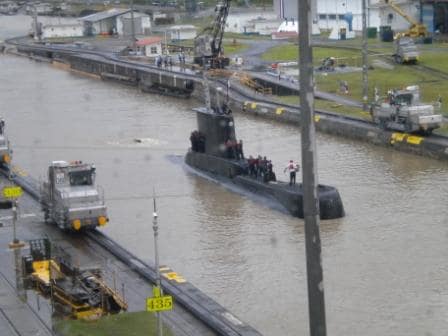
The Peruvian submarine Antofagasta in the Pedro Miguel Locks. Note the full conning tower and all the sub crew outside, keeping a safe distance from the Panama Canal bo’sun on the bow.
While everybody could look to the right and see the new locks in progress, they could also look to the left and see a submarine following us. She was going through the locks together with a red Russian gas tanker. This submarine was called the Antofagasta and belongs to the Peruvian navy. As you can see in the photo, even such a small submarine gets the full works in the canal. Two locomotives at each side and as there was not enough room on the deck for a complete canal crew, the Canal Operators had specified that two senior Canal bo’suns would handle the locks by themselves. I do not think that they were very happy campers, as the moment the heavens opened for a awhile there is no place to shelter on a submarine. I assume that the sub was on a good will tour of the area as it was a bit far from home for any naval action. Also it looked quite old to me, so too much naval action might not have been a good idea to start with. We had a long transit today as we had to kill time waiting for the Northbound Convoy to come through. There is still a lot of work going on in the Gaillard Cut and that means that there is only one way traffic there and thus no passing of ships before that convoy cleared Gamboa. So we went like a “slowboat to china” through the canal with 7 knots, and that meant that from sea buoy to sea buoy it took 12 hours this time. A lot longer than Northbound last time. By 1800 we were in open water again and for the night we will sail along the south coast of Panama and then Costa Rica. Tomorrow afternoon we will do some sightseeing in Golfo Dulce and I need dry weather for that. Keeping my fingers crossed.
November 18, 2011 at 5:27 am
Very interesting! We will be on the Rotterdam going southbound on Monday 28th November so will look out for everything you mentioned.
November 18, 2011 at 11:26 am
Volg regelmatig de berichten. Zeer boeiend voor mij. Hoop volgend jaar deze reis mee te maken.
Liefst vise versa
November 18, 2011 at 4:46 pm
Good morning, captain!
I have been wondering what the Fumigation officer does and (assuming we’re referring to pest fumigation), how is that handled with crew and passengers aboard.
Enjoying your blog. ( and I think it’s going to cost us fare for a Panama canal cruise ;-). )
Loralee
November 18, 2011 at 6:25 pm
Good morning,
It is something from the old days, when there was an inspection for rats, cockroaches and other vermin. The function still exists and he does comes onboard as part of the routine. Nice way of making a living I suppose. On cruise ships he/she does not have anything to do and thus it does not affect anybody.
thank you for reading my blog.
Capt. Albert
November 19, 2011 at 12:14 am
Hi Captain Albert,
This submarine was on it’s way to the east coast of the us. The US Navy uses Peruvian subs every year to give their crews a chance to train against Diesel Electric boats. The program is called DESI (Diesel Electric Submarine Initiative). It’s been in operation for about 7 years. The US hopes that this program will entice some European countries to send subs as well.
I really enjoy your blog. I was even reading it when we were aboard the Prinsendam for this years Med cruise.
Rod
November 20, 2011 at 7:06 am
Hi Capt;
A bit more info on BAP (Buque Armada Peruana/Peruvian Navy Ship) Antofagasta SS-32. She is a German-built Type 209/1200 submarine and was laid down in December 1977 at Howaldtswerke Deutsche Werft AG in Kiel. She was launched two years later and commisioned in May 1981. Her home port is Callao Naval Base, Peru. Her crew consists of 5 officers and 26 enlisted and her motto is “Nuestro orgullo es su vergüenza” or “Our pride is your shame”