From the Panama Canal exit at Cristobal to Cartagena Pilot station is almost one straight course with just a small knick north of the San Blas islands. As soon as you are 30 miles from the Panama Canal you do not see much traffic anymore as there are no significant ports in the area except Cartagena and although a busy port it does not generate that much Panama Canal bound traffic. Sometimes you come across a cruise ship on a similar run as we are doing but that is about as much excitement as you will get. The sea area here is called the Columbian Basin and is basically the extreme South West part of the Caribbean Sea. The moment you come away from the coast the depth increases dramatically, down to 4000 to 5000 feet, only to rise sharply again when nearing the Columbian Coast. Then, when it approaches Cartagena Bay it becomes extremely shallow. So much that it makes me wonder sometimes. The draft of the Statendam is not that much that it becomes a problem but it must hamper the ports capabilities with not being able to have the big container ships or big tankers coming in fully laden. Also the width of the entrance channel is not that great and again it must put a limit on what can go in and out of the port. Still, we knew that we fitted in with our draft and that was all that counted.
By 0700 we were at the pilot station and the pilot was there as well. It takes about 45 minutes to sail through the bay towards the docks. It has always been like this, the Boca Chica passage forms the only way in and out of a bay which is surrounded on three sides with docks, tankers berths and other commercial enterprises that rely on ships for its success. Due to several rivers ending in the bay, there is an enormous amount of silt coming in from inland and that all deposits itself in the bay. Last night while heading for Cartagena we had torrential rains and some exciting thunderstorms and this morning we could see the result of that rain. The whole East side of the bay was one muddy happening. It just looked like the Amazon but without the current. We were the only cruise ship in today and that meant that we were assigned Pier 2. Not because it is the cruise terminal, they do not have one, but because it has the most room for the buses and is the furtherest away from the main container stacking area. This location has traditionally been the location for the passenger ships even in the days when the old warehouses were still standing. They were just a bit further inland, in the area where the containers are now being stacked.
In those days when you were allowed to walk over the docks, it was the dock closest to the Main Gate of the port and from there tourists could arrange transport into the city. Now it is a good spot for the tour and shuttle buses to park and provide transport that way.
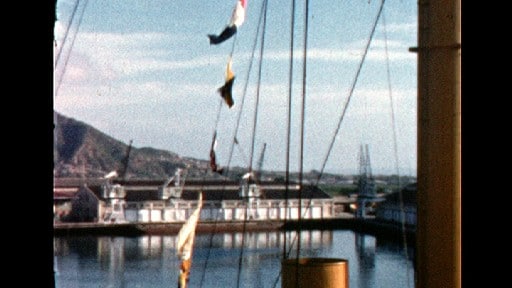
Cartagena docks as seen from the bridge of the Maasdam. A still taken from a color film shot by Captain Van Deventer during a Maasdam cruise. Courtesy: Ruud van Deventer, son. (Note, the memoires of him will eventually be added to the blog site as well)
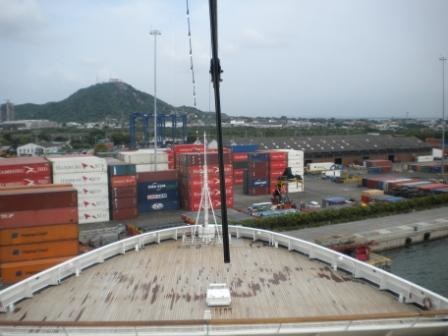
The view today. Where the old warehouses and docks were, the land was filled in and covered over to provide parking for the containers. New docks were built and are now used by cruise ships and container ships. Only the mountain is still there, unchanged.
Just after 8 we were docked and nearly all guests streamed off the gangway to start exploring. Those who stayed behind had the chance to observe on the portside the loading and unloading of the containerships which is very interesting if you have never seen it before. Not many people realize that 95% of all trade goes by sea one way or the other, and most of the items that you will find in your house and have not been made locally, will have been in a container one time, to get where it had to go. Without the sailors manning those ships, not much of the world trade would occur and that is something that the world does not always realize.
We left at 1500 hrs. Staying later would endanger a timely arrival in Fort Lauderdale where our cruise ends. No doubt a lot of guests would not mind to stay another day on board but I have to get the ship in on time, otherwise people might not make the flights. We have a group who does a back to back to San Diego and they will have the option to go ashore and explore Fort Lauderdale and surroundings. On departure we had again one of our tests for the Simulator in Holland as I wrote about before. This time spinning the ship around with thrusters only. For that purpose, two cadets were taking measurements every 15 seconds and hopefully the results will be of some use to the training centre so that they can optimize their computer models.
We will now spend two days at sea. Two days needed to cross the Caribbean Sea and to sail past the Bahamas’ heading for Fort Lauderdale. Tomorrow looks like very good weather, but the closer we come to Ft. Lauderdale the windier it is supposed to get.
Leave a Reply