No changes were received to the schedule that I was originally given and thus the good ship Statendam started to raise the anchor at 0300 in the morning. It was indeed a very muddy anchorage and it took us over 30 minutes to raise the 400 feet of chain and anchor that we had paid out. Normally we do that within 10 minutes. Then we slowly steamed to our designated 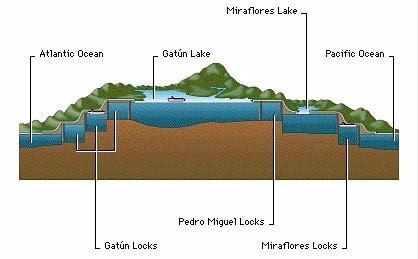
Panama overview. courtesy: unknown source on the internet.
waiting area which was in the middle of the normal Canal anchorage. A lot of cargo ships crews suddenly and un-expectedly had a fully lit up cruise ship steaming by. Always a nice thing to liven up your boring anchor watch. The pilot hopped on board shortly after and then it was time to locate the Panama Canal Clearing Agent to get the paperwork done that would allow us to enter the Canal. As was the same last time, he was stuck on another ship and thus we steamed slowly towards the Canal while awaiting him. He finally showed up on time and we just got the final stamp placed before the whole circus started with 2 more pilots coming and the Panama Canal crew for the first locks. In the meantime we sailed under the Bridge of the America’s in the dark but as the bridge and the whole port of Balboa next to it was lit up as a Christmas tree, it provided a very scenic panorama. With this early start we had the first locks just before sun rise and the next locks before it was getting real-Panama-hot. The sail through, through the lake, you can then see from the leisure of your chair. Either on the balcony or from a public room or the Lower Promenade deck where we have the steamer chairs.
Ahead of us we had a slow tanker, the Riga, and that did not make me very happy as I would have to adjust my speed to his. Luckily we had the most senior Panama Canal pilot on board and he simply decided to overtake the tanker while in the locks. E.G the tanker in the East locks went through slower than us in the West locks.
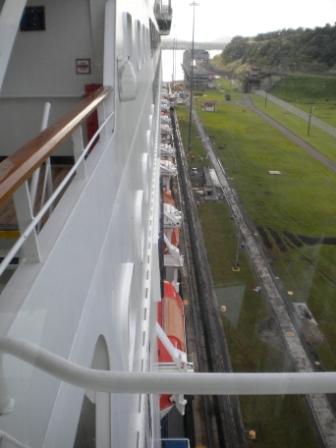
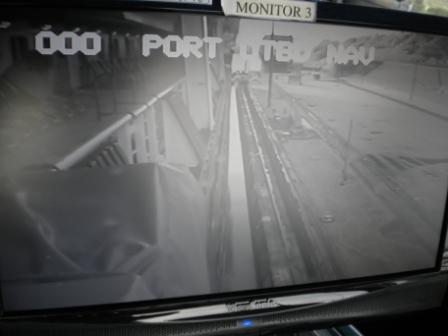
View from the bridge; visual view lining the lifeboats up steady over the lock wall, and peeping under the lifeboats by camera to ensure the 2 feet clearance from the lock wall.
That meant that as soon as we were clear of the 2nd set of locks we could go up to 8 knots for going through the Gaillard cut and then up to 13 knots for sailing through the Gatun lake. At the Atlantic side, the locks were ready for us and that meant no delay either, with the result that our transit time from first lock to last lock was exactly six hours and from Sea buoy to Sea buoy exactly 9 hours. You can only do it faster if all locks are waiting with the doors open and there is no traffic at all. So we did well, as it is not uncommon that you have to anchor in Gatun Lake to wait for the convoy to assemble and then you are as fast as the slowest cargo ship.
Today we were North 17 which means the 17th ship going through since midnight, Northbound. After we passed the tanker we only had two containerships ahead of us, and they are normally in an even bigger hurry than a cruise ship so I knew that they would not bother me and they didn’t. Another thing that can really slow you down is a “relay”. This means that you have to change locomotives in the locks. If too many locomotives are on one side of the locks, then the only way for them to get back to the other side is over the same track that is being used by the locomotives that are guiding a ship through. A ship will dock alongside the lock wall by means of its own mooring ropes; all the locomotives in use will cast off and the last three of the locomotives coming back from the far side will hook up to the ship. A standard procedure but it takes at least 30 minutes to accomplish. In the Pedro Miguel locks (Atlantic side locks) they have now made a centre rail with turn tables at each end, so locomotives can run to the far end of each lock site, the turntable lines them up the right way for the back run and when there, they are again lined up with the rails along the lock wall.
What can slow you down even more is if you have a real Panama Max Size ship ahead of you. Max. Length, Max. Width and Max., draft. (965 x 105 x 40 feet) Because there is then hardly any room for the water to flow in or out and it takes a very long time for such a ship to push through those locks. It gives a feeling as if a cork is plugging off the whole canal and you can’t do anything about it. That will become less of an issue when the new locks will be finished in 2014. Then much larger ships will be able to get through.
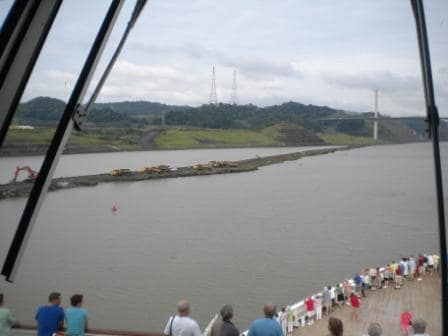
To the left; the approach to the new locks has been flooded for the first time. Things are really progressing and it seems that the project is six months ahead of schedule.
The locks (1400 x 180 x 60 feet) will have an operational size of 1200x 160 x 50 feet. The United States Navy will be able to get its Nimitz class aircraft carriers through (1092 x 124 feet) and the commercial world cruise ships such as the Queen Mary II which is roughly the same size. It will certainly have an impact on the cruise industry as it will make it possible to let the very large cruise ships become part of the bi-yearly track to and from Alaska.
We were in open sea by 1400 hrs. and on our way to Cartagena. That means that I will adjust my ETA to Cartagena and arrive an hour earlier there. We are scheduled for 0900, but I will arrive on 0800. It helps with my fuel (same engine configuration at sea anyway, but longer on one engine in port instead of three) , it helps with the tours and it helps the guests with a bit more time in port as our departure is scheduled for 3 pm in the afternoon to ensure a timely arrival in Fort Lauderdale.
Cost of our transit today, all the levied fees & costs together:…….just under $ 250,000. That is 200 dollar per bed. ( $249,000 ./. 1244 lower beds)
November 8, 2011 at 11:30 pm
As always, fascinating reading, thank you Captain!
$250,000 sounds like a lot of money, especially for a cargo ship where every penny counts (and I bet they pay more than $250k), but given the alternative route via Cape Horn, with a Panamax cargo ship burning 6+ tons bunker per hour at $700 per ton then I can see why Panama charge what they do….!
Can you let us know what the Statendam uses en-route? I know Zuiderdam and her Vista sisters burn very roughly 8 tons per day at 20 knots…
Cheers!
Mik