- Captain Albert's Website and Blog -

Ocean Liner History and Stories from the Sea, Past and Present. With an In Depth focus on Holland America Line

Page 76 of 241

11 Aug.2016; Bergen, Norway.

We left Geiranger just before 10 pm. last night and then had to sail 4 hours back to open waters. Contrary to the Inside Passage of Canada and Alaska you cannot sail from one fjord to another through an Inside Passage. You have to go back to open waters and then sail up or down the coast to enter the next one. Some fjords are interconnected, or branch off, or merge and some are singular cracks in the mountain stone and have no side branches at all. Some are very deep fjords such as the Hardanger Fjord, the Oslofjord and the Geiranger Fjord and some are very short or are really water ways around small islands or bare mountains tops.

Bergen is located very close to the sea, located behind a large number of small islands and coastal strips of rock which offer easy access, and at the same time a great protection against bad weather. This is one of the reasons Bergen is so popular with the Oil-Offshore. Plenty of safe anchorages in shallow and deep water and with the sound infrastructure of the town Bergen very close by. Being so close to open sea we could we pick up the pilot at 10 am. and started to dock by 11.30 and ready for our scheduled operation by noon time.

Today the sun was shining in Bergen and the temperatures reached 15 to 16oC or 61oF in the shade. Out in the sun it was a few degrees more. Still we had to re-arrange visiting this port as two days ago it was mayhem here. Although the port is well protected from a too great an onslaught by bad weather, winds of 50+ knots can get in even if the waves are held back. So does the rain and Bergen had to cope with 8 cm (4 inches) of rain while the storm system moved over. Even for an area where it can rain heavy at times that is a lot. And thus we had to stay away until things cleared up.
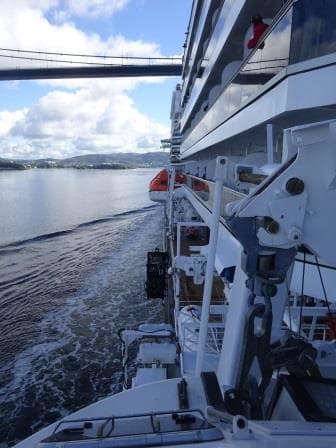
The bridge from a very unusual perspective. This photo was taken from a tender, which hangs partially outside the ship.

The bridge from a very unusual perspective. This photo was taken from a tender, which hangs partially outside the ship.

Although to get to Bergen is not a long way and the waters are deep, there is one obstacle which makes every captain grab for his calculator. They built a bridge over the main access route to Bergen harbor.  Whatever size ship you have, the first thought is always do I fit under? And do I still fit under if the tide is high?. Many a Ship’s captain ended up with a lot of paperwork because there was an inch too many in height and it did not fit. We know we can sail under the Askoy Bridge and we always check. The tidal difference in Bergen is not that great but still……………………  The top of the funnel of the Koningsdam cleared the underside of the bridge by 6 meters to day. The bridge itself has a 62 meters clearance above chart datum and then often you have to take a little bit off for the water height. Today we had only 2 feet in tidal difference (60 cm.) and thus we had nothing to worry about.

Today Bergen showed itself from it’s best side and pleased a lot of cruise guests. Apart from us the Amadea (the old Royal Princess of 1984) now sailing for a German charter company and the Horizon (from 1991 and used to be owned by Celebrity) but sails now for Croisieres de France were in too. The rest of the port was given over to local cargo ships and a large number of offshore vessels waiting for assignments.
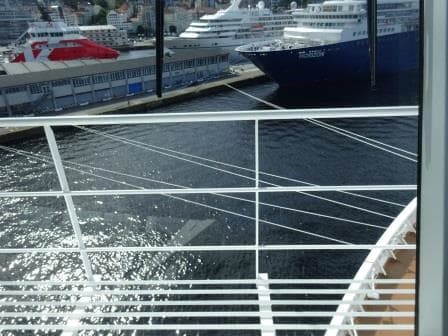
The two other cruise ships. Please note the length of the bow lines running ashore. In perspective the Blue Horizon is about 85 feet wide.

The two other cruise ships. Please note the length of the bow lines running ashore. In perspective the Blue Horizon is about 85 feet wide.

We docked today at Bontelabo which was constructed as a fisherman’s dock and hence way too short for cruise ships. Even our small Prinsendam sticks out, let alone the length of the Koningsdam. Still the dock is long enough to be able to have two gangways out even if the ropes have to run very, very long. We will have something similar in Eidfjord where we are tomorrow.

We are staying in Bergen until 8 pm. and then sail back to open waters again, turn south and then enter Hardanger fjorden of which the Eidfjorden is a part at 2 am, to get to the dock by 8 am. in the morning. The weather tomorrow might take a dip, as rain is expected and with it comes a low temperature of 8oC or 47oF.
 

10 Aug.2016; Geiranger, Norway.

Well, the winds died down and so did the waves but much later than forecast and not after showing us that the “venom is in the tail”. I do not know if that translates exactly the right way into the English, it might be “sting is in the tail”, but you will get the meaning. In the cause of the afternoon the waves deepened out and reached 10 to 12 meters (30 to 36 feet) at times and the wind peaked at 56 knots. That is serious stuff and although the Koningsdam is turning out to be a very good ship in bad seas, you have to be respectful of such ferocious weather and treat that weather gently. Otherwise there will be damage to the ship and much worse damage to its occupants.

Then, late in the evening, the winds eased off and the waves started to die down, but it had affected the schedule again. First the storm had caused us to stay longer in Amsterdam and to re-arrange the cruise and now we could not keep the schedule once again. It was still possible to keep the noon arrival time at Geiranger but only if the service stop at Hellesylt was cancelled. And then as captain the need to make a very difficult decision: Will you deprive 300 guests of their tour or will you let the other 2300 guests arrive at least an hour late at Geiranger? And of those 2300 more than 800 were going on tours which might have been put in uncertainty as well.

As unpleasant as it is, if safety is not the overriding concern, then the need of the majority prevails and quite rightly the Captain opted for bypassing Hellesylt. Those who were now without a tour received their money back and/or were offered the option of another tour.

By the time we left the open sea it had completely come to rest and nice weather prevailed once again. Even the rain only brought out a few drops instead of the big showers which were forecastd.  We picked up the pilot at 0800 hrs. and then sailed into the fjord and managed to be at the anchorage location at 11.30 and had our tender service going by noon time. As scheduled and as planned, although it had taken some suffering to do it.

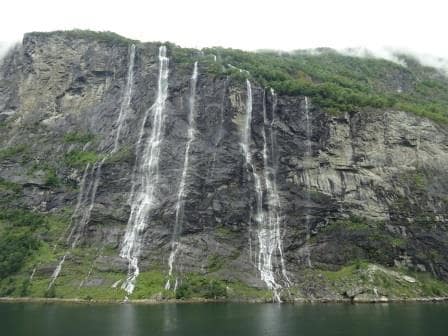
The Seven Sisters. Water coming down several hundred feet straight into the fjord.

The Seven Sisters. Water coming down several hundred feet straight into the fjord.

It is acclaimed that the cruise into Geiranger offers some of the best scenery in the whole world, including looking at some of the highest waterfalls as well. These are called the Seven Sisters, for obvious reasons, and we sailed by them just after 11 am., shortly before coming to the port, and of course when you think you have everything under control, there is always something else. In the fjords, you try to sail in the middle and when there is opposing traffic both ships will go a bit to starboard and make room for each other to provide a safe passage.

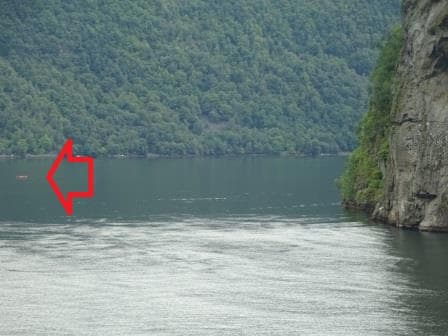
Why do they always have to sit in a location where the big ships HAVE to go ?

Why do they always have to sit in a location where the big ships HAVE to go ?

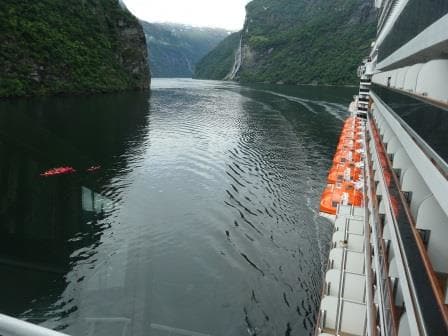
What did we find in the middle, right in our way?  A group of canoe’s admiring the scenery without a care in the world. So we honked the horn but it took several blasts before they got the hint that we did it to alert them. They moved a few tentative strokes and then sat happily waving to all the guests on deck.  I do not think they even realized in what sort danger you can be in when you come close to a huge ship with a strong wake. This was some sort of sightseeing/ paddle tour and the tour leader should have known better. Hopefully the Pilot was later able to contact the canoe company and raise some hell with them. So the Koningsdam had to slow down to what was safely possible and had to make a wider turn than would normally have been proper seamanship. From previous blogs you might remember that we call these people “six pack navigators” but I do not think that this applies in Norway with alcohol being so expensive here. Some other salty words come to mind.

And so the big ship curved around them ensuring we made no wake.

And so the big ship curved around them ensuring we made no wake.

The main anchorage at Geiranger had been damaged last year (where you drop the anchor and tie up the stern to the shore) and thus the ship had to stay further out and drift on the engines. From there we run a full tender service with all the six ships tenders. Tonight we will sail at 10 pm. and then arrive tomorrow at noon time in Bergen.

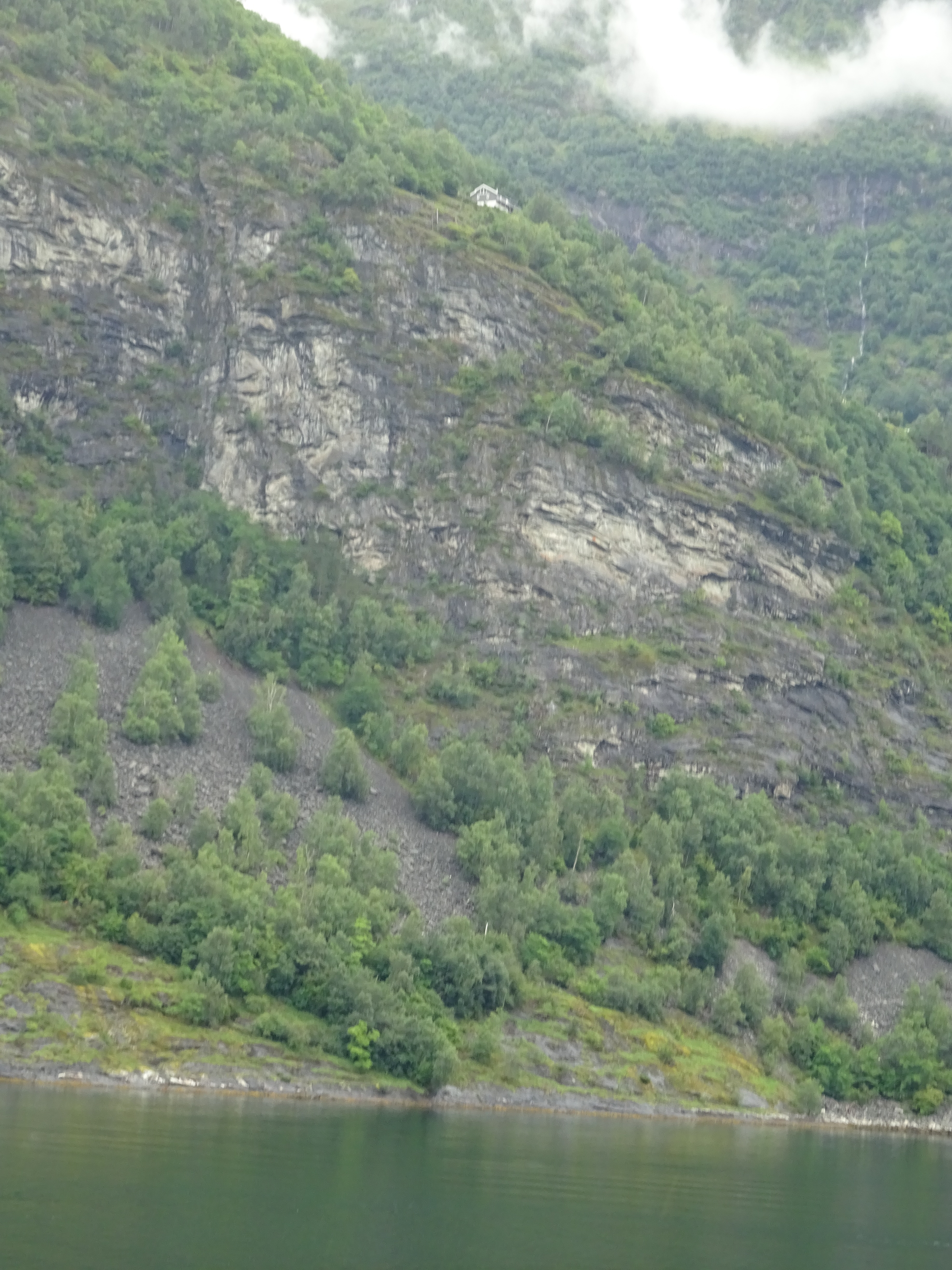
For me the most fascinating house in Geiranger Fjord. All by itself. Perched on the top of the mountain. I do not envy the newspaper boy who has to go there every morning on his bike.

For me the most fascinating house in Geiranger Fjord. All by itself. Perched on the top of the mountain. I do not envy the newspaper boy who has to go there every morning on his bike.

You will read this a day later than normal, as the mountains sides of Geiranger Fjord are so high that there is no internet communication at all, until you are at the entrance again.

09 Aug. 2016; North & Norwegian Sea.

I always love it when the weather follows the weather forecast. Then at least what you have planned for happens and you can deal with it. Not that I mind it if the forecast says there will be storm and there isn’t one, that seldom happens, but if it has to be stormy then it is nice if you can go and plan and prepare along with what the forecast says. Thus today we were fully in synch with the weather gods. We did have a windy night last night but the ship rode the short jagged swell of the North Sea very well.

The North Sea causes a ships movement which is totally different from any other sea I have sailed on. The North Sea is shallow (often not deeper than 150 feet), has a lot of current or better said currents as the flow comes from various directions, and when the wind blows it cannot really build up any deep and long waves.  This results in a short and abrupt swell pattern which can give a very unpleasant motion. Here helps the length of the Koningsdam with over 300 meters  it sits on the crest of several waves at the same time and thus there is hardly any rolling or pitching motion. Just a sort of jittery movement which goes through the ship when the hull adjusts to the constant onslaught of the multiple waves crests.

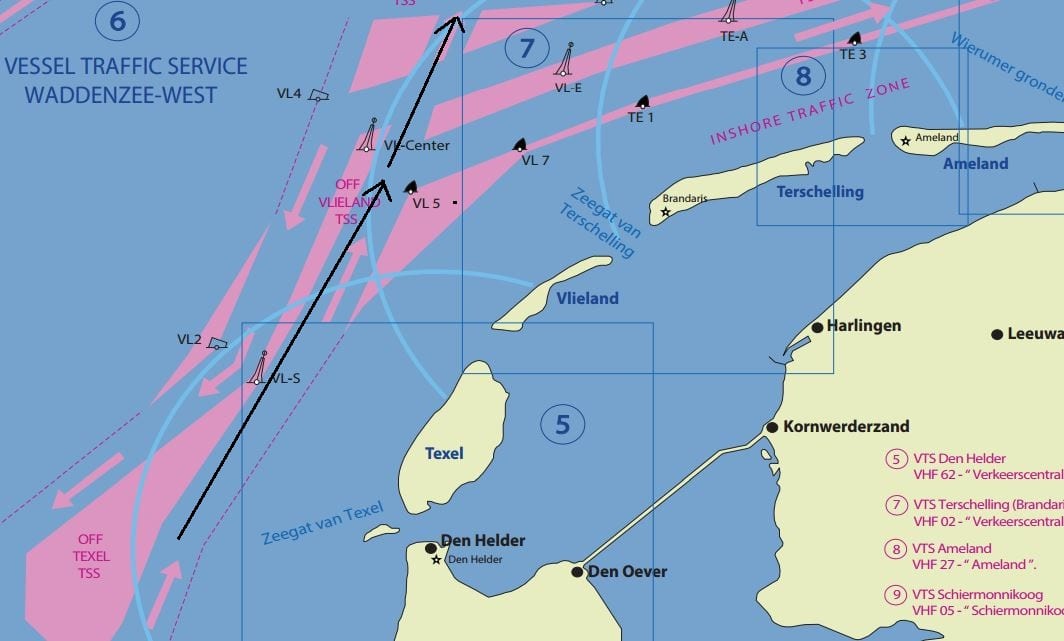
Cutting through the Stream of traffic while above the Dutch Island of Tessel.

Cutting through the Stream of traffic while above the Dutch Island of Tessel.

While sailing along the coast we followed the various Vessel Traffic Separation Schemes. A lot of through traffic comes from the English Channel in the south, more traffic comes from Rotterdam and Amsterdam (like us) and there is traffic coming from Scandinavia and North of Scotland on its way to the German ports such as Hamburg and Bremen. This all meets north of the Frisian Islands and to keep things a little bit under control we have Highways at Sea here, including an exclusion zone in the middle to keep the opposite flows apart. It is always fun for cruise ship navigators to race through here and pass all the other ships as if standing still. There is always a crucial moment when you leave the system or “change streets” while wriggling your way through the other ships that are staying on the “same road”.

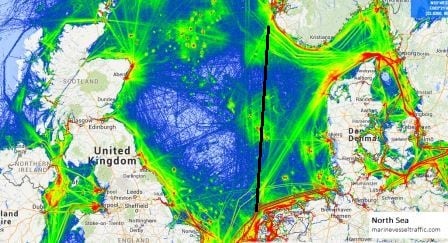
There is a lot of traffic in the North Sea. The green spot in the middle is caused by Offshore vessels servicing the oil rigs. (Courtesy www.Marinetraffic.com)

There is a lot of traffic in the North Sea. The green spot in the middle is caused by Offshore vessels servicing the oil rigs. (Courtesy www.Marinetraffic.com)

The ships movement changed more and more when we came into open waters and deeper, further away from the Dutch coast. As was expected that movement changed even more when the ship “fell” off the North Sea shelf and came in water of 60 meters and over. Now the waves could expand downwards and stretch out and the Koningsdam started to pitch as now it rode two waves at the same time instead of being carried by a multitude of small ones. Thus for a short while we got the ke-deng of the bow slamming into the waves, the famous pitching movement. The stabilizers were quite good in taking care of the sideways or rolling movement. But the pitching remained.

As explained yesterday, this was expected and thus in the early afternoon the ship reduced speed to get rid of that movement. When reducing speed you give the hull more chance to ride up and down the waves instead of being propelled so fast forward that a head on collision – pitch – is the only option.  That did not mean that the ship was now suddenly quiet but it reduced the motion to what I call “bearable”. Again whether the guests agree with me remains to be seen but then they do not sail every day of their lives. Still there many of them were up and about; although maybe less than normal as breakfast this morning was a quiet affair.

lkllkk

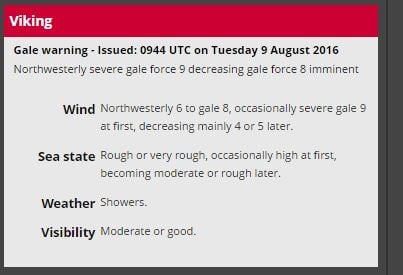
Still bad at 09.44 English time this morning, but decreasing later. So things are looking up again.

Based on the weather forecast remaining correct, the waves should start to reduce from the highest of 7 meters to gradually about 3 or 4 meters.  So slowly but steadily the ships movement should be getting less as well.

At 2 pm we made it to the Norwegian coast and will now sail along until we come to the pilot station of Brysse around 06.00 tomorrow morning.  Once the pilot is on board, we will sail to Hellesylt for disembarking the tour. As there is no other ship docked, we can go alongside there briefly, march the 300+ guests ashore and then sail on to the end of the Geirangerfjord for the remainder of the call. We are expected there at noon time. The ship will drift there and we will run a regular tender service for the remainder of the day.

Behind a good storm there is normally a good amount of rain clouds filled with rain and we will get those tomorrow. And thus the weather forecast calls for a rainy day will chilly temperatures of around 41oF / 5oC with a bit of a breeze. But for more guests anything will be better than yet another wobbly day and the ship sells rain poncho’s on the gangway so what can go wrong?

08 Aug. 2016; Amsterdam day 2, the Netherlands.

An un-expected day 2 in Amsterdam and everybody was making the best of it. A lot of guests grabbed the chance to do a few tours which they otherwise might have never had the chance to do and some just walked into town. And quite a few just sat on the ship and watched the world go by. Which is in Amsterdam on the IJ (pronounced Heya without the H and the a) a lot of work as the water way if full of all sorts of traffic. Varying from the river Rhine barges, small & large, Cargo & passenger, sightseeing boats; to contraptions which should never have left the back garden.

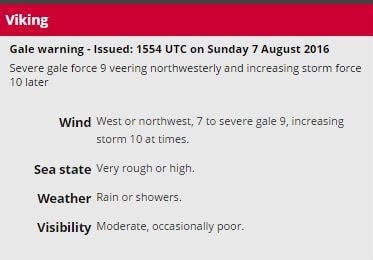
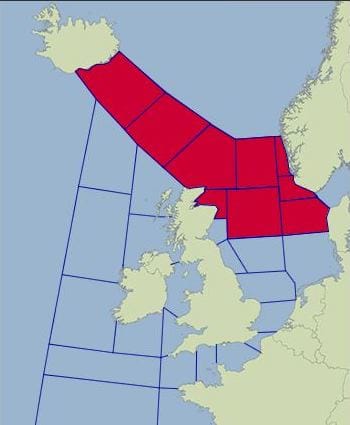
Weather Forecast for the area off the Norwegian coast. This section is called Viking by the shipping forecast. (Courtesy the Shipping Forecast)

Weather Forecast for the area off the Norwegian coast. This section is called Viking by the shipping forecast. (Courtesy the Shipping Forecast)

Although these are all benefits that came with a 2nd day in port it was not the plan of course. But things were not looking good up the Norwegian coast and thus the Captain had to take action. This time it was not only the worry about getting in also what would happen while going there and when arriving there and then not getting in. It is not a good idea just bounce around with a ship in wind force 10, (In the waves that these near hurricane winds generate) if this can be prevented.

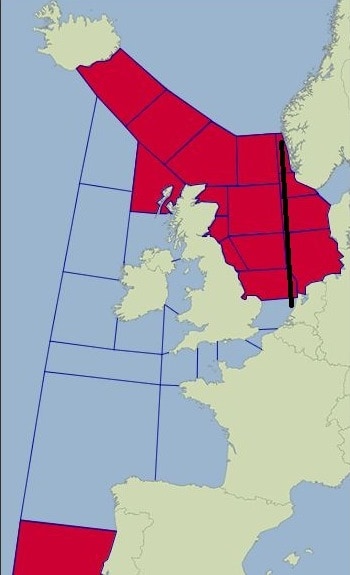
Viking is the section at the top of our Black course line. Red can vary from not good to very bad. (Courtesy the Shipping Forecast)

Viking is the section at the top of our black course line. The red color indicates a variation from not good to very bad. (Courtesy the Shipping Forecast)

So the Captains logic was: If I sail on time (yesterday) then I would have arrived off the entrance to the Fjord to Bergen while knowing I would not get in due to wind and the waves and then have the ship bounce around with nowhere to go. Although you cannot fully predict what the weather is going to do, the 3 day forecasts are in general very reliable.

The challenges in this case were two fold. The bad weather up north in the Norwegian Sea and the very windy weather on the North Sea outside Ijmuiden.  Amsterdam might have the better cruise port compared to Rotterdam (although nobody in Rotterdam would agree with that statement) but to get to Amsterdam you have to go through the locks at IJmuiden. The ship fits in, but with not much room to spare. Cruise ships are happy drifters due to their bulky superstructure and cruise ships with balcony’s drift even more as the wind can really push into the balcony holes and the balcony side partitions help considerably to keep the wind there instead of it being bounced off and dispersed.


At sea blowing away is not a big deal and the faster you go the less you drift from your course line.

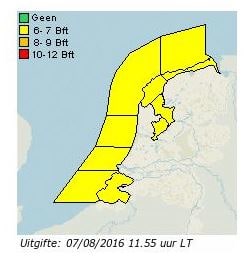
The Dutch shipping forecast uses yellow while the British us Red. This is the Dutch way of Not Good yesterday. (Courtesy KNMI scheepvaart weer bericht)

The Dutch shipping forecast uses yellow while the British uses Red. This is the Dutch way of “Not Good” yesterday. (Courtesy KNMI scheepvaart weer bericht)

But we have to go through those locks and that goes at a very slow speed. The Koningsdam towers very high above the dock height and 30 knots of wind on the side makes it very tricky – too tricky – to maneuver into the small opening. Two good reasons to rethink the battle plan.

As soon as a plan has been made, it is checked with our head office and after the green light is given, the changes are made. In this case the decision was made to drop Aalesund from the schedule with the view of providing the guests still with the best experience possible under the given circumstances.


Today the wind was as strong as yesterday but had shifted more to the west. Thus the wind would be on the bow while entering the locks and then there is no drift and thus not much of a problem.

Once out of the locks, the pedal was put to the metal to gain as much time and speed to maintain until we come to the storm area where the waves are getting higher. Then by slowing down the ship, the most comfortable speed can be offered while still keeping the schedule for the call at Hellesylt / Geirangerfjord. Now it is a matter of keeping our fingers crossed that the weather is going to follow the weather forecast.

Tonight it will be windy but the North Sea should not give much of a discomfort (Apologies to all those guests who might think otherwise……….) but sometime tomorrow afternoon we are entering the wave field on the border of the North Sea and the Norwegian Sea and then things will change. Hence the slowing down to ensure the change in movement will be as little as possible. By that time the storm should also start to abate and eventually the high waves as well.

Weather forecast for tonight in open sea. not so bad. (Courtesy The Shipping Forecast)

Weather forecast for tonight in open sea. Not so bad. (Courtesy The Shipping Forecast)

Weather forecast for tomorrow: Sunny, Windy and temperatures around 59oF / 15oC.

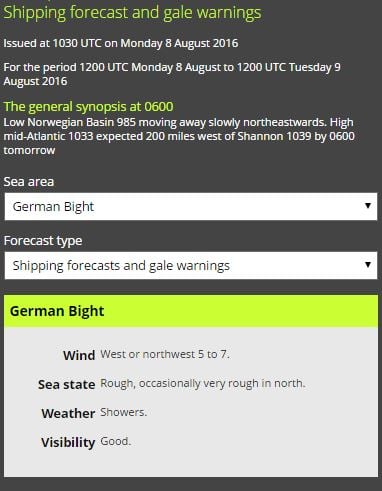
Shipping Forecast:  The red is gone from the German Bight section.

The red is disapearing. Today from the German shores, tomorrow it should be gone from Norway as well. Leaving on the swell to contend with. (Courtesy: The Shipping Forecast.)

The red is disappearing. Today from the German shores, tomorrow it should be gone from Norway as well. Leaving only the swell to contend with. (Courtesy: The Shipping Forecast.)

07 Aug. 2016: Rotterdam/Amsterdam, The Netherlands.

While the ms Rotterdam started their 2nd day in Rotterdam, I left the ship at 08.00 and took the train to Amsterdam. The Netherlands has the densest railway network in the world (not so difficult when you are a small country) and also runs a large number of trains on Sundays.

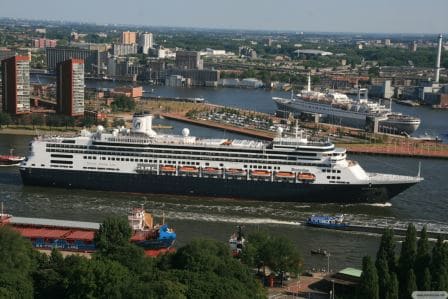
The ms Rotterdam passing the ss Rotterdam in Rotterdam in 2011

The ms Rotterdam passing the ss Rotterdam in Rotterdam in 2011

There is even the option of a fast train, which is called the Inter city, and only stops at Schiphol Airport and there is the stop and start train which stops (nearly) at every train station along the route. That costs Euro 2.40 more but it saves up to half of the journey time.  Although I was not in a particular hurry, I decided to go for the fast one as I was not going to make an in depth study about trains in Holland and certainly not about how the Dutch got on and off of them. (Preferably while arguing over the whose bike should go on and off, as Dutch trains are bike friendly)

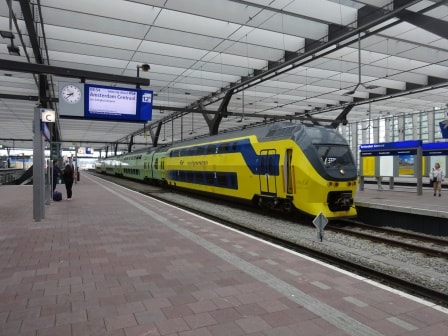
The Green train coming in. This one was on the way of the longest journey you can do by train in the Netherlands Maastricht (far south) to Groningen (for north) without changing trains.

The Green train coming in. With the middle section painted green. This one was making the longest journey you can do by train in the Netherlands: Maastricht (far south) to Groningen (far north), without changing trains.

While at Rotterdam Centraal Station I came across a new phenomenon, The Green Train. I had never heard of it but it turns out that the plan is to have all Dutch trains run on wind generated electricity by 2018. Now they have only a few and they are painted green. I do not see how they can run one specific train on green and the rest on the same overhead power supply on normal so I assume that it is just an indication that this green symbolizes the percentage of the Wind energy which is fed to the rail grid.

????????????????????????In 45 minutes I arrived at Amsterdam Centraal Station. I wanted to be early as this weekend there is the Gay Parade in Amsterdam; yesterday they had canal parade, when you can see pink things afloat that would normally sink, and today was the 2nd day with street party’s and other Dutch Mayhem planned. Everybody on the ms Rotterdam had been warned to allow extra time if travelling there as it was expected to be busy. But I suppose party people do not get out of bed at 10 am and it was nice and quiet around the station. I decided to walk with my suitcase as it is only about a mile to the Cruise Terminal. I was not the only one as I had to wade against the tide. A lot of disembarking guests (mostly Dutch and Italian) had decided to do the same and walk to the station for transport. Maybe that is why we do not have suitcases anymore without wheels. It saves on taxi costs!!!!

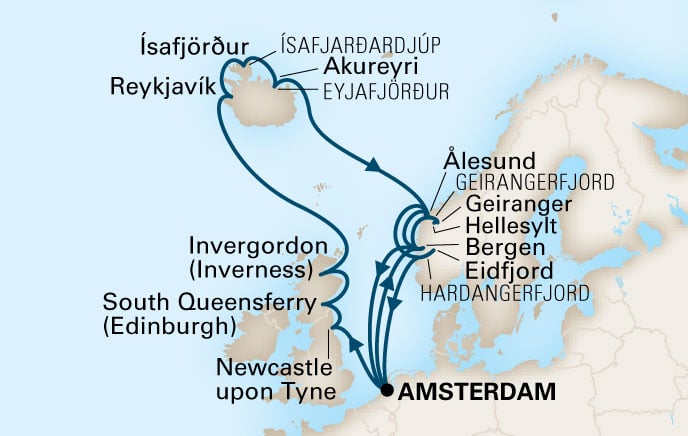
So by 10.30 I was on board as I had never been away. Now a nearly 4 week period will start on the ms Koningsdam. We will first do a 7 day cruise to Norway, then a 14 day cruise to Scotland, Iceland and Norway, and then there is another Norway cruise, which I will leave in the middle. You can book this cruise as a one week, or a three week, by adding a one week to the 14 day cruise.

Norse Legends and Northern Isles.

Norse Legends and Northern Isles.

Whatever we plan for cruises, it always had one thing that you cannot plan for and that is the weather. There is a very strong storm going over the Netherlands today and this means that the Koningsdam cannot sail safely through the North Sea Canal (see my yesterday’s blog) and go through the locks. And thus the ship will stay overnight in Amsterdam and will sail tomorrow afternoon at 14.00 hrs. This means the original schedule cannot be kept and thus the port of Alesund has been cancelled and we only call at Geirangerfjord, Eidfjord and Bergen.

Captain in command of the Koningsdam is Capt. Darrin Bowland who is from Canadian descent and who joined us a number of years ago from Royal Caribbean. He is on the final part of his contract and by next time Amsterdam he will be relieved by Captain Emiel de Vries who will be returning from leave.

So the good ship Koningsdam will stay in Amsterdam overnight.  I do not know if the guests are going to be happy but the crew certainly will as downtown is only a 15 minutes walkaway and we all expect the City to be heaving tonight.

06 Aug. 2016, Rotterdam, The Netherlands. First day.

We are back on traditional ground as from 1873 to 1973 Holland America ships were in and out of this port on a daily basis. Not always in the most easy way as in the early years the depth of the river was not kept up with the vast increase in size and draft of the ships but eventually it was all sorted out.

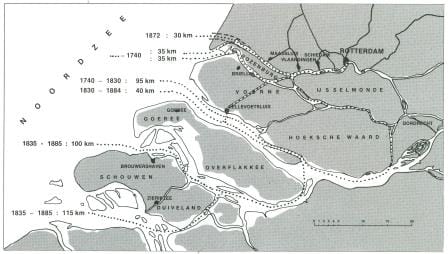
This chartlet shows the various routes to Rotterdam. As rule of thumb the deeper the draft the more southerly route you had to use until 1873.

This chartlet shows the various routes to Rotterdam. As rule of thumb the deeper the draft the more southerly route you had to use until 1873.

The water we float on is the water of the river Maas (Dutch) or Meuse (French) and consists of rain water coming all the way from France and while running through Belgium and the Netherlands it is getting bigger and bigger. Before it looked as it does now, the river split up once it came to Holland or the Netherlands which was barely above water in those days.  The area was a sort of Delta and the river split up in various smaller streams. Creating many little exits to the sea and all very shallow. Nothing could to be done about it; it was the way it was. When Amsterdam received a direct connection with the North Sea (the North Sea Canal) in the 1850’s, Rotterdam felt entitled to have that as well. So for the next 20 years they bombarded the government in The Hague with plans and complaints about them being left behind.

One of the deep drafted ships which benefited from the New Waterway was a nebuilt the P.Caland. Named after the designer of this New Waterway.

One of the new deep drafted ships which benefited from the New Waterway was the P. Caland. Named after the designer/ main engineer of this New Waterway. Holland America was so grateful for the direct connection that they named a ship after him. This was before the company went to DAM names only.

Then finally funding became available to straighten one arm of the Maas and being the Dutch way we gave it another name: the New Waterway. Based on this New Waterway plan it was decided to launch a steamship company but as a private enterprise called Plate & Reuchlin C.V named after the two main owners. They bought two new ships, the Rotterdam (I) and the Maas and then found that the river was still too shallow. So the ships had to go via the islands of Zeeland to get to Rotterdam via the backdoor. Extra costs and delays were the result. Then in 1873 the Nieuwe Waterweg /New Waterway was finally that far that deep sea steamships could make it to Rotterdam directly. At the same time the company went public to raise money for fleet expansion and thus we were officially born on 18 April 1873.

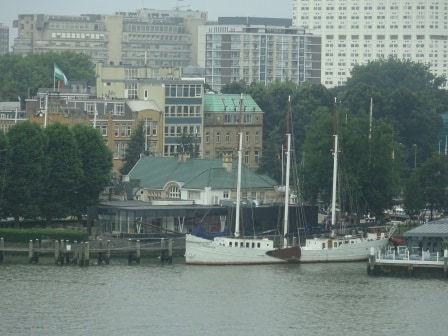
From the bridge of the ms Rotterdam on the north side. Our first office in 1871. (The low building with the green roof)

From the bridge of the ms Rotterdam looking to Starboard ,the north side of the river. Our first office in 1871. (The low building with the green roof)

The river side has changed enormously. Where there used to be only farm fields there is now industry and lots of Apartment buildings, as many of the small towns along the river are now more or less connected and form one big chain of Suburbia. Coming close to the passenger terminal, the layout of the city and the port has not changed very much but with the coming of Containerization for freight transportation the old docks have lost their commercial purpose and are now being redeveloped for housing.

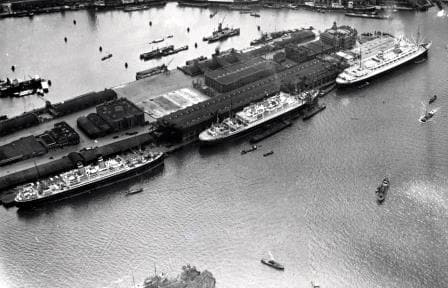
The Holland Amerika Lijn Terminal in the 1930's. From Right to Left: ss Nieuw Amsterdam (II), ss Statendam (II) and either the Veendam or Volendam from 1922.

The Holland Amerika Lijn Terminal in the 1930’s. From Right to Left: ss Nieuw Amsterdam (II), ss Statendam (II) and either the Veendam or Volendam from 1922.

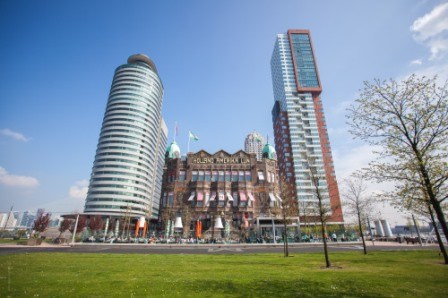
Once you have docked at the Cruise terminal you are in the heartland of Holland America. The current cruise terminal (about 50% of the old building it is still left) was built by the company after the 2nd world war when the first terminal was bombed. The parking areas and the apartment buildings around it now stand where once the cargo sheds of the company were. Our old head office (built between 1901 and 1909) still stands on the end of the pier and is now a hotel. Holland America has a sales and manning office in one of the large apartment buildings opposite. From the end of the pier you can also see the very old head office of the company (1871), the next office (Poortgebouw 1881) and in the distance the imposing silhouette of the Rotterdam V which is now a hotel, conference centre and museum.

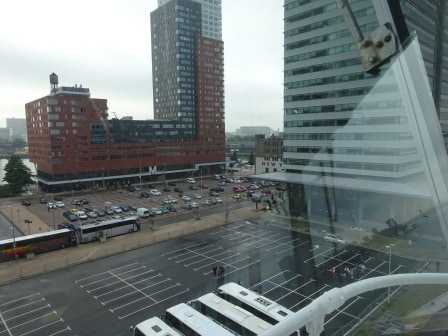
From the Bridge of the ms Rotterdam. In the brown building the Dutch office of the HAL and next to it the old head office of the company.

From the Bridge of the ms Rotterdam looking to Portside. In the brown building is where the Dutch office of HAL is located and next to it the old head office of the company now Hotel New York.

The area is a sort of triangle sticking out into the river. Where we are now docked was always the passenger side and as many as 3 passenger ships could be dock there at the same time. The other side (Rijnhaven) is where the cargo ships used to dock. Now it is open water or in use by river barges. At the corner, next to the old head office is a water taxi station, which takes you for 5 euro’s to the ss Rotterdam or into town. Cheaper than a taxi and much more fun.

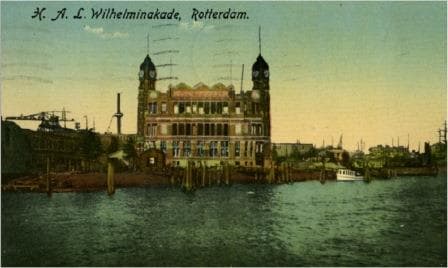
Our Dutch Head office in the Good old days.

Our Dutch Head office in the Good old days. The little white boat is the special tender for transporting the company management through the port. It had the name: Dam.

I will have to take a regular taxi to Rotterdam Central Station as they dammed a long time ago the canal which ran all the way up it to the Central Station area, so no chance of taking a boat. From there I will take the local train to Amsterdam and my next blog will be tomorrow from the Koningsdam.

And what it looks like now. To the left the harbour masters office and to the right what we call in dutch a "woon toren" === tower to live in.

And what it looks like now. To the left the harbor masters office and to the right what we call in dutch a “Woon toren” === tower to live in. (Somebody took this photo but I lost the name. Apologies to the maker)

05 Aug. 2016, At Sea.

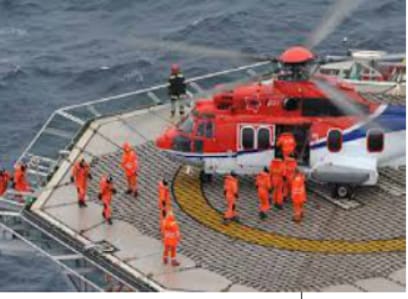
Just after midnight we were back in open waters again and shortly after we disembarked the pilot. Then it was setting a southerly course towards the next port of call Rotterdam.  The weather is a mixture of overcast with dark and light clouds and blue skies peeping through on occasion and the good thing is that the very strong North Westerly wind is with us and is cancelled out by the ships speed. Thus the relative wind on deck is almost zero. Glad we are not going the other way. On occasion we see oil rigs on our starboard side and we passed one quite close this morning and could see a helicopter landing. Either bringing supplies or being involved in a crew exchange.

Crew change on an oil rig. Note the survivals suits they all have to wear (Photo courtesy: www.oilriginfo.com)

Crew change on an oil rig. Note the survivals suits they all have to wear (Photo courtesy: www.oilriginfo.com)

Most of the oil rigs in this area are being serviced from Bergen which became a real boom town once the Norwegian oilfields came in operation; but there are also ports on the other side such as Inverness in Scotland and Great Yarmouth in England that have become important centers to support the oil industry. If an oil rig is manned by crew that belongs to the British Isles then they can easily come over by helicopter from that way.  Only now on occasion crew exchanges take place by boat.  In the past this meant a hazardous climb up a ladder or using an external lift system but nowadays there are ships equipped with a crane & walkway which makes it possible to do this much safer and faster if still needed.

dfd

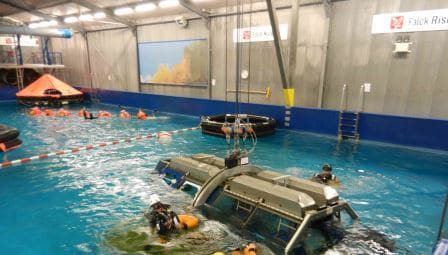
Helicopter water crash training for oil rig crew by submerging a mock up with seats into and under water. (Courtesy Falck Rotterdam)

If you are working on an oil rig, you have to go through training in the same way as all crew on a ship has to do. Additional to that, extra training is the need to be proficient in escaping from the helicopter in the water, in case one would crash. On the North Sea that on occasion still happens as here the helicopters sometimes have to fly on the margin of what is possible. This does not mean they take risks but the North Sea weather is sometimes so un-predictable that risks occur regardless. But those who were up and about this morning and outside at the right time witnessed a perfect landing with a helicopter. One of those moments that I berate myself of not having my camera in my pocket.

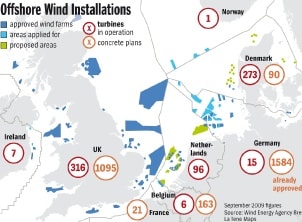
Wind mill areas in the North Sea. The ms Rotterdam sailed roughly from nbr 3 to nbr 96 on this chartlet and as you can see you can not miss them.

Windmill areas in the North Sea. The ms Rotterdam sailed roughly from nbr 3 to nbr 96 on this chartlet and as you can see you cannot miss them.

Apart from oil rigs which are mainly placed in the northern part of the North Sea we will see windmill parks in the southern part of the North sea, all the way down to the border with Belgium. There it stops as then the English Channel starts and there is no room anymore.  With the danger of fossil energy running out countries such as England, Holland, Germany and Denmark have started to build large numbers of windmills in their territorial waters. For some countries there is the aim to, by 2020, having reduced their reliance on fossil energy by at least 20%. For that you need a lot of Windmills or Wind turbine farms are they are now called.  They are built in allocated plots of sea, outside the shipping lanes but in some instances only “just outside”.

I was involved a number of years ago in the planning of one of these locations and it was interesting to follow the process which involved all stake holders. The interesting part was that the Shipping world had a good idea of what was needed to make it work but that the politicians and electricity companies did not really understand what ships did. They thought it was easy for us, just to sail a 100 miles around it all and were highly amazed that there was a link between fuel costs and the cost of a packet of cornflakes in the super market. For a country such as the UK where 95% of the goods which go in and out of the country go over sea a deviation by a ship will result in the transport price going up and thus the end cost in the supermarket. The result was quite some intense bickering about how wide the shipping lanes had to be and where they had to go. In the end the threat of collisions resulted in allocated shipping lines which worked for all parties.

The ms Rotterdam will arrive tomorrow morning at 03.00 hrs. at the pilot station and then make its way up the river. We should be docked around 07.00 hrs. Although you can hardly see that it is a river, at least the water is. But here the river Maas has been so canalized and dredged that it is called the New Waterway or Nieuwe Waterweg.

More about that tomorrow.


04 Aug. 2016; Eidfjord, Norway.

Eidfjord is located almost at the end of the EidFjord although there is a little bit more going further inland just around the corner from the town itself. The town & dock is located in a sheltered bend in the high mountain ranges which you can see on either side of the fjord. The mountain ranges are not as steep as when going to Gerainger fjord but still steep enough to lose our satellite connection for internet and telephone all day. If you wonder if it leaves the ship completely without communication, the answer is no, as the captain still has the iridium telephone connection on the bridge, which uses any satellite available. But you do pay $ 10 a minute for it so it is only in use as the Hot Line. And of course your regular cellphone /mobile phone is still working as long as you have Global Roaming.

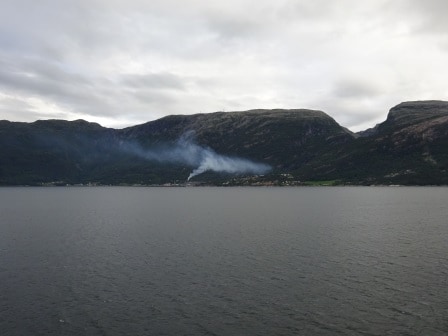
Strange thing today while sailing in. The wind pushes the smoke against the mountain and then it bounces back again with the wind.

Strange thing today while sailing in. The wind pushed the smoke towards the mountain and then it bounced back again with the wind.

But for the regular ships operations is was a quiet day as far as email traffic was concerned. We could not talk to Mama Main frame in Seattle and that reduced the number of emails going in and out to zero. With our lives nowadays completely connected (or entangled) with the internet it does upset the routine. You would almost get withdrawal symptoms.  I am somehow convinced that if our crew did not all have cell phones then there would be quite a few of the Generation Y and the millennials who would have had a tuff day to day. I think by 7 pm everybody who is not at work, will be sitting behind the computer trying to get contact with the rest of the world again.

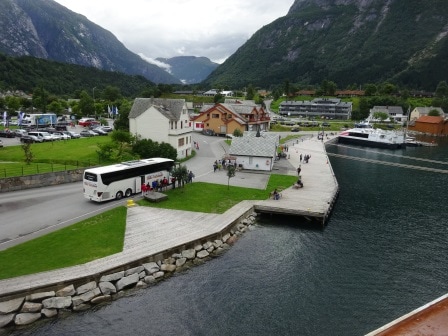
The town of Eidfjord. Not exactly a metropolis as things go.

The town of Eidfjord. Not exactly a metropolis as things go.

This does not stop anybody from having a great day in Eidfjord. The rain stayed away, apart from the last hour, for the whole day it just remained overcast. Being sheltered in the fjord means that there was no wind and thus it was very pleasant outside. This stop is really made to go on tour and explore the country side. Hordaland which is the county here is full of ancient stuff from the early days of Scandinavia. Even the little church of Eidfjord is from the 14th. Century.  The town itself has only 900 inhabitants but it is a tourist “processing point” for approx. 500,000 cruise ship visitors a year. If you come from the land side then it is a long travel with only limited hotel capacity and thus we saw a lot of campervans or R.V’s as the Americans say coming through. Right under the bridge at the dock there was a small camping and at one of those camper vans a German family was having a late breakfast as it was 10 am. the moment we docked. Not a bad way to see Norway.

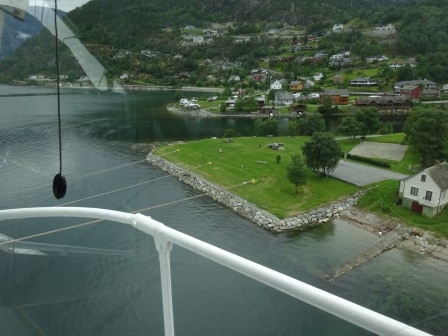
The dock is very short and thus have all the long mooring lines be even longer and go inland.

The dock is very short in length and thus have all the long mooring lines to be even longer and go inland.

We had two pilots this morning, due to the distance, and one of them was a Lady. Although the world of shipping has been open to ladies for a long long time we still do not see Lady Pilots very often. I think most of the time it is a job which is hard to combine with children, as you can join pilotage only after you have your Master License (around your 30th.) and the cut off joining date is somewhere around the 40th – 42nd. birthday and that is prime time for having children. Therefore sailing remained for a long time really a men’s world although there was a Russian Lady Captain already in 1935, Holland America had its first lady officer/cadet in 1968 and since then we have had a regular influx of Ladies. The Rotterdam has currently only one on board, a 3rd officer from Flemish side of Belgium but sometimes there are two or three. We have now one Lady Officer who is Staff Captain and if things work out, the way we hope it will, she will be the first Lady Captain of Holland America Line.

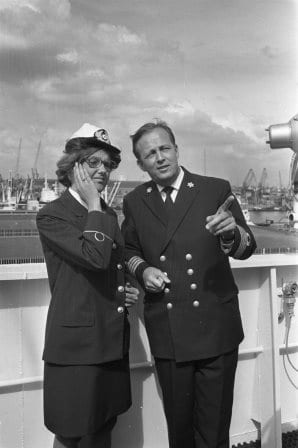
A dip in Holland America history. The first female (cadet officer) in the company. Esse Rieke Agter. Seen here on with Capt. ten Kate.

A blast from the past of Holland America history. The first Lady (cadet) Officer in the company. Esse Rieke Agter. Seen here with with Capt. Ten Kate.

A side effect of the Ladies joining the seafaring community later in history has always been that our systems never took into account if an officer was male or female. You were simply a Navigator. So when the ladies started to join, we never had the issue which you hear about on the shore side that ladies get paid less than men.  Our wage scales are part of a union agreement and just state the remuneration for a rank and that is it. And that is the way it is should be.

We sailed from Eidfjord at 18.00 hrs. We sail under the bridge at the entrance of the Fjord around 23.00 hrs. and expect to be outside by 00.30 hrs. Then we have a day at sea before the ship spends two days in Rotterdam. About 140 guests will leave the ship on the 7th. but the rest will travel back to Boston on the 2nd leg of the Voyage of the Vikings. I will leave the ship that day as well but I will take the train to Amsterdam to transfer to the Koningsdam. In the meantime life goes on as emails will start to come again in the evening. Norway with its mountains is simply not constructed for modern day –interconnected- life.

(Eidfjord is a good fjord for blogging. At 1920 to 1940 hrs. there was a low section in the fjord making it possible to upload today’s blog)


03 Aug. 2016; Aalesund, Norway.

We had an early and a shorter day today as before; all docked by 07.00 hrs. and all gone by 16.00 hrs. Compared to the standard 08.00 – 17.00 call times. We moved the times forward here by an hour in order to make the next call at Eidfjord on time. Which is set for at 10 am arrival. The little town of Eidfjord is tucked away at the end of a deep fjord so it will take us some time to get there.

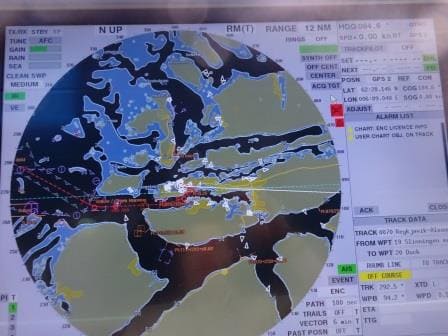
Following the dotted Red line it is about 14 nautical miles to the dock from the pilot station

Following the dotted Red line it is about 14 nautical miles to the dock from the pilot station

Aalesund took only an hour from pilot station to dock as it quite close to open waters but still beautifully sheltered; laying behind a high rock or hill and then in the inner curve of another rock formation.  Things must really be bad outside before it gets noticeable here. We were not the only ship in today, ahead of us was the Arcadia which is the fifth Holland America Line Vista Class but was handed over to P&O for completion. If this was done because they lately realized that a compass rose only has four main directions (Zuider – Wester – Noor – Ooster ….. dam) and not five or that some marketing insight decreed that P&O needed more ships. I do not know but the fact is number 5 went to P&O and is now the Arcadia. Nice thing about it is; P&O also keeps the tradition of using established names in their system and this is number 4. (1. Arcadia 1888, 2. Arcadia 1953, 3. Arcadia 1996) Being of roughly the same size as the Rotterdam she is also doing a similar variation of cruises, although while being focused on the British Market.

With her 2200 and our 1400 Aalesund was invaded by roughly 3600 visitors, not counting the crew. The cruise pier is right in down town: you only have to cross the street. Houses/apartments are built almost onto the cruise pier and thus this morning I could see a local lady doing the ironing while I was having breakfast. I am happy to report that a Norwegian iron just looks like a Dutch or an American one. There is a fairway which cuts completely through Aalesund with a small harbor in the middle. This also divides the two piers from each other, where we were docked today.  I think it is a natural connection, resulting in most of old Aalesund sitting on an island, but for small boats it is very handy to get from one bay and dock area to the other.

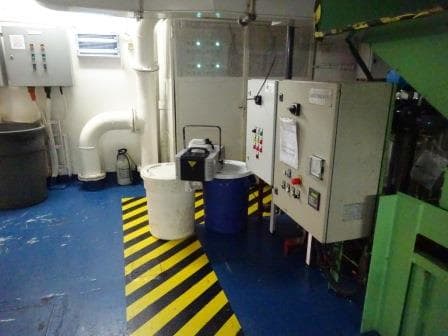
This is a corner of the Recycling Centre with the smoke machine at the ready. Note the 6 green lights and then look two photos down.

This is a corner of the Recycling Centre with the smoke machine at the ready. Note the 6 green lights and then look two photos down.

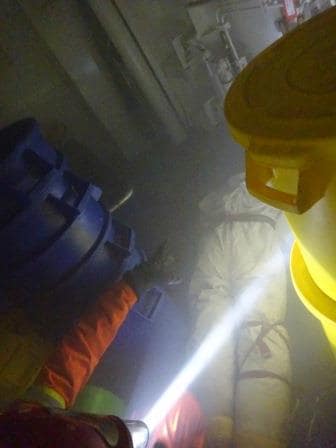
While the guests were ashore, the deck and engine officers were exposed to one of my special fire drills today. Solas requires that as a minimum the fire teams conduct a complete/drill/exercise once a week, and that exercise has to mimic a real life situation.  We do not have to create an actual fire on board but we should simulate it as best as possible. Setting up a good scenario, which really focusses everybody, is not always easy to do and that is where I step in.  Deck and Engine departments take turns and this week it was the turn of the Technical department to take the lead. To organize a drill for them is sometimes difficult as you cannot stop ventilation in the engine room as it can cause the lights to go out, if it starves the engines of oxygen.  Thus I try to find a space with technical equipment that is not so critical when it comes to ventilation or light.

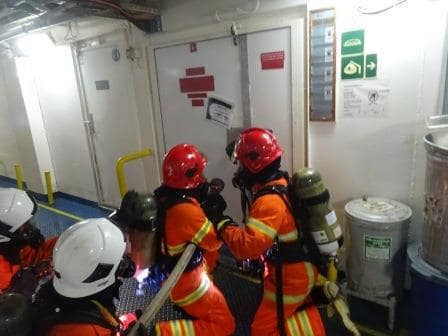
The Engineering Teams lining up for the attack, just before entering the smoke filled area.

The Engineering Teams lining up for the attack, just before entering the smoke filled area.

So today we drilled and trained in our Recycling Centre, less nicely named the Garbage Room, where everything that has been used gets recycled.  (Holland America has come very far and nearly everything on board gets recycled ashore after separation in this garbage room. The only thing that goes overboard are the five star food left overs for the fishe. Today things were complicated as the fire resulted in a chemical spill and a casualty who got caught in the spill. For those casualties we have a volunteer called Mr. Dummy who nearly permanently lives in the infirmary, recovering after each calamity after subsequent fire drills.

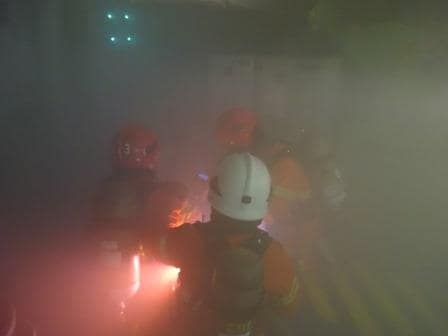
Approaching the source of the fire. Note the green lights at the top.

Approaching the source of the fire. Note the green lights at the top.

So we had smoke, smelly –chemical- air (I used a fragrant from the Spa Steam room) and a large area to search to find the source of the fire and the casualty. When Mr. Dummy was found it became complicated as Medical first needed to know the sort of chemical to advise the best way of handling. Medical is never allowed close to an emergency as we only have four of them and thus they talk to the fire team on location through a sort of mini assessment and then advise how to get the casualty out.

Mr. Dummy has been found. Teams now waiting for the heads up from medical.

Mr. Dummy has been found. Teams now waiting for the heads up from medical.

I like to switch off all the lights, whether it is realistic or not, as it is the only way to reduce the familiarity of the Officers with the area. Engineers know their engine room by heart but they always work there with the lights on. Lights off and they have to go a step slower and rethink the area in their mind.

So tomorrow we are in Eidfjord. We will be at the pilot station at 03.00 hrs. in the morning and then be docked just before 10 am. after a very scenic voyage in.  The weather looks a bit changeable with a good chance of showers and temperatures of 57oF or 13oF.
 

02 Aug. 2016; At Sea.

I think most guests have taken advantage of the 2nd day at sea, or maybe it was the 2nd hour forward, as early this morning it was a lot quieter in the Lido Restaurant than what I am used to. Normally by 06.45 – 07.00 on a sea day there are already a lot of guests going for an early breakfast but today it was not until 08.00 before I saw the same level of activity. Well I suppose that is what a cruise is all about you do not need the 6 am bus to get there and thus far we have not yet ever ran out of food.

We had a distinctively wobbly night. The disturbance to the North is disappearing but the wind is pushing the wave system caused by it down. This caused the increase in swell during yesterday afternoon and evening. It must have been quite a strong disturbance as any swell is supposed to die out after the wind is gone, and the movement over the ocean should help the dampening even more, but the waves still deepened out to 3 meters (9 feet) and sometimes more, and just with the sort of length that made the ms Rotterdam pitch. If a ship has to pitch then we always hope for a steady pitch with a predictable pattern. Everybody on board can get used to it and it prevents incidents as people know when the next movement (“Lurch” according to most of the guests) will occur. However Nature seldom works that way and thus the ship occasionally lurches more than at other times and it feels as if the ship is going into a dip and then jumps out of it again.

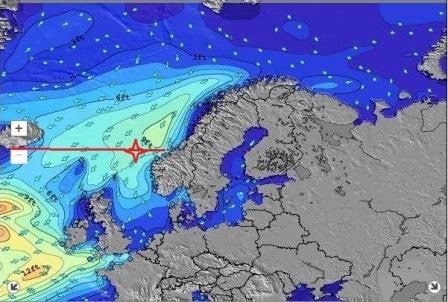
The lighter the color the higher the swell. Where the ms Rotterdam currently is the height is 9 feet and over.

0 The lighter the color the higher the swell. Where the ms Rotterdam currently is the height is 9 feet and over. (Map Courtesy www. surf-cast.com)

This extra dip is caused by the way the waves, now called swell, as they are old waves, interact with each other. Not all the waves are running exactly at the same distance from each other. Now they have different speeds, different levels of height, they interact with waves which were already there and they can even merge and become a bigger wave among the regular pattern of similar waves.  When two of those waves meet, they can either cancel each other out (e.g. the 2nd wave fills the hole of the first wave) or it can enhance the other wave by adding to the existing wave height and wave depth. And that is what we had last night and today. Sometimes a very pronounced pitch, and then a sort of restful period with only minimal movement. And nothing we can do about it apart from going very slow. But we are already on a slow speed of 15 knots and 15 knots is needed to get to Aalesund on time and thus we “lurch” along our course line until we run out of this wave field.

I am talking of course about the “pitching” of the ship, not the rolling. There were the bow rises up and down because the waves/swell are coming from straight ahead or under a small angle on either side. At the moment this angle is about 30o measured from the bow. The more that angle would be going towards 90o, the more it would affect the rolling of the ship and less and less the pitching. Once the swell would be nearly perpendicular the ship would only roll. So with this angle of 30o we have both movements. Pitching and Rolling. We do not feel the rolling today as the ships stabilizers can completely take care of it.  Stabilizers normally take care off about 90% of the rolling movement of a ship. If we would have the current 10 feet of swell  90o on the beam then there would be a maximum of 1 foot influence on the ship. With the 30o angle there is no 10 feet influence and that  the stabilizers can easily control of what we perceive as rolling.

There is no cure against pitching yet. There is a large prize out there of several million dollars waiting for the person who comes up with a solution but thus far no takers. So we just have to pitch up and down until we come in the lee of the Norwegian Coast. That will be in the early morning when we approach the pilot station. Aalesund lies sheltered inside the coastline and thus it will take about an hour from the pilot station to get to the dock.

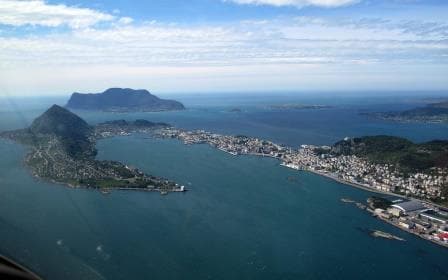
Aalesund has a very nice sheltered.

Aalesund has a very nice sheltered harbour. We dock at this side of the town, close to the down town area. (At least as of this moment!)

The plan for us is to dock in the south harbor which is on the Southside of the city. At the Northside there are docks as well and a smaller inner harbor which once is/was the fishing port. According to the weather forecast it is raining there today but sunshine and very little wind is expected tomorrow.  Temperatures will be around 54oF / 12oF which is a bit chilly for the time of the year but to be expected as long as the Northerly Winds keep blowing.


« Older posts Newer posts »