- Captain Albert's Website and Blog -

Ocean Liner History and Stories from the Sea, Past and Present. With an In Depth focus on Holland America Line

Page 223 of 241

03 April 2008, Montego Bay.

Sometimes in life you come across things that do not make sense at all but that you just have to accept. Normally the biggest ship gets the best dock in a port, which makes sense as you accommodate the most people in the best way. But not so in Montego Bay. While approaching the port we saw the Discovery (old Island Princess) happily docked at the passenger terminal. A terminal which can handle a ship double her length. She only carried 600 passengers or so, while the Veendam with 1200 on board was relegated to the cargo terminal, where the ship barely fits. So a small ship at a big dock and a big ship at a smaller dock. Plus the fact that all our 1200 guests now had to be shuttled through the cargo terminal to the passenger terminal. There were plenty of buses available for the purpose but it was all extra work. But “it had been scheduled that way by the authorities” and that was it. It did not really affect the guests that much, it just did not make sense.

So I parked the ship alongside the cargo dock with the nose into the port. Normally we swing on arrival for a quick sailing out but the technical department had to repair a cracked window and might needed scaffolding from the dock side in case the repairs were more complicated then expected. Also it was time to exercise the starboard lifeboats again and thus we went portside alongside and nose in.

The weather remained nice until just after lunch time when the first squalls started to come over. It culminated in a big downpour around 1600 hrs. Of course that was the moment that the afternoon tours were coming back, so a few of our guests got really soaked between the terminal and the ships gangway even while the distance was only 200 yards or so. This rain shower just stopped before sailing time and that gave me the needed visibility to sail out again. With the disappearance of the rain also the wind died down and that made it possible to back out of the port, the same way as we had come in.

You can swing in the harbor of Montego Bay but it has only been dredged to 10 meters and with the draft of the Veendam plus the squat generated by the maneuvering, we have not much more then 4 to 5 feet left under the keel. That means that ship only turns very slowly as all the water under the keel has to be pushed away through this 5 feet gap between sandy bottom and ships hull. By the time that the ship has turned around 360o the whole harbor is one muddy basin. The turning ships propellers and the flow caused by the thrusters bring all the sand to the surface. So I backed the ship out through the fairway and into the open sea. As soon as you are away from the first entrance buoy, the water depth drops from this 10 meters to over 150 meters and that makes swinging the ship around much easier.

There was a tanker at anchor just outside the port limits waiting for the Veendam to clear the cargo berth. We could see all their officers standing on the tanker bridge having a look at the antics of that cruise ship. With all the maneuvering power that the Veendam has, I can do things that a cargo captain with just one propeller at his disposal can only dream about. So he would never have backed all the way out, as he can only steer with his single rudder while I have two rudders and can do it with the stern thruster as well. We were out of the port by 17.15 hrs, heading for Grand Cayman while all around us, more rain came down on the shores of Montego Bay. The wind is with us, so I am wondering how much of that rain will make it also to Grand Cayman. We will find out tomorrow

02 April 2008, At Sea.

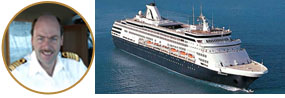
I finished up my day last night with introducing myself to the guests before the first and second show started. It can be a bit unsettling for guests to suddenly hear another captain’s voice over the P.A system. Especially as my voice is rather different to the one of my colleague. So I hopped on the stage for a few minutes to say hello and to show the face that goes with the voice. I found out through the years that most entertainers do like it when they get the captain as a warming up act and in this case it was no different. Drew and Angela are a Magicians act and they thought it was quite funny not to have the normal intro by the Cruise Director. Anyway now the whole ship knows who is doing the driving the boat and who takes the credit for the nice weather.

Today, a sea day, we had very nice weather. We are on our way from Cozumel to Montego Bay traveling at a sedate pace of 16 knots. The distance is too great to cover in one night and if we would go full out than we would arrive in the middle of the next night and not much happens in Montego Bay in the deep of the night. So we took our time and had a beautiful day at sea. The trade wind was not that strong today and as were not going that fast either there was a nice gentle breeze blowing over the decks making it very pleasant. I warned the guests against too much exposure tot the sun, the weather forecast indicated an UV 10 factor which is quite high, and with the wind cooling things down there is always the danger that people stay too long in the sunshine. We had a few showers in the late morning but the navigators have my permission to change course when possible so we sailed between the rain clouds and stayed dry and in the sun shine. Rain clouds at sea are quite often sharply defined and with a little course change you can often just skirt around them.

The Veendam has just started with our new Mariners recognition program. Before we held one or two gatherings (depending on the number of repeat guests on board) in the main lounge but the company has recently changed that to a Mariners luncheon in the dining room. So this morning we had the non-medal group for an 11.30 lunch, about 260 of them. Near the end of the cruise we will have the medal group and those who get a medal awarded. Thus far most guests seem to like the luncheon bit, well who does not like food…………., the only thing is that due to the lay-out of our dining room it is more difficult to do a speech as not everybody can see me. So I am still tinkering with that one. Most ships are now using this new system and I assume that the office is keeping close tabs on what the majority of the Mariners think about it.

The route took us above Grand Cayman, where we will be the day after tomorrow. Around Grand Cayman is a 12 mile environmental exclusion zone and that means that if you are not calling at Grand Cayman, you should stay out of it, although it is not compulsory, to disturb wild life as little as possible. So we keep a fair distance and happily trundled on to Montego Bay.
On other cruises we have been to Ocho Rios but that port was full of Mega Liners so the schedule opted for Montego Bay. We will be in port tomorrow with the Discovery, which is the old Island Princess. Together with her sister the Pacific Princess (from the Love boat series) she did a lot to make cruises popular among the public.

The Weather for Montego Bay looks quite good, although showers are expected later in the day. As Jamaica is a very tropical island, you get these showers coming down from the mountain ranges at regular intervals. so we might get some rain in the afternoon.

01 April 2008, Cozumel Mexico.

This morning I reboarded the Veendam after spending a few days in San Diego. As you might know, the company organizes each year a SMC. This stands for Senior Management Conference and means that in two groups all ships staff come together for a three day conference and seminar. Only the onboard staff of the Amsterdam and Prinsendam could not attend as it was too complicated to fly them from the other side of the world and their relieves to the ship. Those three days are filled with (office) speakers who give the latest updates about where the company is heading and what new initiatives are being developed to keep the company competitive with the rest of the Industry. For the rest there are breakout sessions for Captains, Hotel managers, Chief Officers and Chief Engineers to discuss the specific issues for their area’s of responsibility. At the same time the ships Environmental Officers get their refreshment course in the latest environmental rules and insights.

From San Diego I flew to Cozumel and after a hotel night boarded the ship. To my great happiness the ship was docked at the Lagosta Pier which is opposite down town and also right opposite the hotel I was staying in. Cozumel has been a difficult season for the Veendam as the ship had to anchor most of the time. We were originally scheduled all season to go to Costa Maya but since the piers were destroyed by hurricane Dean last year, the ship has been calling at Cozumel. Docking spaces are normally booked two years in advance and that means that the Veendam could only dock if there was a space available; we did not have a scheduled berth as such because of the last moment rescheduling. On the standard cruises, that meant that the Veendam had to anchor or drift as with a Thursday call the piers where all occupied with mega liners.

This cruise we are on a slightly different schedule with calling at Montego Bay and Grand Cayman instead of Key West, Belize and Santo Tomas and that meant that Cozumel was a Tuesday call. On a Tuesday not all berths are booked and one open berth was available at the downtown Lagosta Pier. Perfect for the guests of course. Later in the cruise it will also mean that we are the only in ship in Grand Cayman and that is of course even better.

I will now do a four month contract on the ship and will then be relieved on July 28th or so in Vancouver by Captain James Russell-Dunford which has been the alternating captain since 2004.

We left Cozumel at 1900 hrs. with a romantic sail away as Cozumel was lit up against the dark blue sky on our starboard side. The guests were enjoying a barbecue at that time and entertainment was provided by a local Mariachi band, which left the ship about 30 seconds before we pulled the gangway. We are now crossing the western part of the Caribbean Sea on our way to Montego Bay, where we will arrive at 8 am on the 3 April.

02 March 2008, New additions to the weblog.

Good morning,

In the past few days the following has been added:

1. Three small photo gallerys: Faces of………….: under the my ship tab.
(With more to come)

2. Another future Avid Cruise article about the first Mass market cruise ship ever built: under table Of days gone by

Enjoy

27 February, additions to the weblog

Good morning,

Today were added:
1. The histories of Veendam II, Veendam III (under Hal ships past and present)
2. A future article for the Avid cruiser magazine about the first dedicated cruise ship ever built. (under Of days gone by)

Enjoy

25 February, New additions

Good morning,

As promised in December, here are the first new updates to the website. I have started adding pages with the individual history of the companies ships. I am starting with the Veendam’s and will progress from there until the whole fleet has been covered. Just click the tab: Holland America Line ships Past and present above the website header and click the sub-tabs

Enjoy.

08 Dec. 2007, At Sea and going home.

Tomorrow we are in Tampa and I will be going home for a four month leave period. Normally my colleague and I are doing three on, three off, but due to the scheduling of the yearly captains conference we have changed it this time to 4 on 4 off and then 2 on, two off. In that way it also works out that I will be on board for Christmas 2008 after having had the previous two holiday periods off.

I will be relieved by Captain James Russell-Dunford who has been alternating with me on the Veendam since 2004.

I would like to thank all the readers for taking their time to follow my daily escapades on the high seas. My apologies for not always answering your queries and questions. Some I could not answer as they would involve company policy and statements. As a captain I do not make company policy, I only execute it. For the rest I have tried to in coorperate as many answers in my blogs as possible. I hope you enjoyed it.

Please check the website later in the New Year; I hope to add two sections to it during my leave. One with history of the company and the Holland America Line ships and items of life on board the Veendam including of who is Who.

Happy holidays

xmas-card-3.jpg

07 December 2007, Georgetown Grand Cayman.

07 December 2007 Georgetown Grand Cayman.

It was a beautiful day, it was a gorgeous day and even better, we were alone. We were the only ship in port. No lines in the shops, no tourist jams in the main street. Having sting ray city all to yourself. It could not be better. The sun shone all day and there was a gentle breeze blowing to make it pleasant.

That gentle breeze is also of extreme importance to me as it is needed to keep the ship in position. Georgetown is the strange place where if there is too much wind and or from the wrong the direction then you have to cancel. If there is not enough wind then you can not anchor as the ship will drift unto the reefs.

Georgetown has four anchorages each one about 2000 feet away from the other. The ship anchors on a ledge with the bow in 30 feet of water and the stern in about a1000 feet of water. The steady trade wind keeps pushing the ship away from the coast and the anchor then holds it connected to the ledge. If there is too much wind, the anchor can not take the strain, it starts dragging and will fall of the ledge. If there is no wind, the current that runs along the ledge will slowly push the ship onto the ledge and into too shallow water. The only thing you can do to avoid this is to keep one propeller working and going a little bit astern so the ship stay off the reef in that way. Having a gentle breeze doing it for you if of course much better.

To find the right spot on the reef is done with the help of the local Pilot Captain Banks.
He comes out in a tour boat and parks himself on the exact spot that he thinks is best for the ship. It is then up to the captain to bring the anchor above the pilot boat and the ship to a standstill when it gets there. If you overshoot, you end up in too shallow water. As soon as the anchor is above the pilot boat, the pilot boat moves away and the anchor is let go. That letting go of the anchor is always a bit scary with that pilot boat floating under it. There have not been any accidents but there have been a few close calls, when a too eager young officer forward was too quick with giving the “let go” order after permission came from the bridge.

When the anchor has landed on a sandy spot on the ledge, the ships bow (and thus the rest of the ship) is moved sideways and the chain is paid out over the ledge. In that way we create maximum holding power. The anchor will dug into the sand with the flukes and then the ship moves little bit astern so that most of the ship is over deep water again. For a person that has never seen this sort of “ledge anchoring” being done it is a bit of an eye opener. The bow is moving closer and closer to the beach followed by almost dropping the anchor on top of a boat and then for the remainder of the day relying on the wind to keep you in position. But it is safe and never has ship has come to harm over it.

cayman-ships-anchoring-on-the-ledge.jpg

Due to the influx of bigger ships, the town has a new pier for tender boats so there is now a lot of space, even when there are six or seven ships calling at the same time. Plans have been made to build two docks for four ships but the starting date of the construction start has been moved back a few times and a firm date is not in sight yet. Until the piers have been completed, we drop the hook on the ledge and float behind the anchor on the easterly trade winds.

grand-cayman-new-tender-pier-2.JPG

We left Grand Cayman on time and headed Northwest in the direction of the West point of Cuba. Tampa is our final destination. It should be a good home run as the weather forecast looks very good.

06 December 2007, At sea.

Today was meeting day. The ship was merrily on its way to Grand Cayman and making good speed for a timely arrival. That gave time to get a number of “end of the month” things done. We have several monthly committee meetings, where representatives from the various departments on board come together. There is the environmental meeting which is shared by the Environmental Officer. In this meeting various aspects of improving environmental procedures on board are discussed which include recycling, better garbage separation at source and ideas about how to reduce waste etc. Then there is the Safety meeting shared by the Chief Officer, which pertains to on the job safety. How to reduce accidents, if any, how to improve procedures, have any un-safe situations being seen and are there contradictions in the company’s safety procedures. The theory on paper versus the reality of real life.

Then there is the Unit meeting, which is shared by the Captain. “Unit” means groups from the Indonesian and Philipino community who meet to discuss various issues at hand. The crew is hired via unions in Djakarta and Manila and they nominate for each group on board a person who can represent each faction when there are issues. The persons nominated as representatives have all worked for a number of years for the company, so they can advise their group about how things work and will also know where to go when there is an issue. If there are more persons who fit the selection criteria, then the faction on board votes for their representative. Minutes are kept of the meeting by a lady from the front office and the ships staff ensures that items that do come up are resolved as soon as possible.

These are all monthly meetings. Then there are weekly meetings, such as the Health & Sanitation meeting, the ships staff meeting and the Crew Activity Committee. As everywhere else in a big organization there are also a large number of departmental meetings on a daily basis. If I would get a dollar for each time, that a meeting is taking place somewhere on the ship, I would drive a much bigger car.

All these meetings ensure that information is shared with all involved. Information needed to make the ships operation run more smoothly and daily life on board more pleasant. One of the things that I try to keep a very good eye on is the trickle down effect of this information through the various layers. As every manager knows; at each level of an operation information and context gets lost. As a result the person at the end of the chain can sometimes make neither head nor tail of the order that has been handed down. This is on a ship an even bigger challenge due to the many nationalities involved. If a message is given by a Dutch captain, in his English and it goes via a German chef to a Philipino cook and is discussed in their English, than there are bound to be variations in the way the message is brought forward from one layer to the other. Thus when something does not happen or happens in different way then anticipated, I always try to find out, the why. And the why is quite often very puzzling and sometimes mind boggling.

One of the biggest hiccups in the trickle down system is the perception of time that various nationalities and races have. If a Dutchman says that something has to be done, he really means it should already have happened yesterday. For a German now is now, but for a philipino, now, is when he/she gets round to doing it and that might not be “yesterday” or “now”. So when a message is passed on, it is important that the time frame is explained as well as the reason fir it. Something might have to be done directly or today but it might also have a time frame of several days before it has to be accomplished.

For me this is still one of the most fascinating parts of managing. How to anticipate this trickle down effect through the layers and to get that message across on each level exactly as it was meant.

Therefore there are these meetings that bypass the various levels on operation and the message reaches directly the representatives of all groups. It creates better understanding of the issues at hand and there is better and more direct feedback to the senior ships management for follow up.

Tomorrow we are in Grand Cayman and the weather forecast promises us a very nice day without a cold front in sight. Last cruise it was a sudden cold front that forced me to cancel the call at Grand Cayman but now it looks very good.

05 December 2007, Oranje Stad Aruba.

The calm weather, e.g. little to no wind, keeps persisting. Also on arrival Aruba this morning while it normally blows considerably here, today there was just a very light wind blowing. The pilot spoke about strange weather, very strange weather. I did not mind at all, as the less wind, the easier the docking. That is one of the reasons why I always arrive very early. The wind tends to be much less before sunrise and that makes it easier as well. The ship is supposed to be docked by 7 am. but most of the time we are already safely parked by 05.45 am. before the sun rises. Same so this morning. Maybe it is due to this lack of wind but, same as in Bonaire yesterday, we had rain clouds floating in. Clouds that off loaded a lot of water a few times during the morning. For the rest it was a sunny day with temperatures in the mid 80’s. Aruba is a short stay, due to the fact that the distance to Grand Cayman is considerable. It takes an average speed of 19 knots to get there on time. So when everybody was back on board just after 14.30 hrs, we raced out of the port, got the pilot off while making the turn to the North West and cranked the ship up. Within 30 minutes we were flying.

As I am nearing the end of my ships contract and my “blogging” period, I will try to tie up some loose ends, e.g. questions posted in the recent past:

1. Stabilizers. The are started, pumped out, from an operating console on the bridge. They have a length of 15 feet and as they are under an angle the stick outside the ships hull for about 10 feet. So it is important that they are pulled in, before the ship docks. If the ship does not move, we keep them in. Stabelizers cost speed and thus extra fuel has to be burned to compensate for that. When the ship starts to roll, the officer of the watch will decide to engage them.
2. Bollard: any sort of belaying cleat on the pier side. Most are round but some are angled. A dolphin is a bollard standing in the water. Some are complete artificial islands, some are just sticks.

bollard-in-katakolon.JPGdolphin-in-ocho-rios.JPG

3. Receiving a bollicking is indeed “een uitbrander”
4. Reporting “rogue” cargo ships who do not follow the rules of the road. You can only really do it when a ship is in coastal waters. Say if it happens within the three mile zone of a country, you could report it to the local coastguard station and they might take action. Dover VTS which covers the English Channel, has been known to pass “rogue” actions on to port state inspectors if the ship in question would call at an English port directly after the incident. For the rest it is very difficult to do something about it.
5. The captain not drinking. Holland America has an Alcohol policy which sets limits for the amount of alcohol that can be consumed when “on duty” and when “off duty”. The limit is clearly defined in percentages but it is hard to translate that into the exact number of glasses of beer of wine you can drink, before you reach that limit. As the captain is supposed to be “on duty” all the time, it means that whatever accident occurs, he will have to do a D&A test. To make my own life easy and not having to worry, whether I am close to the limit or not, I simply go dry for three months. It also stops the questions of “who is driving the ship” when you stand in the bar.
6. Cruise planning. It is one of the most complicated issues that a company has to tackle as it all hinges on the ultimate question: “will it sell” and you are never certain until the cruise is sold. For Holland America guests we need to offer a mixture of cruises. We have guests who just want a simple cruise to hop onto, such as the Veendam is currently doing at the moment from Tampa. We also have guests who want the HAL product while doing something exotic, such as the cruises the Prinsendam is doing all year around.
Some of the things to consider:
a. Length of the cruise. Has the target group the number of days off during the year to make that cruise.
b. Does the ship fit in the port
c. Can the ship make the ports in the set time? Speed wise and route wise.
d. Is the route safe (middle east as an example)
e. Is it politically acceptable to go there?
f. Is there enough to do in a port for the target group? (shops, tours, local attitude)
g. If it is a change over port: connections with the airport, access to the ships, check- ins, bunkers, provisions.
h. If a whole new cruise is being developed a balance is sought with putting in a few “old-timers” and a few new ports. This way at least everybody will enjoy a few of the ports, if all the new ones do not work out. Even if the guest books a cruise just because of that new port, it is still our fault, if after calling there; the guest did not like it. So mix and match.
i. What is the feedback from the guests during past cruise calls.

Tomorrow we have a day at sea and the weather forecast is really good.

« Older posts Newer posts »