It was extremely busy at the West Anchorage of Cristobal with a large number of ships waiting for a canal transit. On the East side were a number of containerships waiting to dock at Manzanillo port, just east of the Canal. They cannot anchor because it too deep there and that creates a problem. They drift all over place and of course also onto our course line. As explained in my last Canal blog, they are not regulated by the Panama Canal as the East area is out of their jurisdiction. So we had to wriggle our way through the accumulated drifters to get to the breakwaters for a 05.00 arrival. We work that sort of thing into our voyage plan and thus we had extra time on our hands for that wriggling and that meant that the bridge sailed through the breakwaters at 05.00.14 and I could not make it more precise. Continue reading
Page 131 of 241
After leaving Aruba we sailed west, keeping a large number of those waiting tankers on our portside. They were drifting with about 1.5 miles in the hour to the west due to the current that flows under Aruba. We had that current to our advantage for a few hours as well and a free push in the back is always appreciated. We lost that current around 9 pm. and from then on we just had our ships speed with a following wind. We will keep that following wind until a few hours before we reach Cristobal as the weather chart is indicating that it will be wind still in the Panama area.
The moment you talk about Aruba, the first thing a sailor asks is “how is the wind” because it can blow there…. considerably. Even with the port located on the south side of the island it is still a windy happening as the island is basically flat. There is one real hill, called the Hooiberg, or “Hay Mountain” rising up from the flat land but it does not offer any protection to the ships entering the port. Thus the wind is of great interest to any ship’s captain coming in and certainly to captains coming in with floating apartment buildings that seemed to have been constructed to catch even the slightest breeze and turn it into a challenge. So I keep a close eye on the expected wind in the local forecast and when we arrive we check with port control whether the “Forecast” is indeed also happening in the port. Continue reading
By the time I received my wake up call, the mountains of Haiti were clearly visible on our portside. The ship had just sailed by Cape Tiburon, that is more or less the most South western point of Haiti, at least the one with the most recognizable name. The weather forecast was not indicating any surprises apart from a large wave field in the late afternoon and early evening. That wave field was slowly moving to the West and by the time that we went through it, we skirted the edge and not the centre area and that caused a bit of movement but nothing to be concerned about. Continue reading
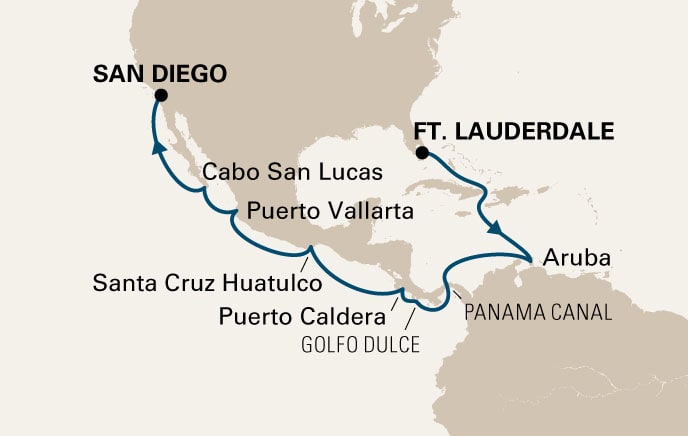
Our final westbound transcanal cruise for this year.
By midnight we had left the Florida Strait and sailed into the Old Bahama Channel. Because the strong, cold front wind was pushing the Gulf Stream towards the coast of Florida, it squeezed the width of the Gulf Stream a bit as well. That caused a sort of build up against the Cuba coast and as the water has to go somewhere; it flowed quite strongly into Old Bahama Channel. That gave us at times about 2 knots of current with us and that helped gain me back some of the time lost yesterday, waiting for the C.Eclipse to sail. The average speed to make to Aruba was 17.9 knots and we topped the 20 knots on occasion and that helped balance the books a little bit. Continue reading
Apologies for the late posting, but the satelite guru’s in Miami have had us switch to different satelite reception and our big funnel was in the way for most of the day while sailing close to the coast of Cuba . Changing course was not possible as we are not allowed to go to Cuba yet.
It was extremely breezy when I came on the bridge at 04.30 so much that I decided to call out a tugboat, as a safety precaution, especially as we had to back up the Intracoastal, past the Celebrity Eclipse and past a bunker barge. Bumping into another ship is never a good idea but bumping into a fuel barge is an even worse idea, thus a tugboat for peace of mind. All the ships were nicely on time and so the whole parade could enter as planned by the harbor master. Then 30 minutes before the pilot station, the wind suddenly moved to a North Westerly direction and as it was now blowing overland it lost most of its ferocity. Which meant it could have easily done it without a tugboat. But we cannot predict what the weather is doing and thus we get it wrong sometimes. (If I could predict the weather correctly, then I would be working for CNN and make real good money) Continue reading
The cold front did come down faster than expected and instead of having a nearly wind free day while sailing towards Ft. Lauderdale, it blew 25 knots from the North East and it kept doing so for the remainder of the day. And what happens when it blows from that direction; it changes the current in the Old Bahama Channel, from one that goes with us, to one that goes against us. So instead of getting a free push of .05 to 0.75 in the back, we got it against us now, which makes a difference of 1.5 knots. Over 24 hours that is a nice bit of fuel that could have been saved. Continue reading
After two busy days, the Panama Canal and Cartagena, we now had the first of two sea days, giving all the guests some time to relax and catch their breath. Tomorrow the challenge will be for the majority to pack their suitcases as their cruise will be coming to an end. A small number will make the return voyage with us, although “small” is relative, there are about a 100, as far as I know. Making “back to back” cruises, which is getting more and more popular as it cuts out the need to fly and does not limit you in the amount of luggage that you can take with you. So if you have the time, why not? But we have two sea days in a row, 1143 nautical miles to travel and ample time to enjoy the ship. The weather looks good, although the word “changeable” is in the air as the whole area is settling down for the winter now the hurricane season is coming to an end. Winter season means that cold front after cold front will descend over Florida bringing with it cooler temperatures but also more wind. It looks like we will get the first of that wind over us just after docking in Fort Lauderdale. Continue reading
After a windy night we arrived at the Cartagena Pilot station at 08.30. We had seen on the radar that the Island Princess was on time for her 07.00 hrs arrival and as soon as she was inside a whole stream of cargo ships came out. I still have not been able to figure out, or get the answer from the pilots, about why this happens at this time. Whether the ships leave at sunrise from their berths for some special reason or that it is cheaper to sail after 06.00, I do not know but it is a remarkable pattern. Not that I mind, because it means that by the time we arrive the coast is clear and the entrance channel, open to sail, in without waiting. We had issues this morning to find the pilot boat and it turned out that it was because they had upgraded their equipment; in a rather strange way. More and more pilot boats, worldwide, are adding AIS to their equipment (Automatic Identification System) so approaching ships can recognize them from amidst all the clutter in a port. The Cartagena pilots had received one for their pilot boat here. However upon installing, it became apparent that the software for this box, could not display the text denoting it as a pilot boat, only as a fishing boat. Oops, somebody in government office far away had not done his/her homework. Our pilot was not foreseeing a quick correction to this forthcoming from the governmental decision making process and so he advised us to keep looking for the fishing boat during our coming calls. Continue reading
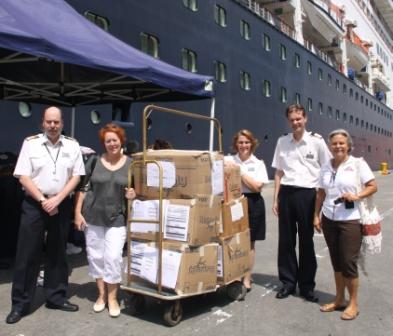
The Canal authority decided to keep the schedule unaltered and thus I was on the bridge at 0400 hrs. to start operations. Shortly before 5 we started picking up the anchor and as the holding ground is so good here, (very thick grey clay) I had to run the anchor over the top to break it out of the ground. (This is a maneuver whereby you slowly steam forward until the anchor is past the bow of the ship and is forced by the ships pull on the chain to “flip over” causing the flukes to break out of the ground). The one danger it has is that the flukes then fall the wrong way when coming up and the anchor does not want to fit in the hawse pipe. When the anchor party had finally washed about 5 tons of mud from the anchor it showed indeed that the flukes had falling the wrong way. So we kept the anchor outside the hawse pipe and slowly steamed towards the pilot waiting area. While there we let the anchor go again and when it hit the sea bottom the flukes fell back the right way and we could put the anchor in its housing. Continue reading
Captain Albert
© 2026 – Captain Albert's Website and Blog –
Theme by Anders Noren — Up ↑