- Captain Albert's Website and Blog -

Ocean Liner History and Stories from the Sea, Past and Present. With an In Depth focus on Holland America Line

Category: ms Prinsendam (page 1 of 6)

01 Aug. 2025 Going home & the Verdict

My final installment of the cruise comes a bit later then intended because when I got home, real life hit at once. I volunteer as a Director for our Apartment Building and it seemed they all waited until “I came off the ship”. Hence a weeks delay.

This morning the ship docked at Bremerhaven just before 7 am. shortly followed by the ms Amadea also from Phoenix Reisen. There were no disembarkation announcements  as everything was in the Daily Program  and everybody followed those instructions.  Internationally they call this “Silent Disembark” and there was also a “Express Disembark” where you roll your own suitcases of the gangway before regular disembarkation starts. I did not get the impression that this was very popular as it seemed that most guests first wanted to have breakfast. Disembarkation started from the top deck downwards at 08.30  but with only 900 guests everybody was off by 09.00 hrs. or shortly after.  The only challenge we had was waiting for a taxi as we got the impression that the “taxi world” thought that disembarkation was starting at 09.00 and not at 08.30 hrs. By 09.00 long convoys of taxis were approaching the dock to deal with the growing line of waiting cruise people. We made it back to the hotel by 09.30 and after retrieving our car and saying farewell to our Dutch Friends (he drives a bit faster than I do, so we do not drive in convoy)  we set off for the night ferry back to England. If all goes well, we will be home again by 10.00 hrs, tomorrow morning.

The Atrium where you come in and go out. The gangway connection is via the outside Promenade deck. The Mermaid is still from Royal Viking days, the Piano is from Phoenix and to get that piano in, they had to remove the Atrium sculpted glass pole installed by Holland America. I wonder if the company saved that one as it was a beautiful piece of art.

The Verdict.

Starting with the most important question: did we enjoy the cruise ?
Yes we did, we enjoyed it very much. Good atmosphere and traveling with fine friends made it a very positive and pleasant experience,

Would we take another one?
Maybe, if they go to a place we have never been. The “maybe” is mainly because it is such a long journey by car to Bremerhaven.

Was it worth the money?
Yes, this is a 4 star product and the cost was in line with it. 4 Star, which I measure on what is available on the buffets for choice. Which is limited compared to 5 star.

What is available for the guests to enjoy who do not go on tour and stay on board. Not much as all the cruise staff is on tour-bus-duty,

What is available  in the cabin with bedding, shower amenities, linen quality, change of linen ( new bedding only once in the 7 days)

Is it worthwhile to book a suite? Yes according to my wife and I. Also my Dutch friends who upgraded  after their initial booking found the cabin with separate sit and bed area very nice. Then there is a large number of amenities/gifts that come with it. Shoulder bags, logo coffee cups, logo water bottles, logo pins, logo pens, full fridge with free drinks, and nibbles,  A posh box with shower amenities for him and her, The Gold / concierge Room,  Two TV’s in the cabin. (including international programs), special luggage labels, champagne (by the end of the week we had had 3 of them) Attentive cabin service. Voucher for free massage, voucher for champagne breakfast. Early booking option for specialty Restaurant.   We thought it was well worth the money.

What is REALLY different to other (main stream) companies.
A. No announcements in the cabin. Only announcements made are for scenic cruising. Arrival announcement Yes, only one and not in the cabin. All announcements also come over the Bow View Channel so you can just switch it on. Every German reads the daily program and is on time for whatever they are involved in. Compare that with a lot of company’s who are very irritating with announcements in the cabin such as: Fred Olsen, Saga, Celebrity etc. etc. But this was a “peaceful cruise” and if you wanted noise, you went and found it, the peace in the cabin was never disturbed.

B. Official ships tour guides on every bus, in addition to the local tour guides, It is something that company’s used to have in the “good old days”. It must be appreciated by the guests when on tour. This is not the same as we see with other company’s where they put a “crew escort” on board for a free-bie and who then sits the whole tour in a corner on the cell phone or runs off as soon as the bus stops. No these were the professional ships cruise staff, in uniform and helped the guests off the bus and supported the guests in every way needed.

C. Germans on Phoenix do not go for cocktails, they go for after dinner drinks. Thus there is no pre dinner cocktail music in the lounges until about 20.00 hrs. After dinner there is music for the rest of the evening and the lounges are full.

D. Everything starts exactly on the time indicated in the daily program. So if there is a get-to-gether or a party, guests arrive early, so everything can start exactly on time. Dining room from 18.00 – 20.00 hrs., then the serving starts at 20.00 hrs. but guests will have walked in from 19.40 hrs. or so, to find their table and to be ready for the menu.

The Glare.
If you read my cruise reviews on this site, you will see that I always have this entry. “The Glare” is something I do when I walk through the ship. I look each Officer and Crewmember straight in the face with my blue piercing eyes and then wait for the crewmember to acknowledge. The ms Amera crew were extremely good, during the whole voyage, from captain to waiters, sailors to front desk etc. etc. everybody smiled said hello or reacted in another positive way. The only one who failed (3 times) was the Ship’s doctor but  he was walking around as if he was on another planet altogether anyway.

Very friendly Captain and deck officers, very friendly Hotel Manager and very friendly and capable waiters (kellners) & cabin stewards and Front Desk attendants. Nice cruise staff but we did not see them very much as they were each day out on tour and then with a maximum of 10 hrs. a day being allowed to work, there is not much time left.

Mr. Uwe Noster, the man of the Gold & Silber level / concierge was a very gregarious man and very helpful, but although he said that he had “desk hours” we were never able to find out when as the hours were not posted in the daily program and also not on his desk itself on deck 8 Atrium.

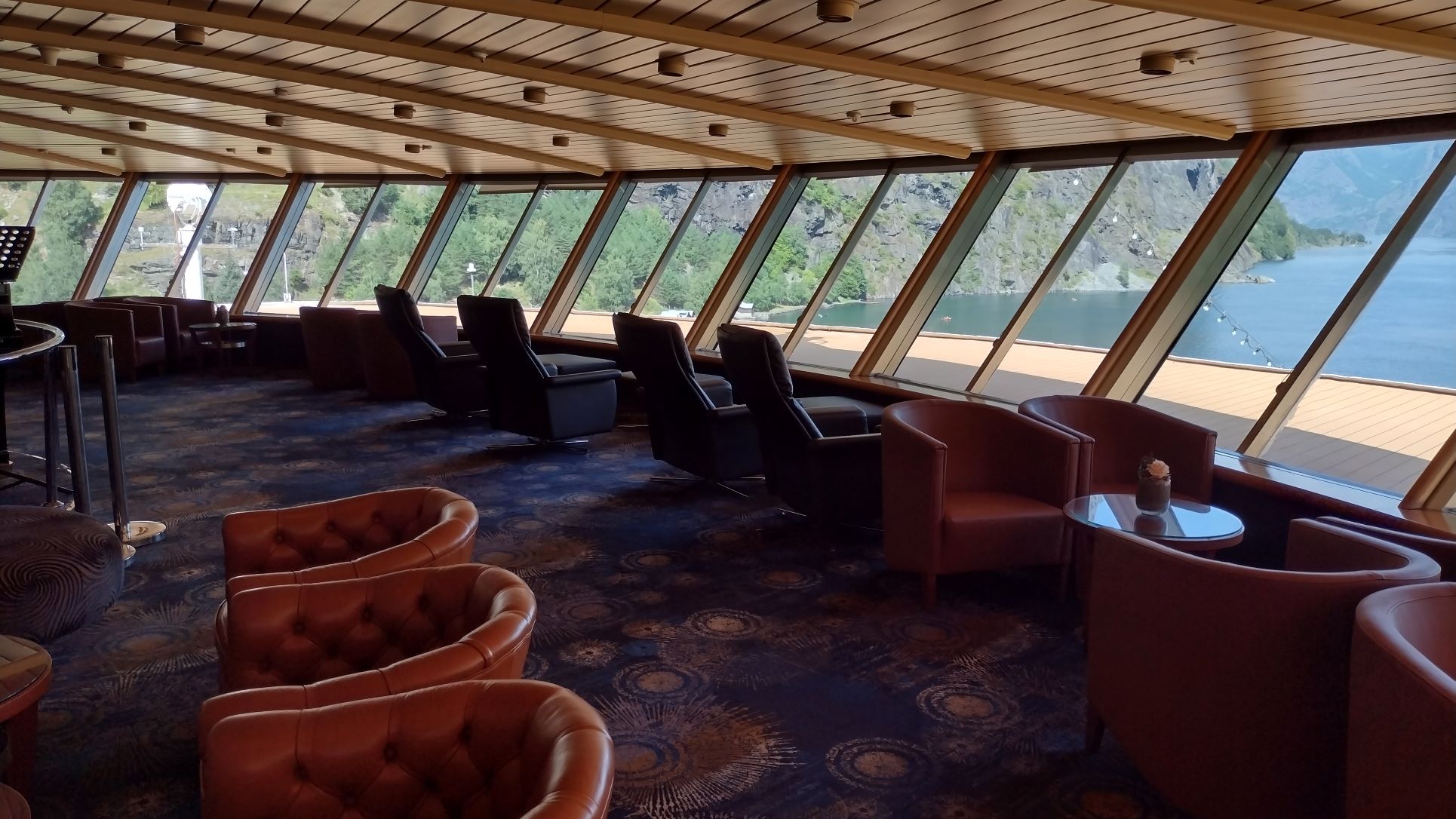
The Crowsnest, or Panorama Lounge.  The only lounge completely left as is from the Royal Viking Days.

Other Compliments.
*The “Schone Ausflugge” lunch on the first and last day on the top deck midships. Apart from the free beer, it was just very nice to be present and enjoy it. Regardless of nationality and background. Holland America has the “orange party” but they tend to cut if off after a few songs but here it just went on………… ………………………….Wunderbar.
*Tea in the afternoon. Much better than expected on a German ship and a lot of guests did partake in it.
*Real ships escorts on the coaches. Much appreciated by those on tours.
*Maintenance. For a 37 year old ship the ms Amera looked very good. As was with Holland America keeping the underside of the balconies up to standard was a battle that one could not win, but the old Lady looked very good, both inside and outside. And it seemed that the crew were genuinely proud of her.
*Duo in the Piano Lounge, very good and enjoyable.
*Service in the dining room and lounges, quick, friendly and always with a smile (and automatically a jar of peanuts) .
*Cabin service for our section (10 suite cabins) very good and un-obtrusive..
*Gold Room, very nice for snacks and coffee drinks if you used it. It was under used, so I would not be amazed if Phoenix takes it away. Before Hal it used to be the Staff Captains cabin but if it stays it is a very nice perk.
* Very reasonable bar prices and a very good wine list

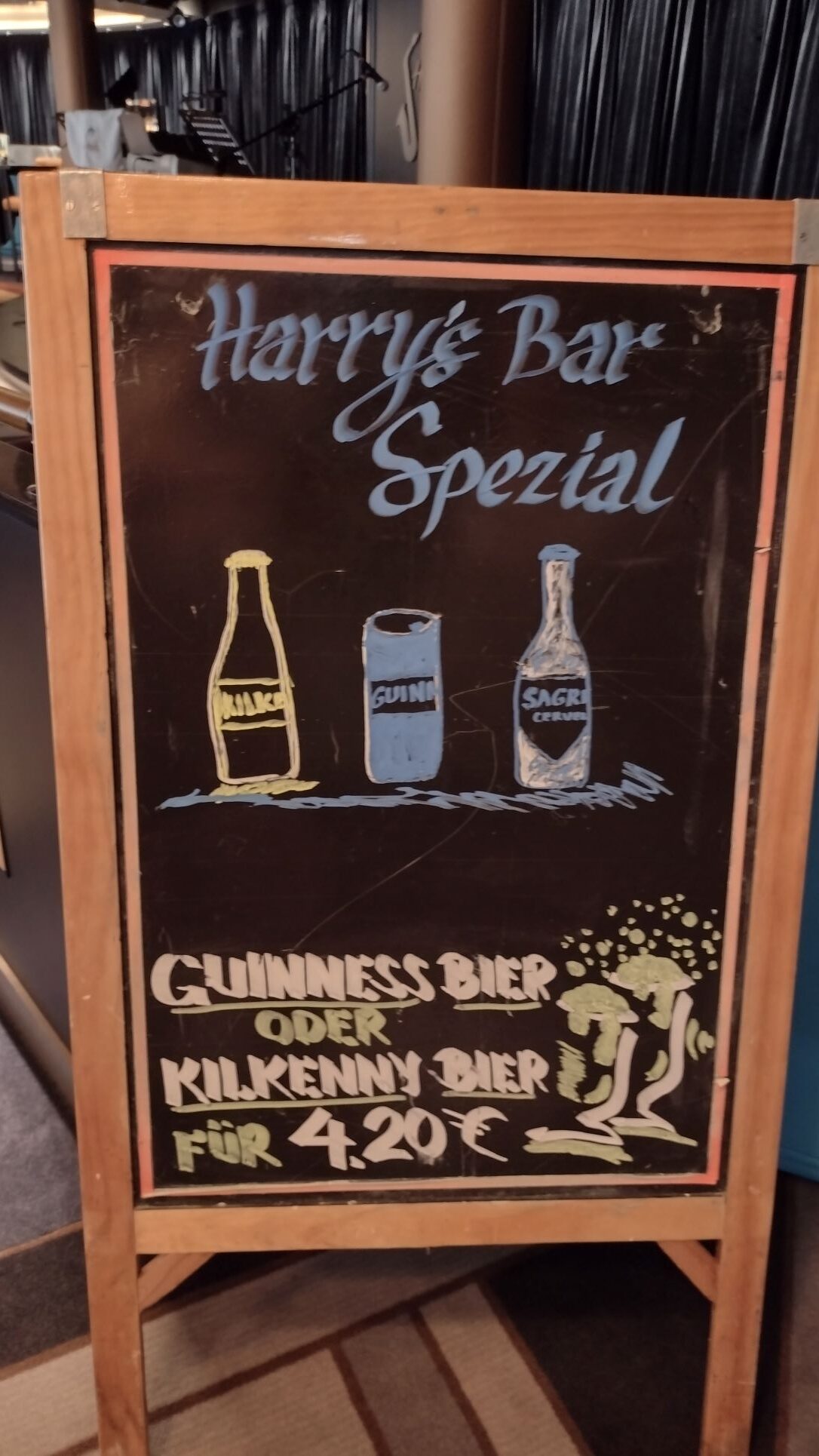
There was a promotion for a drink or cocktail every day. A pint of Guinness for Euro 4.20 / 3.64 pounds / 4.89 US is not bad at all

Points for improvement:
*Get better cast shows and have them choreographed by somebody who knows how to do that. This was awful. Full Stop.’

The backing music (click- track) was too thin and needed padding out and the lighting was from a bygone era. The spotlights on the side of the sound booth were not used while with HAL they formed an integral part of the show.

The cast (no doubt talented) were not good enough. It was a pity that the talented trapeze girl had to work in this show set-up  and in a show lounge with such a low ceiling. If somebody from Phoenix reads this, then please look on U-tube and you will be able to see what can be done with such a small stage as Holland America managed it.

*Tender service. It ran extremely well with no delays but antics of some of the drivers…. e.g lack of docking experience…… could be dangerous during windy weather.
*It would help if what is included in the “Gold service” or “Silber service” would be completely listed. There is some under the cabins specifications when you book, there is some that we found out when googling a travel agent site and some we only found out when we got there.
*Same for the suite cabin amenities. Nowhere does it say that you get slippers in the cabin or umbrella’s so we brought them with us,
*Maybe an ice bucket in the cabin for the suites” Our steward found a way around it, but with a double suite, it should be a standard thing.

Can a non German speaker survive?

YES, all the crew speak English and often better than their German. English menus are available in the Dining room, and with Google Translate it is not difficult to translate the German Daily Program.  The only thing you have to get used to, is that the cruise is driven by the Daily Program and that there are no reminders for those who do not read programs, or expect to be reminded by announcements. Phoenix really expects that as you have a brain that you use it.  I loved that part of the operation as I hate interfering announcements.

During my posts, there is always more texta than photos. My Dutch firends have also a blog running for the friends back home when they are travelling. that has more photos than (dutch) text. This is the link:

https://www.polarsteps.com/RuudvanD/18239437-bremerhaven-en-cruise-amera-naar-noorwegen?s=ea486edc-5129-47a0-a9ae-e71c3a170923

A very nice touch was the thank you letter, see below, we received 7 days after the end of the cruise, something I have not seen any other companies do, apart from trying to have you book another cruise. This felt quite personal as the Captain and Cruise Director laid the link between the ship and the guest, instead of just some vague general / letter / email from somebody in the head office.

Willkommen zu Hause
Sehr geehrte Frau Schoonderbeek,
sehr geehrter Herr Schoonderbeek,
Reisenleiter Herz

vor wenigen Tagen haben wir Sie an der Gangway von MS Amera verabschiedet. Hoffentlich hatten Sie eine angenehme Heimreise und sind gut nach Hause zurückgekehrt.

Dem gesamten Schiffsteam rund um Kapitän Dariel Valdes und Kreuzfahrtdirektor Joe Liemberger war es eine große Freude, Sie an Bord zu umsorgen und mit Ihnen gemeinsam schönste Reiseziele erleben zu dürfen.

Wir hoffen, dass Sie sich bei uns rundum wohlgefühlt haben und die Reise Ihren Wünschen und Erwartungen entsprochen hat. Am meisten würde uns freuen, wenn Sie sich noch lange an viele schöne Momente und Erlebnisse Ihrer Reise erinnern.

Auch der schönste Urlaub ist irgendwann zu Ende, und nun wünschen wir Ihnen, dass Sie ganz entspannt in Ihren Alltag zurückkehren.
Vielleicht schmieden Sie ja schon wieder Pläne für die nächste Auszeit.
Dem gesamten Phoenix-Team an Bord wie an Land wäre es eine große Freude, Sie recht bald wieder mit einer neuen Reise begeistern zu dürfen. Seien Sie stets an Bord von MS Amera oder einem der anderen Schiffe von Phoenix Reisen auf das Herzlichste willkommen!

Wir wünschen Ihnen alles Gute und senden Ihnen herzliche Grüße.

Willkommen an Bord! – Willkommen zu Hause!

Ihr

Michael Schulze
Direktor Schiffsreisen
Bonn, den 08.08.25

31 July 2024; At Sea.

Today we are on our final day of the cruise and sailing south from Norway towards Bremerhaven Germany. Yesterday the Shipping Forecast gave rough weather but we were tucked deep inside the Norwegian Fjords and by the time we came outside it was already a lot smoother. Today we woke up to sunny skies and smooth seas with only a low swell running from the west. That could have made the ship wobbly but for that we have stabilizers. New ones were installed during Drydock 2019 and they are working as expected.

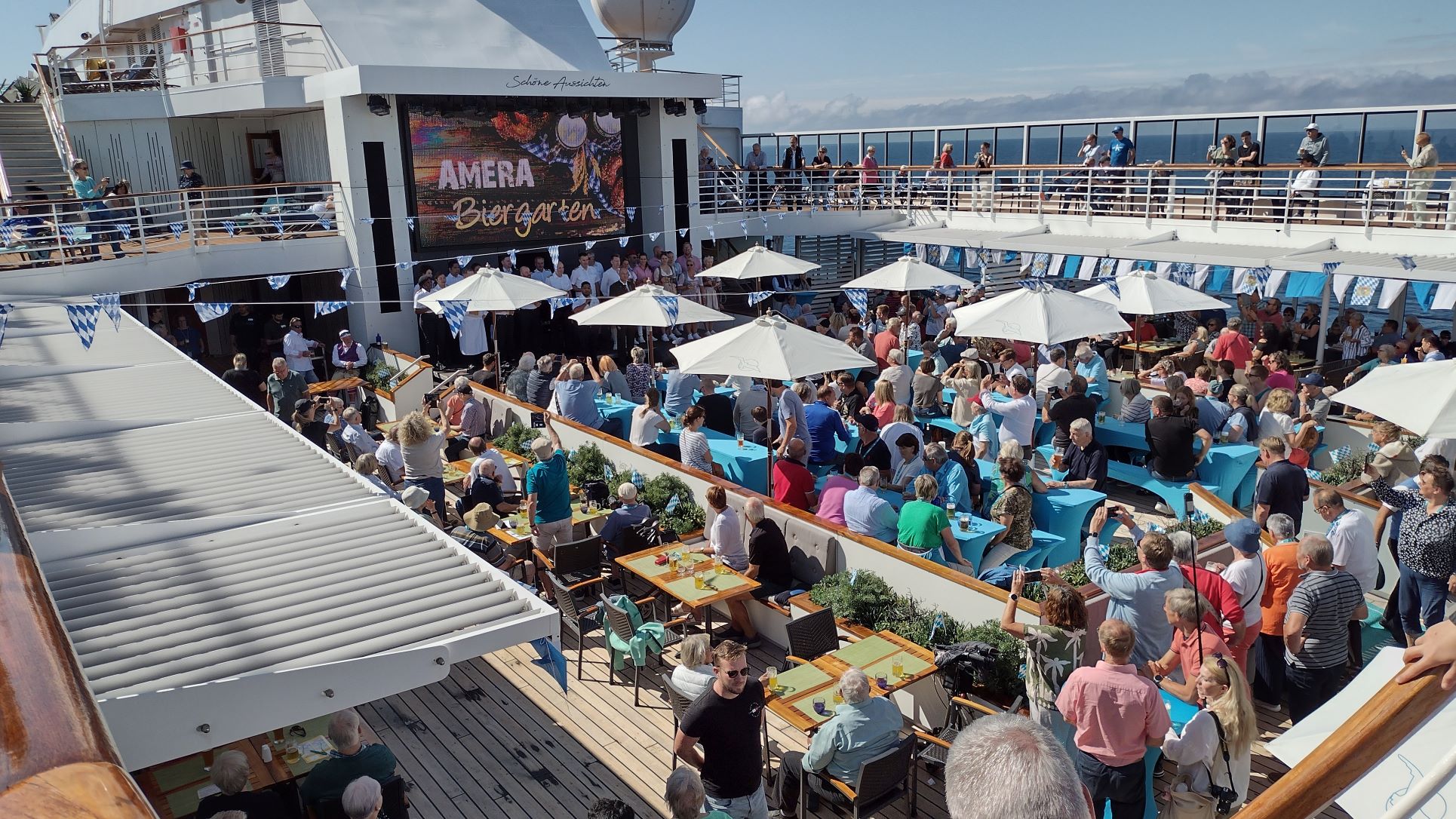
The party place on deck 11 midships. I did not see a single table that did not have a glass of beer, or more on standby. If there were non drinkers on board, then they must have been hiding somewhere.

The daily program was all about food & drink with the first main event being the “Bier Garten” or Beer garden, loosely based on the Munich Oktober Fest and with “Frei Bier” and Bavarian Specialties. As expected the Germans were out in force and most had secured a table well ahead of time with all the seats filled by the time the festivities started. As it was sunny, the crew installed parasols in the center section to ensure that those who did not want a sun burn, would not get one. As most were going to be there from 10.30 to 14.00 hrs. (with free beer and food between 11.30 and 12.30) it was going to be a long day.

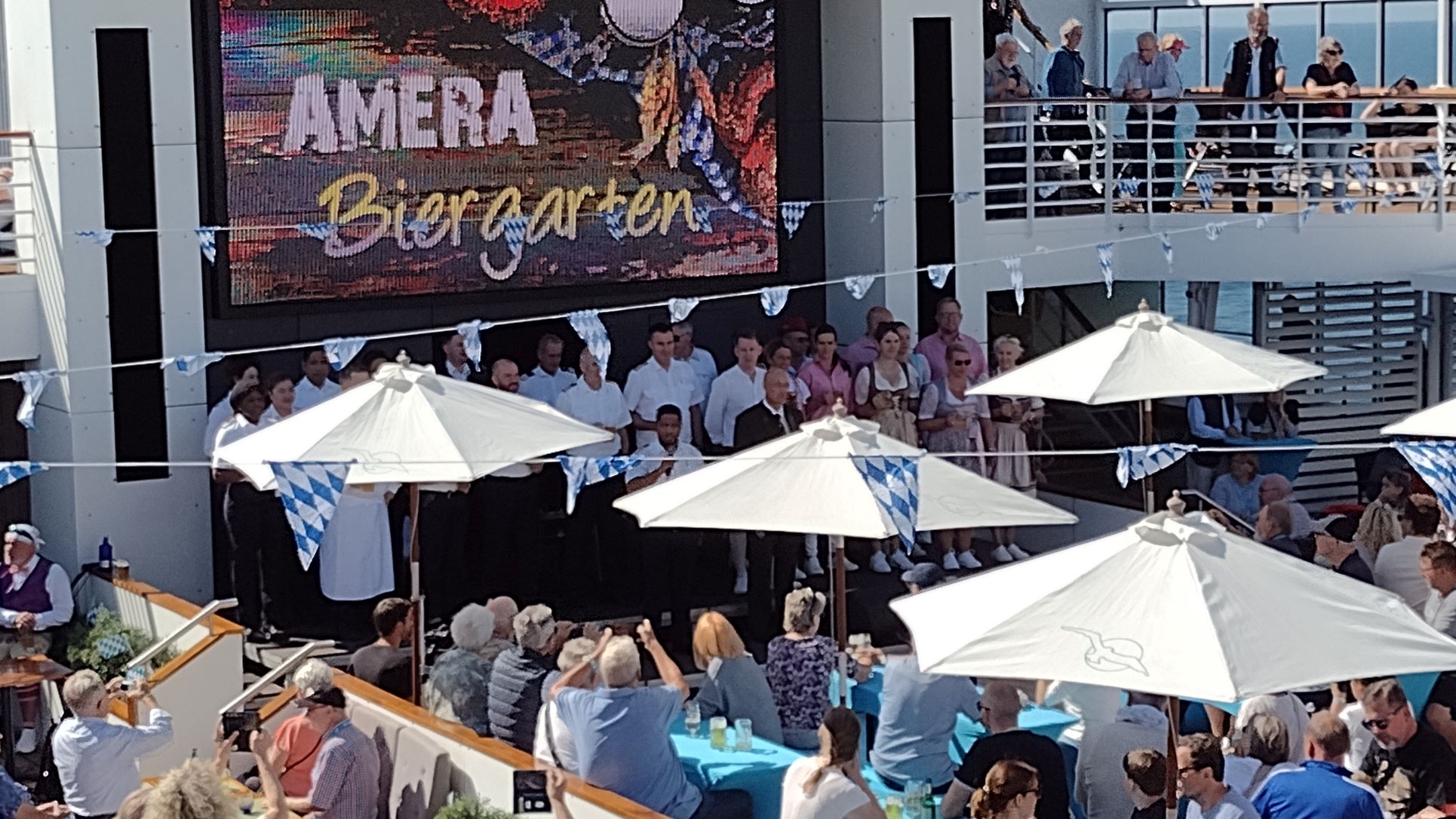
The farewell speech of the captain. Followed by a toast on the good cruise had. The captain announced that he had apple juice in his glass and later on I saw a lady sniffing at the glass to make sure it was.

The whole thing is a sort of farewell show with the Captain and Ships staff coming on the stage (with a glass of beer in the hand) to say thank you for being on board and hope to see again. Most of the Cruise and support staff were in various stages of folk costumes from Bayern to give a sort authentic feeling to it all and then the buffet opened and from there it went by itself. “Duo-lin” the two man band from Harrys’ Bar provided German Country and Folk music and by the time that the waiters had gone around for the 3rd time with pints of German Bitburg beer, the mood got very Beer-Hall. The Captain went around with his beer glass (but with applejuice in it) through the crowd to take selfies at the various tables. The ships photographer could have made a lot of money had they been able to go around with him. I calculated that I easily could have been served 6 pints of beer in that hour as the waiters kept, the pace up and even started to bring out free “Schnapps” as well; But as there is always “somebody” watching me, I did not make it that far as I also had to get some of the “Bavarian” delicatessen and had a discussion with the ships Vicar / Reverend who was also on deck and enjoying a drink. I do not like men or women of the cloth who do not drink as they are forsaken a lot of what God has put on this world to enjoy but he was hoisting a pint, so we had a good chat about Maritime Days in Warnemunde and the connection with it to the church. (The full story is somewhere in the daily blogs of 2010) Then we had a quick lunch where I tried the Vegan menu which was amazingly good and spicy.

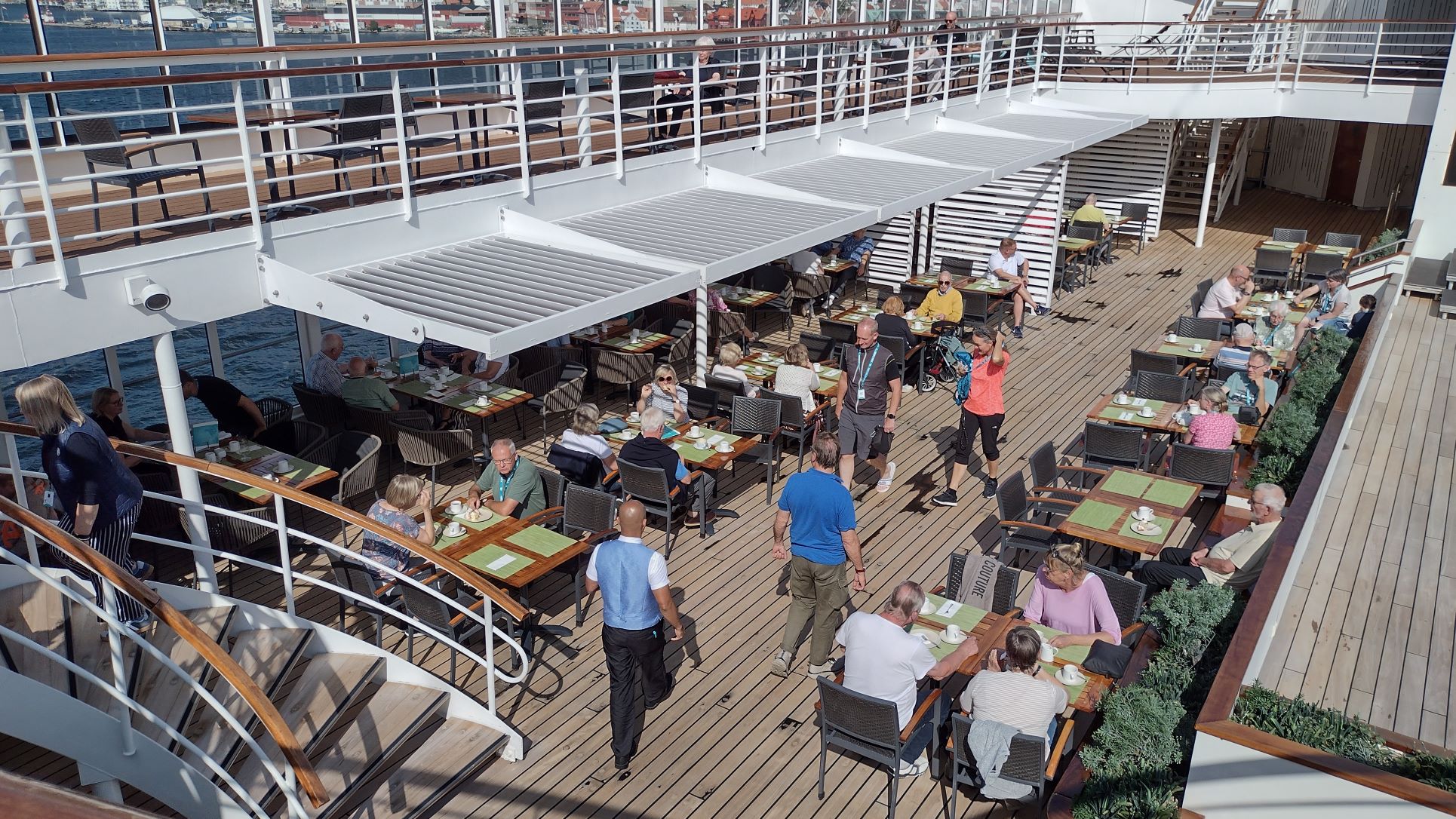
Tables made ready for German tea in the afternoon.

On the way out we saw the crew setting up the dining room for the afternoon tea (15.30 – 16.30) On port days it is in the Lido and on sea days in the 2 dining rooms. Somewhat like Holland America Line does with “High Tea” but now on steroids’ and for the last sea day of the cruise a bit more elaborate. We did not attend as we had eaten already more than enough in the morning. Plus we had the important challenge of packing our suitcases. The more experienced guests had already packed in the morning, knowing the amount of alcohol coming at them but we decided to pack in the afternoon.

That gave a matrimonial discussion about what to wear as Phoenix Reisen has a formal night on the last evening of the cruise, when that cruise is a shorter cruise. During the first formal, I did not see too many people dressed up, beyond jacket and tie, so we decided to forgo the full formal variation and tuned ourselves down to what most of the Guests decided that was in their eyes “Nice Enough”. So we will be – nice enough – and then pack up the rest. Suitcases out of the cabin is by 2 am. but we will be earlier than that as we are most likely the first ones off tomorrow morning at 08.30. Lesley being an “Alien” in the eyes of European Immigration had to turn in her passport and she can pick it again after arrival. Then when leaving the Netherlands at Hook of Holland tomorrow evening, she will get her check-out stamp so we have proof that she did not over stay her time in the EU. In October Europe goes digital and will then have the same system as the USA, Photo and Finger prints. Not for me, as I am semi British (Settled status which is a sort of Green card), on the Island side and Dutch on the European side. The UK is also planning to do a similar thing but it is rather vague how that supposed to work as their (His Majesty’s) Custom and Border Force is absolutely not ready for it as it has not enough officers. So it either will be postponed or we will have long waiting lines at the airports and ferry terminals.

Final dinner was in the main dining room and our friend Ruud had asked if there was anything Indonesian for dinner as so many of the crew was from Indonesia. To our utter amazement there was and the kitchen was able to provide aside from the German food, also Sate with rice (pork sate with peanut souce) and a Soto ayam soup. (Indonesian chicken soup) so we did not need any main courses anymore. After dinner we did not go to the show as they had done the Revue show (songs from hollywood) at 17.15 hrs. and that was our packing time. The bars were still full with guests all eager to be out for a final night.

Tomorrow will be in the ships home port of Bremerhaven we are expected to be together with the Amadea from Phoenix Reisen. Disembarkation time is 08.45 hrs., with silent disembark so hopefully we will be off by 09.00 hrs. After getting a taxi to the hotel to pick up the car we will go back to England. Our friends will drive to their house in Lunteren ( in the middle of the Netherlands) and we will see them again near the end of the year. We have the night ferry back to the UK so we have all day to get there (It is approx. 5 hour drive) but we also have to go shopping in Holland to stack up on all sorts of goodies we cannot get on the island. Some items like cheese are not allowed to take home anymore since Brexit as the EC health standards do no apply any longer. The UK has not changed those standards since Brexit but it now needs another stamp than before and thus we have extra red tape to deal with. Hence it will be “stroop wafels” (caramel wafers” rice, licorice, and chocolate (You are not allowed to take milk back to the UK but choclate is ok) Weather back home wil the same as we have today 18oC and sunny.

After this blog, there will be one more with “The Verdict”. and an advise if this is of interest to pure English speakers who can think & enjoy themselves a little bit outside the box. I will then also post a link to my friends travel blog with all the food photos of those might enjoy that. That will be posted coming Sunday.

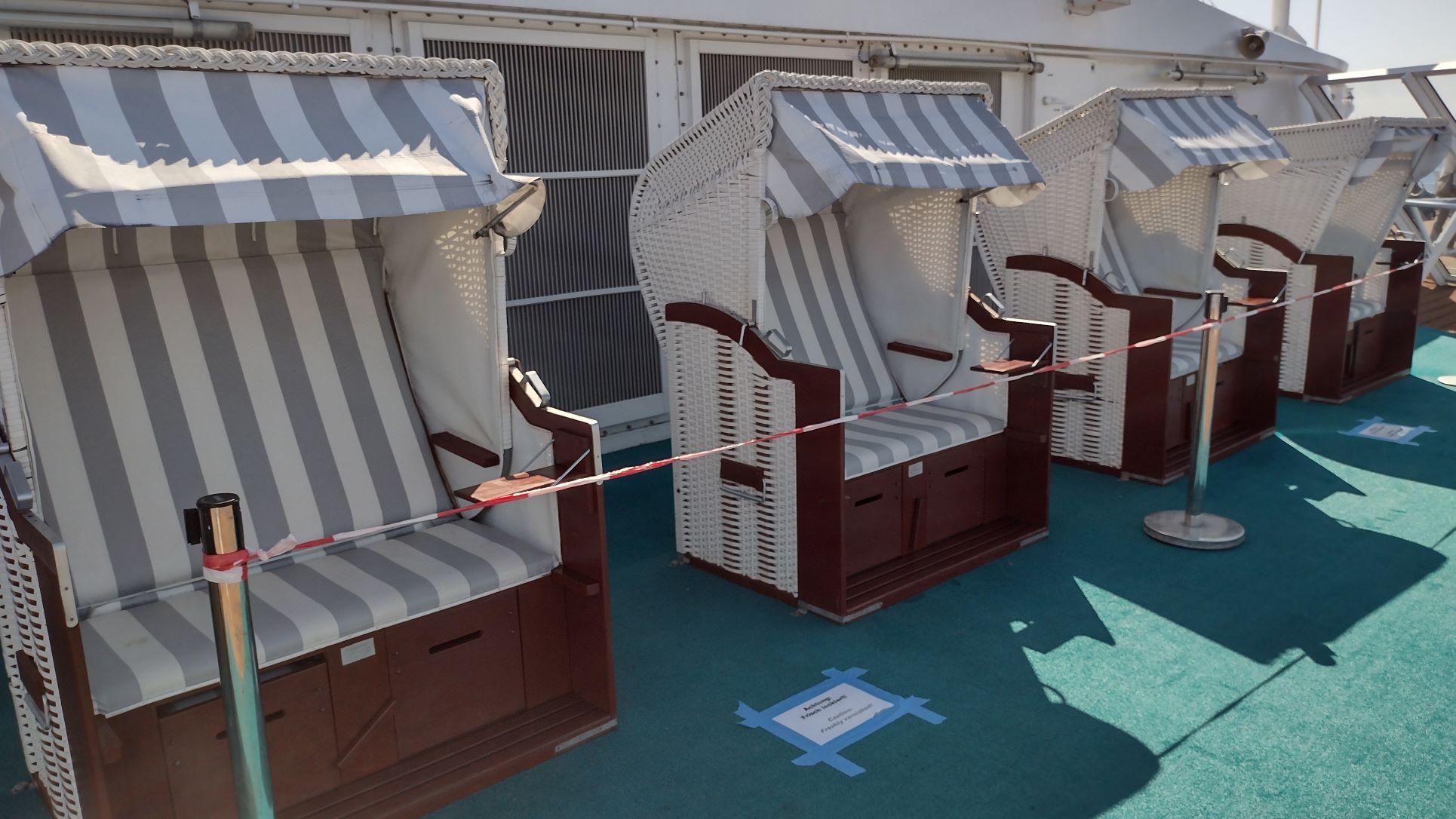
Nice deck chairs for a nice sunny day, and then the deck department starts painting.

Smile of the day: Sometimes things do not go as planned. With a sunny day and most guests on the outside decks, the bo’sun had decided to paint the deck chairs on the shady side, most likely with the un-beatable logic of “the guests want to sit in the sun, not in the shade so I can paint on the shady side. No doubt with good intent but as a deep sea professional it goes a bit against the grain. If the project was authorised by the chief officer, then I will need a good glass of beer to get over that shock.

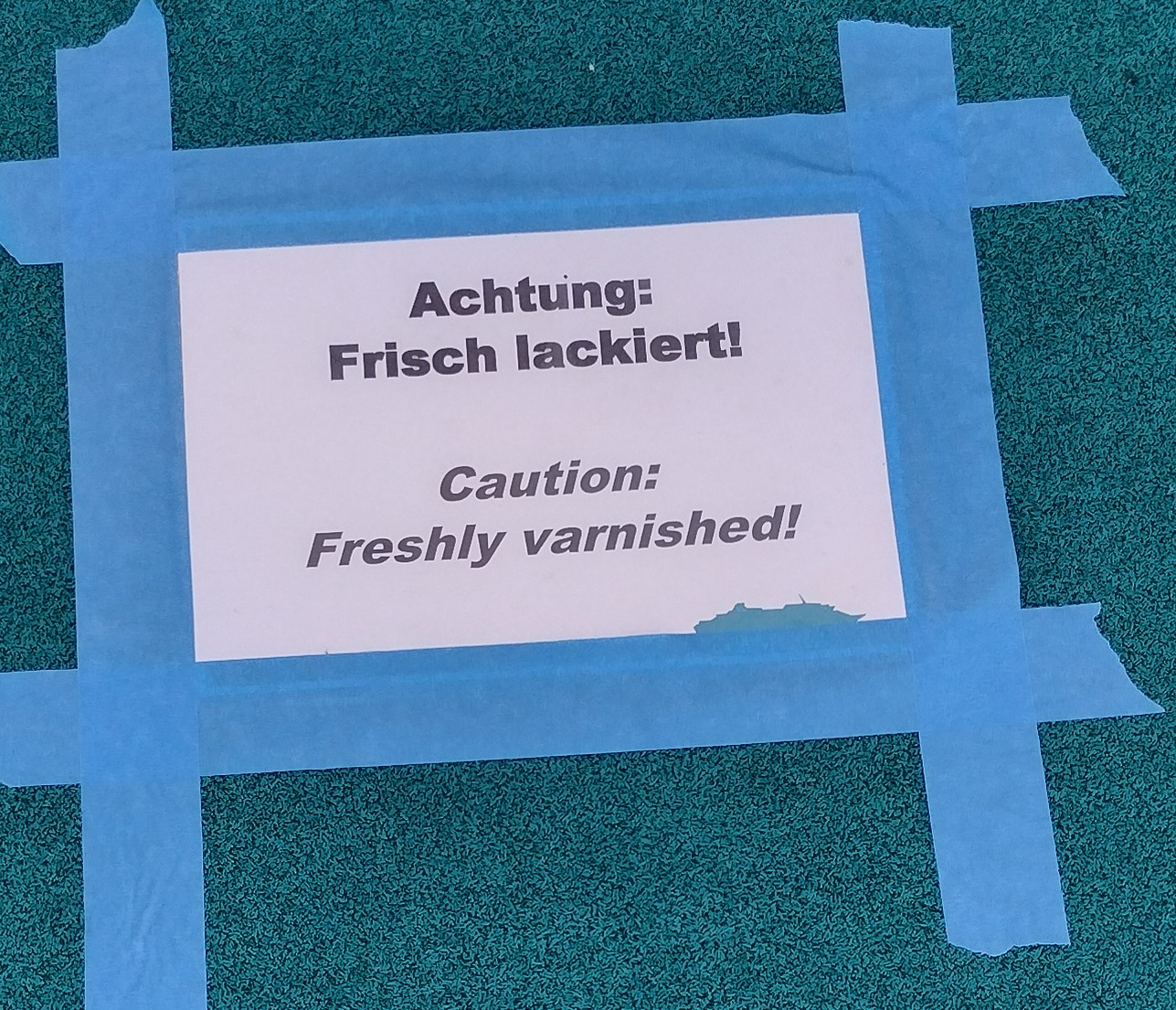
Luckily the wet paint sign was completely in accordance with International safety rules which require that the text can be in the national language but has to be in an international language that is understood by everybody on board. 

30 July 2025; Ulvik, Norway.

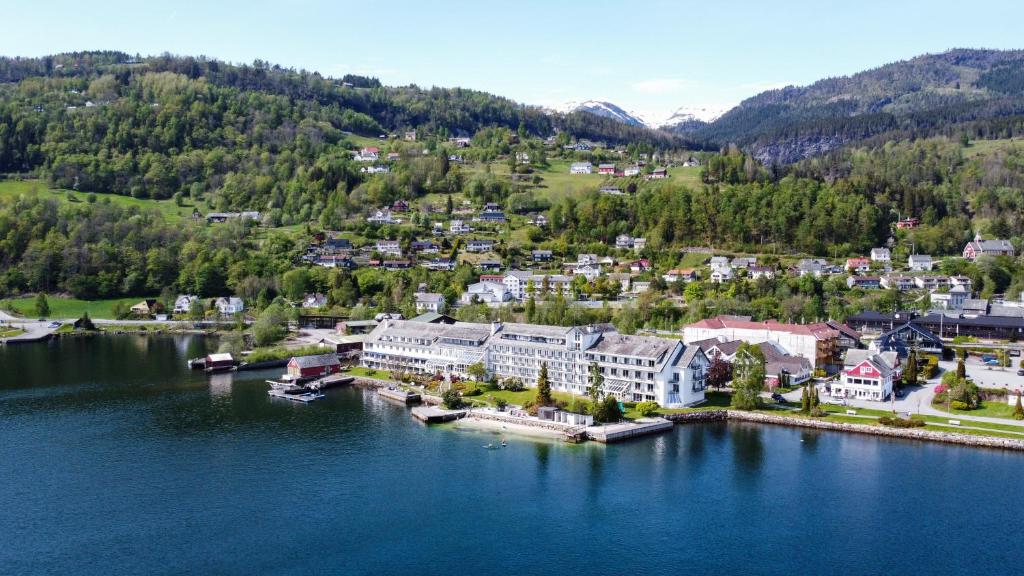
The Brakkenes Hotel in Ulvik and official Tender port for the ms Amera tenders.

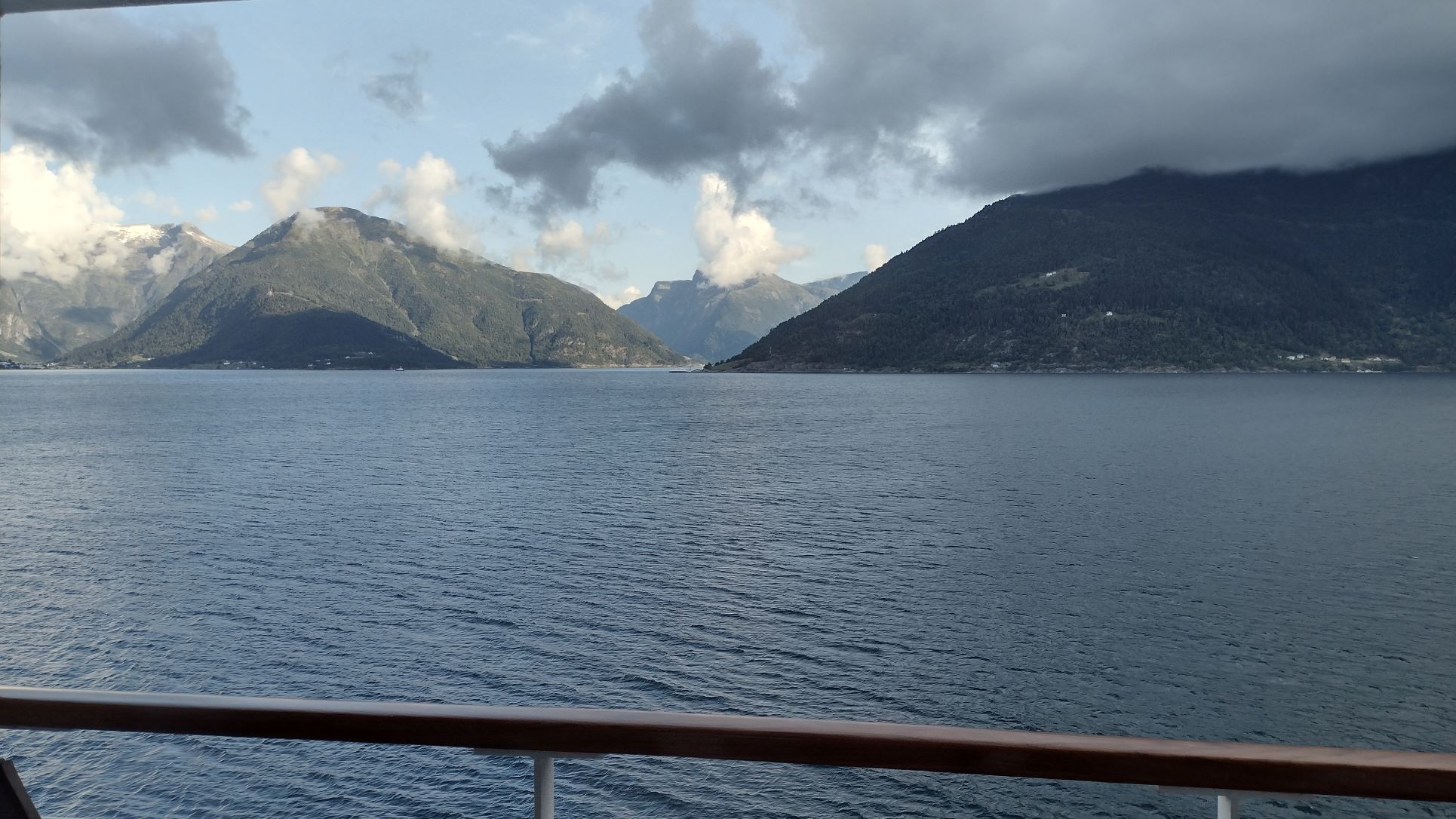
Today we were in Ulvik, a small town located at the end of the Eidfjord which is an extension of the much larger Hardangerfjord. In principle it is one of the “fingers” at the far end of the very wide Hardangerfjord. From sea it takes about 4 hrs. to get there, hence an earlier morning for the captain planning on a 0700 arrival. The first section can be done at 16 knots and then with the fjord getting more and more narrow the ship has to slow down to 10 knots. Then when it ends at Ulvik, the fjord widens in a sort of small lake, large enough for the ms Amera to anchor safely. Being so deeply tucked away into the fjords meant that it was a wind still day with partly cloudy skies and an official temperature of 18oC / 65 oF but with the lack of wind it climbed quite a few degrees.

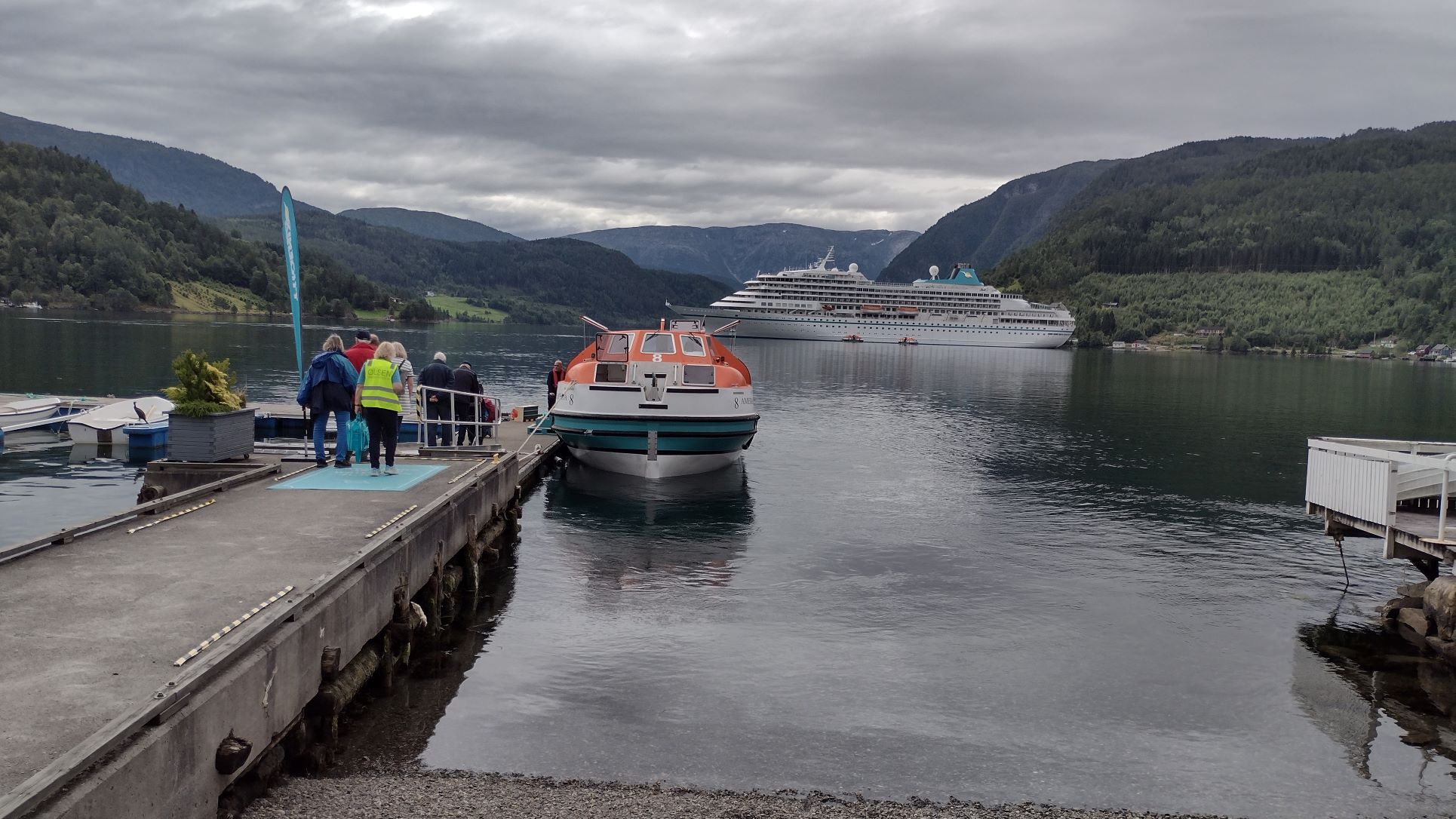
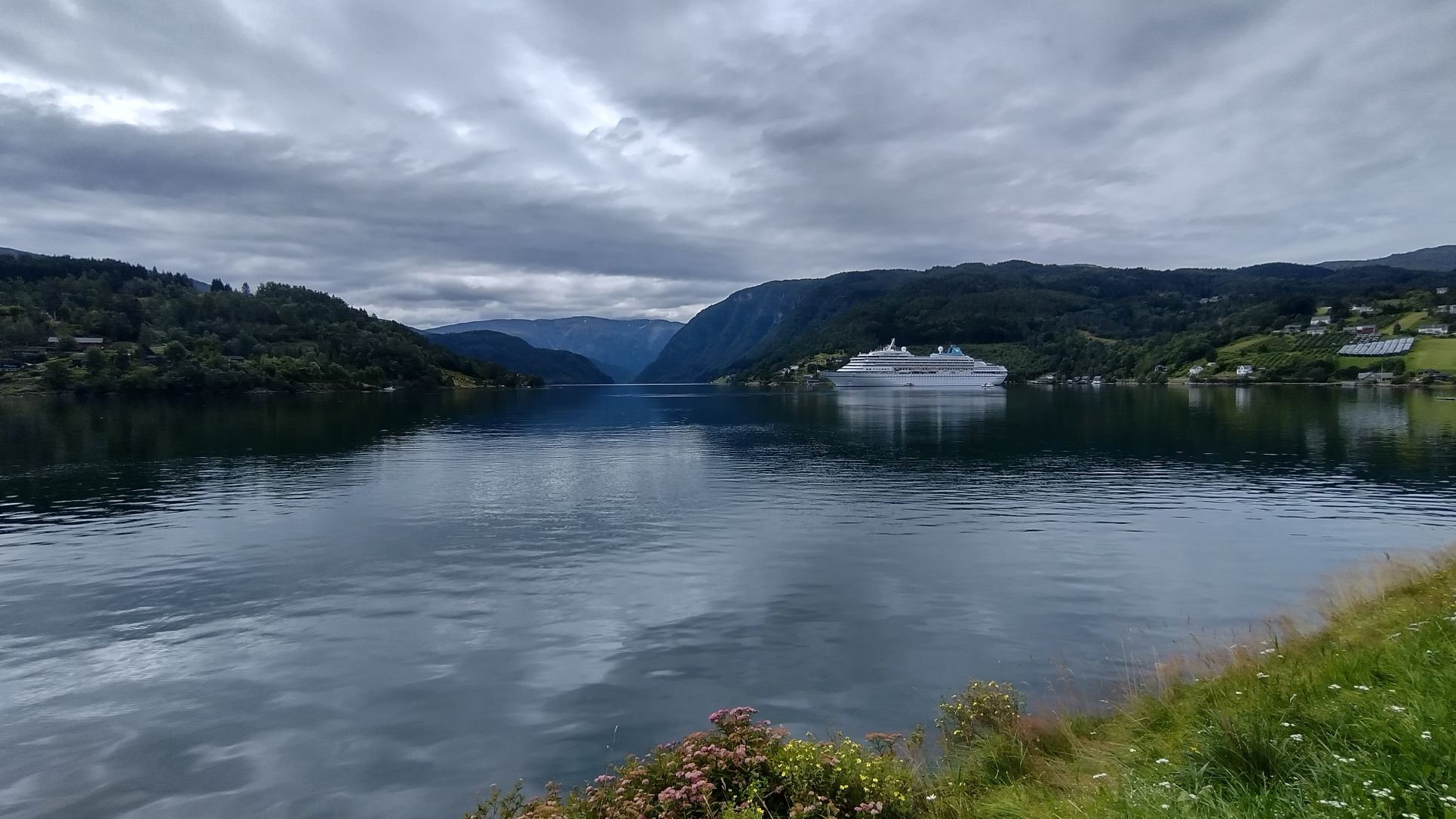
View of the ship from the tender dock

Ulvik is far removed from anything “big” and the connecting road goes from small village to small village and to get to the first major city is a long drive. Still it is a sought after place for people who travel through the country and thus there are 3 hotels here near the water but one seems to have gone bankcrupt as it looked in a sorry state with most of the inventory still inside. But the town is so remote from the major city centers there seems to be a distinct lack of Hooligans available to cause damage. The biggest and most successful hotel, the Brakkenes, had built a tender dock and thus the tenders run the service from there. Quite a clever idea as quite a few guests, after walking around and seeing that there was nothing to do, went for coffee and cakes and sat on the hotel benches to admire the impressive scenery. And that is the main reason we are here to day, the tour busses/coaches had a good place to stop at the hotels parking space and those not on tour could enjoy the scenery. The Norwegian fjords are scenic everywhere but this area gets one of the highest ratings of the “Fjord experts”. Time simply seems to go much slower here thn anywhere else. I wonder if during the winter, it is almost coming to a standstill………………………
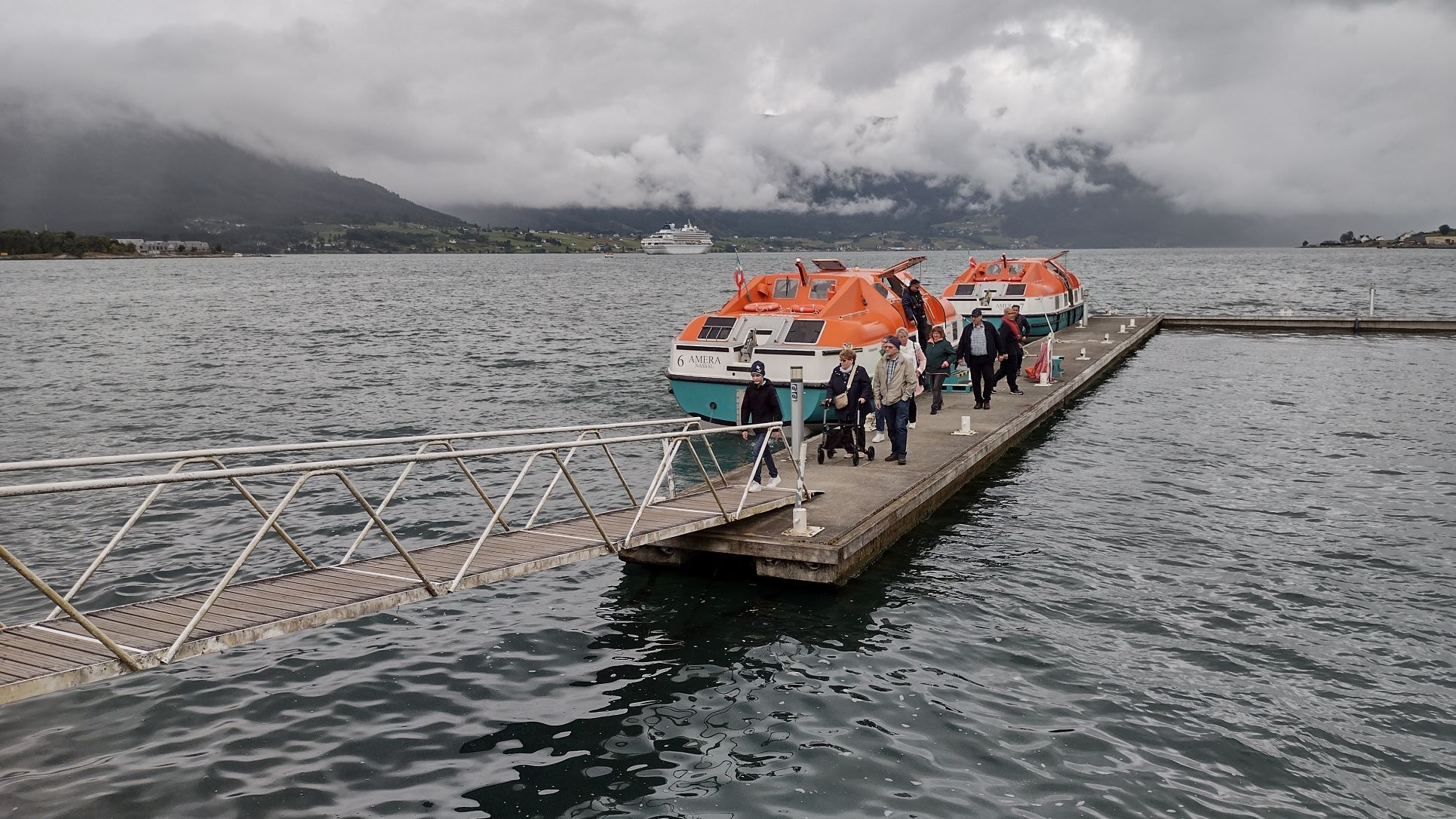
The ship could anchor reasonably close to the tender dock, so we had a 2 tender distance today but they started with 3 tenders to get the tours off as the tender dock was big enough to handle 2. It was interesting to observe the tender drivers as some of them had not really mastered the basics yet and one missed – while it being wind still and current free- the dock by about 6 meters. Hopefully the ship has an extensive training plan in place because I wish them luck in the more windy ports.

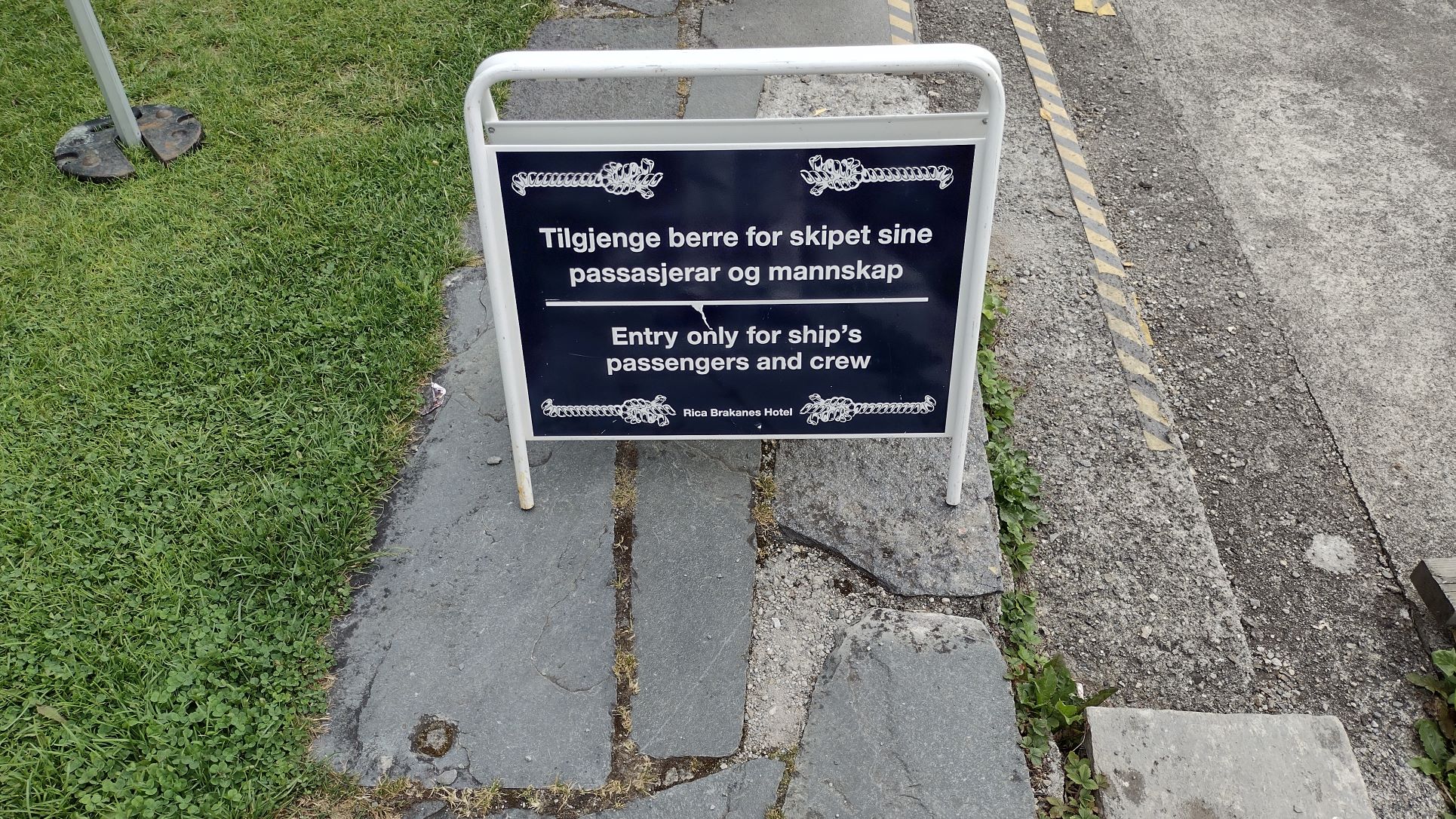
This is the main sign to protect the ship from local mayhem. It worked without a glitch.

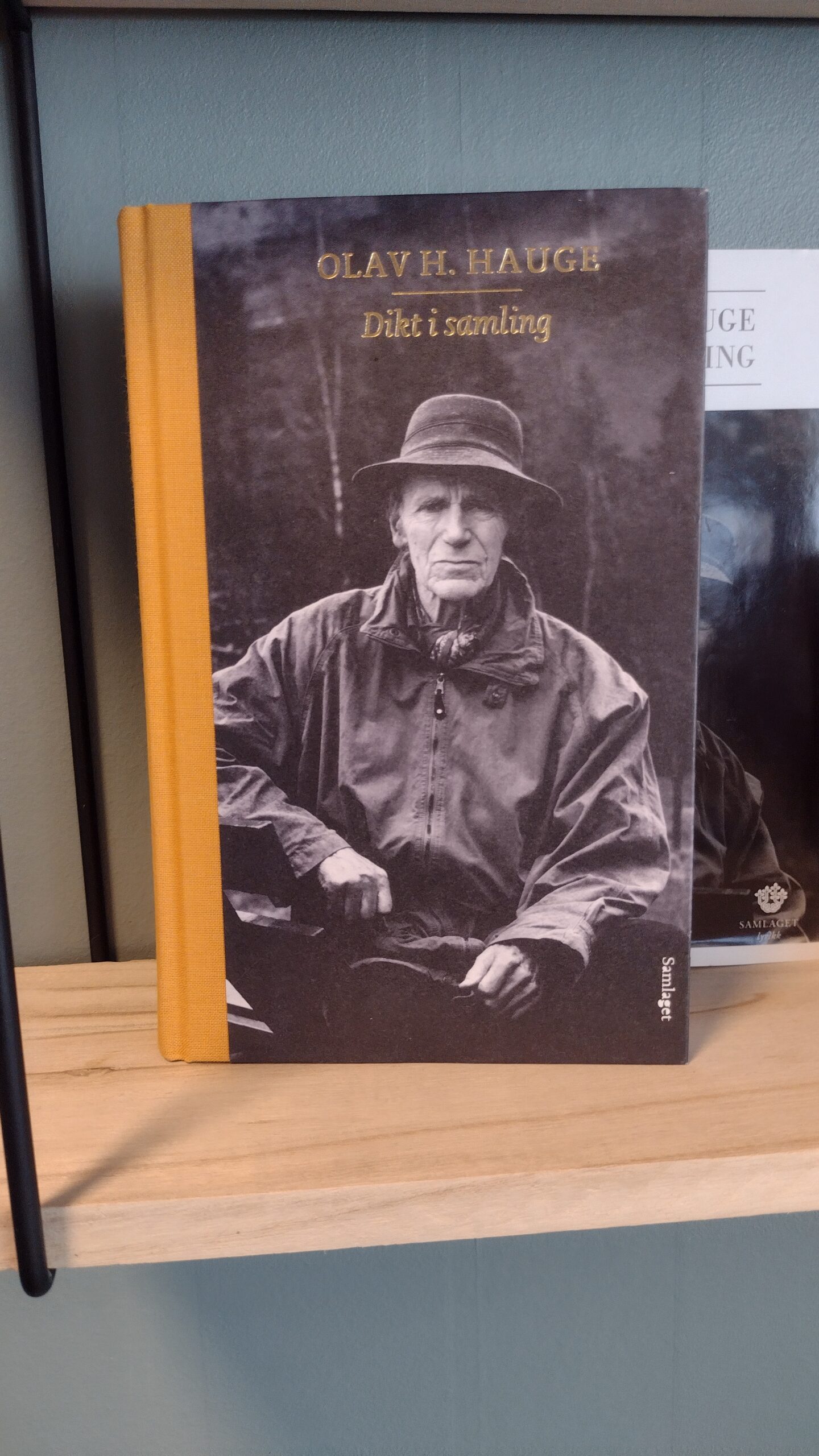
Ulvik is very small and I counted 4 regular shops, which were all closed as they had decided to go on vacation at the same time. The tourist center opened at noon, four hours after our invasion began in the morning and the only place open and busy was the local CO-OP super market. Ulvik’s claim to fame is to have been the birth place of the Norwegian Poet Olav Hakonson. Hauge. (1908 – 1994) He lived there all his life, was involved in Horticulture and published his first poems in 1946. He is considered one of Norway’s most beloved poets and they turned one of the largest houses in Ulvik into a museum. When walking around we found several “traffic sign” size signs with a short poem of his on it, which you could read while looking at the scenery. Quite a nice way to get people focused on poetry. Main traffic on the road were indeed tourists in RV’s or regular cars and we observed a “column” of Dutch cars coming by who had left the hotel on their way to the next beauty spot. Indeed the most foreign license plates you see are from Dutch people, who due to their language skills have no problem, and no fear, to travel anywhere. Years ago, when I was captain of the Prinsendam, I docked in Kirkeness near the North Cape with the bow overhanging the local parking area and right in front of me, taking up half the parking area, were a large number of Dutch Cars. They then biked the rest of the up to the North Cape. Yesterday we saw a 1960’s Volkwagen “flower power style” camper coming by, indeed manned by hippy- type owners and their brood and they had also made it deep into Norway while driving a 70 year old mini van.

Ulviks famous son, the poet Olav Haugh or Hauge. His poems have been translated into English and can be found on the internet.

So we spent 1.5 hrs. ashore for a nice walk, avoided the ice cream stand (55 NOK for a small cornet) and got back on the tender before the tours were coming back. One thing that makes me smile are the security arrangements in each port. Each dock is supposed to conform with the ISPS regulations (International Ship and Port Facility Security), which includes regulations for fences, screening and supervision. In Sandane they had a sign, and nothing else, that said this is an ISPS port and today, there was nothing except the nice ship security lady with a clicker. It must be wonderful to still be able to live in an area where nothing is needed to be safe. But as mentioned above, Ulvik is too far away for any self respecting hooligan to make mayhem, so all is still well in the world here. Norway has very strict fire arm laws, strict enough that it is not needed for the local police to be armed. To get a license there is an arduous process and then one normally only gets a license if there is hunting involved. Then the police will visit your house regularly to see if the fire arm is safely locked away in a safe inside the house.

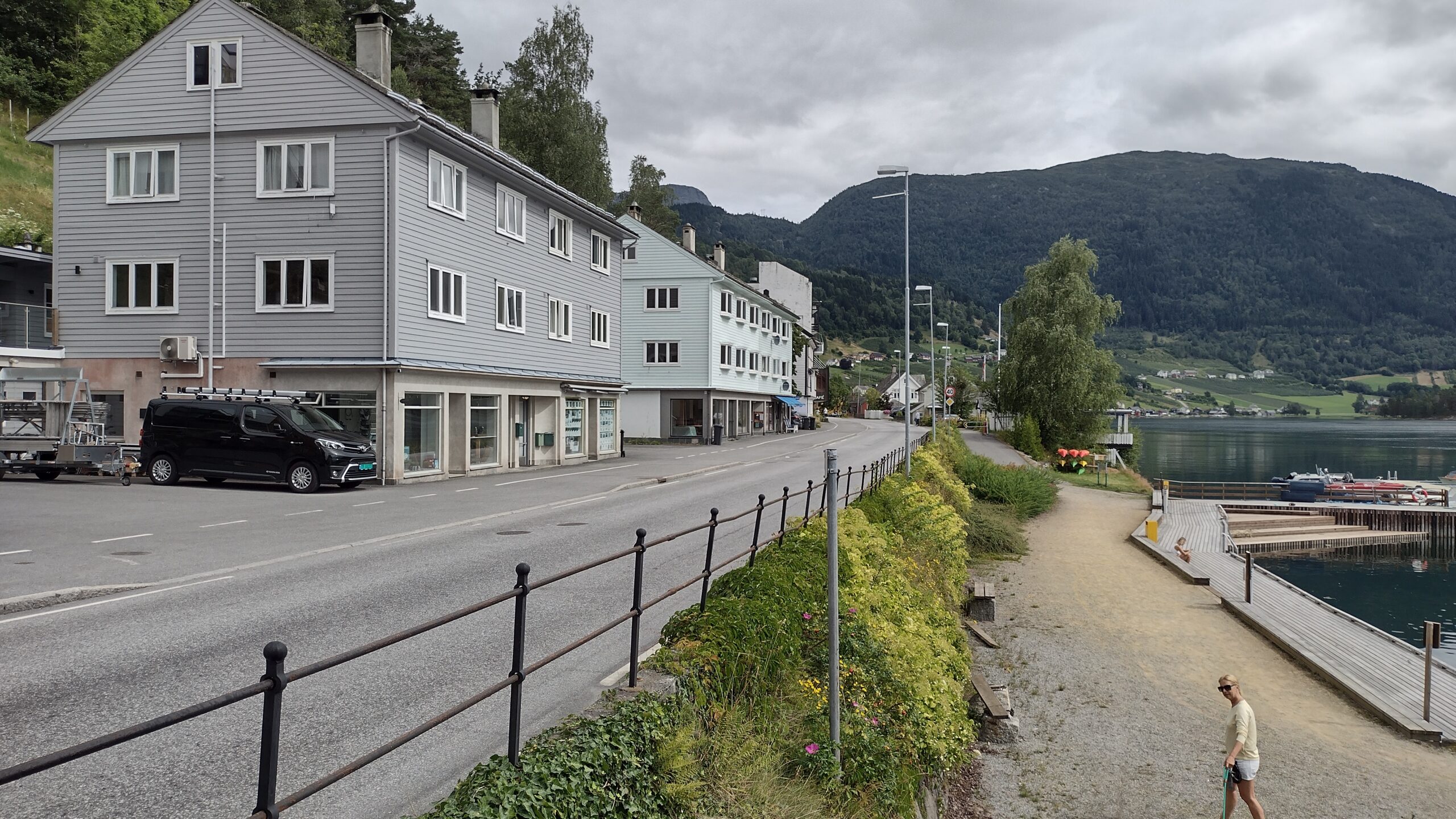
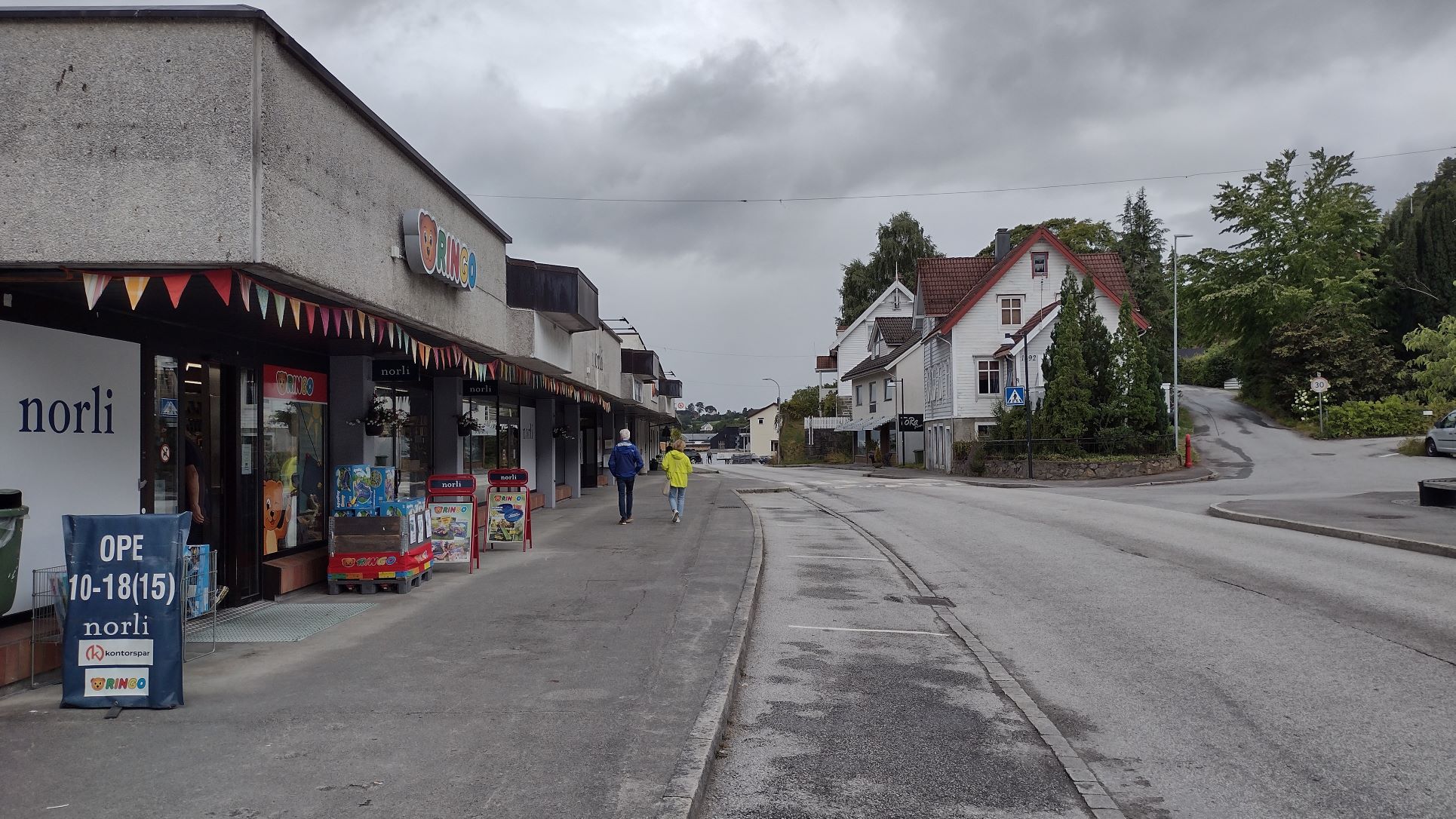
The main shopping street of Ulvik and all shops closed. All shop owners seem to have decided to go on holiday at the same time. Not a bad idea maybe, as nobody will be confused of which shop is open or not during the summer vacation season.

Back on board we scrutinized the daily program which came today with a flyer for duty- free orders. I assume the prices are good when compared to the German supermarket but we can do better on the ferry back to england so we let it slip by. As expected nothing was happening on board until the evening as the whole “event staff” is escorting tours each day. Highlight of the early evening was a Jewelry presentation in the shops. We went for the ice cream, still the same stand as in the Prinsendam days, except they have removed the Soft ice Machine. I was in line with a little boy who had brought a ships waiter with him to ensure he did get his ice cream with top ups, as yesterday a guest had emptied the whole bin with whipped cream (Slag-sahne) and he was not going to let that happen for a 2nd time. I fully agreed with him, having the right condiments for your ice cream (and you add those yourself) is a most essential part of one’s daily cruise experience. And it is not to be endangered by one greedy guest. So we spent the afternoon people watching as I still try to get my head around how the “German” flow on board works. We have now learned that they all show up about 30 minutes early before an event, so they are in place on time, that no announcements are needed to get people on time to the right location for tours as they all read the paper work, and that everybody is back on board in time (even ahead of time) so that “Herr Kapitan” does not have to wait. Hence we have departed from all ports, exactly on time.

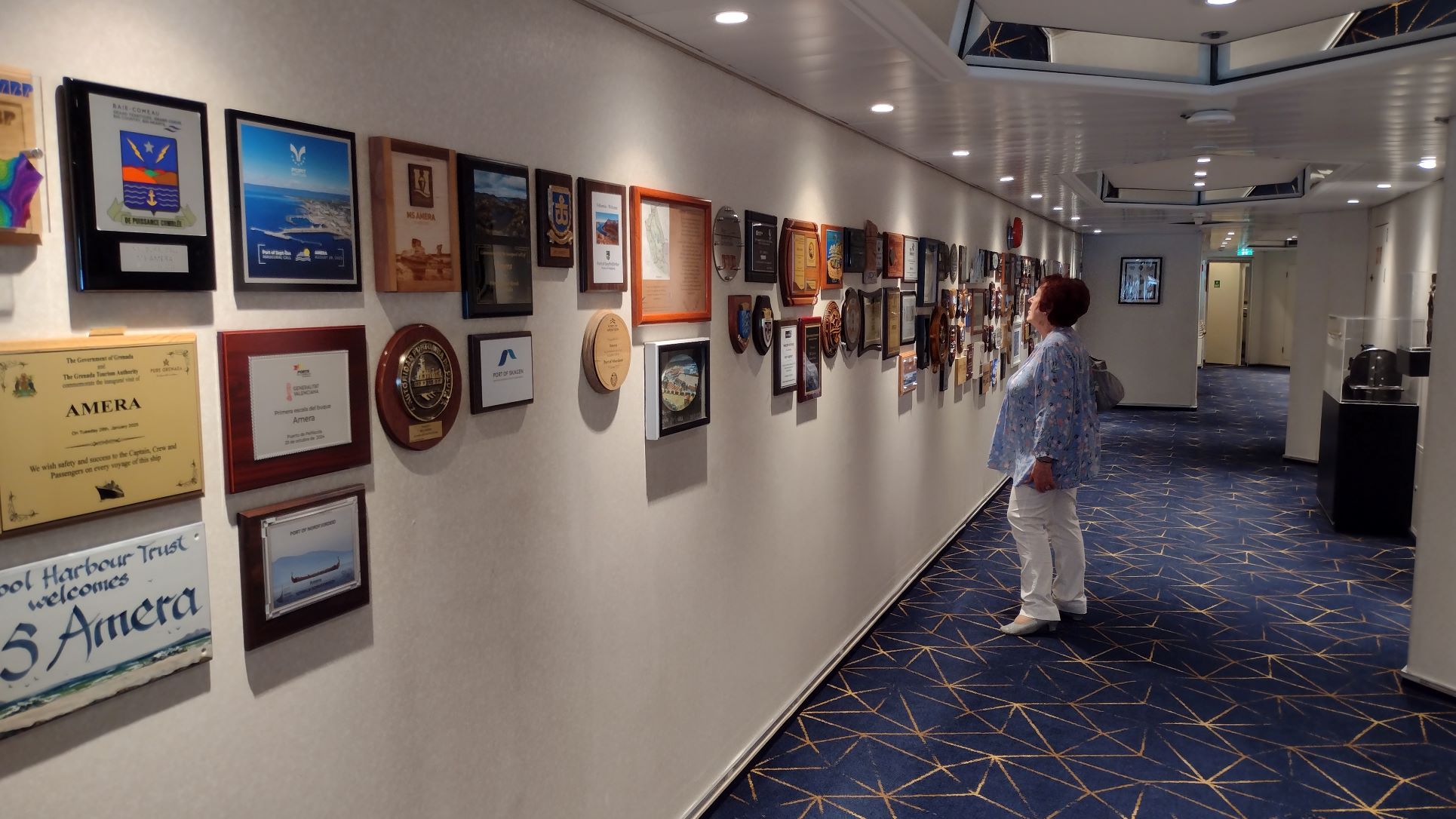
The ms Amera hall. of fame. As other ships, first -port-call – plaques are being put on the wall. Here my Lord and Master is checking if there is any port she has not been to, as the ms Amera also makes world cruises so the collection is going up quickly. This is outside the Crowsnest / Panorama Lounge where HAL left the collection from Royal Viking Sun in place. from the days that the ports still gave very nice presents.

The one thing still to find out is why the shows are not very well attended. We can understand the lack of “full house: interest as Cast shows are not very good but the show of last night, which was very good, was also only about 3/4 full. We sneaked this evening after dinner into the lounge for another Cast Show (now based on the songs of the Rat Pack). The show was slightly better than before but an Englishman trying to imitate in German, the antics of Dean Martin simply does not work. Again the lounge was not more than half full. The rest of the crowd was in Piano Lounge and Harry’s Bar enjoying the music with drinks on the table (and peanuts so even more drinks were ordered). We have not yet inspected the late evening snack so hopefully we will get around to that tomorrow. Here the “midnight buffet” is at 10 pm. which works perfectly after having had a few drinks after dinner in the lounges.

Ulvik Fjord, which country can beat such a view.We left Ulvik “punktlich” on time at 1800 hrs. and then enjoyed a 4 hrs. sail out through Hardangerfjord. Phoenix Reisen has a company tune, that they play all over the ship during the departure, and it gives a sort of Welcome Back feeling. We had our 2nd dinner in Pilchers Restaurant (Pinnacle Lounge) courtesy of having a Gold star cabin and being able to book ahead of everybody else and it was very good again. This time we were the last ones out and the Maitre had time to talk to us and was full of questions about sailing everywhere in the world. So I had time to give one of my 5 minute lectures again with the pro and cons of the Panama Canal versus the Suez Canal. Knowing the Philipinos and the way they enjoy gossiping, it would have gone around the crew messroom in no time.

Tomorrow we are at sea and on the way home to Bremerhaven. The weather is supposed to be good. Today while tucked away at Ulvik it was blowing wind force 7 in the open sea but it started to die down in the late afternoon so by the time we are in the open, it should be smooth seas again. Then tomorrow smooth seas and sun for a glorious last day with packing. We have received our landing tags for the suitcases, so what can still go still wrong in the world?


29 July 2025; Bergen, Norway.

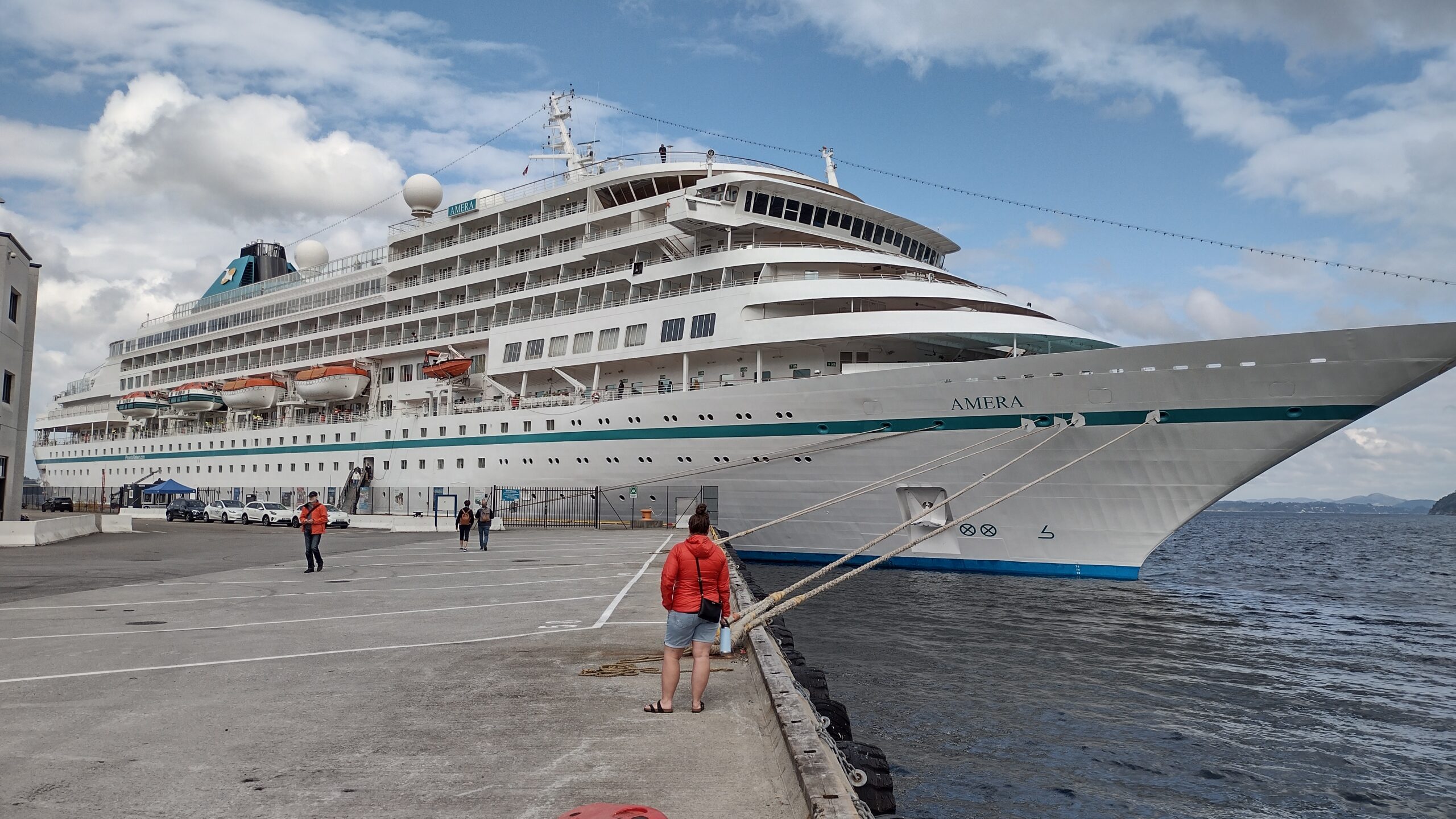
The ms Amera docked in Bergen. This dock is normally occupied by fishing boats large and small but it fits the ms Amera although there is an overhang with the bow.

Today we are in Bergen, docked at the Bontelabo dock which is at the end of the South West side of the Bergen old town right behind the old fort that guarded Bergen for centuries. With us in port, apart from several Oil Platform Support vessels and a number of large yachts, were the ms Trollfjord (Hurtigruten), ms Costa Diadema (Costa Cruises) and the ms Viking Saturn (Viking Cruises). The latter we had a good look at as Lesley and I will be taking a cruise on her in February 2026. We have heard some very good things about Viking so we are going to do a Mediterranean cruise. For that cruise we will have to fly, which I do not really like but then in each life some rain has to fall. No rain today in Bergen, although the port is quite famous for it, it was partly cloudy with temperatures in the mid sixties (18 – 20oC) and that is perfect sightseeing weather. We have been to Bergen many a time, also because it is nearly impossible not to visit it during a cruise.

It is the only major port on the west coast of Norway apart from Stavanger, and thus it falls somewhat automatically in the cruise schedule. There is Oslo to the South and Tromso & Trondheim to the north and not much in between, size wise. Hence for those with the urge for a good session of “retail therapy” going ashore is a must. There are some very nice department stores in Bergen and a large range of tourist related shops in the “Brygge”, the old wooden housing area on the west side of the harbour. My Lord and Master was going to hunt for Christmas gnomes. We bought some of a special design years ago in Tallin and here in Bergen and it was always the wish to make the series complete. So the Ladies went to the Christmas store and my friend and I marched around the port up the hill to the Maritime Museum.

As in the old days the “Norwegian America Line” used to sail from Oslo with calls at Bergen and Stavanger so there is a good amount of Ocean Liner history and ships models to enjoy. But those are part of the permanent collection and I enjoyed looking at all those years ago. This time my focus was on the bookshop. 10 years ago they had a nice collection of books, old and new, and as it is so difficult to order books outside the UK (since Brexit the postal costs have gone up dramatically, as for the European Union, the UK is now a 3rd world country) and getting them to my house for a decent price, the hunt is on where ever I get during a cruise. After a 25 minute walk into the suburb of Bergen we came to the museum and there was hardly anything there. A few new books, really focused on the main stream reader and small bookcase with rejects from the Museums library / archive. While I was going through , my friend explained to the lady behind the desk what I was doing and she ran upstairs as “there was some more there”. She came back with an armful and among them 2 books that caught my interest. One a bound year of “Sea Breezes” magazine and a book about Australian coastal steamers. Both surplus to requirements for the museum. The helpful lady wanted 20 NOK for the two, so for 2 Dollars or 2.5 Euro I had at least found something and for a very good price. And then we marched down the hill again and caught up with the Ladies who had not been able to find anything in the Christmas store and were drowning their sorrows with a McDonalds ice cream. Then we decided to split up and Lesley and I went back to the ship.

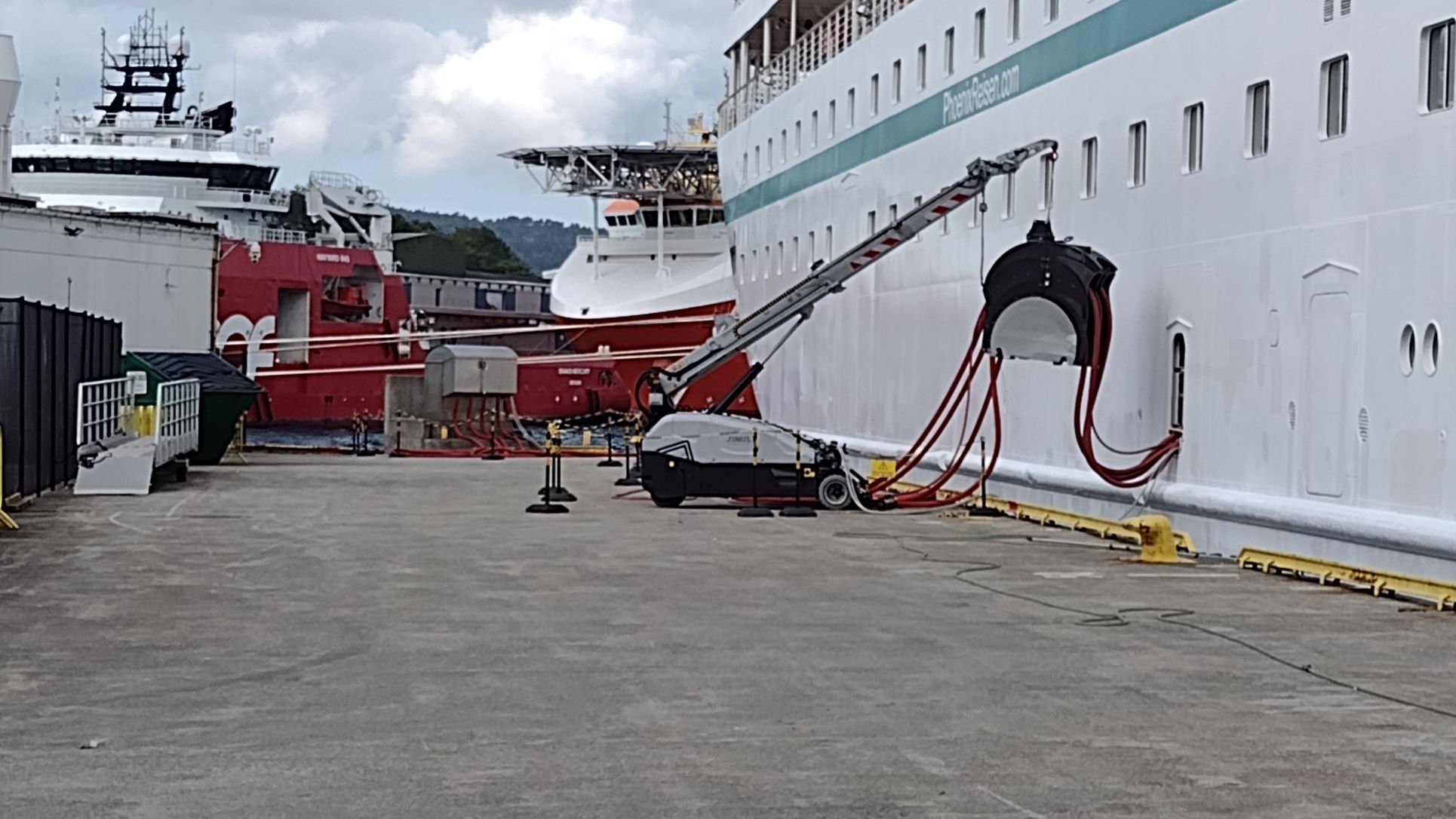
The shore connection for electricity in Bergen.

When at the ship we saw that the ms Amera had been hooked up to Shore Power. When they exchanged all the engines in 2019, the new setup became Diesel Electric and that makes it fairly easy to switch from “one electric plug to another”. Norway has an abundance of electricity available, and apart from reducing emissions, it also reduces the fuel costs. The fuel costs are quite high for the Norwegian waters, the ships have to run on Diesel fuel instead of Bunker C fuel which is about 15% cheaper if I remember the prices right. So an hour before departure the engines sudden came on with quite a bit of shaking as they had to synchronize the output again so the shoreside electric plug could be pulled out.

The whole outside deck full of tea drinkers, and there were a lot more of them inside, for guests who could not find a seat outside.

I mentioned a few days ago, that there is very little to do on board the ship in port, today there were no activities at all, most likely because all the cruise staff are escorting tours, but for this type of cruise passenger it does not seem to matter as they all go ashore or are happy sitting in the lounges with a drink. So the whole front page of the program is given over to the tours, in clearly large spaced letters, the inside is about still registering one’s credit card, an announcement about ships boat drill and then a lot of advice how to get your Norwegian Tax back on anything purchased. Page three inside is all about the evening entertainment and page four outside all about when the ships venues are open. As one can only eat so much we did not go to the dining room for lunch, but took a few sandwiches from the Gold Room (ex Neptune Lounge) For alcoholic drinks and non alcoholic drinks it stocks the same as the complimentary bar in the cabin so it is handy if you run out during the day.

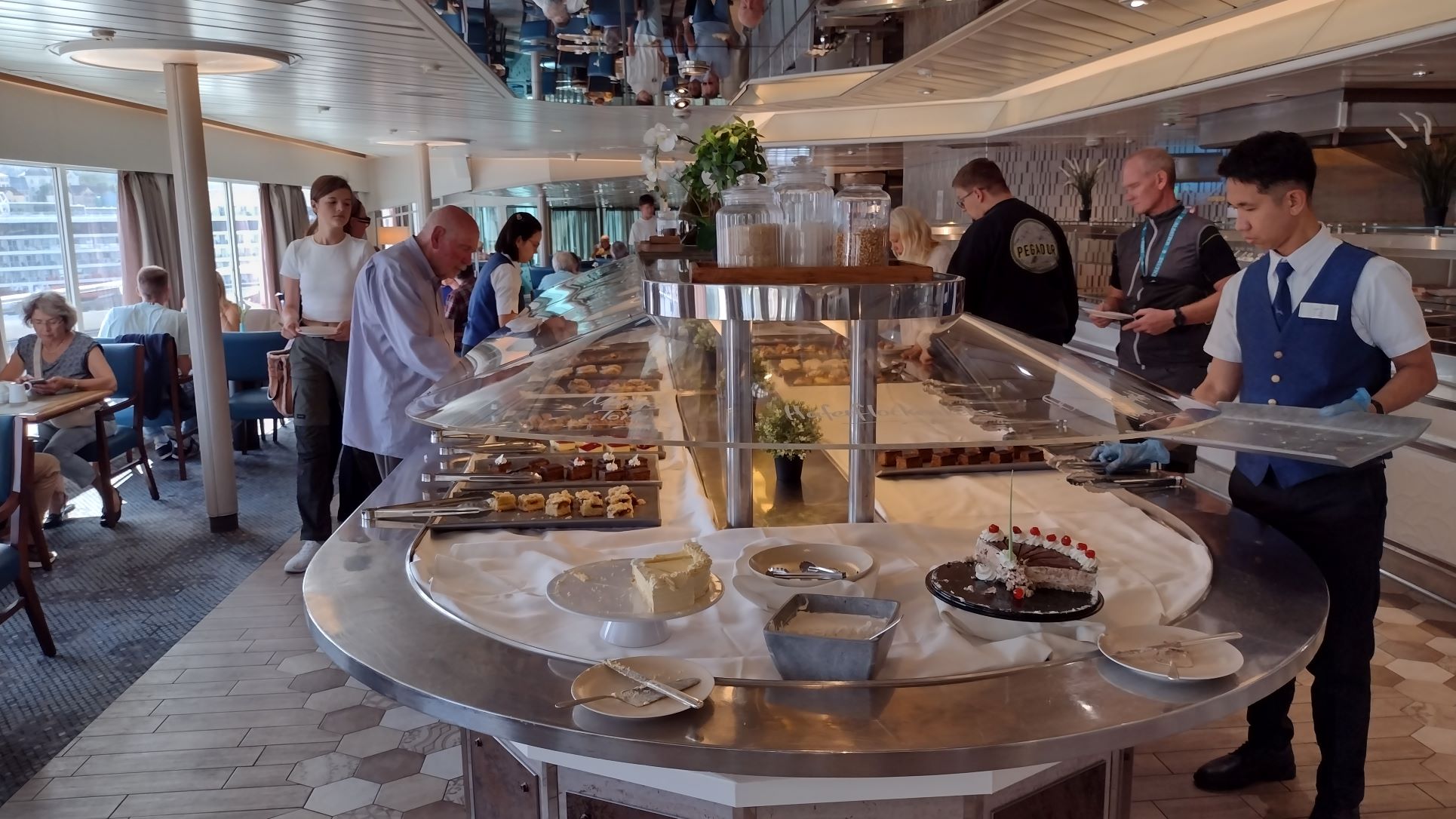
The indoor Lido Buffet with cakes, savoury’s cookies and everything else that goes with a good cup of tea. Note the empty spaces in between the trays. That is the only difference between HAL and Phoenix here. Less variation, not less quality,

With the tour participants trickling back from shore by the early afternoon, tea time (15.30 – 16.30) at the Lido restaurant was well attended. There is an elaborate tea time every day but as today was dry and sunny, most guests were sitting outside. Tea was served and one could get sandwiches, cookies and cakes (including Sacher Torte) from the buffet stand inside. Again compared to Holland America there is less in abundance of variation but not less in quality and quantity. I can only say that for a 4 star product it is all very good and it runs very smoothly. For those who did not like tea, the bars were doing a very good trade and the new outside bar was slowly filling up. partly with smokers but not all of them.

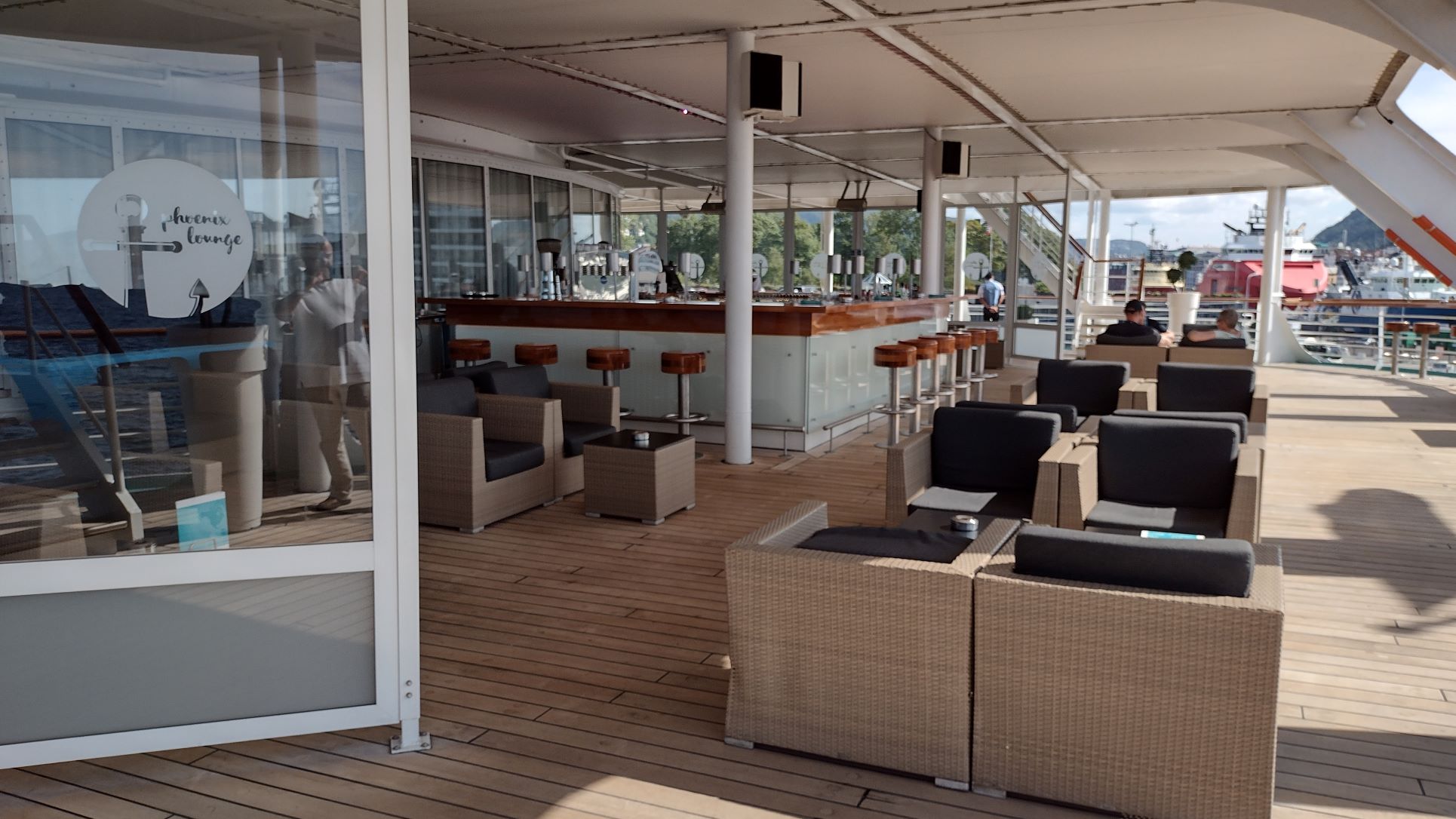
The NEW outside Bar on Deck 7 behind the dining room. If it was not for the smoking you would find me there very often. Holland America had a small round bar one deck up near the aft pool. It is still there but I was advised it only opens up occasionally as it is too small to handle the traffic.

When I join a cruise ship, I always send a letter to the captain to tell him/her that I am on board. Not that I expect anything but it is very irritating for a captain to find out by surprise, that there is another captain on board. And find out they do, as since Covid and the HAL diaspora of crew with the 6 ships sold, you find ex HAL crew everywhere. I have not seen one yet but I have heard that they are on board, in behind the scene functions. Most captains will then send an answer note (only Cunard is very bad at it) wishing me a good cruise, but sometimes they want to talk to me, even if it was only to find out what sort of “idiot” would take bushman’s holiday cruises, after 42 years at sea. This time there was another interest as the captain was eager to talk to me about the ship and compare changes made since Phoenix took over. So at 1800 hrs. all 4 of us were collected by the Hotel Manager (they do things properly here) and escorted to the bridge. Where we had a long chat about engine and bow thruster power and maneuvering with high winds. We only had a short time but I might have another session with him on the last sea day about certain ports where the ship calls.

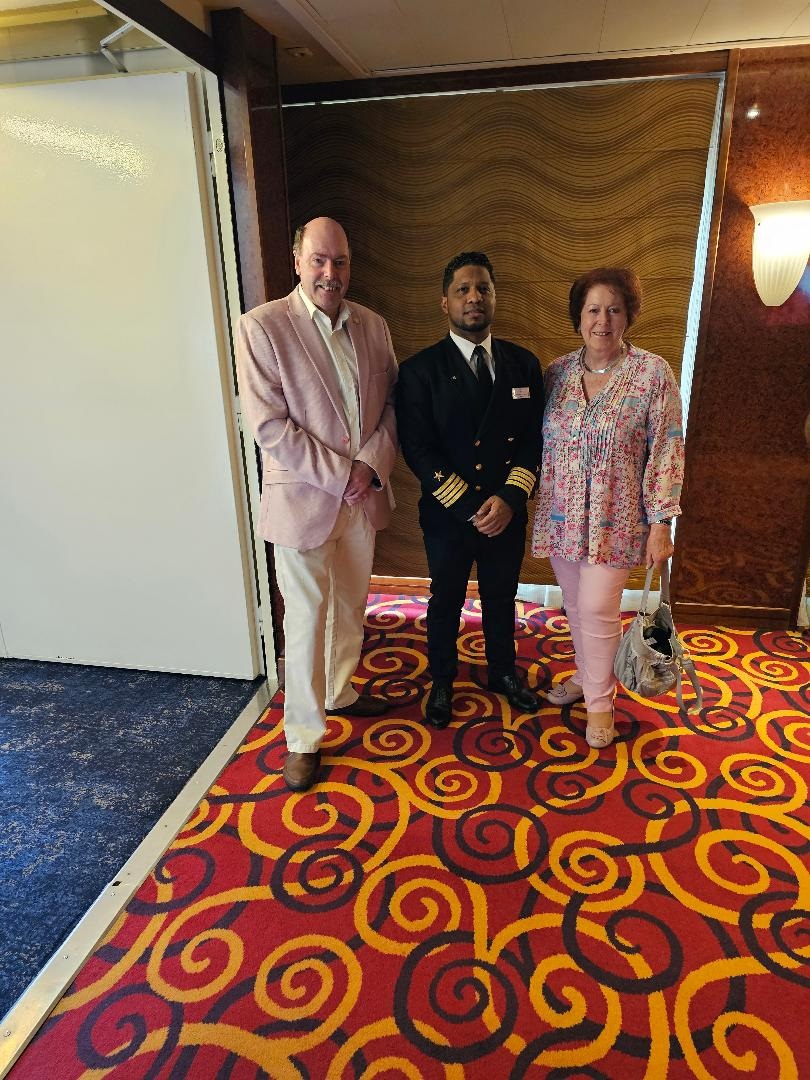
Capt. Dariel Valdes and guests, seen here  yesterday during the Gold & Silber party. He lives in Panama but has been with the company for about 10 years.

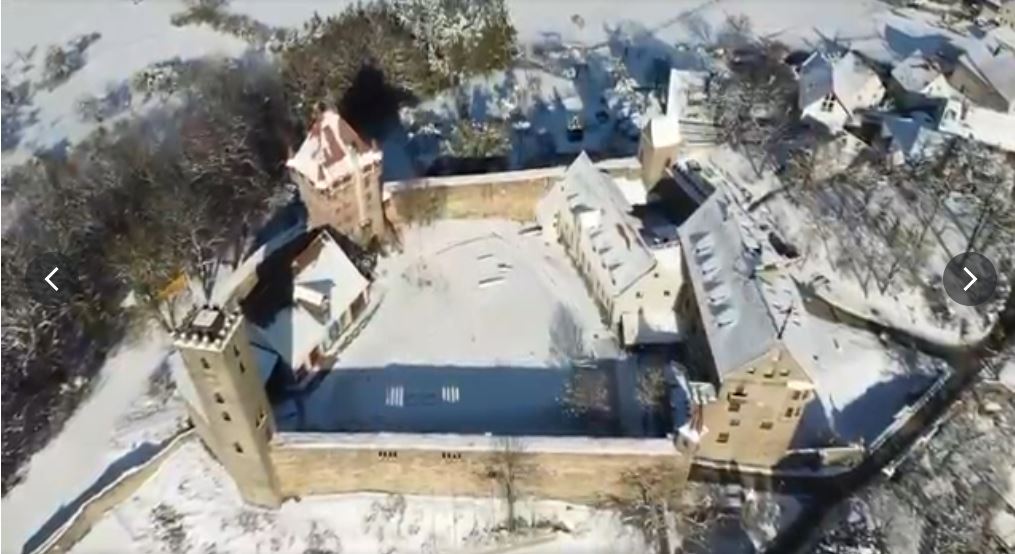
Then the Hotel manager (also 40 years at sea) decided to invite us for dinner. Hurrah, ……………….free wine,,,,,,,,,,,,,,,,,,,,, That turned out to be very pleasant as he knew quite a few people in the industry so we could have a good time gossiping. (Sailors love to gossip and we are very good at it). Mr. Christian Schneider also owns a Castle in South Germany near Nurnberg that is run by his Dutch wife. A castle that includes a keep and has in total 22 bedrooms. Then I mentioned my plan to wean Lesley away from cruising (eventually) and take her inland in Europe to see a bit of country away from the ports. And I had the plan to do the “Route des Burges” or the “Burg Strasse”. You book each Castle – hotel for one night and then during the day you sight-see to the next one. Staying in an Castle Hotel has two advantages: A: the rooms are normally cooler then a regular hotel (European hotels often have no A.C) and B:there is always ample off street parking as there is normally land around a castle. And all that sort of conversation took up most of the evening.

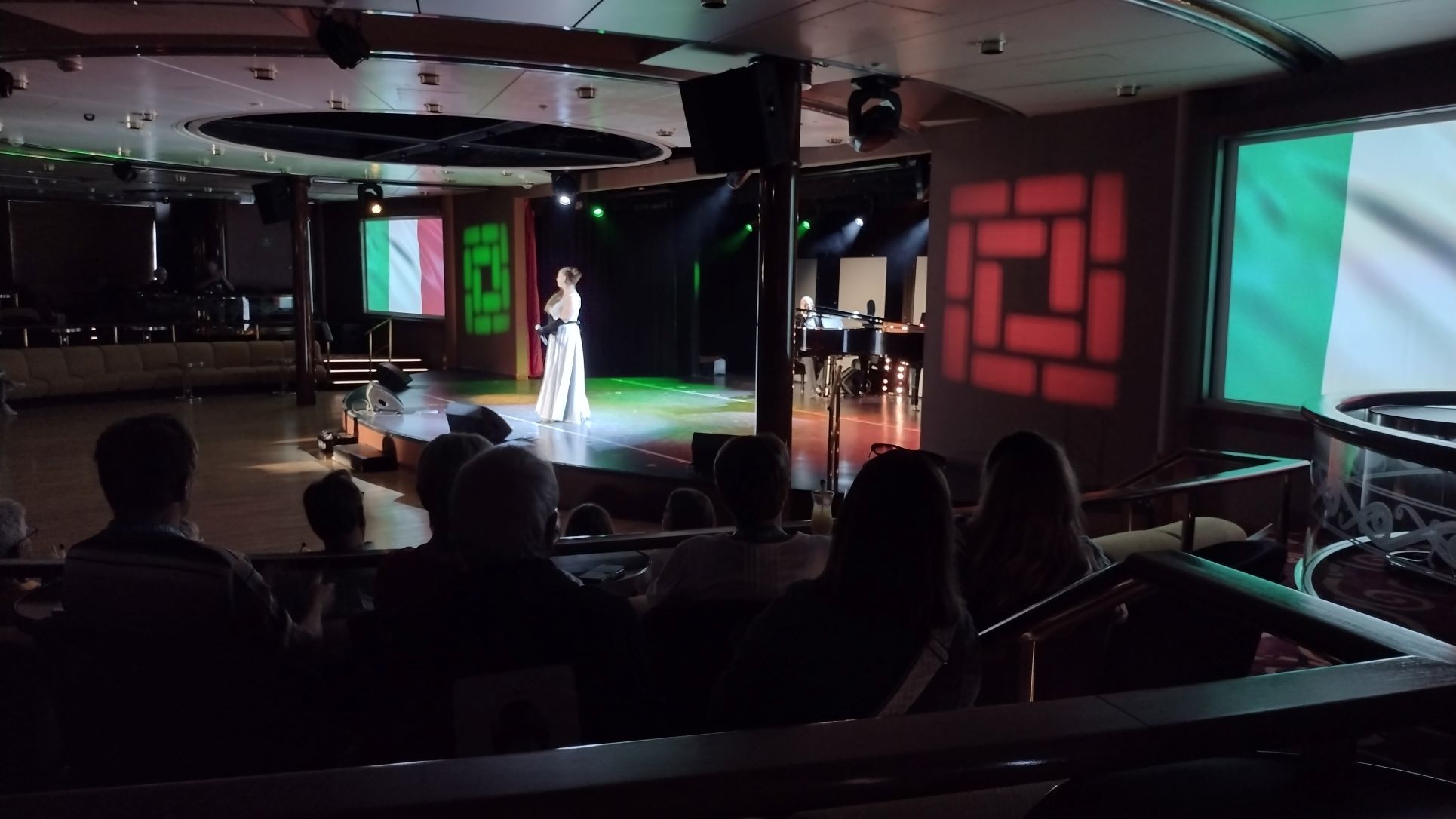
Singer Olga and piano player Janibek with their show, “Rise Like A Phoenix”. 50 minutes of International European song and piano play. Here the Italian flag is on the screen and Olga is singing something Italian. It was very good.

We could just catch the most of the show by the couple that normally entertains in the Piano Lounge. They had a show in the form of a musical trip around Europe. And they were very good, a real relief from the Cast shows of the last 3 days. Tomorrow we are in the metropolis of Ulvik located at the very end of the Eid – fjord. It takes several hours to get to the end so it would have been an early morning again for the captain. We are the only ship in port and it supposed to be sunny with temperatures around 21oC / 70oF and no wind, which means it will feel a lot warmer.

Hotel Burg in Abenberg near Nurnberg south Germany. Nothing to do with this blog, but maybe nice to see that some sailors have a whole different life on the side. Most of the rooms are in the big castle-keep tower and the rest plus restaurant etc. in the other buildings. The center courtyard in the summers is used for Jousting Competitions and other medieval fun. (Photo courtesy,  Hotel Burg website)

28 July 2025; Sandane & Floro, Norway.

With the constant increase in the number of cruise ships calling at Norwegian ports (and not considered very welcome in Bergen and Oslo), more and more little towns are getting new cruise ships docks. Most of the extensions and improvements of the postal ferry docks (Hurtigruten) but also complete new ones. They are almost all the same, a dock of about a 100 – 150 meters with ships longer overhanging at the bow and at the stern. Sufficient bollards are for that purpose put down further inland so even the big girls (we saw the QM 2 yesterday in Olden) are able to dock. Draft restrictions are normally not there as the fjords are normally very deep with the hill sides sloping straight down under water. So the docks are normally there where a little river found its natural end of run into the fjord and created a small plateau.. Some ports can then also offer one or more anchorages but not all of them, and most captains are not that excited by those that are there, but as long as there is no wind at the end of the fjord those anchorages are do-able.

The tender service to the dock in Sandane.

Sandane has a few small docks but they cannot handle much more than a large fishing boat or very small ferry. Hence we tendered into the small town which had a very nice new tender dock built for that purpose. It can handle 3 tenders at the same time. The tender distance is what we call a “4 boat distance” and thus all 4 tenders (capacity 75 max.) were in the water. That then gives the option of having 1 boat at the ship, one going to the shore, one at the shore and one on the return journey. By 10. am the tours were gone and most of the rest of the 800 as well and it was “open tenders”. E.G no need to get a tender ticket. For the suite people, like us, you can go to the gangway directly anyway, same as with many other companies. As we had waited for everybody to have gone ashore we had to whole tender to ourselves, not a bad way to start the day. We had the Phoenix supplied green (officially the color is turquoise) umbrella’s with us as the mountains had managed to catch some rain clouds and they were busy testing the town’s drainage system.

One of the two main streets in Sandane. To the left a sort of bookstore, luxury department store with a very nice book selection and a lot of children’s toys and puzzles.

Sandane is a small district town so it has a number of amenities needed to serve the locals who come by car down from their mountain homes and farms. 5 hairdressers, 3 or 4 cafe’s, one supermarket in down town, A city Hall & bank, and a nice bookshop (Unfortunately with only one nautical book, about sunken local ships along the coast, so nothing for me. I went in Bremerhaven to the Maritime Museum and there the book shop is completely gone, so I have high hopes for the Maritime Museum in Bergen. Otherwise only Hamburg is left and that is quickly shaping up as the best maritime museum in the world in my opinion.)

We walked the two main streets and then got back on board before the tours were returning. One tour did not come back but was rejoining the ship in the next port of Floro. This is a sixty mile journey through very scenic waters. Now the sun came out and by the time we arrived there at 1700 hrs. the temperatures reached a balmy 20oC / 68oF. A nice temperature for the Norwegian summer and much better than the heat wave they had last week.

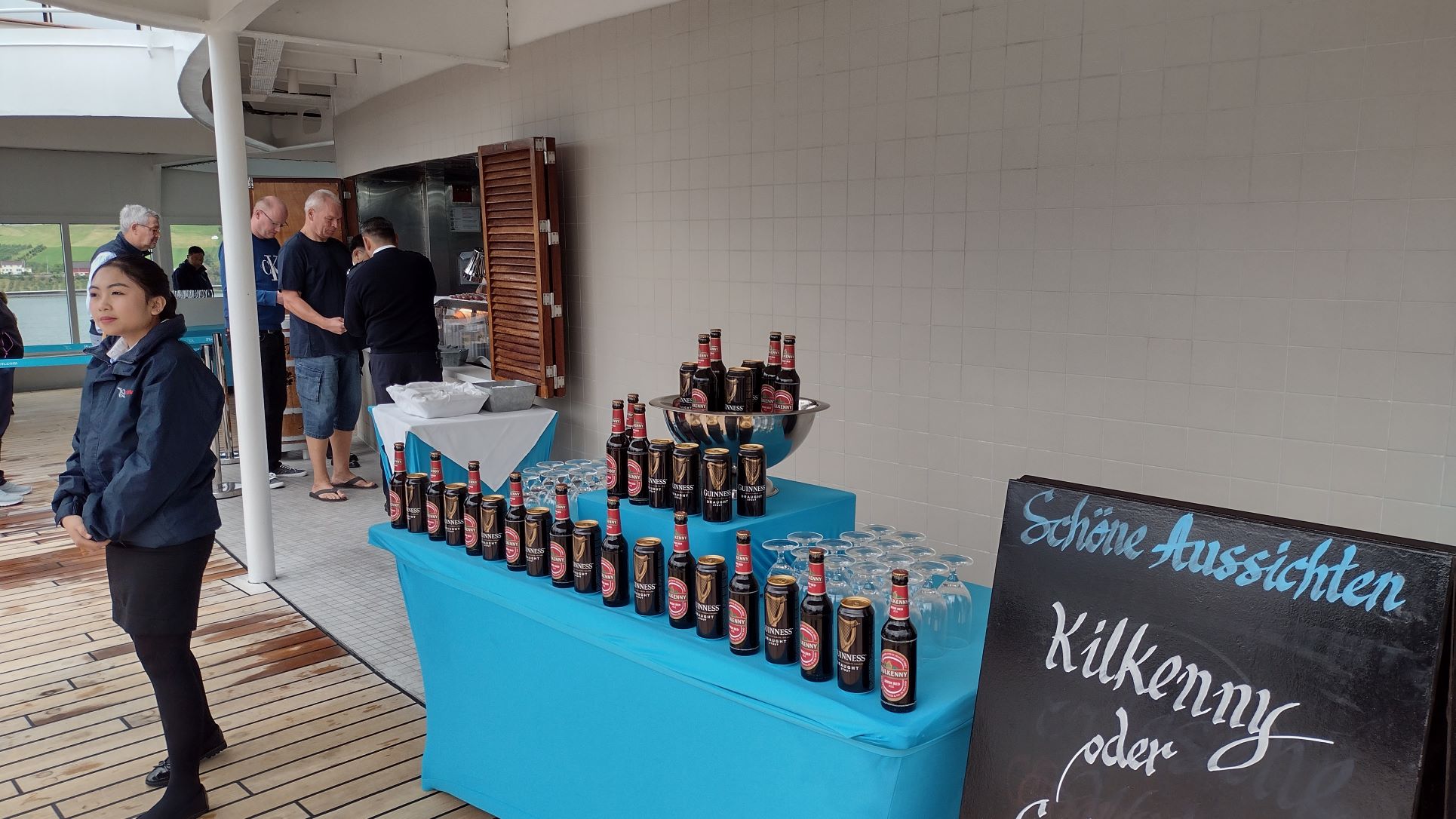
Once back on board we went for “Curry Bratwurst” on the open top deck. This is basically a sausage with a curry sauce pored over it, with some paprika and dry unions. Served together with french fries or “pommes frites”. It was not as spicy as you can get on many a German street corner, but Her Ladyship approved of it, so it was good. You could have a normal beer with it or and Irish Beer.

It does not make sense to me, promoting Kilkenny Irish Beer during a German fast food lunch, but the stuff tasted good.

On the way to the next port, we had a gathering of the Gold & Silber cabins in the main lounge. We were expected to be there at 15.30 hrs. but now having learned that the Germans are early everywhere, “to be in position for when it starts”, we made it a point to arrive 10 minutes earlier. Only to find that they were all there already again with the Hotel manager as main entertainment on the stage telling about his career. (He had worked everywhere in his 40 years, so lots to tell) At the entrance stood a rather annoyed captain, who had popped down from the bridge to shake hands with everybody only to find them already all inside. Luckily there was us as he arrived the same time as we did.  10 minutes before start.. So he made a brief speech, explained that he had to be on the bridge and  went back to the bridge.

This made us question whether they really knew what they were doing. The invitation that came to in the cabin should have warned us. It was signed by the Captain, the Cruise Director, the Hotel Manager and the Gold & Silber host. More Chiefs than Indians and none of them seem to have checked on the other to see how it all was possible. Anyway we got a planters punch (alcoholic or non alcoholic version) to keep us happy and then the three left told stories about the ship, the company and answered questions. The Cruise Director had been at sea since the Maxim Gorky days so he also had been everywhere and done everything. The regular questions were asked but it somehow felt wrong that all the answers came from the Cruise Director and not from the captain. Maybe they get it right next time.

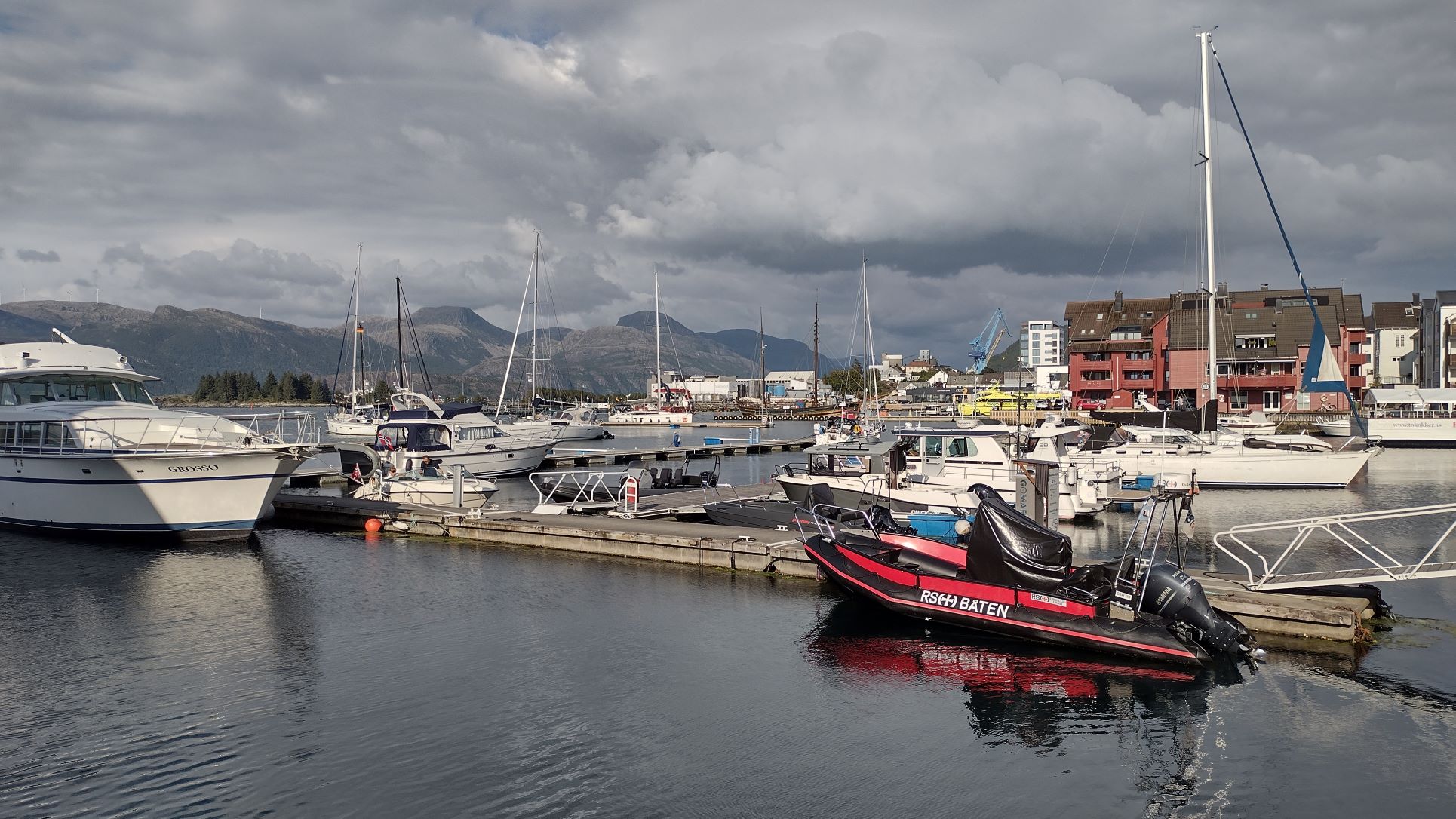
The Marina of Floro. Full of pleasure boats but also work boats that serve the fishing industry.

Right after arrival we went ashore, as soon as the initial “invasion” of guests had made it off the gangway. Floro is a similar town as Sandane but with several older buildings in town and two hotels. A nice size marina and some good looking fish restaurants. For the rest a Thai restaurant (and a Thai bar…….. we never found out what that was supposed to be as it was closed) and a pizzeria. NOK 290 for a standard 12 inch pizza (About 10 kroner to the US dollar so $ 29,—), so we decided not to be tempted and returned to the ship.

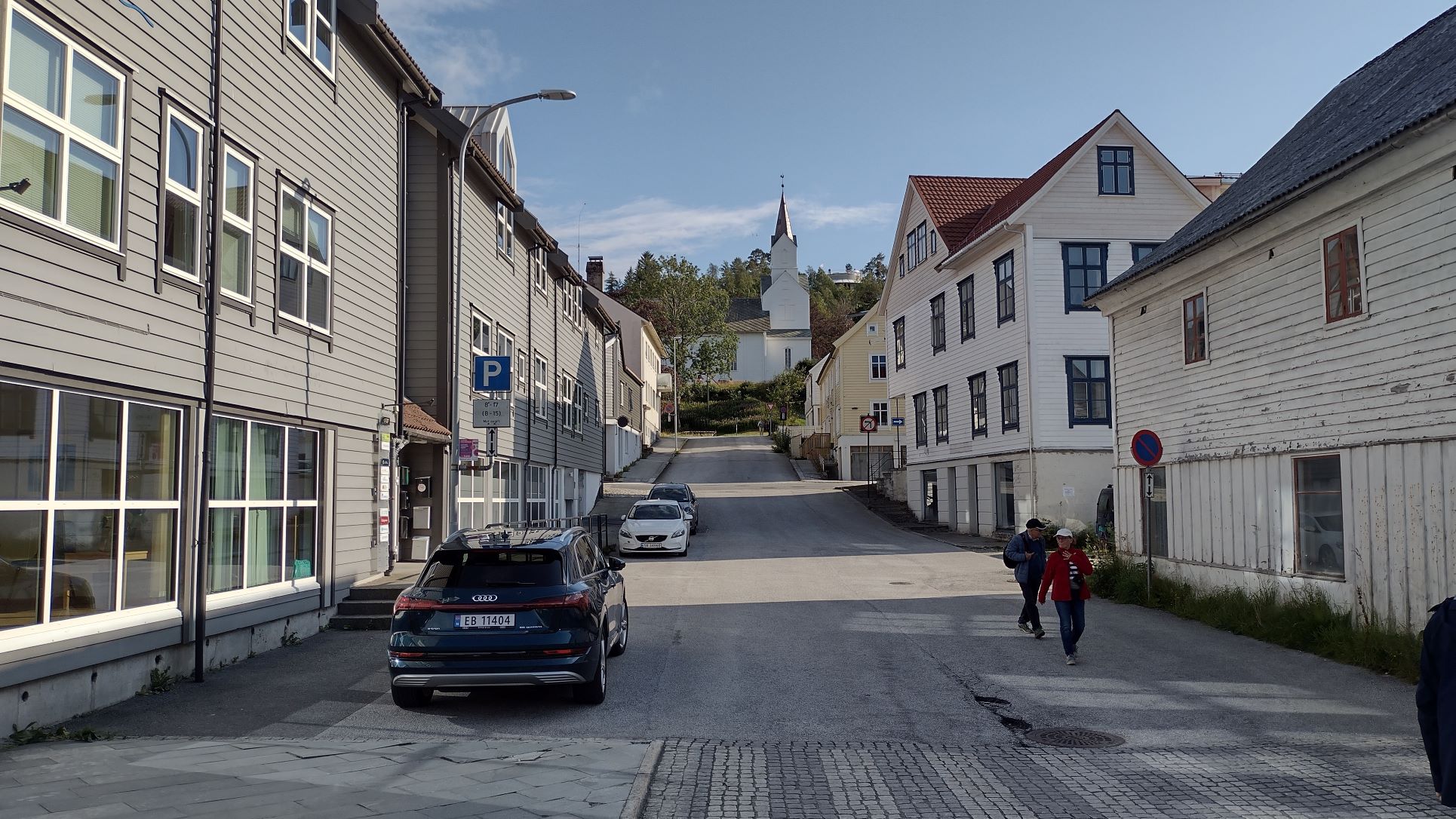
The main street in Floro. This was around 1800 hrs. and as you can see it was not a hive of activity, even with the nice weather.

Having learned now that First and Second sitting is marching in about 30 minutes before the actual dinner time we decided to go for cocktails first in the Piano Lounge and show up at dinner around 20.00. (closing time being 20.30) A large glass of beer is 7.5 euro’s and about the same for a large glass of wine (with a large wine list to choose from) so the prices are very reasonable compared to a company such as Cunard. And you get standard a pot of peanuts while at other company’s you have to ask for it. And that is something I do not understand from other company’s where you have to ask, because as soon as you start eating peanuts, or mixed nuts,  you want to have another drink…………..

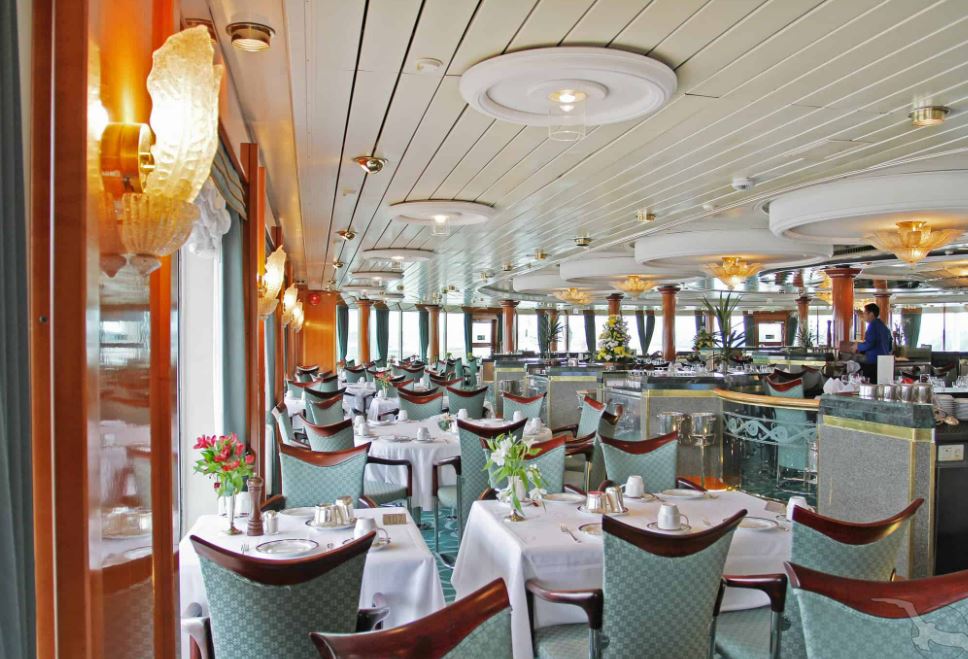
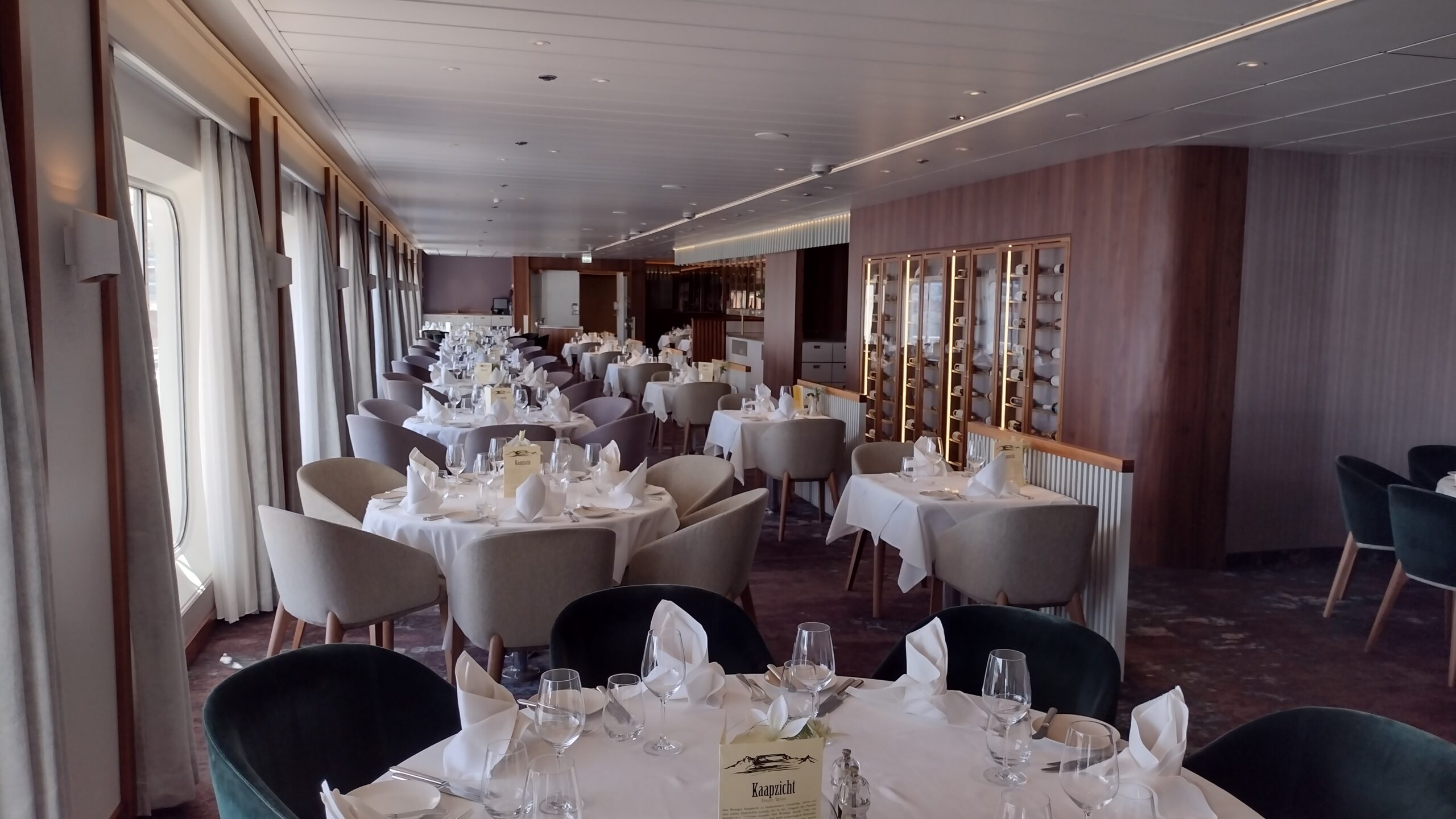
The La Fontaine Dining room aft part. Seen from starboard entrance towards the stern. As it was during Royal Viking and HAL days.

We learned something new in the dining room tonight. As we could not find the “daily dishes available through out the cruise” on the menu, something that most company’s have, we investigated and found that you can order from the Room Serve Menu, which has quite a few nice dishes. This included Wiener Schnitzel which is not on the regular menu. Well, making a cruise on a German ship, we could not do without the Schnitzel experience and it was promptly ordered. And it was good, very good. After dinner we poked our nose into the show lounge to see part of the show.

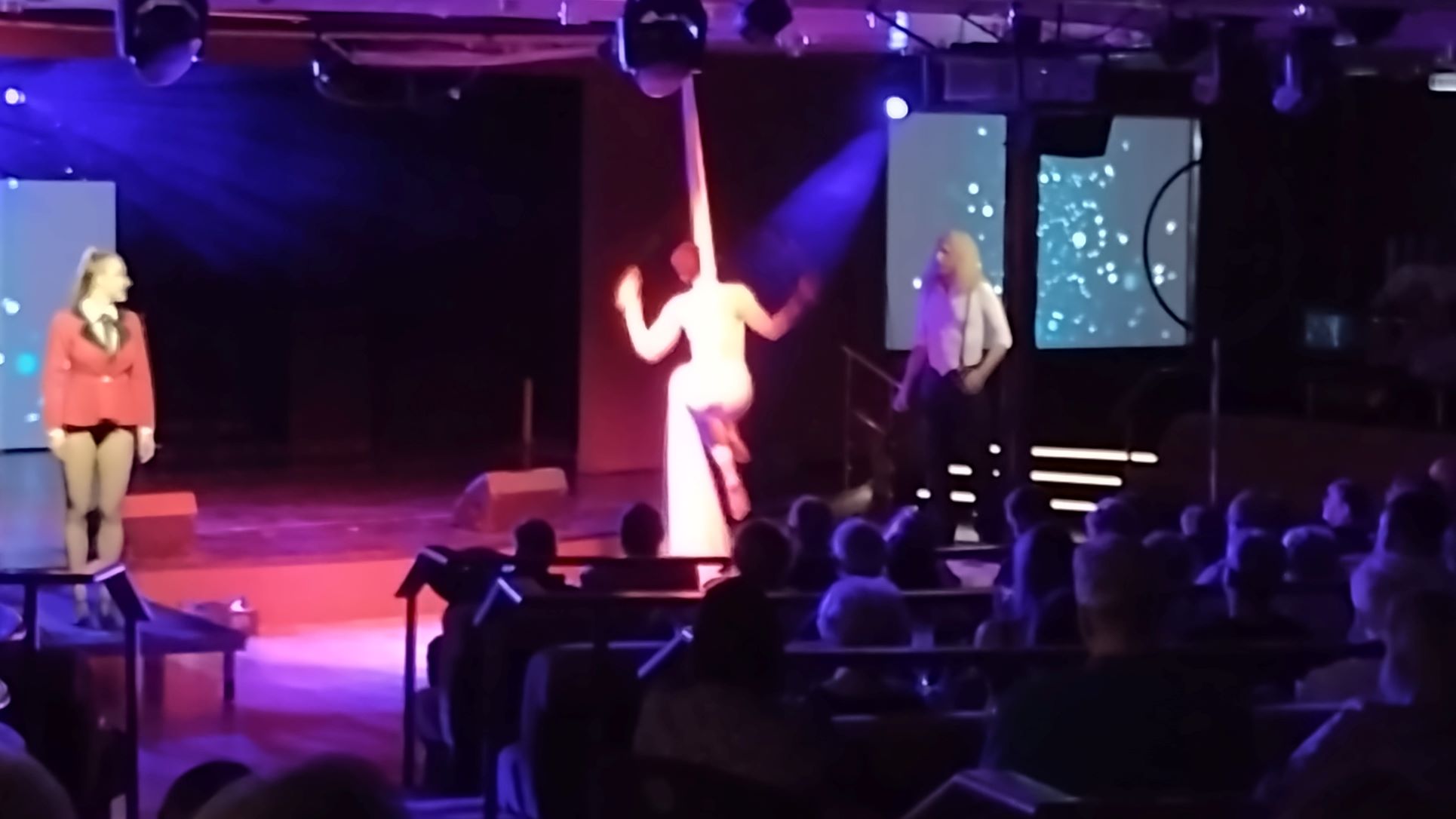
Singers to the right and left and the trapeze lady in the middle. (Apologies for the photo quality but I am not a cell phone wizard.)

Tonight it was again a Cast show, now based on the “Greatest Showman” musical / movie. It was not as bad as the previous two days as the ladies are good singers but the cheography was again very bad. The acrobatic lady hung from the ceiling again, being very talented and this time it sort of fitted in with the “circus theme” of the show, but it does not really work with such a low ceiling. But the audience seems to love it, so for them all was well in the world. I think we are a bit spoiled with our international cruise ship experience. ……………..

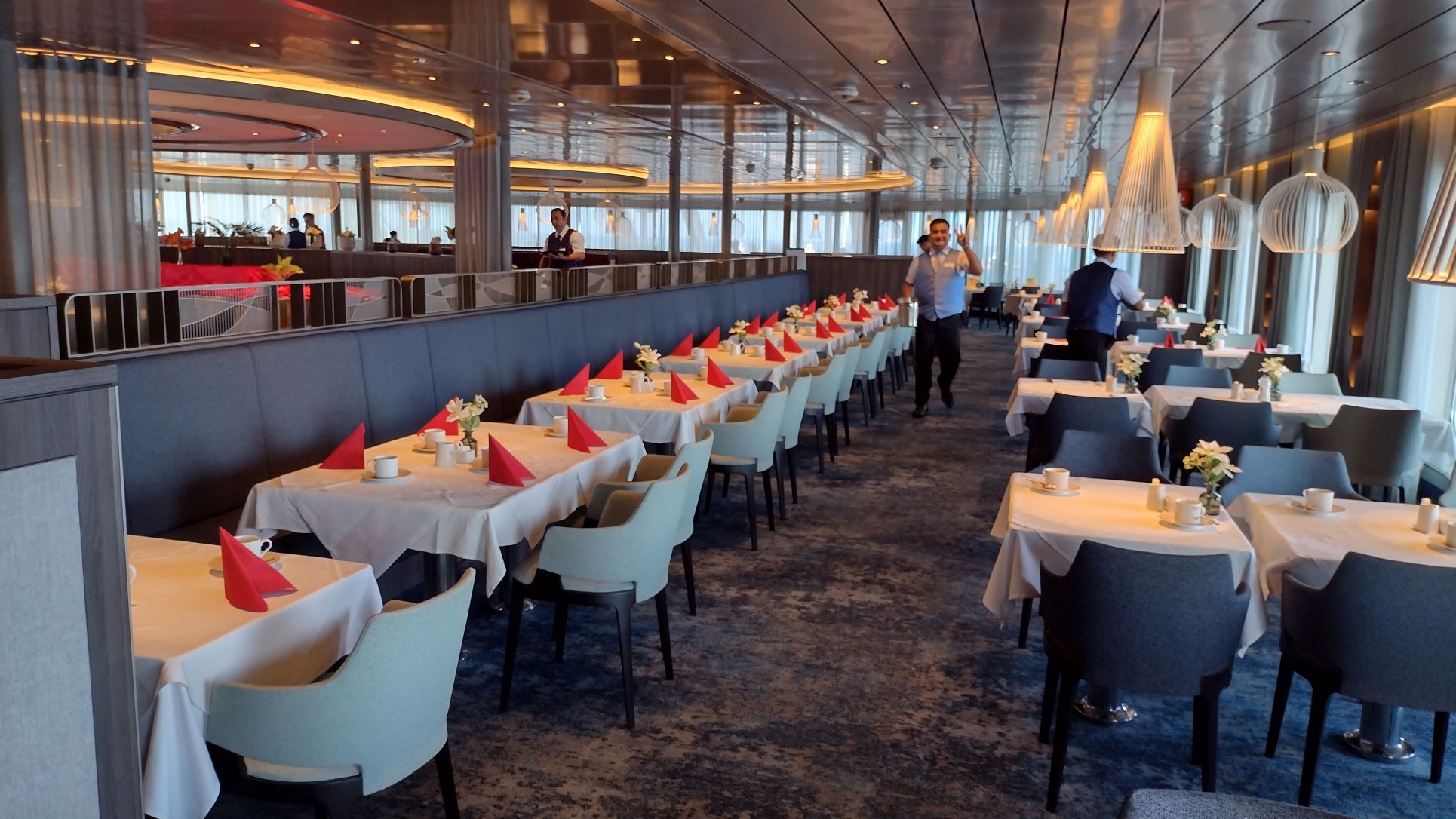
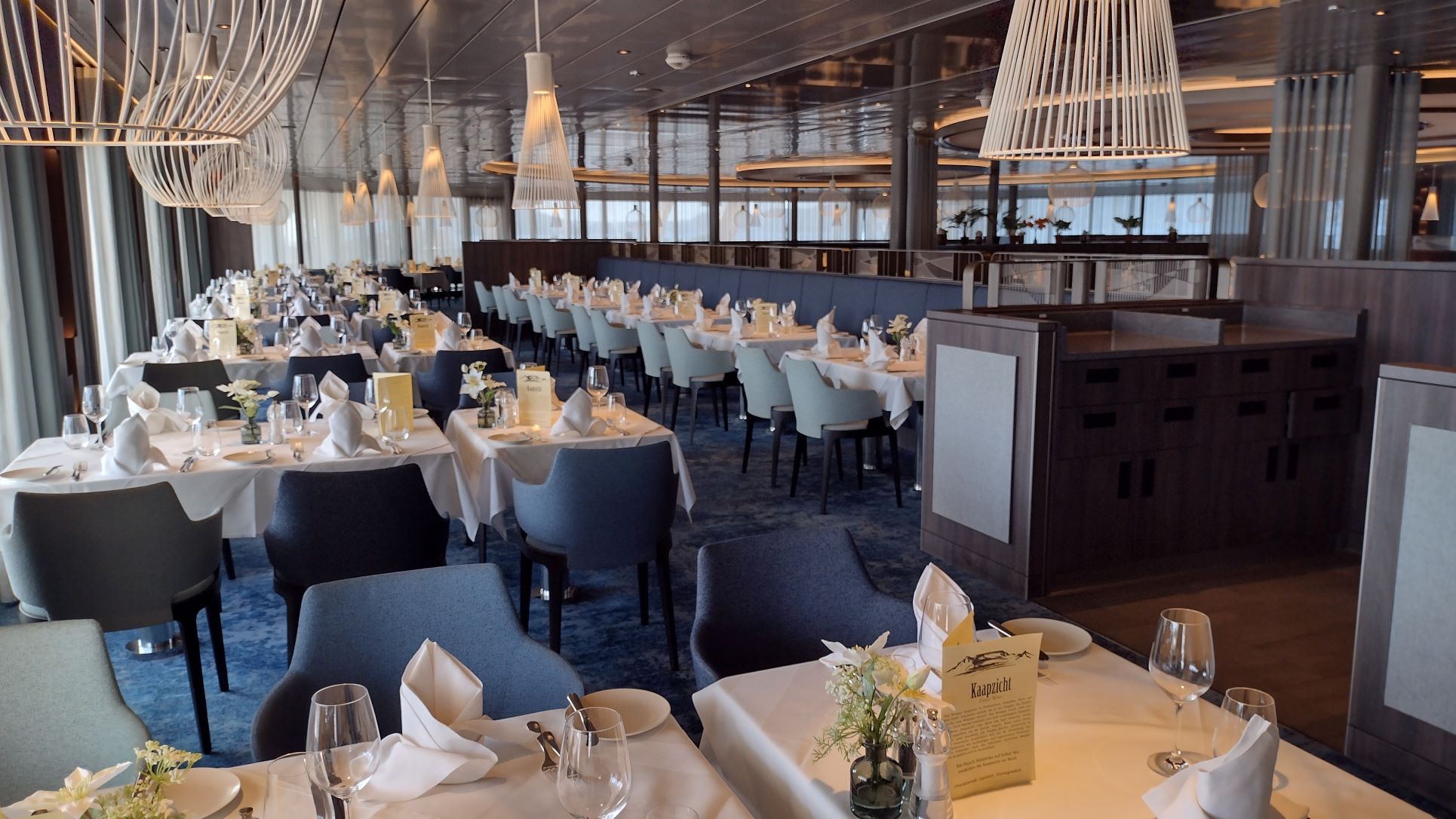
The new dining room look with Phoenix Reisen. Taken from the same location as the old photo above. Now the restaurant is called the “Ozean Restaurant”

Tomorrow we are in Bergen. It is supposed to be dry and partly sunny and that is not  so usual for Bergen so everybody will be out in force. Also in port: ms Trollfjord (Hurtigruten), ms Viking Saturn (Lesley and I will be on that one in February 2026) and the Costa Diadema. In total about 5000 cruise guests going ashore. It could be much worse and there have been protests in Bergen against having too many cruise ships on one day. 5000 guests marching through the fish market is already a lot, let alone when the count goes up to 9000 or more. And then add the regular tourists to it who come by sightseeing bus.

One more photo. This is the separate forward part,   “the small dining room”, seen looking aft. To the right used to be a circular staircase going up to the Explorers Lounge. It was removed providing space for a steward station. More to the aft a Buffet has been installed, used in the mornings for breakfast and in the evening for cold orders.

27 July 2025, Flam; Norway.

Still in the wider part of the fjord at 08.30 am.

Although the days are getting shorter, it is still sun rise around 5 am. and thus a beautiful sail in with the sun shining on the mountain sides of the fjord. I am never much bothered about having a balcony cabin but when cruising here it does pay off and one can enjoy breakfast on the balcony while seeing Norway float by. Or better said the other way around, Norway stands still and we float by. It is nearly 6 hours from pilot station to Flam, depending how much speed the ship is allowed to make. From the pilot station to where the fjord gets smaller you can run at sea speed but as soon as you get in the smaller parts the ship has to slow down to avoid the ships wake hitting the shore side. It would not do to tip a local fisherman out of his/her boat due to pulling a large wake.

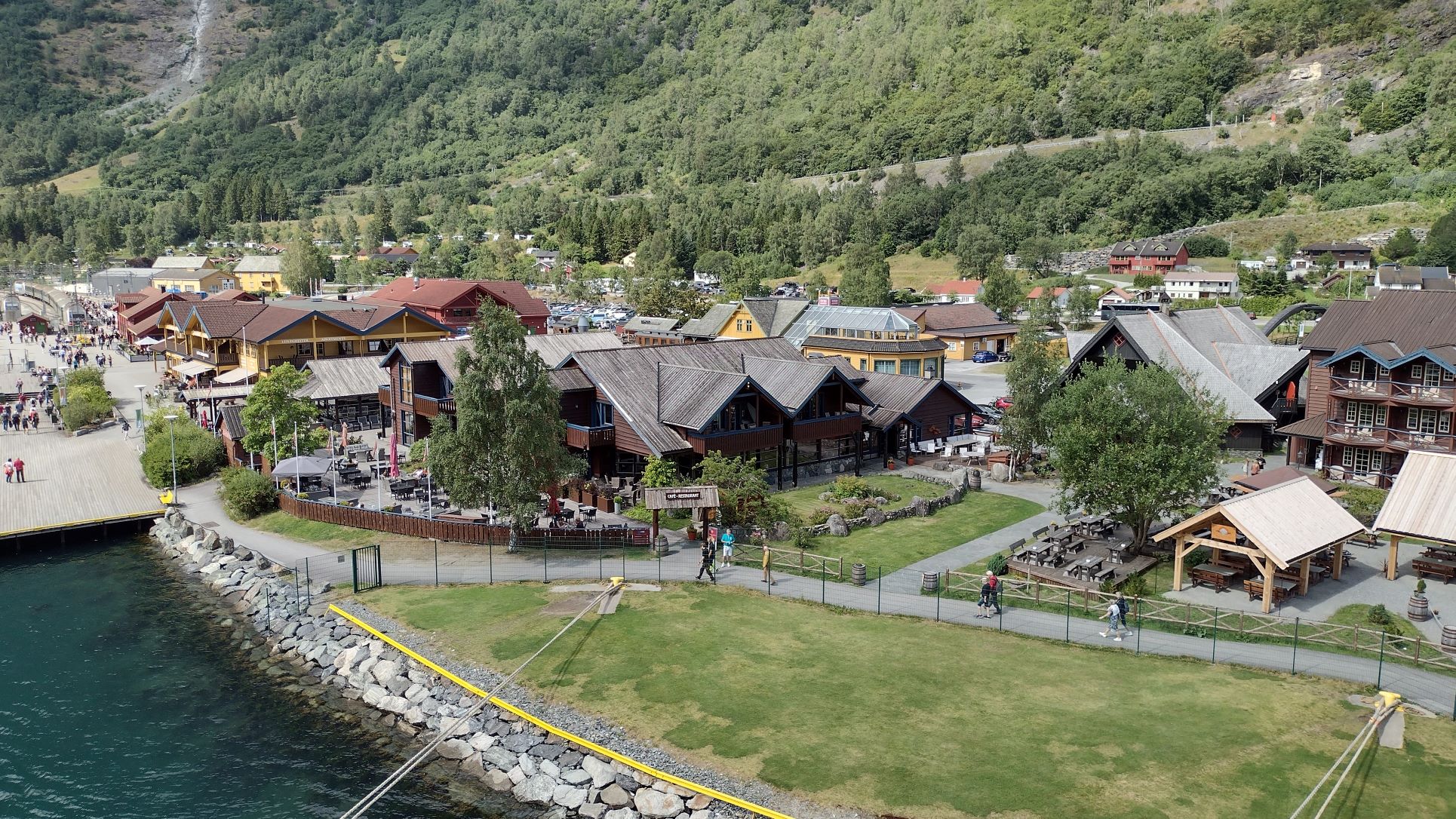
The dock in Flam. There is space for one cruise ship to dock. Right on the grassy area are the souvenir shops, and sitting areas for the local hotel and the new Viking brewery. To the left the walkway to train station and in the back (yellow) the super market..

We could dock today as a larger ship scheduled cancelled for unknown reason their call. This is happening more and more that due to port congestion or weather, ships are re-arranging their schedules and show up another day. Port calls are normally reserved 2 years in advance but there are not many ports that charge for the booking up front, so there is a lot of last minute (read 3 or 4 months) re-shuffling going on and that can indeed still happen at the last minute. But the captain was happy to take the spot and docked stern in so our portside cabin was overlooking the port of Flam and with it the local train station which is the main reason we are here. Guests from the ship and tourists coming in by car, will take the scenic train up the mountain and then either come down again in the same way or continue with a bus or coach further inland and that bus then ends up on the Flam Dock side again. Apart from the train station, there are a few small hotels and B&Bs, a small CO-OP supermarket (open today to service all the cars and RV’s coming in) and now they also have a brewery here. Built in the form of a Viking Longhall (modern version as it has WI-FI) which shows the brewing process and beer for sale. Normally that has my great interest but the “Viking” prices charged made me change my mind.

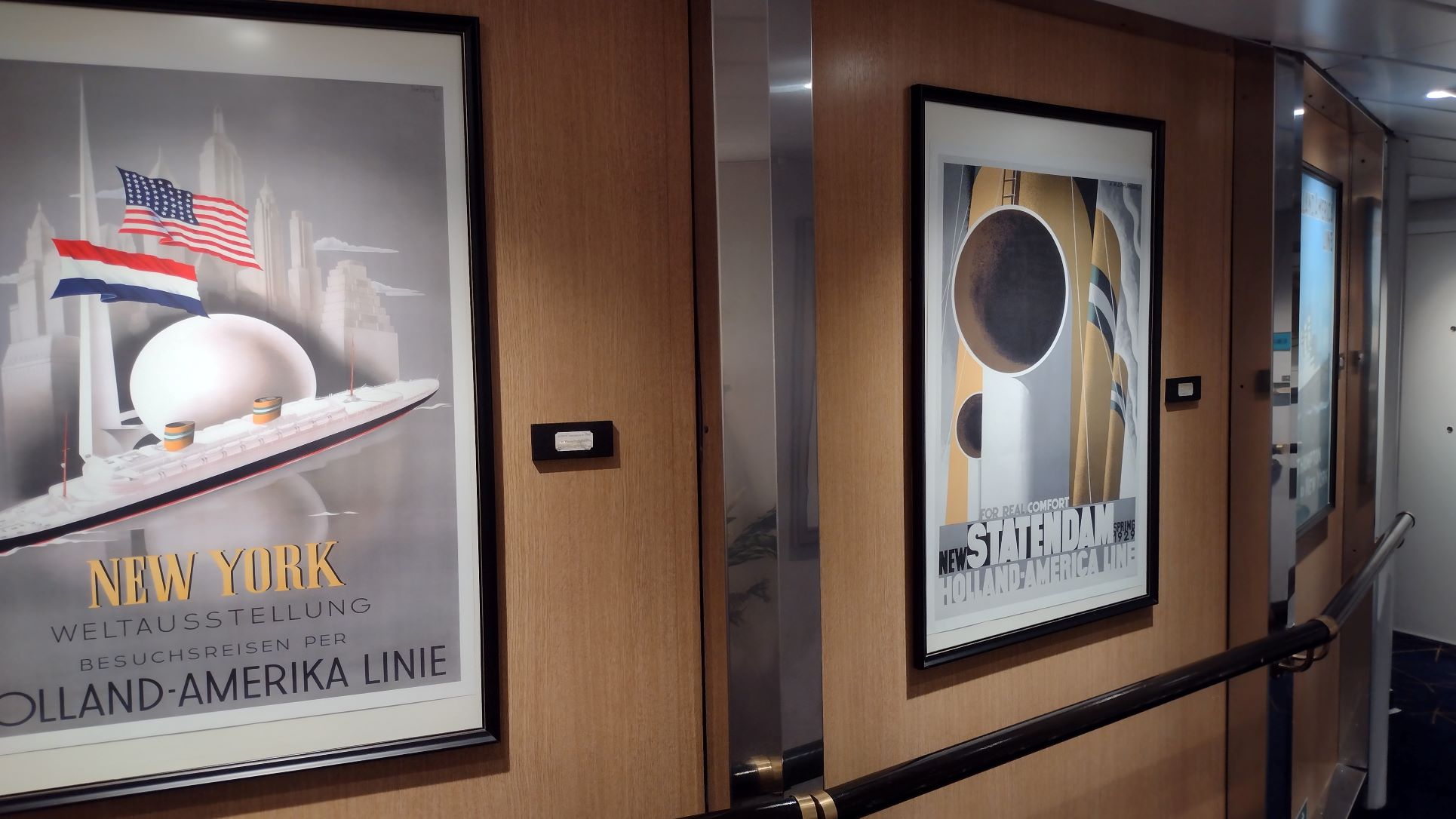
What made me very happy was the fact that my HAL posters were still there. I put them up in 2010 when HAL added the new cabins on deck 8 aft. There was only this bare brown wall which hides the old lifts going down to the dining room from the demolished Midnight Sun Lounge.

So we waited until the majority of the ship had marched ashore and then took the chance to have a good look around. I estimate that Phoenix Reisen has spent since 2019 about $30 million on the ship. In 2019 during a six months dry dock it was roughly $24 million on new engines, new rudders and a lot of pipe work and renewing of all the cabins. Then later on they did more work on the suites and also made the Captains cabin smaller by putting an extra suite in the sitting room space that we always used for parties.

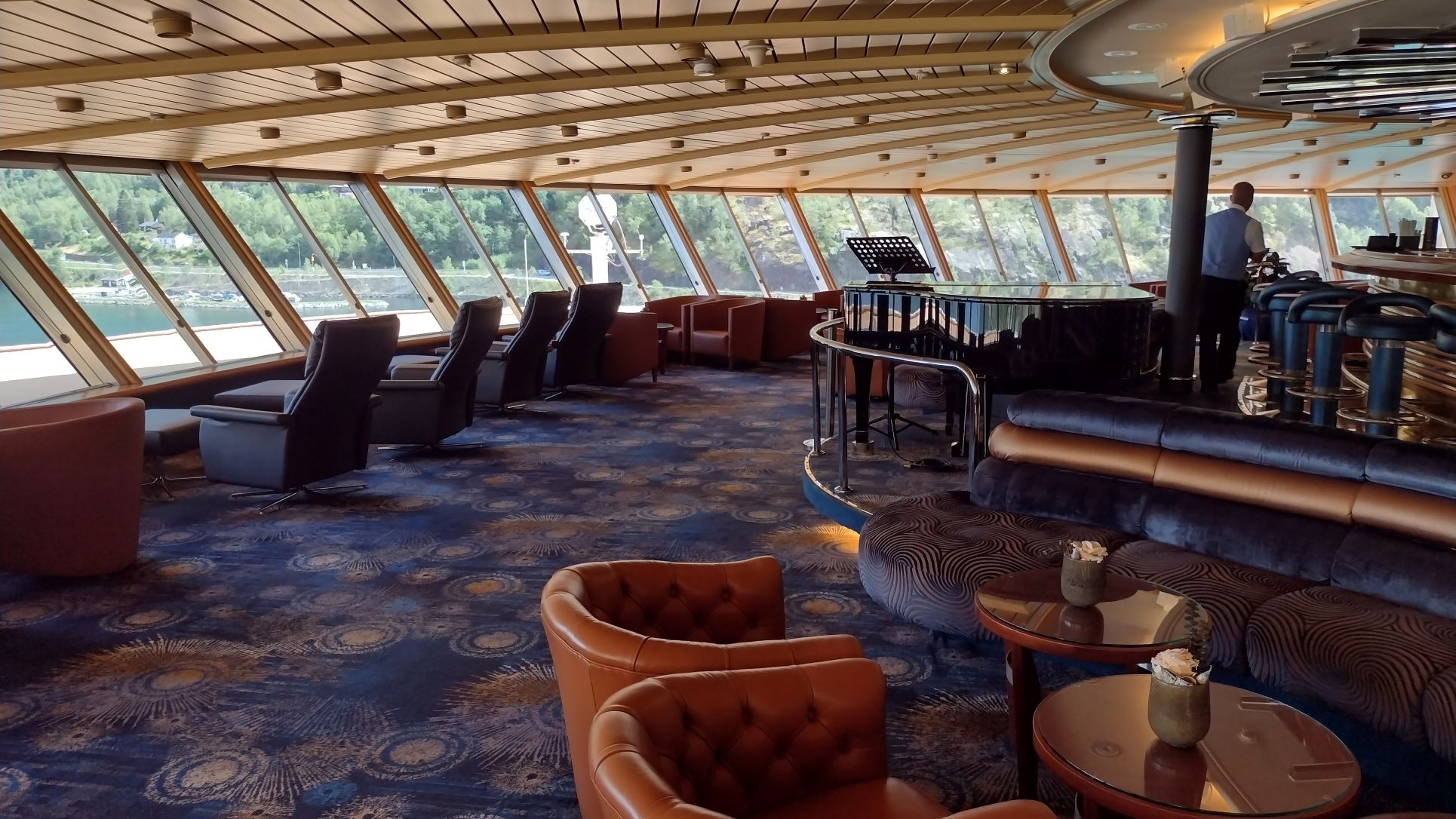
The Panorama lounge ex Crows  nest. All the same except some chairs added to increase capacity.

If we start on the top deck, deck 12, the Crows nest, now Panorama Bar remained the same. Then a deck down 11, the midship pool was taken out and replaced with a wooden decking for deck parties. This area is now called “Schone Aussichten” or “Nice Views”. See the photos on the blog of yesterday with the deck party/lunch.. Then the Lido part at the stern has been spruced up considerably and what was with HAL a semi outside venue is now completely closed in with good air-conditioning. If you then enter the aft staircase, you can see the 17th. ships painting that was once hanging in the HAL explorers lounge has been installed against the bulkhead. So it was not thrown out, as often happen during refit.

Deck 10 & 9 is still the same with all the cabins having been rebuilt, and to my wife’s consternation the self service laundry on deck 8 was taken away. There is another ,bigger one, on deck 6 but from the top deck cabins that is a long way down. For the suites there is free laundry but it is not always wise to send a Ladies dress to the ships laundry as they tend to kill it with kindness. Then on Deck 8 the public rooms start. The show lounge has not changed at all, even the carpet is still the HAL carpet. Front desk is still front desk and the photo gallery on the portside is still the same as is the cinema. The shops have been reduced to only the center large one and the boutique that was on the port side is now the Future Cruise office for Phoenix Reisen. The Explorations library is still there but much less elaborate than in HAL days. Also the large Captains cabins, where I could hold parties for up to 70 guests has been reduced to a regular officer cabin and an extra suite installed. Makes sense from a revenue point of view but not from a service point of view as now they have to block off part of a public room for a party. For the “Gold service” meeting, the Panorama Bar was closed off and tomorrow when we have the “Gold & Silber cabin” party and they do it in the Main Show lounge at 15.30 in the afternoon. We will see if it works, but I like my parties at cocktail time between 6 and 8 in the evening but not in the mid afternoon.

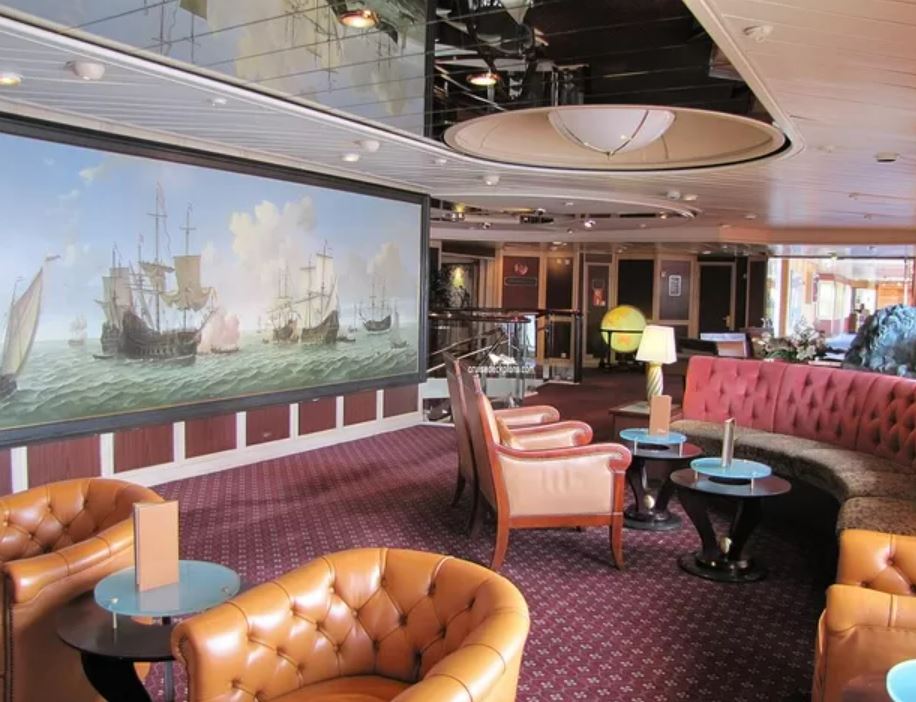
The old Explorers Lounge looking forward.

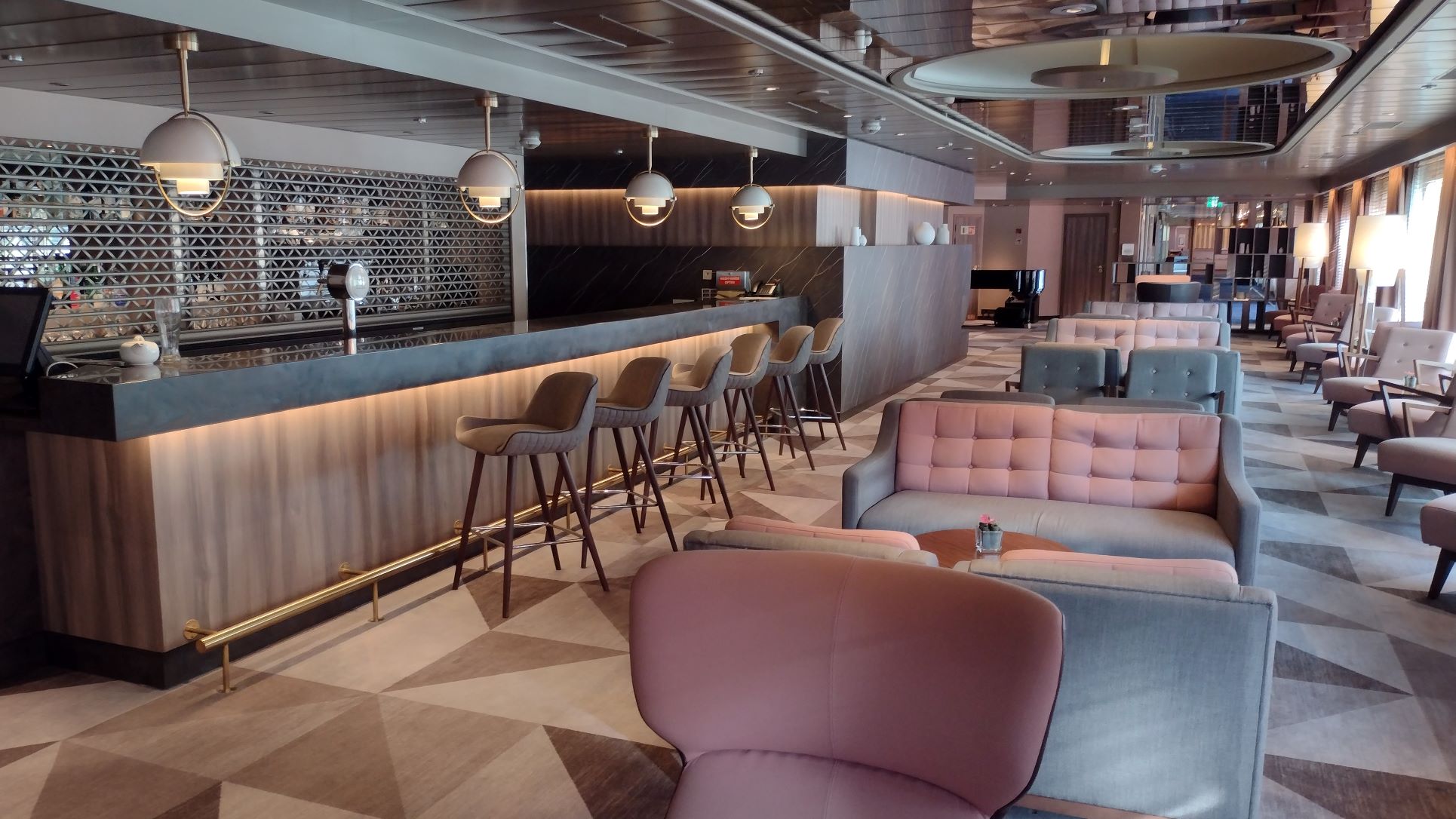
The biggest changes made are to the old Explorers lounge area & the casino & the Java Cafe & small bar on deck 8. It has been completely changed. The Casino was removed as Germans do not gamble and replaced by 10 cabins. The the Java Cafe & bar area and the Explorers lounge have been completely ripped out and made into “the Piano Lounge” and it has a large bar. Now many more guests can enjoy this venue and listen to the piano player & singer. Originally this lounge was called the Casablanca Bar and the old Ocean Bar, the Harry’s Bar. Both names taken from the movie Casablanca with Humphry Bogart and Ingrid Bergman. Then for some reason the name was changed to Piano Lounge & Piano Bar and they do have a duo playing and singing there.

The new Piano Lounge with bar. The photo  taken from the same location as the photo above. The lounge curves around to the portside at the end.

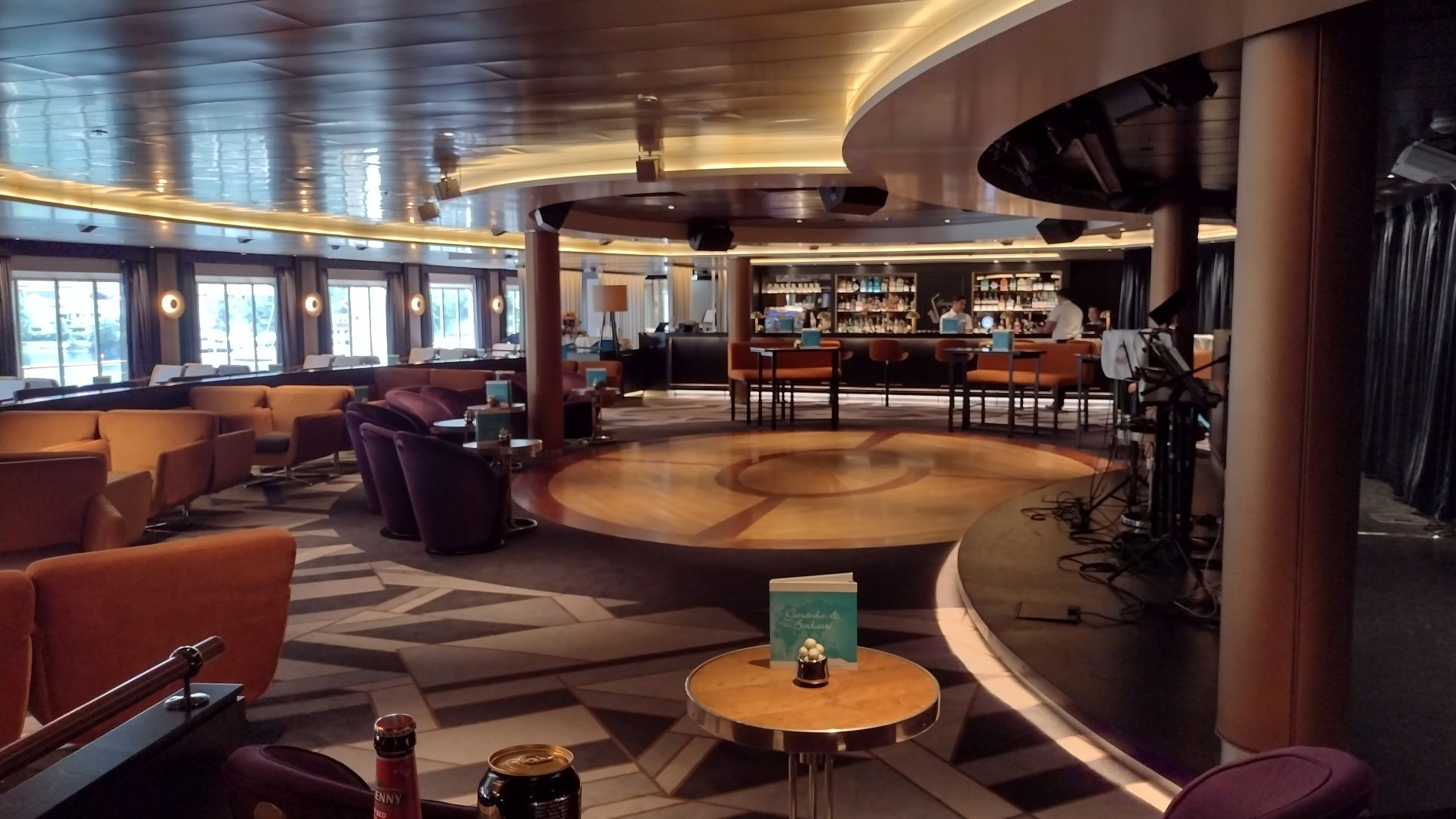
On deck 7, the old Ocean Bar is now Harry’s Bar. The bar itself has been made larger, the band stand re-arranged, and all the partitions removed so there is more place for sitting. In the starboard forward corner an enclosed Smoking Room has been put in, with glass wall so you can see who is working on a slow suicide. In the afternoon and evening there are two older gentlemen playing (They look a bit like motor cycle lovers with a mid life crises) and they play a mixture of German pop and dance music. Obviously they must think that their public has hearing issues as last night it was very loud.

Harry’s Bar. With Royal Viking this was a dining room. With HAL it was remodeled to the Ocean Bar with band and dancefloor, but with the bar hidden behind a screen. Phoenix has now opened everything up. It has a bigger band stand and much more seating.

Phoenix needed to make these two rooms bigger as Germans go much more for drinks in the afternoon and after dinner drinks and dancing than the Americans with HAL do, and I think they did a very good job, Two very nice lounges, who serve their guests well.

Deck 6, 5 and 4 are cabins again with on deck 5 in the forward staircase there is a multi purpose room, which with HAL was mainly for crew training, incentive group meetings and Club HAL. Now this is a “Kreativ Room” which on this cruise seems to consist out of “Sit & be Fit”. For that purpose a hard wooden floor has been put in while with HAL it was carpet. And then finally, “hurrah” they put in 4 new tenders. That meant installing new davits to hang them from which is quite expensive but they did so.

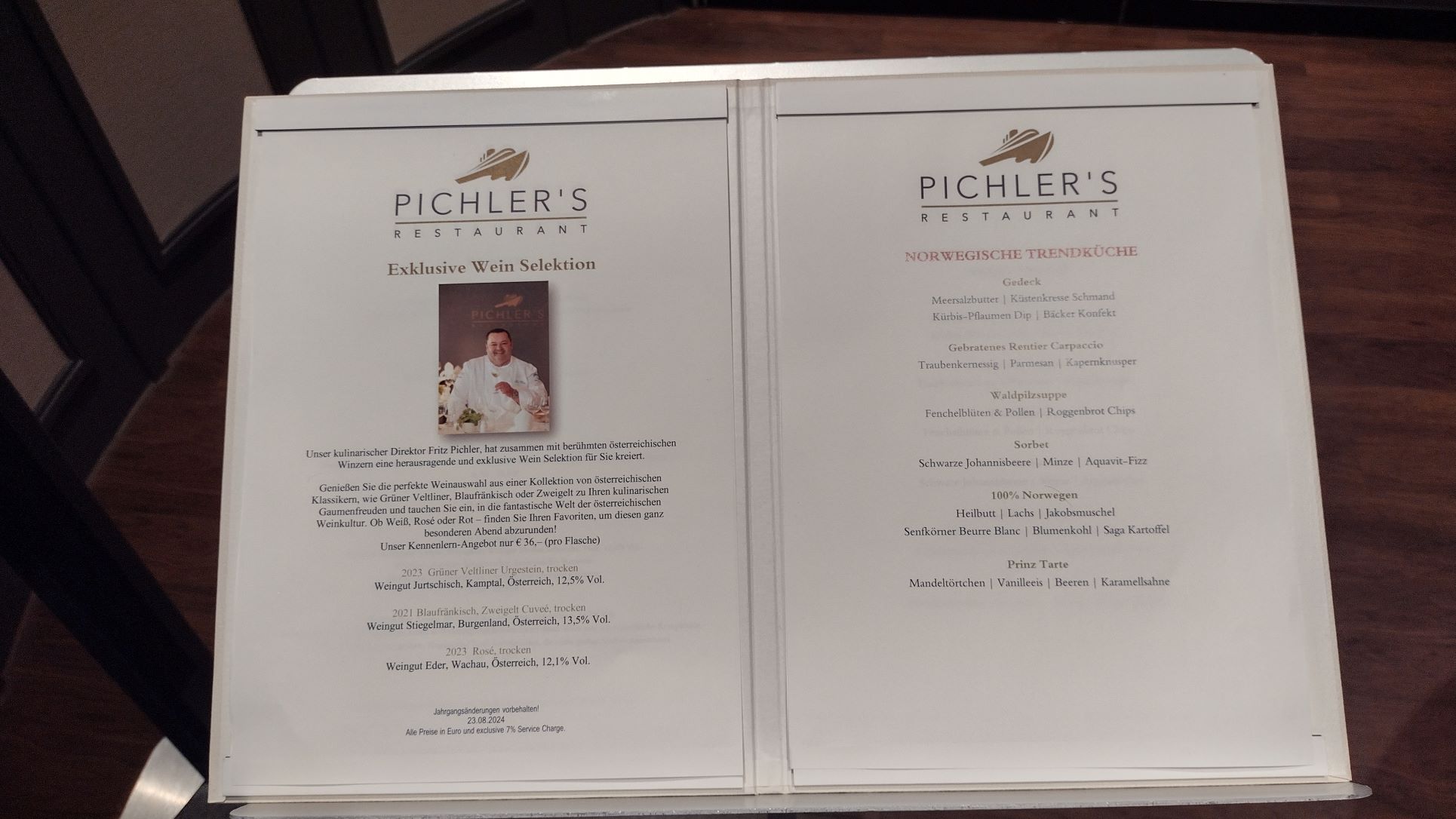
The menu at Pichlers.

We went for pre-dinner cocktails to the Piano lounge, which was completely empty. We are now getting the hang of the German flow. They were either watching the scenery on departure outside or they marched directly into the dining rooms or Lido. I wonder if they are indeed afraid that the kitchen will run out of food. Then they all congregate in the lounges afterwards where the bars were doing a roaring trade. We had a booking for Pichlers which is the old Holland America Line Pinnacle Restaurant and it is still exactly the same. The system works in a German way, everybody comes in between 18.30 and 1900 which gives the staff time to take your drinks order. Then when everybody is in, they close the doors, ……….yes they close the doors………… and then you get served a set menu served. If there is something you do not like or cannot eat (like milk in a dish) then they will get you something from the dining room. Food is free, drinks, water, tea and coffee you have to pay for. With a specialty restaurant you do not expect to pay for tea and coffee but here you do and they do not tell you. But once having experienced this, you know and can be ready to make a more quantified decision next time. The food was very good and the service very smooth. Even with a full house, there were enough waiters to make it all work perfectly.

That meant of course we missed the show but when we came out, “Die Beatles Show” was still going on, in the theatre, here called “Die Atlantik Lounge”.  Again this was a revue show, so same cast as last night, and again it was very bad. 3 of the four singers are not too bad to listen to , but the sound system, the  back stage lighting and set-up,  and cheography of the dancers is not good at all. Maybe Phoenix should only have bought 3 new tenders and spent some more money on the shows. On the other hand the guests did not seem to notice and were enjoying themselves so what can I say. We will have to find out eventually what quality of the shows are on “Mein Schiff ” and “Aida” but it cannot be that bad. That concluded our day, so time to translate the daily program to Lesley and plan for tomorrow.

Tomorrow we are in Sandane from 0700 – 1300 hrs. then a 60 mile jump to Floro for an evening call. Sandane, is an anchor call, so with tender service, but Floro is docking. We have never been to neither of the two places so we want to step ashore, even if it is only for 5 minutes. Weather for tomorrow, it calls for overcast weather with rain on the mountain but that rain normally has a tendency to come down the mountain at some time during the day. Who cares, the cabin is equipped with 2 large umbrellas so we can handle weather. Temperatures around 61 oF / 16 oC. and maybe somewhat higher.


2021 April 18; Happy Birthday

Today Holland America is 148 years young and although 2020 was the most challenging year in its history as far as sailing goes, we will weather this storm and we will continue.  Our history has taught us many valuable lessons and gives ample proof we the company is able to weather any storm. Whether it was War, Depression, the onset of the Airplane, or the Mass market cruisers,   the company has always navigated safely through every challenge.  So I am confident that we will sail through the Covid Storm as well.

In November this year I will be sailing for Holland America for 40 years in those years I have seen how strong this company is in dealing with challenging great and small.

So Happy Birth Day Holland America. Two years to go to the big 150

As a small tribute I have created a company time line from the beginning to the current day.

Please find below the highlights of our History, year by year, condensed to two sentences. Every year has several highlights and what are considered the most important greatly depends on an historians personal insights. These are mine. I have tried to find an illustration in my collection which relates to the year concerned,

For more information, under the drop down box of HAL history on this website, I have also brought the company history up-to-date with more information and photos.

Enjoy

Capt. Albert
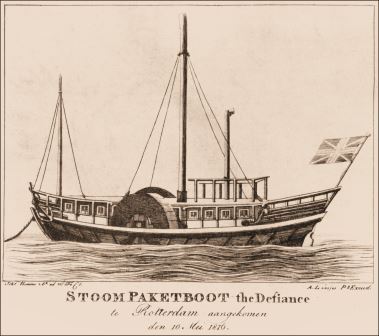
The Defiance credited with being the first steam driven boat to enter Rotterdam

1816   The first Steamboat visits Rotterdam and the public and business community gets the first glimpse of what can be done without sails.
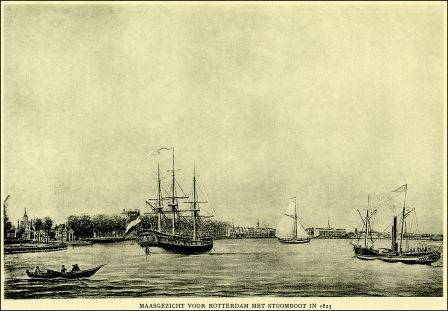
The caption reads  view on the Maas at Rotterdam with Steam boat in 1825.

1825   The first river boats with (auxiliary) stream propulsion arrive on the Dutch inland waterways and thoughts in Rotterdam are going towards using steam for deep sea.
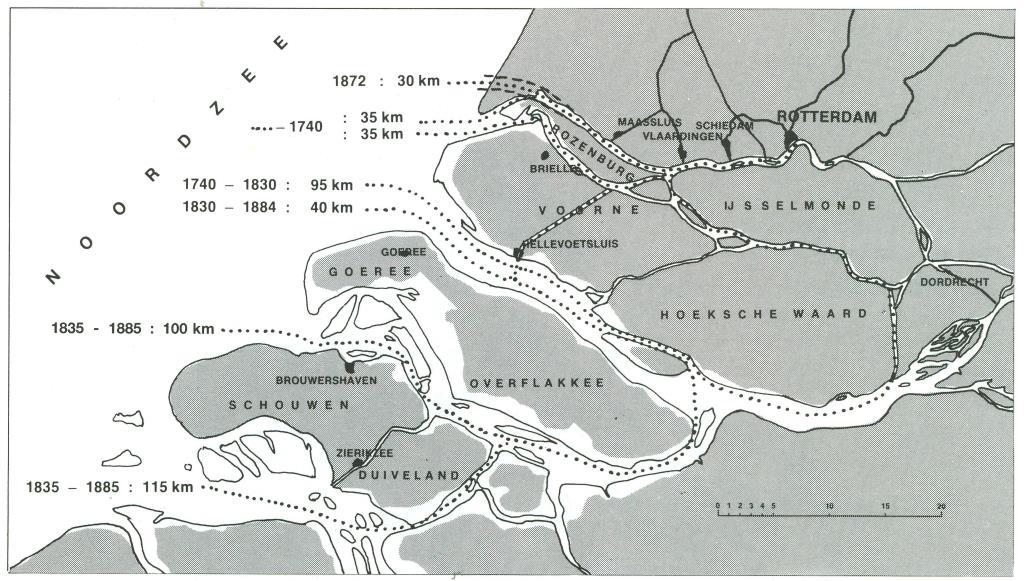
This was what all the fuss was about.  Before 1872 it was a long way around the islands to get to Rotterdam with a large and deep drafted ship.

1863   The Dutch Government agrees to create a “New Waterway”, capable of accommodating deep drafted Steamships, which will link the port of Rotterdam with the North Sea.
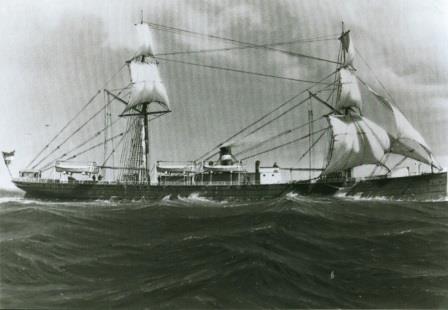
Our first ship the ss Rotterdam (I) depicted on a painting by C.A de Vries.

1871   On February 08, the forebear of the Holland America line is founded; by means of the private company C.V Plate, Reuchlin & Co. and two new steamships are ordered in Scotland.
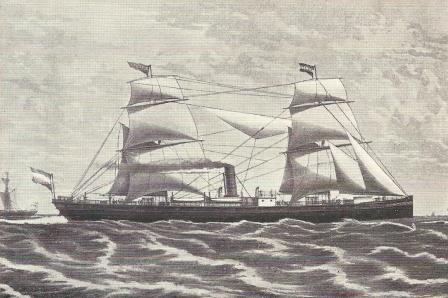
The sister ship ms Maas. named after the river which gave Rotterdam access to the sea. she was later renamed to Maasdam (I) to bring all the ship names in line with the DAM naming policy.

1872   The Nieuwe Waterweg .e.g. New Water Way is opened. On October 15, the first ship of the new company the ss Rotterdam (I) departs for New York.
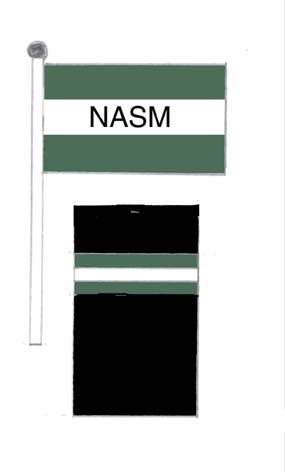
Funnel Markings and Flag. Green-White-Green where the colours of the city of Rotterdam

1873   On April 18, the private company goes public to obtain funds for more ships and the Nederlandsch Amerikaansche Stoomvaart Maatschappij or NASM sees the light of day. We consider this  the official birthday of Holland America Line.
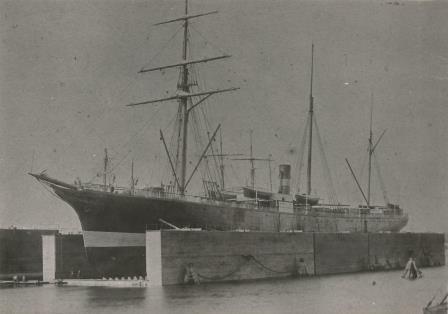
The P. Caland. The 2nd newbuilt of the company after it went public. Seen here in the local drydock.

1874  Two new ships are added to the Fleet, the s.s. W.A Scholten and the s.s. P. Caland. With four ships a regular steamship service to New York can now be maintained.
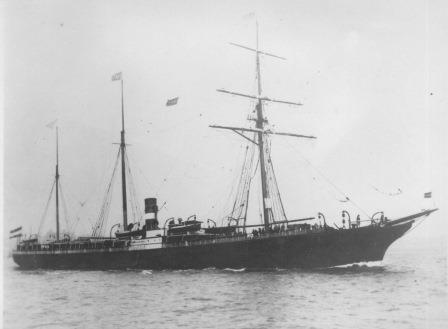
And here a sea-view of the same P. Caland  at New York. the ship was named after the designer of the “Nieuwe Waterweg” which Rotterdam access to the North Sea.

1875   The “Nieuwe Waterweg” starts to silt up and the ships have to take a circumstantial inland water route to reach Rotterdam or discharge cargo to reduce the draft. All costing time and money.
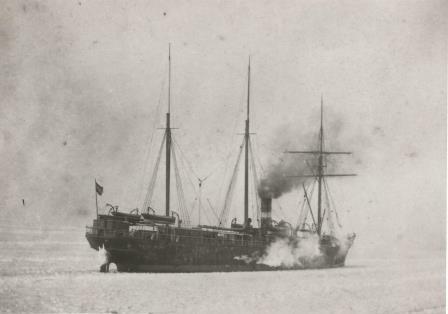
The ss W.A Scholten sister to the P. Caland and named after a major investor in the company. Seen here ploughing through the winter ice in New york.

1876   The new company is in crisis as there is an economic slump in the USA and no investments can be made as there is not much money coming in.
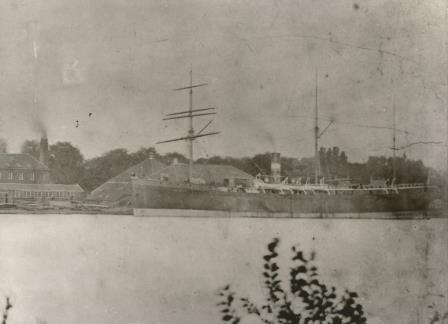
The ss Schiedam (I) shortly after she came into service.

1877 Trade picks up and a fifth ship, the ss Schiedam (I), is added to the fleet. This is an existing ship which is taken over from English Company and could thus be directly slotted into the fleet.
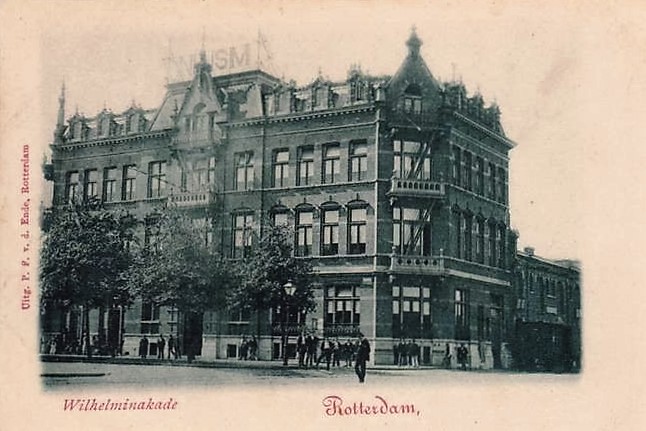
In the beginning emigrants stayed in local hotel which were often not that great. In 1901 the company opened its own Hotel on the company pier. It came complete with a chapel, a Cafe and medical facilities.

1878   Holland America at this time was primarily an emigrant carrier and in this year it started to work together with the local authorities to ensure good local hotel facilities for the waiting emigrants.
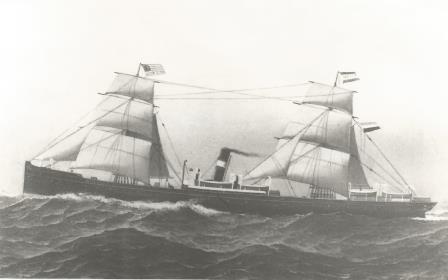
The ss Amsterdam I.  The painter who created this took some liberty with reality as the wind is pushing the sails one way and the smoke the other way.

1879 Profits are up and the company orders a new ship. The ss Amsterdam (I) would arrive in March 1880. Also this year dividend could be paid again to the shareholders.
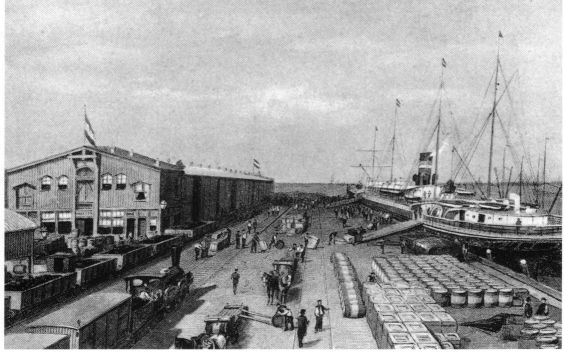
The Holland Amerika Lijn docks before 1900.

1880   A sister ship to the Amsterdam (I) was ordered and arrived in 1881, called the Edam (I) The ships now had a permanent dock location in Rotterdam where the company would stay until 1891.
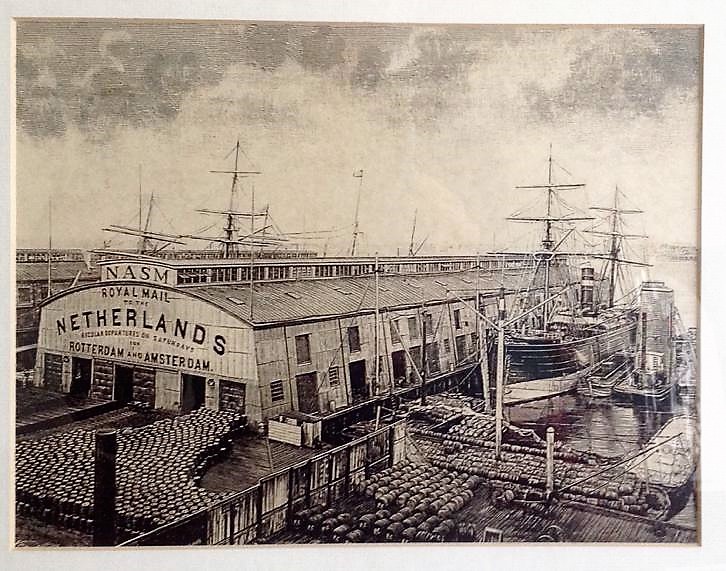
The docks at Hoboken. this engraving is from around 1890,

1881   Also on the American side a permanent pier was leased. The company settled down at the Hoboken side of the river. Here the leases were cheaper and the docks were also closer to the railroad station.
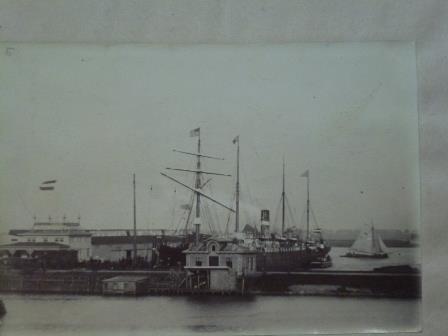
The companies docks in Amsterdam.

1882   Competition from a company in Amsterdam had to be warded off and for the next 10 years Holland America also sailed from this port. Using charter ships in the beginning and own tonnage later.
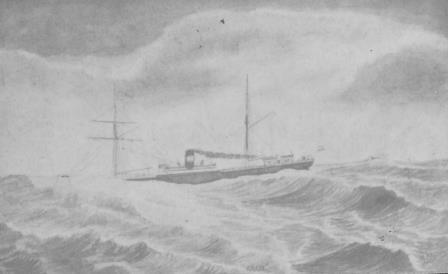
The ss Edam (I) of 1881 was the first of 4 ships bearing this name. this is a rather scarce postcard showing the ship in bad weather. And not un-realistic as the ships were small and the waves were big.

1883   The ss Maas, the 2nd ship of the company went for a refit and the company grabbed the opportunity to rename her in Maasdam (I) establishing the naming pattern which has lasted to the current day.
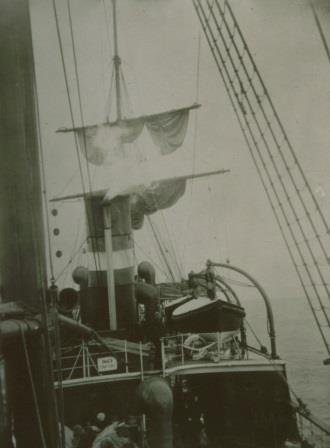
A very scarce photo is showing a deck scene on board the ss Edam (II).  The sign on the railing  is there to advise the emigrants to stay off the First Class deck area.

1884   The ss Amsterdam (I) was lost due to a fire caused by an exploding petrol lamp and the ship was not directly replaced as trade was not as brisk as was hoped for.
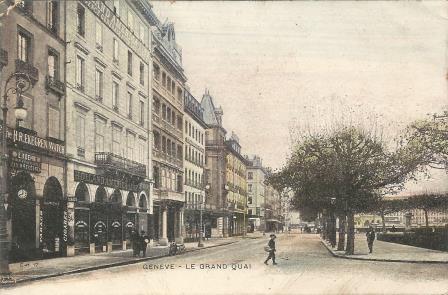
To attract passengers, first class and emigrants alike,  the company had an extensive network of agents all over Europe and the US. This, to the left, is the office in Geneva around 1900.

1885   By now a trade war had broken out on the North Atlantic. More ships meant more berths to fill and thus the emigrant ticket prices went down. It would not be until 1892 that a solution was derived at.
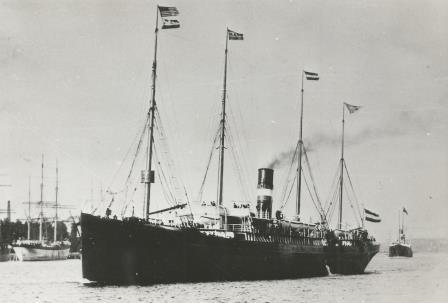
The Werkendam. One of a series of new ships bought. Marketing in later years did not like the name very much (hard to pronounce for non -Dutch) and thus it was not repeated in naming routine.

1886   Trade started to pick up again and in a few years’ time seven more ships were added to the fleet. Rotterdam (II), Amsterdam (II), Maasdam (II), Obdam, Werkendam, Veendam (I), Spaarndam (I).
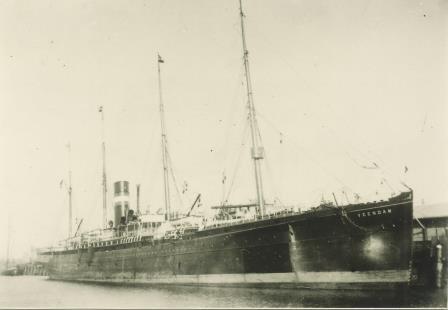
The Veendam (I) seen here docked in an unknown port but most likely Rotterdam.

1887   Another ship was lost, the W.A Scholten from 1874, which sank after a collision. The man after which the ship was named came from the town of Veendam and hence a new Veendam (I) was added.
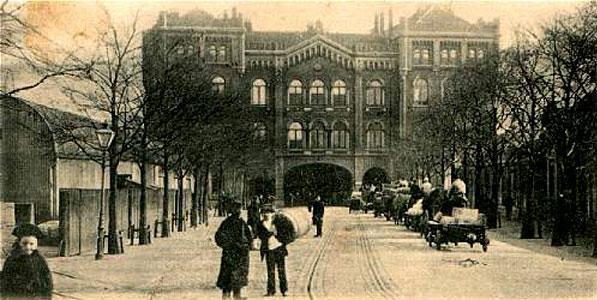
Poort means Gate and hence it is easy to see why the building was called the “Gate-Building” Holland America had its offices on the second floor.

1888   A new headquarters was established at “Het Poort Gebouw” in Rotterdam. Easily recognizable as the entrance road into the dock area went under the office areas. The company would stay here until 1891.
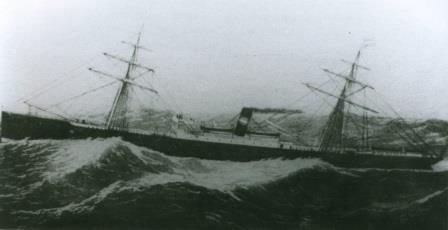
The ss Zaandam (I)Painted by Antonio Jacobson of New York who had a preference for wild seas if given a free hand in the composition.

1889   The company decided to diversify and opened a service to Argentina with the Zaandam (I) taking the first sailing to Buenos Aires in December.
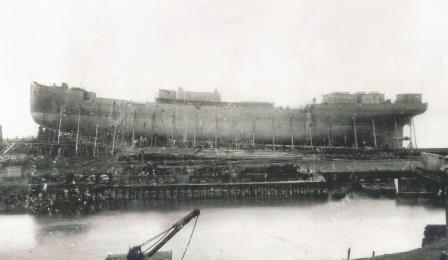
The ss Didam of 1891. The company had the ships for the Argentina service especially built as they needed a much larger coal storage / bunker space due to the long distance to Buenos Aires.

1890 The trade to Argentina look promising and two new ships were ordered for this route. The Didam and the Dubbeldam. However a revolution broke out and the venture came to an untimely end.
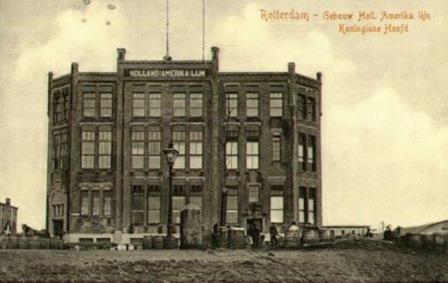
The New head office under construction. It is still exists and is now a very popular hotel and /restaurant,

1891 The Head Office moved to the Wilhelminakade in the center of the port and here it would keep it main office until the passenger side was moved to New York in 1971.
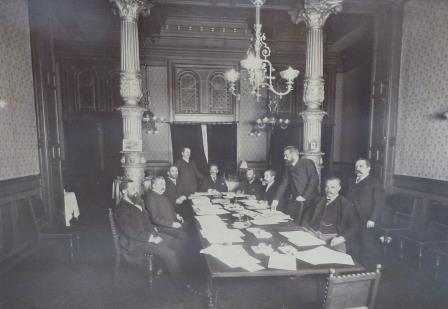
A well-known photo of this very important agreement. All the representatives of the participating companies are present here.

1892   Very important for the survival of most of the North Atlantic steamship company’s was the creation of the North Atlantic Steam Association which from now on regulated the prices for emigrant crossings.
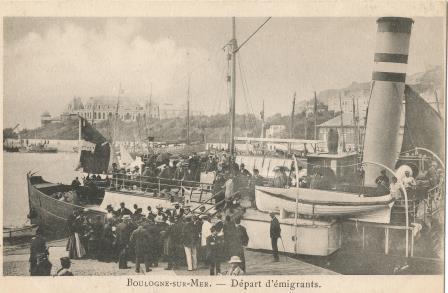
The Holland America Tender “Chicago” embarking emigrants to take to the ship at anchor outside the port.

1893   The World Fair took place in Paris and the HAL ships started to call at the French Port of Boulogne Sur Mer. BSM would remain the regular French port of call for the company until the 2nd world war.
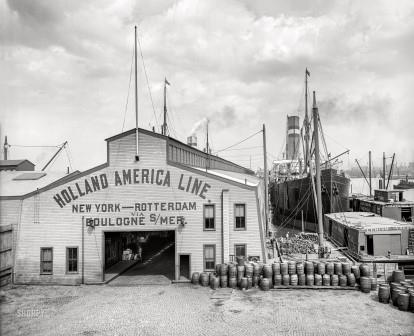
The docks at Hoboken sometime after 1900. Alongside the ss Potsdam recognizable due to the very tall funnel.

1894   At Hoboken a 2nd pier was leased from the port Authority at 7th. Street and here the company would keep its terminal until 1964 when it fully moved to the Manhattan side of the Hudson River.
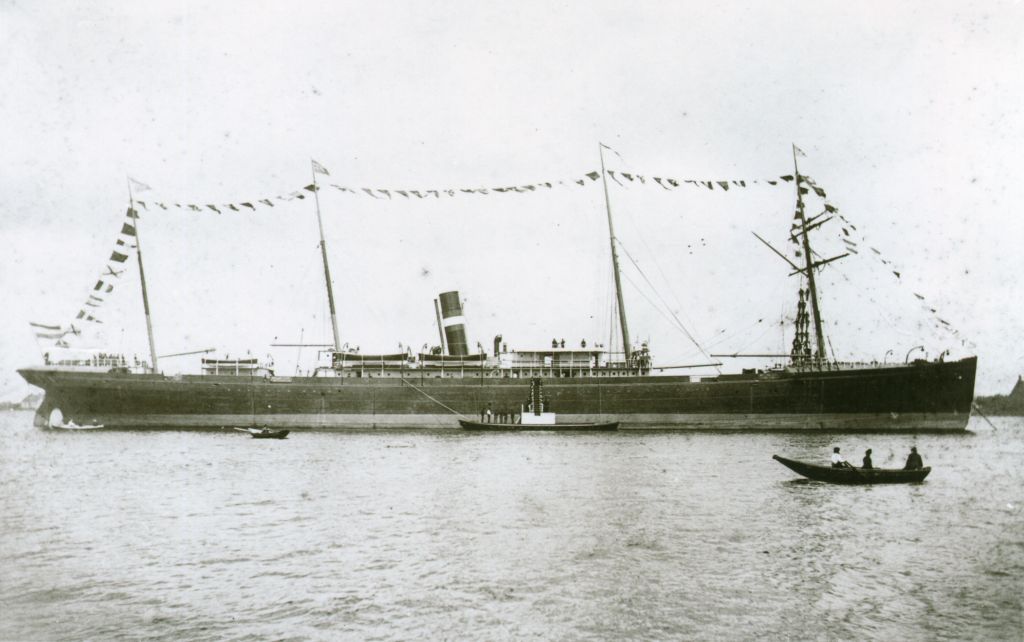
The Rotterdam (II) at anchor near Copenhagen. Apart from going through the Canal  a visit to this city was also part of the “Excursion”.

1895 The ss Rotterdam (II) made the first cruise for Holland America with an “excursion” to the Kieler Kanal. The success would help to decide the entry into cruising a number of years later.
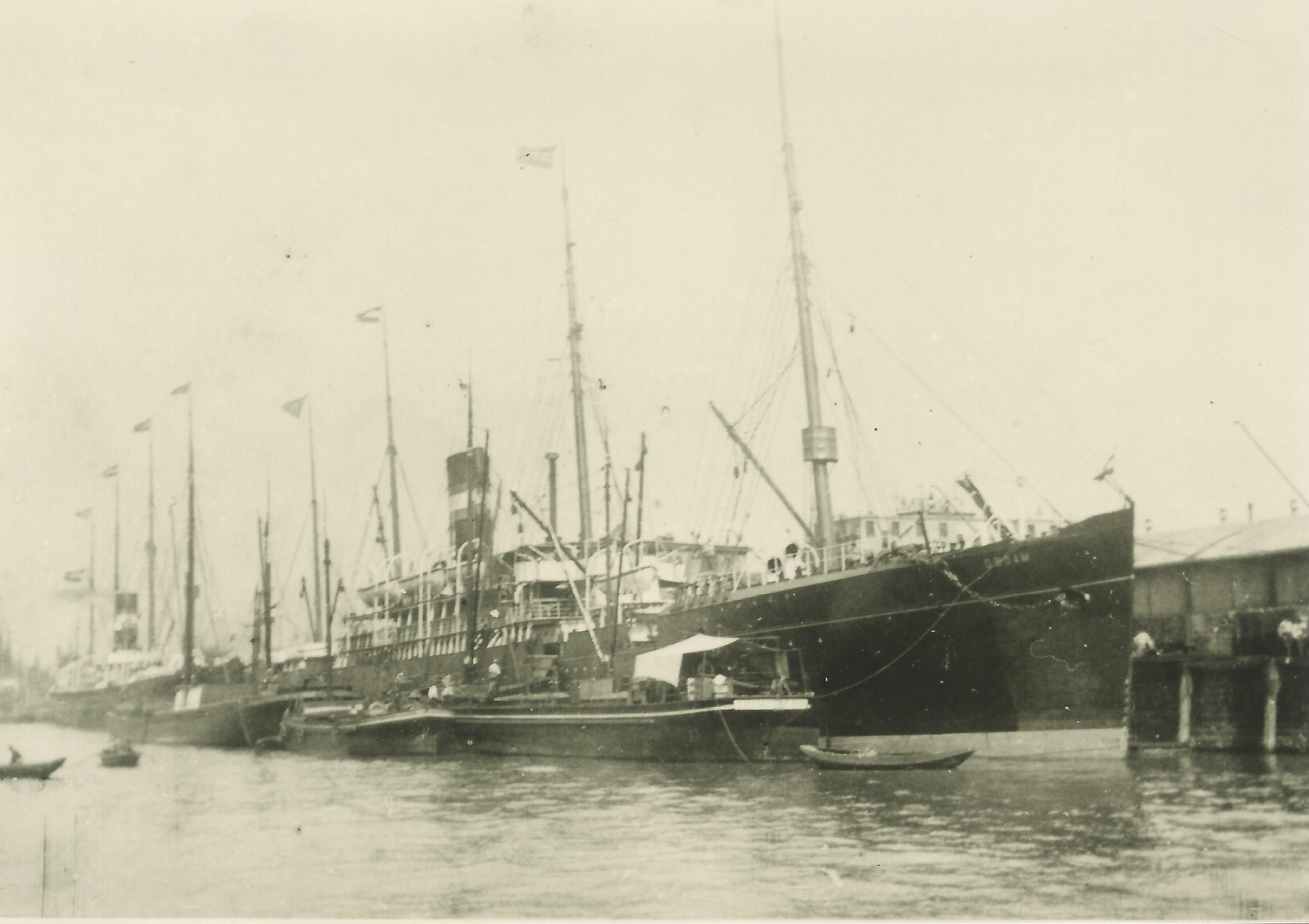
The ss Obdam, seen here loading in Rotterdam, did not sail long for the company but was sold in 1898 to the USA and played a signifciant role in the Spanish- American war.

1896   The Directors of the NASM finally accepted the fact that everybody called the company Holland America Line and not by its very long founding name. Both titles were now to be used.
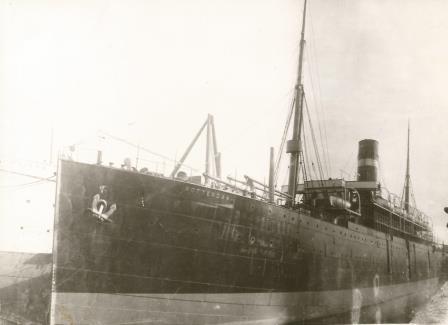
The ss Rotterdam III is the least known of all the “Rotterdams” which sailed for the HAL. Most likely as she was overshadowed by her namesake of 1908.

1897   The ss Rotterdam (III) entered service and she was the first twin screw vessel for the company. This ship was still built in Great Britain as the Dutch yards could not yet deliver ships of this size.
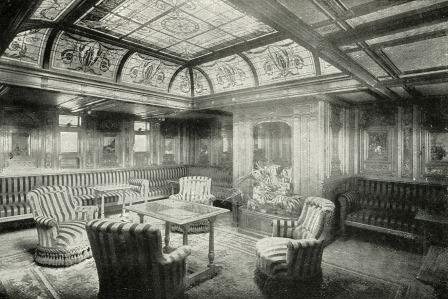
This is the “Ladies Salon” also called the “Drawing Room” or the “Parlor” depending of the preference of the newspaper men.

1898   A near sister if the Rotterdam (III), the Statendam (I) entered service and she has been credited with being the first ship where the management took a great interest in the interior lay out of the vessel.
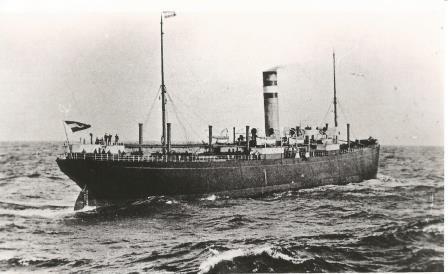
The ss Amsteldijk (I) one of the first cargo-only ships of the company. Apart from cargo she could also carry 350 head of cattle and had accommodation for 48 officers and crew and 18 Cattle Hands.

1899   A new route was opened to Newport News for cargo ships and this was so successful that 3 new cargo-only ships were ordered. These all received names with Dijk endings such as ss Amsteldijk (I).
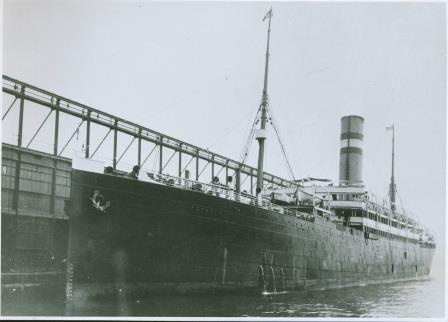
The first in the series of new passenger ships was the ss Potsdam of 1900.

1900   The ships with a DAM name ending were now designated as Passenger ships and three new ones were brought into service. The ss Potsdam (1900), ss Noordam (I) (1901) and the ss Rijndam (I) (1902)
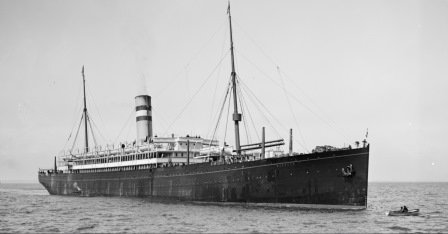
The ss Noordam (I) which entered service in 1901 as was an identical sister to the Rijndam (I) of 1902

1901 The Banker and Rail Road magnate J.P Morgan obtained control of a large number of HAL shares and also those of some other companies. Idea was to create a “railroad at sea” without competition.
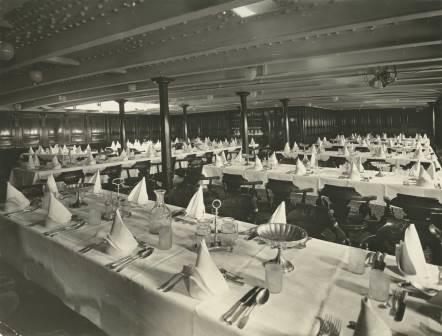
The First Class Dining room. There is  a small sky light for natural light in in centre. with the later ships this would grow out to a two story affair.

1902   More than 51% of the shares came under his control and timetables were brought in line with the sailings of the other companies. It was not until well into WWI before HAL was independent again.
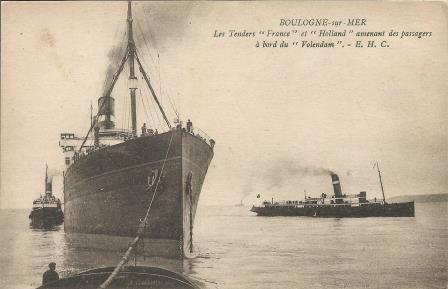
This shows the Tenders Holland an France attending the ss Volendam (I) from 1922. The  ships would often stop not longer than 30 minutes to an hour to do the transfers.

1903   The company established a French Subsidiary in Boulogne Sur Mer, called the Compagnie Franco Hollando Americaine, needed to operate its tenders as the ships stayed at anchor at this port.
The original Wireless Transmitting “Marconi” Radio Station on the ss Noordam (I)

1904   Telegraphy arrived on the ships and the ss Noordam (I) was the first to receive such an installation. Not operated by the company’s officers but by the Marconi Company who controlled the trade.
The Nieuw Amsterdam (I) on the slipway of Harland and Wolff in Belfast.

1905   With the Ticket prices regulated competition had become fair again and the company had ordered two new and very big ships the Nieuw Amsterdam (I) and the Rotterdam (IV).
The Nieuw Amstedam (I) of 1906 seen here at full speed.

1906 The Nieuw Amsterdam (I) arrived this year and with a tonnage of 16967 Grt. It was one of the 10 largest ships in the world for that year. It could carry 2350 emigrants but also 440 First Class and 246 second class pax.
The Japanese Tea room on board the Nieuw Amsterdam (I) A large skylight provided natural light which was considered a luxury item for a ship.

1907   The service to Newport News was expanded with regular calls at other ports and would remain part of the Holland America route system to well into the late 1960’s.
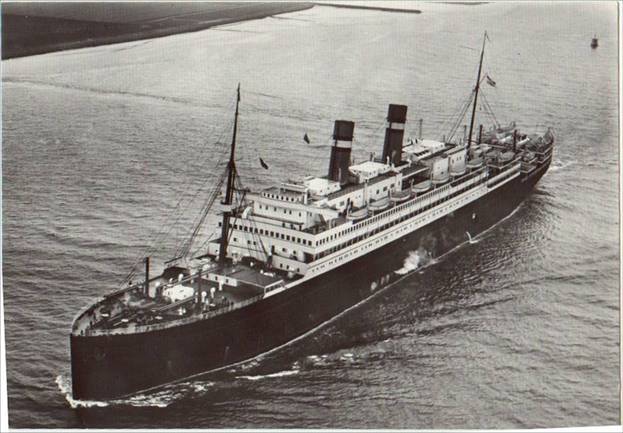
The ss Rotterdam (IV) seen here on the Nieuw Waterweg heading for open sea.

1908   The Rotterdam (IV) was 30% larger than the Nieuw Amsterdam but its emigrant accommodation was smaller as the company was now offering more elbow room for even its cheapest fare guests.
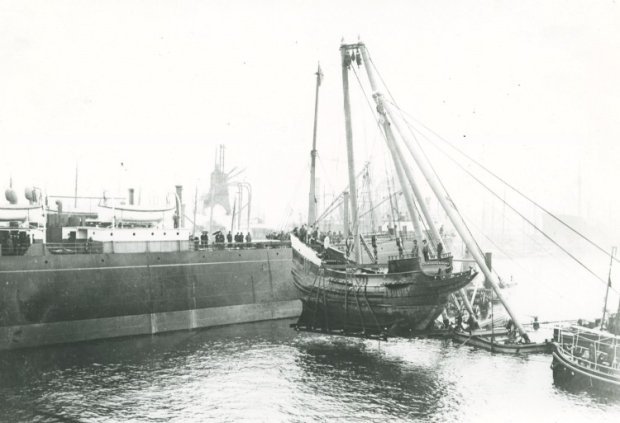
The company donated a replica of the original Haelve Maen which Henry Hudson used to sail up to what is now Manhattan. The model can be seen loaded her on board the cargo ship ss Soestdijk (I) for transport to New York.

1909   The British Neptune Line to Newport News was taken over and with it came six cargo ships, greatly expanding the fleet. In New York Holland America took part in the Hudson – Festivities.
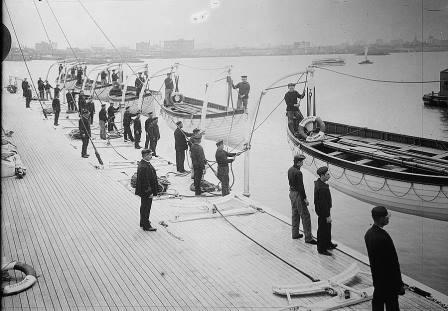
Not many photos exist of the safety drills in the old days. But here is one of a boat drill held on the Statendam (I) Pre-Titanic so no lifejackets, no railings and no safety lines.

1910 The Statendam (I) made a cruise to the Holy Land in March and its success made sure that the ss Rotterdam (IV) would eventually be used for similar voyages.
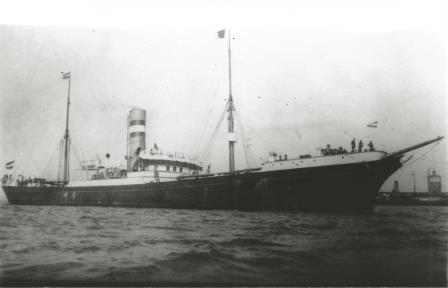
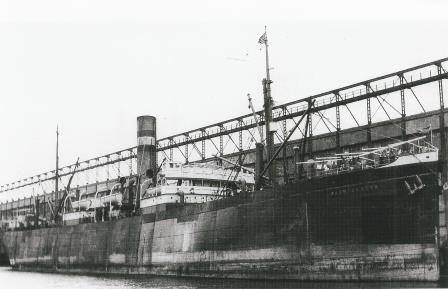
The ss Zijldijk of 1909 still had a bowsprit and a figure head as a throwback to the old sailing days. She called on her voyages at the port of Savanah.

1911   Another service, started in 1910, became a permanent feature with cargo ships sailing from Rotterdam to Savannah. This route was called the “Burg Lijn” and was carried out for a Dutch brokerage company.
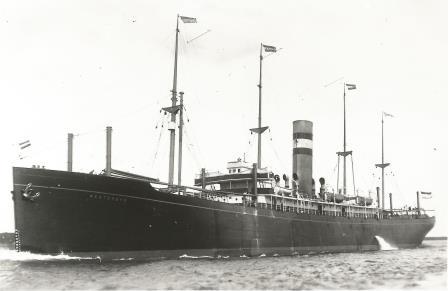
The ss Maartendijk of 1909, built for the service to North East America was moved to the new Gulf service in  1913

1912   A new cargo service to Cuba, Mexico and New Orleans was opened. This was such a success that after WWI a series of 4 passenger cargo ships was built especially for this route.
The ss Westerdijk of 1913 filled the gap when the ss Maartendijk was moved tot the new route.

1913   To have sufficient capacity for all these new routes, new cargo ships were taken into service. The Oosterdijk, Westerdijk and Zuiderdijk, all named after the main points of a compass.
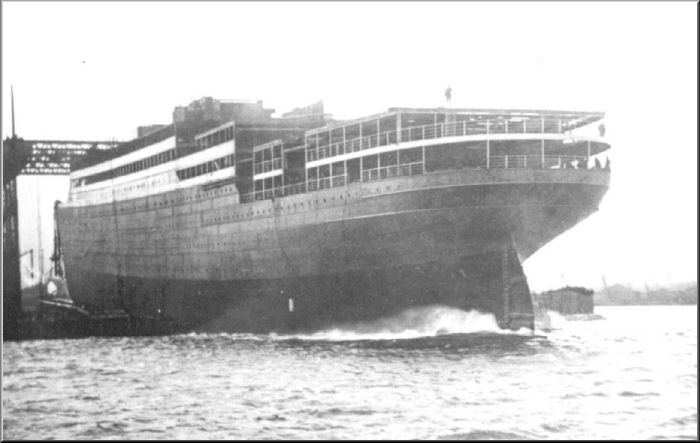
The ss Statendam (II) seen here launched on 06 July 1914. She was supposed to be about 30% bigger again as the ss Rotterdam (IV) from 1908.

1914   On the 6th. of July, the Statendam (II) was launched with the intention to have her enter service in 1915. War interfered and she was torpedoed in 1917 as the troopship Justicia sailing for the British.
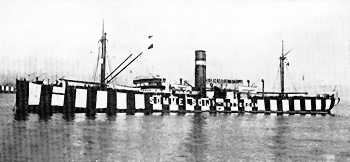
To avoid being torpedoed several ideas were tried. Being neutral required the name of the ship on the side and then “dazzle Paint” was applied to make it as difficult as possible for an U boat commander to see the ship. This is the Sommelsdijk (II) of 1912.

1915   The Netherlands was neutral during WWI and most ships continued sailing but under very difficult circumstances. 3 ships hit a mine and all ships were subject to strict inspections by the allied forces.
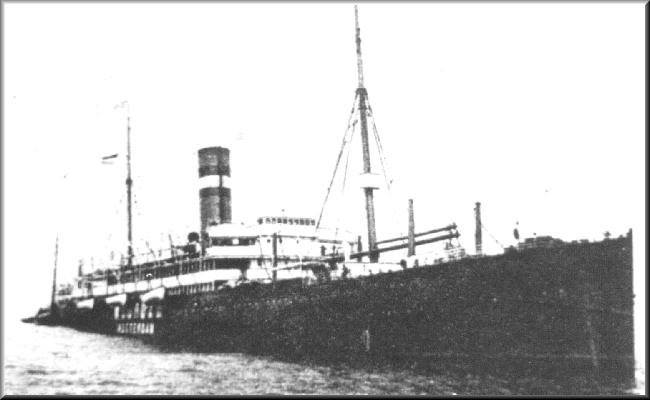
For neutral ships the biggest danger was mines. Here the ss Noordam (I) is seen sinking  after mine hit the stern of the ship. Luckily she could be saved.

1916   The U-boat danger was now so grave that the ss Rotterdam (IV) was laid up but the profits made with the other ships were so high that the 1915 dividend was set at 50% over each share.
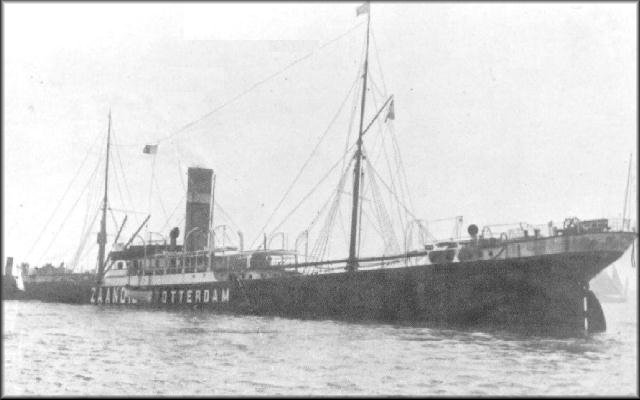
The ss Zaandijk (I)ran on a mine in 1916. as seen above, but cold be repaired. The next year she was not so lucky.

1917   Two cargo ships, the Noorderdijk (I) and Zaandijk (I) were torpedoed on the same day and sunk. The Noordam (I) ran on a mine for the 2nd time. But profits continued to be good and  the company managed to buy back all foreign held shares. Making it a fully independent company again.
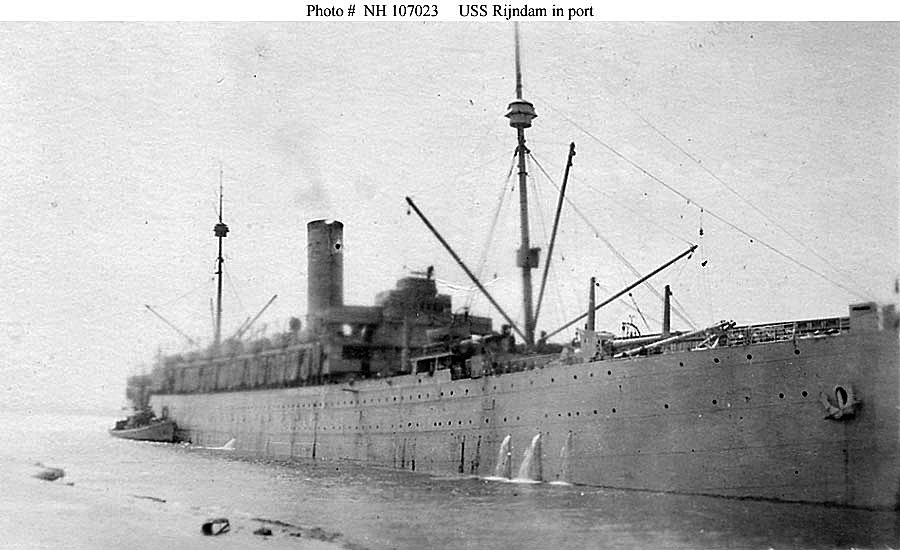
The USS Rijndam (I), seen here at St.Nazaire France, ferried US troops to Flanders Fields and later back again. (Photo courtesy: US Congress)

1918   All the HAL ships that were laid up in USA ports had been seized in 1917 and forced into service for the US Government. The Oosterdijk sank after a collision and the ss Rijndam (I) became a US troopship.
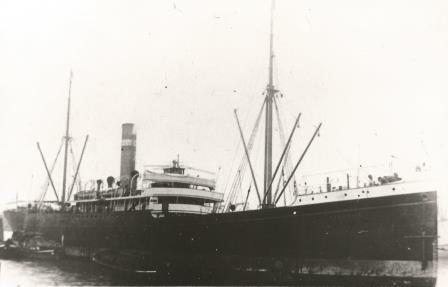
The ss Zaandijk (II) was taken over from the Germans as compensation for the sinking of the Zaandijk (I). She was originally the ss Silesia of HAPAG.

1919   With the war over reconstruction could begin. Cargo ships from Germany were taken over, two replacement passengerships were ordered for the sunk ss Justicia and 60,000 tons of steel was received as compensation.
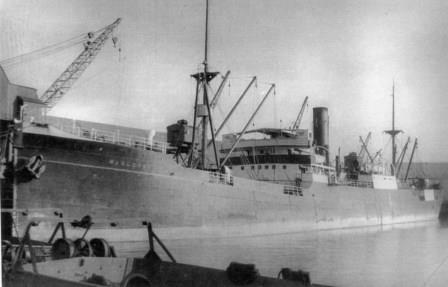
The ss Waaldijk which had joined the fleet in 1914 seen here in VNS charter. The only change to sail for the VNS was, to paint over the hal colours on the funnel to one red band.

1920   Holland America participated in a joint venture with other Dutch companies called the VNS or United Shipping for services to the Far East and Africa. Each company participated with entering own ships.
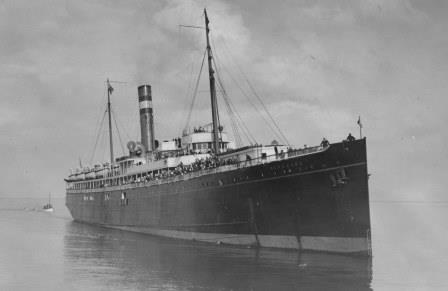
In 1919 the company had bought an American ferry, the SS Madison and used here as the ss Warszawa to feeder emigrants from Dantzig and Libau in the Baltic to Rotterdam. She was  sold back to her original owners in 1926.

1921   Plans to return to the pre-war emigrant trade were dashed when US congress approved a Quota Act to reduce the number of emigrants entering the USA. Basically now only 10% of the postwar emigrant numbers were allowed to be landed by each company. Other sources of income had to be found.
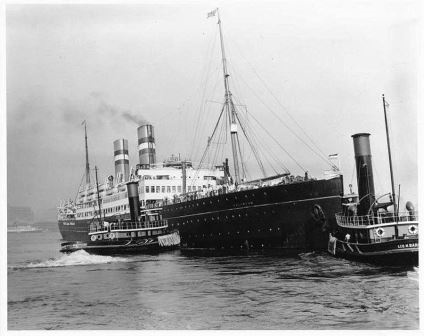
The ss Volendam (I) of 1922 Seen here manoeuvring off Hoboken in New York

1922   Two medium seized passenger ships entered service, the Veendam (II) and Volendam (I) their immigrant capacity reduced from 1200 Third class to 484 Tourist Class.
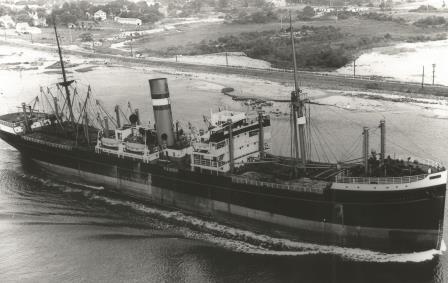
The ss Bilderdyk (I) of 1923. the others in the class were the Binnendyk, Blijdendyk, Breedyk, Burgerdyk, Beemsterdyk, Boschdyk and Blommersdyk.

1923   With the 60,000 tons steel a series o f cargo ships were built called the B class. Construction of a new Statendam (III) started in 1920 was halted. Holland America changed the spelling of the ships names from IJ to Y. So a Dutch Dijk became an American Dyk.
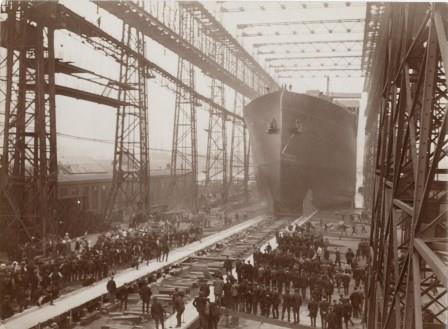
The Statendam (III) launched on 11 September 1924

1924   The hull of the Statendam (III) was launched without ceremony and promptly laid up with all work suspended due to lack of money.
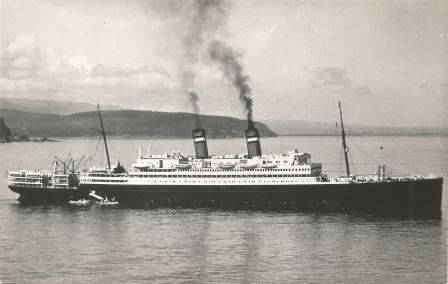
The ss Rotterdam (IV) seen here at Cannes during one of her 1920’s cruises.

1925 The Rotterdam (IV) had resumed the pre-war Holy Land cruises from New York and would from now on make each year such a cruise during the North Atlantic Off-season of January, February and March.
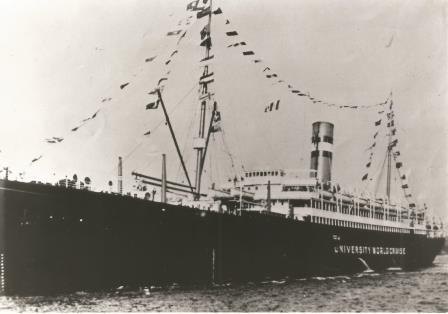
The ss Rijndam (I) sailing as a floating University.

1926   A more un-usual cruise was made this year, the Ryndam (I) went for a seven month around the World cruise as a floating University. The 506 students on board visited the countries they studied about on board, saw the sights, and also met Mussolini and the King of Siam.
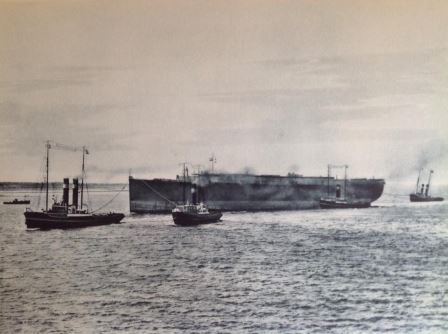
The unfinished hull of the ss  Statendam (III) being towed to Rotterdam by three Dutch Tugs.

1927   The hull of the laid up Statendam (II) was towed to Holland for completion and would enter service in 1929. Finally there was money to complete the ship which was quite similar to the ill fated  Statendam (II)
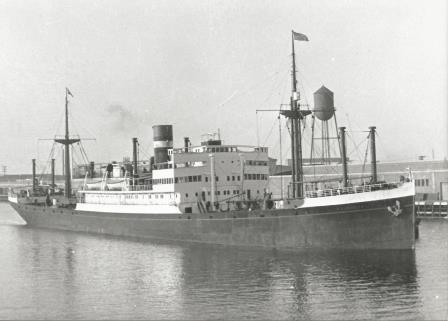
The ms Delftdyk was especially built for the North Pacific service. After the war she hit a min and was completely rebuilt and given a new name: ms  Dongedyk.

1928   Two new motor ships (Delftdyk/Damsterdyk) had been ordered for the North Pacific service to Vancouver in 1927 and would come into service in 1929 and 1930. Each could carry 50 passengers.
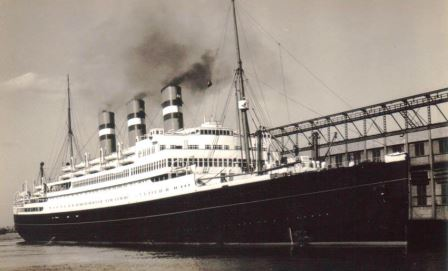
The ss Statendam (III) when finished, she was the only 3 funnelled ship ever to be in operation for Holland America.

1929   There was the Wall Street Crash and the maiden voyage of the ss Statendam (III). The company now had 3 large passenger ships in service but at the same time revenue plummeted.
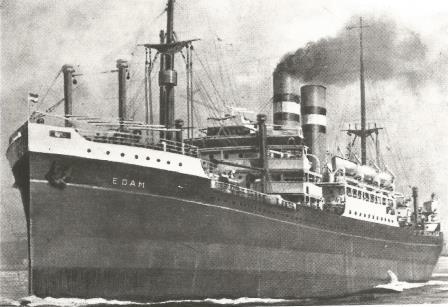
The ss Edam (IV) was the lead ship of a class of four passenger cargo ships built for the Rotterdam, Iberia, Cuba and Gulf Service in 1921. They could carry 14 First Class, 174 Second Class and 802 Third Class.

  1930 Most of the Cargo ships were laid up and carrying passengers to Cuba and the Gulf of Mexico was completely stopped and the route only continued as a cargo service.
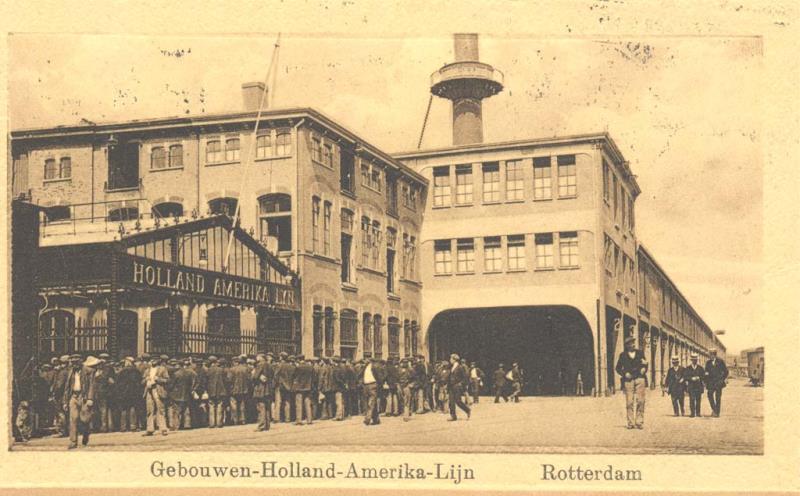
The entrance to the Company docks. Laborers waiting to go to work.

1931 Cost savings had to be made and Sea and Shore side personnel were laid off. Contributions to the pension fund were reduced and some permanent labour contracts were changed to “by the day”.
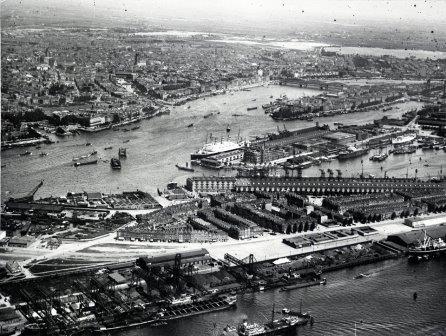
Aerial view of the port of Rotterdam. the whole center area was part of the Holland Amerika Lijn. The ss Statendam (III) ca be seen alongside the passenger terminal

1932 Ticket prices were reduced by up to 40%. Laid up cargo ships were sold off or scrapped. The Nieuw Amsterdam (I) was sold for scrap in 1931 and no feasible plans could be considered for a replacement.
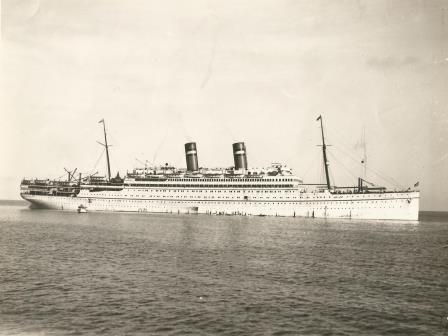
The passenger ships made as many cruises as possible to compensate for  the down turn in Trans Atlantic business. The Rotterdam (IV) was even painted white for a short while but that was not a great success.

1933 The shareholders became so worried about their investments that a special “strong man” from outside the company was appointed to restructure the company at save it for the future.
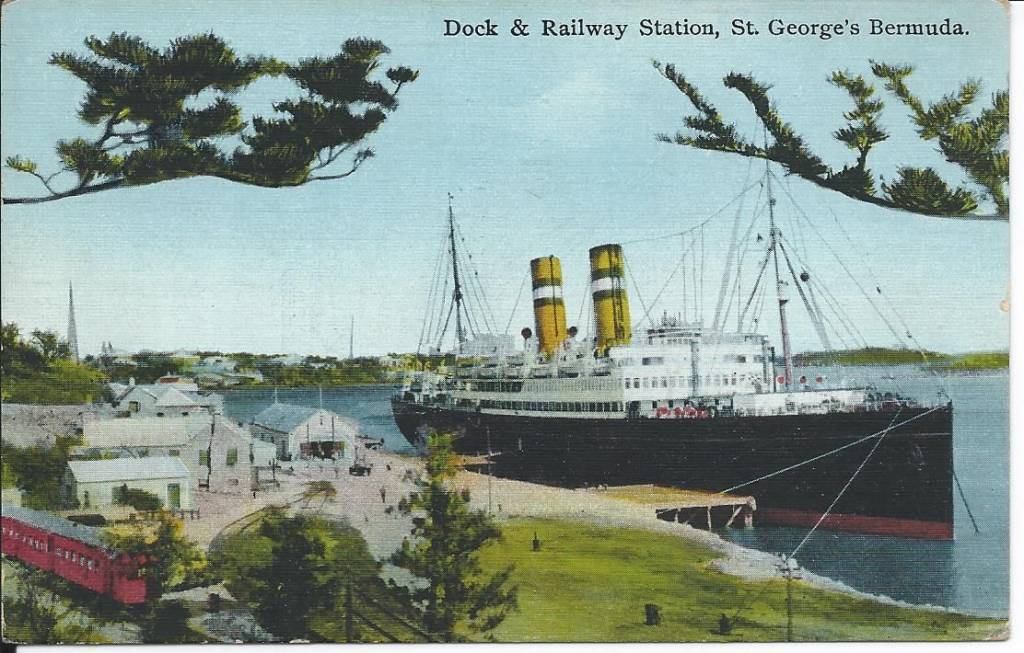
The ss Veendam (II) seen here docked at St. Georges, Bermuda during one of her cruises from New York.

1934   The new company structure was successful and as world trade slowly improved plans were drawn up to build a running mate for the Statendam (III) which eventually entered service in 1938
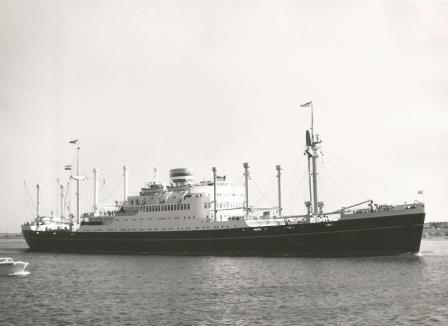
The ms Noordam (II) was the first of a series of four passenger cargo ships with the first one arriving in 1938.

1935   The company made a profit again and decided to design 4 passenger cargo ships for the direct intermediate service to New York with a one class accommodation of 125 passengers.
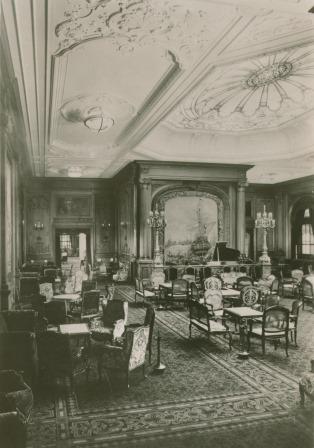
First Class Lounge on the Statendam (III). The carpet could be rolled away and then a large dancefloor was exposed.

1936   A sign of things to come was when the Statendam (III) carried an airplane to the Netherlands for the Royal Dutch Airlines. It were the airplanes which eventually brought the regular passenger liner service to an end.
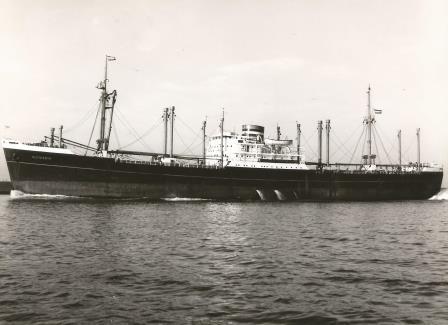
The Sloterdyk (II) and her sister Sommelsdyk (III)  came into service just before the war started. Although being cargo ships there was space for 12 passengers,

1937 On the 10th of April Queen Wilhelmina launched the new flagship of the company the Nieuw Amsterdam (II) and two new cargo ships were ordered, the Sloterdyk (II) and Sommelsdyk (III).
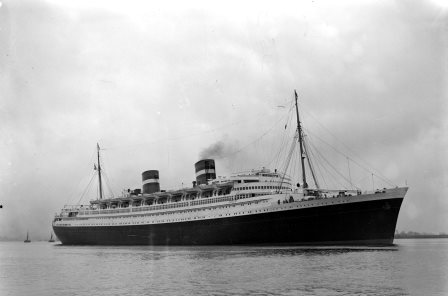
The Nieuw Amsterdam (II)  this photo was taken on the departure for her maiden voyage to New York.

1938   The first of the four passenger cargo ships the Noordam (II) came into service in April followed by Nieuw Amsterdam (II) in May. With a size of £36,287 gt. She could carry 1200+ passengers in 3 classes.
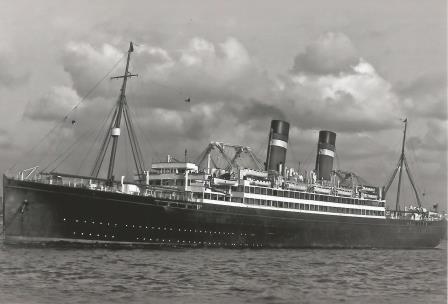
The ss Westernland in HAL colours. She was eventually sold to the British Admirality to be turned into a Navy support ship.

1939 The Red Star Line was bought. Owned by the Jewish Mr. Bernstein who could no longer operate the company due being under arrest in Germany. Two ships the ss Pennland and the ss Westernland were taken over.
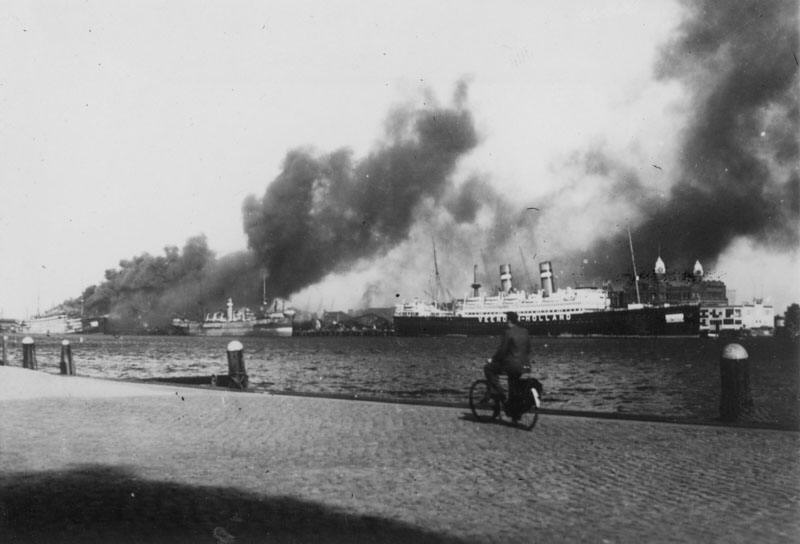
The HAL ships came in the cross fire when German Paratroopers came up against the Dutch Royal Marines.  To the left the ss Statendam (III) can be seen on fire. Behind the man on the bike is the ss Veendam (II) which spent the war in German hands.

1940   On 10 May 1940 Nazi Germany invaded the Netherlands. Luckily most of the fleet was outside the home port and joined the Allied war effort. The Statendam (III) caught fire and burnt out. As resistance was fierce, the City of Rotterdam was bombed causing the Dutch to surrender.
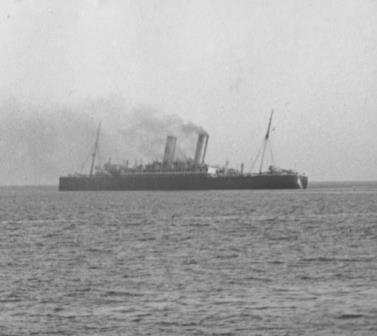
The ss Pennland on fire off the coast of Greece. (Photo courtesy Capt. A.M van Gemert from whose lifeboat this photo was taken)

1941   The cargo ship ss Beemsterdyk was torpedoed and the ss Pennland sank after air attacks off Greece. Shortly after the ss Maasdam (II) was also torpedoed and sank while in convoy when a nearby ship exploded.
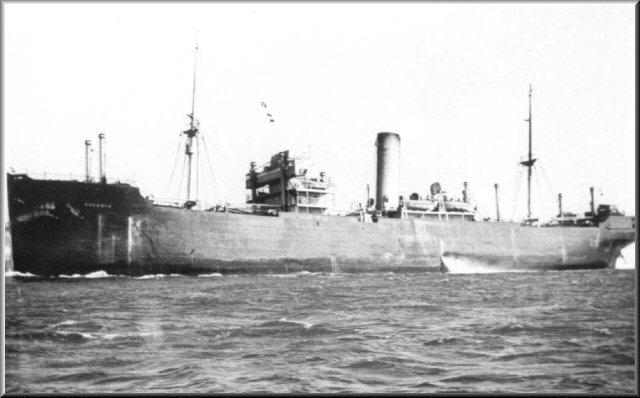
The ss Breedijk in war ship grey colours. She was torpedoed on 14 September 1942 South of Las Palmas. The Captain and one Steward died in the tragedy.

1942 Apart from the cargo ship ss Breedyk also  the ppassenger cargo liner ss Zaandam (II) was torpedoed and suffered 127 casualties including two Holland America Line captains.
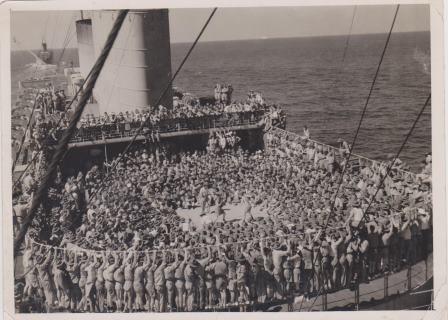
Full house on the Nieuw Amsterdam during troop transport in the tropics. Apart from boxing contests there was often a complete entertainment group on board including well known stars from Stage and Screen.

1943   The passenger ships were all converted to troopships. The ms Noordam (II) designed for 125 passengers could now carry 2300 troops and the ss Nieuw Amsterdam (II) just short of 9000.
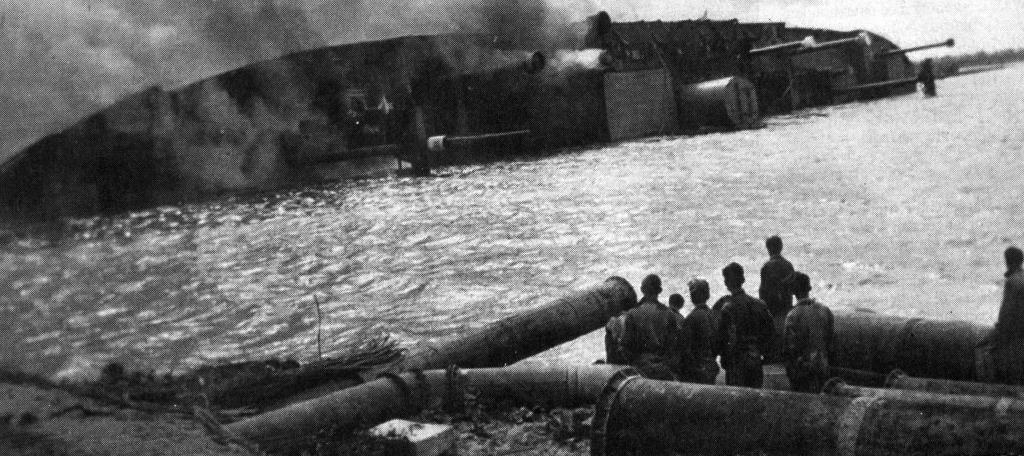
The ms Zuiderdam (I) sister to the ms Noordam (II) and ms Zaandam (II)  was sunk in the “Nieuwe Waterweg” and burnt out. the hull was deemed beyond salvage and scrapped after the war.

1944   At home two cargo passenger ships, Westerdam  (I) and Zuiderdam (I) had been under construction when the war started and were now used as blockade ships to keep the expected invasion out the ports.
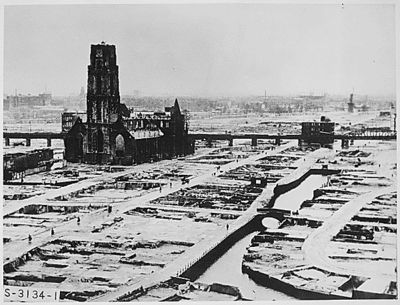
This was what was left of downtown Rotterdam after the bombardment of 1940. The situation at the company docks was not much different with only the main office building still standing.

1945 After the liberation on the 10 th. of May 1945 the rebuiling started at once. Holland America had lost 50% of its fleet, 265 employees had lost their lives and nearly all the Rotterdam property was damaged beyond repair and needed to be rebuilt from scratch.
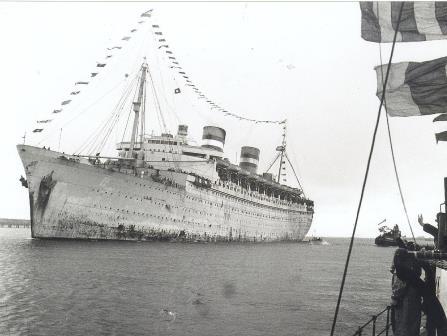
The ss Nieuw Amsterdam (II) coming home in 1946. When the war ended she still sailed a full year as a troopship for bringing the troops home.

1946   The Nieuw Amsterdam (II) arrived home on 10 April 1946 with a war record of having steamed 530,452 miles and carried 378,361 troops. A record only broken by the Cunard Queens who were double the size.
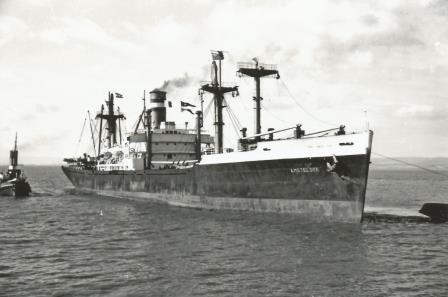
The Amsteldyk (II) was the first of 10 Victory cargo ships acquired by the HAL.

1947   Part of the rebuilt program was the acquisition of 10 Victory cargo ships who were called the A class. The Veendam (II) which had spent the war in Germany returned to service as well as the Nieuw Amsterdam (II).
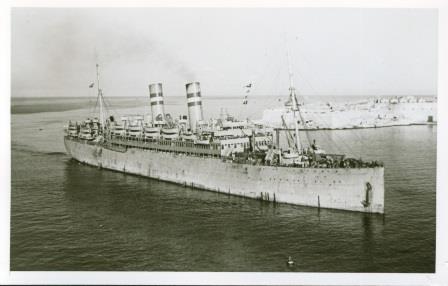
The ss Volendam (I) seen here entering the Grand Harbour in Valetta Malta had served the whole war as a troopship. Together with her sister Veendam (II)  they were refitted for post war duty but were by then old and tired ships.

1948   In three years’ time 19 ships were added to the fleet and 5 passenger ships were in operation. Plans were drawn up for new ships for the West Coast service and to replace the Veendam (II) and Volendam (I)
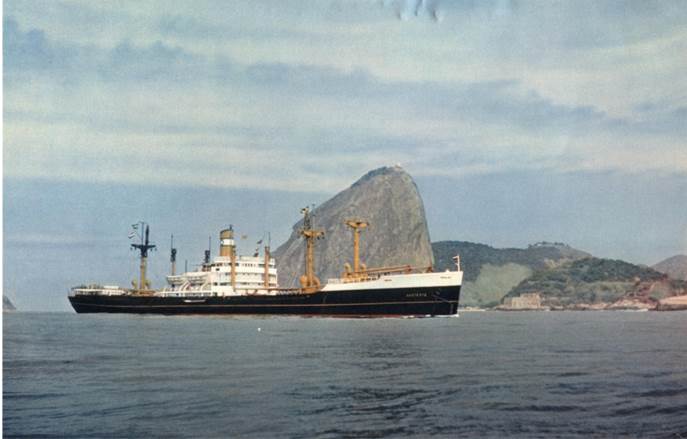
The ss Aalsdyk sailing by Sugar Loaf mountain near Rio de Janeiro

1949   A new service was opened to South America and the company became an important carrier of goods for the Marshall Plan, the support program the USA had set up to get Europe back on its feet again.
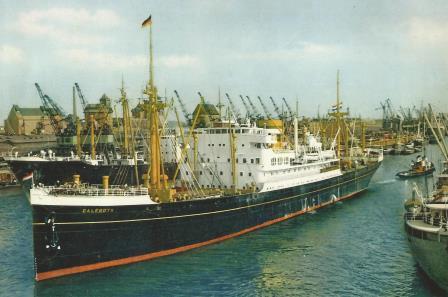
The ms Damsterdyk from 1930 re-emerged after the war as the ms Dalerdyk after a complete refurbishment.

1950 Two pre-war ships employed on the North Pacific service  were completely refurbished and renamed.  This service ran from Hamburg via Rotterdam, Panama Canal along the whole Pacific Coast of North America to Vancouver.
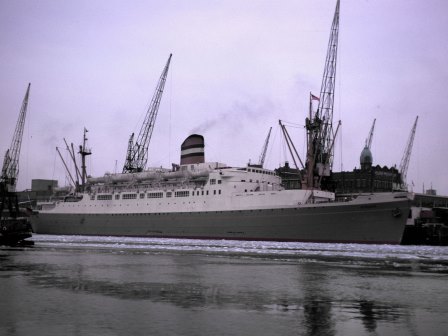
The ss Ryndam (II) of 1951 had for those days, the very unusual concept of only a small First Class area just under the funnel and the rest of the ship assigned as Tourist Class.

1951   The ss Ryndam (II) was commissioned followed by a sister ship the ss Maasdam (IV) and they took over from the aging V ships. Because the original hull design had been meant for a cargo ship they were known to be very ” lively”.
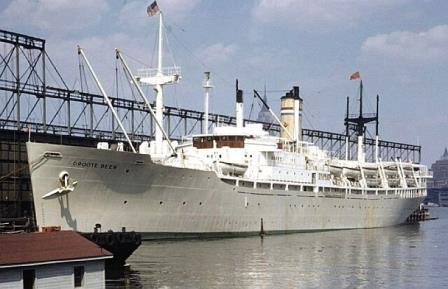
The ss Groote Beer was originally built as a Victory ship with troop capacity. Obtained by the Dutch Government, first for troopship duty and then for emigrant voyages. Those to North America were under management of the HAL.

1952   For the booming emigrant trade the HAL took over the troopship Groote Beer from the Dutch Government and used her for emigrant services to the USA and Canada and student trips to Europe.
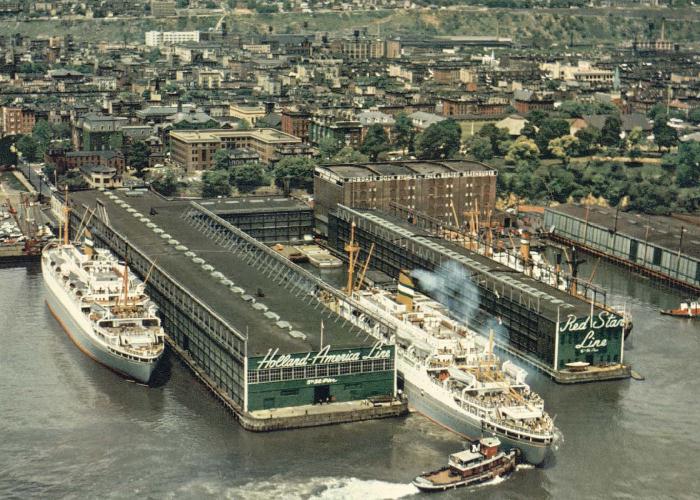
The Ryndam (II) and Maasdam (III) both docked at Hoboken Piers. For a while they were marked as “The Thrifty Liners” as a Tourist Class ticket was really good value for money.

1953   Business was going well and thoughts went towards an intermediate liner which could also be used for cruises and a running mate for the Nieuw Amsterdam (II) which would become the Rotterdam (V).
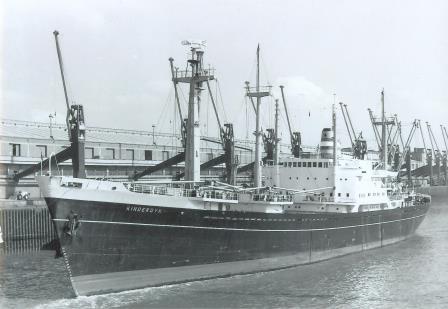
The K -class, with the ms Kinderdyk seen here as the first of the series. These ships  just fitted in the new St. Lawrence Locks.

1954   The company expanded once again their cargo network with opening a new route to the Great Lakes when access locks to the St. Lawrence River were enlarged. The K-class ships were built.
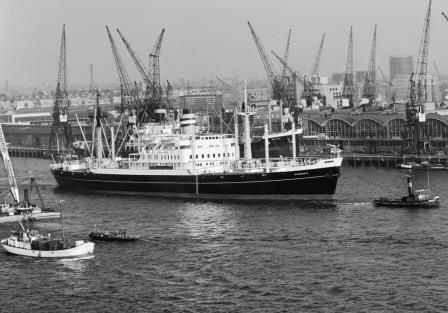
Apart from ordering ships for the St. Lawrence locks, also new builds were commissioned for the North Pacific service. Here we see the ss Diemerdyk  leaving Rotterdam.

1955   The name ss Statendam (IV) was announced for the intermediate Liner which was to enter service in 1957 and the order for the Rotterdam (V) was given to the Rotterdam Dry-dock Company in Rotterdam.
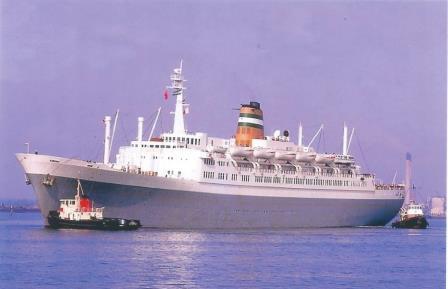
The ss Statendam (IV). The first class accommodation of 89 passengers was located on the decks right behind the funnel. The 857 in Tourist class had the run of the rest of the  ship.

1956   The clasas concept of the Ryndam (II) had proven very successful and thus the Statendam (IV) also was designed with a small First Class and a large Tourist Class capacity making it easy for one class cruising.
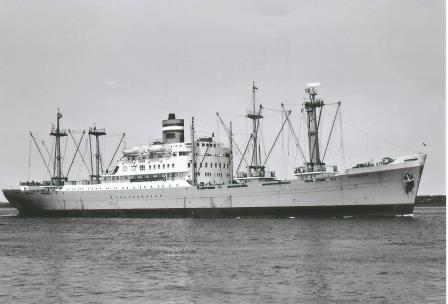
The ss Dinteldyk (II) Although being  a cargo ship with a large passenger accommodation she was given the grey color passenger hull as she was considered the flagship of the west-coast fleet.

1957   The ss Statendam (IV) came into service on the North Atlantic route and would make in 1958 the First World cruise for the company with normal guests on board.
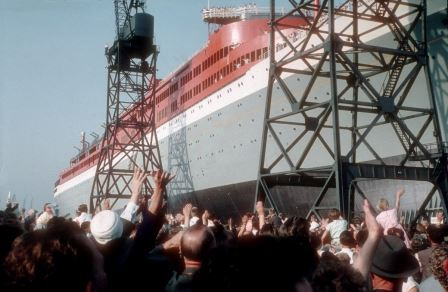
The ss Rotterdam (V) being launched. It was estimated that approx. 100,000 people from City of Rotterdam attended the launch.

1958   The Statendam (IV) made the first world cruise for regular passengers and the ss Rotterdam (V) was launched on the 13th. of September by her Majesty Queen Juliana of the Netherlands.
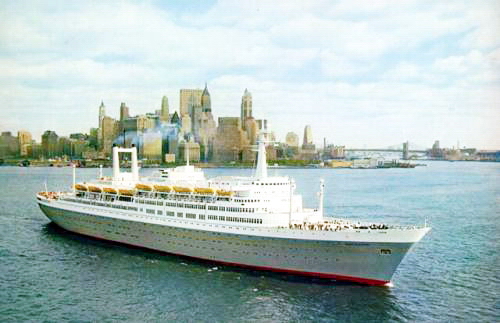
Most traditional liners had the accommodation laid out vertically. The Rotterdam (V) had all the public rooms horizontally. First Class on Upper Promenade Deck and Tourist class on Promenade deck. Open the connecting doors and two full decks were easy accessible to all during One Class cruises.

1959   In 1958 the airplane had carried as many travellers as all the ships on the North Atlantic route together and thus cruising became more and more important. Hence the new Flagship was optimized in layout for one class cruising during the North Atlantic off-season.
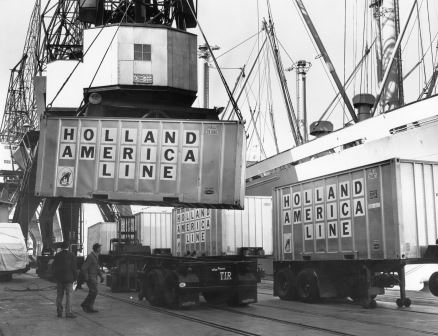
The arrival of the container caused a major disruption in the port and ships operations and also in labour relations.

1960   The step by step arrival of the container in the cargo business meant that conventional cargo ships became less and less effective. Competitors from the past now joined up to form joint ventures to reduce the costs.
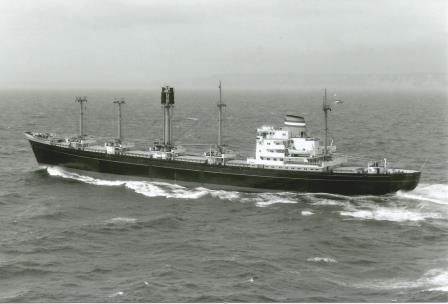
The ms Gaasterdyk (II) The lead ship of the G- class especially meant for for the Gulf service. Although they were also seen on all the other routes of the company.

1961 New cargo ships, called the G-class were introduced especially for the Gulf of Mexico service and the older A class cargos ships were sold off one after the other and were all gone by 1969.
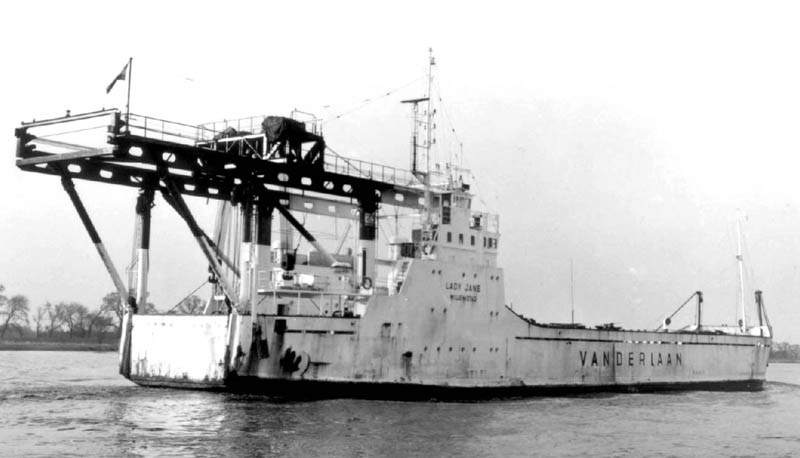
The ms Lady Jane ,of Vander Laan Shipping, was one of the first ships designed to carry ultra heavy cargos and where in high demand for transit with oil exploration related cargos. HAL had taken a share in this “heavy Lift” company.

1962 With both the North Atlantic and the cargo business facing an uncertain future, the company decided to diversify with investments outside its core business. Acquisitions were made in hotels, an airline, travel agencies, a dredging company etc. etc.
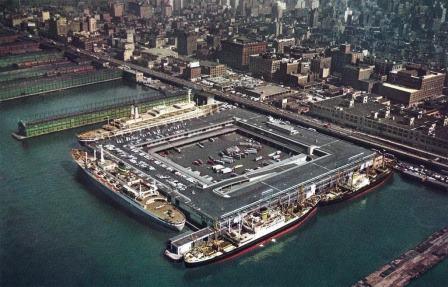
Pier 40 was the best pier there was for processing cargo and passengers when opened in 1962 . From left to right: The ss Rotterdam (V), the ss  Statendam (IV), either the Noordam (II) or the Westerdam (I) and a K class freighter.

1963   Between the end of 1962 and mid 1964 Holland America moved its operation from the Hoboken side of the Hudson to downtown Manhattan where it had taken a lease on the brand new Pier 40.
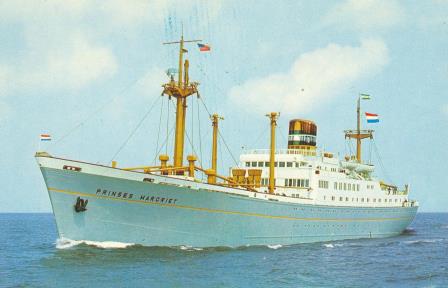
The ms Prinses Margriet was taken over from another company and as she carried the name of the “God child” of the Dutch Merchant Marine (2nd daughter of the Queen) she was not renamed to a DAM name.

1964 A small passenger- cargo ship the Prinses Margriet which had been in charter for a while was taken over and used for North Atlantic crossings and well attended “cargo cruises” from New York to the Caribbean.
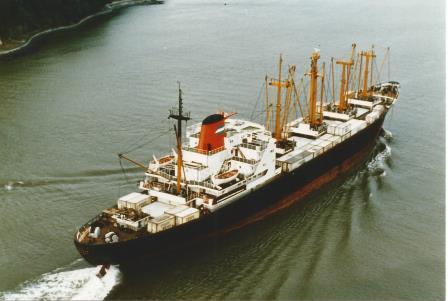
The ms Moerdyk (II) This ship was already container friendly with having space for them around the cargo hatches but it was not enough to keep the real container ships from taking over.

1965 The last conventional cargo ship the ms Moerdyk (II) came into service. The next step would be to invest in container ships and the company participated in the Atlantic Container Line.
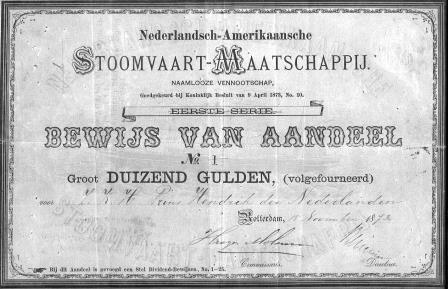
The first ever Share of the company. bought by His Royal highness Prins Hendrik of the Netherlands and sponsor of the company in 1873.

1966   When the company was founded in 1873 it had been scheduled for a lifespan of 100 years. To avoid the company from being abolished in 1973 a new charter was adopted for an open ended future.
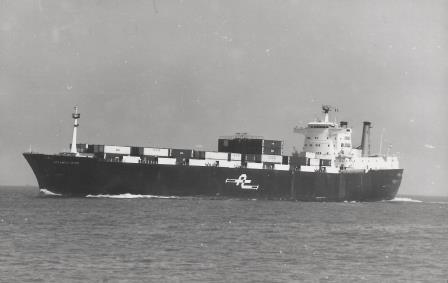
The first containership the ms Atlantic Star. She carried containers in front of the bridge and rolling stock (cars and anything else on wheels) in a large space under the accommodation with a ramp at the stern.

1967 The English company Cunard joined the ACL combine and each company would now participate with two ships. One slow, one fast. Holland America brought in the Atlantic Star and the fast Atlantic Crown.
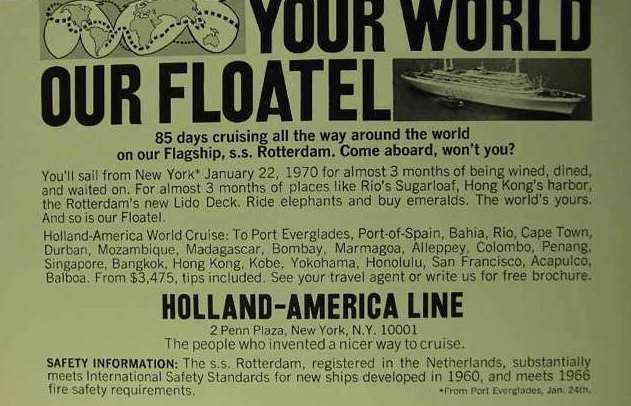
The ships became Hotels and somebody in marketing came up with the idea of “Floatels”.

1968   The North Atlantic service was coming to an end and the operating structure on board the passenger ships was changed to a Hotel setup with an integrated service led by a Hotel manager.
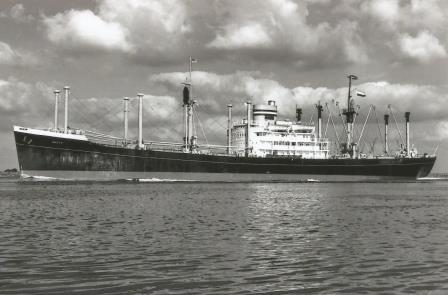
The last of her kind with HAL. The Victory cargo ship ss Andyk (II) was phased out in 1969.

1969   The shore side operating structure was also re-organized with more clearly defined departments and overlaps were removed. The last ship of the A class the ss Andyk (II) was sold.
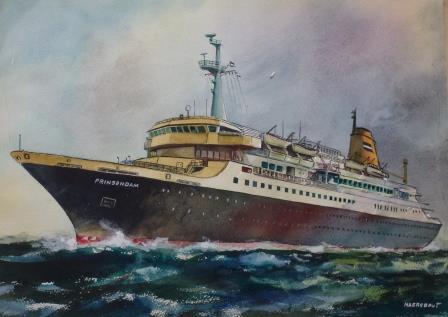
The first artist impression of the Prinsendam (I) Here Holland America would test its idea’s about the future of cruising.

1970 An order was placed for two small cruise ships as the company wanted to experiment with an own design for the future cruise fleet. In the end only one was built. As the Dutch Tax system became so progressive the HAL introduced Indonesian crewmembers on the ships.
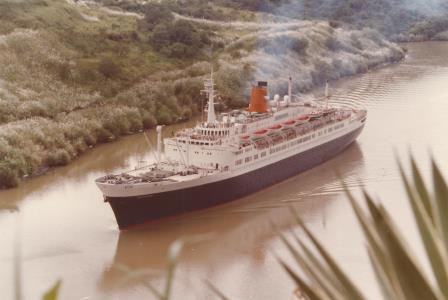
The ss Statendam (IV) seen here sporting the new blue hull and the orange funnel with the wave logo.

1971   A 70% share was taken in the Westours Tour Organization of Seattle which gave Holland America access to Alaska. The cruise ships were refurbished and a new “Wave” logo and hull color appeared.
The ms Bilderdyk (II) A large crane moved over the whole length of the ship cargo bays. The barges were lowered into the water at the stern of the ship.

1972   The company had also just introduced the ms Bilderdyk (II) a LASH (Lighter Aboard SHip) barge carrier for the Gulf service. 83 barges could be left behind for loading and un-loading while the ship continued its voyage.
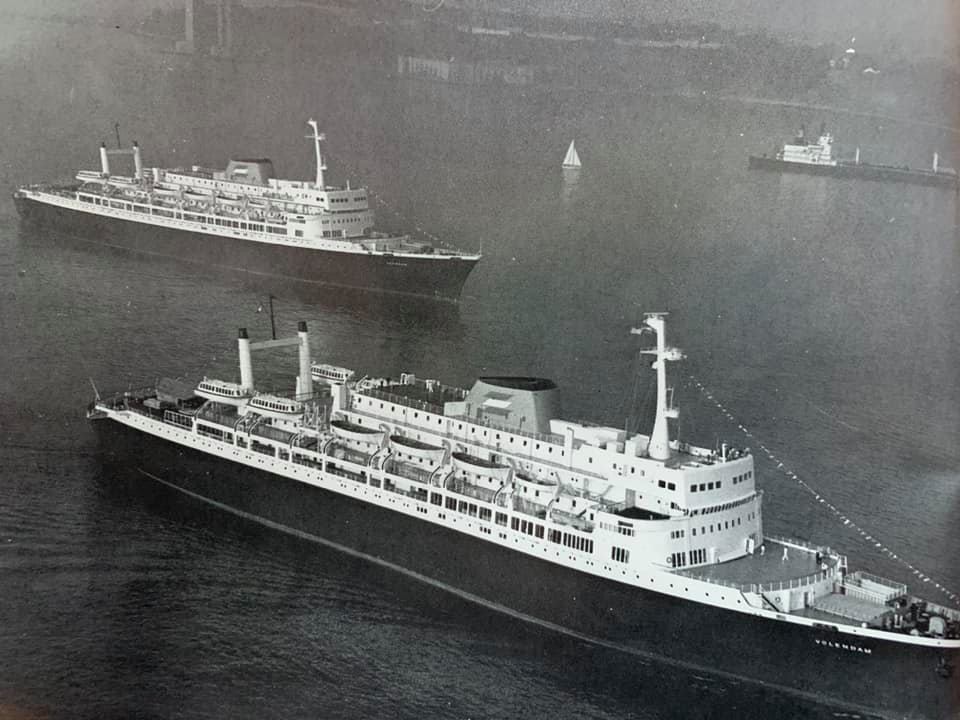
The ss Veendam (III) and Volendam (II). Very steady, deep drafted and spacious ships. But they used a lot of oil and thus their profitability after the Oil-crisis was somewhat limited.

1973   Now 100 years young and the company brought into service two ex-American passenger ships under the names of Volendam (II) and Veendam (III). But due to the oil crises they had to be laid up again.
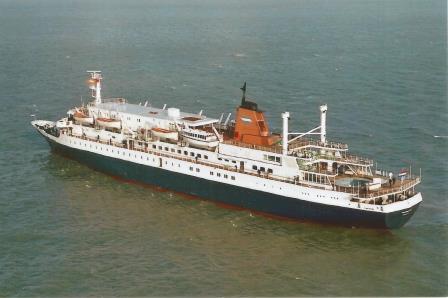
The ms Prinsendam (I). A sistership was never built but her design was the basis for the new N-class

1974 The 8900 ton Prinsendam (I) arrived carrying 374 guests was sent to Alaska and Indonesia for summer and winter cruises. It was also decided to sell off the complete cargo division as per 01 January 1975.
The Monarch Sun and Monarch Star. Operationally it did not really work out with this daughter company and hence the company lasted only a few years.

1975   The Veendam and Volendam came back into service but for a Subsidiary called Monarch Cruises with trips to the Caribbean from Miami. The Lease of Pier 40 in New York was sold and the offices moved to Two Penn Plaza.
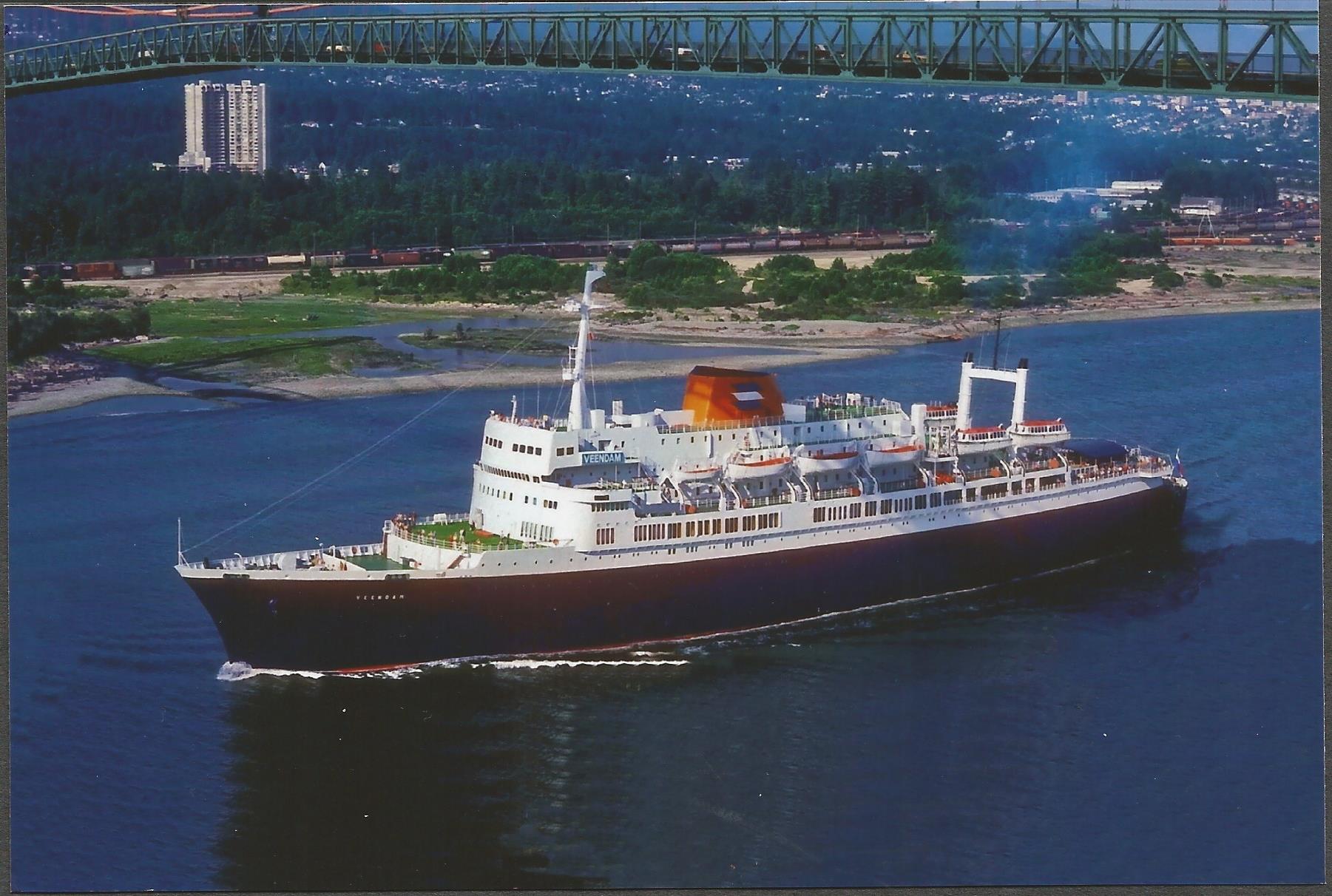
the counter the larger P&O ships, the Monarch Star was send to Alaska. And when the ships came back under the HAL flag, the ss Veendam (II) continued to do so. Here the ship is sailing under the Lions Gate bridge from Vancouver to Alaska.

1976   Although Holland America had pulled out of Europe with its ships and marketing, the company bought a British travel Agency chain as it was noted that many British Guests took P&O ships to the USA and Alaska.
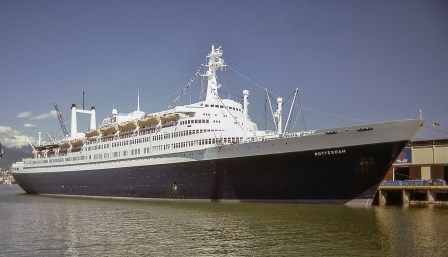
The ss Rotterdam (V) in the mean time made cruises to the Bahamas and Bermuda until also she was sent to Alaska.

1977  In 1973/74 the registration of the cruise ships had been moved from Rotterdam the Netherlands to Willemstad, Curacao.  In this year the financial seat of HAL was moved here was well.
The Fairweather I was used as a dayboat between Juneau and Skagway sailing up and down the scenic Lynn Canal.

1978 Monarch Cruises had been absorbed into a new company Holland America Tours. Investments were made in the Alaska infrastructure with buying more hotels, a day boat for the Lynn Canal and more coaches.

1979   As part of the Coach expansion The “Gray line of Seattle” franchise was bought. The buses were used to bring guests from Seattle airport to the ships in Vancouver and for sightseeing tours.
The N-ships were an enlarged version of the 1973 Prinsendam (I) with some features taken over from the V ships such as the Crowsnest.

1980   Experience with the Prinsendam (I) had learned how much more economical a purposely designed ship was compared to the older tonnage such as the Statendam (IV). Two enlarged Prinsendam versions were ordered in France.
The Glacier Queen I was used for day trips at various locations in Alaska.

1981 The Prinsendam (I) would never see her larger sister as she sank in autumn 1980 in the Gulf of Alaska  due to an engine room fire; luckily without any casualties. A sightseeing company in the Prince William Sound was bought to provide glacier tours in College Fjord.
The Fairbanks Hotel in Alaska. Holland America -Westours operated a large number of these Hotels under the Westmark name.

1982   More investments took place in Alaska and by now Westours / HAL controlled 65% of the Alaska Tour trade. The Statendam (IV) was sold to French Operators.
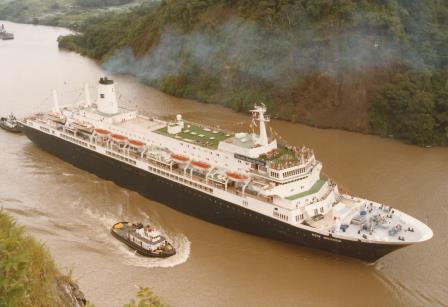
The Nieuw Amsterdam (III) of 1983 and one of the most fuel economic cruise ships out there. She could almost carry double of the V-ships capacity for a 3rd of the fuel consumption.

1983 The operating costs of the older ships had weighed heavily the balance sheet and this year was a crucial year in turning the company around by moving away from the old ways of operating and cost control. The first new build the Nieuw Amsterdam (III) entered service.
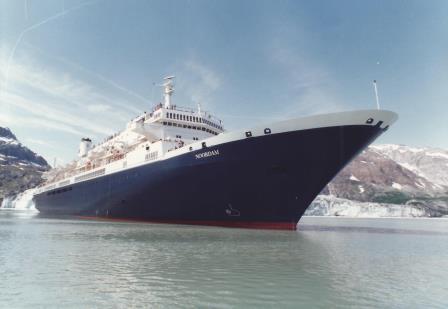
The ms Noordam (III) Once completed she was immediately sent to Alaska for the summer season. Seen here in Glacier Bay.

1984   The 2nd new build the Noordam (III) entered service in April. The V ships were sold off but the Rotterdam (V) stayed as she could still very well cope with the changes in the Cruise Industry.
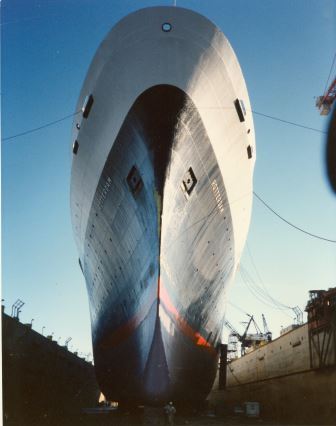
The mighty bow if the ss Rotterdam (V). Seen here during her 1985 dry dock.

1985   Apart from the yearly world cruise of the Rotterdam (V) all three ships were now employed on short but very profitable cruises to Alaska, Mexico and the Caribbean.
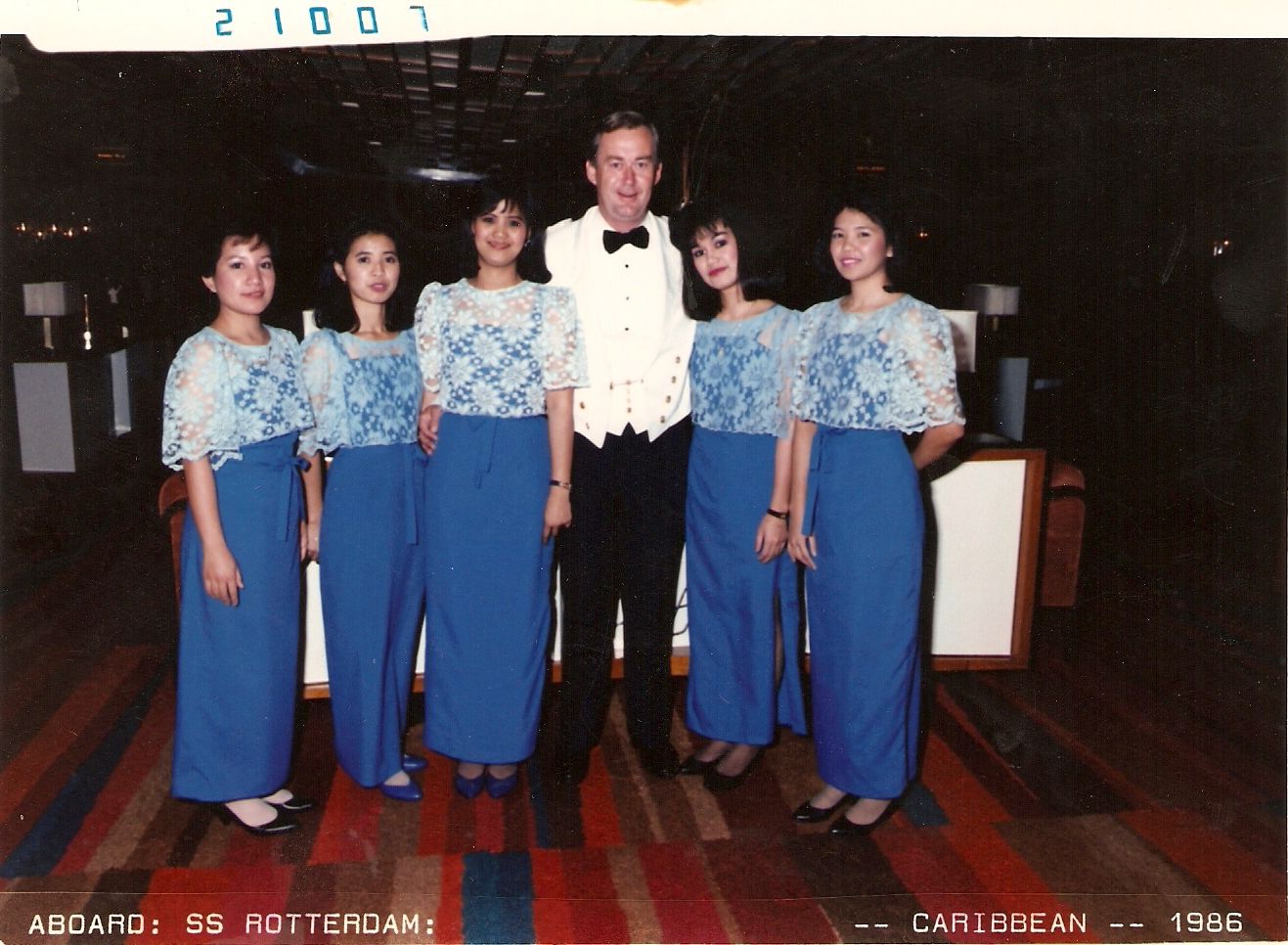
The first group of Philippina Bar stewardesses on board the ss Rotterdam V. Some of the Ladies served more than 30 years with the company, In the middle Chief Officer (later Captain) Leo van Lanschot Hubrecht.

1986  The company started to employ Ladies from the Philippines  in the Front Office and in the Bars.
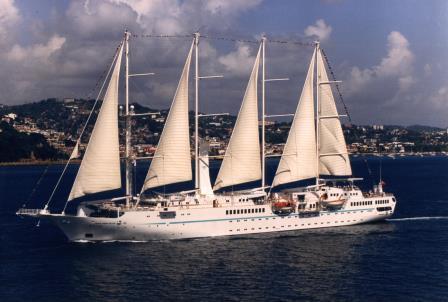
The motor sailing yacht  Windstar. If the wind was blowing the wrong way, then the engine ensured that the next port was still reached on time.

1987   The Rotterdam (V) made her last world cruise as the revenue on the shorter cruise was much higher. A 50% share in Windstar Sail Cruises was taken and the company bought outright in 1988
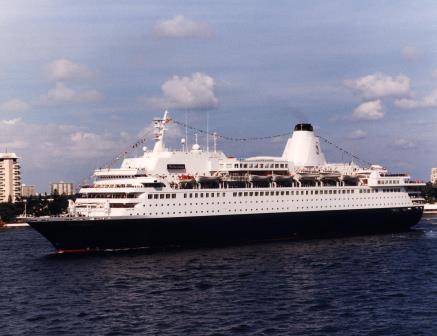
The ms Westerdam (II) ex ms Homeric. In the winter of 1989/90 she was stretched by an 100 feet  to increase capacity.

1988   The next acquisition was buying the Home Line ships, Atlantic and Homeric. The Atlantic was chartered out and then sold off but the Homeric became the Westerdam (II) and was with 42000 tons the largest ship ever to sail under the Holland America Line flag.
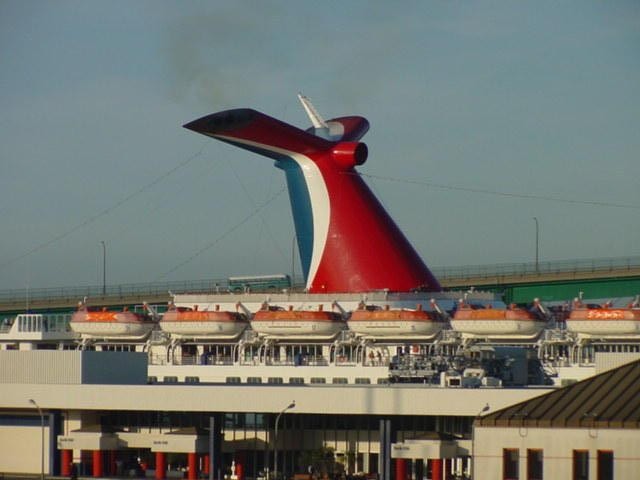
Carnival Corporation owned Carnival Cruise Lines but was not just a cruise company. It was a much larger organisation which even owned an own Air Line.

1989   On 15 January Holland America became un-expectedly an independent subsidiary of the Carnival Corporation of Miami. They operated Carnival Cruise Lines but now wanted access to the premium market.
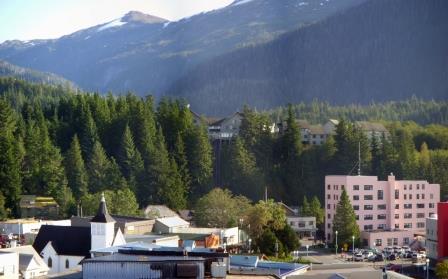
The Cape Fox Hotel, high up the hill,  was operated by WestMark hotels and could be reached by road but also by Funicular.

1990 Money was made available to order 3 new ships called the S-class in Italy. Each to be in the region of 55,000 tons with 1266 lower beds. A new hotel was built overlooking Ketchikan in a joint venture with the local Indian tribe.
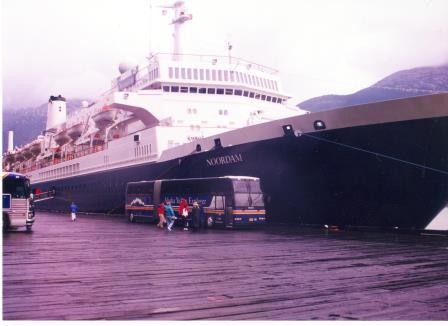
These coaches were called  “Bendy Busses”  on they ships and had a bar in the back part of the carriage.

1991   17 more coaches were added to the Alaska coach fleet and they were quite special as they had a small kitchen/bar with stewardess on board at the end of the cabin.
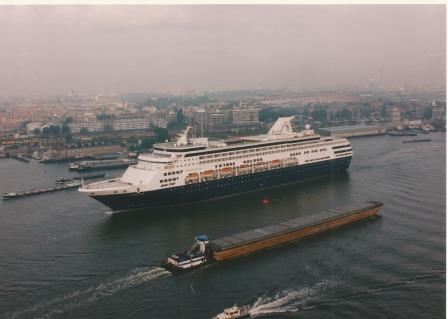
The ms Statendam (V) arriving in Amsterdam in 1993. Almost double the size but with the same umber of guests as the N-ships, the S -class was a great improvement.

1992   The company now geared up for a major tour de force, doubling the fleet by adding a new ship every year for the next 3 years and needing to train up about 3000 new crewmembers.
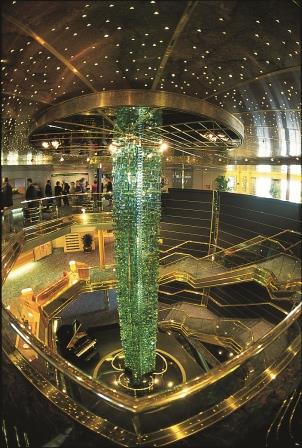
The S-class ships came with the first real atriums on the HAL ships. Located in the center of the ship. This is the “Jacobs” ladder on the ms Maasdam (V) made of Murano glass.

1993 The first new built ms Statendam (V) was delayed entering service by 6 weeks but made a big impact as, although carrying more guests, her space ratio compared to the N ships was 43.8 against 27.9. The Maasdam (V) followed in October.
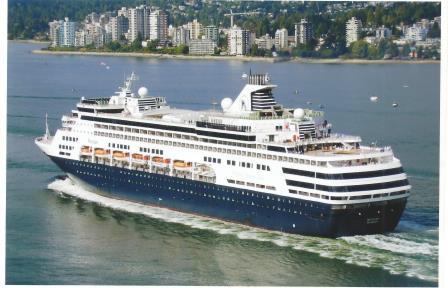
The ms Ryndam (III) Seen here sailing to Alaska with a Vancouver departure.

1994   The ms Statendam (V) was send on a world cruise but it was decided to move the cruise back to the Rotterdam which had done made the 1993 World Cruise. With all the extra capacity available the company started to sail in European waters in the summer as well and not just to Alaska.
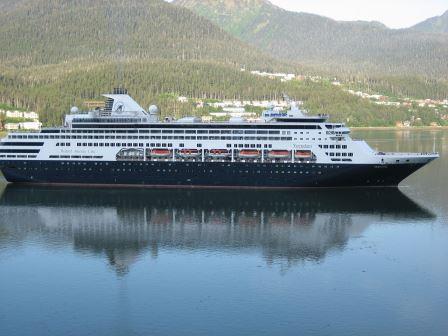
The ms Veendam (III) seen here on a windless day off the port of Haines in Alaska.

1995   With the arrival of the Ryndam (III) the fleet was complete but a fourth sister the Veendam (IV) had been ordered for 1996. HAL ships were now sailing to all corners of the world.
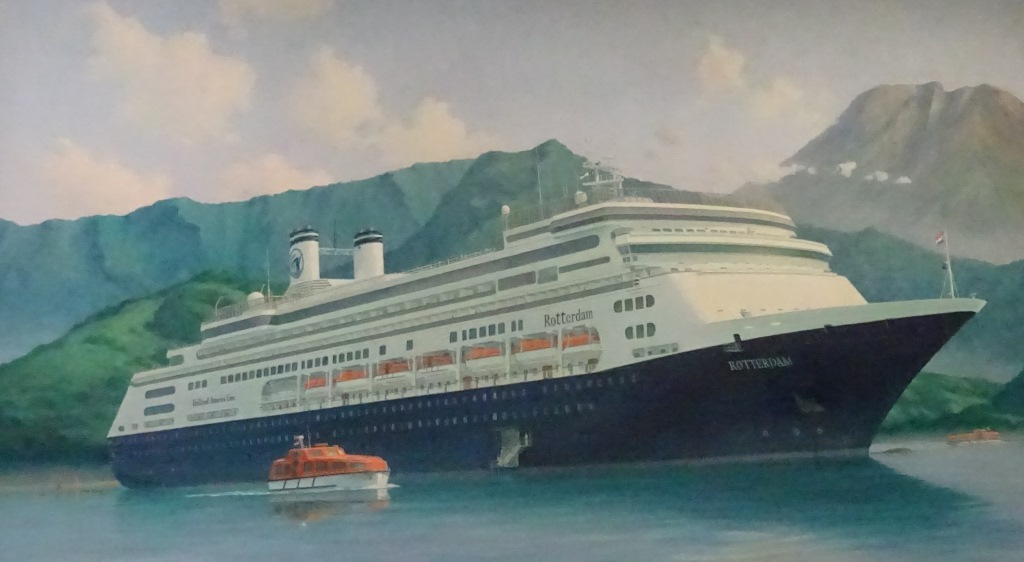
The new Fastdam as per artist impression painting by Marine Artist Captain Stephen Card.

1996   Project “Fastdam” was embarked upon. A ship which could take over the role of the Rotterdam (V) and with a 25 knot speed visit more ports on longer (world cruises) in a same time period.
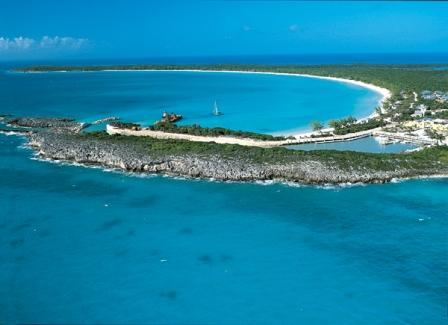
An artificial harbour was dug on the west (=lee) side of the island where the ships tender could dock.

1997   The company leased 15000 acres of Little San Salvador Island in the Bahamas as a resort and renamed it Half Moon Cay.  The Rotterdam (V) left Holland America on September 30th. but a new Rotterdam (VI) filled the void.
Apart from the close sister to the Rotterdam (VI) also two more ships in the class were ordered, the Volendam (III) and the Zaandam (III). These last two only had one funnel and a slightly larger guest capacity.

1998   Now 125 years young the company was thriving as never before. In this year 120 departures to Alaska were offered and a sister ship for the Rotterdam (VI) was ordered.
The Vista class was an evolution of the Signature Class with now the focus on optimizing the number of balcony cabins.

1999   Competition was fierce in Alaska with Princess Cruises bringing in larger and larger ships. The answer was the Vista class; a series of four ships with 1900 guests but with the same space ratio as the S class.
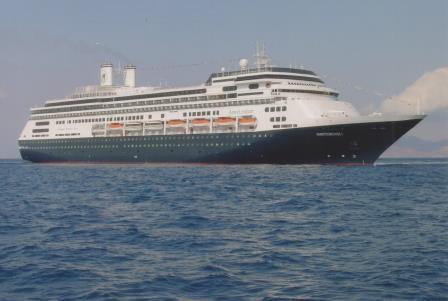
The ms Amsterdam (III) was a near sister of the Rotterdam (VII) only the tone of her interiors was different and the Azi-pod propulsion.

2000   The Volendam (III) had entered service in 1999 and was followed by her sister the Zaandam (III) in this year. Also the Amsterdam (III) was commissioned, completing the R Class of four ships.
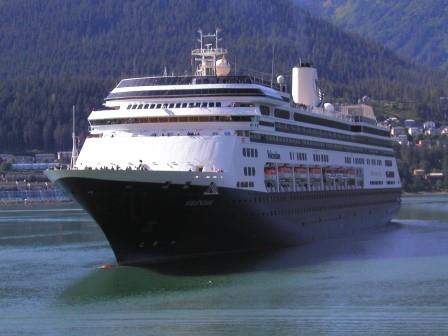
The ms Volendam (III) seen here approaching the dock in Juneau.

2001 The Nieuw Amsterdam (II) had been sold to United States Lines in 2000 and renamed in Patriot only to return after USL went bankrupt. The ship was eventually sold on and chartered by TUI for many years.
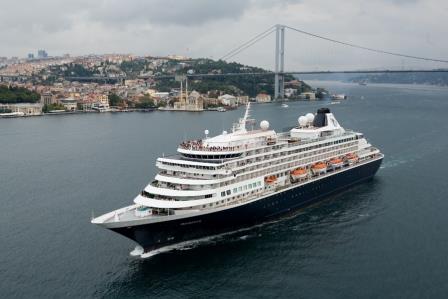
The Prinsendam (II) sailing through the Bosporus. During her far flung voyages, calling at Istanbul was a regular part of her routine.

2002   The Prinsendam (II) arrived. Transferred by Carnival Corporation from Seabourn / Cunard to HAL who needed a smaller ship for longer cruises which also able to go into smaller ports.
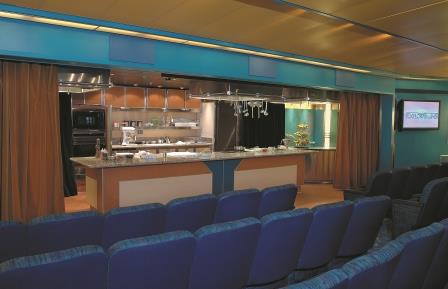
The ms Ryndam (III)  was the first ship to be part of the SOE program and in the Movie theatre a  kitchen was installed , called the Culinary Arts Center, where the Exe. Chef or Guest Chefs would give cooking demonstrations.

2003  The Signature of Excellence program started. This was an investment program to bring all the existing ship up to the highest standards by investing in remakes of public areas, new soft goods in then cabins and back of the house upgrades.
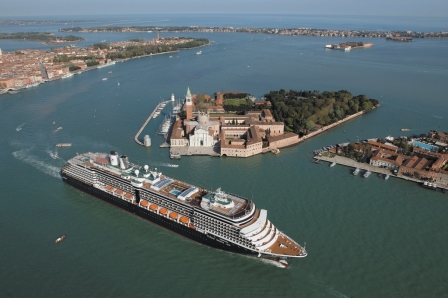
The Westerdam (III) sailing through Venice after delivery from the shipyard.

2004   In 2002 the first Vista class ship had entered service; the Zuiderdam (II), followed by the Oosterdam in 2003 and now the Westerdam (III) in 2004. Eventually the Noordam (IV) followed in 2006.
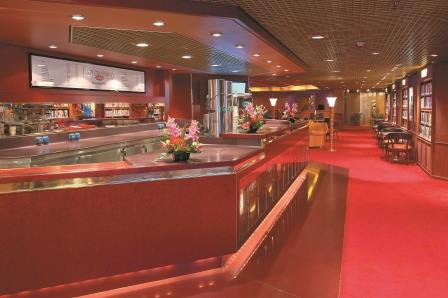
Another introduction  which was part of the SOE was the Explorations Cafe. Library, Reading room, Puzzle corner and Coffee Bar are combined into one Multi Purpose space.

2005 While the SOE program continued, more new ships were considered and an upgraded version of the Vista class, the Signature class was decided upon. One to enter service in 2008 and one in 2010
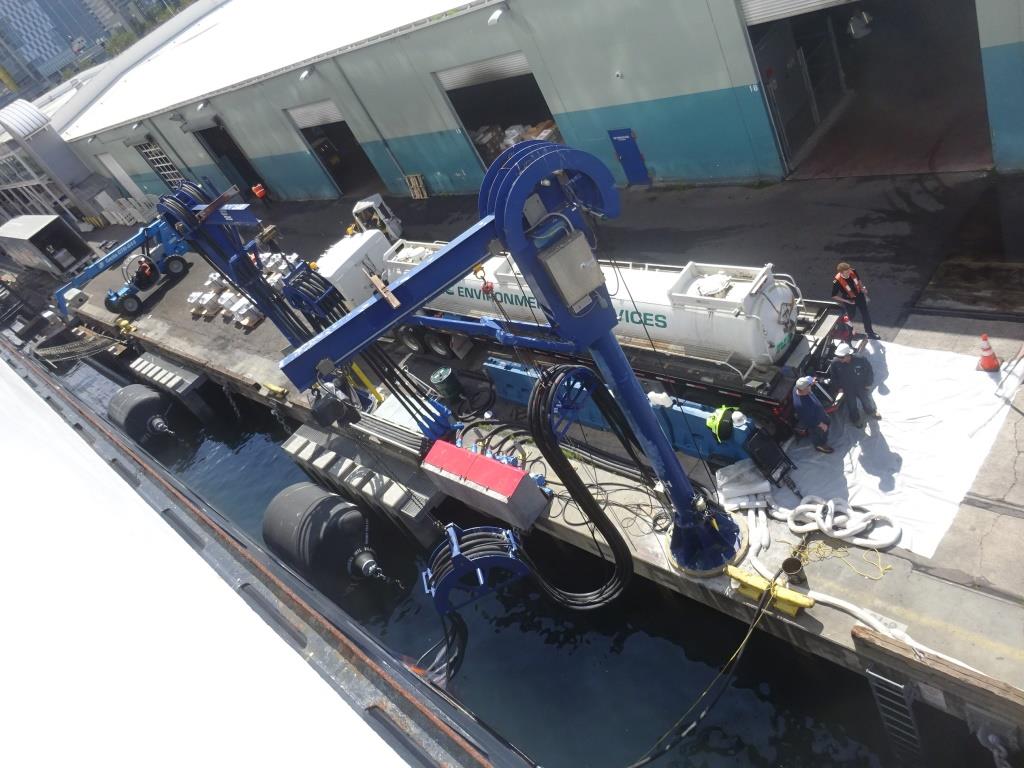
See here at San Diego a shore side installation provides electric power to the ship. ALL the engines could be switched off while in port.

2006   One of the “back of the House” upgrades was the introduction of “Hoteling”. When a ship was in port it could now be connected to the shore side power grid and for the duration its own engines were not needed. All ships from the Amsterdam (III) onwards were upgraded in this way.
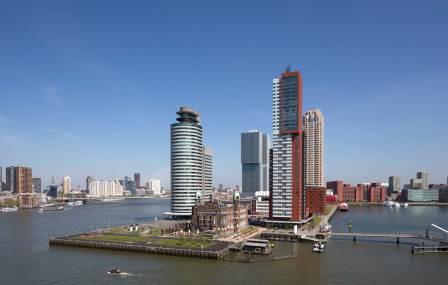
When the company gave up the Wilhelminakade, the “Dutch Offices” left the City for awhile. When they returned the old Main office was a Hotel but space was found in the brown sky scraper to the right. Behind the rounded building (Harbour masters office) to the left is the Passenger Terminal from the old days but still in use.

2007 Windstar became less and less compatible with the core operation of the company and was sold off. Investments were made in the offices both in Rotterdam and Seattle.
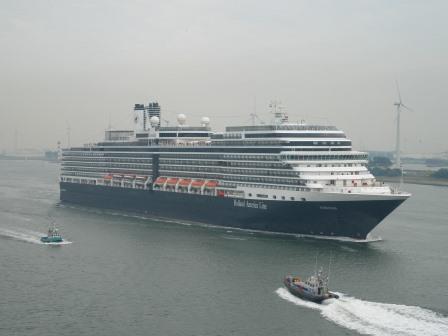
The ms Eurodam first of the Signature Class sailing into Rotterdam.

2008   The ms Eurodam was dedicated in Rotterdam by HM Queen Beatrix of the Netherlands. The ship had an additional Far East themed restaurant on board and with it came the first female Indonesian employees.
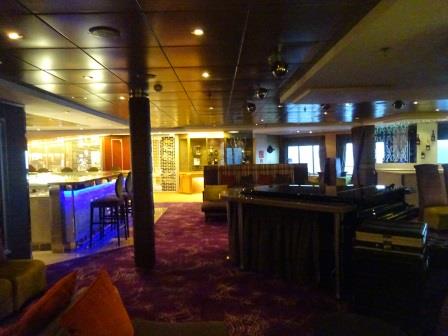
The “Mix” was a cluster of three bars (Champagne, Sports and Cocktail) located opposite the shops on board which also doubled up as the Late Night Piano Bar. This is the layout on the ms Veendam (IV)

2009   As part of the SOE the “Mix” was introduced on the ships, a central public area with bars and entertainment. Computer classes were given and the facilities on Half Moon Cay were expanded.
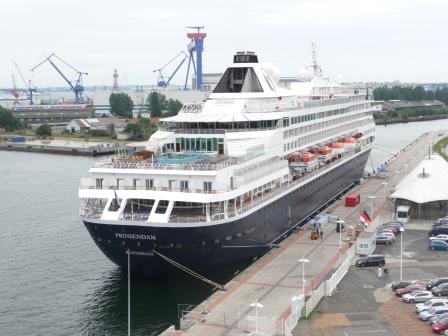
Seen here at Warnemunde Germany, the new cabins at the stern of the ms Prinsendam (II) are clearly visible. Apart from more guests it also gave the company the change to increase  and modify the swimming pool layout, which had been a challenge until that time.

2010   The capacity of the ms Prinsendam (II) was increased with 22 cabins at the aft part of the ship and the Nieuw Amsterdam (IV) the 2nd ship of the Signature class entered service.
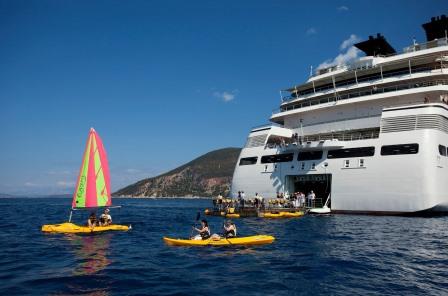
The Seabourn ships, apart from being smaller then the HAL ships,  also had facilities which were not possible on larger ships such a a water sports Marina in the stern.

2011   Seabourn Cruises became a daughter company of Holland America and this resulted in cost reductions as the operations departments could merge or work closer together.
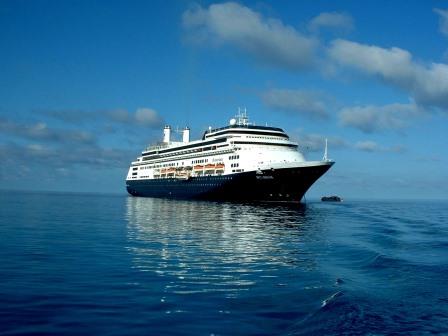
The Rotterdam (VI) had been especially designed for longer cruises  with a higher cruising speed in mind and thus winter cruises from the port of Rotterdam were no problem as the ship simply raced from the wintery weather into the sun and the tropics

2012   The number of cruises starting in Europe had been expanding through the years and this year the Rotterdam (VI) sailed all year around from the port of Rotterdam on long and short cruises.
These various companies were brought together under one umbrella as their operating styles were not dis-similar although the Brands were.

2013   The HAL Group was created within Carnival Corporation consisting out of Holland America, Seabourn, Princess, P&O Australia and the Alaskan Land Operations. A new ship was ordered in Italy.
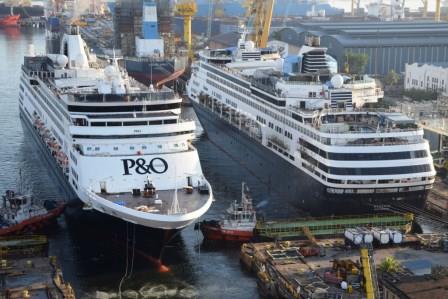
The ms Ryndam (III) and ms Statendam (V) at Keppel Shipyard in Singapore, for transformation into the Pacific Eden and the Pacific Aria for P&O Australia.

2014   Statendam (V) and Ryndam (III) were transferred to P&O Australia to make room for the new class of ships, The Pinnacle Class of which a 2nd one was ordered this year.
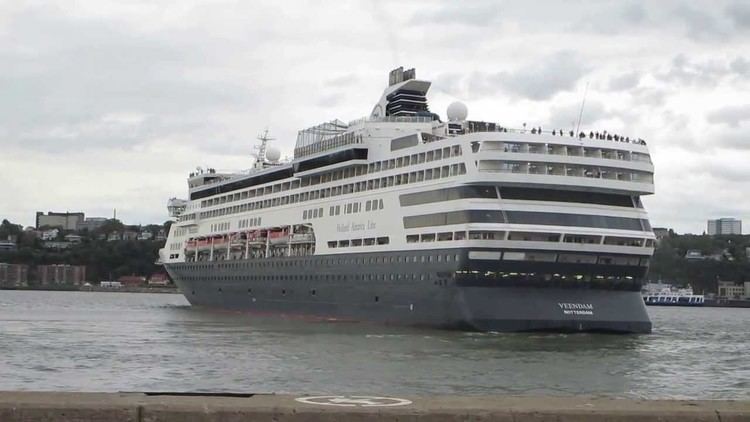
The other two sisters ms Maasdam (V) and ms Veendam (IV) remained with the fleet. the Veendam’s capacity was enlarged by adding balcony cabins to the stern.

2015   Re-alignment in the HAL Group continued with the creation of two branches. Brands (Marketing and Sales and related ) and Marine Services (Support, HR, IT, Nautical, Technical and related)
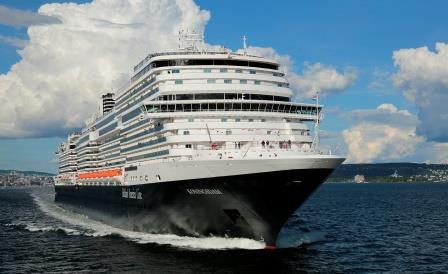
The ms Koningsdam. The first ship of the Pinnacle Class , seen here at full speed in the Norwegian Fjords,

2016   The first ship of the Pinnacle Class arrived, the ms Koningsdam. With a size of 99,500 tons she could carry 2500 guests. The main theme on board was music with musical art and multiple musical venues.
The new Office of the company located on 3rd Avenue, in Seattle, just one block away from the old one.

2017 Holland America built a new Head Office in Seattle, one block away from the old one, but now solely occupied by the HAL Group. A 3rd Pinnacle Class ship was ordered with a delivery date of spring 2021.
McKinley Chalet Park and resort in Denali Park Alaska. Chalets, Hotel rooms, Restaurants, a Saloon and an Outdoor Auditorium. coaches would stop her for overnight while on their tours through theAlaskan interior.

2018   The company continued to invest in Alaska by expanding its McKinley Chalet Resort hotel in Denali Park with and extra hotel wing having 99 rooms. The Nieuw Statendam (VI) entered service in December.
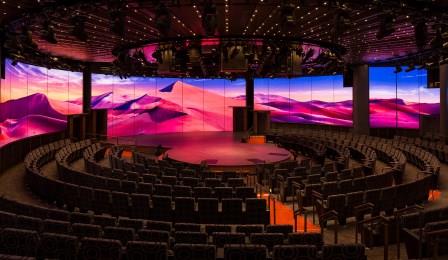
One of the outstanding features of the Music Walk on the Pinnacle Class ships is “The World Stage” with its 270o  LED screen so everybody in the audience can have a perfect view.

2019   In June 2019 the ms Prinsendam (II) left the company and was sold to a German Operator. On 21 November 2019 the keel of the 3rd Pinnacle Class ship the ms Ryndam (IV) was laid.
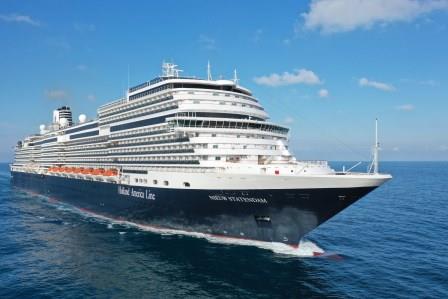
The ms Nieuw Statendam (V). Sistership to the Koningsdam and the Ryndam / Rotterdam.

2020   On 14 March 2020 the company ordered a stop to all cruise operations due to the Covid-19 pandemic and all ships were ordered to disembark their guests. The ships went into Warm Lay-up.  4 ships were sold to other operators. On 20 July it was announced that the ms Ryndam (IV) would enter service as the ms Rotterdam (VII)
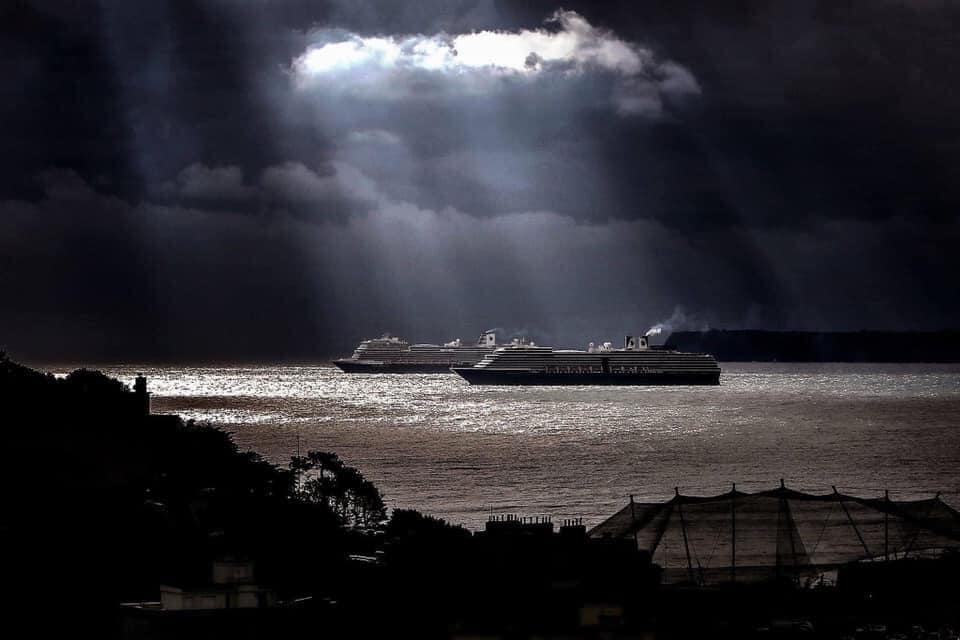
The Nieuw Statendam (VI)  and Westerdam (III)  in lay up at the anchorage at Tor Bay near Torquay England. October 2020. (Photo courtesy: Mr. Ian Williams  www.iwpix.com) 

2021   The ships continued in lay-up waiting for the Pandemic to be brought under control with the vaccination programs and various countries opening their ports again.

Published 18 April 2021

Last Update 28 April 2021
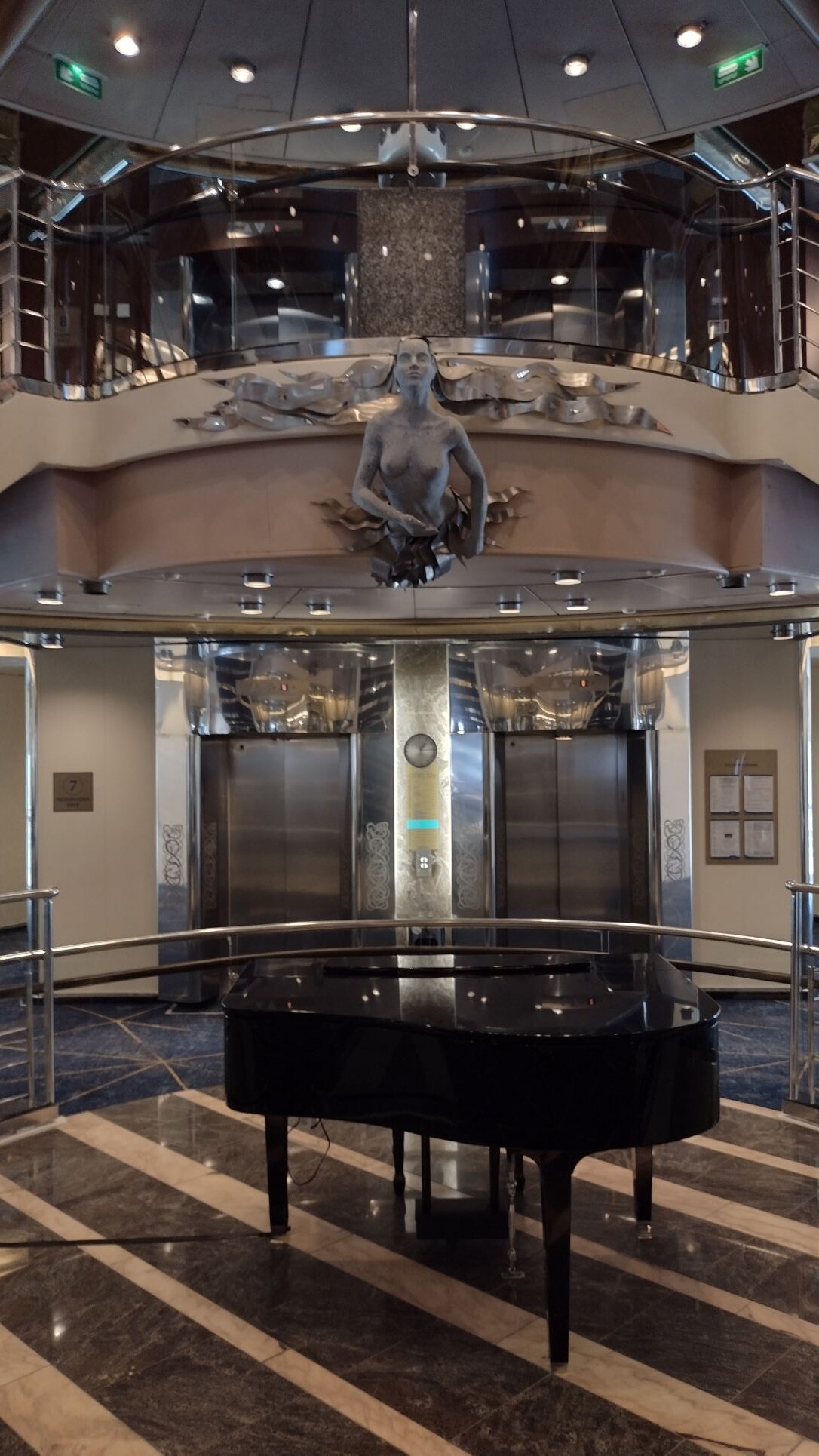
2021 Feb. 17; Waiting for Better Times.

Dear Readers,

Here a little update from my side.  I have not posted since July 20 last year as the worldwide situation was so fluid that any update from my side would be old news, before it was uploaded.

I hope that everybody is doing well and adhering to the precautions needed for succeeding in defeating the Covid-19 virus. Here in England vaccination is well on its way and it is now becoming apparent that the continuous spread of the virus is mainly due to not keeping a social distance, wearing a mask and washing your hands.   Not much different as what we were used to in the past when there was a norovirus challenge on the ships. The Covid-19 virus is of course much more aggressive and deadly but the principles of combating it are not much different. Remember when you were on the ships; Sing happy birthday twice when washing your hands with water and soap. If we not all do our little thing, then we will never get the cruise ships going again. Continue reading

24 March – 10 April 2020; Panama to Fort Lauderdale.

So I am back on the blog. A blog which I had to stop as things were getting too confused and fast moving for me to relate correctly and with sufficient authority. If you look at the last blogs, I had mentioned already a few times that the company was moving faster than I could record it. Then throw the world stage, with all its politics into the mix, and I did not know any more if I was coming or going. So we stopped.

On 09 April the last guests left the ship, and then ship went into warm lay-up. Healthy guests but a few guests remained on board who could not leave as they could not get home for all the reasons that went with the current situation. Things on board are now returning to a sort of normal, albeit a new normal.

This blog is a compilation of the past period as seen through the eyes of yours truly and as I am not involved in politics (*) there is no opinion about why something happened, just what happened and how the ships made it work.

(*) Maybe Captains should all run for office, each in their respective country, I am absolutely convinced the world would have less issues. Continue reading

30 June 2019; At Sea, Final Prinsendam Cruise day.

Today we are sailing in the North Sea and are on our way home to Amsterdam. This is our final port of destination and the end of the final cruise of the ms Prinsendam. Voyage 307 will come to an end and with it 17 years of cruising under the Holland America Line banner.  All guests and 270+ of the crew will disembark but a small skeleton crew will sail her to Hamburg. There she will be handed over in Dry dock after the new owner has checked if all the propellers are still there. The last of the crew will then leave on the 7th. of July.  The ship will receive an extensive refit and come back into service in August. Not too much will change. The Casino will go out and be replaced by 10 new Guest Cabins and the Explorers Lounge will receive a new bar area. Continue reading

Older posts