By 07.00 hrs. the ms Prinsendam was at anchor and commenced tender operations. Geiranger does not have docks, except for the small local ferries which maintain a regular ferry service inside the fjord. You can drive all around the fjord, sometimes along the fjord, sometimes high up over the mountains but it takes a lot longer than rolling your car on the ferry. I do not know if it is cheaper to do so but it certainly is quicker as long as the ferry timings connect with your personal schedule I suppose. There are several anchorages available and today all but one were occupied. There is also one mooring location on the buoys very close to town and that is normally reserved for ships willing to pay and use the Sea Walk. This is a floating bridge system (The Sea-Walk) which abolishes the need of running tenders. It is a beautiful solution for the very large ships but there is a price to pay. Today the MSC Poesia was on these buoys and she was also the largest ship in the port with an on board capacity of 2550 lower beds or a maximum of 3013 when all beds are full. Continue reading
Category: Destinations (page 12 of 13)
Alesund is one of the better ports in Norway at least from a Navigators perspective. It is sheltered from most winds, it has nice docks, we dock with the gangway in downtown and downtown is worthwhile to visit. Most of it is constructed in German Jungendstil style or related to it after a big fire they had here a long time ago. There are some other good ports as far as shelter or docks or downtown distance is concerned but there are not that many Norwegian ports that have it all together. You might think about Oslo but this port is located at the end of Oslo fjord which is so wide that the wind can still blow the ship all over the place or keep it pinned to the dock. So Alesund is very highly rated on the list of ports that come closest to a Cruise Captains dream of having the best of all. And I fully agree as it even has a Big Red Bus for hop on hop off and for an initial exploration of a city it is one of the best ways to go. Holland America also recognizes that and nowadays you can buy the tickets on board. Continue reading
With sunrise at 06.00 and a hazy sky we serenely sailed over a flat calm Mediterranean and then into Santorini. The hazy sky was courtesy of the lack of wind today but it all cleared up by 09.00 hrs. when the sun burned it off. The high pressure system over the Balkans which causes the winds in the Aegean Sea is not yet permanently in place (they also have cloudy days on the Pusta’s) and thus it was wind still, yesterday and today. The captain had opted to come in via the South West entrance and then sail north to our “floating area”. The Celestyal Spirit was already at anchor on the hump as she is larger than the Ovation in guest capacity and makes more calls but still small enough to leave plenty of space to come close to the town. Sailing into Santorini is always interesting as parts of the outer Crater wall loom overhead and the black core creates a sort of round-a-bout where the ships have to sail around to get wherever they want to go. Continue reading
We left indeed later than scheduled last evening. The first coaches were back on schedule but not all of them, plus we had a private tour that got somewhat lost but the delay was kept to about 30 minutes and that is not bad for Aqaba.
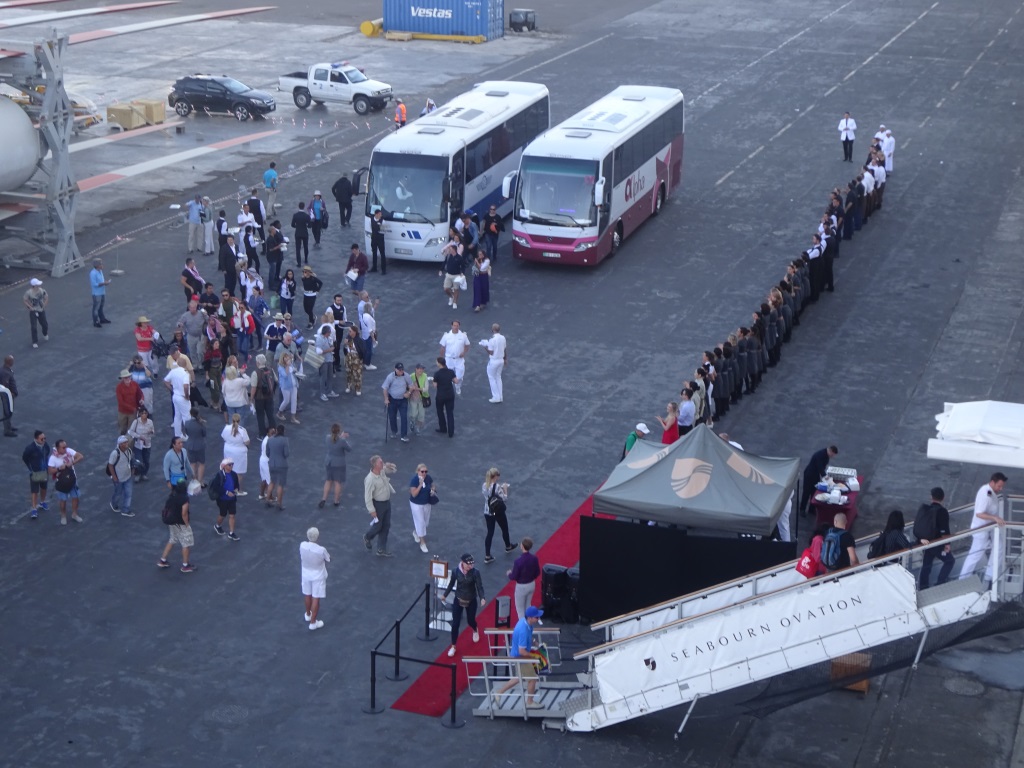
One of the Seabourn signature activities. The crew meets and greets the returning Guests from the tour. Music, Waving, Champagne and Cold towels.
And 30 minutes on the next stretch to the Suez Canal is nothing. For the remainder of the night we sailed back to where we came from and this morning we were back in the Red Sea. Only to make a turn to the North around the corner at Sharm-El- Sheikh which is also a well-known holiday resort where many cruise ships call. While sailing in the Gulf of Aqaba we were fairly sheltered from the northerly winds but when we made the turn at Continue reading
Another Sea day, the last one before we reach Aqabah and the wind his changed. Before it was in the back or stern and it increased during the day time which is normal for winds generated by landmasses warming up. That changes about half way up the Red Sea. And we were halfway yesterday afternoon. At about 1600 hrs. we passed Mecca with its port, Jeddah, on our starboard side. We had 50 miles to starboard and 50 miles to port so our course stayed as far as possible from all the land around us. Now we are coming closer to Europe and Asia so other landmasses, read temperatures are starting to play a part in the weather equation. And thus in the early morning hours the wind breezed up and is now against us with a nice wind force 4 to 5 blowing (20 to 25 knots) and the ship is “bumping” into it with 16 knots of speed. This gives a bit of movement as the Seabourn with being smaller does not have all the options of a larger ship, with a bigger bow, to ride over everything. Continue reading
With the sedate speed of 15 knots are we sailing through the Caribbean Sea. The weather is following the weather forecast and that is appreciated by everybody. We expect that the Trade Wind will start to re-establish itself this evening and through out the night and with it the swell. But by tomorrow morning 05.30 we will be slipping inside the entrance of Boca Chica, the large inland water area where at the far North East the port of Cartagena is located. As explained in previous blogs, it takes about 90 minutes from pilot to gangway out and thus the captain is aiming to have the pilot on board at 05.30 hrs. The ships average speed has been set up for this as arriving earlier has not much use. If we put the pedal to the metal we could be there my midnight but what then. Continue reading
So we were hopeful that the whole weather system that had been raining over Ft. Lauderdale and whose tail creating wind in the Bahamas would be gone by the time we arrived. And indeed 90% was gone as the wind had died down and there was only an overcast sky left. Those clouds sometimes carry wind but today the skies looked quite benign and there was no cloud formation that indicated any menace. And it worked out quite nicely. It took all day for the “silence after the storm” to move over.
We left a little late from Bar Harbor as the tours were delayed which is sort of normal. Something to do with traffic somewhere along the route. As a result we just made it on time to Halifax but it took a while to get the gangway lined up (first time of the season) and thus a real avalanche of eager shoppers burst out of the ship once the ship had been cleared. The lone piper who welcomed us into port was drowned out by noise caused by the stampede going down the gangway. I have never seen a ship empty itself out so fast as today. But then it was a gorgeous day with the sun brightly shining, no wind and still having cool temperatures which kept the haze away from spoiling our visibility.
Thus very quickly the large majority of the guests were gone and the rest trickled off the ship shortly after. A good thing as well, as at once controlled mayhem was initiated by means of our weekly fire and boat drill. Regulations are getting tighter and tighter, based on incidents and past experiences and that is reflected year by year in the increase of the intensity of our drills. All very much with my blessing; as in my humble opinion you cannot train enough. And if I could get away with it, then I would have everybody messing around with fire extinguishers and fire hoses and everybody would be proficient in driving and commanding a lifeboat. Maybe in the future that will happen, now crew specializes in certain duties and that works as well but there is always room for improvement.
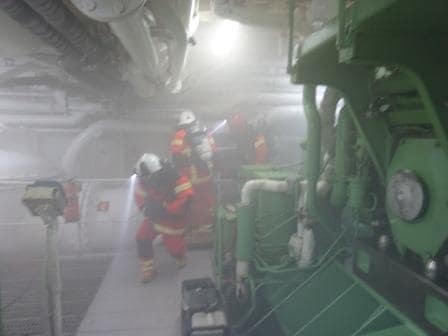
A ships firefighting team coming around the aft end of Main engine nbr. 5 In real life the smoke would be black from burning fuel but we can not simulate that so we use white stage smoke.
As a result of the regulations and the way they are interpreted, it means that every crewmember has to attend a fire drill each week and each crewmember has to attend a boat drill every month with instruction and exercise. We cannot have all 600 crew of the Maasdam running around with a fire hose so for most of them assembling and getting ready is enough. Thus with every weekly drill we now have the whole crew on the move. And that goes as follows:
- We sound the First Stage Emergency alarm because there is an emergency, normally a fire.
- This means the firefighting teams assemble and exercise. Today we put engine number 5 “on fire” and drilled all the procedures for extinguishing it again. About 100 people are involved.
- The captain gets concerned about how the “if we can extinguish the fire or if we cannot”. He orders to sound the crew alert alarm and all the crew is now on the move. The majority of them report to their assigned stations ready to support the guests. Those with non-specified functions report to the crew mess room and wait for further instructions.
- The captain is now getting really concerned and wants everybody at the lifeboat station, just “in the case “. We ring the General Emergency Alarm and simulate that the guests have already reported to their lifeboat stations and now the crew can follow. The crew in the ship gets dismissed by groups and starts to appear on deck. The more critical the function is, the longer they have to stay where they are. So the firefighters are normally the last ones to appear on deck.
If things go so far that we have to abandon ship, then the sequence continues with announcements over the outside P.A system as everybody is on deck anyway. Guests are sent away in the lifeboats and the crew follows in the life rafts. The last person to leave is the Captain who will only leave the ship when he absolutely sure it will not survive.
Not all the crew has to stay on deck for this whole procedure, as soon as everybody has been accounted for, 75% is dismissed and the remaining 25% get their monthly training. So during the required monthly period everybody will be trained, refreshed and kept alert.
While this is going on, vital activities have to continue such as bridge and engine room watches but also preparing for lunch. Thus there is a rota for that crew to get excused for one of the four monthly drills. The whole sequence normally takes 60 to 75 minutes and today we were all quite happy because outside it was such nice weather.
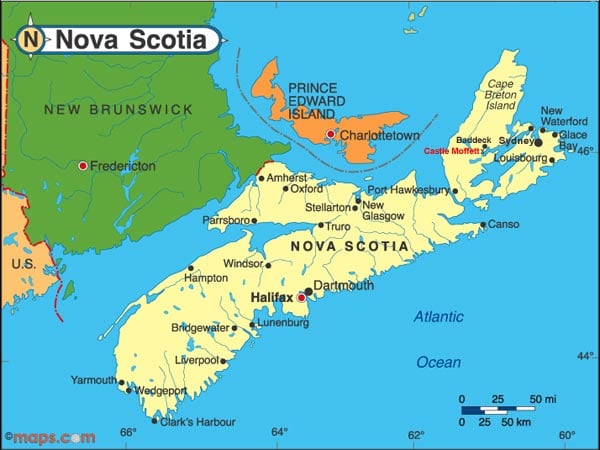
The route from Halifax on the soutside of Nova Scotia to Sydney on the North side of Cape Breton Island. Map courtesy: www.maps.com.
Tonight we will sail around the northwest corner of Nova Scotia, what is called Cape Breton and then we will be in Sydney by 11.00 hrs. which is located on Cape Breton Island. We are still out running the rain, but it will catch up with us in the late afternoon. Still there is no wind expected and the temperatures should be around 61oF or 16oC which will make it quite pleasant.
It is still very windy out there but we now have following wind; which means the relative wind on the deck is the real wind minus the ships speed. The ship is doing 12 knots; the apparent or relative wind is 18 knots, so it is still blowing 30 knots out at sea. And 30 knots is a big 6 or a small 7 on the Beaufort scale. Very windy. Sailors call that a Very Strong Breeze or a Near Gale. All caused by the regular Trade Wind being super charged by large weather systems North of Puerto Rico. I think the word Near Gale comes from the observation of it being very windy but not yet that windy that it feels stormy. Still there is a lot more wind than there should be in this area. Most of the Zuiderdam’s open deck spaces are screened off by large glass partitions so the guests can still sit out of the wind if they want to. Only the aft deck around the pool is open on three sides and that brings the danger that the cooler sea air does not make you feel that hot; and then you forget that you are baking in the Caribbean sun. Some guests forgot it today but will remember it tomorrow and the days after.
A bit more engine stuff today. Now outside the engine room, with the fascinating question, what happens if all the engines stop? Do all the lights go out? The answer is no. In the unlikely case of a full black out, when all the engines have stopped or the two Main switchboards have a major hic-up, we still keep the lights on.
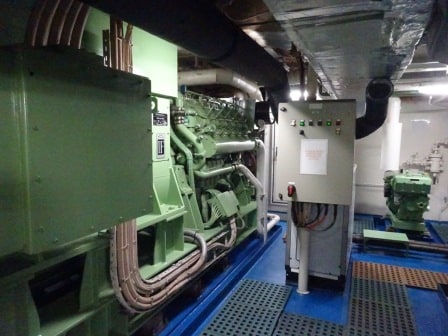
The Emergency Diesel Generator, with next to it a small diesel engine in case we run out of starting air for the EDG.
When all the power would stop, the Emergency Diesel Generator (EDG) would come on line and provide sufficient power for the ship to stay in minimal operation. That happens by itself. The electric setup is so that when the main power goes down, within a maximum of 10 seconds the EDG has to come on line. In reality it goes much faster. But the 10 seconds are a requirement and when we have USCG inspection or Lloyd’s renewal of our certificates the EDG is always tested. Although we then do not make a real black out, we simulate by pulling fuses. The EDG powers all the emergency lighting, all the bridge and Engine Control Room equipment, lights in the corridors etc.etc. It does not power air conditioning and toilets. For that we have another auxiliary engine. The EDG powers what is legally required. It does include elevators, one in every staircase. On every cruise ship you can recognize those as there are small green signs on every deck indicating which one it is.
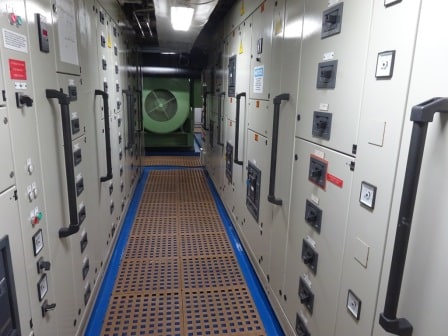
The Emergency Switchboard. Two sides so it can bring power down to each of the Two main switchboards we have in the engine room. In the back the EDG.
The EDG is located near the top of the ship on deck 10, so if the ship would be sinking it could keep happily running until everybody had left the ship.
Now what would happen if the EDG would not start? It normally starts as a regular Diesel Engine with air which comes from an Air pressure vessel. If that tank or drum would be empty, then we have another smaller air compressor standing next to the EDG which would then fill up the Air tank again until it would have sufficient pressure to start the EDG again. The EDG has sufficient Gas oil to run for at least 24 hours. Ours can do at least 36 hours and if we can get more gas oil there (or mgo) then it can run indefinitely.
Now what if we would eventually run out of MGO or the EDG would break down? Then we still have batteries. A whole room full and they are capable of providing power for all the emergency lighting in the ship for at least 4 hours. Thus making it possible for everybody to safely disembark also during the night time. (Remember lifeboats do not need power to go down in the Davits as they are gravity operated)
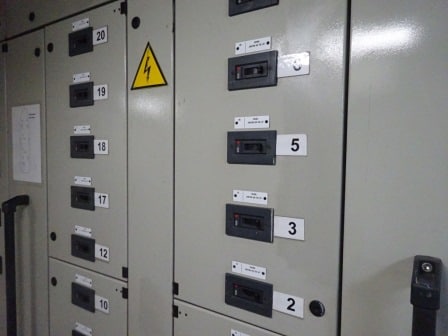
All the Elevators are connected to the EDG so the Ch. Engineer can decide which ones should run during an emergency, or if the power is sufficient keep even more of them on line.
Most guests only notice the existence of the EDG when they hear the announcement that we carry out the weekly test and we ask them to refrain from using the Elevators while this is going on. This is because we bring the EDG on line (Engineers called that “under full load”) and thus only four elevators need to continue to work. So the other ones might stop and then descend by themselves to deck 3 (lifeboat deck) and the open the doors. Not dangerous but a bit startling for a guest who was convinced that he or she was on the way to deck 9 for an early lunch.
Tomorrow we are in Cartagena and we expect to be at the pilot station around 05.30 am and to be docked an hour later. Weather forecast: Mainly overcast with a chance of showers. 31oC or 88oF. but very little wind inside the port. Overcast is not a bad thing as most of our guests will be on tour. Hopefully we get our chance of showers after the early afternoon departure.
It was not one of the best Panama Canal days in my life but it all worked out. Occasional rain, which it has to be otherwise The Canal Zone does not get its 200 inches of rain a year which it needs to operate the Canal; and very windy. However the wind was from the North and the First set of locks are almost north south as well. Only 8 degrees away from the true North. Thus the wind was only pushing or slowing the ship down, it was not causing much drift which otherwise would have hampered the lining up for the lock entrances.
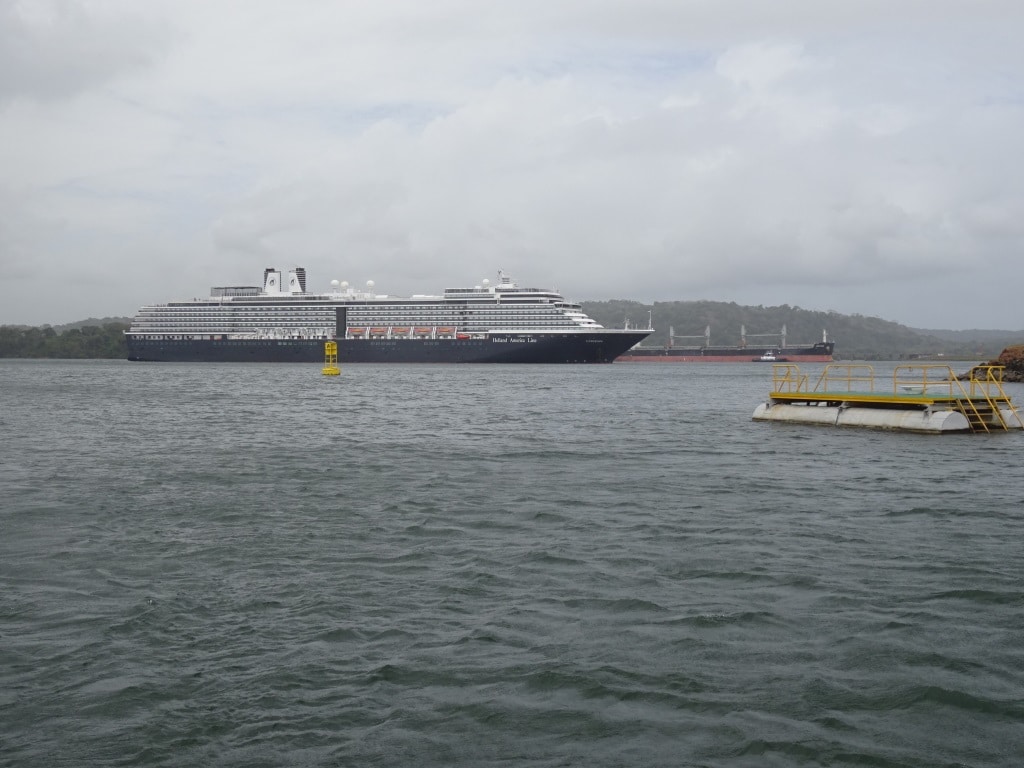
The ms Zuiderdam drifting in the anchorage area just outside the Traffic Lane to the Gatun Locks.
This is a Panama Canal visit with a twist. You see the canal, by going through the first set of locks and then you have the option to take the local tours and catch the ship again in the evening. If you do not take a tour then you can see the ship sailing out of the lake again, back to open sea, and then sail to the dock at Manzanillo to collect the tour.
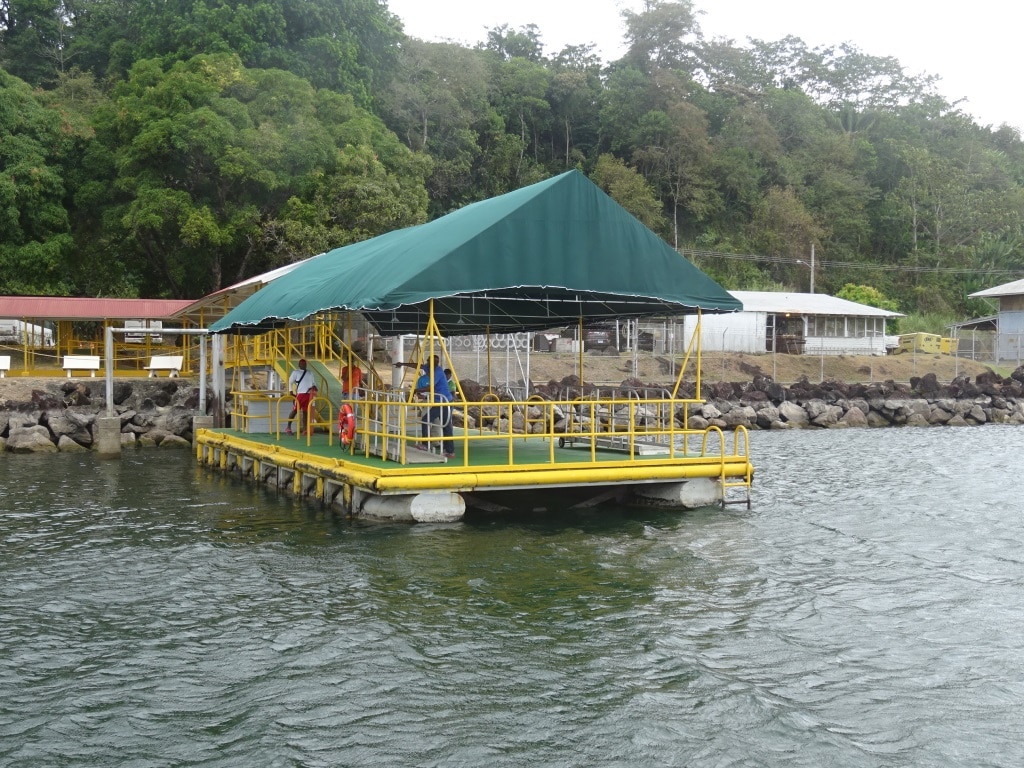
The tender dock we use to disembark the guests. Designed by a pilot and thus a delight to use by us. Safe mooring and safe loading and unloading. It floats as the level of the lake goes up and down with the rain fall.
This morning the whole happening started at 05.30 with the arrival at the pilot station. Then there is the clearing of the ship and then line up in the convoy. Although we are not going all the way through, the Panama Canal Authority still has to make sure that the locks are used efficiently and will lose as little water as possible. With the new locks in operation and thus more traffic, more water is used and focus on efficiency is now even more important than it was before. But by 09.00 we had made it through, had left the locks behind and the ship parked itself between the two lock sections in the anchorage area of Gatun Lake. All the tenders were lowered as we had to shuttle 1120 guests ashore, out of the 1970 on board, Thus it took two good hours before all the tours were on the way and the tenders had been retrieved. Then the ship was ready to turn around and go back.
This is the moment where everything goes out of the captains hands, as the ship can only go back if there is a gap in the convoy or no opposing traffic so the other side of the lock system can be used. Sometimes the ship has to wait one or two hours and then it docks just on time to collect the returning tour people again. Today we were lucky, there was a gap in the traffic and the ms Zuiderdam could slot in without having to wait. Good news as it gave the guests who remained on board the un-expected bonus of being able to go ashore and noise around in Colon 2000.
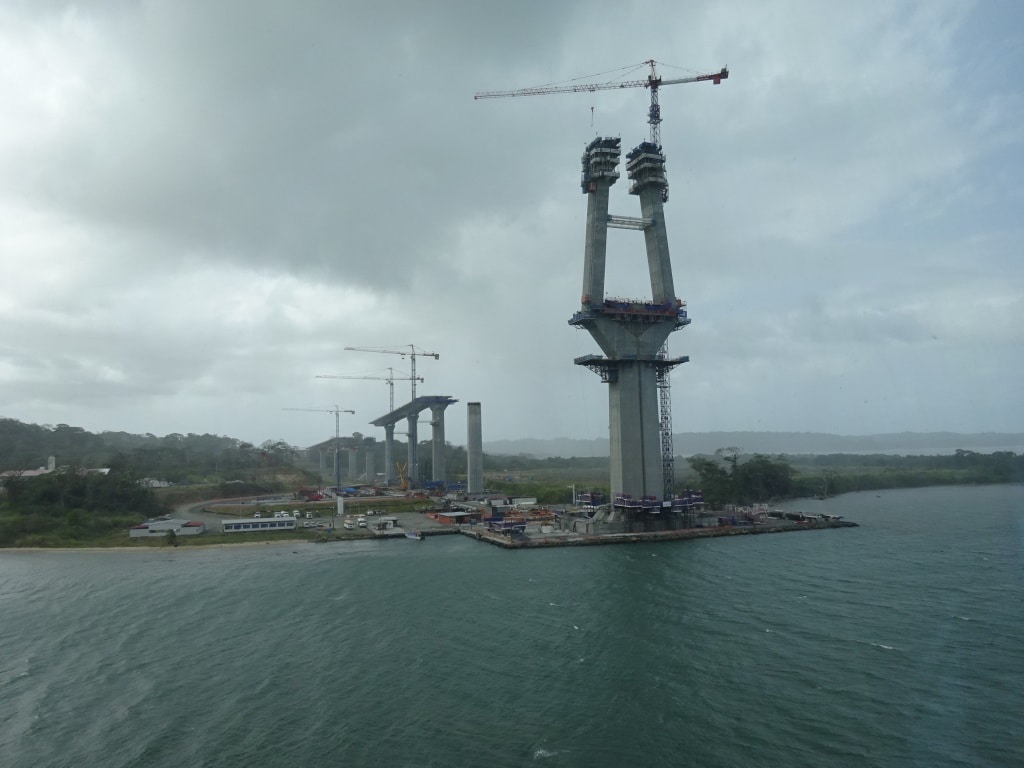
The bridge is going to be pretty high so even the tallest ships will fit under the bridge span.
Sailing back, means going down the locks back to sea level, I personally find that more impressive than going up because it is easier to comprehend a downwards depth, than an upwards lift in measurement. Also there was now something new to see. They are building a bridge on the Atlantic side. First there was only the Bridge of the Americas near Panama City. Then they built the Centennial Bridge near the Continental divide (Culebra Cut) and while that was very nice, the Caribbean or Atlantic side could only cross over the bridge built into the Gatun locks or had use the ferries closer to Colon. Both created long waiting times if there was a lot of shipping traffic in and out of the locks. But now there is a new bridge being constructed which should be finished late 2017 or early 2018. I suppose it will depend on the amount of rain for how fast they can work.
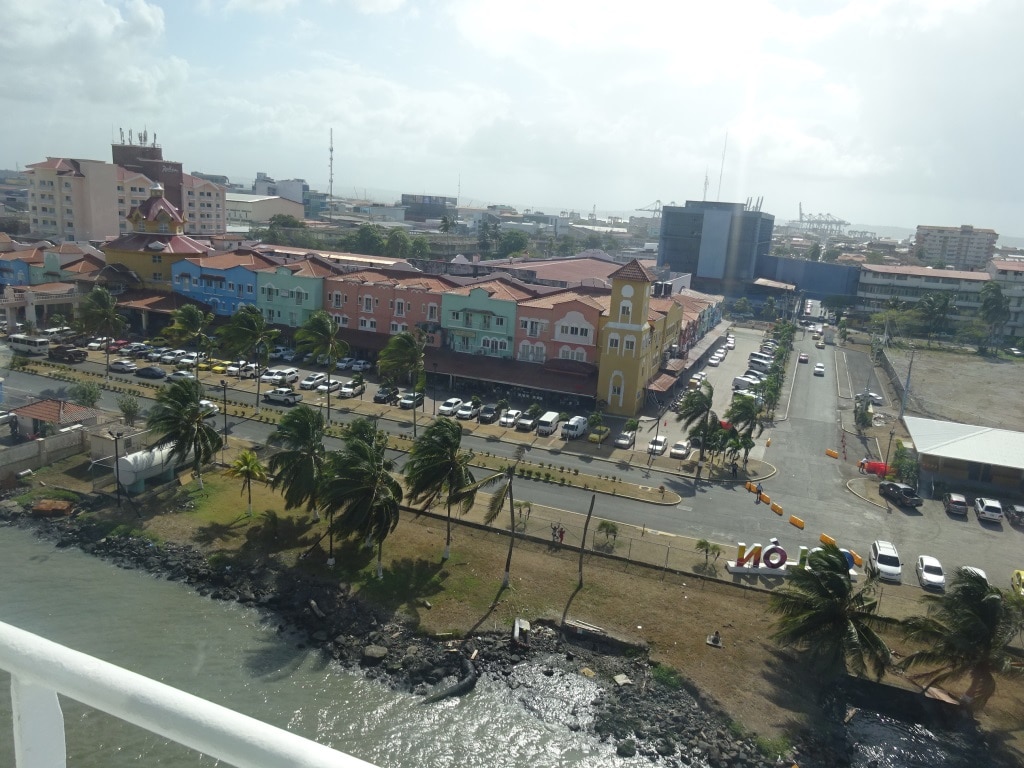
Colon 2000. I suppose the locals go here was well, but it seems to be focused on the cruise ships that stop here in ever increasing numbers.
Normally our ships docked at Cristobal but this season the ships have started using Colon 2000 full time, which is tucked away in the corner of the Manzanillo container port. To get there you have to sail out of the Panama Canal, make a sharp 180o turn in open sea, and then enter the port of Manzanillo. There they have two berths, dock 1, today in use by the Monarch of Pullmantur and Colon 2000 which is a sort of little terminal village with shops eateries and a Casino. We were docked by 15.00 hrs. which is a record so far and thus a bonus for the guests.
Tonight we will sail around 1900 hrs. and head for Puerto Limon in Costa Rica. Weather is expected to be the same; windy and a with certain chance of rain.
Captain Albert
© 2026 – Captain Albert's Website and Blog –
Theme by Anders Noren — Up ↑