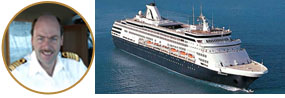
The calm weather, e.g. little to no wind, keeps persisting. Also on arrival Aruba this morning while it normally blows considerably here, today there was just a very light wind blowing. The pilot spoke about strange weather, very strange weather. I did not mind at all, as the less wind, the easier the docking. That is one of the reasons why I always arrive very early. The wind tends to be much less before sunrise and that makes it easier as well. The ship is supposed to be docked by 7 am. but most of the time we are already safely parked by 05.45 am. before the sun rises. Same so this morning. Maybe it is due to this lack of wind but, same as in Bonaire yesterday, we had rain clouds floating in. Clouds that off loaded a lot of water a few times during the morning. For the rest it was a sunny day with temperatures in the mid 80’s. Aruba is a short stay, due to the fact that the distance to Grand Cayman is considerable. It takes an average speed of 19 knots to get there on time. So when everybody was back on board just after 14.30 hrs, we raced out of the port, got the pilot off while making the turn to the North West and cranked the ship up. Within 30 minutes we were flying.
As I am nearing the end of my ships contract and my “blogging” period, I will try to tie up some loose ends, e.g. questions posted in the recent past:
1. Stabilizers. The are started, pumped out, from an operating console on the bridge. They have a length of 15 feet and as they are under an angle the stick outside the ships hull for about 10 feet. So it is important that they are pulled in, before the ship docks. If the ship does not move, we keep them in. Stabelizers cost speed and thus extra fuel has to be burned to compensate for that. When the ship starts to roll, the officer of the watch will decide to engage them.
2. Bollard: any sort of belaying cleat on the pier side. Most are round but some are angled. A dolphin is a bollard standing in the water. Some are complete artificial islands, some are just sticks.


3. Receiving a bollicking is indeed “een uitbrander”
4. Reporting “rogue” cargo ships who do not follow the rules of the road. You can only really do it when a ship is in coastal waters. Say if it happens within the three mile zone of a country, you could report it to the local coastguard station and they might take action. Dover VTS which covers the English Channel, has been known to pass “rogue” actions on to port state inspectors if the ship in question would call at an English port directly after the incident. For the rest it is very difficult to do something about it.
5. The captain not drinking. Holland America has an Alcohol policy which sets limits for the amount of alcohol that can be consumed when “on duty” and when “off duty”. The limit is clearly defined in percentages but it is hard to translate that into the exact number of glasses of beer of wine you can drink, before you reach that limit. As the captain is supposed to be “on duty” all the time, it means that whatever accident occurs, he will have to do a D&A test. To make my own life easy and not having to worry, whether I am close to the limit or not, I simply go dry for three months. It also stops the questions of “who is driving the ship” when you stand in the bar.
6. Cruise planning. It is one of the most complicated issues that a company has to tackle as it all hinges on the ultimate question: “will it sell” and you are never certain until the cruise is sold. For Holland America guests we need to offer a mixture of cruises. We have guests who just want a simple cruise to hop onto, such as the Veendam is currently doing at the moment from Tampa. We also have guests who want the HAL product while doing something exotic, such as the cruises the Prinsendam is doing all year around.
Some of the things to consider:
a. Length of the cruise. Has the target group the number of days off during the year to make that cruise.
b. Does the ship fit in the port
c. Can the ship make the ports in the set time? Speed wise and route wise.
d. Is the route safe (middle east as an example)
e. Is it politically acceptable to go there?
f. Is there enough to do in a port for the target group? (shops, tours, local attitude)
g. If it is a change over port: connections with the airport, access to the ships, check- ins, bunkers, provisions.
h. If a whole new cruise is being developed a balance is sought with putting in a few “old-timers” and a few new ports. This way at least everybody will enjoy a few of the ports, if all the new ones do not work out. Even if the guest books a cruise just because of that new port, it is still our fault, if after calling there; the guest did not like it. So mix and match.
i. What is the feedback from the guests during past cruise calls.
Tomorrow we have a day at sea and the weather forecast is really good.