There has been no change in our plans and we are still on the way to Egypt. Thus this morning at 06.00 we changed course under the South West point of Crete and are now heading on a straight course towards the Sea buoy of Alexandria. I am aiming for a pilot time at 04.30 and if the pilot is on time, then it will mean that we will be docked by about 06.15 hrs. Our tours are leaving at 0700 hrs. and I want to make sure that they will not be delayed due to clearance procedures. Most of them are full day tours and I need them back on board on time as otherwise it might endanger the arrival time in Port Said, where we also have full day tours. The localized windy weather is causing strange currents around Crete and last night we had for awhile 2.5 knots going with us. Then during the day that diminished but we were then propelled forward by a following wind as the wind shifted to the North West. When this wind died away in the late afternoon, we suddenly got the current against us, losing about 2 knots in the hour. That lasted for about three hours and then all was normal again. No wind and no current. Continue reading
Category: CaptAlExport (page 119 of 203)
Well the wind did dissipate but not for long. By the time we were heading into the Ionian Sea a fresh wind started to blow from the South East and with a free surface area to play with, it was even capable of whipping up some waves. The weather cooking pot in this area had come up with a new idea. Now a whole string of little intense wind areas were forming. One in the mid Adriatic, one in the Ionian Sea, one to the East of Crete and one near Rhodes. Intense winds, but in a very limited area, thus we had strong winds in the afternoon and evening. By early tomorrow morning it will be gone and the moment we clear the SW side of Crete we will meet the next one. That one should be with us until late afternoon and then during the night should die away leaving just a gentle breeze behind for Alexandria. We will have these winds on the side of the ship and tomorrow in the back, so even if the winds are strong it will not affect the ship too much. It is just going to be very windy. This is the first sea day of two as it is 1,173 miles from Ravenna to Alexandria. Today we spent all our time leaving the Adriatic and then sailing along the coast of the Peloponnesus towards Crete. Tomorrow we will spend crossing the southern part of the Mediterranean Sea between Crete and the Libyan/ Egyptian coast. Continue reading
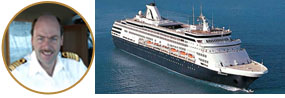
Ravenna is just around the corner from Venice and to ensure that we were not drifting for a few hours, we made a nice slow turn in the Adriatic. Our Venice pilot was off the ship just after midnight and the Ravenna pilot was scheduled for 06.00 In between we plodded along with a sedate speed of 10 knots to get there. While it takes about 90 minutes to sail into Venice, the sail into Ravenna is only a short hop. The port itself is quite large but most of it is only suitable for small ships. The downtown berth has draft restrictions of 5.35 meters and is for ships larger than 150 meters a challenge. To alleviate that problem it was decided by the wise men of the port authority to build a dedicated cruise terminal at the entrance of the port, just to the right of the breakwater entrance. That meant that from the pilot station it was only 2 miles to the dock. In our case it was just a mile by the time the pilot came onboard. This new port is still under construction and that meant that our only documentation was a photo of the general lay-out, a copy of the sounding chart and the local knowledge of the pilot. Between the chart having been made and the photo taken, work had progressed and as a result the situation was different when we approached. Luckily the change was in our favor. More dredging had been carried out and the average depth was now 10 meters, while we had expected no more than 8 or 9. I do not need that much water with the Prinsendam but the more there is, the easier the flow of water under the keel and the quicker the ship will maneuver. Continue reading
The nice thing of an overnight stay is for a captain is that for once you do not have to get up that early. Most days start either at 4 am or 5 am. and on the Prinsendam that is nearly every day except when on the crossings. Thus the day started for me at 0700 this morning and Venice looked exactly the same as I left it last night when going to bed. The other nice thing is that the crew has a better chance of going ashore. The Heads of departments normally tinker a bit with the scheduling so crew who normally have a hard time getting ashore under the regular 9 to 6 port schedules, now have the chance as well. I am really try to encourage that as much as possible and when we come to Egypt and the Holy land we will even be running special crew tours for the ships ratings. Normally crew tours are monopolized by the concessions and the entertainment department as they are free in the ports. Except ofcourse when there are drills and some skeleton duties to perform. For cabin and dining room stewards , deck and engine personnel it is much more difficult as they work shift hours that continue around the clock, regardless of whether it is a port or a sea day. So two days in port is a welcome interlude in those busy routines. Continue reading
After leaving the bad weather behind, the Adriatic Sea slowly returned to a flat surface and by late evening we slid with slow speed through a mirror like sea again. Near Venice all traffic heading that way, from the West side of the Adriatic and the Eastside of the Adriatic, end up there in a sort of round-a-bout. Venice has two port entrances, the one that leads into Venice itself with the option to continue on to Marghera and a 2nd entrance to the south for tankers and cargo ships to go to the Marghera area as well and the town of Mestre just to the west of Venice. As a result it can be quite hectic there, Italian hectic. However this time it was quiet and our approach was only marred by the presence of fishing boats. As is an established fact worldwide, the fish likes to sit where the deep sea traffic goes and as a result the fishermen sit on top of them. Still, when we came closer they all had the good grace to move out of our way. I remember vaguely that the Italian Coastguard had a go at them a few years ago when some of them complained of being run over by merchant navy ships. Since then things have improved considerably. They were simply told to stay or move out of the Traffic Lanes when there was big ship traffic and not to come complaining to the coastguard about hairy situations that they created by themselves. Whatever was discussed, it seems to work. It is a lot less problematic now then 10 years ago. Continue reading
The bad weather came, only it came late. While all the weather guru’s and local specialists were warning that it would pass through in the late evening, it was not until 03.15 that the strong winds hit the ship. Accompanied by spectacular thunderstorms the wind gusted up to 50 knots around the ship. Unfortunately the rain stayed away from the ship as that would have really cleaned all the sand away. Sand that we have been collecting since Dakar. Our bo’sun cannot win the battle at the moment as the sand is very sticky and needs a real downpour to let go off the sides of the ship. The late arrival of the storm brought the realization that Split might not be an option today. It would take about 12 hours for the whole system to come through and that meant that docking in the port of Split would not be safely possible until mid afternoon at the earliest. Still, you never know, think positive; the local situation in Split might be different and thus I decided to go and have a look. I had no alternative options anyway, as the other nearby ports would take too long to get to and were also suffering from the same sort of weather. Still I always think that the bottle (Mineral water only) is always half full and not half empty. Continue reading
Not unlike other ports on this coast Kotor has two pilot stations. One on the outer border of the fjord and one tucked away inside incase the weather is bad. Other ports use bad weather pilot stations only for the more dangerous ships, such as tankers or in a combination of both. Or when there are narrows passages to navigate before a port can be reached. The pilot, who boarded today, was apart from a capable pilot also a good and proud ambassador for this area. So after the Master – Pilot conference, about how to go about it and how the ship worked, he offered all sorts of details and historic tit bits about what there was to see. There was ample time for that, as we cruised with 10 knots and less for the whole period. Everywhere there are boats and houses at the water line and the whole area is a no-wake zone. Thus the 20 mile journey was going to take two hours and as our arrival time was 0800 hrs that worked out exactly right. The fjord is quite wide, except at one location where it is less than a 1000 feet and one has to stay exactly in the middle. The area is very rich in history which is not unusual as it has always been on the border of the Western and Eastern influence. Thus the area has been fought over by many countries and cultures. With mountain regions crisscrossing the whole area there is a strong national feeling by region and thing that became very clear when Yugoslavia fell apart in the 1990’s. Several new States emerged and Montenegro of which Kotor is a part was one of them. Continue reading
As mentioned yesterday, the South East side of Sicily is more Greek than Italian and thus it comes as no surprise that the sea to the East of Sicily and to the South of Calabria is called the Ionian Sea. That is where we spent the night, while heading on a North Easterly course to the South East point of Italy, the cape that carries the beautiful name of Capo di Santa Maria de Leuca. Here the Adriatic Sea starts. Our course bends around this Cape and if we had been closer you could have seen it in detail from the SE side, the East side and later from the NE side. However we stayed about 14 miles off shore as that brought us to a Northerly course line heading straight for Kotor in Montenegro. Also it kept us away from coastal traffic and that makes life a lot easier as well. Still the cape and the coastline could be clearly seen, even from 20 miles away, as it was a very clear day courtesy of very strong winds blowing down the Adriatic Sea into the lower Mediterranean. At day break we had about 40 knots head wind, resulting with our 10 knots speed into 50 knots of relative wind on the decks. It remained like that until the early evening when the wind suddenly dropped away to zero. Leaving a confused sea behind that flattened out during the night. Continue reading
The South East part of Sicily is a bit of an anomaly as it is more Greek in its roots than Italian. Several of the port names have a distinct Greek flavor and many of the local cultural traditions also have their roots in a Greek past. With that curious thought on my mind we approached the pilot station for 07.00 in the morning. I had never been to Siracusa (English spelling Syracuse) and based on the high hopes that I might be able to go alongside, I did not want to grope around in the dark near an unknown dock. Hence a pilot boarding time scheduled for after sunrise. So plan A was to tender and we setup everything accordingly. However if the master pilot conference went to my liking and I felt comfortable with the information provided, I was willing to go for plan B and attempt to dock. From the nautical chart I could not really see what the situation was so I simply had to go in, push the ships nose towards the docking area and see if it was feasible. The pilot looked relieved after I mentioned that the ships draft was as he needed it to be, there was no wind and thus we decided to give it a go. Continue reading
Lipari is an Island that forms part of a string of volcanic islands of which Stromboli is laying the furthermost East. It is located about 15 miles to the North of Sicily and is a famous hideaway place for the Italian Jet set or those who think that they are part of it. As a result Real Estate is on the pricey side. The island itself does not have an active volcano anymore but just to the south it is the island Volcano and that one was smoking all day long. From the top but also from exhausts in the side. Also Stromboli had a plume on it when we passed by. So enough volcanic action even if your own island is dormant. By the morning it became apparent that I could not make up the lost time from yesterday and the fact that we ran into early morning fog did not help either. It was to be expected that fog would form as it has been wind still for the last two days here in the Southern Tyrrhenian Sea. With the sea water temperature not that far off from the air temperature and both chilly at times, the temperature difference was just enough to create sea-smoke during dawn. It did not last long; by 9 am it was all gone but in the fog were fishermen and then you have to be really careful as their behavior is not dictated by the rules of the road or common sense, but by where their nets and the fish are. Still I had already extended the time in Lipari by one hour, so even when arriving late, it still means the same amount of time spend in port. Continue reading
Captain Albert
© 2026 – Captain Albert's Website and Blog –
Theme by Anders Noren — Up ↑