We continued our crossing with good weather. Partly Cloudy skies with a little swell that kept the ship just pitching a little bit. The weather is supposed to remain good but a broad band of clouds is coming over the North Atlantic so it is expected that from this evening until Lisbon we will have cloudy skies. No rain is expected although we see on the radar occasional small rain showers in the vicinity. Rain does reflect on the radar. Especially a dense rain down pour acts as a reflector to a normal radar beam. We can boost the radar waves so that they penetrate rain clouds. However most of the time we keep the radars on a nice weather setting as that setting gives a better reflection of normal targets. However, with seeing the rain clouds on the radar comes the option (if they are not too large) to sail around the clouds and in that way keep the ship dry. Continue reading
Category: Captain’s Log (page 90 of 128)
We were blessed with yet another day of good weather. Due to the new wave field coming in from the North the ship was moving a little bit more compared to yesterday but it is still a very smooth crossing. Also the light Northerly Breeze brings cooler air to the ship and thus the temperatures are about a degree less at noon time than they were yesterday. All and all it is fabulous weather for a spring crossing. Continue reading
This is the 3rd day of our crossing and the weather is holding fine. The sun is shining and with the temperatures in the low seventies it is very pleasant on deck but not too warm. The waves have changed direction again today thus the ship is riding very steady. Tomorrow there is another wave field coming from the north and then the ship will move again a little bit. This is relative as we only talk about waves varying between 2 and 3 feet instead of 4 or 5 feet. It is expected that the weather will remain nice for the foreseeable future. Continue reading
This was the second full day at sea and again we had glorious weather. A gentle breeze was blowing from the southeast, a low swell was running from the northeast and there were just a few clouds to the North of us. As we were heading into the wind with 20 knots (that is a wind force 5) it was a bit breezy in the bow area but it was perfect at the stern. Everybody was settling down in a nice routine, enjoying the ship and its amenities, and I was hoping for a “boring” day so I could deal with the last of the hand over paperwork. However sailing a cruise ship is never boring, even when you hope for it. Murphy is always around and as we sail with people things will always happen un-expectedly. Continue reading
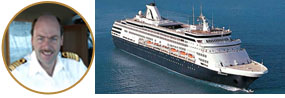
This morning at 6 am., we left North West Providence Channel in the Bahamian chain of islands and entered the North Atlantic on our way to Punta Delgada in the Azores. We are supposed to arrive there on 7 May, so we have six beautiful sea days ahead of us. The weather is cooperating with partly cloudy skies and a gentle breeze and the North Atlantic is letting its presence known with only a very low swell. It just makes the Prinsendam move a little bit. Just enough to let everybody know that they are on a ship but not so much that it is really noticeable when you go around. Continue reading
After nearly 4 months of vacation, in order to fit into the captain schedule of the Prinsendam, I am back onboard.
I spent a week on the Prinsendam near the end of March to get the feeling for maneuvering the ship. It is a company policy, when an officer moves to a new class of ship, or gets promoted, or both, that there is an overlap period. During that period the officer can acclimatize to the new situation and does not have to find his or her way around while having to do the new job at the same time. Continue reading
Although on leave I have not been idle with working on my blog. I have uploaded in four parts an outline of the history of Holland America.
These pages can be found under the tab at the top of the blog called HAL history and its ships Past and Present.
More to follow.
Enjoy your reading.
Captain Albert.
www.Captainalbert.com
After a rainy new years day in Costa Maya we spent a short morning in Roatan. Costa Maya started promising at least according to the weather forecast but when we arrived we saw the dark clouds gathering. During the night the high pressure system above Mexico moved slightly to the North and as a result the rainy part of the frontal system lying off the Caribe could just touch the Cozumel-Costa Maya area. Thus it was a watery day for about 6000 people. Next to us we had the Vision of the Seas who deposited close to 4000 guests ashore with a lot of young people among those. So it was not amazing to see that a lot of our older guests were back onboard fairly early. Too much noise around the pool I suppose. Continue reading
May you have smooth seas and following winds where ever your travels may take you. May your future cruises be safe and enjoyable and, of course, with Holland America Line.

With an early arrival came a bit of consternation on the bridge as we could not find the pilot boat. The pilot boat operator has the tendency to switch off all the navigation lights when he is racing to and from the dock in Belize so we can not see him until the boat is very close to the ship and the lights are being flipped on. As the boat is mainly plastic it does not give a good reflection on the radar screen and thus we can not find the boat that way either. When you call him, the standard answer is, pilot will board on arrival, and that is it. Where arrival is, is left to the ship but if you do not know where the pilot boat is located then it is getting a bit difficult to slow down correctly and the “boarding on arrival” by the pilot can be dragged on for quite a bit. In the end I just kept going until the boat suddenly popped up and then I took some speed off until we were down to six knots which is the best speed for this sort of pilot boat. Continue reading
Captain Albert
© 2026 – Captain Albert's Website and Blog –
Theme by Anders Noren — Up ↑