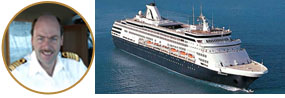
Thus we started our Trans Atlantic crossing by leaving Cadiz on a wind still and moonlight night. The Cadiz pilot had already forecast that Cadiz was in for some rain and we saw that rain clouds were gathering at the horizon; early this morning it also came over the Prinsendam, courtesy of the tail end of a weather system that is moving over the North of Spain. However that weather system was going North East and we were going South West and logic demands that eventually you have to run out of it and that we did by noon time. The accompanying winds of force 6 to 7 disappeared as well and by late afternoon it was wind still and sunny. Also the predicted forecast of about 8 feet of swell proved to be true and thus the Prinsendam moved steadily through the ocean with just the slightest hint of pitching. It is always nice when the weather follows the weather forecast especially if it is a good forecast. Continue reading
Category: Captain’s Log (page 57 of 128)
Cadiz is one of the most important cruise ports for Spain, after Barcelona. It offers sightseeing options to Seville and the surrounding area and also towards its own city centre. Hence that many cruise ships make a call here, some on a regular basis and some such as the Prinsendam during Atlantic crossings and when repositioning from the Baltic to the Med and back. For us it was the last call on the European mainland before we start our Trans Atlantic crossing. The port is located in the shelter of a peninsula which is laid out as a crescent moon with the entrance to the port in its sheltered curve. The only issue with the port is that the bay is very shallow and has a heavy high ocean swell if coming from the South West that tends to build up over the shallows. That can make the approach very rocky to say the least and getting the pilot onboard a real challenge. Nothing of that today though. The North Atlantic weather has been predominantly bad further to the North with the British Isles and the Bay of Biscay taking the brunt of it. That generates North Westerly swell and Cadiz is reasonably protected from that by the coast of Portugal. Continue reading
Malaga port is basically constructed in the same way as Barcelona. Lying nearly north to south and with a very long breakwater that is also used for docking ships. It is just a lot smaller than Barcelona and also more exposed to the elements. The elements are something I constantly have to worry about with the Prinsendam as a lot of wind means using a tugboat and tugboats sometimes have to be pre ordered. Then you take chance and pay for a tug while not needed or not order a tug and find out that the wind has suddenly breezed up and you have problems docking. An average tugboat cost about $ 2000, — so it is worthwhile to be prudent with those costs. Because of the wind in Spanish ports, a tugboat can be called out an hour before arrival and thus the problem is not that challenging here as somewhere else. However the wind was predicted to blow from the NW and only with a wind force 3 to 4 and that does not create a problem. 2ndly I knew that while making the turn in the entrance, the Adventurer of the Seas would be acting as a wind breaker and all little bits help. Continue reading
Cartagena is a port that has only recently become part of the main stream cruise business. I went, with the old Noordam in 2001, as the first HAL ship to this port and then they were just adapting an existing pier to be more cruise ship friendly.
There were the occasional cruise ships coming in, but mainly those who were on far flung itineraries, calling at ports off the beaten track. Since that time the port has been included as a port of call for the 7 day cruise business and larger ships are now visiting. Today we had three cruise ships in port; the Prinsendam, the Discovery and the Azamara Journey. Three ships that are focusing on calling at the less usual ports, albeit for different company’s. Discovery sails for Voyages of Discovery, which is a one ship company, focused on the British Market and Azamara is a sub company of Celebrity which is a sub of Royal Caribbean and focuses on the American market. Continue reading
After a windy night it turned into a very nice day. The wind was from the starboard side and so it pushed the ship against the dock and thus we did not have to worry about the ship blowing away. The north westerly wind did make it a chilly day something that you do not equate directly with Spain but then it is November which some people tend to forget. The Mediterranean also has seasons although they are less extreme than in Northern Europe. At least it was a dry and sunny day so those on tour could make the best of it. For us onboard it was a normal working day and not as hectic as the past week. Since Athens we have had two Lloyds Inspectors onboard who sailed with us to Barcelona to renew our Passenger Safety Certificate. This is a sort of paper that indicates that the ship is equipped with all necessary and required safety equipment, that it all works and also that the crew knows how to use it all. Although most of it is taking place behind the scenes, some times the guests will notice it, as there is equipment that is out in the open. The fire screen doors are in all the public lounges and corridors and they will have to be closed. Once locally, one by one, and once all together by central release from the bridge. We call the latter a general closure. To avoid it affecting the guests too much we do this in the middle of the night when everybody is sleeping. Nobody will get confused if suddenly the long open corridors are gone and closed of by a door that was never seen before. Continue reading
After a quiet night we arrived at 0630 at the pilot station of Barcelona. Again for the area to the north of us, near the Provence, gale warnings were given but by now we were far enough to the south not to be bothered by it. Barcelona has two port entrances; a new one that leads to the old port and the old one which used to serve both the new port and the old port. The two separated by a double draw bridge. As this bridge had to be opened frequently, causing great delays for the traffic going to the ferries docking on the Eastern breakwater, it was decided to create a 2nd entrance. This new entrance is serving the fishermen port, the shipyard, the marina and the docks around the World Trade Centre. Docking at the WTC has always been my favorite place as you can walk straight across the street into down town. However we were assigned one of the new cruise terminals as the WTC docks were going to be taken up in the evening by ferries coming from the Balearic Islands. So we lined up for the south, the old entrance. Continue reading
The wind went away and the gentle breeze that was left moved accordingly to plan to the South. However the swell remained. These two Gales that had been developing and intensifying east of Monte Carlo, yesterday and the day before yesterday, where enhanced by a South Westerly flow that moved between the east side of the Spanish mainland and the Balearic Islands off the coast. So the swell had been well sustained in the past two days and was not dying off as quickly as expected and forecast. At the same time it was breezing up again near Menorca and thus they would not get lower very quickly. Although the swells did not look that high, as seen from the bridge, experience told me that what I saw did not look good. However one can only be certain in cases like this, when you are actually at the location where you are going to and then carefully observe the situation. So I brought the ship in position at anchorage A, off the harbour entrance of Alghero. This port has an opening to the North so the inside is sheltered from the swell from all directions. The breakwater protects it from NW, West and SW. and the land from the North, East and South. The problem is that the area directly to the North of the port entrance is very shallow and can only be used for anchoring ships with a draft less than 4 meters. The Prinsendam with its 7.2 has to stay further out, outside the 10 meter line. The port authority has established 3 anchorages for this purpose, A, B, and C and we were allocated A, because it was the nearest one and also because we were the only ship. Continue reading
When I arrived on the bridge at 0600 in the morning, the VHF’s were announcing gale warnings all over the area between France and Italy; what we call the Ligurian Sea. Another minor disturbance near the Provence was building up and becoming a major headache. However we were heading south to Calvi, which is located on the NW point of Corsica but a considerable distance away from the Italian mainland. With a bit of luck it was not going to affect us. The wind was still from the South West and that meant that the bay of Calvi would be sheltered. At 7 am. the pilot hopped onboard, mainly to have his paper signed and to enjoy a good cup of coffee, and I parked the Prinsendam as far inside the bay as possible, with the Fortress of Calvi towering high above us. Quite impressive. What impressed me even more was that we were indeed completely out of the swell and thus we could run a safe tender service. It was going to be the first day of what a Mediterranean cruise should look like. Nice sunny weather, calm waters and a very picturesque setting in a crescent shaped bay, overlooked by a village built against a hill. It all topped off with fortifications from the 13th. century. Continue reading
So I went to bed with the good feeling given to me by the latest weather forecast. The ship was only gently moving on the remnants of the swell left over from the previous days and all was well in the world. Then about 1 am. the ship started to move; this was not expected. By the time they called me for arrival, the wind was whistling around the superstructure of the Prinsendam and the Officer of the Watch advised me that the winds were up to 35 – 40 knots again. The minor disturbance off Monte Carlo had decided to become a major disturbance and was visiting the Livorno coast. Luckily they have very strong tugboats in Livorno as it is a port that deals with a lot of large tankers, car carriers and container ships. The port was open but the only thing was that I could not get in as the ferries were arriving and they had preference. The problem with the Livorno ferries is that their sailing schedules are not standard, not for the day, or the week or the time of the day. So it is very hard to figure out what the best time is to arrive. Pilots normally say stay away between 6 and 8, but that is when all our tours are going and thus as a cruise ship captain the only thing you can do is wait for a gap in between. Continue reading
I woke to a glorious sunrise over the mountains East of Civitavecchia, at the same time that the wind finally decided to subside. It still took awhile and much longer than forecast but by 10 am it was finally wind still. By that time the majority of our guests were on the way to Rome or other locations in the area for their tours or on own initiative. Civitavecchia has a very good train connection to Rome and from there to other places and also there is an adequate bus system. As a result we have guests and crew who armed with a handful of euro’s and a booklet “how to say it in Italian” venture out for themselves. A great way to really see the local life from nearby but dangerous if you forget the time or miss a connection. The ship only waits for Tours organized by the company and not for individual endeavors. If you go off by yourself it is very important to really err on the safe side and set your return time a bit earlier than the schedule would normally call for. Quite a few crew wandered off into the local town during their break in the afternoon. Just behind the entrance to the docks and the Michelangelo Fort that guards the port is a boulevard or esplanade with lots of little restaurants where the food is good and not expensive. Fish dishes and pizza’s abound and a full meal including wine, beer or bottled water normally does not cost more than 15 euros. So it is a favorite place for officers and crew to do something away from the ship and still be nearby. Continue reading
Captain Albert
© 2026 – Captain Albert's Website and Blog –
Theme by Anders Noren — Up ↑