It was blowing hard when we approached the island of Aruba from the West but not as hard as the weather forecast had indicated. By the time we were 12 miles away it blew 25-30 knots and that meant that by the time we would enter the port, it would be 15 to 25 knots. The obstructions on the island always break the wind somewhat. Still enough wind to make sure that I had a plan B up my sleeve and that was a tugboat. If the wind would breeze up about 26 knots, which is the max I can handle with the thrusters and rudders, then the only option would have been to sail out of the port again, wait for tugboats and try again. That would have meant delays for the guests and I am not so keen on that. So a tugboat on standby to keep the stern in while docking (that area catches the most wind due to the funnel) and I knew we would stand a better chance to come alongside if the wind would suddenly gain strength. Continue reading
Category: Captain’s Log (page 26 of 128)
Since leaving the Panama Canal we have sailed on a North Easterly course, roughly following the coastline of Panama and Colombia. Most of the day we spent crossing the Columbia basin; that curve in the land near the cities of Cartagena and Barranquilla. As all the ships keep roughly the same distance from land, we had a lot of opposing traffic today, meeting ship after ship going to the Panama Canal and coming from areas on the North side of South America. Ships going to Europe and North America follow other routes, as they have to get out of the Caribbean Sea by sailing somehow around Cuba. There are various “gaps” to use for that and we will be using the Windward Passage later on, located between Cuba and the Westside of Haiti. First we will visit the port of Oranjestad on Aruba. Continue reading
At 04.30 we started to approach the Canal area and the weather looked good. Overcast but no thick dark clouds in the area. That meant that at least until the Continental Divide there would be no rain. Not bad for the rainy season. Instead of waiting at the sea buoy, we were directed into the anchorage area for the clearance procedures. Always interesting for the guests to see all the cargo ships at the anchorage, all lit up like Christmas trees and waiting for clearance and or bunkers. So I zigzagged slowly between them towards an empty spot, designated by Flamenco Station, which is the Control tower that regulates all the traffic in the area and lines the ships up for getting into the convoy. Below me on B deck at the pilot break, the whole circus of clearance was in progress; agent, boarding officer, fumigator (who was very disappointed, no rats or cockroaches insight) shops supplies coming on board (we had a special Panama Sale while going through) Canal technician (to see all navigation equipment was working), Canal Narrator) and finally the first pilot.
Continue reading
Although it is the rainy season, we had thus far only sunny days since we passed Cabo San Lucas. This morning we found out why. Mother Nature had decided to make it one delivery and drop all that missed rain on us in one hour. We sailed into one wide curtain of rain and for one hour we had torrential rains. Visibility was less than a mile and a deluge of rain swirled around the ship. I had to close all the exits to the outside decks as it was simply dangerous to be out in the open. Continue reading
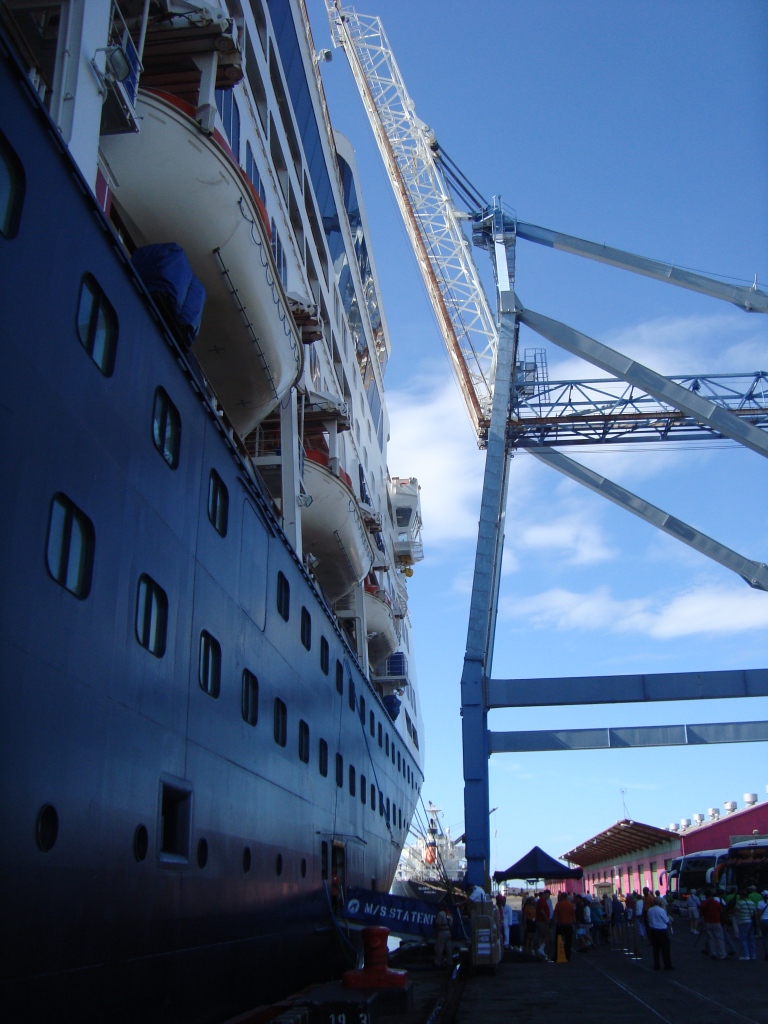 During our last call in may northbound, I had discussed with the pilot what was the best times would be for the ship to arrive and to depart. Although we were scheduled from 0800 to 1400 hrs the cruise brochure times seldom take the operational windows into consideration. As they are a cargo port and mainly visited by low powered cargo ships, the pilots are very concerned about the current going in and out of the port. With a 10 knot max. speed and a 2 knot current, you lose 20% capability and that is considerable. For a cruise ship it is of lesser concern but I had the option to arrive at 05.30 when it was high slack water and thus I did so. The swell had died down overnight and thus we had a very quiet ride towards the berth. It is a short but complicated approach as the current does not follow the channel and swirls around various islands so it takes careful conning to get around the corners of the fairway. With the pilot telling me where the shoaling was taking place (“captain not too close to this buoy and a bit closer to that buoy”) we were happily docked by 07.00 at the container dock. After making sure that we did not hit the container crane we could happily settle down for the day.
Tonight we enjoyed an hour back as Guatemala is on a different time zone. They normally do not do summer or winter time and are thus an hour off with Puerto Chiapas in Mexico just over the border. We approached the pilot station at 04.00 and the pilot hopped on board, right on time. Going in, through the breakwaters is a very interesting affair, as you have to make a 90 degree turn into the basin and then a 180 turn to get the ship lined up and go sternway to the berth. I wanted to go portside alongside so I could get out fast on departure. In the afternoon a land wind normally picks up which makes swinging around in the basin more difficult. On arrival it is normally wind still and so why do things difficult if we can do it the easy way. By 05.00 we were happily docked and the early tours could leave while the sun was just getting above the horizon. Continue reading
There was more wind than predicted and it came earlier as well. It being earlier is in principle a good thing, as it means that by the time the guests go to bed, it is quiet again and while they are at dinner or in the show, they do not notice it either. More wind than predicted can be an issue if you take the weather forecast as gospel. I don’t, I have my own weather forecast system for Tehantepec, which worked out again well. It started to blow around 18.30 and we passed the axis at 21.30 when we observed a top velocity of 58.3 knots. Just a little bit more than I thought it would be. But we were well prepared and the navigators on duty were able to keep up with the ballasting of the ship and the Statendam stayed nicely straight up. By 11 pm. it was all over and I could still catch 6 hours sleep before we had our next challenge, Puerto Chiapas. Continue reading
With the Norwegian Jewel leading the way, we approached Huatalco. With only one pilot in residence, I had adjusted my speed to arrive 45 minutes behind them and then we only had to wait a few minutes until the Jewel was putting its lines ashore and he could come over to us. By going nose in, I saved 20 minutes so we still had the gangway out by 08.00 and all was well in the world. The approach was an interesting happening as the current was all over the place. The ship was set to starboard, then to port, and when we drifted past the pier to our stop location, I had to keep the stern thruster going to keep the stern from being pushed away. Amazing that two tropical storms can make such a difference to the pattern of the current. The Jewel left at 1600 hrs. and I made sure that I was on the bridge watching how she would set when going astern. Luckily by that time the current had greatly diminished and the Jewel and later us, could just come astern and stay in the middle of the entrance without much problem. It remained mainly overcast today which kept the temperatures down while at the same time it was still a nice tropical day for sightseeing without any rain to bother about. Continue reading
Although hurricane Miriam is long gone, we are staying under its influence, as the general flow of the current along the Mexican coast is the opposite way at the moment. It should not take long before it is reversing itself to normal but at the moment it is in our favor and giving us 0.7 knots extra speed free of charge. We had a dry day today which is also a pleasant surprise as the rainy season is still in full swing. I expect that we will get some rain during the coming night as this is not usual for the area at the moment. There is a lot of moisture in the air and at a certain moment it will have to come down. We sailed about 10 miles from the coast and we could see how green the mountain slopes were and that is a good indication that it has been raining here a lot lately. But that is the way it is, if you visit the Far East during the monsoon season you have to keep up your umbrella all day long up as well, and for Middle America it is the same, although the rainy season does not have a special name here. Continue reading
Tropical Storm Norman did an un-expected thing during the night by bouncing off the Mexican mainland in the Sea of Cortez and crossing straight over to the West and going ashore on the East side of the California Peninsula. That had quite a bit of influence on our weather today. Instead of the rain clouds following Norman to the east and also coming over Puerto Vallarta, they now followed more to the West and that created a dry and sunny day in the town. For some who do not like too a high a temperatures it was a mixed blessing as the thermometer hit 34oC (93oF) in the afternoon. The moisture in the air made for very humid conditions and thus we had our first real tropical day of this cruise. As it is still the rainy season we will have a quite few more of these. Continue reading
Captain Albert
© 2026 – Captain Albert's Website and Blog –
Theme by Anders Noren — Up ↑