Stenger, Geert.
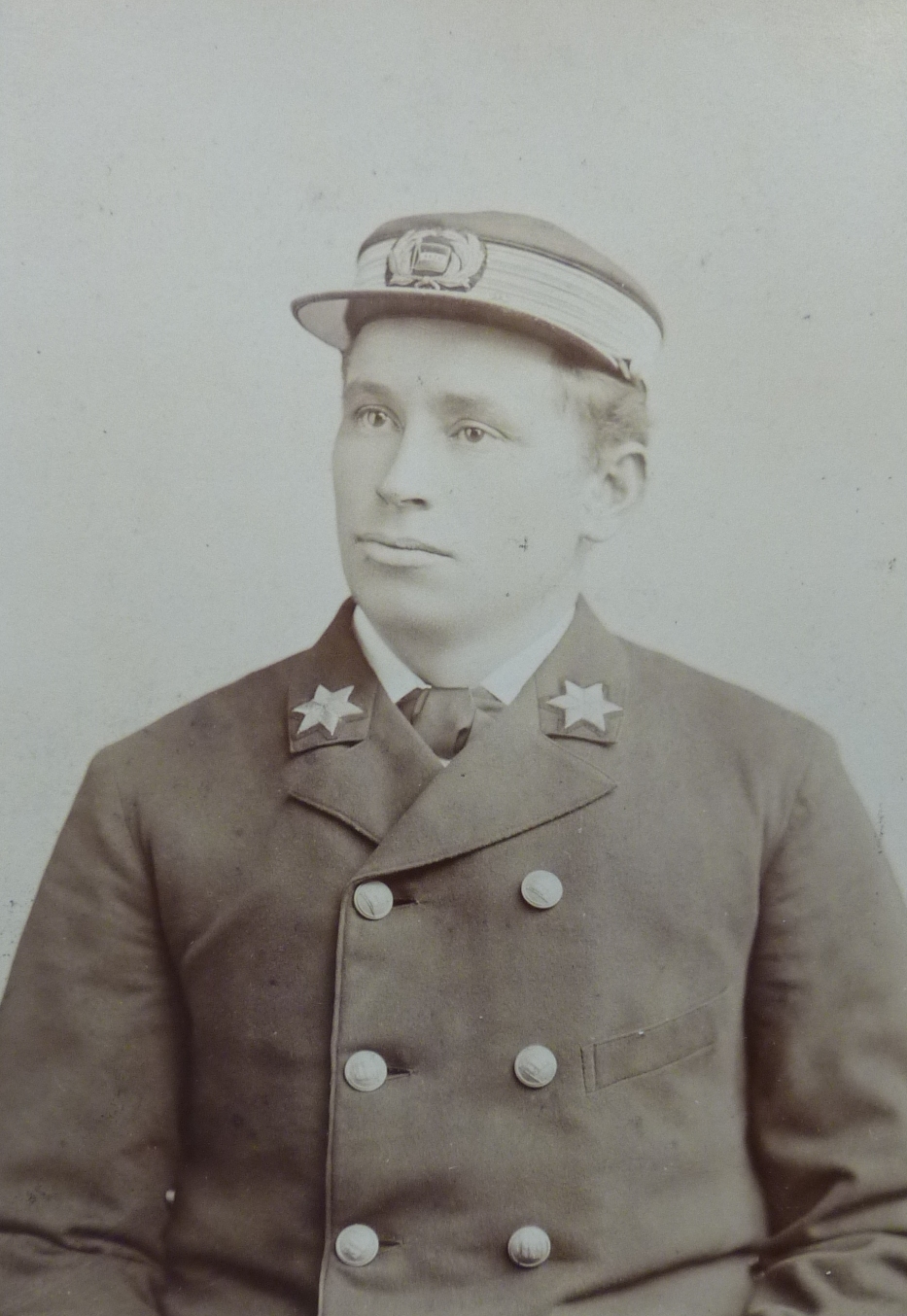
Captain Geert Stenger on a photo taken on 01 December 1887 shortly after his promotion to Captain. (d)
Geert Stenger was born on 10 August 1858 in the town of Farnsum in the North East of the Dutch province of Groningen. The nearest larger town and also sea port is Delfzijl. This area was wellknown for having a large number of sea-farers (although the area itself was mainly agricultural) But as only one son could take over the farm (to avoid too much subdivision of the land) other sons had to do something else. Most of the families in the Netherlands, especially in those living on farms, had large families. Thus many sons ended up at sea or in the forces. The father of Geert Stenger, Johannes J. Stenger was not a farmer but also a sea captain; but he might have had to deal with this large family challenge when he was young. The mother of Geert was called Gesina Smit.
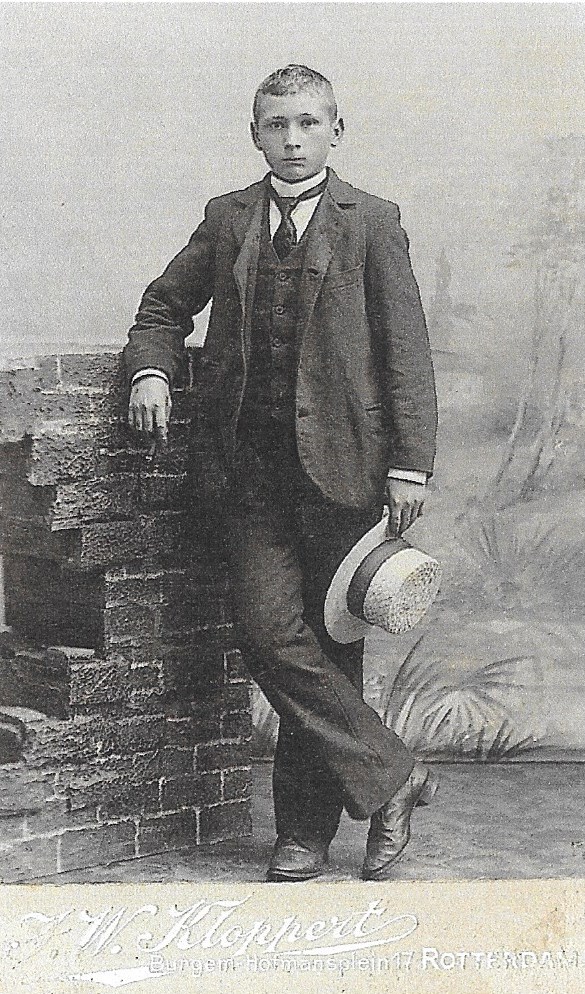
Geert Stenger at the age of 16. This would have been roughly the age when he would have attended a Maritime School. (b)
It is unknown where Geert Stenger attended a maritime school and where he did his cadetship. If he went to a Maritime School he would have graduated when he was 18 (in 1876). Then a year as cadet (1879) followed by obtaining his 3rd mates ticket. From then it would have taken 3 years to sit for his 2nd Mates ticket (1881) and that would have qualified him to join Holland America on 29 December 1881 as 3rd. officer on the ss Edam (I). (The above count is to be “subject to confirmation”).
He stayed on this ship for 4 months and then transferred to the W.A Scholten. Had he remained longer, then he would have been on board when the Edam (I) sunk on 21 September 1882.
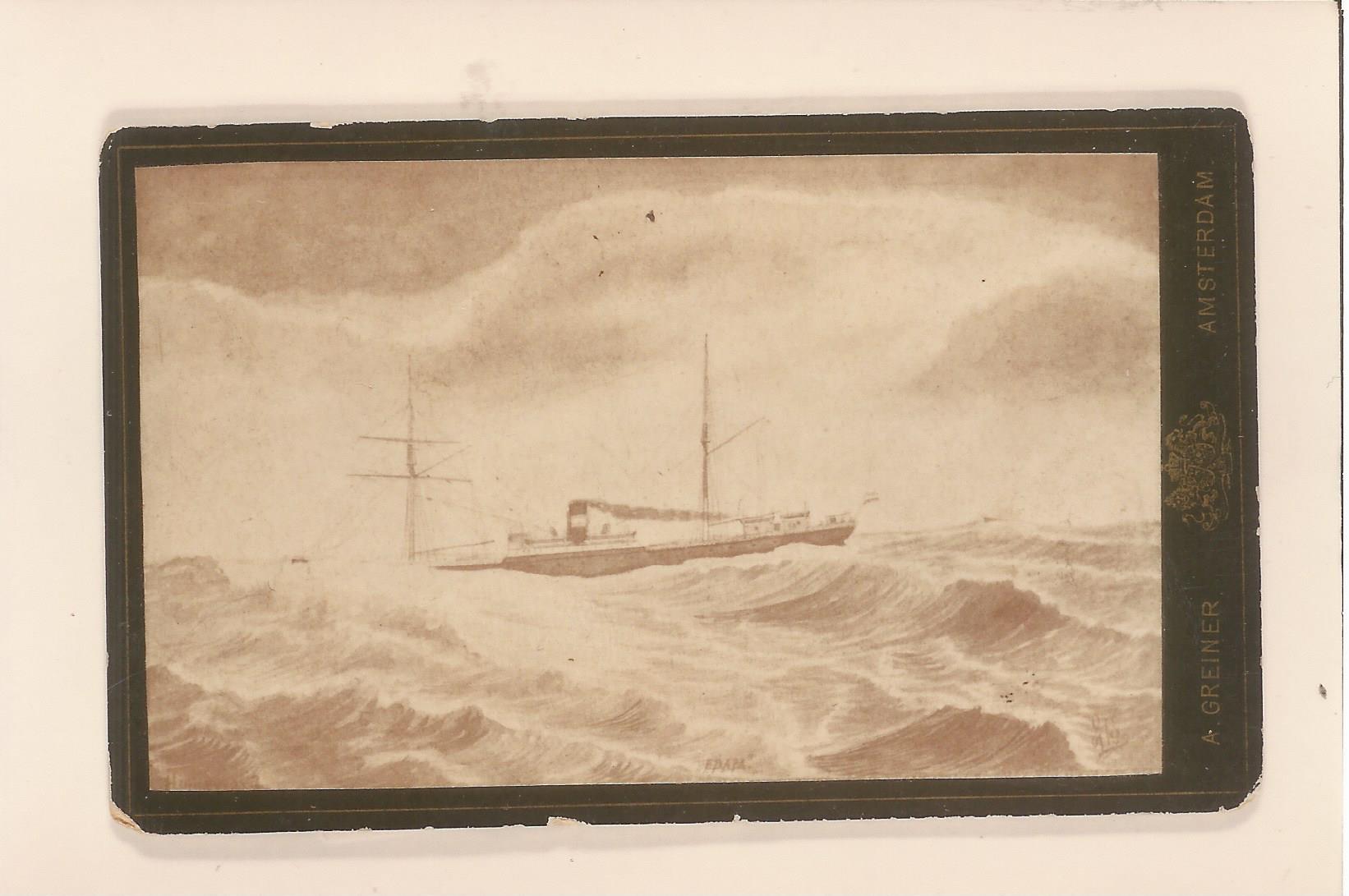
The ss Edam (I) from a contemporary postcard. As the Edam only sailed for the company for barely 2 years there are no known photos of the ship (d)
Geert Stenger married on 05 November 1883 Pieternella Oelssen in Rotterdam. Eventually there were 12 children, when counting them on this photo. (b)
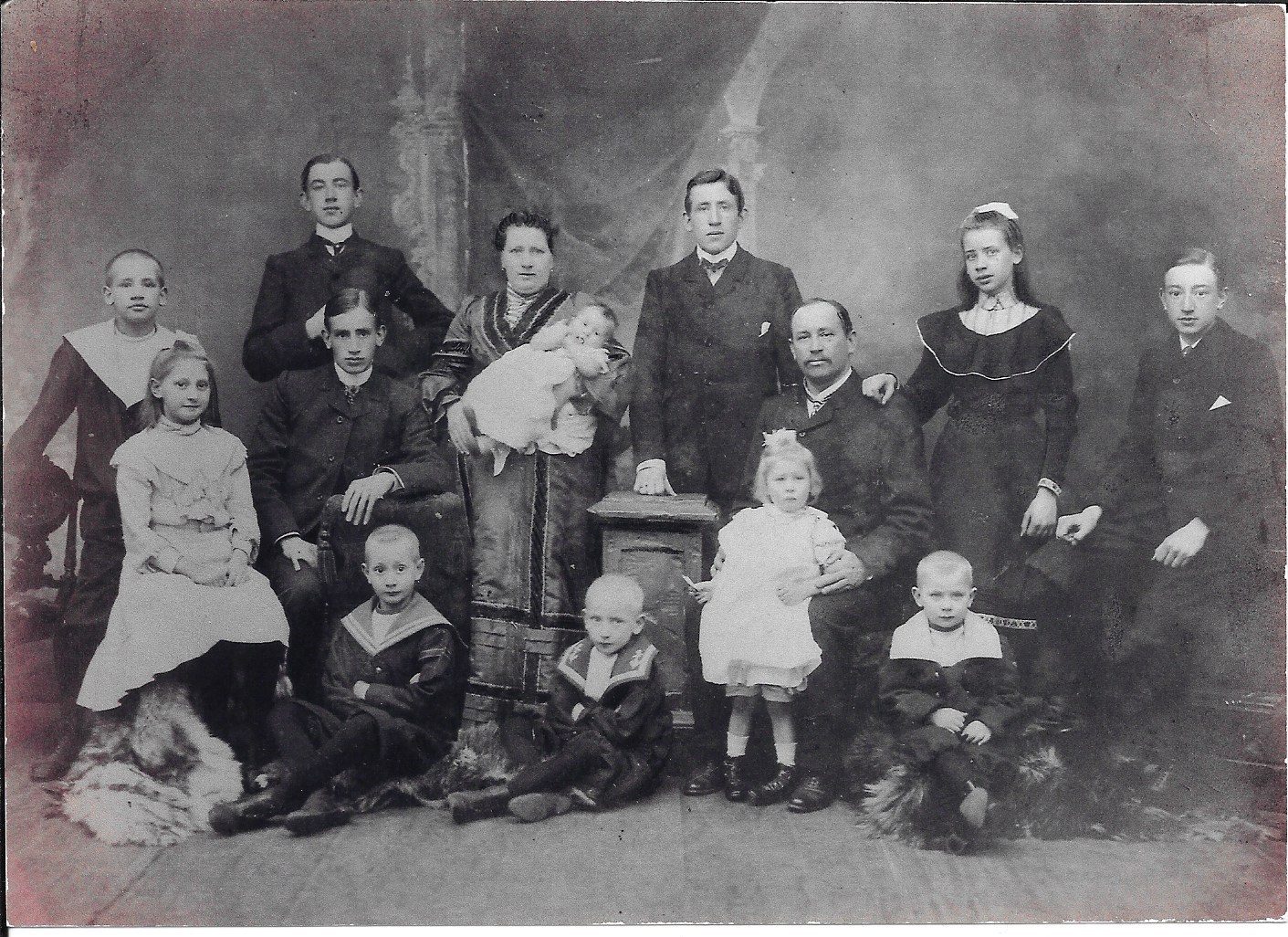
Captain Stenger and wife with their off-spring,12 in total. Luckily HAL captains were well paid (share in the cargo profit) otherwise it might have been a challenge to feed them all. (b)
His later obiturary in the newspaper listed: Dr. G.A Stenger, A.J. Stenger, J.P. Stenger, P.G.M. Nessel van Lissa – Stenger, Chr. G.F. Stenger, A.Stenger – Uiterwijk, F,G.J Koning – Stenger, G.A.F. Stenger, M.F. Stenger, A.F. Stenger, G.B.E Stenger. (11 in total, so one untimely death at a young age ?)
Promotion was now going very fast as the company was expanding and on 08 September 1886 he made a fill in voyage as acting captain on the W.A Scholten. Full promotion follows a year later on 05 March 1887 when he was given command of the ss Leerdam (I). On 19 June 1889 he was transferred to the ss Amsterdam (II) one of the express ships of the company. At that time sailing from the city of Amsterdam from where the company opeated a second service until 1893.
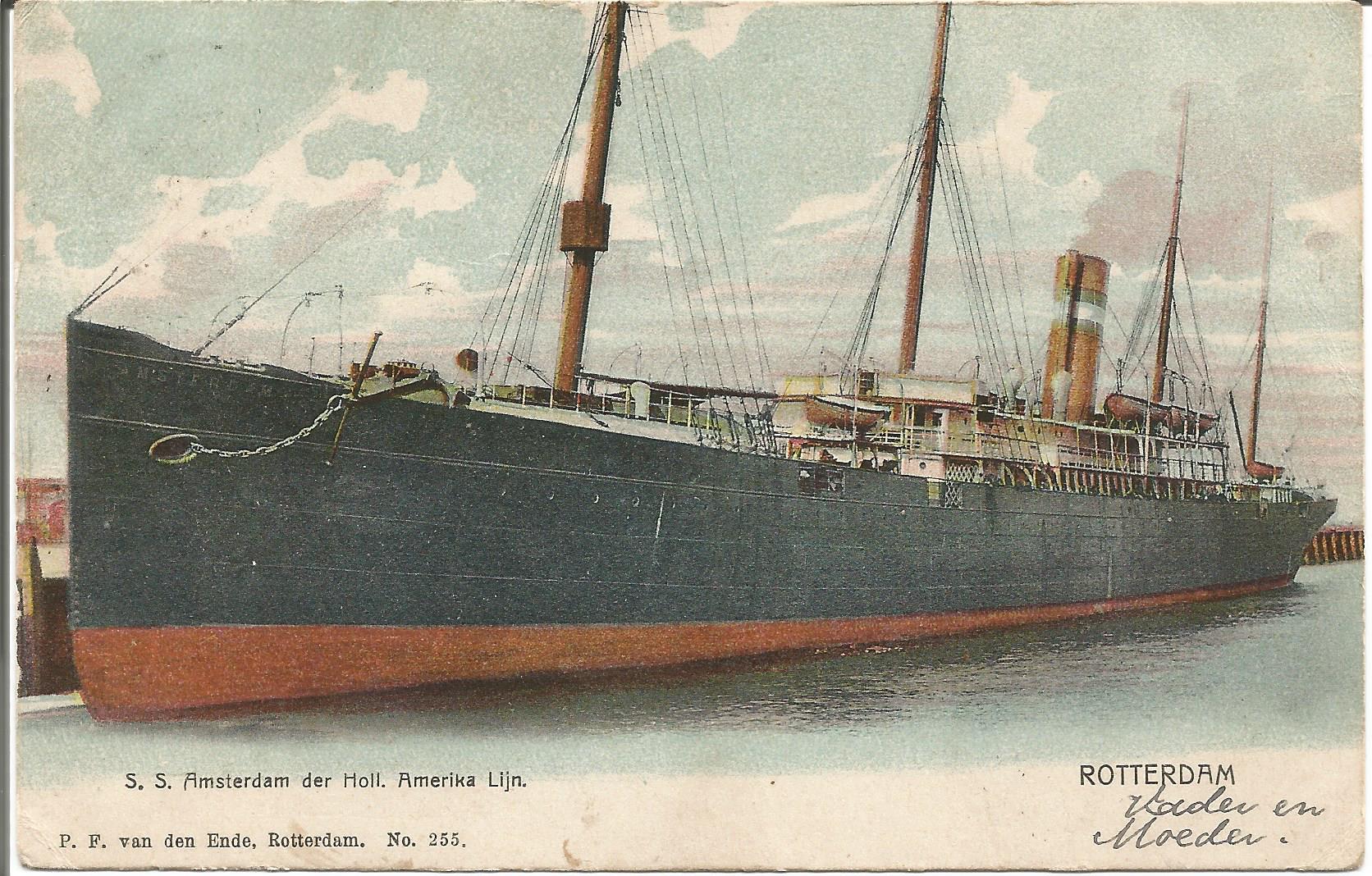
The ss Amsterdam (II) as seen on a contemporary postcard (d)
In 1891 he received a price of 200 Dutch guilders for saving the crew of the Swedish bargue “Signe” (Captain Larsen) that had sunk on 23 May 1891. Captain Stenger took them all on board his ship the ss Amsterdam (I).
He also received a medal from the Dutch Lifesaving Society (Zuid-Hollandse maatschappij to het redden van schip breukelingen) for the same action. The Chief Officer (C.W. Landman) received fl. 50,–
In total he sailed for 5 years on the Amsterdam (II) before he was transferred to the ss Veendam (I). Before this happened he saved in January 1894, the crew of the American Schooner “Mary (or Maggie) Wells”, which had sunk at sea. President Cleveland of the USA presented him with a gold watch. There was also an gift from America of 500,– Dutch guilders.
He also received a gold medal from the “Life-Saving Benevolent Association of New York”. This was handed to him during the next call of the ship in New York. The only sailor (crew of the lifeboat) A. de Wit still on board the ss Amsterdam received a silver medal.
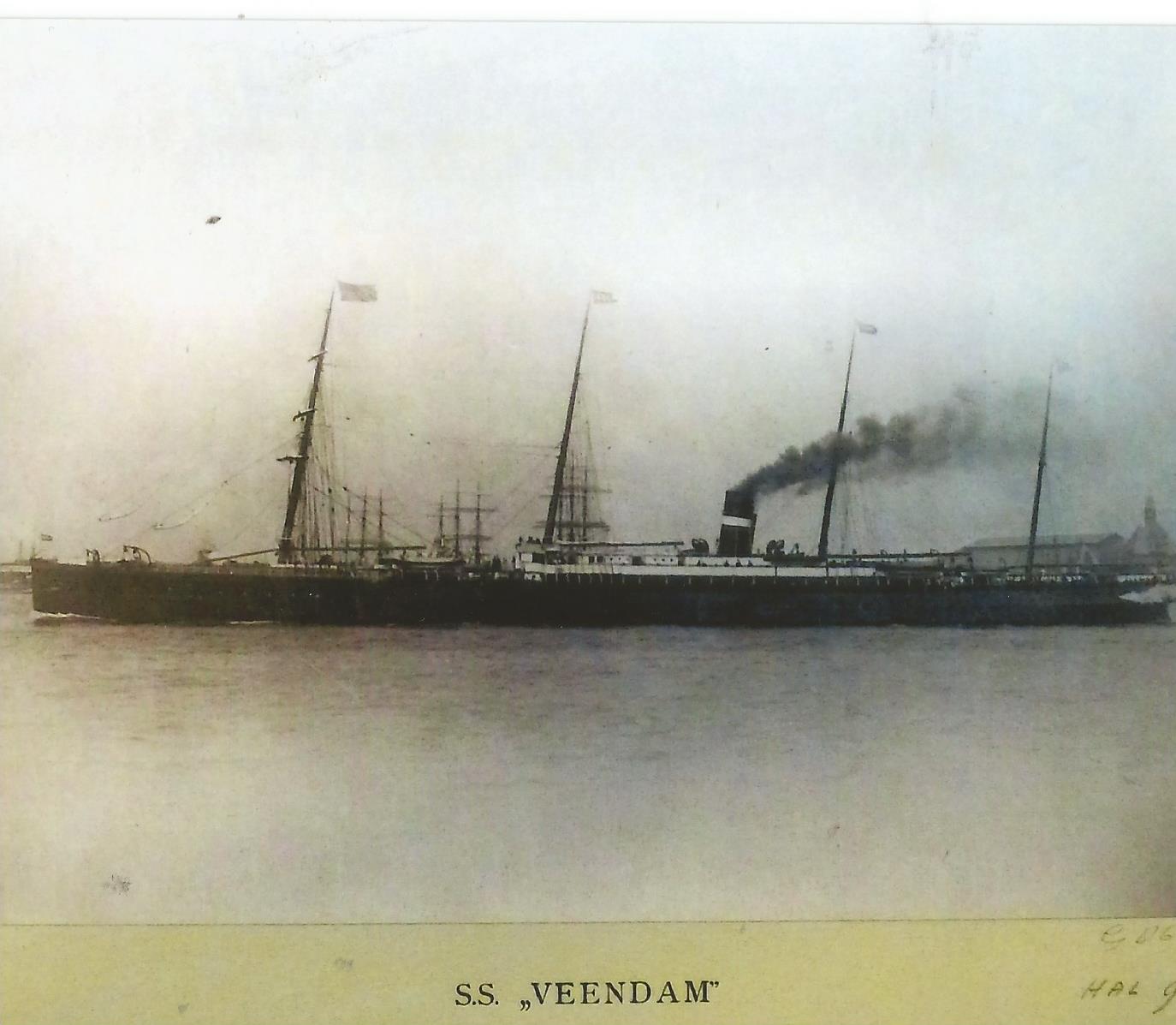
The ss Veendam (II) as she looked like in 1888, just after having been taken over from the British White Star Line. The origin of this photo is unknown but believed to be part of the HAL Archives in Rotterdam (d)
On 10 October 1896 he took over the command of the ss Veendam (II) in New York and then makes the return voyage to Rotterdam. The Veendam was no tdissimilar to the ss Amsterdam (II) as is was part of a series of similar ships bought by the company in 1887-1889.
On 03 Feburary 1898 the ss Veendam (I) leaves Rotterdam for a regular scheduled crossing to New York. The ship encounters very bad weather and hits on 6 February at 17.17 hrs. a submerged wreak and takes on water. During the night it becomes apparent that the pumps are losing the battle against the ingress of water and when in the early morning of the 7th. the ss St. Louis (Capt. G Randle) of the Inmann Line is seen,Capt. Randle is asked to take over all the passengers, which he agrees to. All on board are transferred without injury or problems in about 3 hrs. time. Captain Stenger then sets the ship on fire, to ensure that it sinks. Although the hull of the ship was made of steel, most of the superstructure and the inards of the ship was of wood. This would create the danger that the sunken hull woould submerge itself to just under water and then stay afloat by the amount of wood then on board. So setting a ship on fire might not be nice and go against the grain of any seaman but it was proper seamanship. The St.Louis was on its way to New York and after picking up everybody from the Veendam continued on it’s voyage. It arrived in New York on 12 February. As the ship was not full, there was not much of a problem to provide accommodation for all the un-expected guests. The officers and crew of the Veendam returned to Rotterdam on 25 February with the ss Spaarndam (I) (For more information about the ss Veendam (II) see the entry under HAL fleet.
For saving passengers and crew he received a gold medal from the Dutch Lifesaving Society (Zuid-Hollandse maatschappij to het redden van schip breukelingen)
On 18 August 1899 it was announced that Stenger had made his 100rd round voyage as a captain. On his ship the ss Werkendam (I) a festive luncheon or dinner was held and he received the 100 voyage medallion of the company and also a set of framed portraits of the Directors. As advised by the great grandson of the captain, he also received a inkstand set at this occasion from the company. (b)
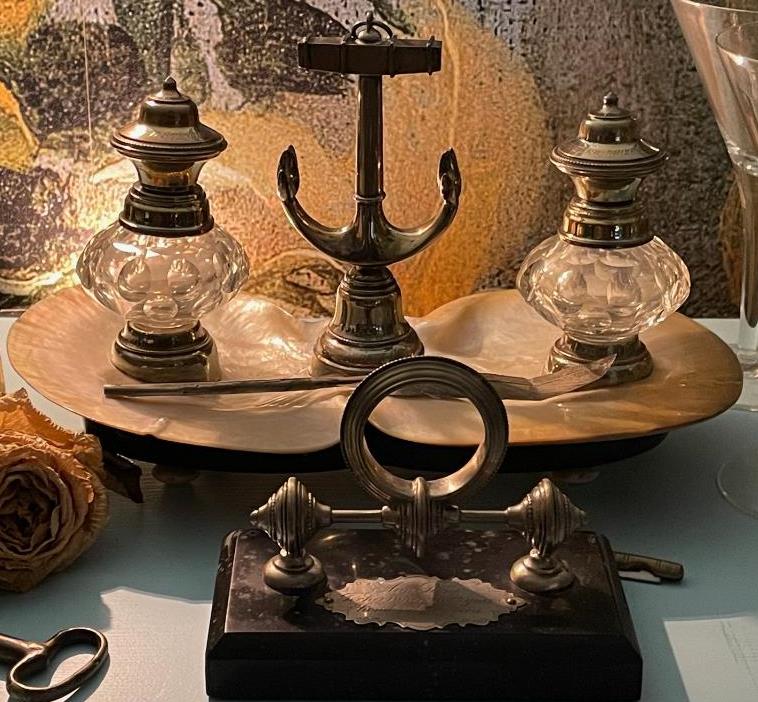
The inkstand that Captain Stenger received on the occasion of his 100th. voyage. The press-papier in the foreground was a gift from his children marking the same occasion. It reads (in Dutch): To Daddy, as a memory of his one hundered voyage. (b)
In December 1904 while in command of the ss Rotterdam (III) he saved the crew of the American schooner “Pioneer” registered in Newfoundland which had run into problems off the American coast. On behalf of the NewFoundland Government he received a pair of binoculars (TBA, as it might have been a long-view version) with inscription. De crew of the ships lifeboat received a monetary recognition of £ 2,– and £ 5,– depending on rank. (1 Br. pound in 1904 was the weekly wage of an average skilled worker in England)
The seniority system as applied as by HAL continued and thus from the Rotterdam (III) he rotated to the newer ships after 1900. This saw him in command of the ss Potsdam by 1905. Here he had the honor to receive Queen Wilhelmina on board on 28 March 1905. Her Majesty was on a port visit to Rotterdam and had been travelling around the port on the ss Columbus of Holland America, to observe and note all the commercial progress made in the port of Rotterdam.
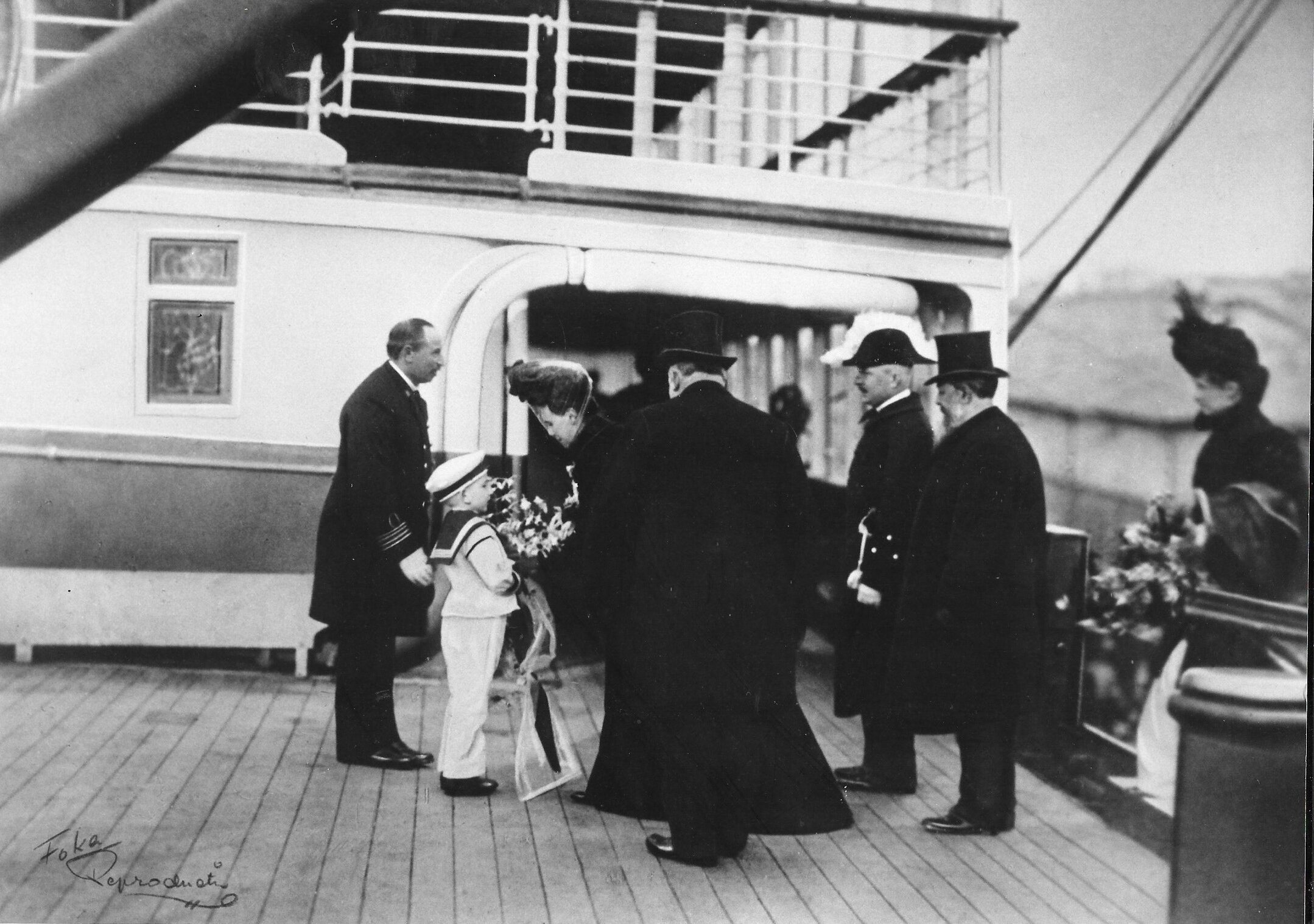
Captain Stenger welcomes Queen Wilhelmina and her husband on board the ss Potsdam in Rotterdam. (b) (This photo also exists as a postcard in a series commercially issued to honour the visit to Rotterdam) (b,d)
There is a small anecdote connected to the above photo. The boy in the sailors suit is the son of Captain Stenger, Rinus. He initially fefused to give the bouqet of flowers to the Queen because she did not look like a real Queen as she was not wearing a crown. Looking at the photo it seems that he changed his mind. (b)

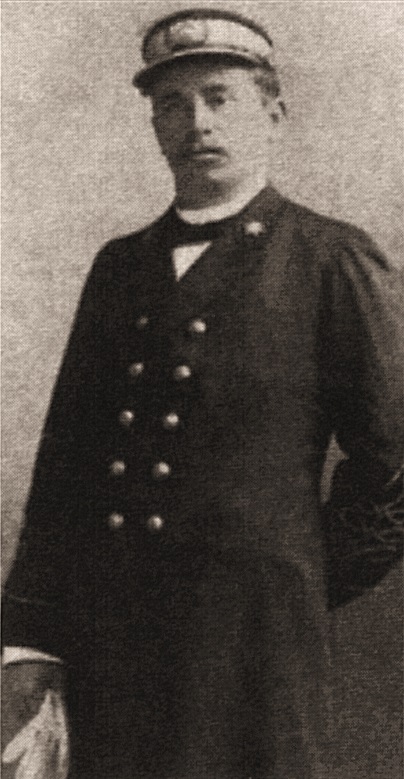
Commodore Stenger. Please note the full gold band aroundhis cap denoting his title. (d)
On 23 September 1910 Captain Stenger completed his 200th. crossing and apart from receiving the company coin/medallion commorating this, he also was made a”Knight in the order of Orange Nassau”. (comparable to an OBE in the English system) He also received a painting made by the marine painted Chr. Dommelshuizen, showing the ss Rotterdam arriving in the City.
On 06 April 1914 he left Rotterdam for his 480th. crossing or 240th roundtrip. This was voyage 45 of the ss Rotterdam (IV) and the ship sailed via Boulogne Sur Mer to New York and from there via Plymouth in England and Boulogne Sur mer in France, back to Rotterdam where the ship arrived on April 30.
Just before he had made a cruise with the ship from 17 January to 29 March 1914 from New York to the Mediteranean and the Holy Land. The American newspapers featured this prominently as the ship had a record number of 800 guests onboard for this cruise. A number that was not surpassed until well in the 1920’s as the First World War put an end to any idea of cruising to Europe. The ss Rotterdam (IV) only made her next cruise in January 1923, repeating the 1914 cruise.
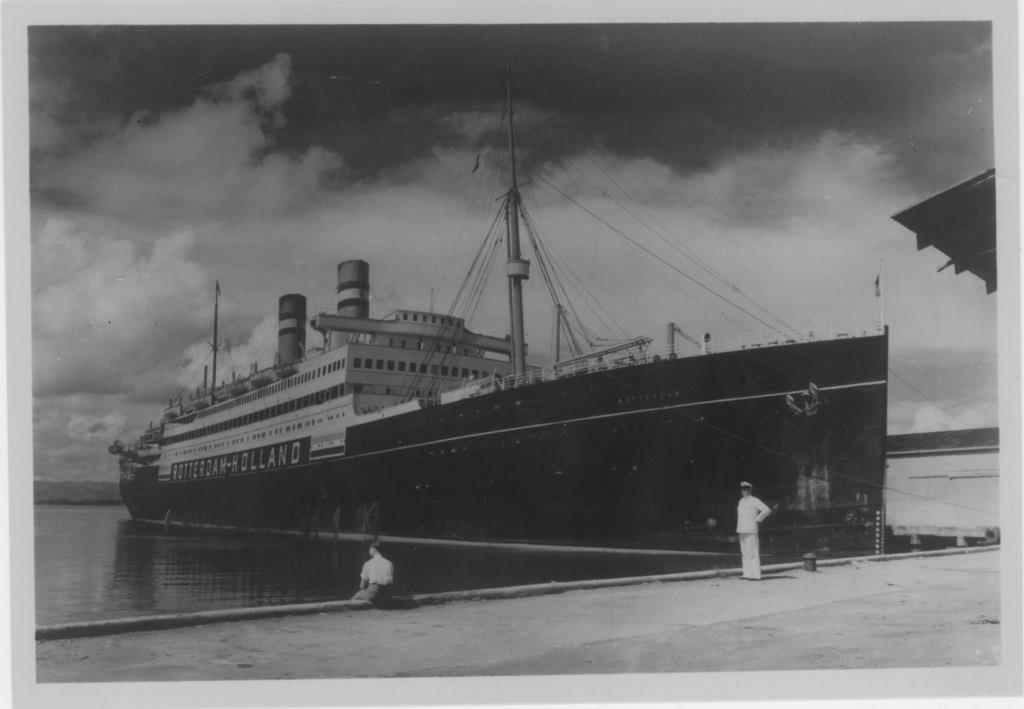
This photo shows the ss Rotterdam IV in Naples. For collecting displaced and unwanted persons. Please note the neutral lettering and Dutch flag on the side of the hull, indicating a neutral Dutch ship. (d)
On 14 November 1914 (voyage 51) he ship was send on an unusual voyage to Italy. Commodore Stenger received orders from the Dutch Government (who acted on a request of the also neutral US Government) to sail to Italy to deliver and collect a number of displaced, or unwanted ersons or persons with refugee status. Thus the ship sailed first from Rotterdam to New York for a regular crossing and then left New York on 3 December for Naples, where it arrived on 14 December. Here it stayed overnight and then sailed to Genoa (16 dec to 06 Jan. 1915). From there it returned to Naples for another overnight on 7 January and then sailed back to New York where it arrived on 19 January. Sauling from New York there was aa total of 1919 persons on board who were landed in Naples. Then returning from Genoa and Naples a total 1709 persons were embarked with destination New York. This voyage must have ranked as the most unusual the Captain ever made.
The ship remained making North Atlantic crossings for the whole of 1915 and most of 1916. Then due to the ever greater menace of the German U-boats. the ship was laid up in Rotterdam for the remainder of the war.
Commodore Stenger made his last crossing in command of the companies flagship the ss Rotterdam (IV) between 08 September and 15 October 1915 (voyage 59) with the ship calling at Falmouth (a 2 day stop for contraband clearance), New York (20 – 23 October), then a deviation to Newport News for a quick dry dock. Then sailing back, there was the stop at Falmouth for the mail (30 October) and a call at the Downs (08 – 14 November) for the Eastbound contraband inspection. This stay took longer than expected as the ship had caught an anti submarine chain in the propellors. Upon arrival Rotterdam Commodore Stenger signed off due to illness and officially retired from the company on 01 March 1916) (c)
The reasons for his retirement are somewhat unclear as in 1916 he was 57 years old and the compulsory retirement age was 60. There is a letter in the archives, dated 16 February 1916 in which Capt. Stenger expresses his regret that the company had asked him to go, without any recognition whatsoever. The letterhead of this letter lists him then as a Nautical Advisor – Expert based at the Mathenesserlaan 306 in Rotterdam. The official sailing listing of the company (Stamboek) notes that he was “honorably dismissed”. Which in the language of that time means, honorably retired.
GAP in information: did he remain an “Expert” in this period between 1916 and 1927 ?
Commodore Stenger passed away on 27 March 1927 and was buried on 30 March 1927 on Algemene Begraafplaats Crooswijk, Rotterdam. Nearly the complete management of the company was present as well as a large number of collegues and persons out of the maritime industry.
(Last known address was Spoorsingel 5 Rotterdam. This house was not bombed during the 2nd worldwar and still exists)
During his life he was at some time Chairman and Boardmember of the “Vereeniging voor de Zeevaart” commonly known as “the captains club”,
Note: are there any family members out there, or people who knew the captain, who can fill in some more details his private life and maybe know what happened in the period 1916 and 1927,tt eh Dommelshuizen painting, and to all his medals. If so please contact me at Captalbert1@aol.com.
Sailing List: (e)
Date: Function: Ship: Wages and/or remarks.
29 Dec. 1881 3rd Officer Edam 40,–
22 May. 1882 2nd Officer Scholten 60,–
06 Jun. 1883 Temporary dismissed due to exam
22 Sep. 1883 Chief Officer Scholten Rosestraat Rotterdam
08 Sep. 1886 Act. Captain Scholten
28 Sep. 1886 Chief Officer Rotterdam 100,–
05 Mar. 1887 Captain Leerdam 200,–
05 Apr. 1889 Ashore on standby
19 Jun. 1889 Captain Amsterdam 200,–
28 Sep. 1890 Captain Edam 200,–
21 Mar. 1891 Relieved from command
29 Mar. 1891 Captain Amsterdam 200,–
26 Nov. 1894 Temporary dismissed
01 Jan. 1895 Captain Amsterdam 200,–
10 Oct. 1896 Captain Veendam 200,– handed over at new York
16 Nov. 1896 Temporary dismissed
19 Dec. 1896 Captain Veendam 200,–
After sinking of the Veendam on 7 february 1898 arrives on 12 Febr. Per ss St.louis at New York. From there with the Spaarndam on 13 Febr, as passenger back to Holland. Arrived 25 feb.
16 May. 1898 Captain Spaarndam 200,-
13 Dec. 1898 Temporary ashore and available
23 Jan. 1899 Captain Spaarndam 200,–
02 Jun. 1901 Captain Rotterdam 200,–
17 Feb. 1904 Captain Potsdam 200,–
21 Dec. 1904 Captain Statendam 200,–
01 Mar. 1905 Captain Potsdam 200,–
13 Dec. 1905 Captain Noordam 200,–
10 Jan. 1908 Captain Potsdam 200,–
19 Feb. 1908 Captain Noordam 200,–
22 Mar. 1910 Captain Rotterdam 200,–
01 Jan. 1911 Due to the review of the renumeration wages put at 400,–
19 Oct. 1915 Temporary dismissed due to illness
01 Mar. 1916 Honorable discharge.
Sources:
(a) Holland America Line Photo Archive.
(b) Mr. Tim Stenger, Great Grandson of Captain Stengera nd son of “Rinus”, son of Captain Stenger and the one in the photo..
(c) Mr. Laurens van der Laan. Hal Historian.
(d) Captain Albert collection.
(e) Stamboeken and mouvement boeken of the Holland America Line archives as held by the Municiple Archives of the City of Rotterdam.
Last updated: 17 November 2025
January 8, 2020 at 2:28 pm
My Grandpa (1898-1983) has made, on the s.s. Rijndam and the s.s. Rotterdam (IV) as ‘Pantry Boy 1st Class’ in 1914/1915, two journeys from Rotterdam to New York and vice versa.
I know this from his N.A.S.M. Pocketbook that I ‘inherited’ after his death. It also states (with signatures) that his captain on the s.s. Rijndam was P. van den Heuvel, and on the S.S. Rotterdam Captain G. Stenger.
A lot has been described about Pieter van de Heuvel on this site.
But (almost) nothing mentioned about Geert Stenger. While he still had an impressive track record at the HAL. And in Groningen as ‘sea hero’ is considered according to this article: https://www.deverhalenvangroningen.nl/alle-verhalen/geert-stenger-groninger-zeeheld-bij-toeval
Perhaps also interesting to mention it here (after permission?).
Regards, Jan
Rotterdam
January 8, 2020 at 6:00 pm
Thank you for your comment and for reading my blog.
The reason that I do not have posted much about Capt. Stenger is because I am still digging. I am ware of the information on the website, link that you posted. I even have the grave suspicion and some of the sources for this article, came from me via other 3rd parties during informal discussion. Not that I mind, the more that is published, the better it is. The bio of Capt. Stenger will appear in due course as soon as I have been able to confirm some information about him that I received but based on “family lore”.
Best regards
Capt. Albert
November 28, 2021 at 11:06 pm
Hi,
You could find more on dates over here if you haven’t used that site already:
https://www.gjenvick.com/Passengers/Ports/Rotterdam-PassengerLists.html
November 28, 2021 at 11:02 pm
Hi,
I kind of went down a rabbit hole because I started out with the flight schedules of the Hindenburg but ended up on passenger lists of old routes for migration. Since I also live practically in Rotterdam, I picked Holland America Line as first and saw the first record available is that captain Stenger and found this post. The name Van den Heuvel is also mentioned in the crew list (and 151 passengers). It was on the Spaarndam though.
SS Spaarndam Passenger List – 7 September 1899
Commander: Captain G. Stenger
Chief Officer: Van den Heuvel
Chief Engineer: Sauer
Physician: Dr. Harrington
Purser: Spruyt
Chief Steward: Vogelzang
The first log I found on that website from the SS Rotterdam is of February, 2nd, 1904
Senior Officers and Staff:
Commander: Captain G. Stenger
Chief Officer: Van der Goot
Chief Engineer: Steenwyk
Purser: Bödenz
Physician: Dr. Henderson
Chief Steward: Hooft
First one of the Rijndam/Ryndam:
12 September 1908 but with a lot more passengers and not with Cpt Stenger, but A. Roggeveen.
All other sailing companies from that era their passenger logs, postcards and other info when available:
https://www.gjenvick.com/Passengers/Holland-America/Spaarndam-PassengerList-1899-09-07.html
October 3, 2025 at 6:26 pm
Geert Stenger was the father of my grandfather . When my father died, I inherited an inkstand made of silver and mother of pearl, which he recieved in honor of his 100 cruise as a captain.
October 5, 2025 at 6:37 pm
Thank you for your comment. Much appreciated. I will contact you via my hobby email Captalbert1@aol.com, as I would like to ask for a photo of the inkstand, to put on this page, as I was not ware of its existence.
Thank you and best regards
Capt. Alber t