Herk van, Cornelis.
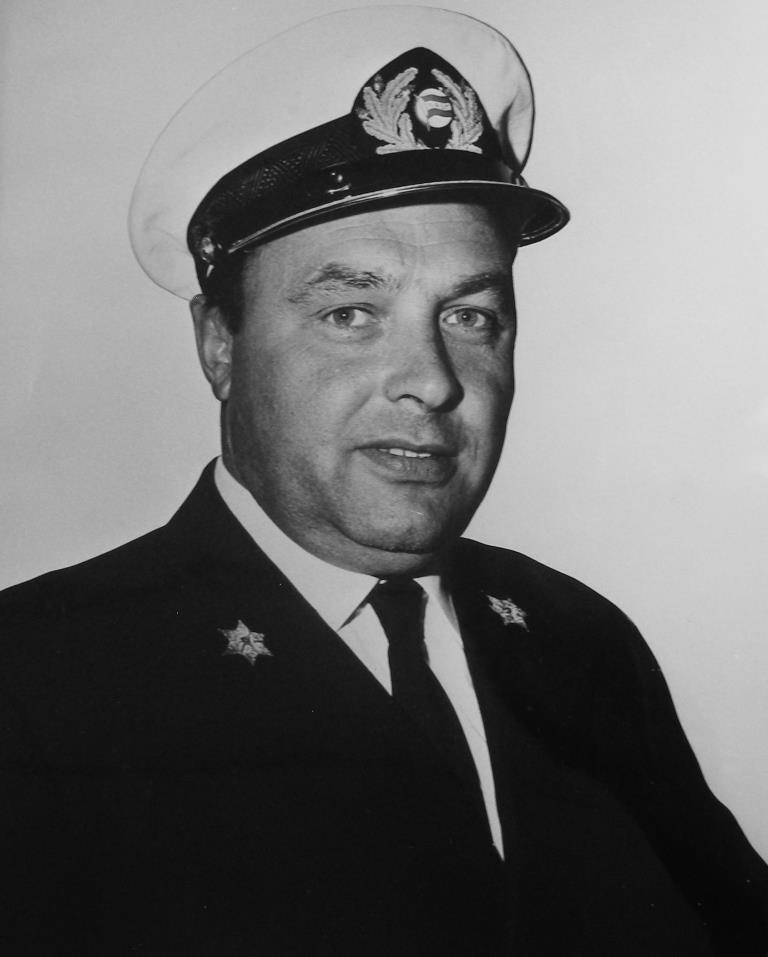
Captain Cornelis van Herk early in his career as captain on the cargo ships. (c)
Cornelis van Herk was the son of Captain Jozias van Herk (see his biography on this website) and was born on 17 December 1923 in Rotterdam as the oldest of 3 boys. His father was at that time Chief Officer also with Holland America. The maiden name of his mother was Berendina Baarschers. The family lived in the town of Voorburg at the Oostenburgerdwarslaan 29. Voorburg was a commuter town North of The Hague and valued by many sailors due to its good travel connections with Rotterdam.
On 2 Sept. 1942 he was accepted at the “Kweekschool voor de Zeevaart” in Amsterdam, following in his fathers footsteps. As his father was at sea during the war, it was the mother who signed the articles of acceptance. The general education in the Netherlands was at that moment constantly disturbed due to the German occupation and the pupils (called kwekelingen) had to be careful not to be arrested by the Nazi occupier and send to Germany for forced labour. From 1943 onwards the minimum age for “forced labor” selection was 17 years or older and thus they were all a prime target to fill the quota’s for Forced Labor if not excused.
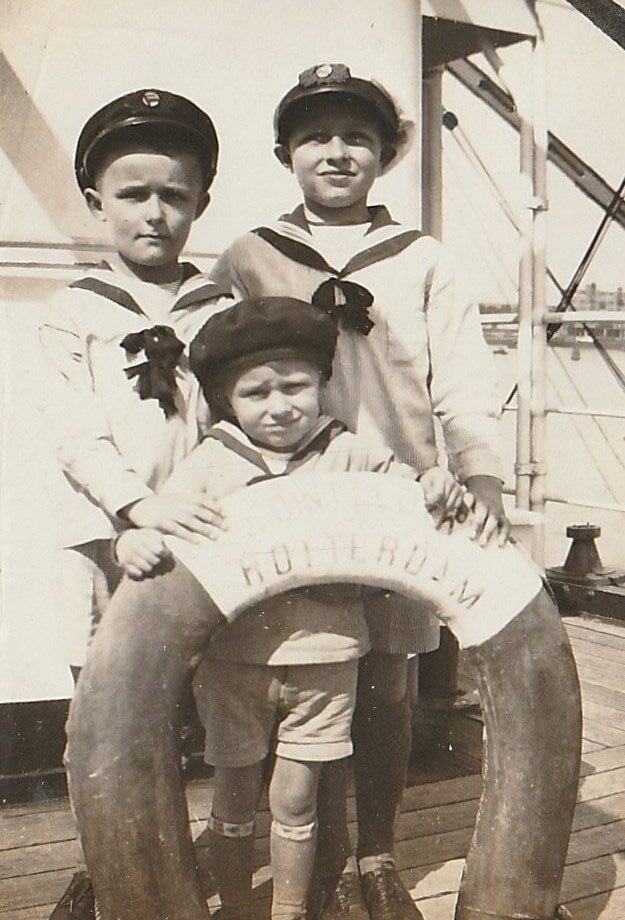
The three sons of the later Captain Jozias van Herk. All three in sailors costume. So indoctrination started at an early age and for Cornelis (top right) it worked, as he indeed went to sea. (b)
Thus a lot of “kwekelingen” had to go “underground” (in hiding at a safe and unknown address) to avoid being detected. Cees van Herk was 19 when he completed his nautical education after following the 2 year course and did the same thing. He had very good marks for the navigational topics but did not have seemed to have liked mechanics very much. (d)
In July 1943 he was discharged from the Maritime Academy and went “underground” on a farm (Farm “De Weikamp” of Family Dorrestijn in the town of Silvolde), in the East of the Netherlands. He was able to disappear there as his uncle, a local reverend, had made arrangements with one of the members of his church. He was there togeher with this brother Hans (born 18 July 1920).
He was soon put to work on the farm and it seems that he was even contemplating to forget the sea and become a farmer. He remained there for 2 years, learned the local dialect which helped greatly to pass himself off as a local laborer. Some of those local laborers had dispensation from the Occupying Forces to ensure that the harvest came in on time. With a false I.D card and a good accent things could be a little bit easier.
During this period he met his future wife Catherina Louwerse. She was employed as a nanny by Baroness Alexandra Herculine Van Heemstra and she had followed her to Terborgh also in the East of the Netherlands. (Her husband Kaeso Fabius was Burgomaster of the town of Oostkappele from 1936 to 1943 and then he also had to “go underground” as he was replaced by a “German approved” Burgomaster. Hence Catherina ended up in the same area as Cornelis. They met during the weekly Religious instruction by the Church to prepare for acceptance as a full member of the church. (Note: a sister of this baroness, called Ella, was the mother of Audrey Hepburn a wellknown movie actress.)
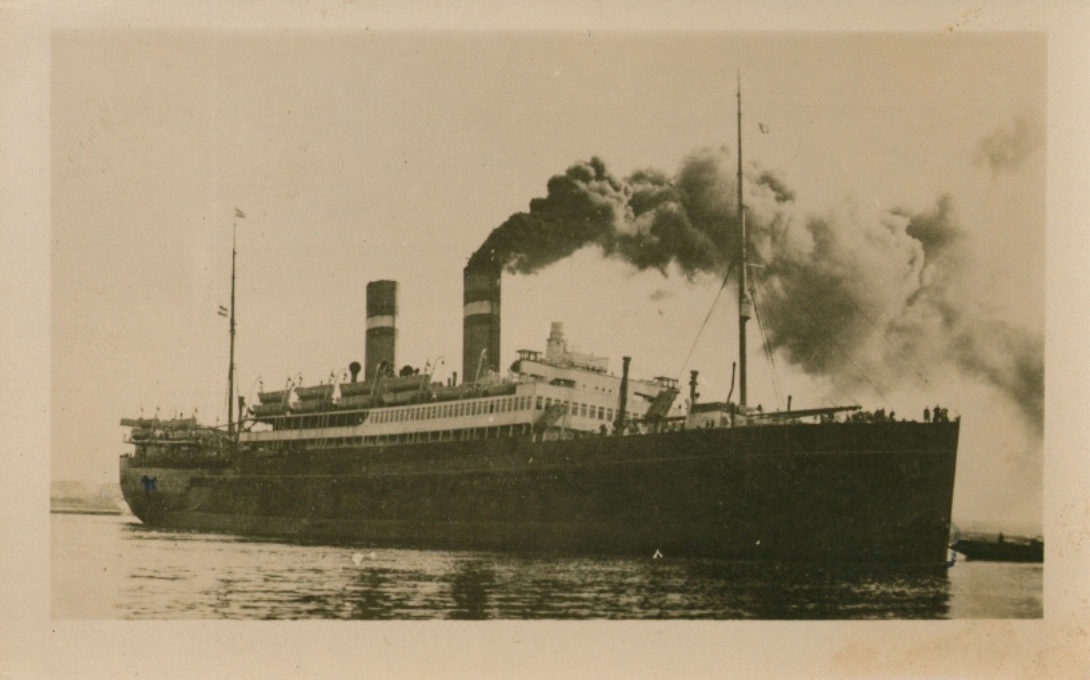
This is how he would have seen the ss Volendam (I) when he came on board. Weary from 5 years of war service, partly repainted but still a troopship. Note the large liferaft just past the forward mast. (c)
The Netherlands was liberated on 10 May 1945 and all the Maritime School students came out of hiding and started to apply for a job. Not un-expectedly Cornelis ended up at the same company as his father. He joined the Holland America Line on 11 September 1945 and joined his first ship the ss Volendam (I) on 15 September 1945. Peculiar situation was that his father was at that moment the Staff Captain of that ship. It was not the normal company policy to have family sailing together but the times just after the war were far from normal, and even for the HAL, the planning the situation was chaotic. Those on the ships (having been away from home for 5 years or more) wanted to go home as soon as possible and also wanted to stay home for a long time. Those at home wanted to go to sea as soon as possible to earn a normal wage again. But after 2 voyages on the Volendam, he was assigned to the ms Westerdam and all was back to normal.
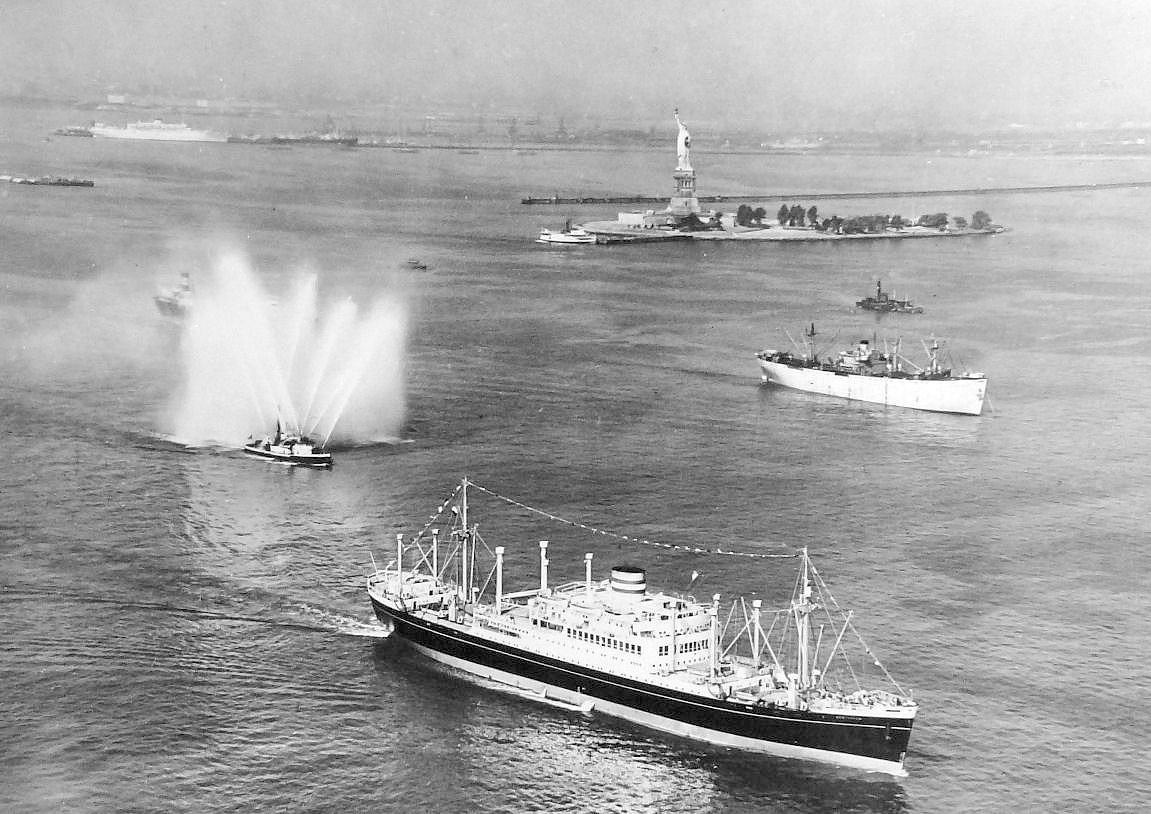
This photo shows the ms Westerdam (I) on arrival in New York after its maiden crossing of the North Atlantic on July 08th. 1946 (c)
The ms Westerdam (I) was a brand new ship, (Part a class of 4 passenger cargo ships, Noordam, Zaandam, Zuiderdam and Westerdam) and 4th. Officer van Herk sailed on the technical trialtrip, followed by the maiden voyage to New York and then on the next 2 voyages.
Then followed voyages on the A class cargo ships. These were a series of 10 Victory cargo ships which HAL bought in the period 1946 – 1950 and were called the “A-class”. The ships were surplus to requirements after the war and the US Government was very willing to sell them to get the European economy back on its feet as fast as possible. The influx of soo many ships did wonders for an officers career and in the next years promotion for many of them would go very fast, with sometimes being promoted within a year from one rank to the other. Also for Van Herk. He made 3rd. officer within the year and then had to get his 2nd mate’s license before further promotion was possible.
On 14 January 1949 he married Catharina Louwerse (born in Domburg) in the town of Domburg. (Town located in the province of Zeeland, southwest of Rotterdam)
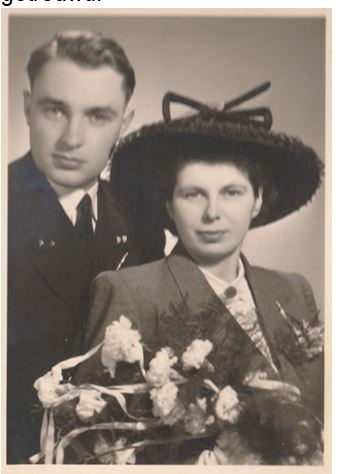
The marriage photo of Cornelis and Catherina. Note the 2 pips on the revers, indicating he was wearing the uniform of a 3rd. officer. (b)
The company obviously did not believe in a honeymoon period as 4 days later he had to back to sea being assigned to the ss Axeldyk.
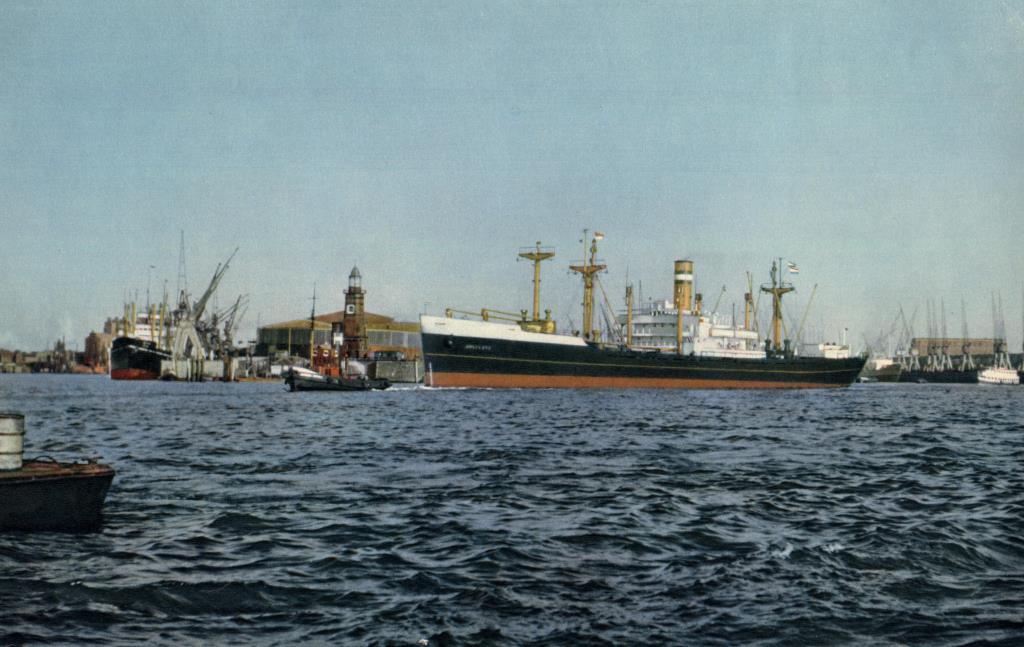
A colour photo of the ss Axeldyk leaving port. (c)
He sailed on this ship for one contract and then could go home for a longer period as he went to school for his 2nd mate’s license, which he obtained on 23 December 1949, Then on 13 January 1950 it was back to sea with the ss Leerdam (II), a cargoship with a limited passenger accomodation which sailed between Rotterdam and New York. Just over a year later he was promoted to 2nd officer. Just under a year later he was as second officer already senior enough to be assigned to the passengerships and ended up on 14 January 1952 on the flagship the ss Nieuw Amsterdam.
Promotion came again on 18 July 1952 to First Mate / Chief Officer without even having his first mate’ / master license. Most likely this was done by the company to keep him and other senior officers loyal to the company as competition was fierce. Many other companies had also bought ships from the USA and experienced officers were scarce.
Cornelis van Herk went directly to school in August 1952 and passed his exam on 27 May. 1953. Six days later he was assigned as Chief Officer for two voyages on the Nieuw Amsterdam as the regular (and much more senior chief officer went on leave). In normal times, this would have been unheard of within the Holland America senority system but the ship had to sail. Then things returned to normal and he was assigned to more A class ships. Appingedyk, Aardyk and Arendsdyk.
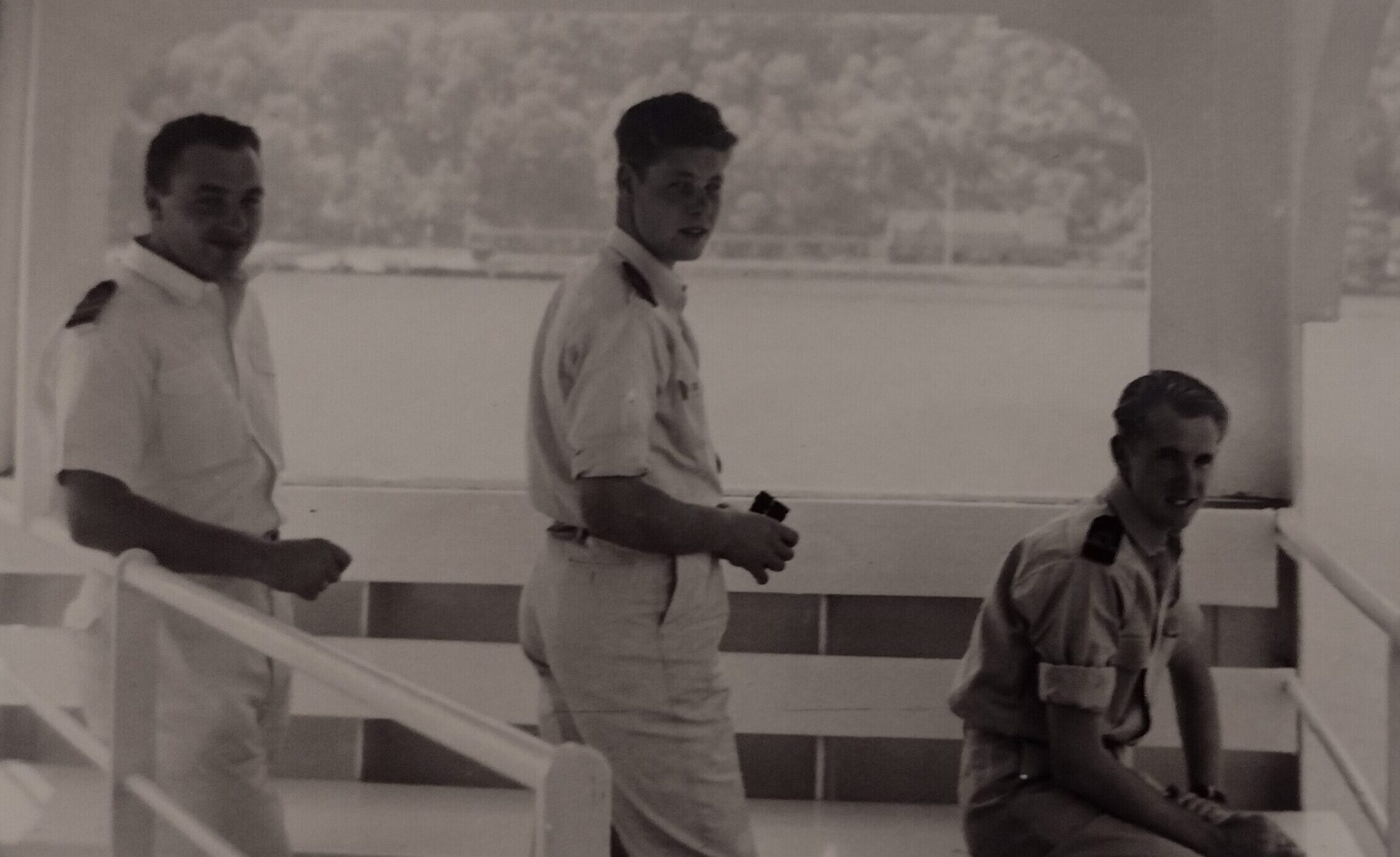
On board the ss Aardyk between Albany and New York. From lef to right, Chief Officer Van Herk, Cadet Sigling and 3rd. officer De Vries. (Photo by Captain Snelleman of the Aardyk, Courtesy the Estate of Captain Snelleman)
Then on 30 November 1954 he sailed as a passenger on board the ss Ryndam (II) to New York to join the ss Axeldyk in New York. Van Herk had sailed on this ship before but in the mean time it was moved from the North Atlantic service. Now she sailed on a route from New York to South American ports and did not call at Rotterdam. This made being relieved difficult and hence the company had decided that all officers within the company had to serve one year away from home.
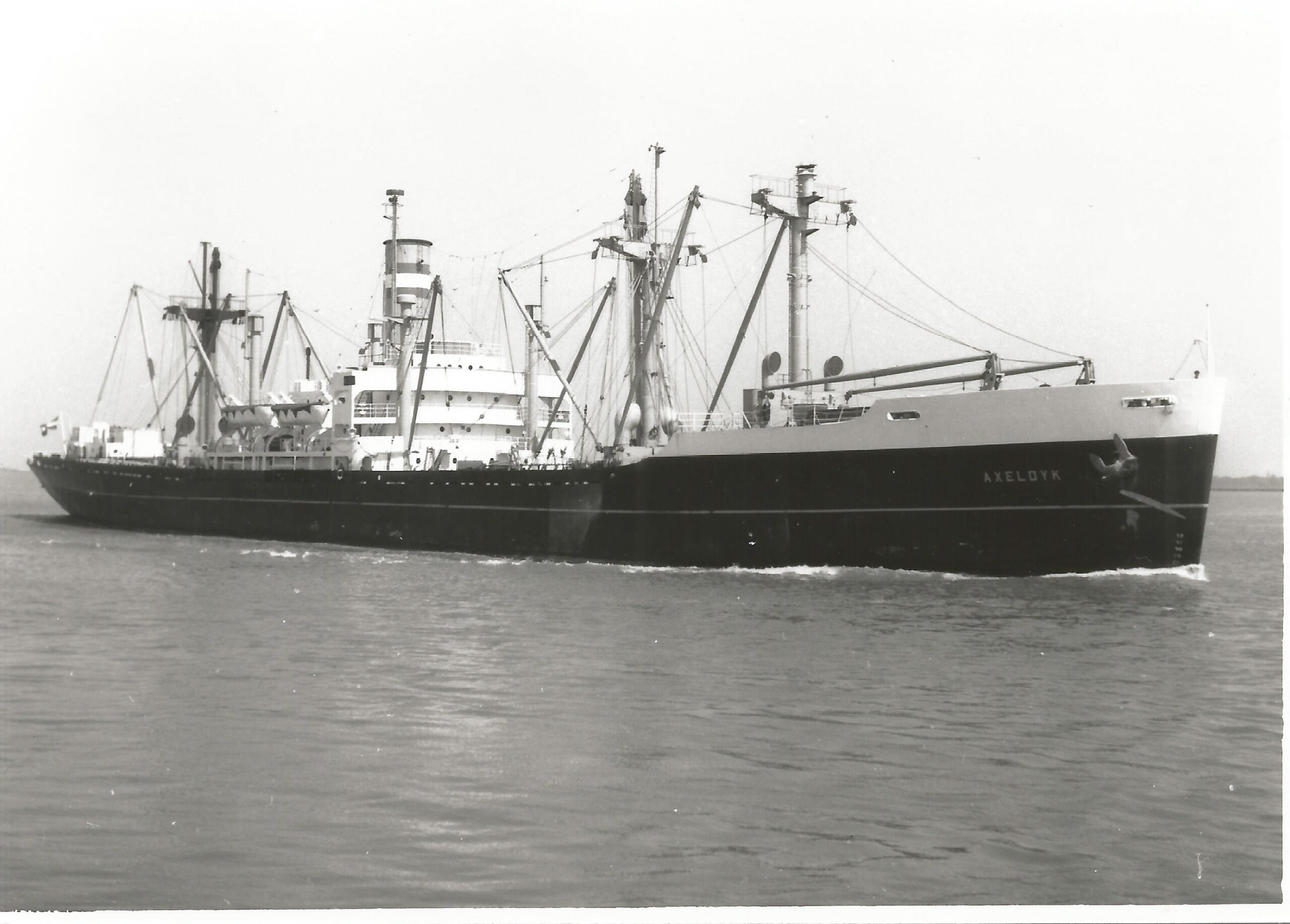
Another photo of the ss Axeldyk.
He made four voyages on that ship and one roundtrip from New York took normally about 3 months and called at ports such as, (Voyage 48) New York, Port Of Spain, Rio de Janeiro, Montevideo, Buenos Aires, Santos, Rio de Janeiro, New York, Boston, Baltimore, Newport News and back to New York to start the next voyage.
By Spring 1957 he was considered senior enough to be assigned to the passengerships and on 30 March 1957 he joined the ms Maasdam (III), a sister of the ss Ryndam (II). These two ships had been built in 1951 to take advantage of the increasing emigrant trade to the USA and Canada and the tourist Trade from the USA to Europe, by Americans going to visit the battlefields.
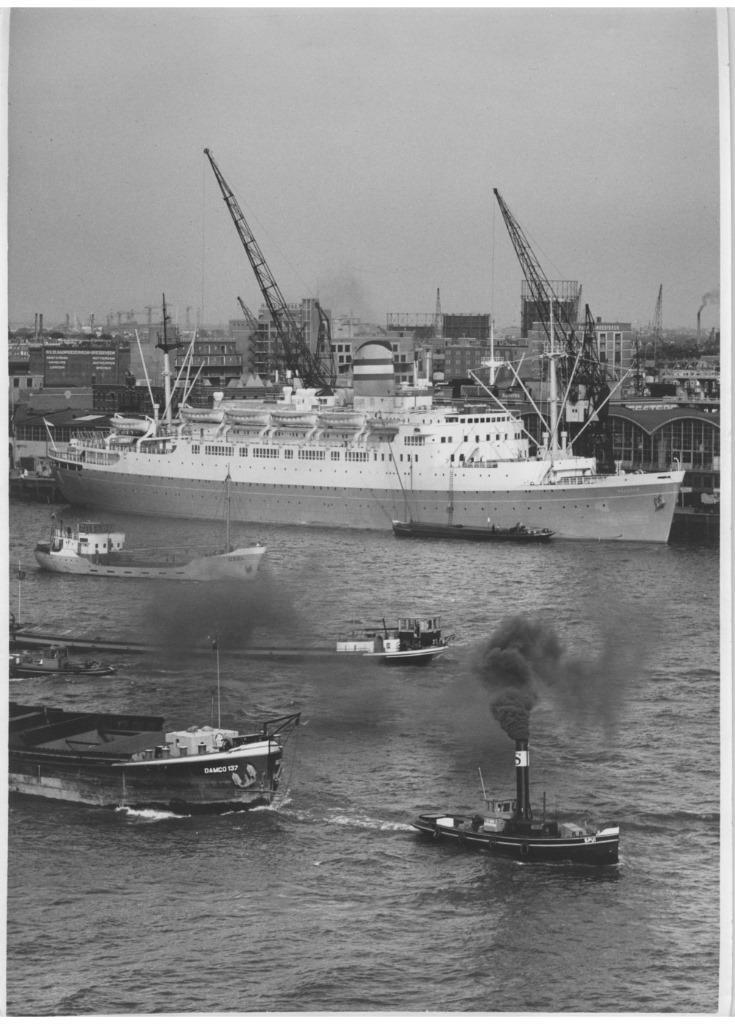
This photo shows the ss Maasdam (III) docked at the Wilhelminakade in Rotterdam, being made ready for departure to the USA.
Van Herk made voyage 46, leaving Rotterdam on 30 March and calling at Le Havre in France and then Halifax in Canada were 189 emigrants were landed. From there it went to New York and then back again via Cobh in Ireland and Southampton and Le Havre to Rotterdam. A round trip lasting 22 days.
Then he was tranferred to the ss Statendam (IV) on May 7th. 1957 to relieve the regular Chief Officer. (Who had been part of the newbuilding, had made the maiden crossing and the following 3 cruises and the return voyage). Van Herk would remain with this ship until promotion to Captain in 1959.
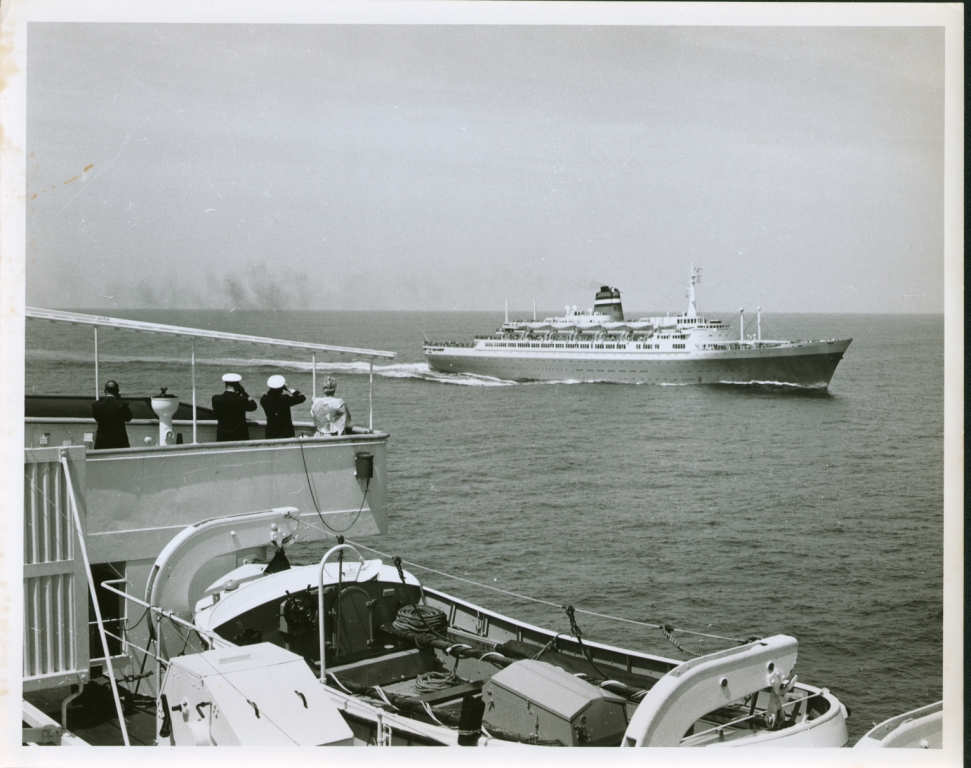
This photo shows the brand new ss Statendam (IV) passing at full speed the ss Nieuw Amsterdam (II) going the opposite way during a North Atlantic crossing. (c)
The ss Statendam had been built especially with cruising in mind, as the company recognized that the North Atlantic passenger trade was heavily challenged by the airplane, and that cruising would be come more and more important. For the Trans Atlantic trade the ship still had a First class of 89 passengers but the Tourist class could handle 800 in an accommodation good enough for a world cruise. And that is exactly what the ship was going to do. Making the first real worldcuise for the company in 1958. (The ss Ryndam (I) had made one in 1926 but that was was a floating university)
Van Herk was deeply involved with the planning and when he was relieved on 27 September 1957 in New York, he spent the next period in the Broadway Office of the company in New York preparing the navigational part of this 1958 World cruise. On 10 December (cruise 11a) he rejoined the ship in New York. (ED: I assume that he had some leave in this period to return home making the voyage as a passenger). Now he remained on board until 10 May 1958 and was relieved in Rotterdam after the ship had arrived on the 7th.
This planning could not have been easy as in November 1956 Egypt closed the Suez Canal as International Forces did not agree with Egypt (President Nasser) nationalizing the canal. Thus apart from not being able to go to through the canal, the whole Mediterannean had to be avoided, including the Holy Land which the New York based passengers most likely would not have appreciated. Hence the strange crossing from Porto Grande to Dakar.
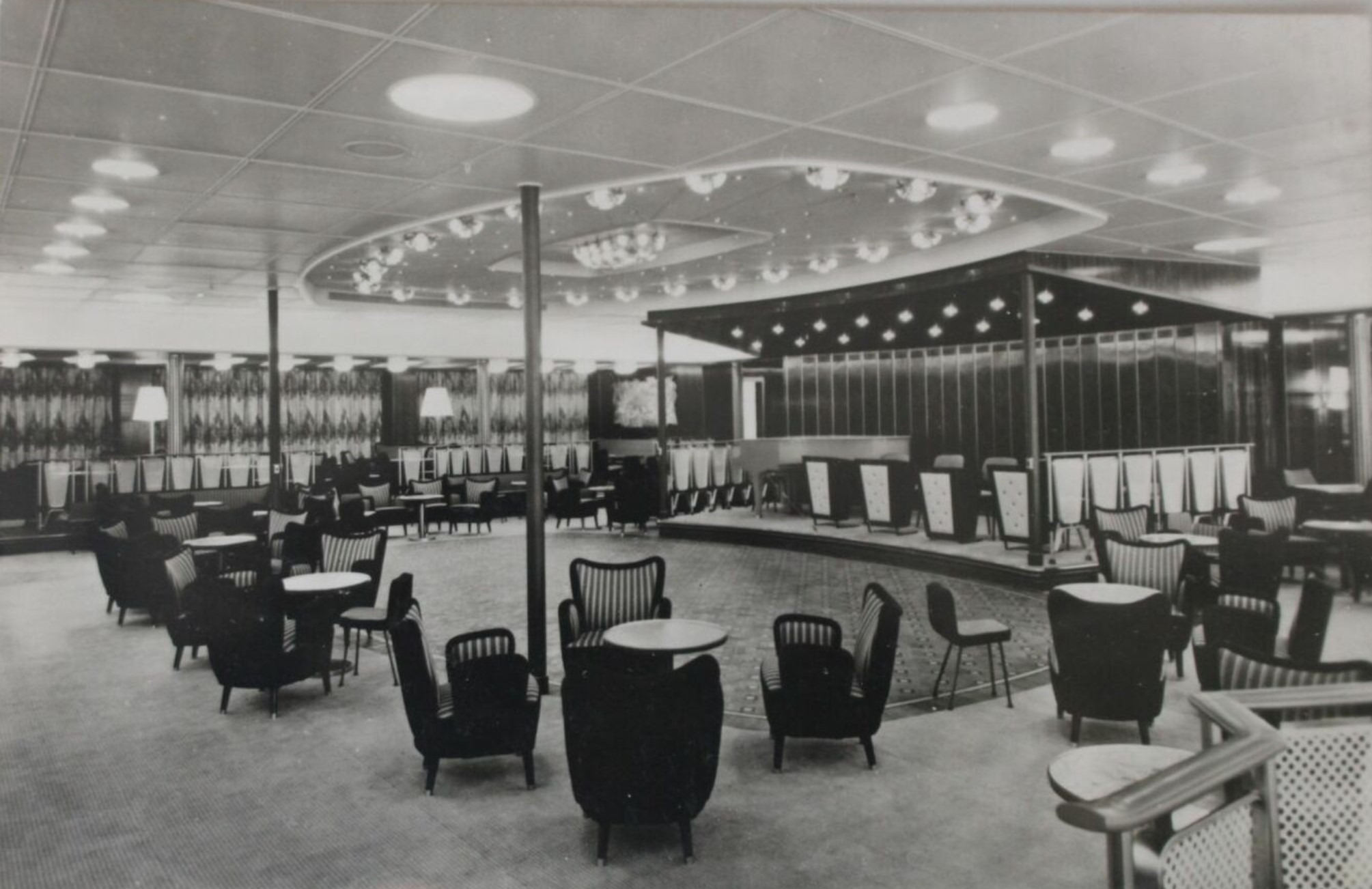
This photo shows the “Cafe de la Paix”, the dance lounge for the Tourist class. The first class only had a small day lounge but had the freedom to go into the Tourist Class at all times. Which many did as it was much more fun. On the first world cruise the ship only operated with one class. (c)
The 1958 world cruise sailed from New York and called at Porto Grande, Dakar, Freetown, Point Nore, Luanda, Walvis Bay, CapeTown, Durban, Zanzibar, Mombasa, Bombay, Colombo, Penang, Singapore, Bangkok, Bali, Manila, Hong Kong, Keelung, Okinawa, Kobe, Yokohama, Honolulu, San Francisco, Acapulco, Panama Canal, Cristobal, New York. From New York it made then a normal corssing back to Rotterdam and Van Herk went on leave after arrival. ( 07 May)
In September 1958, he was again assigned to prepare the 1959 worldcruise for the ship and worked in the chart room (*) of Rottedam office from 14 to 21 November. This world cruise was a close repeat of the one of 1958 as the Suez Canal was still out of operation and so it took much less time to prepare.
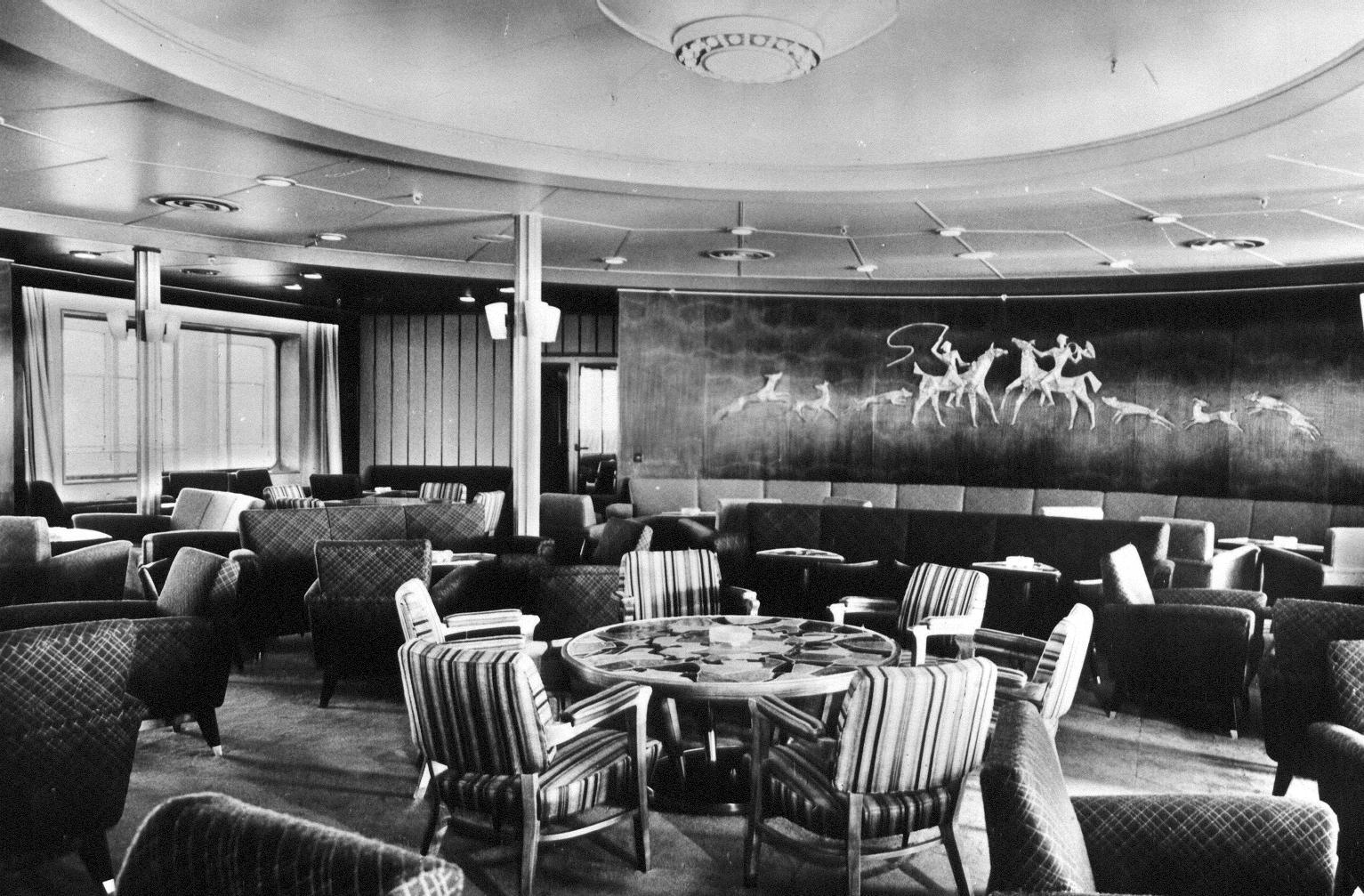
The Tourist Class “Smoking Room” was the other large lounge on board. In 1973 this space was remodeled to become the main show lounge, called “The Queens Room”, when the “Cafe de La Paix” became a Self Service restaurant. (c)
(*) Holland America had in their Rotterdam office, within the Nautical Department, a chart room were several officers would correct and update charts and books for the ships before they went on their next voyage. This had the advantage that the ship was completly ready to sale and avoided the challenge that the 2nd officer had to try and find in each port, the latest paperwork for corrections. Holland America often gave these jobs to officers who were planning to get married, or between school periods, or who were about to become father.
Van Herk did not make this 2nd worldcruise as on 19 February 1959 he was promoted to Captain. Then, as per company senority system, it was back to the cargoships and to work one’s way up again to the senior ships. He was now 36 years old, in general a young age to be promoted to captain, but the fleet was expanding. Also many of the older generation, whose promotion had been on a standstill during the war years, and were thus much older, were retiring.
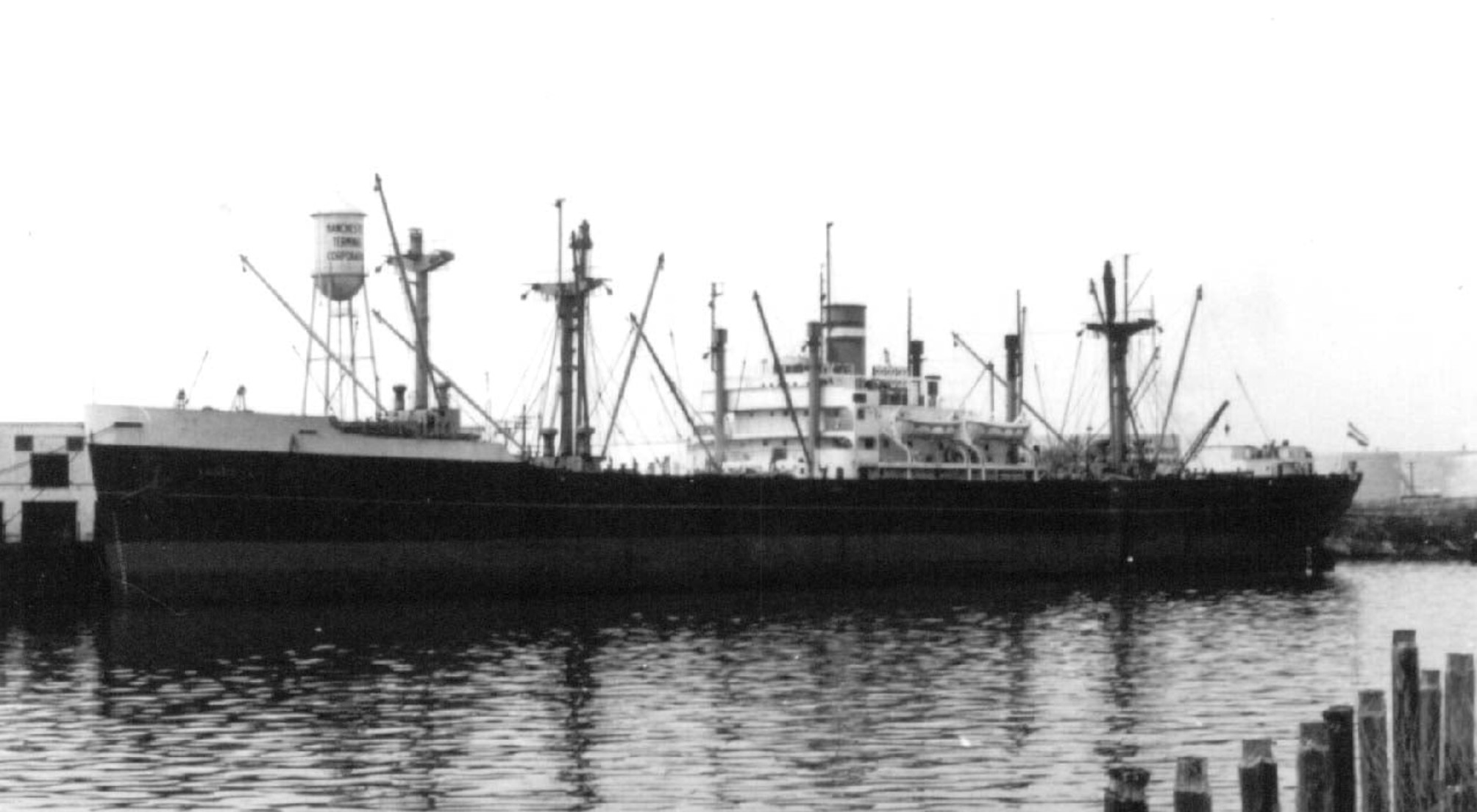
The ss Averdyk somewhere in an American port. (c)
The first ship was the ss Averdyk, one of the 10 A class cargo ships. All these ships were similar but not the same. They had been built at different shipyards and were also configured differently, depending on what they were needed for during the war effort. He made one voyage on this ship (voyage 78 from Rotterdam to Antwerp, New York, Philadelphia, Baltimore and back to Rotterdam)
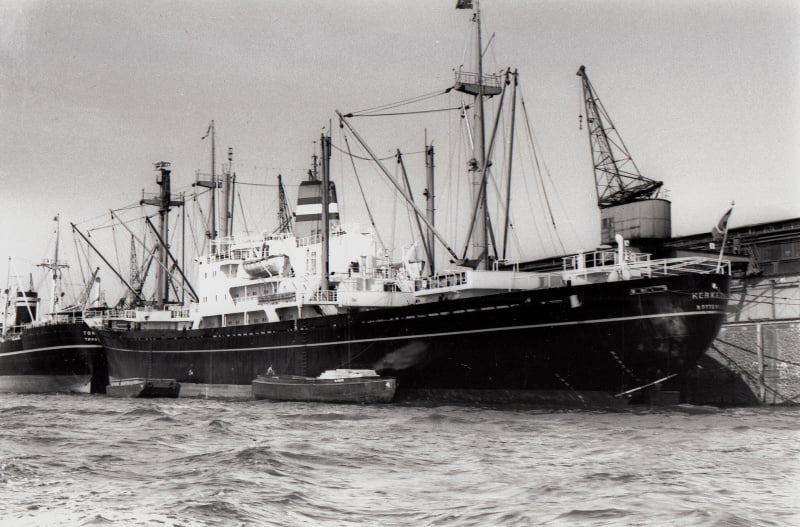
The ms Kerkedyk, seen here docked in Rotterdam with alongside 2 barges to bring or take cargo. (c)
Then for the 2 years he was assigned to the K-class ships (Kerkedyk, Kinderdyk, Korendyk, Kloosterdyk). These ship were built for the company in the Netherlands, for expanding the routes but also to have ships available for when the A class would have to go.
A more unusual but very interesting period for a HAL Officer was being assigned to the VNS. (Vereenigde Nederlandsche Scheepvaart Maatschappij, or United Steam in English). The VNS was a joint venture between several Dutch shipping company’s for a liner service to the Far East and around Africa. The company had been founded in 1921 and Holland America provided (chartered out) ships and crews to augment the VNS fleet when needed. Many HAL officers loved to being sent out on a “VNS charter”, as it went to parts of the world where HAL ships normally did not go to, and also shipboard discipline was a lot looser than on the HAL ships. Chief Officer Van Herk was assigned to the ss Averdyk and remained with her for 18 months. Making 3 month long voyages around Africa.
He remained on the cargoships for the next 2 years (apart from a 1 voyage fill in on the ms Noordam (II)) and was then assigned to the ss Groote Beer.
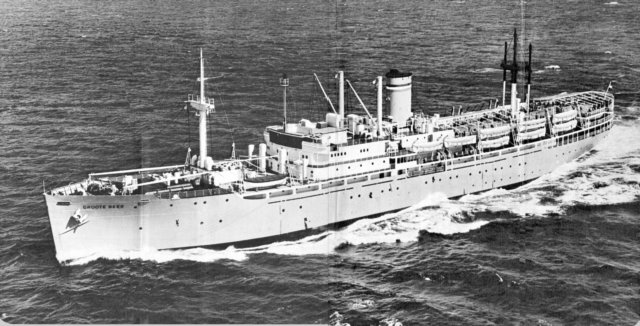
The ss Groote Beer. Bought from the Dutch Government but while in HAL ownership the company logo was never added to the funnel. The small red-white-blue bands (Dutch flag) around the funnel from the Dutch Government days remained. After the ship had been sold to Greece and cahrtered back only only the yellow funnel was kept. (c)
This was a very unusual ship in the HAL fleet as it did not have a “DAM” name and also did not fit in the normal sailing schedules. It first had been used as a troopship for the Dutch Government to the Dutch East Indies, then as an emigrant ship, again for the Dutch Government but with HAL management and was eventually bought by Holland America inJanuary 1961. Still used for the emigrant service to North America and down under but als for student voyages and even a football charter. In 1963 the ship was sold to Greece but chartered back by Holland America for the summer of 1964 and 1965. This was a bareboat charter, which meant that the company provided the officers and crew. The Greeks would deliver the ship to Rotterdam and would pick it up from there again at the end of the season.
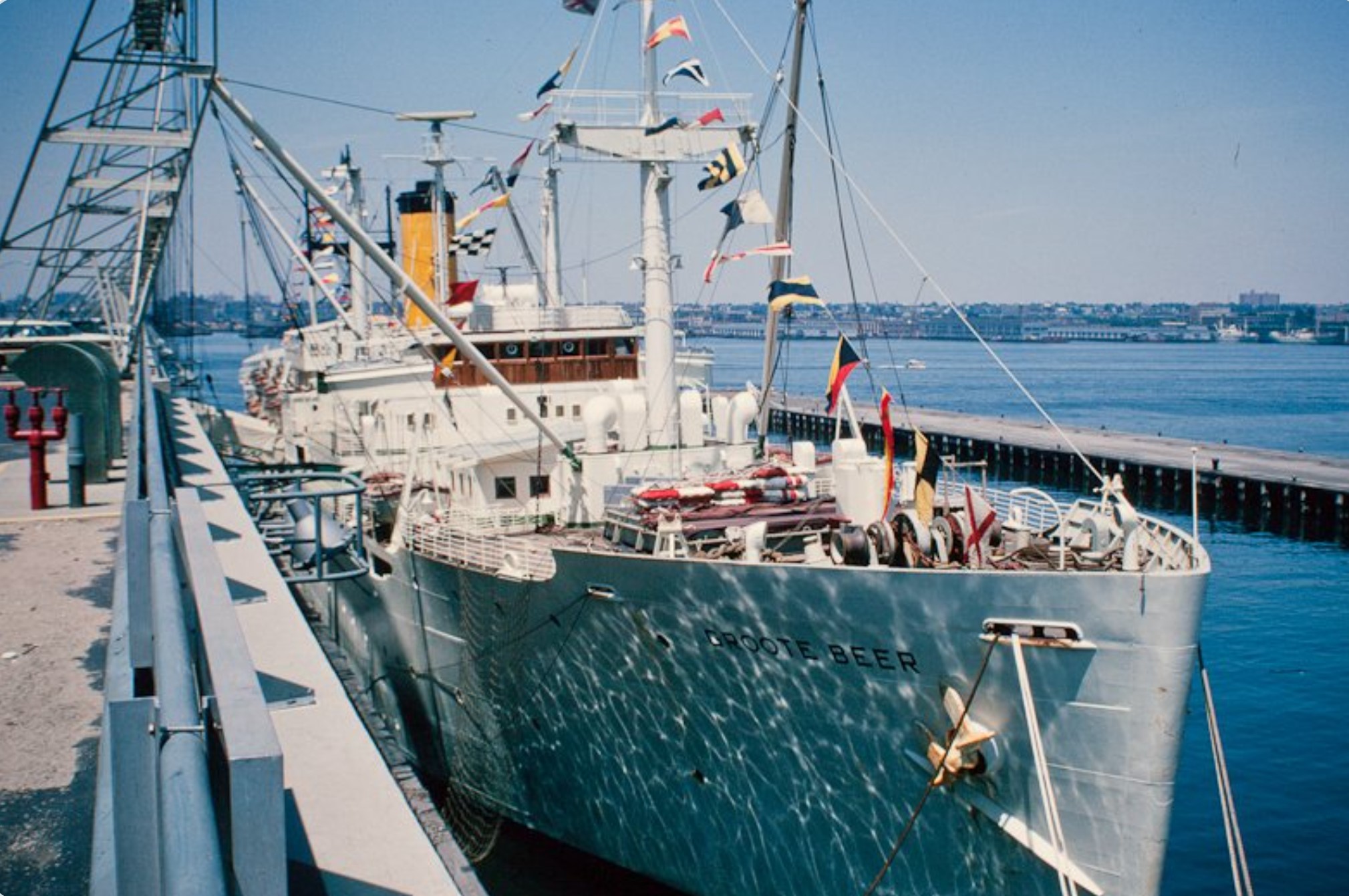
The ss Groote Beer. Seen here in 1964 in New York under the command of Captain Cornelis van Herk. The Dutch Flag bands around the funnel are gone as the ship is now owned by a Greek company and chartered by Holland America (c)
Van Herk joined on 15 June 1964 and remained with her for the full season making 3 week roundtrips with emigrants, students and regular passengers between Rotterdam and New York. This was repeated for the 1965 season but now with full focus on student transport. On 12 September 1965 the ship went back to Greece and Van Herk went home. For 1966 the charter was not renewed as even for students the ship was getting too old. Thus for the time being Captain van Herk had to return to the cargo ships.
In 1963 Holland America had taken over the ms Prinses Margriet of the Oranje Lijn. Holland America had a 50% share in this company and when the passenger service to the Great Lakes faltered, the company put her on the Rotterdam – New York service between 1963 and 1967. Then she was given in charter to the KNSM (Royal Boat) of Amsterdam for a service from New York to the Caribbean. Van Herk joined on 10 June 10 1967 and made three, one month long, voyages on her.
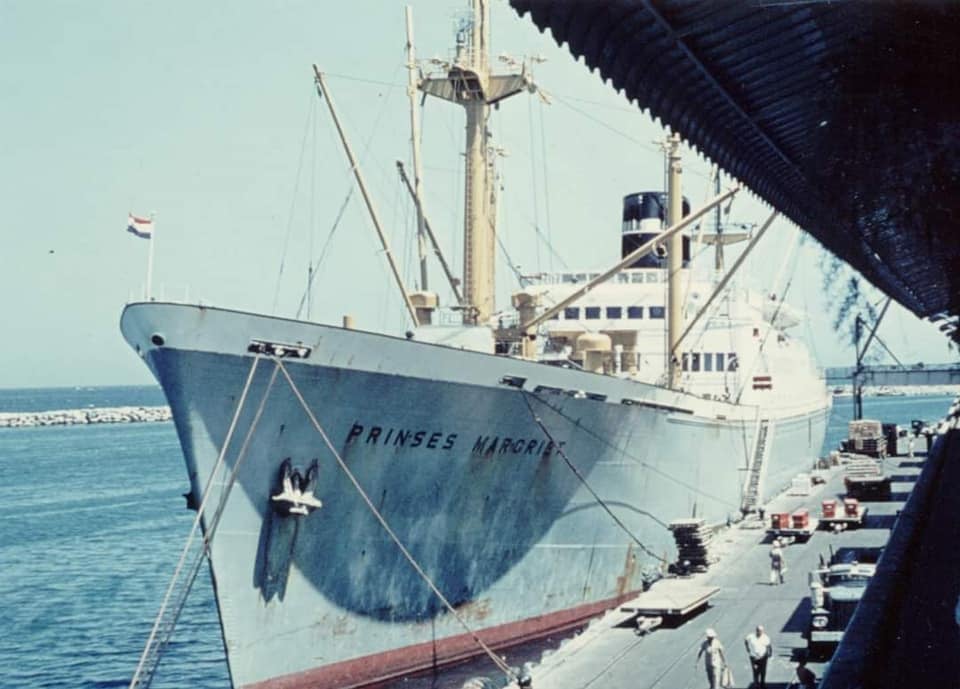
The ms Prinses Margriet, docked somewhere in the Caribbean. (Most likely Oranjestad Aruba). Please note the funnel painted in the black color with white stripes of the KNSM as she was in charter. (c)
Every captain wanted to sail on this ship and thus the company rotated a large number of captains through to keep everybody happy. Being an intimate ship and having close contact with the passengers, it was good fun to sail on her.
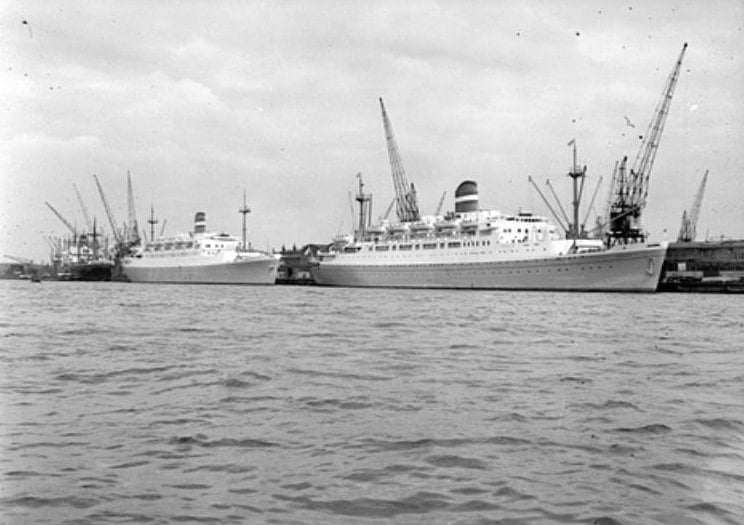
The ss Ryndam and ss Maasdam. The two sisterships together docked at the Wilhelminakade in Rotterdam. (c)
Van Herk then transfered to the ss Ryndam (II). This ship had just returned from a period of sailing for the HAL German subsidiary the Europe Canada Line (ECL)and he took over from the German Captain Hinrich Oltman. Holland America wanted to continue with student voyages and had signed a contract with Chapman College of California to sail around the world as a floating campus in a similar way as it had done with the previous Ryndam in 1926.
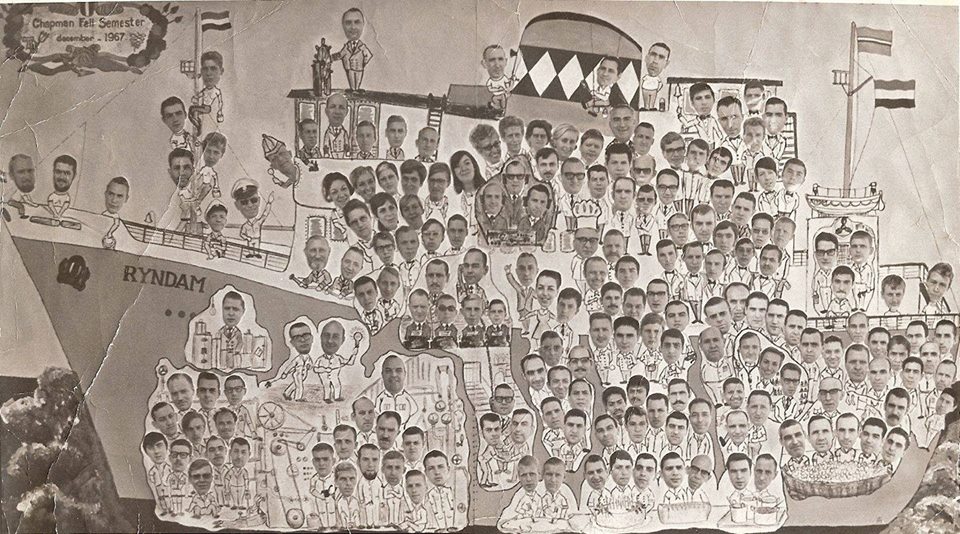
The “crew of the ss Ryndam”. Somebody on board decided to inmortalize those who looked after the students. Please note the funnel colors. Still with the chequered band of the Europe Canada Line. The maker is unfortunately unknown. collection (c) (Note: This creation hung for years in the Hallway of Captain Van Herk’s house in Voorburg and was later donated to the De Lijn – HAL Museum on the ss Rotterdam in Rotterdam.(b)
He made 2 world voyages with the students (400 of them during the first cruise). During the first one, Israel was at war with Eqypt and the Suez Canal was closed and hence the voyage went around South Africa from New York. The cruise ended in Rotterdam on 08 May. To get the students home, a trans atlantic round trip was made (with the westbound part still in Chapman College charter) which included a stay in Tilbury for a visit to London. All the students went home in New York on May 24. Then the ship returned making a regular crossing and is back in Rotterdam on June 4. Captain van Herk went on leave as the company tried one more time to sail with the ship for the ECL from Germany for the summer season but now with a HAL captain in command. It turned out not to be very successful.
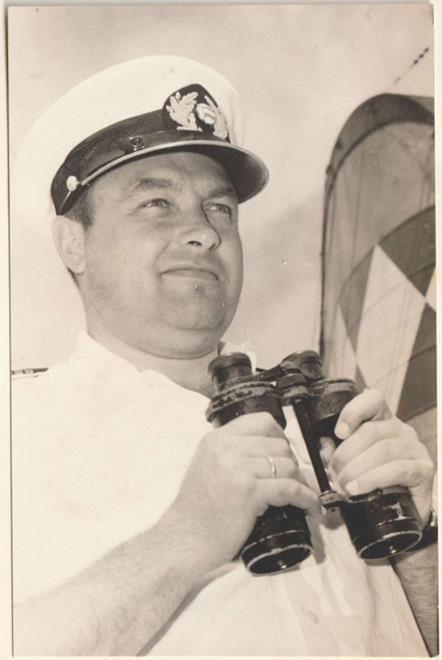
Captain Van Herk on a publicity photo for Chapman
College in 1968
Captain van Herk returned on 29 September 1968 for a 2nd Chapman worldcruise but first made a regular crossing to New York (voyage 09) to collect these students and then commenced the 2nd worldcruise which ended on 29 Jan. 1969 in Los Angeles. Van Herk went on leave as he was scheduled to join the ss Rotterdam on 25 April 1969.
By being scheduled for the flagship meant that he was now rotating with the Sr. captains in the fleet. Hence assignments on the Rotterdam, Statendam and Nieuw Amsterdam occured. The ss Rotterdam (V) being the flagship of the company whad one regular Sr. Captain and other captains were doing the fill ins. Hence the rotation over the fleet.
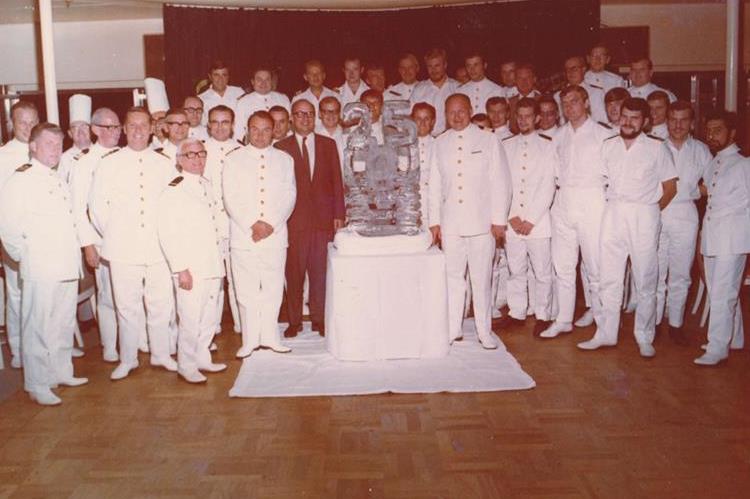
25 years with the Company. It looks that most of the officers of all departments are present in The Ritz Carlton lounge of the ss Nieuw Amsterdam (II)
While assigned to the ss Nieuw Amsterdam (II) in 1970 he celebrated his 25 years of sailing for the company, which was officially on 11 September 1970, but the ship did so after he had returned on the 18th.
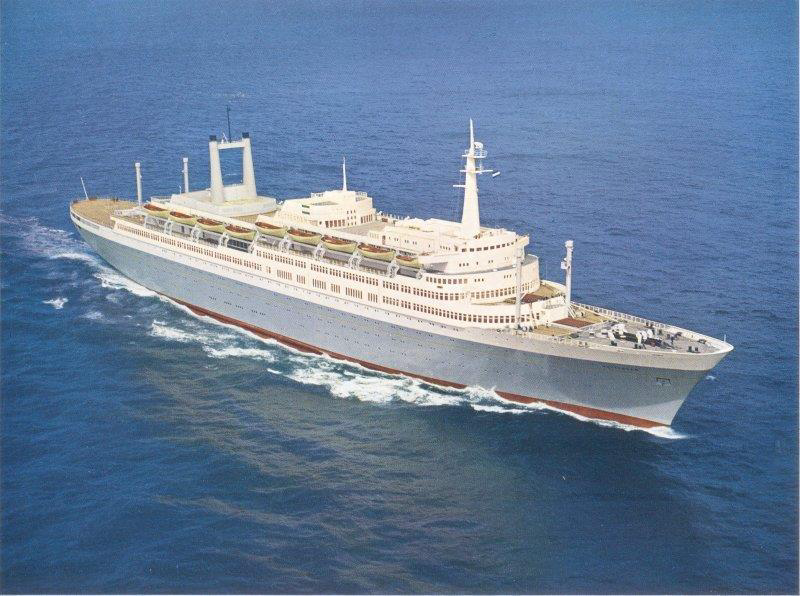
The ss Rotterdam (V) seen here with the grey hull, which she had from 1959 until 1973.
By 1972 he was senior enough to be assigned to the world cruise and made his first one as Master in January 1973 as the most Sr. master Capt. Lagaaij (Jr.) was ill. The latter then made the worldcruises 1974 until 1980 with the exception of 1976.
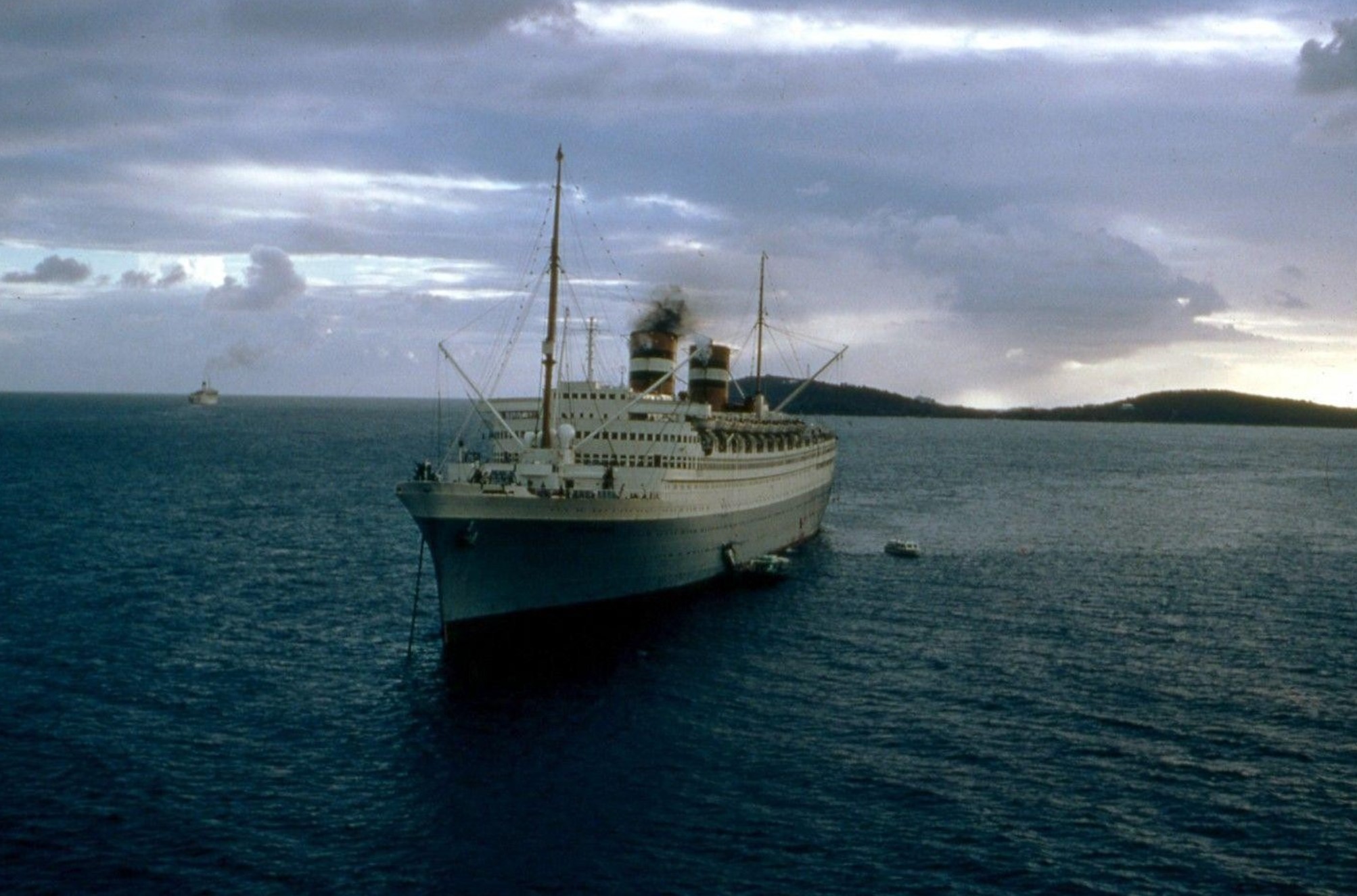
This photo shows the Nieuw Amsterdam (II) at anchor of Morning Star Beach, St. Thomas. From here it was a long distance to the town of Charlotte Amalie with the ships tenders. (c)
Before and after this Rotterdam worldcruise he had sailing periods on the old Nieuw Amsterdam of 1938. Still a beautiful ship but now mainly used on cruises from Port Everglades to the East Caribbean. She had a loyal following but had to anchor everywhere due to her deep draft. Captain Van Herk saw her for the last time on 09 july 1973 when he went on leave as by January 1974, she had sailed for Taiwan to be scrapped.
Then it was back to the ss Rotterdam on 1 September 1973 for one 7 day cruise to Nassau in the Bahamas and then a crossing to Lisbon for a dry dock. During this drydock the hull went from “dove grey” to “Caribbean blue” and for this she had to be stripped completely of her hull paint.
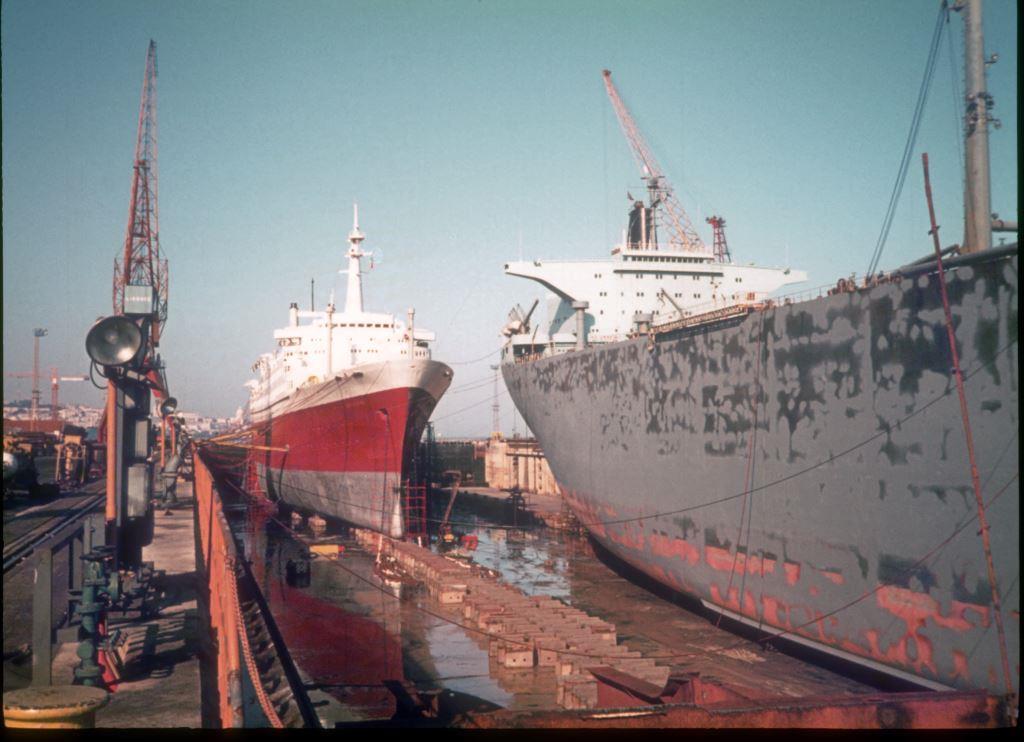
The ss Rotterdam without her outer paint color. As a credit to her builders the red under coating was still in perfect condition. (c)
The ship dry-docked at the Lisnave yard in Lisbon who had a dry dock that was large enough to handle two very large ships. Hence in the front (see photo above) was also a large tanker the Mobile Pegasus. Total disaster almost struck on Sunday morning 30 Sep.1973 at 07.00 hrs. A part of the dock wall near the tanker had collapsed and the dock was filling up. Problem was that many of the under water openings of the Rotterdam (drain plugs of the tanks and sea water inlet chests) were open for cleaning. Inside the ship some of the man hole covers on top of these tanks were also open. The dock master had decided to raise the water in the dock by 2 meters to reduce the pressure of water of the river Tagus on the breached wall somewhat so the ingress of water would be less. That menat that every opening into the ship (man hole covers etc) had to be closed at once. The engineers, with help of the shipyard managed to complete this by 09.30 hrs. and thus averted a major disaster. There would have been a grave chance that the Rotterdam would have listed / toppled over to one side and that would have caused major damage. By 21.00 hrs. in the evening, the crises in the dry dock had been overcome and it was decided that the docking would continue as planned.
ED: this is for a captain the most disastrous situation you can be in as there is nothing you can do. One is totally in the hands of the dry dock people. You can not order the ship to move and you can not lower lifeboats (they most likely have been removed for repairs anyway). Even with a fire, the captains powers are limited as most of the time the shoreside firebrigade gets involved / takes over and they do not take/recognize/understand orders of the Master of the Vessel. Hence Captain van Herk must have had a few very uncomfortable hours.
Then the ship sailed back to New York to continue cruises to Nassau and Hamilton. He stayed with the ss Rotterdam until the 10th of August 1974. In the early 70’s Holland America made a large number of Jazz and Theatre cruises with very wellknown names on board. The ship sailed from New York and many stars did not mind it at all, to have a nice cruise, perform and getting paid for it as well.
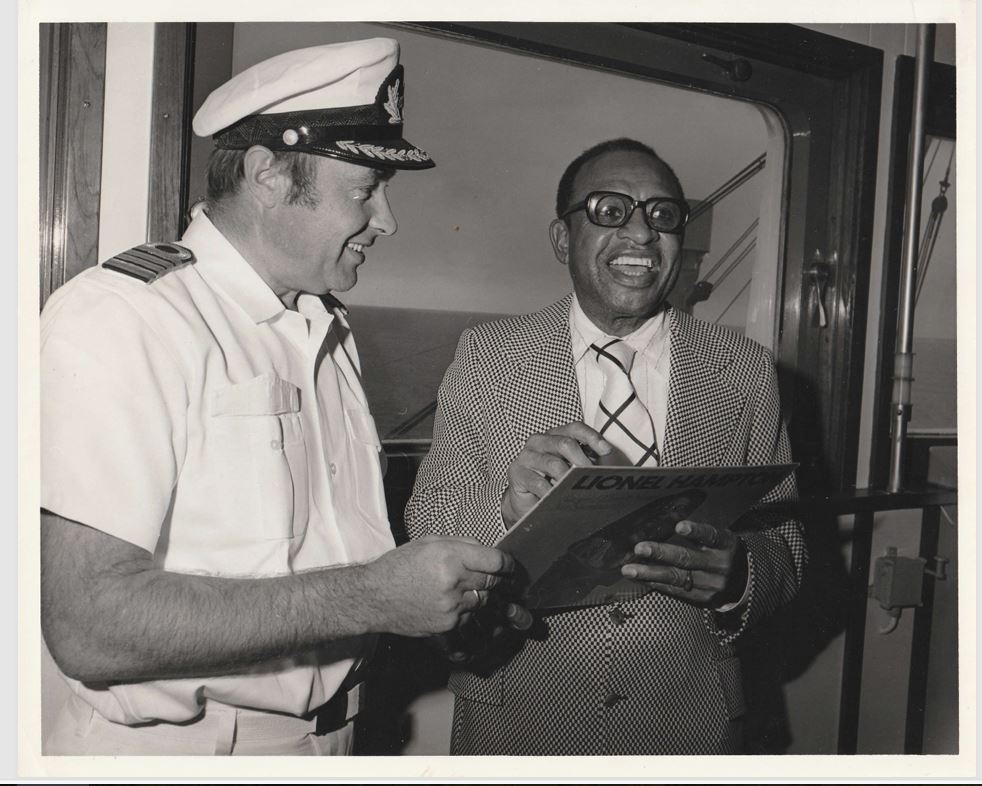
Captain van Herk on the bridge of the ss Rotterdam (V) with Jazz giant Lionel Hampton.
The foto show Lionel Hampton but Count Basy, Louis Armstrong, Sarah Vaugh and Joe Willams also appeared on board in those days.
Then he was suddenly was assigned for 3 weeks to the ms Atlantic Star.
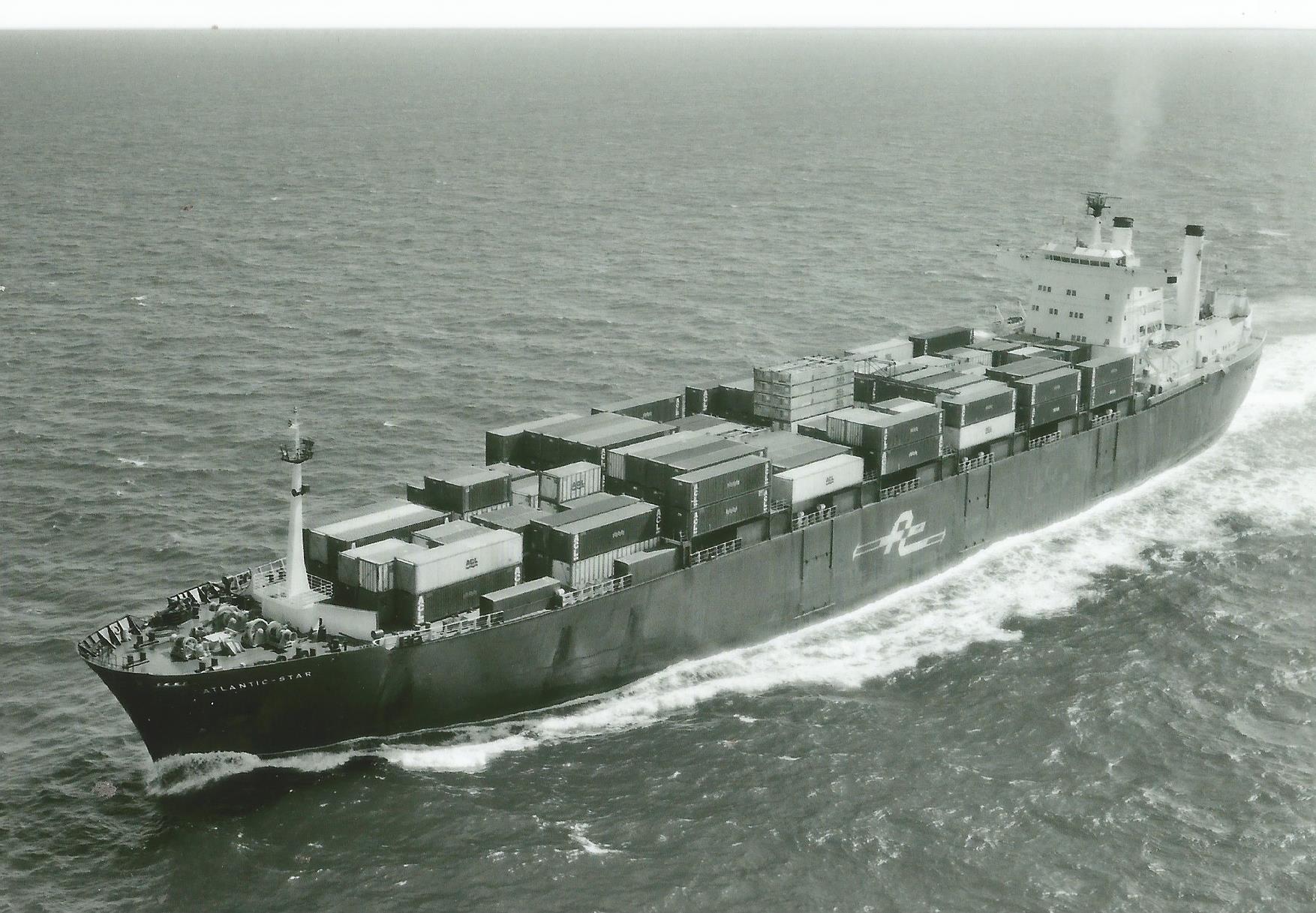
The ms Atlantic Star, a ro-ro container vessel of the HAL in ACL charter,
This was a 1st generation Container -Ro-Ro vessel (there was a large garage for cars and trucks under the accommodation with a roll-on-roll-off ramp at the stern) on a service between Bremerhaven and Portsmouth in the New York area. Capt. van Herk made one voyage with the ship. On 1 January 1975 Holland America transferred all its cargo ships to the Swedish (Bostrom) subsidiary Intercontinental (Incotrans) of Rotterdam. The company had given everybody the option to choose between the cargo side or the passenger side and Van Herk choose to remain with the passenger side and cruising.
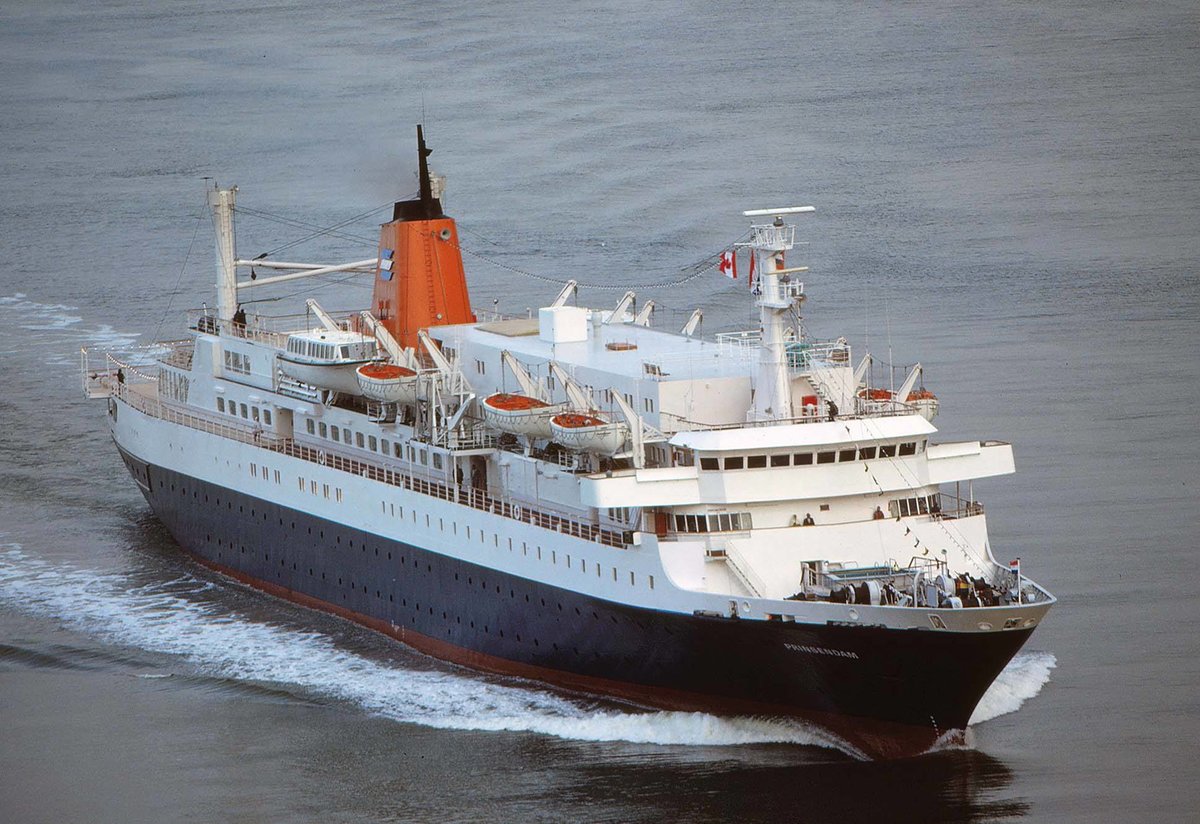
The ms Prinsendam (I). She sailed for Holland America between 1973 and 1980. Then an on board fire brought an untimely end.
That decision brought him on 11 September 1975 on board the ms Prinsendam (I). A small purpose built cruise ship (8600 tons, 450 pax) which HAL had built in 1973 to see if the company could be succesfull in the cruise business. It had been sailing in Indonesian waters since 1973 but had been brought to Alaska for the first time for the summer of 1975. Captain van Herk had been instrumental in this decision some years earlier when he had made a fact finding cruise on board the ms Weststar, a small cruiseship owned by the company’s partner the West Line / Westours.
He made the last cruise of the Alaska season with her and then went on the crossing to Indonesia via Dutch Harbor and Japan, ending up in dry dock in Singapore. After dry dock, 2 cruises were made in Indonesian waters (Singapore, Penang, Belawan, Sibolga, Nias, Djakarta, Bali, Surabaya, Djakarta, Singapore) and he went on leave on 08 December until January 1976. Scheduled to join the ss Rotterdam for the 1976 world cruise.
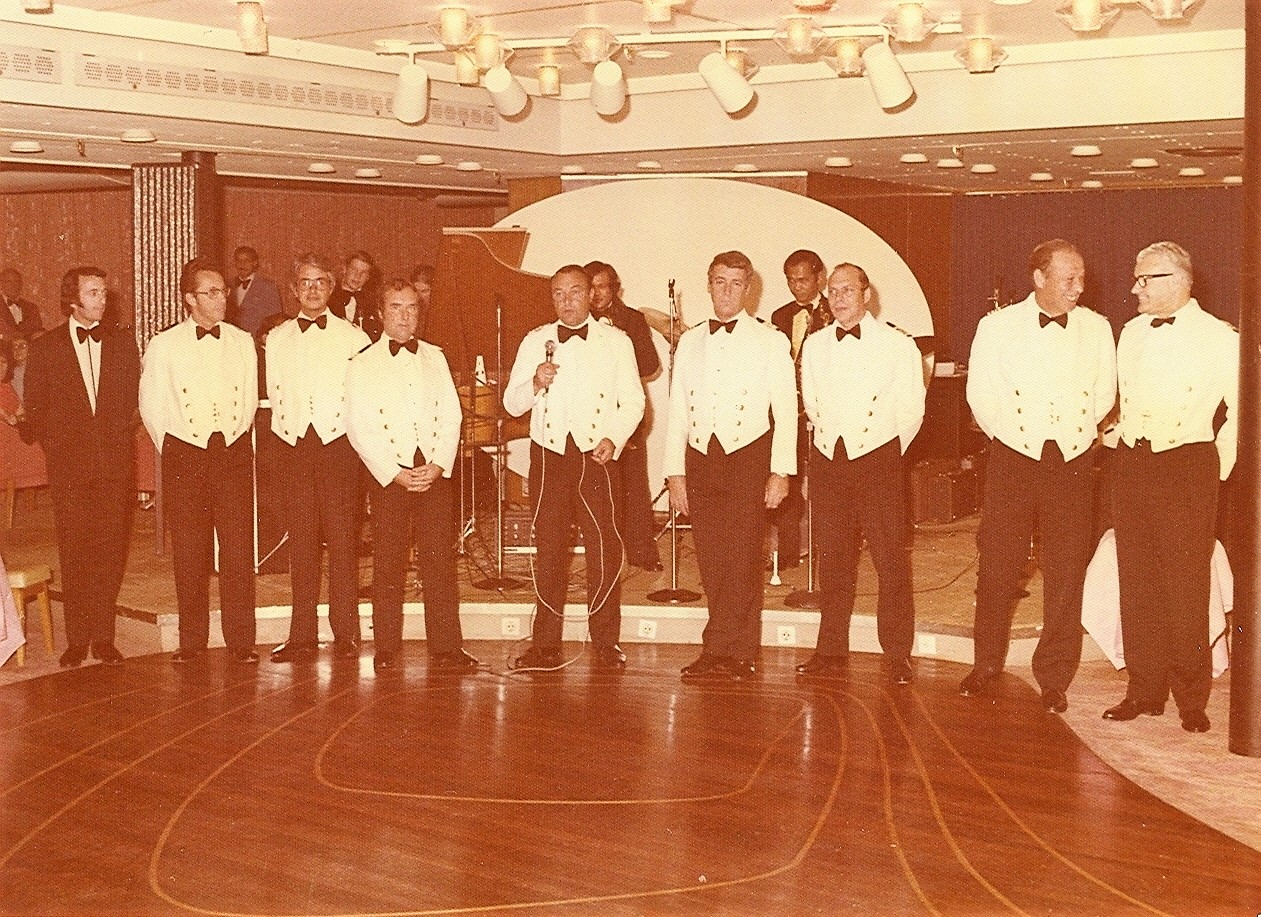
The introduction of the ships staff by Captain van Herk. It is claimed that this photo is from Worldcruise 1976. (ED: I have no confirmation of this)
The 1976 wordcruise (voyage 297), was one that went “the wrong way around”, e.g. instead of following the sun and gaining an extra hour every few days, it went Eastbound, losing hours but gaining a day. The 1976 worldcruise would go down in HAL history as the one with the “Hassan Freak Wave” or ” the big roll” at Casablanca. Voyage 297 began on 20 January 1976 with sailing from New York to Port Everglades (embarking more guests) and then straight accross the North Atlantic to Casablanca. Here the ship arrived close to sunrise (Casablanca pilots in those days did not sail ships into port during the night hours, only when going out…. and then they made sure they left inside the breakwater) So the Rotterdam was slowly steaming in front of the harbour waiting for the pilot. At 06.00 she was hit by a single large wave on the starboard stern which caused the ship to list considerably to port and then to roll back again. Captain Van Herk brought the ship around with the nose into the waves and decided, due to the increasing wind, to cancel the call and sail to the next scheduled port Villefranche were the ship arrived on 02 February 1976. There were in total 192 wounded but none of them very serious apart from one broken leg. Luckily the vast majority of the mainly older clientele was still in bed. (e)
The “Note of Protest” made by the captain indicated that apart from this one rogue wave no other high waves were observed. Local Authorities advised that as it was only one wave, it was most likely caused by an under water earthquake or landside, which was quite common. The presence of a sandbar in front of the port did not help as it pushed the wave even higher. This explanation was accepted by Holland America and the Insurance company. The total cost of the accident was in the region of $ 10,000 of direct damage on board. (In nowadays money: $ 76,000, but most likely much more as labor costs are now so much higher). The costs made by shoreside are unknown but they flew 295 chairs ( 320 had gone overboard) out by KLM plane from Rotterdam to Athens/Pireaus.
E.D note: When I sailed on the Rotterdam in 1986, I discussed with the purser Mr. Lahuis, how much the ship could have rolled as a type writer on a desk in the Front Office (located on Main deck half way down the ship, slid of the desk at the far side). So we re-an-acted this sliding off and the type writer (still on board) starting to slide when the desk went over an angle of 37o and gathered momentum when increasing to 42o. The ss Rotterdam had a “stability angle safety” of 35o at all times but most of the time more, depending the amount of fuel and ballast in the tanks. So it is understandable that the ship came back to even keel quite quickly.
The rest of the cruise was un-eventful and the ship was back in New York on 16 April 1976. Captain van Herk then made another 5 New York Nassau and Bermuda cruises before going on a long leave which lasted until October.
On 2 October he rejoined the Rotterdam in New York for a series of cruises to Nassau and Hamilton and later to the Caribbean. But after departure from New York he fell ill and was medically disembarked midcruise. Chief Dirk Posthumus took over command of the ship and remained with until the end of the year.
The illness of Capt. van Herk turned out to be much more severe that initially thought and he was forced to take early retirement at the age of 54 years old.
Captain van Herk had a great interest in the history of the Holland America Line and for a number of years would describe the history of one of the ships in every issue of the company magazine “Samenspel” which then had a center spread with the photo of the ship discussed. Then in 1981 he published a small book (part of the “Erato Series” by a bookshop in Haarlem) “De Schepen der HAL” in Dutch. As nothing had been published about the company since 1973, this filled a nice gap as it had a complete Fleet List with details.
Captain Cornelis van Herk passed away on 04 November 1995 and was buried in his home towen on the Oosterbegraafplaats in Voorburg.
Final photo:
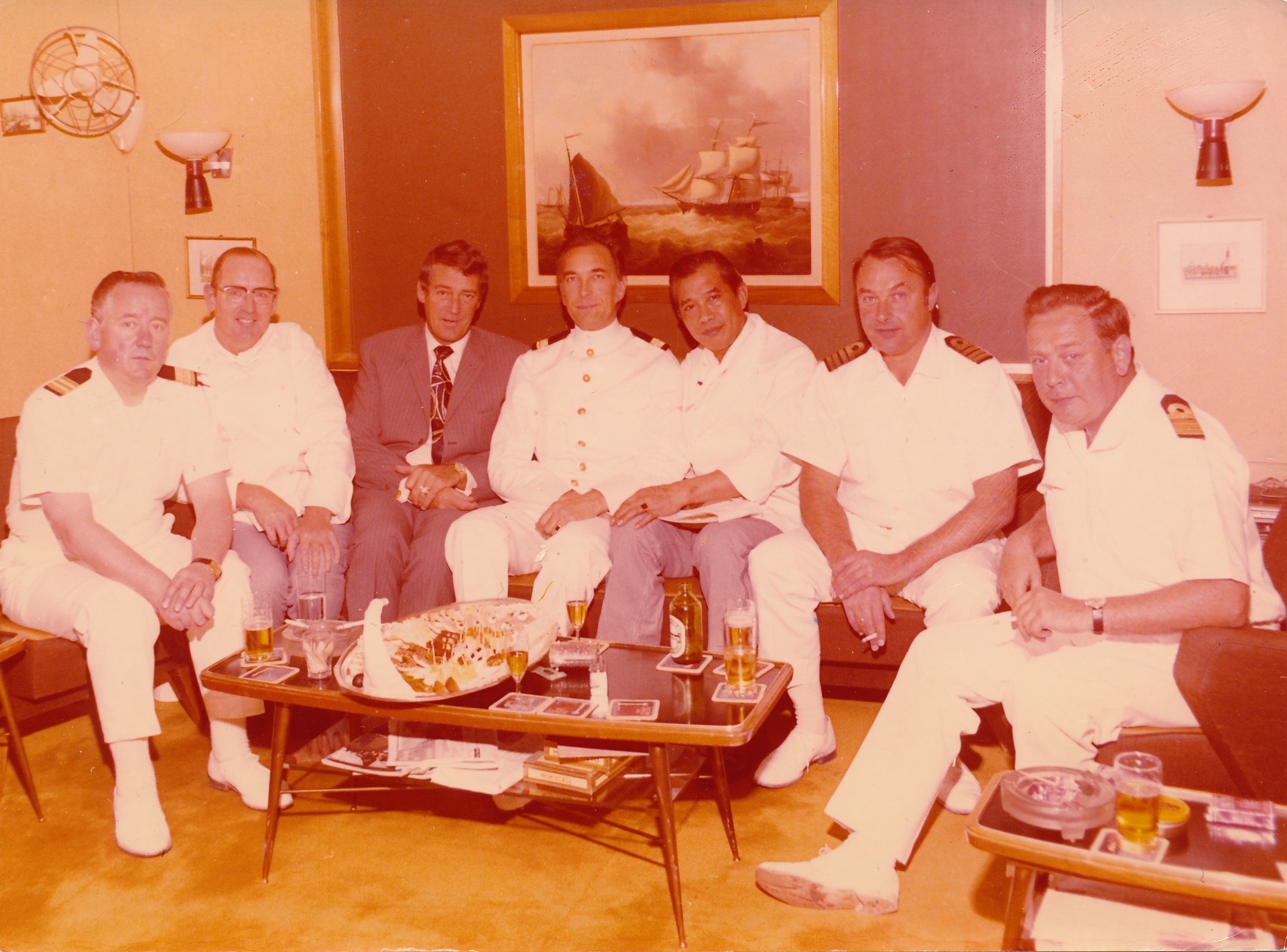
This is most likely one of the last photos of Captain Cornelis van Herk on board as the Chief officer (At the right in the photo) took over from him later. This is the captains cabin on the ss Rotterdam (V). From left to right: Food manager Bill de Vis, Exe chef ???., Hotelmanager G. Adriaanse, Dining room manager ??, Unknown Cook, Captain Van Herk, Chief Officer Dirk Posthumus. The occasion is most likely a special milestone in career of the unknown cook sitting next to the captain. (c)
ED: I am still tracing the captains career from after 1937, but as his sailing list is with the HAL pension fund and they do not give access to historians, there are still a few small GAPS.
Sofar the following has been identified:
Sailing List: (b,c)
Date: Function Ship Remarks
15 Sep.1945 Cadet Officer Volendam Until xx May 1946
05 Jun. 1946 Cadet Officer Westerdam Until 04 Oct. 1946
04 Oct.1946 Goes to school for 3rd mates license, passed on 17 Feb. 1947.
21 Feb. 1947 4th. Officer Veendam Until 10 Feb. 1946
03 Mar.1948 4th. Officer Aalsdyk Until 08 Sep. 1948
18 Sep. 1948 4th. Officer Arkeldyk Until 26 Dec. 1948
18 Jan. 1949 3rd. Officer Axeldyk Until 18 Aug. 1949
16 Aug. 1949 Goes to school for 2nd. Mates license on 13 Sept. 1949 at the Maritime School at Scheveningen. Passed his exam on 23 December 1949, followed by a Radar Course from 27 December to 07 January 1950.
13 Jan. 1950 3rd. Officer Leerdam Until 27 Jan. 1950
Transfer to Arendsdyk in Philadelphia.
30 Jan.1950 3rd. Officer Arendsdyk Until 04 Jan. 1951
13 Feb. 1951 3rd. Officer Volendam Until 03 Apr. 1951
26 Apr.1951 2nd. Officer Duivendyk Until 06 May 1951
02 Jun. 1951 2nd. Officer Westerdam Until 14 Jan. 1952
14 Jan. 1952 2nd. Officer Nieuw Amsterdam Until 05 Mar.1952
07 Mar.1952 2nd. Officer Rijndam Until 12 Apr.1952
16 Apr. 1952 2nd. Officer Nieuw Amsterdam Until 20 aug.1952
18 Jul. 1952 Promoted to First Mate /First Officer / Chief Officer.
22 Aug. 1952 goes back to school for 1st mates exam. (In the Netherlands this also qualifies to serve as captain) Passed his exam on 27 May. 1953.
03 Jun. 1953 Chief Officer Nieuw Amsterdam Until 16 Jul. 1953
(11 July arrival Rotterdam)
(Voyage 160 & 161, as fill in for the regular Chief Officer)
21 Jul. 1953 Chief Officer Appingedyk Until 01 Mar. 1954
28 Mar.1954 Chief Officer Aardyk Until 04 Jul. 1954
15 Jul.1954 Chief Officer Arendsdyk Until 05 nov. 1954.
Travelled on 30 November with the ss Ryndam (II) as passenger to New York to join Axeldijk, departing on 10 December.
10 Dec. 1954 Chief Officer Axeldyk Until 07 Nov. 1955
Transfer in New York for voyage back to Rotterdam.
10 Nov.1955 Chief Officer Arendsdyk Until 30 Nov. 1955
10 Feb. 1956 Chief Officer Almdyk Until 08 Dec.1956
Two month voyages with most likely some coastal voyages off.
30 Mar.1957 Chief Officer Maasdam Until 20 Apr. 1957 (voyage. 46)
07 May.1957 Chief Officer Statendam Until 27 Sep.1957
Until 07 Dec. 1957 Employed ashore in the “Chart room” of the Holland America Office in Rotterdam to prepare the Statendam worldcruise of 1958.
Flew 06 Dec. 1957 with the KLM to New York to join Statendam.
11 Dec.1957 Chief Officer Statendam Until May 1958
20 Jun.1958 Chief Officer Statendam Until 29 Jul.1958
Until 27 Sep.1958 (Most likely on leave in May/June 1958)
On leave from 30 Sept. onwards and then from 14 Nov. to 21 Nov. employed ashore in the “Chart Room” of the Holland America Office in Rotterdam to prepare the 1959 worldcruise of the ss Statendam.
19 Feb.1959 Promoted to Captain
22 Feb. 1959 Captain Averdyk Until 03 May 1959
09 May 1959 Captain Kerkedyk Until 08 Jun.1960
10 Jun. 1960 Captain Kinderdyk Until 02 Aug.1960
coastal voyage vacation 05 Aug. – 17 Aug. 1960
20 Aug.1960 Captain Kinderdyk Until 12 Oct.1960
Goes home by train from Hamburg on 17 October. Then Navigation Course (most likely Sperry Gyro & Radar updates)
29 Oct.1960 Captain On leave until until 30 Nov. 1960
GAP. Most likely on leave.
15 Jan.1961 Captain Korendyk Until 25 Jul.1961
27Jul. 1961 Captain On leave Until 08 Sep.1961
10 Sep.1961 Captain Kinderdyk Until 18 Sep.1961
Fill in on a coastal voyage. Captain Jonkers on vacation.
22 Sep. 1961 Captain Alblasserdyk Until 01 Oct.1961
Fill in on a coastal voyage. Captain Diehl on vacation.
14 Oct.1961 Captain Noordam Until 06 Nov. 1961
Fill in regular voyage. Captain Reedijk on vacation.
03 Dec.1961 Captain Kamperdyk Until 08 Dec. 1961
Fill in on a coastal voyage Captain Elst on vacation.
16 Dec.1961 Captain Kloosterdyk Until 23 Dec.1961
Fille in on a coastal voyage takes of from Captain Lunenburg who is suddenly relieved in Bremen on 16 Dec.
11 Jan.1962 Captain Averdyk Until 06 Sep.1962
HAL voyage 90 &91/ charter for VNS voyage 07 & 08
25 Sep.1962 Captain Averdyk Until 29 Dec.1962
HAL voyage 92 / charter for VNS voyage 09
01 Feb.1963 Captain Averdyk Until 06 Jun.1963
HAL voyage 93 / charter for VNS voyage 10
Then on long leave and from 07 Oct. to 12 Oct. familiarisation course in Noordwijk. (Purpose unknown)
25 Oct.1963 Captain Gorredyk Until 05 Mar. 1964
10 May. 1964 Captain Alblasserdyk Until 16 May.1964
Coastal voyage 77A, stand in for Captain Reedyk (not officially scheduled)
15 Jun.1964 Captain Groote Beer Until 12 Sep. 1964
Ship officially sold to Greece but back in charter for summer 1964 with Dutch captain. Then on leave.
11 Oct.1964 Captain Grebbedyk Until 27 Apr.1965
13 Jun.1965 Captain Groote Beer Until 11 Sep.1965
Capt. van Herk on board as liason officer as Groote Beer was now under greek flag with greek captain.
28 Sep.1965 Captain Kinderdyk Until 28 Mar.1966
Left ship as it went for a 1 month into dry dock. Long survey
Long leave until 13 September 1966
15 Sep.1966 Captain Grotedyk Until 22 Dec.1966
13 Jan. 1967 Captain Gorredyk Until 23 Feb. 1967
29 May 1967 Captain Training course Containership Operation until 09 June 1967
10 Jun.1967 Captain Prinses Margriet Until 28 Aug.1967 The ship started that day sailing in charter for the KNSM (Royal Boat)
28 Sep. 1967 Captain Ryndam Until 04 Jun.1968
Took ship over from ECL (Sale/Charter) on 28 September in Rotterdam. Student voyages with Chapman College. Two world cruises, 28 Sep. 1967 to 04 Jun 1968
05 Sep. 1967 Captain On leave Until 28 Sep. 1968
29 Sep.1968 Captain Ryndam Until 29 Jan. 1969
25 Apr.1969 Captain Rotterdam Until 01 Aug. 1969
On Leave. 02 Aug. Flew home with HAL charter (large crew change)
15 Sep.1969 Captain Statendam Until 07 Feb. 1970
Relieved for vacation in Los Angeles after Trans Canal voyage.
08 Feb.1970 Captain On leave Until 24 Apr. 1970
24 Apr. 1970 Captain Nieuw Amsterdam Until 04 Jun.1970
18 Sep. 1970 Captain Nieuw Amsterdam Until 06 Nov.1970
07 Nov.1970 Captain On Leave Until 06 Dec.1970
12 Dec.1970 Captain Rotterdam Until 21 Jan. 1971
03 Feb.1971 Captain Nieuw Amsterdam Until 26 Apr.1971
05 Jun.1971 Captain Rotterdam Until 30 Jul. 1971
September 1971 fact finding voyage along Alaskan coast. Sailed with the ms Weststar of Westours. This eventually paved the way for the deployment of the ms Prinsendam (I) to Alaska and HAL taking a stake in Westours.
06 Oct.1971 Captain Rotterdam Until 08 Dec.1971
While on board voyage 151 ( 22 Oct. – 29 Oct.) was cancelled and ship remained in New York as the new Indonesian crew was on strike.
16 Apr. 1972 Captain Rotterdam Until 07 Jul.1972
08 Jul.1972 Captain Flew home with KLM. on leave until 18 July. Then with KLM to New York and Port Everglades to join Nieuw Amsterdam on the 28th.
Takes command on 31 July in Oranjestad Aruba.
28 Jul.1972 Captain Nieuw Amsterdam Until 06 Sep.1972
04 Nov. 1972 Captain Atlantic Crown Until 21 Nov. 1972
Sailed the ship from Southampton to Le Havre, partial roundtrip.
12 Dec.1972 Captain Rotterdam Until 16 Apr. 1973
Including “Grand Anniversary Worldcruise”.
18 May 1973 Captain Nieuw Amsterdam Until 09 Jul. 1973
01 Sep.1973 Captain Rotterdam Until 01 Dec. 1973 Including Lisbon drydock.
12 Jan. 1974 Captain Rotterdam Until 01 Jun. 1974
10 Aug. 1974 Captain Atlantic Star Until 04 Sep. 1974
28 Sep.1974 Captain Rotterdam Until 16 Jan. 1975
03 Mar.1975 Captain Statendam Until 12 Jul.1975
11 Sep.1975 Captain Prinsendam Until 07 Dec.1975
Flew on 06 Sep. from Hamburg to Anchorage to Cordova to the Yakutat and Juneau. Familiarisation trip visiting Skagway, Glacier Bay, Ketchikan, Prince Rupert, Alert Bay, and Vancouver
20 Jan. 1976 Captain Rotterdam Until15 May.1976
a long leave until to October.
02 Oct. 1976 Captain Rotterdam Until 04 /06 Oct. 1976
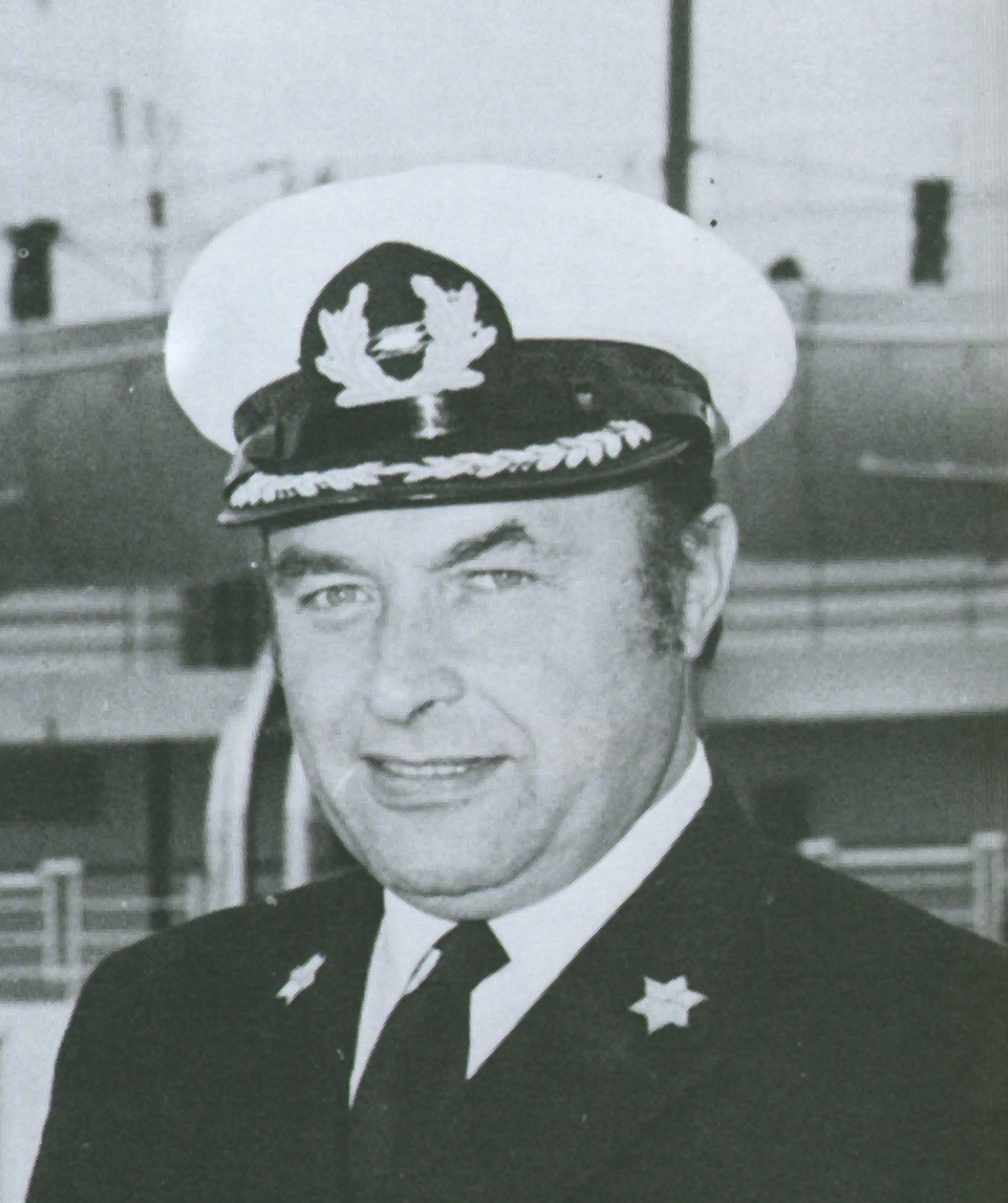
Captain Cornelis van Herk on a company photo near the end of his career. (c)
On arrival Nassau, Bahama’s or Hamilton Bermuda (TBC), he was disembarked due to medical reasons.
Sources:
(a) Family information Wie is Wie Website.
(b) Son of Captain van Herk, Kees Jan van Herk, with many thanks as he provided stories, photos and sailing dates out of his fathers personal papers.
(c) Capain Albert Archive and photo collection.
(d) Comportementen Boek Kweekschool voor de Zeevaart.
(e) Memoirs of Security Offier Mr. Cor Meijer, “achter de blinde kleppen van de Loveboat”
Last updated: 07 Feb. 2026
February 18, 2014 at 12:43 pm
I was crew member of the SS Rotterdam from 1973 thru 1980,as a Bar Lounge and Deck Steward, and perform as a Captain steward to serve Captain Van Herk.C on the world cruise 1976. the ship got hit by big foot wave before entering casablanca,and we continue sail for nice ,Franc. I have that memory with me still.
January 26, 2023 at 9:16 am
Thank you for the story. That’s my grandpa!
November 3, 2025 at 7:17 pm
Captain van Herk was my father and his father was Jozias van Herk also a HAL captain. The funny thing is that Captain JH Dijke’s daughter lives next to me and her uncle Jacob was also a HAL captain. Captain A van Dijk, Captain van Deventer and Captain van de Graaf used to live nearby in Voorburg too. I also have very fond memories of John Diehl and his wife Renee who visited my parents a lot and were close friends. John was a true gentleman and he also sailed as a junior officer with my grandfather Jozias. But I also remember Captain Wabeke a close fiend of my father and Captain Hoogervorst, Captain Haagmans, Captain Heymans, Captain van Driel, Captain Postumus, Captain Hoenderdos and Captain Grippeling who on a regular base visited my dad, reminiscing of old. I heard so many great stories as a kid listening to them, these seafairing people were in a class of their own.
I often heard them memorizing stories in which appeared a lot of the other names on your list as well.
But your research about our granddad Jozias is in some respects new. Thank you for this story.