- Captain Albert's Website and Blog -

Ocean Liner History and Stories from the Sea, Past and Present. With an In Depth focus on Holland America Line

Month: April 2018 (page 3 of 3)

10 April 2018: At Sea.

Today we are hurtling with the low flying speed of 16 knots towards the Island of Roatan off the coast of Honduras. Although we are calling at that country, we will not notice much of it, as we are calling at an island with a custom made Resort, built by our parent company Carnival Corporation. Before Mahogany Bay was opened, there was one cruise dock which could take one ship. That dock is still in use when the two berths at Mahogany Bay are full. Quite often we then see a ship belonging to the competition going there. They can also use our berths but only if we are not there.

In the years B.C. (Before Carnival) Holland America used to go there on occasion; mostly during the Christmas cruise when marketing had glued two 7 day cruises together into one 14 day Holiday cruise. I cannot remember what the guests thought about it in those days but we were not impressed. The dock was always occupied by another ship and thus we had to anchor. The East Bay is quite deep and then becomes shallow very quickly and thus we had to drop almost 300 feet of chain before we even touched the bottom. That was not very pleasant when there were squalls coming over and you wanted to raise the anchor quickly. And with the old Nieuw Amsterdam, Noordam and Westerdam you never knew how fast and how much the anchor winch could pull. Tomorrow we dock and now have no more worries.
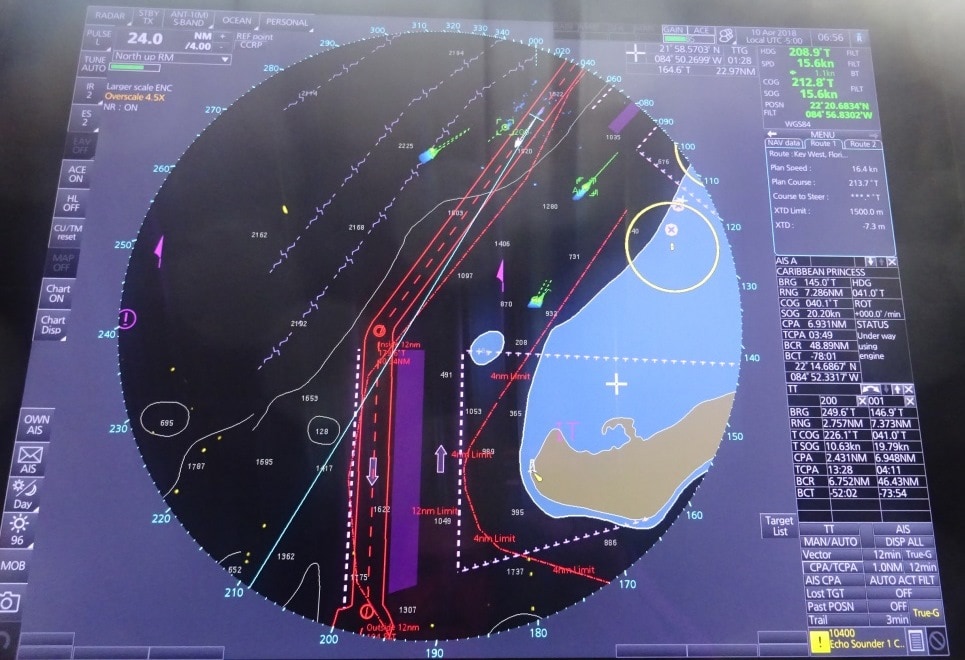
Approaching the VTS, ships highway at sea off the coast of Cabo San Antonio. We are in the top right corner at the end of the white (course) line. There are a few ships around indicated by the yellow dots and the green speed arrows but in general it was a very quiet day today. The green/yellow dot next to us is the Caribbean Princess and on the right hand side of the radar screen you can read her navigation particulars. Most important it says CPA 6.93 miles = Closest Point of Approach.

This morning at 09.30 hrs. we passed the west coast of Cuba, Cabo San Antonio, and then sailed into the Caribbean Sea. The moment we did so, the wind started to breeze up as the Trade Wind is quite strong at the moment due to an extra pressure system laying somewhere in the North Atlantic. But it should calm down again somewhat during the night.

This area of the Caribbean Sea is called the Yucatan Channel as it is located between the Yucatan Peninsula to the West and Cuba to the right. The border between the real Caribbean Sea and the Straits of Florida are a little bit fuzzy as it is all wide open water. For me it roughly starts North of Cozumel and then it stops once past Cabo San Antonio but that is more art than science.  Explorers in the old days, on their slow moving sailing ships, had not much to do so they named everything they could think of. Sometimes after areas at home, sometimes after King/Queen and country and sometimes after themselves.  And thus they were not happy with just naming the whole area Caribbean Sea but gave a different name to the area under Cozumel Island and that has the name of the Gulf of Honduras and stretches from Belize down to the Honduran coast.  That area we entered late this afternoon.
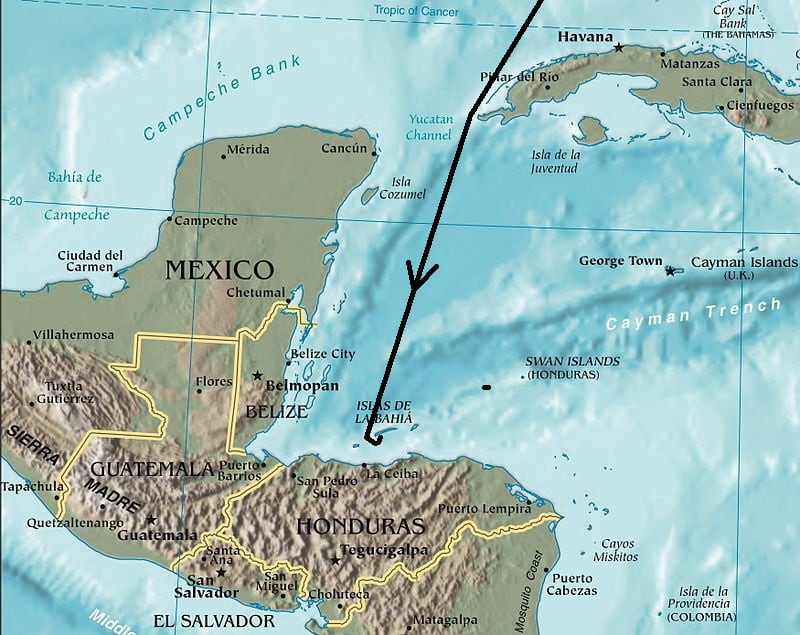
Our course down to Roatan, sailing through the Bay of Honduras.

From Cabo San Antonia it is one straight course down to Roatan. Which is not an island by itself but belongs to a group called Islas de la Bahia or: the Bay Islands. We call it Roatan Island but that is not correct either. Roatan is a town/settlement on the west side of a long and narrow island with the main town of Santa Elena at the East side. The island is called Isla de Utila and is flanked by either side by a very small island. The one on the left is also called Isla de Utila and the one on the right is Isla de Guanaja.
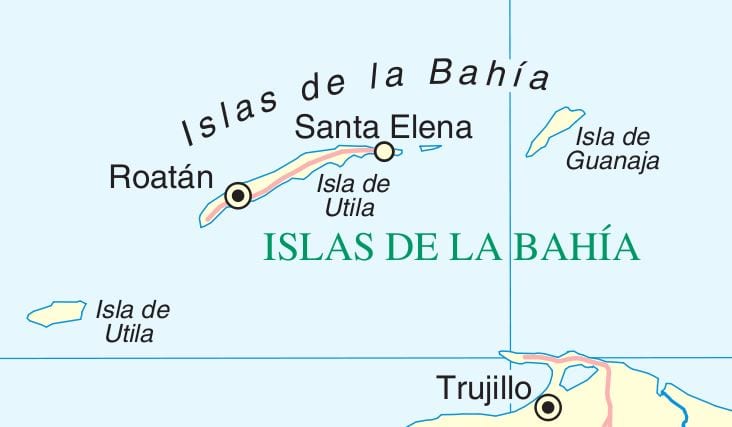
 

The Islas de La Bahia with Roatan in the middle. (Thank you Wikipedia) Trujillo is an important port on the North Coast of Honduras.

Mahogany Bay is located on the south side of the main island and is in general very well sheltered, except if there are squalls coming through, which can change the predominant Easterly wind to S.E., South or S.W. and then the ships have to be ready with their thrusters so they do not get blown off the dock. We will approach Roatan from the west side and sail between the two Islas de Utila towards the pilot station. We are expected at 07.00 hrs. and as we are supposed to be the only ship, we will dock as deep as possible in the Bay, getting as much shelter as possible from the strong Trade Winds. Weather, overcast skies with a chance of a squall are expected but it will be warm and humid with temperatures up to 27oC / 81oF. I hope the guests will be careful as you can get a sun burn here even if it is overcast.
09 April 2018: Key West, Florida.

Tampa to Key West is a “Pedal to the Metal” run and with going full out the ship can just dock comfortably before 11 am. If you have a fast transit down Tampa Bay then you have a bit of leeway in the schedule but if you have to wait for opposing traffic or you have slow tanker ahead of you, then it is a tight stretch to remain within in the schedule. Luckily Tampa transit was fast last night and the weather good and thus the ms Rotterdam was at the pilot station at the arranged time of 10.00 hrs.

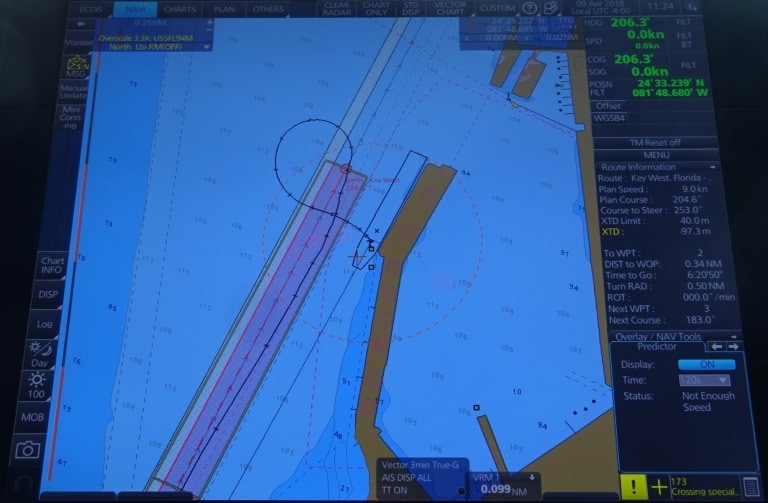
Navy dock mole, swinging on arrival. If you compare the size of the ship with the size of the channel you can see it is not very wide and with a lot of wind there can be problems in the approaches but you cannot go outside the channel as you can do here.

Because everything here is as flat as can be, I think Key West Mountain is 60 feet high at the maximum; we can talk with Key West pilot station while we are still a long distance away. That gives the pilot the sufficient time needed to get ready and we know that he will be out on time as we could give sufficient notice. It also gives the local police or harbor master the chance to carry out their pre arrival security inspections. This includes look for suspicious objects, damage to the pier, flotsam and jetsam, or boating people (canoe’s etc.) hiding under the dock.

A number of years ago when I arrived here with the Statendam we had the VHF on the right channel and we followed a rather bizarre discussion on the VHF. It turned out later that they were doing an exercise and the boat had to find a suspicious package. Because that was not happening, the man shore side was getting a bit restless as we were coming closer and closer:

Shoreside: Have you found anything yet”

Boat: yea we found a broom.

Shoreside: Are you sure it is a broom?

Boat: yea, it has a stick on one side and red hairs on the other side.

Shoreside: Never seen a broom with red hairs.

Boat: that is because it a Cuban broom, they have red hairs, it must have drifted in.

Shoreside: Cuban brooms are not allowed in the USA.

Boat: Shall I tell it to go back or shall I arrest it?

Shoreside: Hold on, let me call the supervisor……………………

Until this day, I have never found out, if this was serious, or a VHF channel 6 staged Abbott and Costello imitation performance. But I have to think about it each time now when the ship calls the pilot and we can see the pilot boat coming out and a second boat going around the dock.

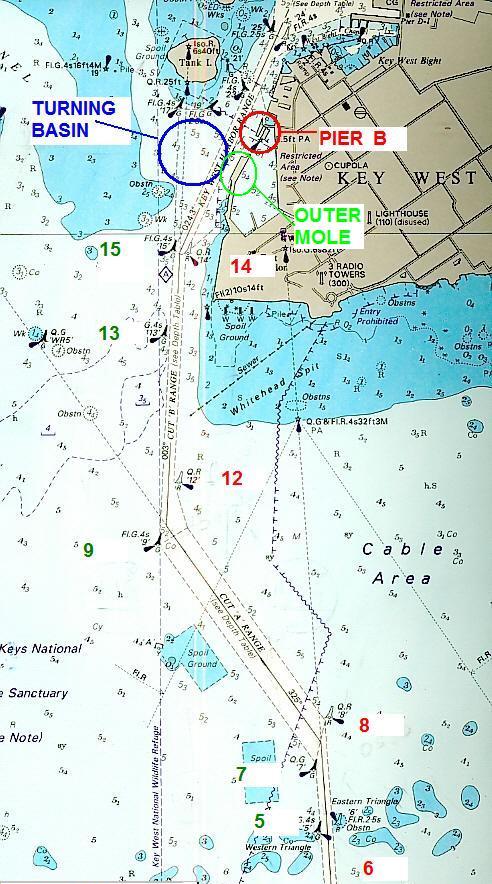
Getting into port in Key West is easy because it is a straight channel with only two course changes. Getting into port can be difficult as the channel is narrow and the wind is nearly always perpendicular over the fairway. To stay exactly in the middle, the have installed leading lights, which makes it easier to see quickly if you are drifting or not. Today we did not have that much wind and we sailed in nicely according to plan.

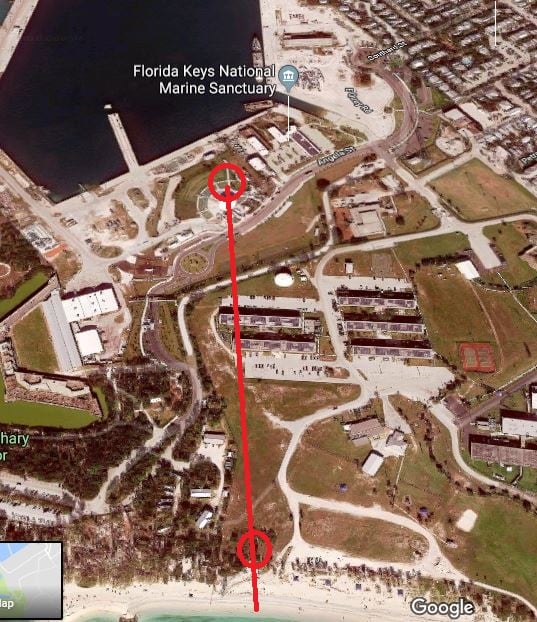
The leading lights in the pre electronic paper days. At nbr 8 we change course to the next leading lights and then at nbr 12, and then one more time at nbr. 14. all the time there are leading lights to keep us in the middle.

The leading lights for the first course into the channel are just poles standing in the middle of a park and at the beach edge. In the chart to the left, they are located close to nbr. 14.

We were assigned at the Navy Pier. The Carnival Glory was at the B pier and the downtown pier was empty, so no ship would interfere with the sunset over Mallory Square. Today there was hardly a cloud in the sky and thus sunset should be quite sensational tonight. We swung on arrival, courtesy of being nicely on time, and thus we will not bother anybody with sunset while we head for our next port of call; Mahogany Bay in Roatan.


So tomorrow will be a day at sea as Honduras is quite a way down south into the Caribbean.

08 April 2018; Tampa, Florida.

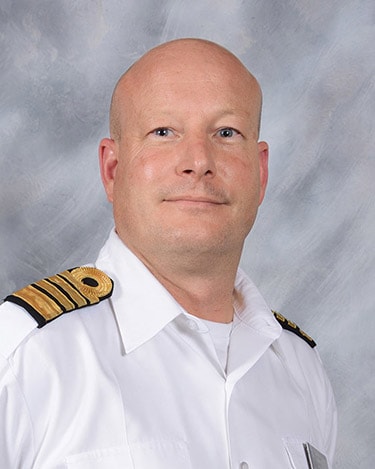
Captain Bas van Dreumel, Master of the ms Rotterdam (VI)

And here we are on board the ms Rotterdam (VI) of the company docked in Tampa, Florida. The ship is starting a final seven day cruise to Key West, Roatan, Santo Tomas de Castillo, and Costa Maya and back to Tampa. Then she will commence a transatlantic crossing and if we have smooth seas and following winds we should arrive in Rotterdam on the 30th. of April.  I will start today my 127th. cruise from Tampa today and so I can rightfully say about this port, been here, seen it and have bought the T-shirt.  I will be here on board until 30 April for training, reviews, inspections and audit on behalf of the captain and anything else that might be useful for the ship and its operation.

The Master of the vessel is Captain Bas van Dreumel who I last met on the Maasdam last year and who took command of the ms Rotterdam today taking over from Captain Eric van der Wal. Captain van Dreumel is a homegrown captain which means he started his career with the company as a cadet some 20 years ago. His biography can be found on the blog site here under Captains and their current schedules.

The ms Rotterdam (VI)) was the first of the R-class ships and entered service in 1997 shortly after we retired the Rotterdam (V). And as she had the name Rotterdam and was at that time the largest ship in the fleet she automatically became the flagship of the company. Then it became a bit more complicated as Holland America created the Flagship Class with the arrival of the ms Amsterdam (III) in 2000. Now the meaning of Flagship is hardly a statement anymore; as a flagship, is the ship that flies the flag of the Fleet Commodore and Holland America retired that rank in 1968 when the end came of the Trans-Atlantic Era. The Commodore always used to be the most senior captain who sailed on the largest ship in the fleet and brought each new ship into service. Most company’s now, including Holland America, work on a team focus instead of rotation and it is possible that a very senior captain is on one of the smaller ships and a relatively young captain is on one of the very big ones.  Plus we have the situation that some of the most senior captains are now Instructors on the simulator or looking after our schools in the Far East, or like me rotate over the fleet. Times have changed and the fleet changes with it.

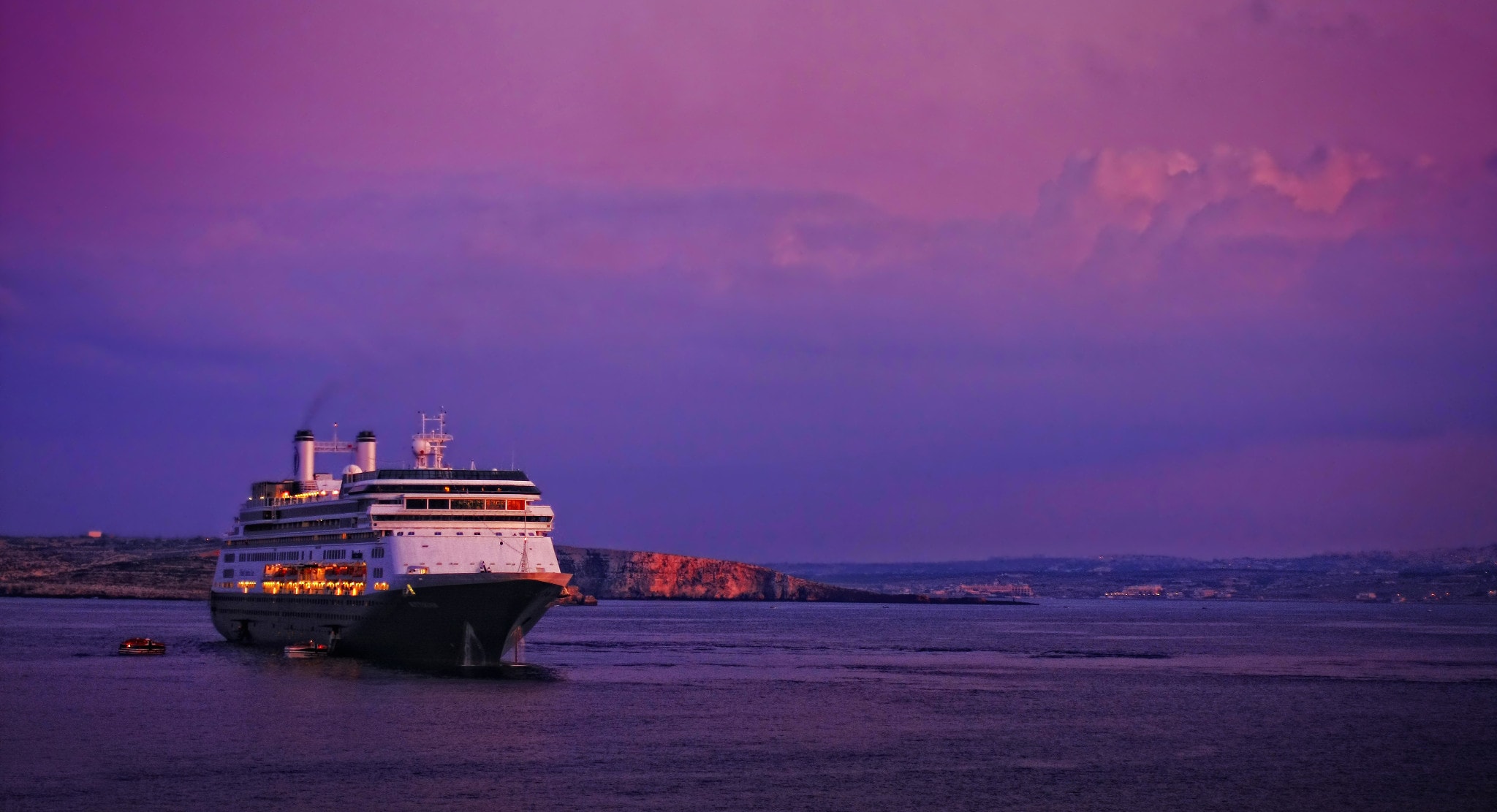
A scenic view of the ms Rotterdam at anchor at the island of Gozo, nr Malta during an overnight stay.

But I still like the title Flagship and it has always been a Rotterdam that was the flagship, except between 1938 and 1959 when there was no Rotterdam in the fleet and the commodore sailed on the Nieuw Amsterdam. No doubt when in the far future the company decides to retire this Rotterdam (VI) it will not be very long before there will be a new Rotterdam (VII) joining the fleet as we like to keep re-using the traditional names. We are not unique in that as our sister company Princess is doing the same with having now a 2nd Regal Princess in service and some others as well.

Today we had 3 ships in port, belonging to NCL, RCI and HAL. The Norwegian Dawn is having her last departure today and the Rotterdam will do so next Sunday. When happens then is that the Carnival Miracle, which is now a Saturday ship, will move to Sunday departures. With other cruise ships it will be fairly quiet in Tampa during the summer until the winter season starts again in October. For years Holland America was the only company sailing from Tampa (with the little Vera Cruz sailing from Manatee), then came Royal Caribbean with one ship and then Carnival and then NCL showed up. And that will stay the same as the catchment area for locals is growing and growing. My Taxi driver told me this morning that Tampa was the fastest growing city in the USA at the moment and that can only be good for business.

This evening the Rotterdam will sail for 3 hrs. down Tampa Bay and once past the sea buoy go south towards the Straits of Florida. The weather tomorrow for Key West, a warm and sunny day: 83oF or o 28C.

04 April 2018; San Juan, Puerto Rico.

Today the good weather held and it was a nice and sunny arrival. And it remained sunny until around 5 pm. when dark clouds started to gather above the Tropical Rain Forest on the south side of the Harbor. It was again a quiet day in port with only the Carnival Glory and Silversea Muse to keep us company. The Glory was docked at the east side of Pier 4 and we were at the west side. 14 days ago we had the same situation but then for reasons unknown we were split up and docked at two different docks.

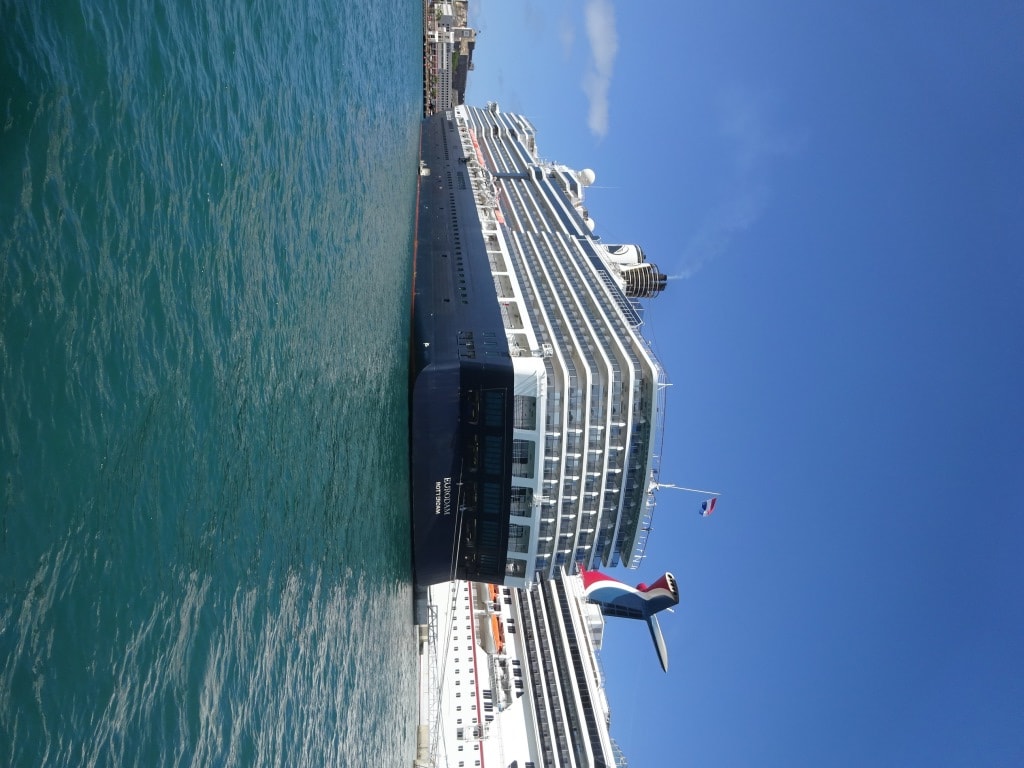
The ms Eurodam docked at Pier 4 together with the Carnival Glory, as seen from the ships tender. The white spot on the hull in the middle of the ship is the tender platform used for the assessments.

My last day here on the Eurodam was taken up with Tender assessments. This is a yearly test for all the deck ratings (Bo ‘sun, Asst. Bo ‘sun, Quartermasters, Able Bodied Sailors, etc.) who hold a tender driver certificate. In the archives of this blog you find some stories from me about giving these training’s if the numbers on board were getting low. Since this year we do not have to do that anymore as the company has now added two real ships tenders to the training center in Manilla where a week long course is given.

So now on the ships we are limiting ourselves to the yearly assessment of the skills. You might say, is this needed, and the answer is yes. Not every ship calls at anchor ports on a regular basis and thus a sailor might not drive a tender for his whole period on board. Coming summer the Eurodam will dock everywhere in Alaska and will only need the ships tenders when it returns to Half Moon Cay and only then when the shore tender capacity is not sufficient. Thus we do an assessment to see if all the basic skills are still there and if they can still dig up all the other knowledge from past learning when the question comes up. …………………………….What do you do when…………….

We like to use ports such as San Juan and Charlotte Amalie for these activities as there is no passing traffic that pulls large wakes. We see that in some other ports where local traffic seems to be totally oblivious of how dangerous it is to have a tender riding up and down along the dock while Grand Mother is trying to embark. Not to mention Mr. Jones who is not willing to hand over the sombrero and camera he is holding in his hand while entering the lurching tender.

For this assessment we rig up the tender platform and the tender driver has to dock portside alongside, starboard side alongside, dock with one engine, dock with one engine on fire etc. At the same time the tender driver should not forget to play the right arrival or departure announcement and also should keep an eye on the Tender helper who has to take care of the guests in the tender while the driver sails the tender. Then they have to be proficient in using Checklists; for preparing the tender, for collisions, for grounding, for a Person over Board and for sinking. If such an emergency occurs they should be able to take all the appropriate actions at once and then verify it with these checklists to see if nothing has been forgotten.

This afternoon we had the extra challenge of a strong wind gusting around the bow of the Eurodam which meant that the tender drivers had to remember: “Use the wind as your friend and not as your enemy) With other words, if you can use the wind to help you dock, do so, and if you can’t then overshoot a little bit and then let the wind help you drift back to the dock. That is quite a challenge for sailors who are often better with their hands than their minds. But as every time happens, the moment you put them in front of a challenge, all the wise training lessons from the past drifts up again to the “operations center” and they know what to do. Today everybody was capable enough to get my seal of approval and they are all good again for a year.

This evening the Eurodam will sail at 8 pm. and then head for St.Maarten where we will arrive around 08.00 hrs. There will be quite a few ships in port so it will be busy in downtown. I will be leaving the ms Eurodam here and fly to Tampa, to pick up the ms Rotterdam on Sunday. So for the coming days there will be no blog as I feel somewhat limited in telling stories about planes and hotel rooms. Although I am scheduled to visit a Chinese Biergarten in Tampa and I have no idea what that is supposed to be.  Sauerkraut with Chopsticks??? That might be a good story for the blog.

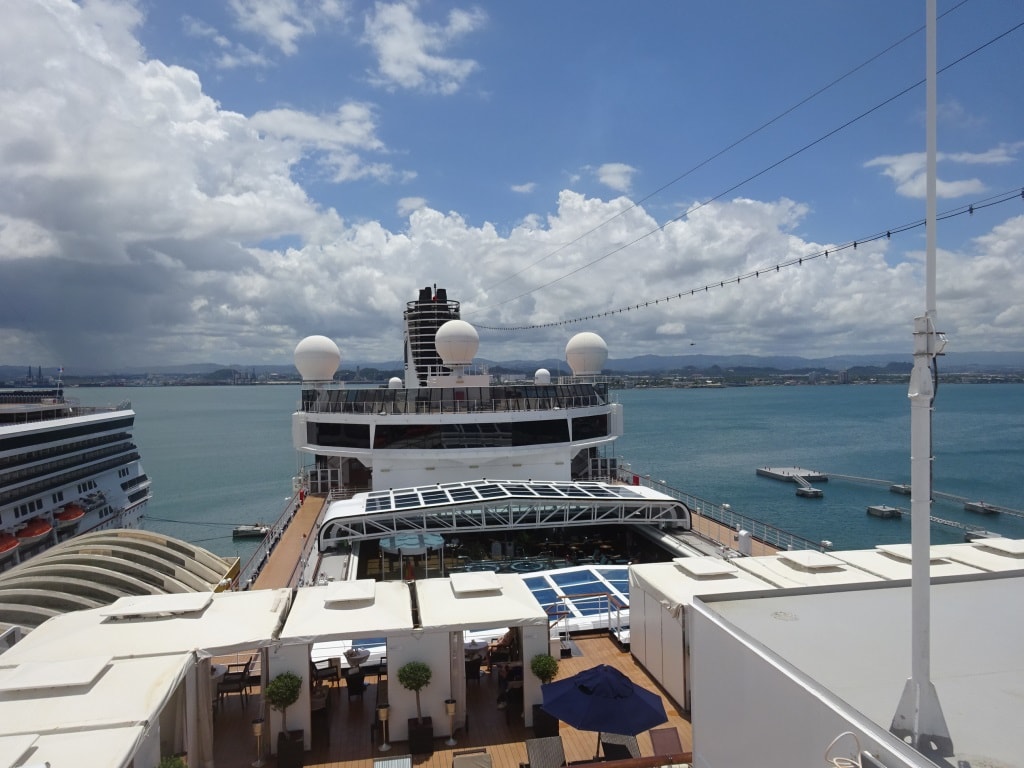
A last look at the Eurodam from the Radar mast, while in port today. In the front are the private Cabana’s and above the magrodome of the pool, and the Tamarind Restaurant, which makes the Signature Class (Eurodam / Nieuw Amsterdam) different from the Vista Class. (Zuiderdam etc.)

03 April 2018; Amber Cove, Dominican Republic.

With dark clouds gathering above the hills around Amber Cove it did not look as if it was going to be a good day. This weather was not in the weather forecast for today but in the forecast for the day after tomorrow. However there is always hope that these are only “Caribbean Clouds” as we call them. They gather during the night and often release some rain when the temperature goes down and the outside air reaches its saturation point due to that drop in temperature. Then when the sun rises, the temperature goes up and the rain clouds dissipate and the moisture it contains is just added to the high humidity again. That does not always work, if the local weather is disturbed by a cold front coming down from the North Atlantic, but if the weather is stable then you can more or less count on it.

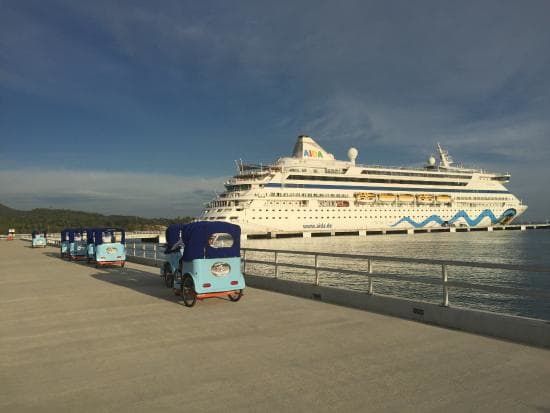
The dock at Amber Cove which can handle two ships. Here an Aida ship as Aida is also part of Carnival Corp. Note the little bike taxi’s available for those who are not as agile as they used to be.

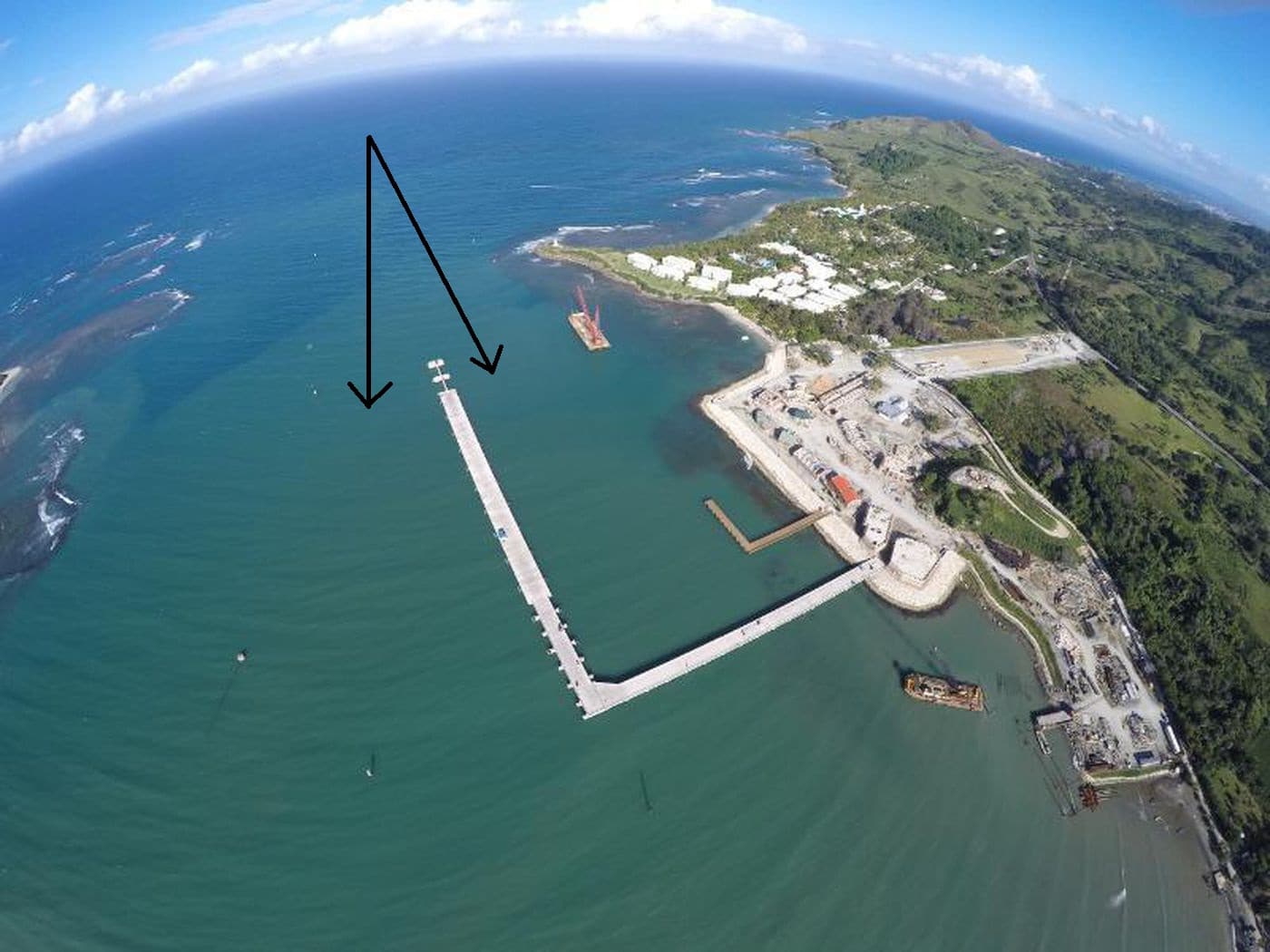
And today we could count on it. An hour after arrival, the dark clouds had moved away and it turned in to a perfect Caribbean Beach day. Although technically we are not in the Caribbean but in the North Atlantic. I mentioned last week that Amber Cove is an artificial port, constructed with the help of Carnival Corporation, and thus it is used by all the Brands under the carnival umbrella. So you see Carnival ships there, Princess ships, Cunard ships and Holland America by means of the Eurodam and the Koningsdam. Because cruising is becoming more and more popular and there seems to be no end to the demand, the cruise company’s deal with it in two ways. A. bigger ships B. more ports. Building bigger ships is not so difficult as a shipyard will build anything as long as you pay for it. More ports is not so easy as you have to find locations that are sheltered, are deep and safe enough for the ships to get in and out, and fit in the average cruise voyage plans of 7 to 10 days.

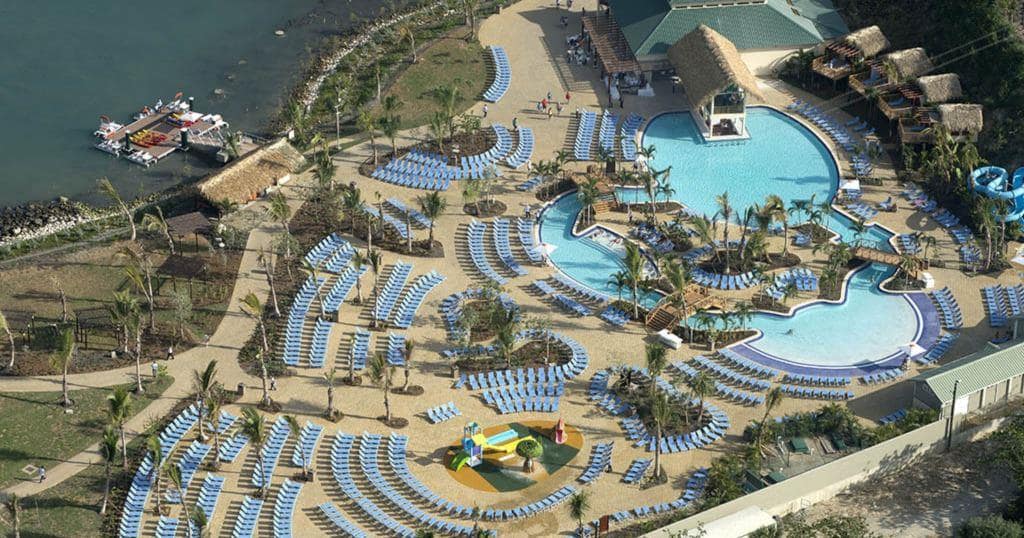
Aerial view when construction was not yet completely finished. But it gives a good idea of why it is so popular with families. (Photo Courtesy Carnival Corp)

Thus the companies are looking for options in the 7 day “maximum travel distance”. Somewhere out there must be a Cruise Destination Explorer, who peddles from bay to bay around all the Caribbean Islands and then thinks ”can I park a cruise ship here”. With the very modern ships, that might look like apartment buildings but are very powerful sea ships, they have those options.  If you would look at the cruise ships from the 1980’s, then these ports would be hardly worthwhile to build as quite often the wind would be too strong to let them dock without tugboats. And in these ports there are no tugboats of course. But now the ships have bow thrusters and Azipods which are so strong that they can visit when the wind blows up to 25 to 30 knots or even more. As an example the ships of the Allure of the Seas class, have over 30,000 horse power of bow thruster capacity; that is more power in the bow than our Prinsendam has in its whole engine room.

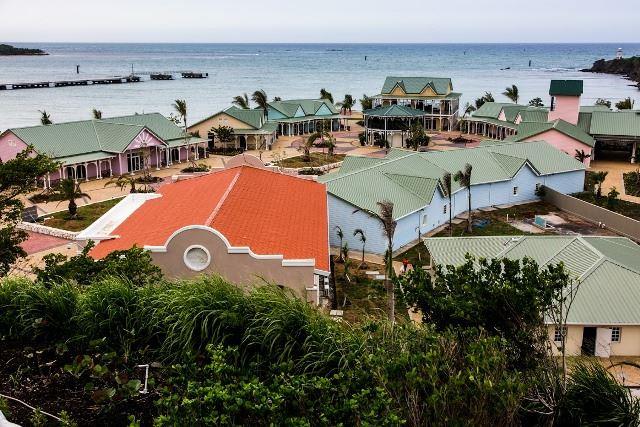
For those who do not sun bathe, there is also shopping and related options to enjoy.

This means that areas can be developed that would have been a complete no-go in the past. When constructed the understanding is there that once in a while a ship will have to cancel because the weather is simply too inclement. That happened to the Eurodam four weeks ago when heavy storms on the North Atlantic caused mayhem on the US Eastern Seaboard and the swells they generated caused mayhem in the bay of Amber Cove. The bay is sheltered on three sides but not to the North side and that can cause in the winter time the occasional problem. But with spring coming, I think that cancelling Amber Cove will be not happen anymore until December of this year at the earliest, if then, as it all depends on the angle of the Wind in those winter storms.

The approach course is the same as the prevailing storm wind direction in the winter and then sometimes we have to swap Amber Cove for something else. (Photo courtesy Carnival Corp and picture taking during construction)

Today we did not have any care in the world, and the ship was mostly empty for the day, with only those staying behind who had been there and bought the T shirt already. Tonight we will cross the Mona Passage and then make land fall in the early morning. The Approach will start around 08.30 and then we should be parked in the port by 10 am. Weather for the day, same as today 83oF / 28oC but with a good chance of a shower.

02 April 2018; At Sea.

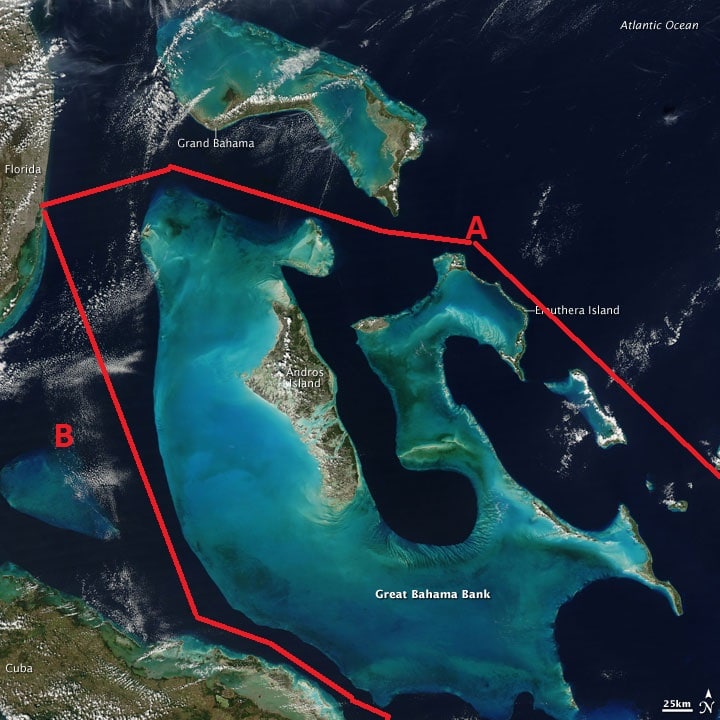
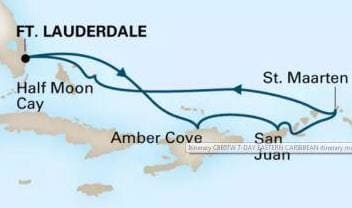
Today we are at sea and cover the distance between Ft. Lauderdale and Amber Cove in the Dominican Republic. As explained last time, we have two ways of getting there, either sailing north of the Grand Bahama Bank or to the south of the Bank. What we do depends on the weather. If the weather looks good then we go north as that is the shortest distance and if the weather is not so good (heavy swells and wind rolling in from the North Atlantic) then we go south. The Southern route protects the ship and the guests on board from the North Atlantic Ocean until about midnight of the sea day. And in that way we do not spoil the first day of the cruise which is one of the only 7 days of this cruise and for quite a few guests the only vacation of the year.

A is the short but exposed route and B is the longer but more sheltered route.

But at the moment the weather is very nice and thus we went around the north, which saves fuel and in the long term also saves on the ticket price, because “the petrol” has to be paid for one way or the other. That money that we save might not be that much but if 14 HAL ships try to do that every day, then it soon mounts up and that works itself through in the prices for the cruises.

The major cost that makes up a cruise ticket price is fuel and labor. Fuel we try to get a cheap as possible by buying in bulk and that saves considerably. Imagine Carnival Corp buying fuel for one ship or for 120 ships, somewhere there will be somebody who will give a good discount to all the 120 ships. The purchase sequence is quite complicated and we do not phone Aruba and say, do you have some cheap fuel left? The fuel they have there is for sale on the international Market and Carnival Corp will buy some for a negotiated or contract price and then a company in Aruba will deliver. Same in Florida, same in Vancouver, same nearly everywhere else. The last time I remember that we dealt with local oil sellers was in St. Petersburg a number of years ago but there things happened in a different way anyway.

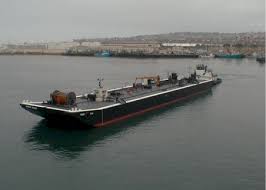
A bunker barge pushed by a tug boat. The round contraption on the bow is the oil boom which is laid around the ship and barge to prevent oil to get into the harbor if there was a spill.

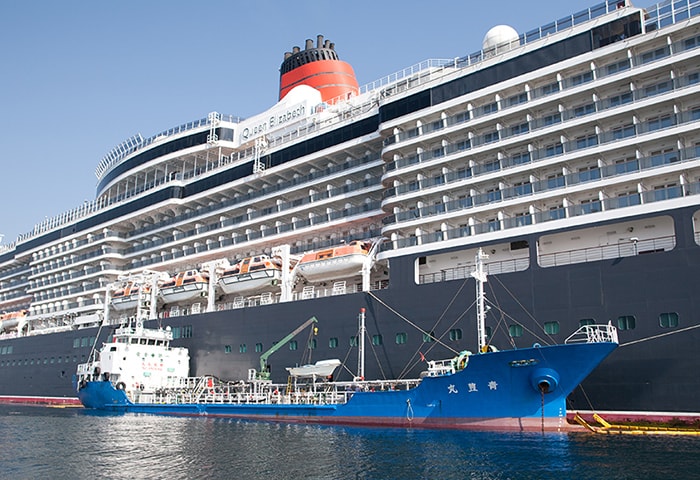
Once it comes to loading the fuel, the procedure varies from port to port. Port Everglades has an extensive pipe system running through the port and the oil is pumped directly from a holding tank to the ship. If you are the only ship loading fuel, then they can do this with speeds up to 400 tons per hour. (1 ton is a 1000 cub. Feet) If more ships are hooked up, then speed can go down considerably. Therefore none of the engineers really likes bunkering in Port Everglades on a busy port day. In ports such as Willemstad they also have manifolds at the dock bringing fuel directly from the holding tank. In many other ports, there is a bunker barge coming alongside. Sometimes it is a real barge, put in place with a tugboat. This is standard practice in most American and Canadian ports. But in some other parts of the world, a complete ship, small coaster, comes alongside to deliver the fuel. That gives for the officers on our bridge the strange phenomena to look straight down into the bridge of another ship and see a colleague doing the same work as they are doing.

This is a example of a bunker-boat. A self propelled oil delivery system as seen here in a far eastern port. The ship is the Queen Elizabeth of Cunard which is a near sister to the Vista Class of Holland America and thus also similar to the Eurodam.

The fuel is always ordered by the Chief Engineer and on regular loop cruises as the Eurodam is doing it means we load fuel every 14 days. On longer cruises the Chief Engineer makes a calculation of what he needs and will order for a certain port. Normally that is approved but sometimes he gets the request to load the minimum possible for one port and then a bit more in the next port if there is a lot of difference in the fuel price. If that can be done safely for the stability of the ship (Fuel provides part of the weight in the bottom of the ship so we do not tip over) then that will be done. Therefore the Chief engineer will always have his fuel calculations verified by the 2nd. Officer in charge of stability to see if it is safely possible.

Tomorrow we are at Amber Cove, arriving around 07.00 hrs. at the pilot station and then docked before 08.00 hrs.   The weather calls for another sunny and warm day with 84oF or 29oC. We have this cruise a large number of children on board and I think that they really are going to enjoy the resort.


01 April 2018: Fort Lauderdale, USA.

Today we started a repeat of the cruise from 14 days ago, going Fort Lauderdale – Amber Cove – San Juan – Philipsburg / St.Maarten – Half Moon Cay – Fort Lauderdale.  We are sailing with a full house, including many families as this is the Easter Holiday Cruise. We had Easter chocolate eggs this morning during Lido Breakfast and the Easter Bunny had deposited them at the Salad corner, because as we all know, Chocolate Easter Eggs are calorie free otherwise nobody would eat them.  Happy Easter from the ms Eurodam.

I will not make the full voyage as I have to catch my next ship, the ms Rotterdam, and will therefore fly from St. Maarten to Tampa as the Rotterdam is also a Sunday ship. Trying to make it from ship to ship in one day is too tight when taking into consideration disembarkation, waiting at the airport and possible flight delays. You can drive it in about 4 hrs. but with picking up a car and dropping it off, it is still very tight.

So I will leave the ship earlier as there would be nothing for me to do on the Eurodam after this cruise anyway as the ship will go to wet dock. The ship’s crew is already very busy with planning for that.

The ship will go to Freeport for a 10 day wet dock and after that it will commence the spring Trans canal cruise heading for Alaska. She will then be a Seattle based ship sailing 7 days to Alaska.  A wet dock is a maintenance docking of a ship whereby it is not lifted out of the water……….. , it is not going dry as it is not going into a dry-dock.  In the old days the ships went into dry dock once a year but with better underwater paint and better seals on the propeller shafts or Azipods that is no longer a requirement. Now the ships are going dry every 2.5 years but even this can be extended if Lloyds Register (on behalf of Flag State and the Insurance companies) agrees. This happens sometimes if the cruise schedule of the ship cannot be brought into synch with the regular dry dock schedule and then everything is a little bit extended.

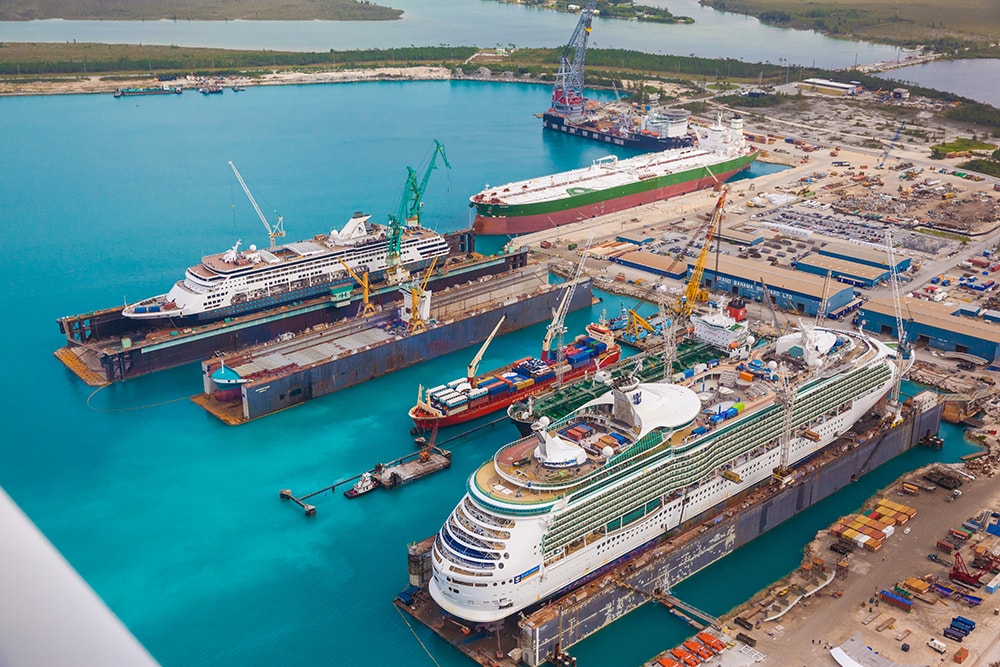
Grand Bahama Shipyard is a big operation and does not only cater for the cruise ships of Carnival Corp.  Here we see from top to bottom, a Crane ship for oil rigs, a super tanker, our ms Maasdam, a small Feeder containership, a regular cargo ship (I think for emergency repairs as the deck cargo is still there), a product tanker and an Apartment of the Seas. (Belonging to RCI, so we also make money from the competition) (Photo Courtesy: I think this photo came via Cruisedailynews)

Grand Bahama Shipyard in Freeport is partly owned by Fincantieri, partly by the Bahama Government and partly owned by Carnival Corp in Miami and thus it makes sense to go there. If you have to pay for a wet or dry dock you might as well pay it to yourself. As all our ships have been built by Fincantieri (except the ms Prinsendam) it is quite handy to have them involved when specialized expertise is needed or Italian spare parts, which otherwise might be hard to get. With Freeport in close proximity to Florida, most of the ships falling under the Carnival Corp. umbrella that are sailing from Florida and scheduled for a dry dock can go there before disappearing to other parts of the world.

A lot of maintenance for a cruise ship can be done while remaining afloat and docked alongside a shipyard pier. It is certainly a lot easier for those on board as there will be no switching over to shore power, no loss of water supplies, steady air-conditioning, etc. etc. The ship has 10 days to accomplish a lot and today we had already service engineers joining us to seize up the scope of the work and to make the initial preparations. Our marshalling area, there where we load the ships supplies, is already starting to fill up with toolboxes, crates, cartons and other pre delivered spare parts. On arrival Fort Lauderdale on the 8th of April a lot more will come on board as we have learned through the years that it is a lot easier to carry the materials on board with us than to start hunting for them in the ship yard.

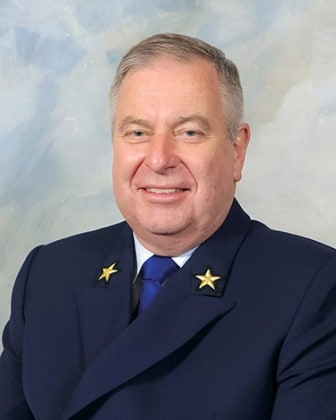
Captain John Scott.

We also had a change of captain today; Captain Eric Barhorst went on vacation and he was replaced by Captain John Scott who has been on this ship already for quite some time.

Captain Scott is one of the English captains who joined Holland America in the mid 90’s when we had a shortage of Master Licenses in the fleet while we were expanding.

He was the first captain of the ms Noordam IV but transferred not too long ago when we had another round of musical chairs. I have a brief bio on the blog site but I hope to expand that in the future.

The good ship Eurodam pulled out nicely on time as all the guests made it safely on board without a delay. As the weather looks good, we will be sailing north of the Bahama Bank (Through the North West Providence Channel) and then come down to the south by passing the Turks and Caicos Islands why aiming for Amber Cove on the North side of the Dominican Republic.

Newer posts