- Captain Albert's Website and Blog -

Ocean Liner History and Stories from the Sea, Past and Present. With an In Depth focus on Holland America Line

Month: November 2016 (page 3 of 3)

10 Nov. 2016: Trans-Atlantic crossing Day 1.

The weather is holding and the ms Oosterdam is ploughing with a speed of nearly 19 knots through a very calm sea. There is just a little movement caused by the regular ocean swell but the ships stabilizers are taking care of it very well.  Stabilizers can only deal with 90% of a rolling movement so there is always 10% or so left. That is the amount that the stabilizers need to “feel” that the ship is rolling. The gyroscope which controls the stabilizers needs some sort of push or jolt to measure the difference between being completely horizontally and not been completely horizontally before it can do its job. And therefore there is always a tiny bit of movement whatever the situation.

We are going faster than we need at the moment as we need to build up a good amount of reserve time because of the adverse currents we will get once we have passed Freeport in the Bahamas. At the moment we have a little bit of current with us, the equatorial current, which is curving away from the African coast and will eventually become part of the Gulf Stream again and so rotate in a never ending oblong circle. We probably get a 0.25 of knot for free each hour, which still helps if you count the total number of hours we will be under its influence. Once we start the battle against the Gulf Stream we will have at least 2 knots against us for most of the time. Unless the Gulf Stream axis is really well over to the Bahama side then we might be able to use the counter current which runs under Miami and Key West. But we cannot guarantee it and thus we build up a bit of “plus” as we call it and then can make it with the same engine configuration all the way to Tampa.
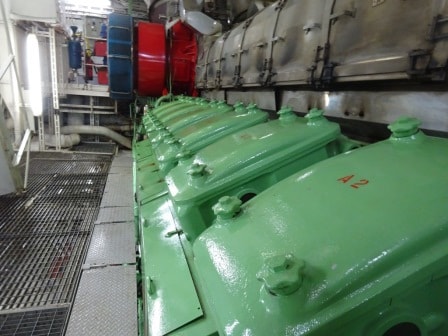
The top of one of the engines. The cylinders are arranged in V shape and thus the covers are under an angle as well.

The top of one of the engines. The cylinders are arranged in V shape and thus the covers are under an angle as well. The red drum at the far end is the Turbo Blower. Most cars have a turbo, the ships have them as well.

Today I did some review work in the engine room of the Oosterdam. The construction of the Vista Class is an evolution of the S class and the R class but with a big step. This was the first class with two separate engine rooms. In the 90’s the regulators were starting to get worried about the size increase of the cruise ships  and having that whole ship rely on one engine room. It would only take a small fire and the whole technical heart of the ship would be out of service.  Thus came the idea to split up the engine room in two parts and have two or three engines in one compartment and two or three in another. As all the new ships were Diesel Electric this was very easy because they did not need a connection to the propeller shafts. Only a few electric cables are needed to go from the engines generator to the transformers and those transformers could be located anywhere in the ship if needed.
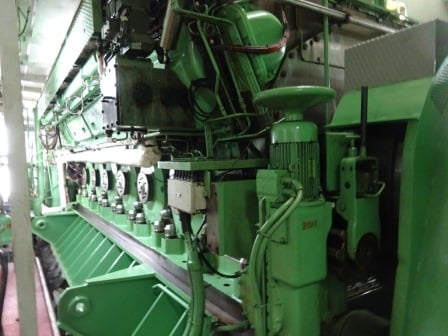
The engines run three decks high. This is D deck level. Then the real foundation is another 5 feet down towards the bottom of the ship.

The engines run three decks high. This is D deck level. Then the real foundation is another 5 feet down towards the bottom of the ship. The round eyes sticking out were used for lowering the engine into the ship by a crane during the construction of the ship.

The Oosterdam is number 3 of the Vista Class and thus has a Forward and an Aft Engine Room. Forward there are 2 engines with a Gas Turbine engine in between and the aft one has three 3 engines.  Three of them have 16 cylinders and two of them have 12 cylinders. The Gas Turbine was a bright idea before 2010 and they were installed in quite a few ships between 2000 and 2010. The Queen Mary has one as well as an example. The idea was that if you needed some extra speed then you could use the turbine which would have less maintenance and a lot less weight than a normal engine and could produce the same or more output.
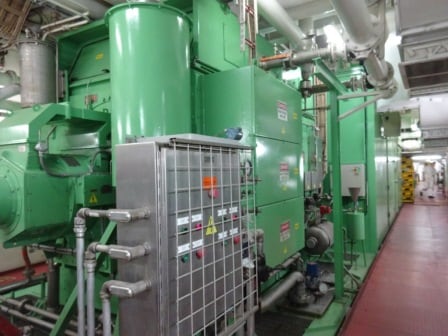
 

On board the jet engine turbine is completly sealed away in a protective housing. It produces a power of 11000 volts and you do not want to get close to that.

On board the jet engine turbine is completely sealed away in a protective housing. It produces a power of 11000 volts and you do not want to get close to that.

At that time the price for the fuel it needed was still low and thus it was economically feasible and operationally a nice perk.  As we know the fuel cost rocketed after 2008 and then jet turbine became a sort of white elephant. The turbine is indeed similar to an airplane engine and thus we call it so. It is hardly used anymore and ships which were constructed with the emphasis on these jet turbines (Royal Caribbean had a few) received additional motor engines to bring the cost down. If we would run it now, then the chief engineer would have to go around collecting money first from the Guests before he could afford to start the machinery up.
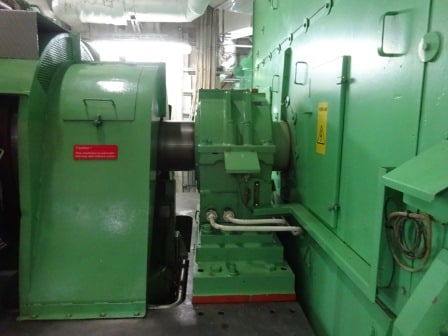
The engine is connected by a 12 inch shaft to a generator. Which is a sort dynamo and generates electricity.

The engine is connected by a 12 inch thick shaft to a generator. Which is a sort dynamo and generates electricity.

Each engine is connected to a Generator which changes the shaft movement into electricity and that electricity then goes to Transformers which bring the power down to a current which can be used by a converter and this converter powers an Azipod which pushes the ship forward. Not all the power goes there; some is diverted and used for the ships operation. And when we go in and out of port, the bow thrusters run on electricity as well.
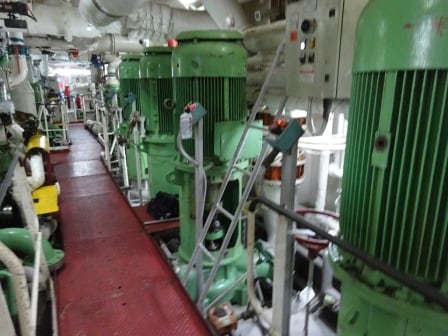
All engines need cooling and these are the 6 feet high cooling pumps for three engines.

All engines need cooling and these are the 6 feet high cooling pumps for three engines.

All ships are so configured that the average speed needed for a cruise can be handled by one engine less than the total on board and the engine not in use can then be put under maintenance.  THis is done on a regular rotation; varying from small repairs and regular piston inspection, to a full stripping down of the whole engine when the maximum running hours have been reached. We take our cars to the garage after so many miles, a ships engine is completely taken apart while the ship is in operation. New parts come on board beforehand and the old –exchange- parts go ashore for refurbishment.

Tomorrow is the 2nd day of our crossing and now the question slowly arises what the weather will bring. As always it will all depend if there is no hurricanes coming over and staying south of Bermuda or a depression created off Cape Hatteras decides to drop down, instead of curving northwards and head directly for Iceland.
09 Nov. 2016; Funchal, Madeira.

At 06.00 the good ship Oosterdam was at the pilot station of Funchal and the pilot hopped on board right on time. Then the main discussion was: are we going portside or starboard side alongside? The captain wisely decided to dock with the nose to open waters. Always easier to get out in case something happens un-expectedly and of course it makes the departure time a lot shorter than if you have to swing first. And we are in a sort of a hurry as the average speed to maintain is quite high and for quite a long time we will be going against the current. Especially when we get to the Florida Straits.  Of course we did not sail on time as we had a “short” port call.  All on board was 14.30 hrs. but as it was so short, everybody came back late and then you do not sail on time. Thus swinging on arrival nibbled off some time from the delayed departure.

We had in port with us today the AidaBlu which came in an hour later. She was not on the agent’s schedule so I wonder if she was a late addition or had swapped ports or route. On the dock side stood a very loud (and very intoxicated) German bellowing a warm welcome to his German countrymen. It was 07.00 in the morning but I think for him time had stood still since the night before as he kept yelling Guten Abend (which is not exactly good morning) As he was partly obscured by the bow of the Oosterdam his welcome speech was a little bit marred due to lack of exposure to those on the AidaBlu. He then wanted to walk along side the Oosterdam to reach the docking location of the AidaBlu behind us but for that purpose he had to walk through our security zone and thus he was stopped. Still happily bellowing he was then guided behind the Cruise Terminal and disappeared from view and from ear shot.

tui..........

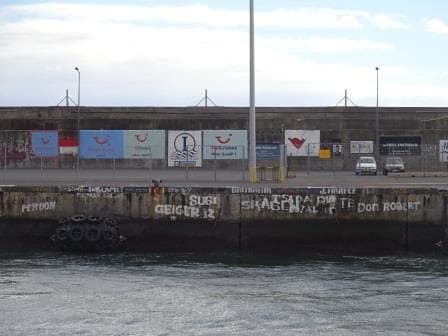
We have: Tui, Indonesian Flagm Tui, Tui, RCI, Tui, Westerdam, Aida, USS Taylor, unknown and the ms Nieuw Amsterdam. The crew names are old, as that is not allowed anymore.

Funchal is one of the very few places where they still allow you to paint logos on the dock wall. They even encourage it as long as it has a design and the end effect is pleasing. They only let you paint over old signs if and when they have completely faded; otherwise you have to find a still bare space. Holland America is very well represented and so is TUI, which makes sense as with their “Mein Schiff” fleet (they have just commissioned Mein Schiff 5) they make a lot of calls here as does the Tui small cruise fleet which focuses on the UK market with the ex Holland America Line ships Thomson Spirit and Thomson Celebration (ex Nieuw Amsterdam and Noordam).

The Oosterdam did not undertake a paint project as we were too short in port and opposite our location all the wall spots were already taken. You have to be further inside to find a piece of bare breakwater wall., but maybe next time. At least we could see the Westerdam and the Nieuw Amsterdam proudly in place right across from us.

The ms Oosterdam docked at the S.E end of the inner breakwater.

The ms Oosterdam docked at the S.E end of the inner breakwater.

The port of Funchal mainly consists out of one large breakwater which runs for 2000 feet in an East – West direction and offers place for two very large ships and a lot of smaller ships. The ships dock on the inside and the strong and high breakwater wall keeps the bad Atlantic weather out. The only challenge we have is the North Atlantic Swell rolling into the port. If by chance the swell is from the South East and not the South West (which is the norm) then the waves roll in, hit the island side, bounce back and make the ships at the Breakwater dock surge along considerably. Not pleasant for the gangway, which then moves with the ship, and not good for the ropes which on occasion brake due to the friction on the mooring cleats.  Today it was nice and quiet.

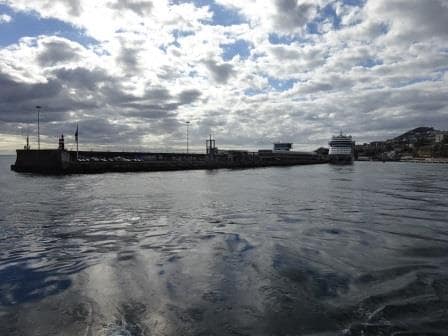
The mighty breakwater as seen on departure. This time minus the shouting German who stood right under the lighthouse.

The mighty breakwater as seen on departure. This time minus the shouting German who stood right under the lighthouse on arrival this morning. The Aidablu sailed later.

By 1500 hrs. we were on our way and will now have 8 full days at sea and then arrive in Tampa on the 18th.  Weather looks quite good at least for the near future with little wind and little swell. There is a frontal system hanging north of Bermuda but we have to wait and see how far its influence comes south. Hopefully only a little bit of swell which can be looked after by the ships stabilizers.

08 Nov. 2016 At Sea, Day One.

Yesterday morning the Oosterdam was the first ship to enter the port of Malaga and last night she was the last one leaving, at least of the three HAL ships. Then it was pedal to the metal to maintain the schedule for Funchal. The weather forecast for the Mediterranean between Malaga and Gibraltar was spot on, but once in the Ocean there was more wind and swell than initially forecast. Sometimes I have the impression that forecasters fine tune their forecasts by looking out of the window. Something that does not work for the Open Ocean.

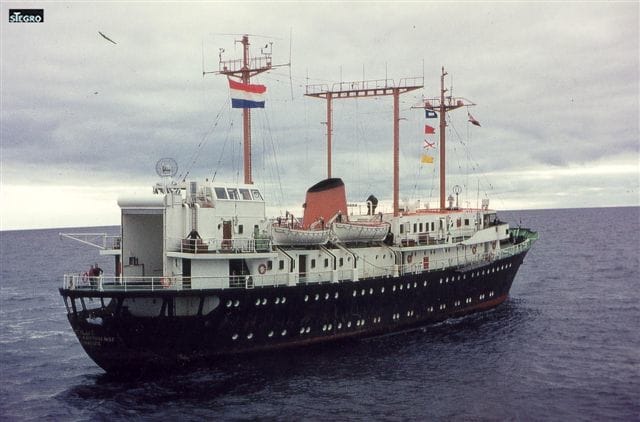
The Dutch weather observation ship ms Cumulus. No stabelizers, not nice in the winter. (photo courtesy Stegro publishers)

The Dutch weather observation ship ms Cumulus. No stabilizers, not nice in the winter. (Photo courtesy Stegro publishers)

In the old days when there were weather ships, you still had a window or a view from the bridge, but those ships are long gone. With that I mean stationary ships, moving explorations ships such as the NOAA has and most navies are still out there in abundance.  When I was at the Maritime Academy between 1976 and 1979 I met officers who did contracts on the Dutch weather ship the ms Cumulus and that happened on a sort of a one by one loan basis from the Merchant Navy. The ship was of course parked where the worst North Atlantic weather could be expected and thus there was little interest for a 2nd contract unless it was in the summer. The ship did very valuable work and I remember my first captain contacting them directly to ask for the weather in the area. No doubt they provided the answer by looking out of the (bridge) window.

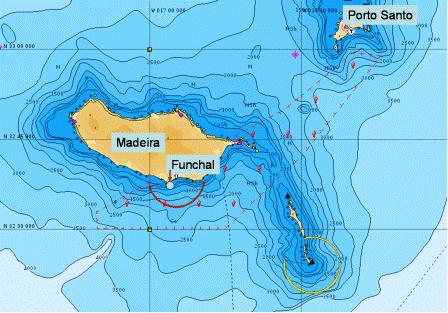
The island of Madeira and the smaller Savage islands to the S.E. The darker the water, the shallower it is.

The island of Madeira and the smaller Savage islands to the S.E. The darker the water, the shallower it is.

Now the ms Oosterdam is on the way to Funchal on Madeira, which is the largest island of the Madeiran Archipelago.  The other islands known as the Savage Islands are very small and the preponderance of the population lives on the main island. The island is a bit to the south of the latitude of the Straits of Gibraltar and thus we are steering a SW course of 249o. Which is always good. The further to the south the less waves there tend to be. There lays a frontal system over the Azores (as it does very often) and that is sustaining a swell coming from the north hand which is just touching the 3 meters or 9-10 feet. It is hitting us under an angle and as a result the Oosterdam is not pitching or rolling; it does both but not consistently. Thus we have a bit of a strange movement. The Azores are about 1200 miles to the North West and thus we are very happy that we are not there today.

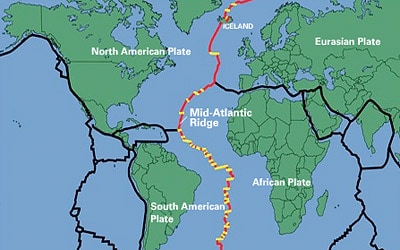
The North Atlantic Ridge and the boundaries of the most important Tectonic plates.

The North Atlantic Ridge and the boundaries of the most important Tectonic plates. (Somewhere off the internet, could not trace the maker)

The islands are all the tops of Volcano’s which were created by mountains ridges rising very sharply several thousand feet from the sea floor. Thus when we left the Straits of Gibraltar behind, we fell off the Continental Shelf and are now sailing over very deep water. That will remain so until about 2 am. tomorrow morning when we approach the ridge running S.E. of the islands and then it gets shallow quite quickly. Shallow in relative speak, it will still be several hundred feet but with an average depth of several thousand feet it can be considered shallow. Then it does down again to very deep water until we arrive at the pilot station where Madeira itself rises up from the depth.

All these rises and depths (Madeira, Azores, Cape Verdes) are all the results of cracks in the earths crust. The major one is the North Atlantic ridge where the European Tectonic plates (the Eurasian and African plate) are being shoved under the North American plate. Madeira is sitting on the border of the Eurasian and the African plate) where the Earths crust is breaking or cracking up, there are normally fireworks to be seen when that happens but on Madeira things are very quiet. The island itself is a shield volcano, which means the island is part of a Volcano rim. But as it is a big rim, there a numerous small volcano cones near the highest points of the island. They are all dormant and the city of Funchal has been built all over them.   As the chance of seeing the island being blown up by volcanic activity is fairly remote, and Funchal is the most important cruise port of Portugal to which country Madeira belongs. It is situated ideally for trans-atlantic crossings but as it is only one sea day sailing away from the European shores it is also for that reason a nice port to go to, when on a 10 day cruise or longer from a Continental home port.

The plan is to have the pilot on board at 06.00 hrs. tomorrow morning and to be docked before 07.00 hrs. We will stay until 15.00 hrs. and then set sail for Tampa Florida. Madeira has a very temperate climate and tomorrow it will be on the low side of temperate with temperatures of 57oF or 14 oC.

07 Nov. 2016; Malaga, Spain.

And thus I arrived on the Oosterdam in Malaga.  I left San Diego on the 5th, and flew via New York to Amsterdam where I arrived on the 6th in the morning. Then the late afternoon flight to Malaga which brought me to the Hotel in Malaga just before 8 pm.  I had to wait for most of the day in Amsterdam for a connecting flight but if you have to wait somewhere in some airport then Amsterdam is one of the best airports there is to do so.  Even if you are not a big shopper, there is sufficient stuff to look at to keep you busy for a good number of hours. And the KLM business class lounge is in my opinion the best in the world. You never run out of food or drink and there are always sufficient newspapers to catch up with the rest of the world. Everything is help yourself and that is something I prefer as in other lounges where they have bar tenders, you always get the feeling that they want a tip and sometimes the tipping glass is standing on the bar, quite prominently. I have nothing against tipping but I tipp for service above what can be expected and thus I see no reason to tip somebody who is just doing is/her job.  I had the same last night with the Taxi driver who brought my suitcase nicely all the way to the hotel desk and that deserves a good tip; this morning the taxi driver did not even know where the Cruise Terminal was and thus there was no tip. Taxi drivers in Spain do not exactly expect tips, so there is not much of an argument but I exercise the principle everywhere in the world the same way and then you can have some interesting experiences.   I do not have children but if I had had them, they would have been dead by now (including my parents and my grandparents) if I had to believe the Taxi driver in Alexandria Egypt. He got rather upset when I explained to him the difference between the connection of a tip and service and no service and still expecting to get rich in one day.

I am now on the Oosterdam and hit the deck running as they call it. The ship is on its Trans-Atlantic crossing cruise which started on 3 November in Civitavecchia, Italy. Today is Malaga and then the day after tomorrow we are in Funchal and after that only sea days until we arrive in Tampa on the 18th. As the ship is coming back from Europe, it will face a very heavy day in Tampa and the captain wisely decided to start preparing for that event as early as possible. There will be a full face crew inspection by CBP, A full USCG inspection, heavy loading & provisioning, fuel bunkering, offloading of recyclables and the start of a Carnival Corporation 5 day audit. And then we also still have to disembark 2000 guests from this cruise and embark 2000 guests for the next cruise which is a seven day West Caribbean.

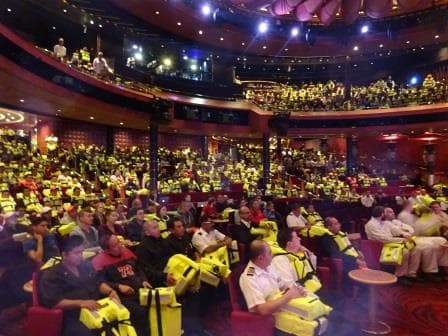
All the Oosterdam crew except an odd 30 or so who were needed to keep the ship running.

All the Oosterdam crew except an odd 30 or so who were needed to keep the ship running.

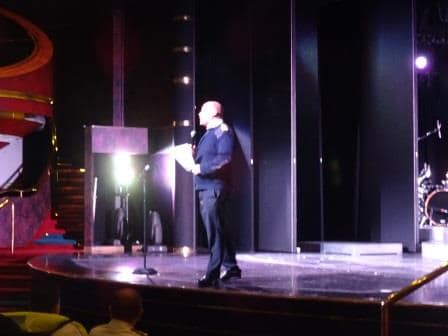
So this morning, the staff Captain called the whole ships complement together in the Showroom at Sea after the General Emergency Boat drill. Most communication in the ship goes by email but that is A. not always conveying the importance of a situation and B. it does not always reach everybody as you depend on the supervisor to pass it on, or on the crewmember to read what has been posted. Most crew never visit the Show room at Sea and thus is it a nice perk to sit on comfy chairs and couches and hear the staff Captain preach the latest “HAL – Gospel”

Staff Captain Jonathan Edwards explaining that nobody can expect a day off during first call Tampa.

Staff Captain Jonathan Edwards explaining that nobody can expect a day off during first call Tampa.

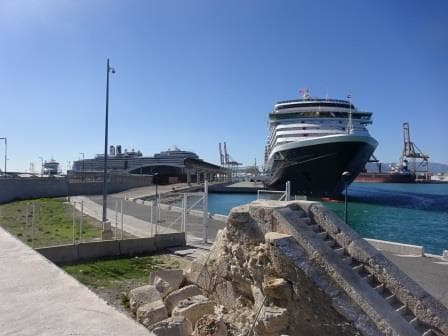
The good ship ms Oosterdam (I) is under the command of Captain Robert Jan Kan whom I sailed with the 1990’s and onwards when he joined Holland America as a Navigator. Today he led the Holland America parade into Malaga as behind us are the Prinsendam and the Eurodam. It is very seldom that you have 3 company ships in port and even more seldom that they are docked at the same cruise terminal. Thus I did have to run ashore to take a photo of the occurrence. Unfortunately the cruise pier in Malaga is long and narrow with water on both sides, so I could not walk far enough to get them all lined up in a row.  An angle was the best I could do. Maybe a local newspaper sees the uniqueness of the happening and diverts a helicopter for a few moments.

Ocean Liner row in Malaga. ms Oosterdam, (I), ms Eurodam (I) and ms Prinsendam (II). Also in port but at other docks: ms Amedea and Aegean Odyssey.

Ocean Liner row in Malaga. ms Oosterdam, (I), ms Eurodam (I) and ms Prinsendam (II). Also in port but at other docks: ms Amadea and the ms Aegean Odyssey.

Tomorrow we are at sea after having sailed through the Pillars of Hercules & Gibraltar during the late night. The weather forecast looks very good and with that I mean not sun or rain but wind, waves and swell. Those things which makes a ship wobble and the guests unhappy. For the time being it looks very good. The 20 knots of wind we currently have will died down to almost nothing and the waves are not supposed to be higher than 2 meters or so, 6 or 7 feet.  And that is very good for this time of the year.


04 Nov. 2016; Off the Californian Coast.

USA California has a long coastal line and so has Mexico California; and since 2 pm. yesterday we are sailing along it and can see it continuously on our starboard side. Some of it is fairly flat but in some areas the mountain ranges almost reach the water line and then we see high sand dunes which are really rocks covered with sand. We will continue to follow the coast until we reach San Diego, which is about ten nautical miles north of the Mexican Border. From San Diego it would at least be another day of sailing along the coast to get to the northern boundary, there where California meets Oregon. The Veendam will not do this as San Diego is the turnaround port and from there she goes back to Florida.

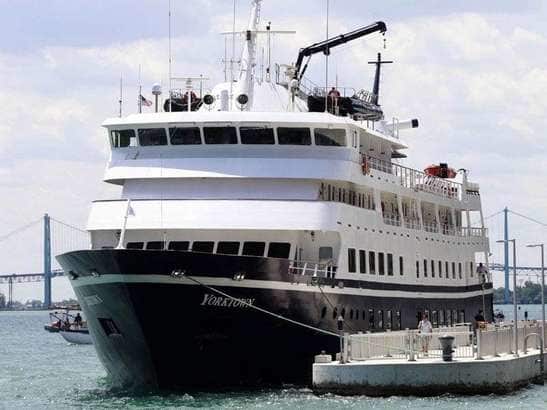
The Yorktown Clipper a number of years ago. I did not have my camera with me, so I could not take  open sea shot this morning.

The Yorktown Clipper a number of years ago. I did not have my camera with me, so I could not take open sea shot this morning.

This is really the start of the winter season and thus I was not so amazed to see a little blue hulled cruise ship sailing by which looked like the Spirit of Yorktown. But I was amazed to see that it was her. The latest news I had read about her was that she had been seized by a bank due to some monetary issues but obviously she is back in business. She is one of those little ships who sail in Alaska in the summer and then sail the Gulf of Cortez area in the winter. Specializing in wildlife explorations. (The Gulf of Cortez is the sea area between the Mexican Coast and the Californian Peninsula)

We had a very nice sunset last night and that brings me back to the need to complete my blog of a few days ago about sunrises, sunsets and twilights. For people ashore the twilight zone is the moment between light and dark, the time of sunrise and sunset. For us at sea things are a little bit more complicated as that time of the day is an excellent moment to take celestial fixes to determine the ships position. We now mostly look at the GPS but the old skills are still important as you never know if some politician might switch the system off. (USA, Russia and the EU all have an independent system developed just because of that reason)

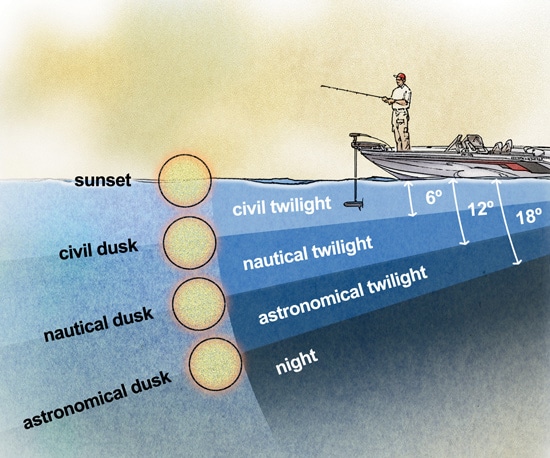
It is nothing to do with fishing but everything with finding out where you are. (Courtesy InFisherman)

It has nothing to do with fishing but everything with finding out where you are. (Courtesy In-Fisherman)

Twilight is the time of dusk or dawn, when we go from full night to full day or vice versa. The sun is below the horizon but it is not completely dark yet. For the explanation we will use sunset. There are three phases in this period, Civil, Nautical and Astronomical twilight.

Civil Twilight is the period which ends when we humans think: now the sun is really gone. We cannot see terrestrial objects very clear anymore. We can see planets but stars are not very clear. Then comes Nautical Twilight. Now the stars are clearly visible and the horizon is as well. By using a sextant (which measures the angle between a heavenly body and the horizon) we can find our position by obtaining “a fix” of several objects at the same time. 3 observations are enough, 5 or 6 are better. Once the horizon is no longer visible we enter the period of Astronomical Twilight. This is a period when astronomical observations can be made; I am not too familiar with this but as far as I know astronomers need sometimes this period as they cannot do certain observations if it is really night.

Scientists have of course figured about exactly between which angles of the sun, which twilight exists. We at sea do not really care much about those angles. We need the time. We calculate when we can expect nautical twilight and we are already in position with our sextant well before that time so we have the longest period possible to catch those stars and planets which will give us the best fix. So once we can see the horizon or until we lose the horizon we “shoot the stars”. Which is nowadays not so easy anymore as we have closed bridge wings; and thus we have to go to the deck above the bridge and then come down again. Because Navigators are not allowed to leave the bridge, you need other officers to come up and make the observations.

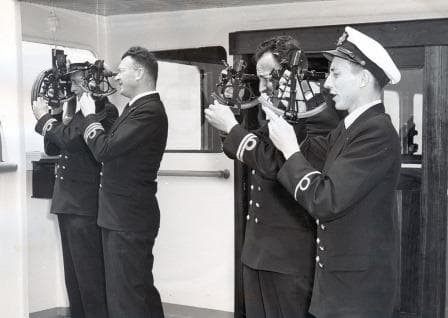
One from the old days. Officers shooting the noon time sun on board the HAL cargo ship ss Arkeldyk. The officer with the 3 stripes is the later captain H.L. Van Deventer. (Courtesy R. van Devener , son)

One from the old days. Officers shooting the noon time sun on board the HAL cargo ship ss Arkeldyk in 1950. The officer with the 3 stripes is the later captain H.L. Van Deventer. (Courtesy R. van Devener , son)

Not a bad idea anyway, because by taking multiple sightings, you can improve your final calculation considerably by middling the results and discarding an observation if one is a bit too far out. That was why in the old days all the deck officers would come to the bridge for the”noon time fix”. This is a way to exactly measure your latitude by taking an observation of the sun when it is at its highest point. As the sun is only there for a few seconds, all officers would take a reading and then decide on the correct one. (Most of the time, the one of the most senior officer involved) But that is another story.

Tomorrow we are in San Diego and I will leave the ms Veendam behind, my work being done here. I was Captain on her from 2004 to 2008 and it was good to see her back. From San Diego I will fly via New York and Amsterdam to Malaga and there join the Oosterdam for her Trans-Atlantic crossing and then for cruises from Tampa.

So tomorrow there will be no blog as I will be travelling. Even if I was not, then there would still be no blog as tomorrow I will be 35 years with Holland America Line, so I would have raised a glass to myself in the best Bar on the ship. Now I will find one in an airport .Cheers.

03 Nov. 2016; Cabo San Lucas, Mexico.

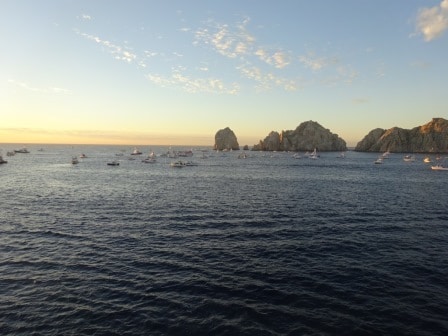
We arrived just after 06.00 with a spectacular sun rise behind us. The weather turned out as expected the only thing which we had not hoped for was that all the fishing boats were assembling just outside the port, to go for a fishing derby. The mother ship was calling out the numbers who had checked in and by the time we drifted by, heading towards the anchorage, the count was up to 139 and still going up. Although the authorities were doing their best to keep all the boats together it was a hopeless challenge and the Veendam had to go very slow, to avoid them all. As was expected and as did happen, there were a few of course who wanted to get out of the way but did so by crossing our bow. At for them a safe distance, but for those on the bridge quite scary as the dead angle of view is 45 meters and most fishing boats consider 20 meters more than enough.

The ship had to carefully navigate its way through quite a few of those.

The ship had to carefully navigate its way through quite a few of those.

The good thing about it was that the fishing competition emptied out the harbor and that gave more room for our tenders to get in and out.  So we dropped the hook and just before 07.00 hrs. we were in full swing. Full swing is a big word; we were trying to swing, as apart from the guests on tours nobody was in a hurry to go ashore. My prediction of yesterday that a lot of guests were not going ashore at all came through as it remained quiet. By 10.00 hrs. the Cruise Director gave up all hope of enticing people to collect a tender ticket and then it was a free for all. Which exactly generated one more tender full of guests. No more than half of all on board decided to have a look at Cabo San Lucas.

Not that the captain minded, it also meant that everybody was back on board on time and the ship could leave the anchorage at 14.00 hrs. It is a tight run up to San Diego and there is the additional challenge of sailing around the South point of the Baja California, with is Sunday sailors, sightseeing boats (whales) and fishermen. That can cost considerable time. Then the ship will try to arrive early in San Diego as we are coming from a non USA port and thus everybody has to go to immigration.  An early start is helpful here, especially to get all the pre paper work done.

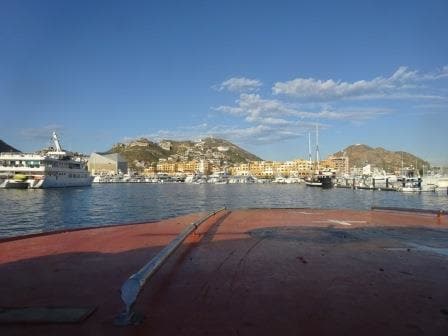
View from the tender. The port of Cabo San Lucas. This is after most boats went fishing.

View from the tender. The port of Cabo San Lucas. This is after most boats went fishing.

In the meantime the four ships tenders kept up the shuttle service with the trainee tender operators running the tenders when empty. Today was a big day as they had to perform under the watchful eye of the officers on the bridge and at the gangway. Tonight they will receive their certificate and on the Eastbound Trans canal they will get a few more tests and then they can be put to work when needed.

Apart from keeping my eye on the trainees, my day was filled with crises management training. When I am on a ship I try to grab the chance and give the Stairway Guides a bit of in-depth training in regards how to handle, obstinate, fearful, obnoxious, scared and panicky Guests in an emergency. We have a few tricks for that, but to get it across some acting is needed and the officers who are normally giving the training are not always comfortable of acting like a fool and getting the rest to act like fools as well. I have no such problems and then the crew is more willing to join in as soon as they see that I am willing to drop my five stripes. And thus we had small far eastern ladies contemplating how to handle big and brawny guests.  If it really would happen then the results will be quite scary for those big and brawny guests………..

Tomorrow is the last day of the cruise and most guests will be packing although there are a few who will return with the ship to San Diego.  I met one family who joined in Montreal, stayed all the way through, will visit friends in San Diego and then sail back to Florida to spend the winter season there. Not a bad way of living if you have the time to do so.

Tomorrow should be another nice day, with similar weather as today, and as today was nearly cloudless we might have a spectacular sun set tonight.

02 Nov. 2016; At sea, 2nd day.

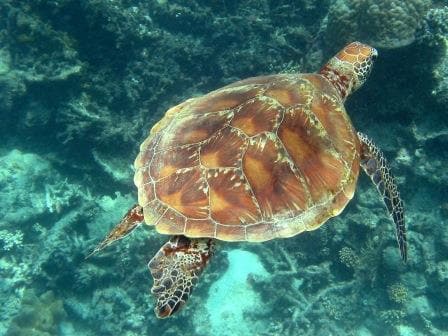
The good weather continues and we had another day in paradise, right here on board the Veendam. Today there was a lot of wildlife around and those who frequented the outside decks could have seen, dolphins, seals, all sorts of birds and turtles. We even had a hawk hitching a ride on the bow. Normally we do not see hawks in open waters but we are less than 20 miles from shore so maybe he/she flew out a bit too far and used us as a resting platform before turning back again. Turtles (or tortoises) are more common and I am always fascinated by them. We literally see hundreds of them and in the beginning I was always afraid that they might be hit by the ships propellers as they are not the fastest of swimmers.

This is the sort we see from the bridge along the Mexican coast

This is the sort we see from the bridge along the Mexican coast

But through the years I kept an eye on them and it looks like that we, at least the bigger ships, cannot do them any harm. With their shields they lay on the water as a cork and they are simply washed away on the bow wave. They might not enjoy the sudden swell rolling by, but when caught they are pushed away a considerably distance. When I follow them I normally seem them 100 to 150 feet away from the ship by the time the stern passes them and they are just bobbing up and down the waves created by the ship. There are a lot of turtles out there but we always only see one sort. A big brown shielded version in size anywhere between 30 and 80 centimeters. (As guessed from the bridge wing)

Tomorrow we are in Cabo San Lucas and then we will see more wildlife in the form of Pelicans and seals which are normally present in large numbers around the port entrance. With so many sport fishermen going in and out of here, there is a fair chance of an easy meal. Then after the departure I have high hopes for whales; some who are here all year around and some who are on the way down from Alaska, as not all Alaska whales go to Hawaii.

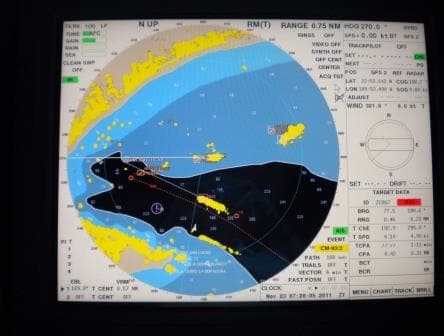
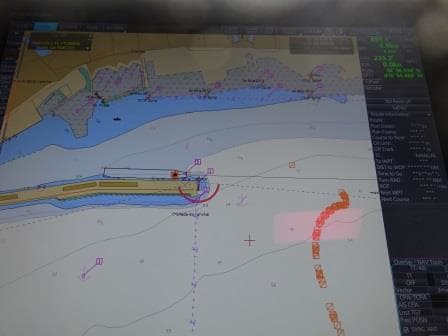
Cabo San Lucas has three anchorages. This radar screen shot shows anchorage 2 in the center, we will be all the way to the left.

Cabo San Lucas has three anchorages. This radar screen shot shows anchorage 2 in the center, we will be all the way to the left. In that direction is the ship/echo heading which is following the dotted line.

Cabo San Lucas is a tender port and the preparations for tomorrow started already a day before. The tenders need to be made ready and the agent has advised us what to expect. We will be the only ship into tomorrow so we can go to anchorage number 1, which is the closest and also the best sheltered from the ocean swell. That saves a considerable time and less tender distance to cover.

Then we have to prepare the operational side of the tender operation as we will be using our own boats. Most of us have all been there but still we take the whole deck department with all sailors and officers through a tender briefing to ensure that the operation is safe but also as efficient as possible. We are in port from 07.00 to 14.00 hrs. which is a short period to get 1200 guests ashore and also back. (Unless a lot of the guests are not going ashore; most have been here already before and will have bought the T shirt)

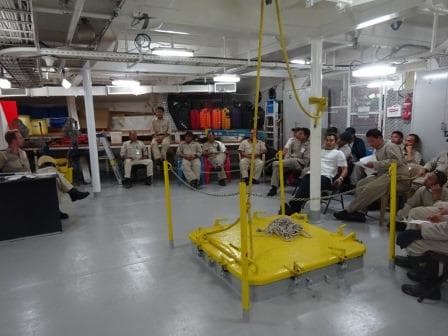
Bo'sun and sailors assembled in the Bo'sun store listening to the wise words of the First Officer on the left.

Bo’sun and sailors assembled in the Bo’sun store listening to the wise words of the First Officer on the left.

Thus today all the troops gathered in the Bo ‘sun store and the First Officer gave his briefing. Route and Safe navigation (the area is normally full of six-pack navigators or worse), Emergency tender procedures, Safe Working Practices, docking, undocking, standby locations, checklists, etc. etc. That takes roughly about a hour, as we want to make sure that there are no glitches. And if there is one, then it is at least not caused by something we could have foreseen.

We will start approaching the anchorage by about 05.30. Have the hook down by 05.45, send our first tender ashore at the same time to collect the officials and as soon as those have cleared the ship, start our tender operation. Hopefully we will be in full swing before 07.00 hrs.

It will be a hot day again tomorrow, with temperatures in the low 80’s and a lot of sunshine. If I was a guest and I had already bought the T short, I think I would prefer to stay on board. I will be up and about early. First to see the anchor operation, and then monitor my school class in helping operate the tender service.

I will continue my story about sunset/ sunrise after Cabo.

For those who are interested I have uploaded the biography of the Master of the Veendam

Captain Noel O”Driscoll under Current captains and their schedules.


01 Nov. 2016; At sea, day 1

It takes two days to sail to our next port of call, Cabo San Lucas, and we have to sail at a fair clip as well. Just over 18 knots to make sure we get there on time. I think a lot of people do not realize how big Mexico really is. Maybe not that wide, but it is long. Especially in Europe the common knowledge is that Mexico is located under the USA; Mexico City has millions of inhabitants, it has lots of Mayan ruins all over the place and some very nice places to go on vacation. But not many people can put a real finger on the fact that it takes quite some time to get from the one end to another.

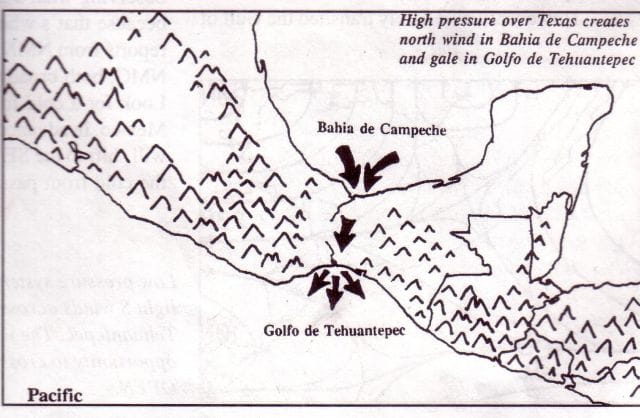
That gap in the Sierra Madre which is causing all those windy problems.

That gap in the Sierra Madre which is causing all those windy problems.

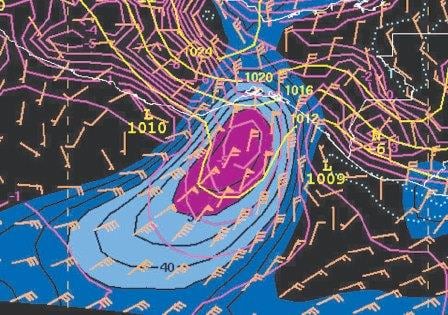
Last night we had our first Mexican adventure, the Tehuantepeccer wind.  When I checked the weather forecast yesterday afternoon it was unclear if it would happen as the angle in the Gulf of Mexico for the wind there was not completely right but in the late afternoon things shifted just a bit and the wind started to blow through the gap in the Rocky Mountains /Andes called the Sierra Madre range.  Then the question was how much were we going to get? The tehantepec wind can vary in strength from 40 to a 90+ knots, and the closer you are to the coast, the more wind you catch but also the less waves it can whip up.

An example  weather chart, clearly showing the outflow of the wind. (Courtesy NOAA.org)

An example weather chart, clearly showing the outflow of the wind. (Courtesy NOAA.org)

For a captain who wants to keep his ship straight up and do not let it wobble too much, it is worthwhile to try and find out how strong the wind is going to be.  Although you cannot predict with complete accuracy, you can have a fair shot at it. Normally you take the predicted wind for Salina Cruz and then add a knot for each mile you are out in the open, until about 50 miles away. Salina Cruz is a tanker port which sits under that wind gap in the mountains. As it is located below the gap it does not get all the wind. Most of it blows higher up directly into sea.  The Salina Cruz weather forecast gave 25 to 30 knots by evening, we were 20 miles away from the coast and thus we could expect 45 to 50 knots of wind. And that is what we got. The wind topping just 50 knots when we sailed through the middle part.  If well prepared (all tanks on the wind side full and lee side empty) an S class ship can compensate to about 50 knots. And thus we did not list. 20 miles of free wind is not enough to build up strong waves and thus we did not move that much either.  If the list becomes uncomfortable than we can do a bit of zig-zagging and keep the wind under an angle. An Angle in relation to the super structure so the list decreases again. But that costs time and speed and we were lucky last night that the Veendam ballasting capabilities were a full match for the wind.

The 2nd very important thing was the one hour back last night. We are now on West coast time and ready for San Diego.  Time zones were invented to make sure everybody got a sunrise and sunset at a workable time. At least everybody, except those above & under the polar circles, they get all or nothing.  Because we go in jumps of one hour we never get it completely steady for each day and thus the sun can rise a lot earlier on board than would be expected. With two days at the sea, we had three nights to give this hour and the Captain decided that after all these hot and busy ports it would be nice for everybody to have a lie in so it was done last night.

There is this moment between dark and light which is the sun rise and sun set as the changes from light to dark, the twilight zone. At sea we have several twilight zones. More about that tomorrow.

Neptune has not yet decided to rock the boat, so the weather of today sunny with a slight haze and flat calm waters, with a low swell is set to continue to tomorrow. It was nearly wind still today and thus the ship could produce its own relative wind, giving a gentle breeze blowing over the deck.  A near perfect day for cruising.

Newer posts