When we left Golfo Dulce it was nearly wind still and it continued to be so until we came closer to the Nicaraguan border. Due to the lay of the land the weather on the pacific side is very much influenced by the weather in the Caribbean. There is a mountain ridge on the Caribbean side of the country but the middle of Nicaragua is flat and mainly consists out of Lake Nicaragua. Between this lake and San Juan del Sur there is just a small mountain ridge with an East to West situated valley.
Thus if it blows in the Caraibbean, the wind travels through a gap in the Eastern mountain range, then unhindered over land and intensifies when flowing over the mountain ridge near San Juan. It builds up even more momentum when coming through this valley that acts as a funnel. The wind is called the Papagayo after a Gulf in the area.
It happens mainly in the winter months but not exclusively so and also tends to happen more often when there are North Westerly winds blowing the North Caribbean Sea. Although the “cooler months” are coming to an end in Middle America; we had a Papagayo on arrival.
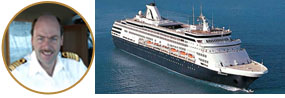
The agent had predicted winds about 10 to 15 knots but when I lined the Veendam up for the anchorage it was blowing over 30 knots. The problem with San Juan del Sur is, when there is a strong wind blowing off the land, it first blows through a bay and then out to open sea. Thus it gets the chance to build up seas that roll out of the harbour. That bay is very shallow and thus a big ship cannot anchor in the bay but has to stay in the middle of the entrance. Even there, there is only about 20 feet under the keel.
With 30 knots of wind and a sea running, it was not possible to run a safe tender service thus I decided to wait. Maybe things would improve. So for the next two hours I kept the Veendam in position; with the nose in the wind and watched intently the wind meter. Instead of the wind dying off, it only increased in velocity and we observed gusts of up to 50 knots an hour. That is no place to be with a ship in a location with rocks on either side, rocks only about 500 feet away, and thus in close proximity.
On top of that, there was a low ocean swell running from the south, out of the Pacific, that made the ship pitch (move up and down) while at the anchorage position. This all together resulted in a wave moment along the tender platform of 2 to 3 feet ON THE LEE SIDE and thus it was impossible to have tenders come alongside. Apart from that the shuttle from the ship to the tender dock ashore, would have resembled a trip in a washing machine on slow spin and that would not have been safe either.
Thus, as the wind was only getting stronger, I was forced to cancel our call at San Juan del Sur by 0900 and let the Veendam blow away from the anchorage; turned around and headed for open sea.
Not very pleasant; but safety comes first. We are now on very slow speed to Puerto Chiapas in Mexico and will have two days at sea to get there. Unfortunately it is not possible to do a substitute port. All the nearest ports, such as Corinto in Nicaragua or Acajutla in El Salvador are cargo ports with no infrastructure to service a cruise ship with 1200 guests on board. A secondary problem is that with now a days security, most ports demand 48 hours or more pre-clearance for the papers and manifests and thus the days of a quick deviation to another port are virtually over.
So we are all now sailing not on a “slow boat to china”, but on a “slow Veendam to Puerto Chiapas”, the day after tomorrow.
April 21, 2008 at 1:53 pm
Good Day Captain Albert,
I am a long-time fan of your blog. It is great that yu go into detail regarding the operation of your ship. I am an ex-US Navy sailor so I appreciate your comments about life onboard.
I have a question. I would like to sail with you on the Veendam in Spring 2009. Can you give me your time aboard next spring?
If you do not want to answer in this forum could you e-mail me your dates for next year?
Thank You so much,
Rich