Today I had my ‘battle” with the Gulf Stream. Before Charleston I had been downloading charts from the NOAA for the location of the main current of the Gulf Stream. This is called the Axis. Sometimes this location is given or sometimes the East or the West “wall” of the current. The knowledge of the location of the Gulf Stream is of acute interest to ships Captains as it helps with the speed.
If a ship is northbound through the Straits of Florida you will try to find the location of the maximum current as it can give you up to four knots of free speed. When you are southbound you try to find the edge of the current so that you have the least current against you. The Gulf Stream normally runs with a velocity of four knots at the maximum near the Miami area but it can be more during full spring tides and it can be more when the wind is blowing with the current. In the same way it can be less during neap tides and less when the wind is against the current.
This time it was not good for us. The wind had blowing from the SE to SW for awhile thus strengthening the Gulf Stream. Based on the Gulf Stream observations from the NOAA, I had brought my courses as close to the East coast of Florida as possible but for most of the day we had 2 to 3 knots against us, sometimes four. Thus while making 19 knots on the engines; the ships actual progress (that is called the speed over the ground) was more like 14 or 15 knots. Four knots were caused by the Gulf Stream running against us and another knot of speed reduction was caused by the wind which was blowing with a velocity of 25 knots against us as well. It was not until passing Ft. Lauderdale that the axis of the Gulf Stream was in synch with the observations of the day before and the ship started to get out of the current.
I was on the bridge for most of the evening, while we passed Ft Lauderdale and Miami. When sailing close to the coast to avoid the current there is not much room to avoid other ships by changing course alone so you might have to slow down. Ships coming in from starboard have the right of way and with the ports of Cape Canaveral, Ft. Lauderdale and Miami on the starboard side, there is a fair chance that there will be a ship coming out of the port and that ship has the right of way. Slowing down if needed, we do of course, but it costs time and speed and thus I like to be there to support the navigator in his decision. However all was quiet, the cruise ships has long since departed, the Sunday sailors were at home having their cocktails and most small craft stayed in because of the rain.
There were numerous thunder storms in the area and the rain clouds had been hanging over the Miami area all day. You never know with thunderstorms whether they come with a lot of wind, with a little bit, or with none. We can see the rain on the radar but not the wind. Also if there is wind inside the rain cloud, it is hard to predict from which direction it will come from. This time we had one coming over with a lot of wind but for a very short period. Within 30 seconds, the wind strength rose from ten knots to 60 knots and the wind direction suddenly changed from SE to West and caught us full on the beam. This makes a cruise ship lists considerably. But there is a plan and a remedy for this. You can either steer into the wind, if the wind direction is close to the ships heading or you can steer away from it. Plus you make an announcement (sorry for the people who were watching the show) for the guests to be careful for the short period that the ship lists.
If you turn the ship into the wind, the listing stops as the wind then hits the bridge superstructure face on. If the wind is full on the beam it takes too long to turn into the wind and then the trick is to go the other way.
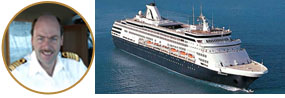
When a cruise ship changes course it lists over because of the turning momentum. Thus we always turn nice and slow or if a fast turn has to be made, we slow down first, as less speed means less momentum and thus less list. You can use this ship’s natural list to counteract the list caused by the wind and that is what we did. By making a fairly quick turn, the ship listed into the wind, the wind blew against it, they counteracted each other and the Veendam was back straight up again within no time. Within 10 minutes the rain storm has passed and we slowly returned to course all the time nicely straight up.
By midnight we were passed Miami and by sailing no more than 10 miles out of the coast we were out of the Gulf Stream influence and back up to our 19 knots of speed
October 20, 2007 at 7:45 am
Dear Capt. Albert: I am SO enjoying reading your daily blog about your voyage. My mother, sister, partner and I are booked on the November 25 Veendam cruise from Tampa, and I feel like I have already learned so much about the “behind the scenes” ship operation. Look forward to meeting you in person!
October 20, 2007 at 12:48 pm
Captain Albert –
My parents and sister cruised with you this summer from Venice to Copenhagen. They learned about your website while onboard the Veendam. I tried to keep up with their journey by finding webcams at your various portcalls or bridgecams from ships which were in port with you. Will you please comment on whether HAL is considering installing bridgecams on their ships? Most other major cruiselines have them. What are the pros and cons in your opinion?
Thanks for your informative postings.
Phil