The weather turned out not to be as good as I had hoped for. A frontal system had peaked up a bit from the south going higher up (or to lower latitude in this case as we are in the Southern hemisphere) than expected and it brought the occasional rain shower with it. It also was responsible for a wind direction change to the North West which was less pleasant. To safely anchor in Cumberland Bay you need both South Westerly swell and South Westerly Wind to have a quiet anchorage. However as the Wind was more WNW than NNW I had high hopes that the anchorage would still be sufficiently in the lee to make a safe tender operation possible. Thus I was happy that I had already decided before in the initial cruise plan to arrive an hour and a half early to have time to sort it all out without giving Murphy a chance to get involved with the planning.
The water in the bay is very deep and then becomes suddenly quite shallow. The best spot is where the German light cruiser Dresden sank in 1915 as it is completely in the shelter of the north Cliff. However anchoring on top of a wreck is not recommended and thus that spot has not been available since 1915. Thus you have to stay further out and that brings you outside the direct lee of the North Cliff.
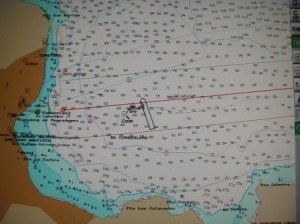 This is as close as you can safely anchor without swinging your stern over the shallows behind a stretched anchor chain due to a sudden wind change or getting your anchor entangled in the wreck of the Dresden. The little 3 vertical stripe mark just north of the red line near the depth number 60 indicates the position of the wreck. The other anchor positions in the chart are for smaller ships or for captains with more trust in the weather.
As the wind was more WNW then NW, the cliff still gave enough protection to park the Prinsendam where I wanted it. Deep water means 60 to 70 meters or around the 200 feet. To deal with that depth we lower the anchor into the water on the winch instead of just letting it “run out of the pipe”. If you let such a length run freely, the chain gathers so much momentum that the anchor brake cannot stop it anymore at the desired moment. Thus the anchor is gently placed on the ocean bottom and then sufficient chain laid behind it. We ended up with nearly 720 feet of chain outside the pipe to ensure a good grip.
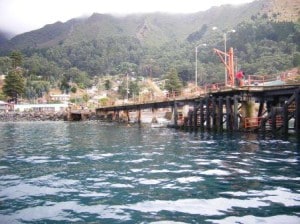 The tenderpier of Cumberland Bay. That it is why we have the word explorer in the ships nickname.
The next challenge was the tender pier. They have a very strong one but not a good one. 14 steel steps to get to pier level. Thus the first tender dispatched carried an invasion team of officers, sailors, carpenters and assorted Hotel personnel to set things up. To make it workable for the guests within the tidal range of the day the carpenter laid pallets for a better step off and step on and we had extra crew all day around to help guests up and down the stairs. Things ran smoothly there from then on.
For the ship at the anchorage it was a different story. The northwesterly wind produced sufficiently high waves that a good lee for the tender break alongside the ship was needed. At the same time the wind came sometimes full on the port beam (valley wind from over the island) and sometimes just poked around the cliff and came full beam on the sb side. Hence I had the nice job for the day to keep establishing and re-establishing the perfect lee for the portside tender break.
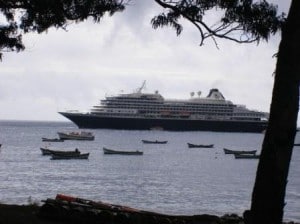 Calm waters according to local standards.Your can see the wave pattern along the ships hull.
Things became very interesting when the tide changed from ebbing to flooding near lunch time. During the ebb, the current was consistent and under the same angle. However at the change a sort of eddy was created in the bay and the ship moved all over the place. For half an hour tender service was hampered while I tried to get the Prinsendam back on the right spot again as a suddenly strong current pushed the whole ship slowly to the North. As soon as the current settled, I could reestablish the balance between all the nature’s elements that wanted to play with the ship and we had a good afternoon. Only the occasional, short, shower marred a very good day. According to the locals this was a perfect day for a cruise ship call, so I wonder what conditions are like at the anchorage on a “less then perfect local day”.
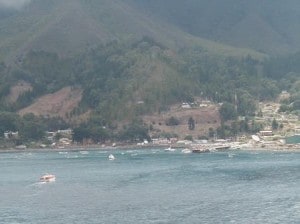 View from the Bridge; a ships tender on the way to the dock. All photos, except this one, courtesy of roving reporter Lesley Schoonderbeek.
After departure se sailed around the south Cliff, where we had a beautiful view into a heavily (by rain water) eroded valley with exactly one, single house, standing at the estuary of the river exit. Closrd in on three sides by high cliffs and the Sea on the fourth side. No worries about noisy neighbors. Tonight and tomorrow we will have a wobbly ride back to the Continent and then we start our Chilean Inside Passage.
Comments from the guests ranged from “quant, to peculiar, to fascinating” and the general consensus was that it was a great call for our sort of cruising.
February 8, 2010 at 1:35 pm
Dear Sir,
Unfortenately I can not comment officially about the virus although we are doing well. My comments could easily be lifted out of its context by people. Hence my ruling for my blog is, to leave these sort of communications to our PR department. I would sometimes love to set a record straight when I read incorrect information being published but as a captain I do not make policy, nor publically defend it. I just execute policy.
Thank you for taking time to read my blog and I hope you enjoy reading about the voyage around south America.