At 4 am. my wakeup call came and 15 minutes later I was on the bridge seeing that all was well in the world. No wind, low swell, all navigation lights (buoys and leading lights) were working and visible for over 10 miles away. It was a chilly morning for local standards with a temperature somewhere in the low seventies. When the pilot came on board he complained about it. It did not help him either that he came on the bridge of the Statendam which is chilly at all times, as that is what all the electronics like. This time we had a very chatty pilot who kept talking about having been to Holland, England and all over the place during the time he was in the navy. It made it somewhat harder for me to concentrate on bringing the ship in but at least he did not interfere with the process itself.
We learned the interesting fact that all pilots have to have a navy background in Guatemala and also the peculiar situation that the Navy’s head office that controls the ports is not located in a port but in the capital, 100’s of miles inland. For a country as Guatemala that might make sense as it has a number of smaller and larger ports with in each a number of patrol boats. There is not much of an offensive navy that can project power into the deep sea and so there is no need for a big centralized navy port. Thus the logic of the navy here was that you have to be from the navy to become a pilot because at least you then know the port. What you are missing is the experience of having sailed on merchant ships and understand their culture. That is not an un-important aspect of the job, as the difference between a cruise ship and a bulkcarrier can be bewildering. So when a cruise ship comes in, with all its bowthrusters, stern thrusters and other gadgets it is an easy gig for the pilots and great interest is displayed in coffee and filling out paper work. When a bulkcarrier comes in, with just one main propeller and a captain that spends more time at sea than going in and out of port (with a cruise ship captain it is of course exactly the other way around) then they have to step up to the plate and get those ships in and out of port. The port of Quetzal is for a large ship not an easy one. You have to make a 90o turn in the breakwater and that becomes 180o if you want to back towards the cruise terminal and 270o if you want to dock portside alongside the cargo terminal.
Our plan was to go portside alongside the cruise terminal and that meant an 180o turn. During our last call the cruise terminal was occupied but this time we were all alone and thus we went. The chief officer wanted portside for his lifeboat drills so he could lower the boats into the water. For me not much of a difference as it meant either swinging on arrival or departure. Doing it on arrival was even better as it would mean a faster departure and that would be good as I need all the time I can get, to make Fuerte Amador on time. That place is located at the south side of the Panama Canal and here we have an evening stop for tours going to Panama City. During the planning of the approach I had figured out that if wind and current would not spoil it, I could make this turn basically with one rudder command, while gradually slowing down the speed from 5 knots at the break water to stop for the moment that I would have start to go astern. It is always fun to try and see if your theory works in practice. It nearly did and my perfect arc was only spoiled at the last moment when a not expected current pushed the ship further over. After deep thinking the pilot came up with the conclusion that it must be from the river. It had been raining hard inland and now the river was “excited”. Compensating for an excited river I gave a bit more power astern and we happily docked at the cruise terminal.
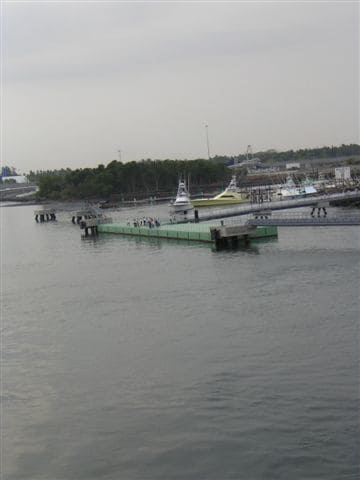
The green pontoon is connected with a movable catwalk to the terminal village ashore.
This is a floating dock with dolphins on either end. Puerto Quetzal can have quite a bit of tidal fluctuation, based on the sea tide coming in and the water from the rivers and thus they decided that it was easier to use a floating pontoon instead of having to build a big pier. I could not agree more, as there are many ports where we always have issues with our gangways due to the tidal movements. Having a pontoon that goes up and down with the ship solves all these issues. Although the port has a nice terminal area with shops, a museum and restaurants, we are mainly here for the tours to the Mayan ruins to Tikal. That is an 8 hour trip and as soon as the tour is back we leave again. So by 1500 hrs. we were racing out of the port and putting the pedal to the metal for a timely arrival in Panama.
The weather for the sea day tomorrow looks good with a bit of south easterly wind and so we should have a nice day at sea again.
Leave a Reply