For the first time this season, we had a quiet transfer through Tampa Bay with only a gentle breeze blowing in the bay. We embarked the pilot half way up the entrance channel as is the rule and then sailed with 15 knots, full maneuvering speed, into the bay.
Although for the first two hours there are no speed restrictions in the channels, I like the ship to be able to slow down without a delay, as a speed reduction and stopping is the only anti collision option that I have. So I never go full out. Smaller ships with less draft can go outside the buoyed route but for most ships you have to stay inside the buoys and then stopping is the only option in case of un-expected traffic or a Sunday sailor in a pleasure boat.
If I go higher than 15 knots, I have to give notice. This means that the engines need time to reduce the power given to the electric motors. When an engine has to give the maximum output possible, the temperature of that engine goes up and it is better that this goes slowly, slowly both ways. This increase of speed, increase in power, is regulated by a computer program and that takes about 20 minutes to go from full maneuvering to maximum. In case of an emergency you can always slow down rapidly but it is not very good for the engines. This is in the same way when applying the brakes on your car while doing 100 mph. It works but the car does not like it. So in the channel I like to stay on speeds that will allow instant slowing down without having to worry about the engines.
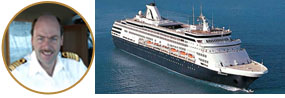
Another issue that relates to speed is going around the corners. There are a two, almost 90 degree turns in middle Tampa bay and if you go around them fast running at a high speed, the ship tilts or lists. Part of this is caused because modern cruise ships being so high above the water; part of it is caused by the fact the Veendam has Becker Rudders. Becker rudders have the advantage that they steer the ship extremely well because they block the flow of the water from the propellers almost completely. The Veendam has two rudders and each one sits right in the middle of the propeller flow. The force of the propeller thrust is fully transferred to the rudder and so to the ship and the ship starts turning at once and very fast and that causes it to list. So we slow down and with less thrust on the rudder and the ship changes course more gently.
Tampa Bay consists out of a number of channels. Some have a name and some have just a letter. The channel that approaches the Sun Shine Skyway from the sea side is called Egmont channel, then you have Molokai channel, the bridge and then it goes to A,B,C,D,E,F Cut, Gadsen Cut and Hillsborough cut. From there it splits up in Port Sutton, East Bay, Sparkman channel and Ybor channel. The latter two are where the cruise ships go through when going to the cruise terminals.
The channels are wide enough for ships to pass each other, although it does not look like it. 150 feet clearance between ships, going at 15 knots in opposite directions, is not that much from the dining room perspective if suddenly a big bulk carrier or a tanker comes into view. For the really big cruise ships such as the Carnival Legend, 1000 ft. in length, there is a no-pass-protocol and the channel is kept empty. This has mainly to do with turning the corners where a length of 1000 ft, makes it difficult to line up properly in the leading lights again. Each channel is covered by two leading lights in line, so the pilot can steer a mid channel course by keeping the two lights in alignment.
Nowadays the pilots have also a DGPS computer which tells them within one foot where they are in the channel; how far they are off the centre line and where the other ships are in the bay. Also they have a predictor in the display software that can tell them where they will meet these other ships and at what time. So if necessary, the ship can speed up or slow down, and won’t meet another ship at the corner between one Cut and the next one.
Guests always want to know who is in charge, the pilot or the captain and is a pilot compulsory.
Answer to number one, the captain retains the overall responsibility and is in charge, the pilot has the safe conduct of the navigation. That normally includes docking the ship if there are tugboats involved. The port or country sets the requirements for having a pilot. Most of the time it is any ship over 300 tons and sometimes ships who fly the countries home flag are exempt.
The Dutch law under which I operate, stipulates the following: A captain will take a pilot when it compulsory, when it is customary and when it makes sense to do so. Customary means, if a port has a established pilot station with umpteen pilots and pilot boats, you shall take one. When it makes sense……….well that is a totally different story.
So for Tampa bay it is compulsory by US law and it is also customary by Dutch law.
It makes sense as well as it is not an easy port. The Tampa bay pilots work under numbers. Each one is a unit. The most senior is unit 1 and the cadet is unit 23. Problem is that when nbr 1 retires, nbr 2 becomes nbr one on first of January of the following year. I know most of the pilots quite well and it confuses me and a lot of other people, not to mention the pilots themselves, when suddenly nbr 5 is not unit 5 anymore but unit 3.
We are getting ready for our 14 day around the Caribbean cruise, hopping from island to island.
November 5, 2007 at 4:19 pm
Captain Albert: Once again thank you for taking time to keep us informed. We are quite interested in hearing about the ships and ports procedures that you as the Captain go through. We are sailing on the Veedam in February 14 day.
Once again
Thank You for your time
Kevin and Kathy Dearmin
Sandpoint, Idaho
November 6, 2007 at 3:27 am
I’m surprised to learn from you how complicated travel thru Tampa Bay can be for your ship. I had no idea there were so many carefully controlled channels. This is a very interesting posting and fun to read. Thank you so much.
November 29, 2007 at 4:21 pm
While having cocktails in the Crows Nest Sat. eve. we noticed the ship had reduced speed to a crawl and then an oncoming vessel passed to port seemingly at a rapid pace. I thought it rather strange at the speed of the other vessel in a constricted channel.