- Captain Albert's Website and Blog -

Ocean Liner History and Stories from the Sea, Past and Present. With an In Depth focus on Holland America Line

Page 71 of 241

19 Nov. 2016; Key West, Florida, USA.

We managed to get out without much delay and thus we could keep the schedule to Key West. It meant a full-out run until the Key West pilot station. As the keys are very low laying there is not much shelter when a strong wind is blowing over it and that is always of concern. And we had a strong wind out in the open Straits of Florida. Also what blows in open water is not necessary what blows inside, neither in strength, nor direction, and thus we are always a bit apprehensive when getting there. The pilot normally gives an update when he is coming out with the pilot boat but his boat is not more than 10 feet above the water and our superstructure is considerably higher. But today we had our own little weather station in port by means of the ms Nieuw Amsterdam who had arrived ad 07.00 hrs. and was docked at the Navy Pier. For the ships the safest pier to dock at but for the guests the worst one as you need a little train system to get you to the gate and then it is still quite a distance to downtown.
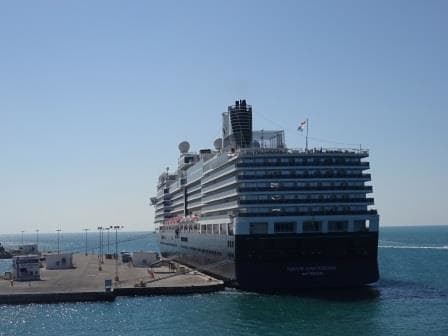
How nice, the ms Nieuw Amsterdam all the way alongside the dock.

How nice, the ms Nieuw Amsterdam all the way alongside the dock.

Key West has three piers for cruise ships, Mallory pier opposite Mallory square, you cannot get more downtown than that, then there is B pier about a block away from Mallory and then there is the Navy pier quite a distance to the south.  For docking all the captains love the Navy pier. The ship rests all the way long the dock and there are bollards galore to safety moor the ship alongside.  Mallory and B pier are not very good in that respect. They are T piers with a few bollards on dolphins to keep the ship alongside. The longer the ship, the harder it is. Mallory is almost too small for the S class let alone for a Vista class ship such as the Oosterdam.  The B pier has a longer T form and thus more of the ship rests alongside but still it is not that great. At the bow you can set fairly good head and spring lines but aft it is mainly spring lines which mean the ship is not very happily docked if the wind comes from the South East. On such occasions the aft thruster or the outer Azipod has to remain on to act as a tugboat.
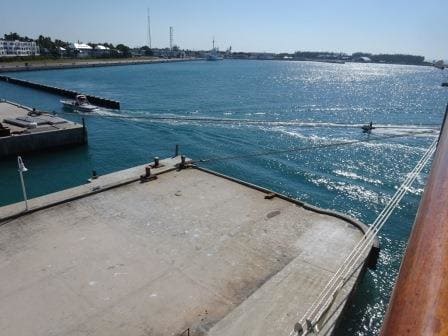
All our stern lines were facing forward. Even the ones set on the next dock. Safely when the wind is from the right direction, a challenge when it is not.

All our stern lines were facing forward. Even the ones set on the next dock. Safe when the wind is from the right direction; a challenge when it is not.

Still we happily docked this morning and as the wind remained from the NNE and thus mainly pushed against the springs so all was well in the world.  Key West is a rather unusual place and it has a sort of love hate relation with the rest of the world and that includes us. Roughly 50% loves us and the other 50% has objections to our presence to varying degrees. This also affects our sailing time. The Nieuw Amsterdam, docked at the Navy pier, can leave whenever it wants to but we at B pier have to leave either well before sunset or well after sunset.  A highlight of the day in Key West is assembling on Mallory Square, watch the sun set in the bay, and then join in with the fun-fair on the square with huskers, fire eaters, art (sometimes) for sale and anything else in alternativety that arrives on the square by bike, pushcart or children’s pram. Great fun for everybody and then a cruise ship can be a party pooper. Both leaving from Mallory and from B pier we have to swing in the turning basin to get out and that is exactly where the sun goes down.
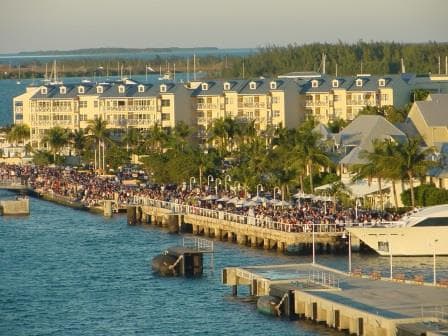
Gathering for sunset at Mallory and B pier. This photo was taking during a departure when sunset was not affecting our schedule.

Gathering for sunset at Mallory and B pier. This photo was taken during a departure when sunset was not affecting our schedule.

This evening all on board is at 17.30 hrs. and sunset is at 17.39 hrs. So we cannot sail before the sun is well gone and everybody is turning away from the dock side.  Even if all the guests were early back then we would have to wait. This cruise we have a very diverse public on board and some of them are diverse enough to not be in a hurry to get back on board. So I expect that we might not be getting out as scheduled. Not that it matters, to make our next port in Mahogany Bay on time, we only have to sail with a speed of 16 knots and thus we have ample time up our sleeve if needed.
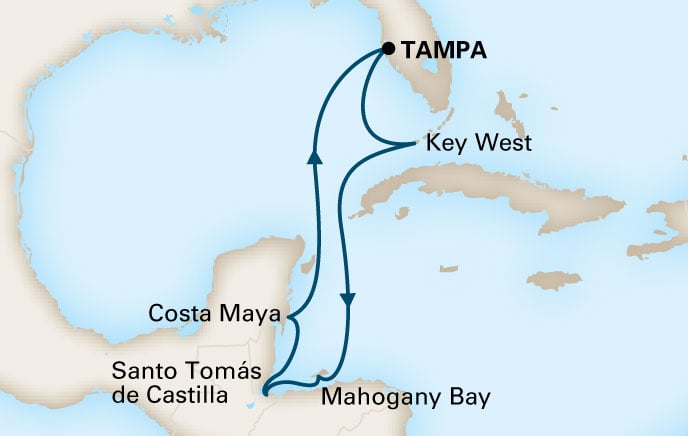
Our intiniary; 7 days West Caribbean.

Our itinerary:  7 days West Caribbean.

Tomorrow is a day at sea while we follow the coast of Cuba South Westwards and we will enter the Caribbean Sea tomorrow morning around 06.00 hrs. when we have passed Cabo San Antonio, the most westerly point of Cuba. Officially the area is called the Yucatan Channel but that is only a local name for the part East of Mexico.  We are making a 7 day cruise from Tampa, calling at Key West, Mahogany Bay on Roatan, followed by Santo Tomas de Castillo in Guatemala and finally Costa Maya in Mexico. Our next cruise, starting on the 26th. of November will be a 14 day around the Caribbean cruise.
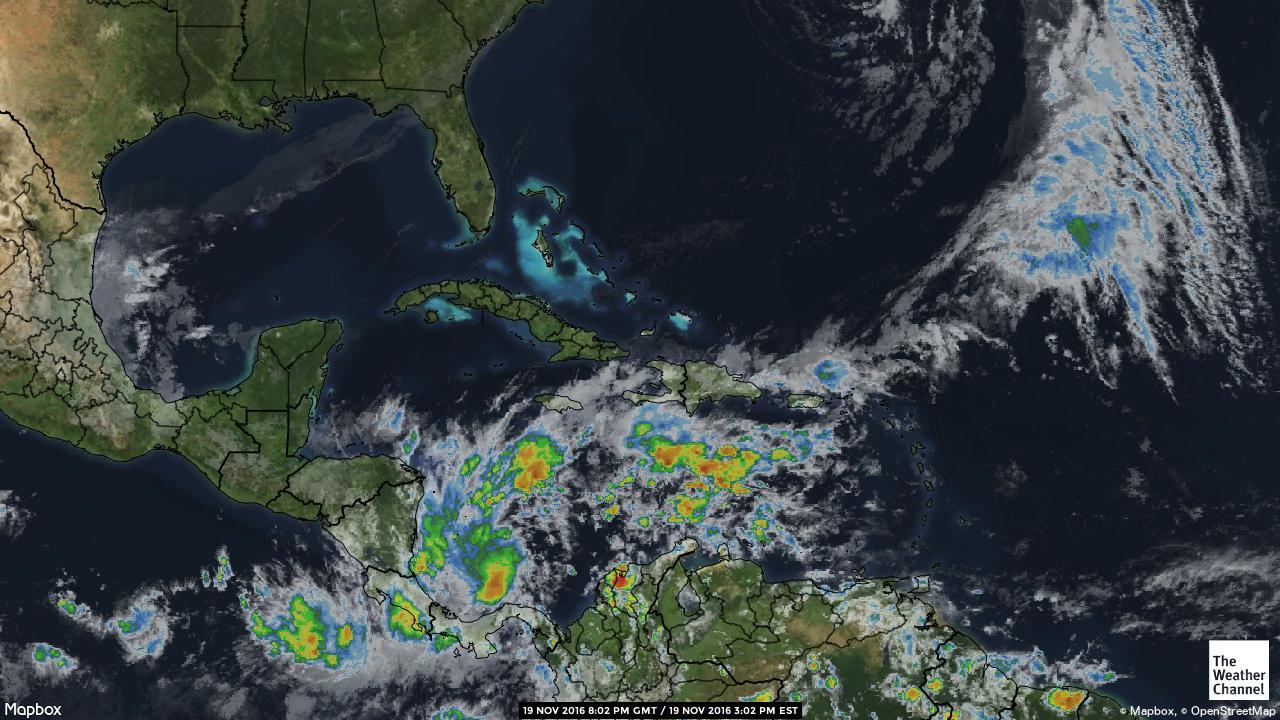
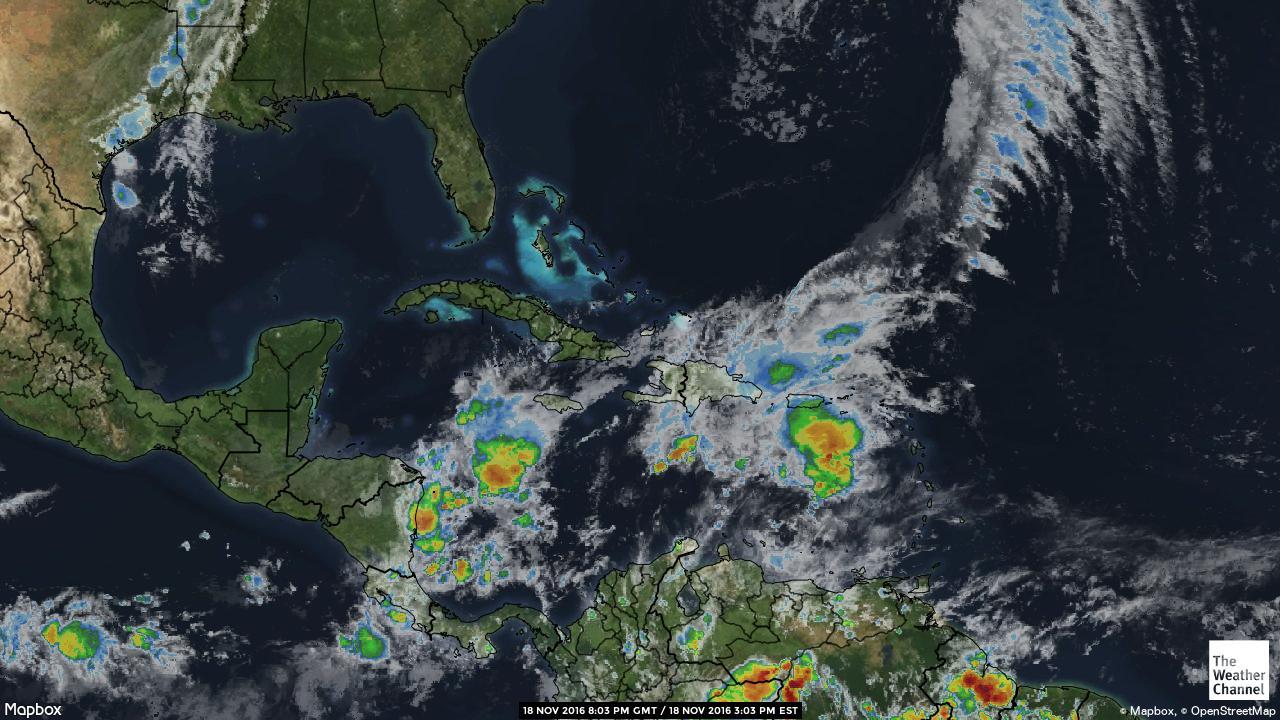
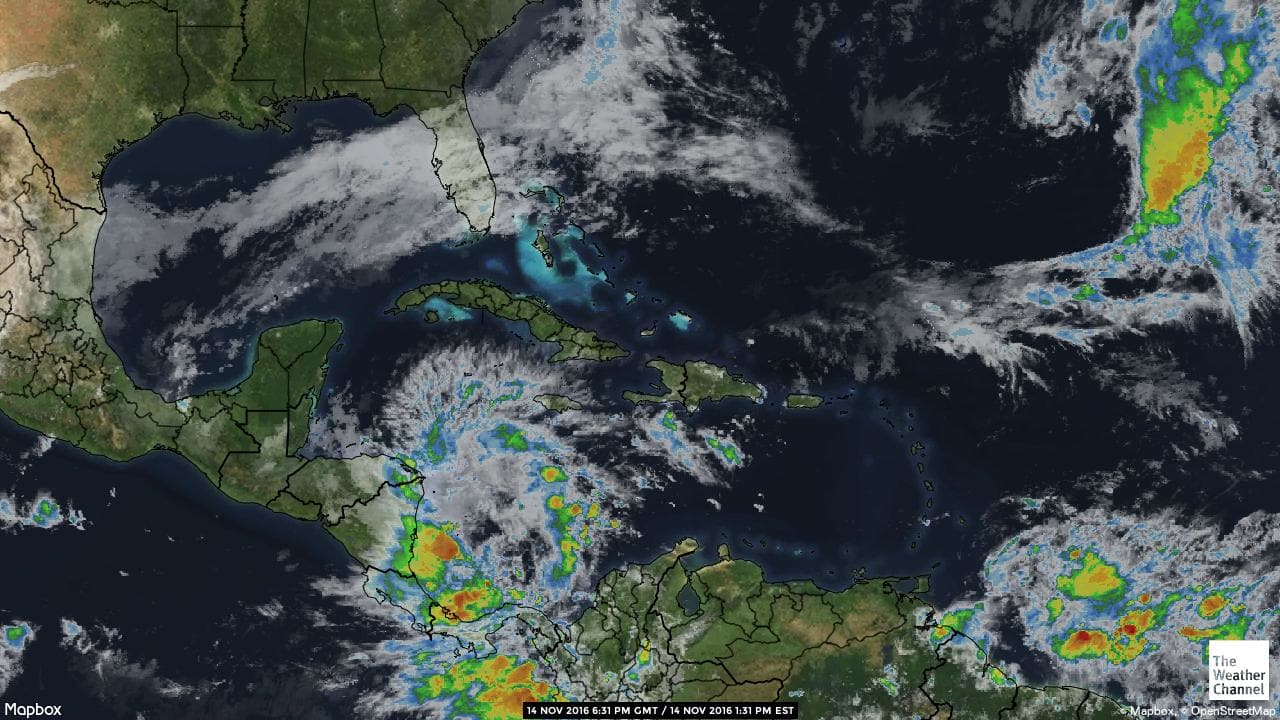
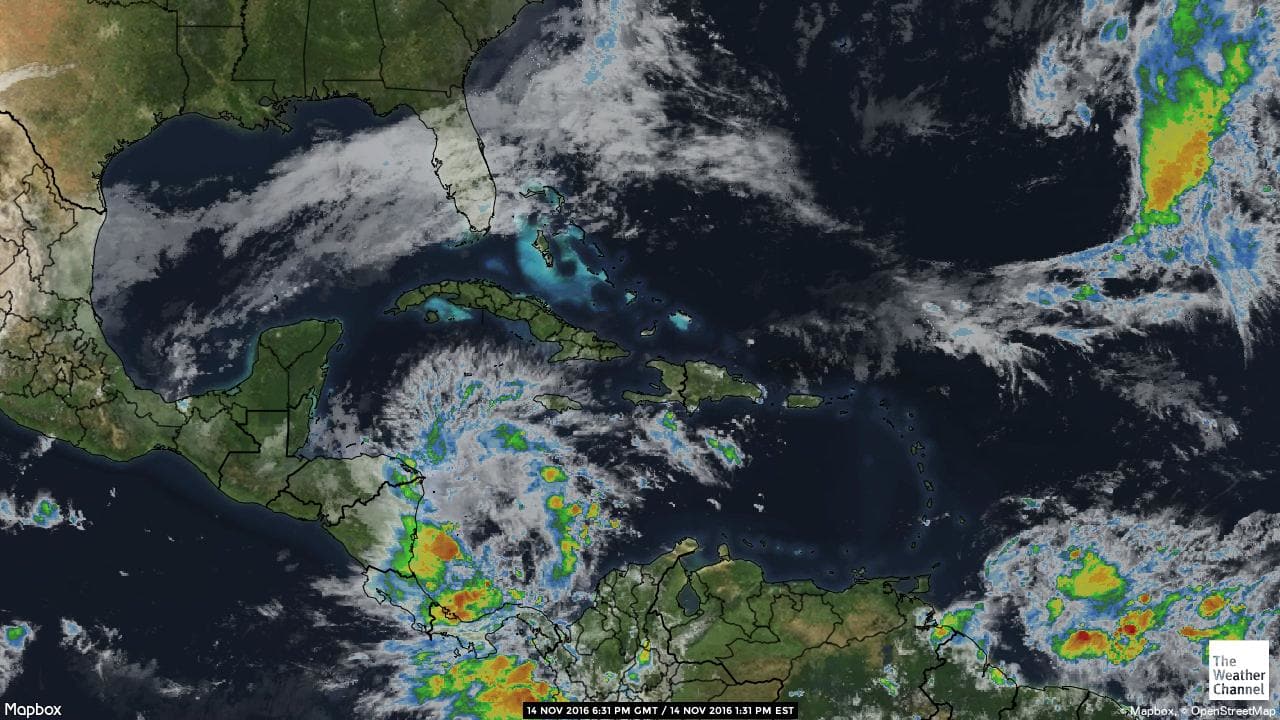
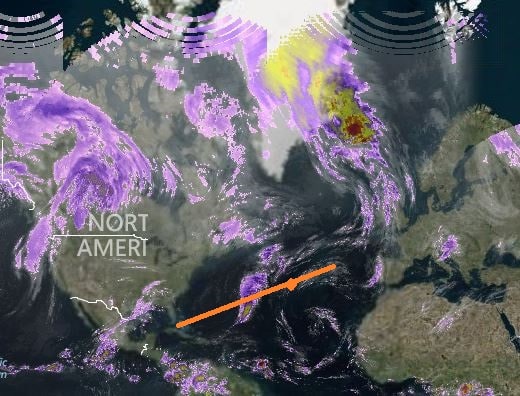
What is green, yellow and red is rain, dense rain. Grey is only overcast or light showers.

What is green, yellow and red is rain, dense rain. Grey is only overcast or light showers.

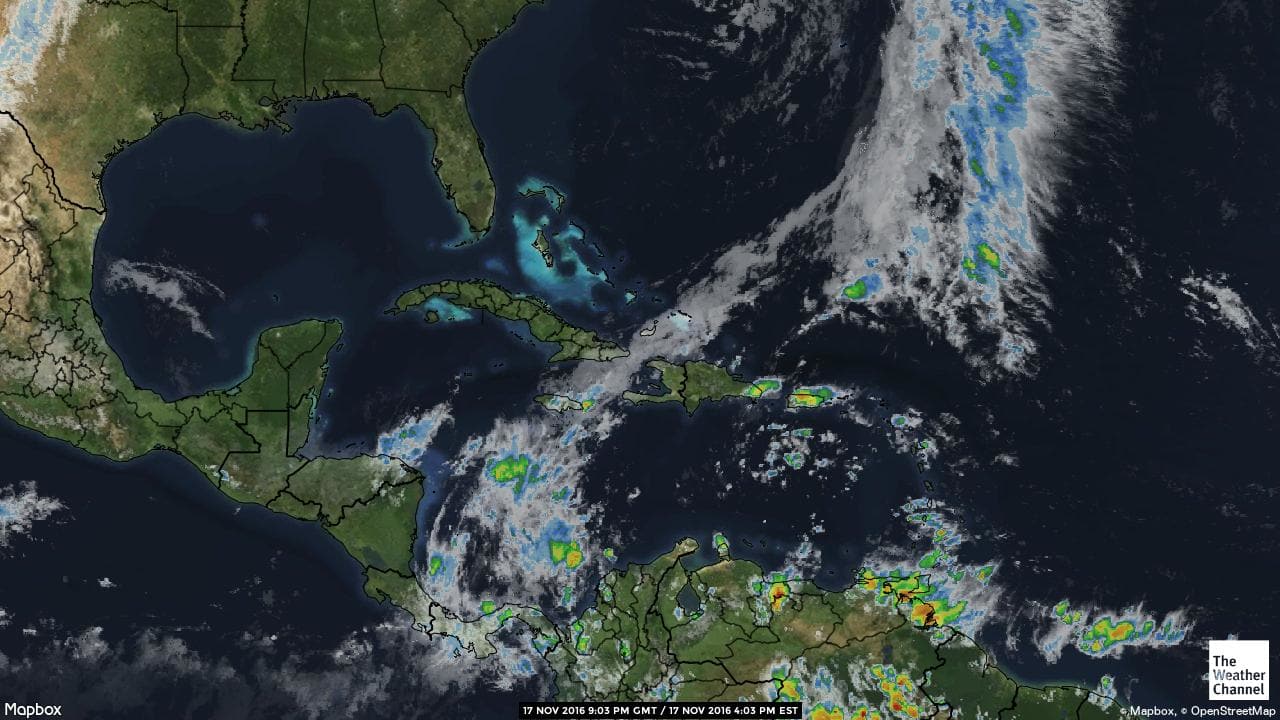
Our eyes are still on Otto. Otto to be or not to be. The weather gurus keep hedging their bets. At the moment, what could become Otto is now called 90L, but it is still not a real depression or worse. But if you compare todays picture with yesterday‘s then you can see that the circle of strong rain is getting tighter and tighter now and that is not good news.  It will take some time to completely develop but it is already bringing a lot of rain and stronger winds to the area where we are going. My estimate is that we will make the ports of Mahogany bay and Santo Tomas before Otto wakes up and then we will sail back ahead of the system.  Still you never know, so we stay alert.

For tomorrow we have nothing to be concerned about. Clear skies, regular Trade Winds and temperature in the high 77’s.

Our latest input from the Hurricane Centre:

Our focus this weekend remains in the far southwestern Caribbean. A broad area of low pressure, labeled 90L, has remained disorganized and it will likely remain so during the next day or two. However, conditions early next week can become more favorable for organization. It is then that there could be a depression or even tropical storm forming. If the latter happens, it would be named Otto. If development occurs, the main threat looks to be Central America late next week.
18 Nov.2016; Tampa, Florida–USA.

With nice weather and according to plan the ms Oosterdam arrived at the pilot station of Tampa Bay. Normally the pilot boards a ship at the entrance to the port or at an enclosed area but not here. The sea buoy is nearly 12 miles away from where the land really starts and the pilot boat is not coming that far outside. Thus the ship itself enters the fair way with buoys at either side and then when it comes to buoys 9 and 10, the pilot boat pops up.  From there the voyage continues under the guidance of the local pilot.  This pilot not only provides service for those ships which go to Tampa but also to Manatee and all the other docks and locations in and around Tampa Bay.

When the pilots are on shift duty, they stay in a number of little bungalows grouped around the pilot dock at the island which forms the boundary with Tampa Bay.  Sometimes they pilot a ship in and out and then return to their bungalow for some down time. But an in and an out is only possible if it fits in the maximum length of a shift time. When a ship goes all the way to the end of the Bay (such as we do as we go to the cruise terminal) then the pilot normally goes home and quite often we see the same pilot coming on board again for the outbound journey as we had for the inbound journey. He/she has then had more than 8 hours of rest and is well rested do the four hour stretch again back to sea.

From pilot station to dock was exactly four hours as the ms Oosterdam came alongside pier 3 in Tampa just before 06.00, the time which our agent prefers as it works well with the clearing process and the timely start of the unloading of the luggage. And with the unloading of the luggage this voyage really came to an end.  Normally the crew takes a turn over day in their stride but a first arrival in the USA after coming from a non USA port and after a long season away fills the crew with apprehension, as it brings with it a lot of extra work.

Thus we had the turnover, which is a full day’s work itself, and then there was the full crew inspection which takes work time away. The CBP / immigration rules require that crewmembers go through a full inspection every 90 days. Thus during a first call of the season it is a compulsory performance that we cannot get around. Today CBP was really stretched in clearing the guests and that delayed the crew inspection as well. But there was hardly any crew who could go ashore today and it being early or late did not matter that much this time.  No time to go ashore as apart from the crew inspection we also had USCG and USPH on board. Both for their mandatory inspections. However they also saw the amazing amount of things going on and thus they have split up their inspections. Today the USCG inspected the safety features of the ship and next cruise they will come back to observe the all crew lifeboat drill and the Guest lifeboat drill. USPH will also return for a more complete and regular inspection.

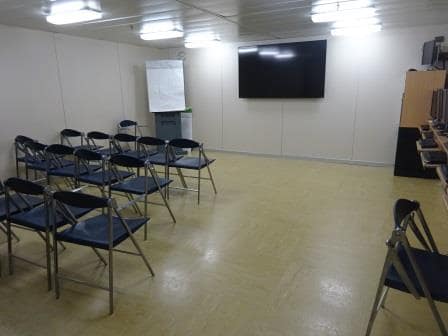
The training room on the ms Oosterdam. 40 seats for class room use and to the right , computer terminals for self study and certification.

The training room on the ms Oosterdam. 40 seats for class room use and to the right , computer terminals for self study and certification.

Then we did not have all the crew available during the day, as almost 10% went on their well-earned vacation.  The new crew coming on board cannot start working until they have gone through their safety indoctrination and by that time it is lunch time. So it is not before 13.00 hrs. that the whole crew is back in full swing. Just in time to start looking after 1800 hungry guests descending on the food outlets and 3600 suitcases being loaded.

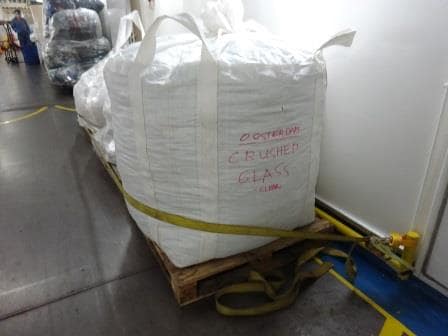
This is a recycle bag for glass. All glass bottles and jars are crushed on board, separated by color and then send ashore for reuse. Money earned goes in the crew fund.

This is a recycle bag for glass. All glass bottles and jars are crushed on board, separated by color and then sent ashore for reuse. Money earned goes in the crew fund.

After a crossing, which means at least 14 days since a home port, there is heavy loading regardless of what ever pressure there is on the rest of the ship. Recyclables accumulated over 14 days have to go off and as the guests have eaten the store rooms empty, a full loading needs to take place. Normally a full loading takes place every 14 days but after a crossing you cannot postpone it because there is hardly anything left on board.

Tomorrow we are in Key West and it is a tight run to get there on time. Pedal to the Metal it will need to be. But it will be another sunny day with noon time temperatures of 79oF / 26oF.  with a moderate breeze throughout the day.

The weather gurus are still predicting a Tropical Storm to form in the south of the Caribbean but Otto is not in a hurry.

All eyes are on Otto to be. Will it become an Otto or will what was to be an Otto fall apart?

All eyes are on Otto to be. Will it become an Otto or will what was to be an Otto fall apart before we can call it Otto? It is around but the circle is not closing so not Otto yet.

As per Hurricane Centre for 18 November:

A disorganized area of showers and thunderstorms associated with a broad area of low pressure sitting a couple hundred miles east of Nicaragua will struggle this weekend against shearing winds aloft. This area will become more conducive for tropical development early next week as the environment becomes more favorable. Once this system becomes a depression, it should continue to intensify and there’s a good chance this system will become Tropical Storm Otto next week. During the past 20 years, most storms that formed in the southwest or western Caribbean went on to become hurricanes. 


17 November 2016; Trans –Atlantic Crossing, Day 8.

Today is the last day of our Trans – Atlantic crossing. Although I counted 8 days, it was really 10 if you include the call at Funchal and the sea day before.  Also today is not really a Trans – Atlantic crossing day but more a “sail around Florida” day.  We could see the first part of the Florida coast this morning around 02.00 hrs. when we came out of the North Providence Channel and then it came closer and closer as we crossed the Florida Straits near Fort Lauderdale. By 09.00 hrs. we were south of Key West and by noon time we had started the turn around the West side of the Dry Tortugas. Now we are on a nearly straight northerly course heading for the sea buoy at Tampa. We should be there tomorrow morning around 01.30 hrs. with a 02.00 hrs. pilot pick up. Then it is four hours to the dock with the plan to be alongside by 06.00 hrs. Today we had a very sunny but windy day but the wind is supposed to die down in the evening hours to a gentle breeze. On the whole we have had a VERY good crossing for November with on average very smooth and sunny weather.  no doubt some people will be disappointed as they were hoping for a real storm but most guests will be very happy with what the last 8 days brought.

The ship is only doing about 16 knots, while our average crossing speed was 19 knots. But all the way across we had a little bit of current in the back and that helped nibbling down our average speed to maintain. The bridge reported not too much adverse current while sailing under the Florida Keys today which means that the Gulf Stream axis was today quite a bit more to the Center of the Straits.  All these positive results also made it possible for the captain to come in a bit earlier and to be docked by 06.00 so the CBP can do its pre boarding. In Tampa they like to do that; a sort of pre inspection which ensures that when all the other Inspectors arrive by 07.00 hrs. things will run smoothly. Although the CBP is federal the local supervisors have a lot of independence and that means that every port has its own routines. That can be a bit confusing if you do not have a standard US home port but for Tampa it works quite well. Once you know the way they like it, it is steady going for the whole season.

Tampa is talking all the time about building a new cruise terminal outside the Sunshine Skyway Bridge, which would make it possible to have higher ships come to Tampa. Now we are limited to the bridge clearance height which for the Oosterdam will be about 10 feet tonight. We as captains would love that as well as it would shave 3 hrs. from the transit. But they are still talking and not much is happening. A long long time ago, in the 1980’s, there was a very small cruise ship called the Vera Cruz which docked in the port of Manatee just behind the Sunshine Skyway Bridge but Holland America who arrived in 1982, has always docked at the top end of the port.  The port is also a bit too small for larger ships. First we went to the Holland Terminal (very appropriate name) and then some bright spark built a cruise terminal but did so in a not very clever place.

To get to the Cruise docks since then, we have to sail through Sparkman Channel, which is fairly narrow and often even narrower because of barges being docked alongside. This channel can be a real challenge when there is a lot of wind and that wind is mostly on the beam and so we drift. But the docks are there and until we get a cruise terminal outside the bridge we will have to go through the channel. Interesting for the guests to see on departure but questionable for the mental state of the captain. I have been in and out of Tampa well over a hundred times since 1993 and I am considered to still (fairly) be normal and thus our Oosterdam captain will also survive the run in and out. Still Sparkman Channel is not one of my favorite words.

Tomorrow is going to be a nice day with sunshine and high temperatures and very little wind. 84oF / 29oC and only 5 knots of wind. A little cooler would have been nice for the guests joining and leaving as lugging suitcases is hard work in the open with only bare concrete around.

Very nice weather around Florida and the upper Caribbean. And still a very dis-organized happening further south.

Very nice weather around Florida and the upper Caribbean. And still a very dis-organized happening further south.

In the meantime we are keeping an eye on the weather in the Caribbean. It still looks like nothing but the weather gurus are convinced it will become something. They thought that three days ago and they are still thinking it. They have even reserved a name for this Tropical Storm that does not yet exist: OTTO.

I quote from the hurricane watch website:

An area of low pressure over the southwestern Caribbean, a couple of hundred miles north of Panama, continues to produce a large, disorganized area of showers and thunderstorms. While it is currently poorly organized, favorable environmental conditions are expected over this area for tropical development, and a tropical depression should form this weekend or early next week. Once this system becomes a depression, it should continue to intensify and there’s a good chance this system will become Tropical Storm Otto. During the past 20 years, most storms that formed in the southwest or western Caribbean went on to become hurricanes.

16 Nov 2016; Trans Atlantic Crossing, Day 7.

They always say the sting is in the tail and so it was today. After six days of an extraordinary quiet North Atlantic we had a wobbly day today. There was more rain and wind in the weather system that lays over Florida and stretches out to Bermuda and the wind whipped up the waves. So the ms Oosterdam is moving a bit on the waves and on the outside decks, especially on the portside it is a bit windy. It started this morning around 08.30 when we sailed into centre of the frontal system but by mid afternoon we were out of it and the sun was shining brightly again.

By that time we will also be entering the Bahamian Islands area and sail through North Providence Channel located between Nassau (to the South /portside) and Freeport (to the North / Starboardside). That will take us until tomorrow morning and then we will be in the Straits of Florida. We are crossing the Straits under an 45o angle so we cut  quickly through the Gulf Stream, which is not our friend this time, and then near Miami we should end up under the coast. By hugging the coast the aim is then to avoid the axis of the Gulf Stream and even hope for a bit of counter current caused by water which flows back. A natural thing as otherwise there would be holes in the Straits of Florida as the 4 mile current would take all the water with it.

The NOAA gives daily advise about the approx. location of the west wall of the Gulf Stream, then the axis is another 4 to 6 miles or so to the East of it, at least in the area of Key West. When the Gulf Streams curves to the North following the Florida coast it comes much closer to land. So we know that whatever luck we have, we will get a certain amount of current against us, until we are past the curve in the coast south of Miami. Hopefully the stretch to Key west and the Dry Tortugas will then bring some counter current.

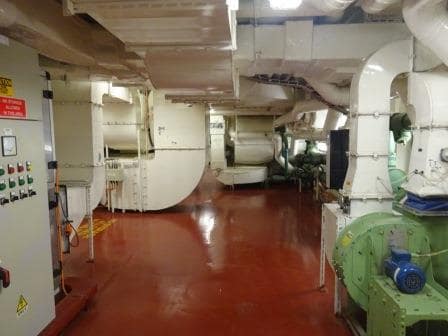
One of the ships AC stations.

One of the ships AC stations.

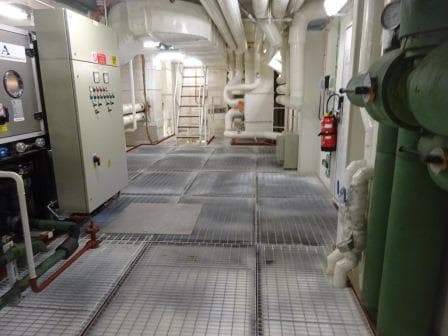
Today I carried out an inspection on Deck 1, the lowest guest deck and met a guest who was quite intrigued into what was hiding behind the doors I was opening and closing. So I showed him the entrance to our largest Fan Room on board, which runs from the Forward Guest staircase to nearly the middle staircase all the way. Here there are hardly any inside cabins, all is taken over by Space for the air conditioning and ventilation. Then they run up three decks as well, so there is this s large engineering space right inbetween the guests cabins where hardly anybody has any idea about.   I simply did not realize the significance of this but if you do not know the lay out of a ship very well, or the basic construction features of a modern cruise ship, then you have no idea about the vast spaces given over to the ships operation outside the Engine Room itself.

And this the next deck up. And then you can go another deck up. Here the floor is made by gratings which can be taken away if major maintenance has to be carried out.

And this the next deck up. And then you can go another deck up. Here the floor is made of gratings which can be taken away if major maintenance has to be carried out.

In the old days, the much less sophisticated Air conditioning systems were smaller units spread all over the ship. Now centralization has taken over which results in less space needed while still being able to get the output needed. The amount needed is calculated when a ship is designed and then approved by the regulating authorities. Sometimes that calculation is a little bit on the generous side and then when a 2nd ship is constructed of the same design, the tinkering starts. “We now have room here for an extra cabin, or we can put a locker there, or make the walk way a bit wider” and that is also one of the reasons why ships in the same class are seldom exactly identical. There is in the interior  – read operational – layout between the Zuiderdam , first of the Vista Class and the Noordam, last of the Vista Class, quite a bit of difference.

So tomorrow we battle against the Gulf Stream while keeping an eye on the activities in the South Carribean. For the time being it is still static there, no change from yesterday, and will not affect the weather in Tamp for our coming call.

jkjjk

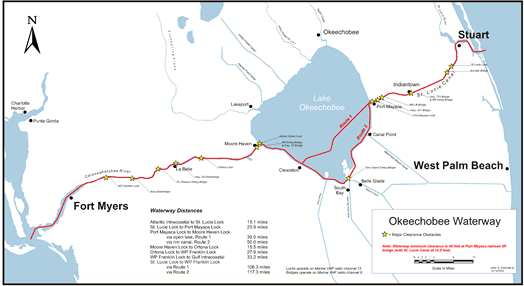
The Okeechobee Waterway, cutting up Florida in a northern and a southern part. It takes a good 15 hrs. to transit at least if you want to do it in one go. I wonder if they have pubs along the route as we have in England and Holland.

Then a correction from my side, I mentioned yesterday that there was no canal to help us get to Tampa without sailing around Florida. One of your good readers pointed out, there IS a canal. It is just no big enough for large ships. It is called the Okeechobee Waterway and runs roughly from 80 miles South of Cape Canaveral to 77 NM  South of the entrance to Tampa Bay. Maybe it would be something for Carnival Corporation to adapt the Canal to our needs. Although it would mean the upgrade of a lot of bridges and rebuilding of  quite a few locks as Lake Okeechobee is fresh water. A sort of mini Panama Canal so to speak.


15 Nov. 2016; Trans – Atlantic Crossing, Day 6.

Today we have another glorious day at sea. The low swell of yesterday has diminished somewhat and now there is for even the most persistent moaners and groaners very little to grumble about. (That does not stop them from doing so but the weather is absolutely not giving any reason to be negative)

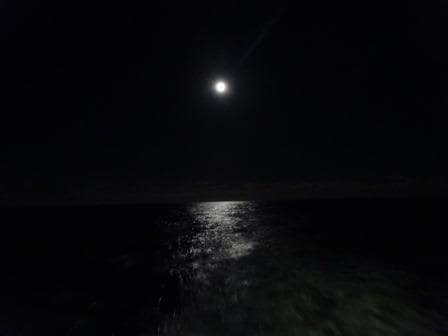
I went on my fact finding mission last night to see the Super Moon and apart from it being a little bit brighter I did not see much difference. Not bright enough to read a book by. I suppose with the vastness of the ocean, a 13% increase in size does not mean that much. So I took my photo and will file it until 2034 when we have the next chance. I do not think I will be in the same location then but on the other hand you never know. We have regularly 100 year old people on board so nothing is impossible. I think the oldest one on board this cruise is 93 years of age and still playing a mean game of Black Jack. There is always the chance to win enough to pay for the next cruise.

Supermoon from the stern of the ms Oosterdam. Just East of the Bahamas.

Super Moon from the stern of the ms Oosterdam. Just East of the Bahamas.

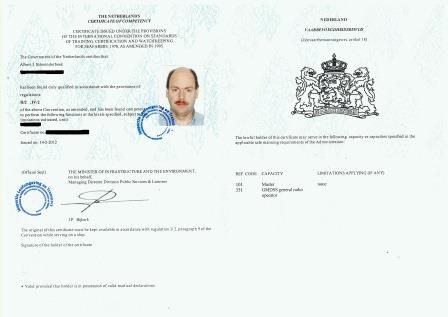
Apart from a myriad of other things which I am doing while on board a ship, one is the standard topic is reviewing on behalf of the Master of the Vessel, the ships mustering procedures. This entails checking if all the paper work of the officers and crew involved in watch standing and major safety responsibilities is correct and up-to-date. Captains have to check that as well, but it is so much and such detailed work, that the time is simply not always there. You think that it would be easy having all your paperwork in order; same as carrying your passport when you go on vacation. But we have so many that it can be a real challenge. Last time I counted I had 28 certificates or papers to my name which approved me to be proficient to do something or the other and that was outside of my Masters License. Apart from the sometimes bewildering numbers, the most important ones are issued by the Country of origin of the bearer.  But they must be compatible again with International Standards and that sometimes requires a cover certificate by the Flag State of the ship.  Then there were countries who issued exemptions for certain certificates which makes it even more complicated.

Ever wondered what a Dutch Master license looks like. This is it. Good for any size ship anywhere in the world.

Ever wondered what a Dutch Masters license looks like ?. This is it. Good for any size ship anywhere in the world.

To get things a little bit under control the IMO (International Maritime Organization) issued controlling standards and updated regulations under what we call the Manila Convention of 2010. Now by 1 January 2017 these 2010 rules will become compulsory and exemptions and national deviations are not allowed anymore. Our company, by means of the Human Resources people, has been working very hard to get everybody qualified or re-qualified before the magic date of 31 Dec. 2016. With about 9000 sea farers involved in our company that is not as easy as you think it might be as some of our crew are notoriously bad in following up and taking action during their vacation period. Even when all trainings are paid for and you get your lost days back again later. Even with a constant bombardment of emails, attacks on Facebook, one liners on twitter, there are still some out there who are hard to get out of their (beach) chair.

Thus on every ship I spend a day, going through the paper work, certificate by certificate, seaman’s book by seaman’s book. Looking if everybody will be in compliance by 31 Dec. 2016. Some crew will go home before that date and then they have their leave in 2017 to sort things out but for the rest there is the deadline and if not in compliance disembarkation will follow and no pay check until the person is back in compliance again. What I mostly find is that certificates have been left at home and/or only a copy has been brought to sea. It is quite funny to follow the hunt for these certificates. Wives at home who cannot find anything and then a domestic ensures by means of email; parents who refuse to search as son or daughter dear left such a bomb explosion behind in their room, that they have simply locked it. Then there are those who have no idea where they might have stored it.

There are always an amazing number of officers who have their certificates with them but have not signed them. An unsigned certificate is not valid, in the same way as if you not having signed your credit card. You can use it, until a clever clog turns the card around and then has to refuse it. (At least if they follow the rules) So I create some ruffled feathers once in a while but it is all in a good cause.

We have two days left at sea from today; of which 17 November will be spent sailing around Florida, due to the lack of a Cross Florida channel.

jjjkkj

We are sailing now under that grey cloud cover but there are broken clouds so we have sun as well. In the Caribbean, you can see the rounding presence of a possible Tropical Storm but the pattern is not solid yet.

For tomorrow the weather looks nice again but the weather gurus are still worried about the system in the South Caribbean Sea which has to potential to develop into a Tropical Storm. Luckily it is going so slow that it will not affect our arrival in Tampa and neither our departure from there again.

14 Nov. 2016; Trans – Atlantic Crossing, Day 5.

I have to start with a correction; the last time there was a Super moon was not in 1942, it was in 1948. We have clear skies today so tonight around 22.30 to 23.00 at our location the moon is at its biggest and hopefully I can take a few nice photos. While we have lost the clouds and the sun returned but we have gained a low swell coming in from the North West. Roughly in line with Bermuda to Cape Hatteras.  Always the place where depressions are created and which then generates a wave field which rolls  all the way down to Puerto Rico.

I was Captain on the Maasdam in 2003 and 2004 and we were making cruises from Norfolk to the Caribbean. Unfortunately San Juan was our last port of call and during the months of January and February we often had to bounce for 2 days against a high swell to get back to Norfolk. On occasion arriving several hours late; instead of being docked at 06.00 hrs.  Although the guests from the Norfolk area were very happy with the Maasdam, it was a bit hard on the guests to bounce home for two days of the 10 day cruise and thus we stopped it. If we had turned it into an 11 day cruise we could have done the cruise the other way around (Surf with the swell instead of bouncing against it) but somehow marketing did not believe an extra day would sell. I am just a simple ship’s captain so I have no idea how they came to that conclusion but maybe it had something to do with flights etc. which often dictate what is possible or not.

The thing with the Super moon is optical trickery as the moon is not getting bigger or smaller. It was Super in 1948, it is Super now on 14 November 2016 and it will be Super again on 25 November 2034. I will have a look then if it is the same size as in 2014 otherwise I can tell everybody that Super moons were much better in the old days.

But what is happening? The moon circulates / rotates around the world but that rotating movement is not a circle. It is an oval. So when the oval is coming the closest to the location of the Earth, we get a Super moon. Hence NASA being able to calculate exactly the date of 24 November 2034. The moon will appear to be 14% bigger than we normally see it and about 30% brighter. So I will do a test if I can read a book in the moon light while sitting in a dark spot under the bridge where there is no ships glare.  A cruise ship is normally lit up like a Christmas tree and only the bow section is in the dark to ensure the Navigators can keep a sharp look-out.

We still have a day and a half in the open ocean before we enter the Bahamas. Then it is a day and a half to get to Tampa as we will have to sail all the way around Florida to get to the pilot station sometime after midnight, for the 4 hour run in to the dock. When are they going to cut a canal through Florida, straight from East to West? That would have a very positive influence on the cruise business from the Gulf of Mexico ports.

We are back in the blue area East of the white streak over Florida but in the South Carib it is getting interesting.

We are back in the blue area just East of the white streak extending over Florida but in the South Carib it is getting interesting.

In the mean time I am keeping a sharp eye on the turbulence in the Caribbean Sea. I mentioned yesterday that something might be brewing there and I am upgrading that opinion that something is brewing there. As you can see from the little chartlet above, the green and red spots are becoming more circular and that could mean a tropical storm in a few days from now. Maybe when the weekend starts or over the weekend. No worries thus for our arrival at Tampa, unless things really speed up, but it could will be of concern for next cruise.  But we still have days for us to think about it and days for the system to fall apart.


13 Nov. 2016; Trans–Atlantic Crossing, Day 4.

We still have nice weather but now it is overcast and a bit gloomy. Although the weather system with the thunder storms pulled north and dissipated, another one developed but this curved nicely behind us but it pushed enough clouds towards us to have an overcast and grey looking sky. Because the sun cannot get through the sea look a bit grey as well and that makes for a gloomy day. But no complaints, nobody is sea sick.  We do not want sea sick people as it upsets the Bar Manager as the revenue goes down and it upsets the Cast in the Show room at Sea as they then have to perform for empty chairs.  Entertainers do not like that very much.

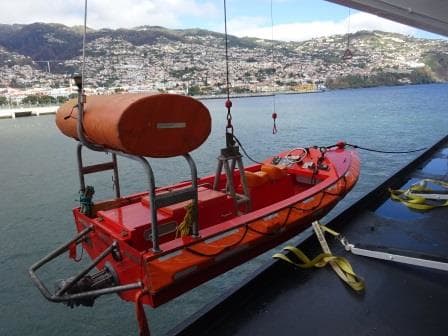
Going back to yesterday and the Fast Rescue Craft. As you can see from the picture it is a very nice and very fast speedboat, pushed forward by a water jet. It appeared first on the cargo ships and there is was a wonderful invention as it gave a cargo ship captain a very good tool to get a boat down quickly to offer help. Before that they had to lower a regular lifeboat. Cruise ships also had regular lifeboats but at least two of those boats had winches which could go at double speed, to lower or hoist very fast. But they were still lifeboats, and lay as a cork on the waves and bounced all over the place as they were really designed only to be operated with a full complement of survivors. So when we had to rescue people or do anything else we lowered a tender. Two engines and not very maneuverable.

The ps Fast Rescue boat of the ms Oosterdam. The orange drum on the top is a sort spoiler, meant to keep the stern down for better water flow.

The ps Fast Rescue boat of the ms Oosterdam. The orange drum on the top is a sort spoiler, meant to keep the stern down for better water flow.

Thus we were also looking forward to getting Fast Rescue boats. And when they came, the officers liked them. Boys with toys. Great to play with. There was only one challenge, the Boats only seat three people and then there is not much room left. And we prefer to go down in the water with a medical person with us, quite a bit of medical gear and if possible a stretcher as well. So through the years it showed that these boats were not so ideal for our kind of operation.  To get that sort of thing changed takes some time but eventually the situation was reviewed and a decision was made about how to make it better.

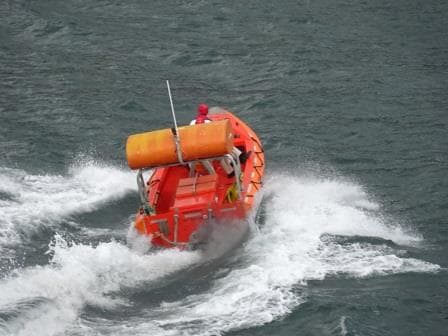
Boys with toys. A deck officer and an engineer putting the boat through its paces.

Boys with toys. A deck officer and an engineer putting the boat through its paces.

The Koningsdam is now the first ship which has a modified lifeboat which works well. Its main purpose is still being a lifeboat but it can act as a Man Overboard Boat or M.O.B. (That name is still from the old days; now we also loose women overboard and thus it should really be renamed in a Person Overboard Boat or P.O.B.  However that might take a while to trickle through in maritime legislation.) What is different to this lifeboat is, it lays deeper in the water and it has a bow thruster, just like a big ship. When the boat is kept in position while offering help, it is much easier to keep the bow also under control and provide a nice stable platform to get a person out of the water or to transfer a patient from another ship. I played a little bit with that boat while I was on the Koningsdam and it all seemed to work very well.

Maybe one day they will retrofit all the ships which such a lifeboat but for the time being we still have on the Oosterdam a Fast Rescue Boat. Much to the delight of the deck officers, who have absolutely no problems for volunteering for the monthly test run.

Just while I was hoping that all was going to be plain sailing to Tampa, we have to be alert again. A system is developing, which could change into a storm, and could change from a storm into something worse and then go the direction of Tampa. We will keep a close eye out and time will tell what is going to happen, or not.

Tomorrow we still have a normal quiet day and we should have a super moon to look at. The last time there was one was in 1942 and thus I have also never seen one. I hope that the clouds break up so we can see something.

We are very lucky thusfar, very little wind, very little swell and the rain nicely moving around us. But have to keep an eye on the South Caribbean.

We are very lucky thusfar, very little wind, very little swell and the rain nicely moving around us. But have to keep an eye on the South Caribbean.

12 Nov. 2016; Trans-Atlantic crossing, Day 3.

We are still doing well. We have even less wind than before, down from wind force 4 to a small 3 and the sun keeps shining as if it is all free of charge.  And for every gift we say thank you and happily accept it.  At the moment there is not much to see outside, wildlife in this particular area of water is fairly quiet as it is too far from land for birds and for some reason this is not much of a dolphin area. The Navigators on the bridge have to get excited about spotting buoys as those are very much the only things which come floating by. And as most of the buoys are either white, red or yellow you can easily see them.  All of them lost over board or broken free from nets during storms.

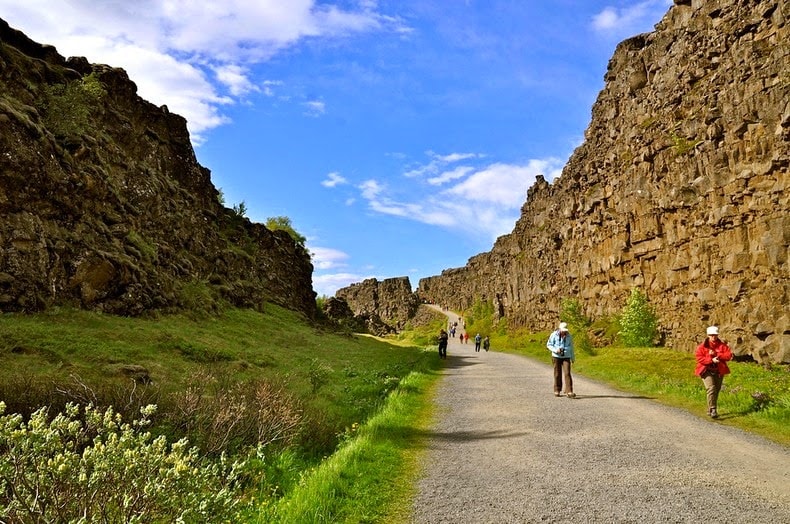
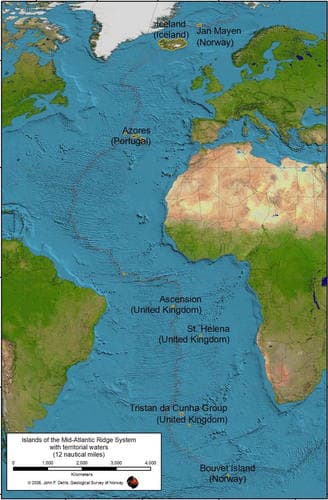
Under water it is a different story. A few thousand feet down we are looking at hills, mountains and valleys. We are about to pass over the Mid Atlantic Ridge and it would be really interesting to see this. But the only place where you can see it is on Iceland and that is one of the reasons why Iceland has so much volcanic action.

Iceland walking through an alley with America to the left and Europe to the right. you can even bike it.

Iceland walking through an alley with America to the left and Europe to the right. .

The same reason applies here as I already mentioned for why Madeira is there. A crack in the ocean floors crust which molten rock comes up out of the core of the planet and solidifies as a new crust. The gaps where this material comes up, we normally call Volcano’s as the material tends to pile up in the same way as candle wax settles on the sides of a candle. If the crack moves a little bit, then a volcano goes dormant and eventually the place becomes inhabitable until it blows up again. Mount St. Helens was a prime example of this.

The ridge all the way from Iceland down to the Far south Atlantic.

The ridge all the way from Iceland down to the Far south Atlantic.

The cracks in the earth’s crust and the fact that they do not always remain in the same place is caused by the Tectonic movement of the earth’s plates upon which the continents rest.  They are in a continuous if very slow motion and the European plate is disappearing under the American plate in mid ocean. If we waited long enough a piece of material which is going down here at the ridge would come up again somewhere else……………….. eventually.


On average the most active plate only moves a few centimeters a year, so the process takes a while. What we notice is the occasional earth tremor, strong or less strong, when the plate is releasing its pressure as it moves along.


Right below were we are, the crack is quite active and the ocean bottom is full of smokers (small pipes which nature constructs from the minerals which come out of the earth’s core and are cooled down by the water of the ocean. In the recent years it has been discovered that the warmth and escaping minerals have created a complete own and very local biosphere. Regardless of the enormous pressure down there, nature thrives. With modern technology in the form of unmanned subs, we now finally know that a lot of things are going on down there.  It is just a pity we cannot see it all from the ocean surface.

What was visible today, for those who were walking around the ship, was the crew who are forever cleaning, painting and maintaining. This morning there was the strange sight of some sailors with lifejackets on sitting in the Fast Rescue Boat. Always a bit un-nerving: “Do they know something we do not know”? But they were at work and we have the regulation when you are close to the side of the ship, and there is no railing, you wear a lifejacket and a safety line.

The Fast Rescue Boat is an addition to the ships since the 1990’s. For Holland America they appeared with the Vista Class. The idea was, heavily promoted by the Safety authorities (remember my blog from yesterday), that if you had a dedicated boat on board, which you could lower very fast and sail very fast, then you could pick up somebody from the water very fast.   It works quite well for shore organizations such as the lifeboat stations along the coasts but for the cruise ships it is a bit more challenging.

Todays picture of the North Atlantic. Not much mayhem to be seen.

Todays picture of the North Atlantic. Not much mayhem to be seen.

As said the weather is still holding and it looks at the moment even the thunder storms are moving away. We might be lucky.

11 Nov. 2016; Trans-Atlantic crossing, Day 2.

Another glorious day at sea. The weather is still holding with little chance of bad weather. There is a chance of thunderstorms a bit further down the road but nothing that gives reason for real concern.  So we can happily keep going on and stay on our course towards Tampa.

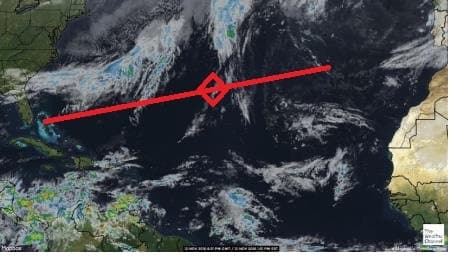
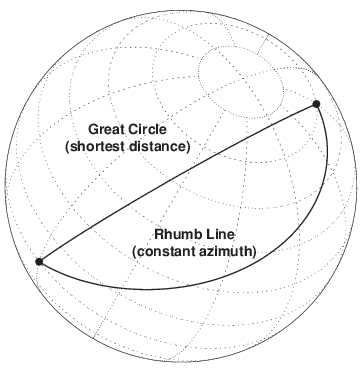
There are various ways to get to the same position/location when crossing the ocean. On a long distance we have two options; either going by Rhumb Line or following the Great Circle. Because the world is a globe, the shortest route is really a curved line and a straight line is longer as it has to be “stretched out” to fit over the globe. Also due to the curvature of the earth, the Great Circle line going further north as the globe is getting smaller in girth while going away from the equator. But going more north means coming closer to less pleasant weather or at least the greater chance of encountering less pleasant weather than when being further south.

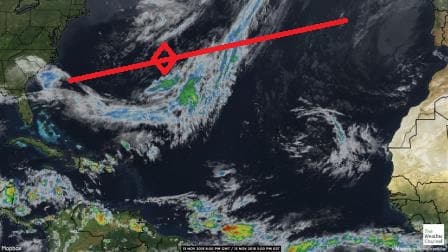
Just imagine folding the globe open and see what it does with the lines. The great circle becomes a sort of short cut to the same destination.

Just imagine folding the globe open and pressing it flat and see what it does with the two lines. The great circle becomes a sort of short cut to the same destination. Constant azimuth means keeping the same course. With the Great Circle you make small course changes all the time to keep the curve.

The Rhumb line provides the most southerly course the ship can take and thus also staying further away from the bad weather up north.  The captain has to decide between the two options.  Shorter route means less fuel consumption but a heightened chance of more inclement weather and the longer route will cost more fuel but might help with finding more reasonable weather.  In our case there was some inclement weather looming after day 3 from Funchal and thus the captain decided to go more south. We will have to travel an additional 15 nautical miles or so but that is much better than bouncing around in a depression. Plus if you are in a depression and the ship starts to bounce then that costs speed as well so it might not even save time.

The sailing of the Oosterdam back to the States coincided this time with a considerable change over in Officers who all joined shortly before the crossing. One lady 3rd officer was even relieved in Funchal and flew home to Holland via Lisbon. Once we get to the other side, there will be another considerable change over on the 18th. and the 24th. and after that date Deck and Engine will not much change anymore until close to Christmas. Now we have 8 sea days to enjoy, it gives an excellent time to refresh some routines which had gotten rusty or which needed some focus as during leave the focus was on other things. Thus we have now embarked on a whole program of trainings, drills and policy reviews which will help to raise the Officers awareness while doing their jobs.

One of the reasons for all this extra focus is the fact that our policies are forever being updated. Where on the shore side a law might seldom change as the political process is either very slow or a large group is against it, at sea things are different. Sailors do not have the option very much to say, this is nonsense, let’s keep it the same as we do not have any political clout. Plus it is hard to go against something that is being sold under the label “it improves safety”.  But what we see going on very much in the industry is consolidation and more detailed implementation. I call it : once we walked around the building keeping to the left and now suddenly we walk around the building keeping to the right. The result is still the same. The ship still sails safely only the routines have been changed.

For the coming winter we will be sailing in the North American hemisphere and this brings with it a whole set of new rules to get used to again. Nothing really new; just different ways to approach an identical topic. It does not really matter if you fight a fire the European way or the American way (metric or imperial) the result is the same but the approach is different. For officers who are new to this or have spent the last few years in Europe and Down under, there is the challenge to get familiar with the new approach. And now we have all those sea days to accomplish this.

What we were really worried about has dissipated to the north, but there is still a tail with a lot of rain and thunder and that might not be gone, by the time we get there.

What we were really worried about has dissipated to the north but there is still a tail with a lot of rain and thunder and that might not be gone by the time we get there.

So while this captain is dealing with that, captain Kan is dealing with a whole set of regulatory requirements to be fulfilled in order to be allowed to sail into Tampa on the morning of the 18th.  In the meantime there is also the weather to keep an eye on. Depressions are nowhere in sight for the meantime but we still have a sort of frontal system looming which might bring some thunderstorms.


10 Nov. 2016: Trans-Atlantic crossing Day 1.

The weather is holding and the ms Oosterdam is ploughing with a speed of nearly 19 knots through a very calm sea. There is just a little movement caused by the regular ocean swell but the ships stabilizers are taking care of it very well.  Stabilizers can only deal with 90% of a rolling movement so there is always 10% or so left. That is the amount that the stabilizers need to “feel” that the ship is rolling. The gyroscope which controls the stabilizers needs some sort of push or jolt to measure the difference between being completely horizontally and not been completely horizontally before it can do its job. And therefore there is always a tiny bit of movement whatever the situation.

We are going faster than we need at the moment as we need to build up a good amount of reserve time because of the adverse currents we will get once we have passed Freeport in the Bahamas. At the moment we have a little bit of current with us, the equatorial current, which is curving away from the African coast and will eventually become part of the Gulf Stream again and so rotate in a never ending oblong circle. We probably get a 0.25 of knot for free each hour, which still helps if you count the total number of hours we will be under its influence. Once we start the battle against the Gulf Stream we will have at least 2 knots against us for most of the time. Unless the Gulf Stream axis is really well over to the Bahama side then we might be able to use the counter current which runs under Miami and Key West. But we cannot guarantee it and thus we build up a bit of “plus” as we call it and then can make it with the same engine configuration all the way to Tampa.

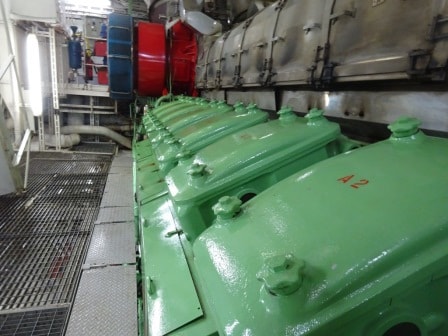
The top of one of the engines. The cylinders are arranged in V shape and thus the covers are under an angle as well.

The top of one of the engines. The cylinders are arranged in V shape and thus the covers are under an angle as well. The red drum at the far end is the Turbo Blower. Most cars have a turbo, the ships have them as well.

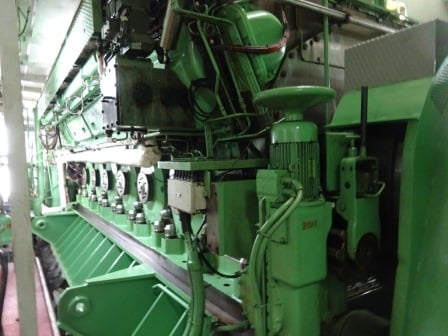
Today I did some review work in the engine room of the Oosterdam. The construction of the Vista Class is an evolution of the S class and the R class but with a big step. This was the first class with two separate engine rooms. In the 90’s the regulators were starting to get worried about the size increase of the cruise ships  and having that whole ship rely on one engine room. It would only take a small fire and the whole technical heart of the ship would be out of service.  Thus came the idea to split up the engine room in two parts and have two or three engines in one compartment and two or three in another. As all the new ships were Diesel Electric this was very easy because they did not need a connection to the propeller shafts. Only a few electric cables are needed to go from the engines generator to the transformers and those transformers could be located anywhere in the ship if needed.

The engines run three decks high. This is D deck level. Then the real foundation is another 5 feet down towards the bottom of the ship.

The engines run three decks high. This is D deck level. Then the real foundation is another 5 feet down towards the bottom of the ship. The round eyes sticking out were used for lowering the engine into the ship by a crane during the construction of the ship.

The Oosterdam is number 3 of the Vista Class and thus has a Forward and an Aft Engine Room. Forward there are 2 engines with a Gas Turbine engine in between and the aft one has three 3 engines.  Three of them have 16 cylinders and two of them have 12 cylinders. The Gas Turbine was a bright idea before 2010 and they were installed in quite a few ships between 2000 and 2010. The Queen Mary has one as well as an example. The idea was that if you needed some extra speed then you could use the turbine which would have less maintenance and a lot less weight than a normal engine and could produce the same or more output.


On board the jet engine turbine is completly sealed away in a protective housing. It produces a power of 11000 volts and you do not want to get close to that.

On board the jet engine turbine is completely sealed away in a protective housing. It produces a power of 11000 volts and you do not want to get close to that.

At that time the price for the fuel it needed was still low and thus it was economically feasible and operationally a nice perk.  As we know the fuel cost rocketed after 2008 and then jet turbine became a sort of white elephant. The turbine is indeed similar to an airplane engine and thus we call it so. It is hardly used anymore and ships which were constructed with the emphasis on these jet turbines (Royal Caribbean had a few) received additional motor engines to bring the cost down. If we would run it now, then the chief engineer would have to go around collecting money first from the Guests before he could afford to start the machinery up.

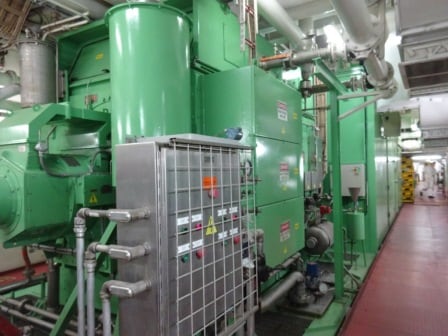
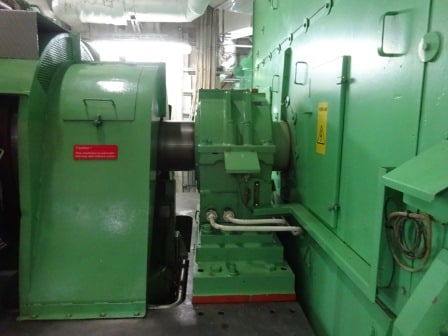
The engine is connected by a 12 inch shaft to a generator. Which is a sort dynamo and generates electricity.

The engine is connected by a 12 inch thick shaft to a generator. Which is a sort dynamo and generates electricity.

Each engine is connected to a Generator which changes the shaft movement into electricity and that electricity then goes to Transformers which bring the power down to a current which can be used by a converter and this converter powers an Azipod which pushes the ship forward. Not all the power goes there; some is diverted and used for the ships operation. And when we go in and out of port, the bow thrusters run on electricity as well.

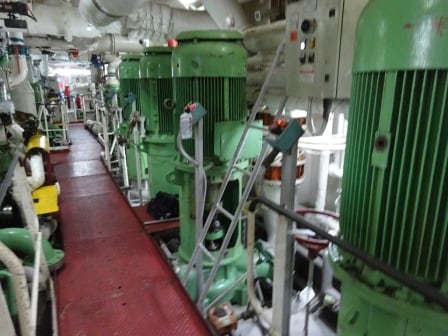
All engines need cooling and these are the 6 feet high cooling pumps for three engines.

All engines need cooling and these are the 6 feet high cooling pumps for three engines.

All ships are so configured that the average speed needed for a cruise can be handled by one engine less than the total on board and the engine not in use can then be put under maintenance.  THis is done on a regular rotation; varying from small repairs and regular piston inspection, to a full stripping down of the whole engine when the maximum running hours have been reached. We take our cars to the garage after so many miles, a ships engine is completely taken apart while the ship is in operation. New parts come on board beforehand and the old –exchange- parts go ashore for refurbishment.

Tomorrow is the 2nd day of our crossing and now the question slowly arises what the weather will bring. As always it will all depend if there is no hurricanes coming over and staying south of Bermuda or a depression created off Cape Hatteras decides to drop down, instead of curving northwards and head directly for Iceland.

« Older posts Newer posts »