- Captain Albert's Website and Blog -

Ocean Liner History and Stories from the Sea, Past and Present. With an In Depth focus on Holland America Line

Page 241 of 241

8 April, The last day at sea before the Azores.

It is amazing to see that while guests love seadays, after a number of them in a row they are all getting restless and want to feel land again. The weather for tomorrow is looking good, just the fact that is the 2nd day of Easter might have some impact on the shopping possibilities for the Ladies. However as we still have some major shopping ports to come I do not think that the disappointment is going to be too great if we find on arrival that not all the shops are open.

The day was filled again with activities and it was a busy day for me as well, as I started my own training class. Holland America had a very clever idea a few years ago and that was to find a way to un-lock the vast experience gained by the senior officers during their career and to have that somehow transferred to the not so experienced. Human Resources came up with what is now called Leadership In Action Workshops. A training book was compiled and with the aid of the book workshops are given in groups of eight to improve the leadership aspects of a person in his function on board. A senior officer who is trained as a facilitator moderates the course which runs for about 9 weeks. Apart from useful for the participant, I find it fascinating myself as it is amazing to observe that each culture approaches the same issue in a totally different way. In my current class I have an Canadian, A Filipino, two Dutch, three Indonesians and an Australian. Although it costs me a lot of time, I believe that training is the only way forward, so we have to spend time on it, in order to keep the quality level up.

Another happening yesterday was my lecture about the Holland America History. If a cruise has sufficient sea days, and the Cruise director has an opening in the schedule, I like to do one as it is very popular with the guests. Quite a few of our guests came over themselves with an Holland America ship in the 1950’s, or had ancestors who once emigrated on a DAM ship. This time the audience numbered about 500 and indeed, there were guests who sailed on the old Veendam (1922 – 1952) on the Groote Beer (emigrant and student ship, first only under HAL management, hence the no-dam name) and a greater number on the Rotterdam V (1958 – 1997) which still has a warm place in the hearts of our long time cruisers.

Last night was the second formal night of the cruise and it is something that I really enjoy. People dress up nicely, there is stylish dancing, good dinner conversation and an elegant atmosphere pervades the whole ship. There is now the trend to go to less and less formal nights in the industry but Holland America tries to keep up this tradition although it seems to be more and more difficult to do so. Our next formal night should be a very good one, as it is the black and white officer ball. Then all the officers, except the watch standers and those going on watch, come out of the wood work to dance with the ladies. As I normally invite the concessionaires as well (shops, casino, beauty spa) there is also a sufficient number of ladies available to keep the gentlemen occupied, who lost their wife to some good looking young officer. But first the Azores.
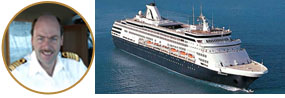
7 April. Half way across the Atlantic Ocean.

Today we were the furthest away from land as we can be on this crossing. 750 NM. or almost two days of sailing. 750 NM translates into 870 land miles, as you have to multiply a nautical mile by 1.16 to get it converted to a statue mile. We were 750 NM away from the Azores, and about 800 miles away from Nova Scotia and the same from the Bermuda’s. The weather is still holding and the wind is now blowing with us and as a result the gentle pitching of the ship has changed to a rolling motion that we can stop with the stabilizers.

Stabilizers can only help against the rolling (that is the side ways movement of the vessel) and not against pitching (that is the up and down movement of the bow). A stabilizer gets its effectiveness from the water flow over the fin and its ability to create an upward or downward force because of it. In a similar way as you can see flaps moving on an airplane wing during take off and landing. The faster the ship goes, the better the stabilizers work. They do not take away the complete rolling movement but dampens it down by about 90%.

The sea bottom under us is called the Sohm Abyssal Plain, a relative flat area of the sea bottom. This will change when tomorrow evening we start approaching the Azores. The Azores are mountain tops located on a ridge near the Mid Atlantic ridge. The Mid Atlantic ridge is a cleft in the sea bottom, where the European Teutonic plate meets the American. (the names are slightly different, but they are the plates that carry the specific continents)

A German scientist, Mr. Wegener figured out in the 1880’s that the continents are drifting apart by means of plates moving over the Earths core. The European plate is slowly going under at the Mid Atlantic Ridge and the American plate is surfacing there. The American plate is disappearing on the West of the Rocky Mountains at a ridge that we know as the St. Andreas fault.

The collisions of those plates there, are causing all the earthquakes. Where plates meet, there is a gap in the earths crust and thus volcanic action. So most volcano’s are found in area’s that border the edge of a plate. If one would go down to the bottom of the ocean at the Mid Atlantic ridge, one could observe volcanic action in various forms. (my apologies to any expert who reads this blog as I am trying to avoid going into too much detail and there is much more detailed info available on the internet)

The ship is gearing up for Easter, and various things are planned to make it a special day. As a cruise is to be a period of enjoyment, we grab everything excuse there is to throw a party or at least do something out of the ordinary. Special morning services are planned, egg hunts in combination with Bingo, special egg baskets in the ship, an Easter Bonnet contest etc etc., and the internet café is offering an Easter special to call or email home. Our cadet is hoping for a proper egg hunt as he is used to that at home, him coming from a large British Family. I told him to get dressed up as an Easter bunny, so now we have to wait and see if he takes it seriously.

6 April, Continuing our Crossing.

Today was another beautiful day at sea. The ship is still lightly pitching on waves produced by the old weather front ahead of us but all our guests seem to enjoy the motion, which is not un-comfortable but does remind us that we are on a ship and not ashore. This sort of weather really convinces you that a cruise ship is the best way to see the world. In each port your hotel is parked right where you want to be and at sea you have a view that no realtor can sell you. No wonder that cruising is so popular and is still increasing in popularity. We have this cruise around a 1000 guests onboard (out of the 1170) who have made at least two or more cruises with the company. The number of days sailed for some guests go way over 700 and last cruise we had a lady on board, called Mama Lou by all of us, who managed 2465 (thus far…..)

A major part of the attraction for our guests is the crew on board. Apart from doing their job, everybody jumps at the chance to do just that little bit extra that makes the guest feel special.
I find still it an amazing thing that our bar tenders manage to remember the favorite drinks of our guests, when they return to the ship for their next cruise, even when it is 5 or 6 months later.
It is an personal aspect that guests love, as it makes them feel straight away at home.
Culinary is doing extra things, beyond what the company requires, with an extra food outlet. Although the items are available on the menu cycle, a sushi bar during one lunch time and a curry bar on the next day, do give some extra focus for the guests and extra enjoyment.

Last night I received a nice compliment from one of our guests regarding one of the cadets. The gentleman had dropped a rather expensive –unused-cigar over a ships inner railing, where it had landed on a ledge below and out of reach. However the cadet realized that he could access the area via a route from below and acted straight away. Small things can have a big impact.

A totally different occurrence took place during sunset, when I conducted a small and private ceremony for guests who wanted to disperse the ashes of both the parents of one of them. We get these requests quite often and the company is always happy to oblige. This particular one was special as it concerned a married couple, who met on an ocean crossing and had stipulated to be buried at sea together when the time came. At a time and location of the guests choosing, the ashes are dispersed over the side and I normally give an appropriate speech, which includes a little poem that I found on the internet:

Do not stand at my grave and weep;
I am not there. I do not sleep.
I am a thousand winds that blow.
I am the diamond glints on snow.
I am the sunlight on ripened grain.
I am the gentle autumn’s rain.
When you awaken in the morning’s hush,
I am the swift uplifting rush
Of quiet birds in circled flight.
I am the soft stars that shine at night.
Do not stand at my grave and cry:
I am not there, I did not die.

April 5, Another great day at sea

The ship is pitching gently on the waves, waves created by a weather system 48 hours ahead of us. This weather system is supposed to completely dissipate in the coming three days thus things are looking really well for the remainder of the crossing. Yesterday we left the Bermuda’s behind us and currently we are sailing over an area called the New England Seamount. This means that the surface under water is more mountainous than before and the interesting thing is the names that have been given to these mounts, Alleghany, Muir, etc.etc.

As we are slowly coming further North, the outside temperature has been coming down. When we passed Key West, the temperature was still around 80oF, it has now dropped to about 60oF during the night time and is barely touching the 70o’s during the day time. As the wind is with us, blowing from the SW, it is still very pleasant on deck and the guests can be seen sunbathing. Also the sea water temperature has dropped considerably and that is something that pleases the chief engineer greatly. The engines are using sea water for cooling, and the colder the cooling water the better the engines perform while consuming the same amount of fuel. When we left Tampa, we were averaging around 19 knots on 5 engines and now we are doing 20.5 while having the same amount of engines on line.

A thing that the guests do not see is what we have to do on the crossing to comply with International rules and regulations for the Water Ballast Exchange Program. This program was set up a number of years ago to protect the local environment from non-indigenous water life. Each ship carries ballast water in its tanks, for stability reasons or to trim the ship. Same for the Veendam, we consume fuel oil, and when an oil tank goes empty, we fill up a ballast tank with water, so the ship keeps the same draft and stability.

A number of years ago international organizations became concerned about the introduction of non native water life in various ports of call. A prime example is the Great Lakes where now crabs and other animals can be found that do not belong on the North American continent. Most likely these animals were brought in by ships that loaded ballast water in another part of the world and then deballasted during loading in an American port. The same is the case in Europe, where wildlife has been found in the local rivers, that was somehow imported from the North American continent. To deal with this problem the Water Ballast Exchange Program was set up. As soon as a ship more then 200 Nautical Miles from land all ballast tanks are flushed one by one and fresh ballast water, e.g. seawater from that area is taken in. We report the participation in this program to the monitoring authorities.

April 4, Going across the Atlantic

Today we continued our crossing and by early evening we were South of Bermuda. The influence of Bermuda is noticeable on our crossing as the island has instigated a 200 miles no fishery zone around the island and also they have a 30 mile – no-pass-by-zone, if you do not call at a Bermudian port. The latter zone is meant to avoid inadvertent groundings and thus pollution from ships that do not need not to be close to Bermuda anyway. Our course took us 75 miles south of the island, so well away from the exclusion zone.

The weather continues to be good. However ahead of us is a low pressure system moving to the South East and dissipating. The uncertainty with this sort of system is always how fast it will dissipate as that is very difficult to predict. So in the course of the evening the ships movement which had thus far been near zero, began to change and a gentle pitching became noticeable. If the NOAA weather prediction is correct, then it should not get worse apart from some showers in the next 36 hours, and that would mean that we should have a real good crossing.

Life on board goes its quiet way, with lectures, activities, cocktails, dinners and shows. Thus far we have had lectures about literature and ocean life. Also very popular are the cooking classes by our chefs. During our fleet wide Signature of Excellence upgrade, a kitchen was built in the ships movie theatre. Here our Executive Chef, 2nd Chef or the Chef from the Pinnacle restaurant (our specialty restaurant on board) give cooking demonstrations and also cooking classes. In the past the movie theatre was only used in the morning for church services and in the afternoon for movies. Now the non-utilized time in between is filled with cooking and it is a huge success. If you look at the daily program, it looks quite comical by having the Pope at 9am, the Chef at 10am and Brad Pitt at 2pm.

The atmosphere on board differs greatly from a regular cruise that has a port each day. On port intensive cruises the focus of our guests is fully on the excitement that each port brings and shipboard life is shaped around that perception. Now with so many sea days in a row, the tempo slows down and guests have time to enjoy all the amenities that the ship has to offer, and each other’s company.

April 3 going across the atlantic

This was our first full day in the north Atlantic and what a gorgeous day it was. Sunny skies, temperatures in the mid seventies and a gentle swell coming from the north that gave the ship just enough movement to let everybody know that we are at sea without really affecting anybody by it. The ship is sailing with a full complement of guests. Many of them having sailed on the Veendam in the past and those who did not are here because they just love ocean crossings.

Last night we had our welcome onboard party, when most guests are coming through the receiving line and where I introduce the senior officers and staff. Although I do not remember all the guest names, I can most of the time place a face with a previous cruise and a time of the year. Thus I remembered quite a few people that were onboard during last years thanksgiving cruise and who were then already announcing that they were coming for the crossing.

After clearing the Bahamas we lost the influence of the Gulf Stream current, but we picked up a little bit of the Antilles current which runs NW above the Dominican Republic. However it curls a bit to the East as well, and that gave us during the morning about half a knot of extra speed. Now are sailing in an area that is called the Hatteras Abyssal Plain and there is not much of a significant current here. The description “Plain” is a bit misleading. The ocean floor is not plain or flat at all. However when you look at the contours of the sea bottom on the chart, it looks fairly flat compared to other area’s. The sea reaches depths over here of up to 15000 ft. and if one would look at the Bahamian islands as a mountain range with an elevation of 15000 ft. then elevation on the bottom of the ocean of 1000 ft. makes it look flat by comparison. Further in the ocean the seabed becomes more mountainous again when we sail over the North Atlantic Ridge.

My day today was filled with ships inspections and meetings. It takes a lot of coordination to keep a cruise ship going especially if the ship is moving away from routine voyages.

A challenge that all of us face nowadays is the enormous amount of new rules and regulations that are coming at us all the time. Where in the days of the Titanic the merchant marine world was definitely under regulated, hence the disaster that took place, now there seem to be a rule and or checklist for everything and the Captains function becomes more and more one of an auditor, making sure that the ship complies with everything applicable. As every country in the world and often also Federal States or provinces inside a country seem to have their own rules it can be quite a puzzle to figure out which rule applies where under what circumstance.

We also saw the first flying fish and some porpoises. The view from the bridge is ofcourse the best there is but with the upper cabins having balconies the chance that guests see more and more of the nature around us is getting bigger and bigger. Unfortenately it is impossible to announce these sightings. By the same that the guest has arrived at a viewpoint the animal has most likely disappeared already.

april 2nd. Our first day at sea

During our first sea day the Veendam sailed around Florida, having cleared the Tampa sea buoy just before 11 pm. the evening before. Next day April 2nd., it took until 7 am to reach the most western point of Florida, the island group called the Dry Tortugas. These low islands are the most western islands that form together the Florida Keys.

In the olden days we could sail between the islands and in that way gain an hour by “cutting the corner”. Nowadays it is a nature reserve so we sail around it. As a matter of fact the whole area around the keys is of special interest and a “stay out” zone of seven miles has been created for that purpose. We stay with the ship at least 12 miles out.

As soon as the ship was clear of the Islands the search for Gulf Stream started. The Gulf Stream is a major world current that forms part of an ocean going current system that travels through all the world oceans. In the Caribbean Sea it is called the North equatorial current, and runs north of the South American coast, and as soon as it passes Cozumel and enters the Florida straits it becomes the Gulf Stream. There it picks up speed, as the all the water from the Caribbean sea is pressed through the Florida straits and water is added from the Gulf of Mexico, also the Trade winds blowing through the Caribbean sea help the momentum.

The Gulf Stream can reach a velocity of up to four knots. The problem is to find the axis of the current, there where the current is the strongest. The axis of the current is not always in the same position, sometimes it is closer to Cuba and sometimes it is closer to the Florida Keys.

The American weather bureau’s give out predictions but these are average locations. Thus the way to do it is to change course according to plan and if we do not see an increase in ships speed, deviate a little bit until we find the current. This time we picked the current up an hour past Key West and it gave us 2.5 knots extra for the remainder of the afternoon and evening.

By 23.00 we were sailing inside the North West Providence channel located between Freeport to the north and Nassau to the South. When I started sailing in 1981, we only saw the occasional cargo ship in this area. Now with cruising being so popular the channel is full of cruise ships.

Sailing ahead of us was the Majesty of the Seas (RCI), next to us the veteran cruise ship Regal Empress (built in 1953) and behind us the Queen Mary 2 (Cunard). At 00.30 on April 3rd we entered the North Atlantic Ocean for our crossing to Punta Delgada, and the weather is still looking very good.

Captain’s Daily Log: Tampa departure

Our voyage started as a real long voyage starts. Departure delayed due the large amount of stores and supplies that we had to take with us. Thus our departure time was delayed from 1700 hrs. to 1900 hrs. However it had the advantage that some lost luggage from guests could still make it to the ship.

Tomorrow the crew will be very busy with relocating all those supplies to their respective lockers and store rooms and to make the ship “shipshape” again below decks. The moment the last pallet (with paintings for the art auctioneer) was loaded onboard, the ms Veendam left the dock for our trans Atlantic voyage to Venice in Italy.

The departure/ undocking maneuver is always done by the captain. While the pilot is the man who knows “the land” in this case Tampa Bay, it is the captain who knows best how his ship handles. After the ship was swung around in the turning basin of Ybor harbor, I handed over the “conn” to the pilot and we sailed at various speeds through Tampa Bay. Handing over the “conn” means that the pilot is then having the conduct of the safe navigation of the ship. The ultimate responsibility of anything that might happen always remains with the Master.

Tampa Bay pilots use a numbering system to indicate their seniority in the pilot system. Thus Unit One, is the most senior pilot and if he retires, Unit Two becomes Unit One, etc. etc. There are 23 pilots in Tampa Bay and our pilot was Captain. McDonald who is Unit Three, so one of the most senior pilots in the bay. He got us safely to the pilot station by 22.30 after which the Veendam left the approach channel and set sail for the Dry Tortugas, which are the most Western part of the Florida Keys.

The weather for the first few days looks very good. Only a low swell is expected when we leave the shelter of the Bahamian islands later in the night. The North Atlantic weather can be very un-reliable during this time of the year when it is the period of change from regular winter storms to nice summer weather, thus it is difficult to predict more than three days in advance. But the first three days look good.

To be continued.

Newer posts »