- Captain Albert's Website and Blog -

Ocean Liner History and Stories from the Sea, Past and Present. With an In Depth focus on Holland America Line

Page 239 of 241

28 April, Koper and Venice.

Today was a busy (last) day for the guests as we did two ports in one day. In the morning we were in Koper, Slovenia and in the late afternoon we arrived in Venice for an overnight stay. The weather was once again sunny and not too warm, resulting in a beautiful stay in Koper and a spectacular arrival in Venice, where the setting sun framed the houses along the canals as if it was a Canaletto painting.

Koper, was a first call for the Holland America Line and we on board did not know exactly what to expect as none of us had ever been there. Upon the arrival the pilot told me the Veendam was the largest cruise ship ever to call at the port and the biggest ship that would fit in the down town berth. Koper is a medium size industrial port with some great deep water docks for cargo ships, but that is not where you want to put a cruise ship. So I swung the ship around outside the harbor entrance and then backed her all the way to the dock.

The town of Koper is working very hard to get a slice of the cruise business so by 10.30 we had about 25 newspaper people on board and two cameras of the National Slovenian Television. I was going to be world famous in Koper during the evening news. Koper has a lot of tours to offer, both historical and otherwise and our guests were very happy with the port stop. The only comment being that the ship should have stayed for a full day. So many things are available there, as Slovenia reaches deep into the Balkan with spectacular sights and it is a clean, friendly and peaceful country. Even if you do not go on tour, the old town was only a 1000 yards away from the gangway.

We sailed at 2 pm. and with the Veendam’s whistle booming over the old town a lot of locals waved us out, watching the event of the day, the BIG ship call. It being a Saturday meant that the whole bay was full of sailing boats, so the Veendam had to zig and zig its way to open waters. Then it was a four hour run to the pilot station of Venice, where we arrived at 17.30 hrs.

Today we had an Italian lady pilot who guided us through the lagoon and past the sights of Venice. As a captain you stand a bit with your fingers crossed while sailing through the Canal, as the fairway is so narrow that the only option you have is to stop when something happens. your can not cahnce course. The local ferries and tourist boats seem to consider 30 feet a safe passing distance but it is a bit un-settling to see one boat after the other disappearing from sight under the bow of the Veendam and to pop up again at the other side. From my conning position on the bridge I have a dead angle of about 120 feet, where the bow blocks the view, so what might be a safe distance for a small boat, looks awfully close to me. But there is always on officer forward in the bow, who will advise me if something happens where I can not see it.

The ship arrived in the evening, to offer the guests the chance to do an evening tour into Venice, including a gondola ride. Also a lot of my crew grabbed the chance to get off for a few hours. Most of them do not have that much time to go ashore, so if we have an overnight port, I encourage the heads of various departments to split up their departments as much as possible (with crew covering for each other) so that everybody gets a chance to go ashore. One group during this call, the next group during our next call. Tomorrow is change over day and then we start our next cruise, sailing to the Western Mediterranean.
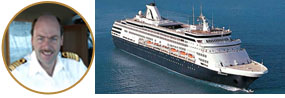
27 April, at sea.

After so many days of going ashore and seeing the sights, this was a day to rest and to enjoy life on board the Veendam again. Although the sort of resting depends upon what you want to do while on board. The cruise director packs the sea day full with activities and that means that there is not much rest for the guest, if the guest decides to partake in everything on offer.
Tomorrow we are in the morning in Koper and in the early evening arrive in Venice during sunset, so what ever the guest still wanted to do on board, it had to be done today.

This is also the last sea day and that means that we have a get-to-gether with the guests to say good bye. The disembarkation procedure is explained and about 200 crew come on stage for a farewell song. This is always much appreciated by the guests and some of them find it a very emotional affair. Following the farewwell party is the Gathering of the Society of Holland America Mariners (for details see 17 April) and then it is already lunch time.

The celebrity chef was cooking Greek food in the afternoon and those who had seen or eaten too much food in the past week could attend a lecture with our environmental officer or gain some in depth knowledge with our Exploration Series speaker about how the Mediterranean was geologically formed. Formal night finished the evening off and the evening dinner also featured the parade of the baked Alaska and the line up of the chefs of the kitchen. I have on formal nights a table in the dining room. People are always curious about how you end up at the captains table. There are basically three options: one, the office sends a recommendation to the ship, two, I know myself guests from previous cruises, three the Dining room manager selects 8 guests who might enjoy the experience. It is not always easy for the dining room manager to do this, as he/she has to find the right mix of people who are comfortable enough with the experience and who will enjoy good conversation as much as the food served. The menu at the captains table is different from the entries of the dining room menu and the guests receive a copy as a souvenir, the next morning, after I have signed it.

The sea was flat calm during the whole day, while we sailed by Brindisi and into Croatian waters on our way to Slovenia. My navigators prefer a bit of wind at sea, as it keeps the fishing boats away from the shipping lanes but no such luck. So for most of the day, the ship was zig zagging all over the place in order to avoid them all. In the evening we had a spectacular blood-red sun set which promised another beautiful day tomorrow.

26 April, Katakolon.

I had not been to Katakolon for a long time and was looking forward to see how it had developed as it is a lovely little place to call at. During my last call they were developing new docks and as were going to dock, good progress must have been made. Katakolon is located at the south west side of the Peloponessos, the big peninsula South of Athens. Upon departure from Piraeus we sailed south leaving the Peloponessos on our starboard side. By midnight we were at the most southern point and then followed the coast northwards until we arrived at the pilot station.

The local pilot is a very nice gentleman who speaks very good English. He, or better said his wife, had a restaurant in the port and piloting helps him escape from doing too many dishes. The outer pier had been finished and by turning the Veendam gently around the breakwater, we were docked 20 minutes later. The port had also developed in the mean time a second pier, that led directly into downtown but no big ships had been docked there yet. I went out with the pilot to have a good look at it and it looked very nice so next call I will park the Veendam there, and the guests then only have to cross the street to be in the town instead of walking all around the port

The main reason for our call there are the tours to Olympia, from where the Olympic Games once came. Today as well was the first day that the train rode again after many years. Katakolon has the 2nd oldest train station in Greece and had been fighting to get a train going again for years. The train did its trial trip and next call I will find out if it was successful. The pilot’s restaurant was quite successful too, as I had lunch there with my wife, and seeing me sitting there, enticed quite a few of our guests to stop there as well.

We left at 17.30 and then sailed on a north westerly course toward the Adriatic. Sunset was at 20.44, it’s lateness caused by being on the western edge of the time zone and thus there was time to do some sightseeing. With the sun shining on the mountains we sailed South of Nissos Kefalonia creating a perfect backdrop for a cocktail on deck, or dinner in the Pinnacle or main dining room.

April 25, Pireaus

Pireaus is the gate-away to the capital of Greece, Athens. City of antiquity with the Acropolis as the worldwide known landmark. For us on the bridge Pireaus is not a port as such, it is a happening, especially the approach. The port entrance is very narrow and there is a constant coming and going of all sorts of ferries heading for the islands of the Greek Archipelago. To control the chaos to a certain extent there is Pireaus Traffic who monitors the shipping to and from the port and calls order when things are getting too hectic, too confused or a dangerous situation seems to develop. A vessel traffic separation system has been established that separates the inbound and outbound traffic preventing ships to get in each others way.

The fun really starts when the ship approaches the harbor entrance. Piraeus traffic is called when 3 miles from the harbor entrance and then the orders follow what to do. In our case we had to park ourselves 2 miles south of the sea buoy to wait for in and outgoing traffic. The ferries take precedent over any other traffic and our arrival coincided with a major influx of overnight ferries coming from the islands. I parked the ship at the appointed spot awaiting the pilot’s arrival.

A little cruise ship ahead of us had been talking to Port control and the pilot at the same time and received conflicting information. The pilot’s information was considered the most advantageous and the captain decided to act upon that. The following exchange on the VHF ensued:

Port control: XXXX what are you doing. I told you to wait 0.5 mile south of the sea buoy.
XXXX: the pilot told me to approach.
Port control: We are in charge tell the pilot to call me when on the bridge.
XXXX: ok ok we stop again.
Pilot: XXXX please move ahead I am approaching.
XXXX: I have been told to wait by port control.
Pilot: Ok Ok you come ahead, I talk to port control.
XXXX: I come ahead.
Port Control: XXXX you have to wait for our orders. Do not move until the pilot is on the bridge,
XXXX: ok ok, I wait but pilot told me to come ahead:
Port Control to Pilot: @#$^**()), (in Greek) to the pilot …………..and then to XXXX: you wait.

More Greek noise came over the VHF when that particular pilot came to the bridge of the XXXX, and although we could not understand what was said, it sounded quite argumentive.

In the meantime, there were ferries going in out and out, who somehow must have had a secret connection to port control as we never heard them on the VHF. Finally XXXX went in and then it was our turn. Pilot came on board, and we moved forward. As the main cruise berth was occupied by a war ship, we had to dock at the alternative berth that had been designed for the QM2 and used by her during the Olympic Games. So the whole maneuver was to line the ship up in the harbor entrance, and then brake on time to swing alongside the berth. In the meantime the pilot kept Port Control entertained in the Greek language. As we were a bit out of the town, a free shuttle was used to bring the guests that were not on tour to the main passenger terminal, thus our location did not matter that much. We had a glorious day again with the weather and a good time was had by all.

24 April, Kusidasi, Turkeye.

Today was our chance to sample a bit of Turkish delight. Kusidasi is one of the most organized and clean ports in the whole area and for a ships captain it is always great to know that everything will run like clock work. It also did so this time. Kusidasi has two piers that can accommodate 3 medium sized cruise ships and one big one. We arrived at 06.15 at the pilot station and in the course of 40 minutes four cruise ships docked at the port, each within a 10 minute interval. Security is very good, the guards are friendly and everything is done to make the guest feel at home.

Although the town is not that big, it is a shopper’s paradise with good bargains in leather, carpets and jewelery. As is custom, you have to bargain a little bit but that is part of the game and most of the time the end result is acceptable for both the seller and the buyer. Only the bank account can suffer considerably. At least mine did. I went briefly ashore to buy one leather jacket, ended up with three and that gave my wife the excuse for an extensive visit to the jewelery store. We got married on the arrangement of 50 – 50, which means 50 cents for me and 50 dollars for her and here in Kusidasi that rule was exercised to the limit.

Most of our guests go on tour to the ancient city of Ephesus, which is one of the best preserved cities from about 2000 years ago. The weather was once again great for sightseeing with sunny skies and temperatures in the mid sixties which is just pleasant to rummage around old ruins.

For the crew it was General Drill time today. Apart from the normal fire, boat and other drills that we stage on a regular basis, the General Drill is a full sequence exercise. This time we started with a (simulated) bomb explosion that caused a fire to go out of hand, needing the whole ship to go to general (boat/raft) stations and concluded with a disembarkation drill. The latter meant that we marched all the crew (580 of them minus the watch keepers) off the ship and lined them up at the ports safe zone.

Under the international security rules, all ports have a safe assembly area where guests from cruise ships assemble if something would happen on their ship. It is generally within the secure area of the port but away from the ship in danger. It was quite an amazing sight to see all the crew wearing lifejackets march in orderly fashion off the ship and assemble boat by boat and raft by raft at the port assembly area. From the moment I gave the command it took less then seven minutes before the last crewmember had left the ship using only one gangway. In a real emergency we would use more gangways to speed up the procedure even more. The only restraint then would be the agility of the guests. We have special wheelchair teams lined up to assist the less ambulant among the guests to get ashore as fast as possible as well.

The port security officer in Kusidasi was a very happy man who looked liked he had won the lottery. He had all those fancy plans on paper, of what to do with a cruise ship in an emergency and never the chance to practice it and now suddenly here was that cruise ship Veendam who gave him the chance of a life time. We started our exercise at 09.25 and by 10.30 it was all done. We checked our security procedures, fought a full (simulated) fire, prepared lifeboats for disembarkation and marched 580 crew off and back onto the ship all this without any in-convenience to our guests. Most were on tour and those still on board found it fascinating to see all the crew lined up, as it is always difficult to picture how many 580 crew are.

23 April, Rhodos.

The island of Rhodos, also spelled Rhodes or Nissos Rodos is located just a few miles South of the Turkish mainland. As a matter of fact you can see the Turkish mountain ranges quite clearly from the town. The port of Rhodos is located on the most North Eastern tip of the island and situated there it controls the entrance to the Strait of Rhodos through which most of the East-West traffic goes in this part of the Mediterranean Sea. Through the ages many countries have coveted control of the island and the town and as a result there are numerous fortifications and a big castle. The old city walls are still in tact adding an extra attraction to a very pretty area.

For the sailor the port can be less pleasant. It is fully exposed to the North West and Eastern winds and it nearly always blows from one direction or the other. Approaching the port is very simple. It is a basic North South course straight in line with the dock. The pilot boards 1 mile north of the dock and brings with him two or three tugboats. It looks a bit silly to see tug boats hurrying around the hull of the Veendam as the ship has so much power in the thrusters. But it seems that too many a ship refused tugboat help in the past and crashed into one of the piers and therefore tugboat assistance is compulsory. A secondary reason is that the port authorities are afraid that the powerful thruster wash of the modern cruise ships will undermine the strength of the dock. Some of the docks are rather ancient with the original construction going back 500 years or more and these docks where definitely not built with the modern cruise ships in mind.

Talking about the thrusters. In the old days the ships just had one or two propellers which moved a ship forward through the seas. In each port tug boats would come out and would help with the docking or undocking of the ship by pulling it in the right direction. In the 70’s electric motors where so far developed that propellers could be installed in the bow and used for bringing the bow in. That meant that ship owners could reduce the cost of tugboats in each port and also could send ships to ports where there were no tugboats available or could have ships docking in ports where before anchoring had been the only option before. The ship now carried its own tugboat in the bow. The technic was improved upon through the years and by the late 80’s it was a standard part of the outfitting of most ships. At the same time the stern thruster was introduced which now made it possible to move the ship bodily sideways, giving captains the option to park the ship in very tight spaces. I have docked in Italian ports with about 10 feet of clearance forward and approx. 15 feet aft with a ships length of 720 feet and it was not a big deal.

The cruise ships were of course the first to implement all these new gadgets as it made it possible to bring the ships to ports and area’s where no cruise ship had gone before. The Veendam has two bow thrusters and one stern thruster and when I also use both rudders I can sit still with the ship with a 25 knot wind on the beam. The latest generation of cruise ships have azipod propulsion. These are pods that hang under the ship and the propeller is connected to that pod. By rotating the pod, the propeller can push the ship in any direction you can think of. It handles in a similar way as an outboard motor on a speedboat. Having Azipods means that you do not need rudders or stern thrusters anymore as everything is combined in the pod.

Apart from the cruise ships, many cargo ships now have thrusters as well and thus there is a lesser need in the ports to have tugboats on standby. That puts the port authorities in a bit of a quandary as they want tug boats to protect the port for the case of but economically they are not viable anymore as the ships do not need them and do not request their help anymore. The only option left then is making tug boat use compulsory in some of the ports.

And thus we had to have tug boats in Rhodos to bring us alongside and the pull us off on departure. We were docked with the bow almost in the old town. It was about a 1000 yards to get to the city walls and to walk into the old town from the gangway. The port has not changed much from the old days. They have added through the years an outer breakwater pier but that is mainly for cargo ships and ferries, as they try to dock the cruise ships on the old docks to reduce the walking distance to the town. Two old forts once protected the entrance to our dock and from the bridge wing I could look directly into the watch tower of one of them. We were once again blessed with a beautiful sunny day, with temperatures around 70 and that made it just pleasant for sightseeing.

22 April, Santorini.

When we arrived at the NW entrance of Santorini it was still very windy from the evening before and it stayed windy when we sailed into the crater. From the old crater cone, three parts come above water. That is Nissos Thira which has the main town of Fira on it, Nidisha Nea Kameni which is the centre island and the Vulcano cone and Nissos Thirasia, which is the western side.

Our first stop was at O’Athinios to disembark our overland tour. From there we sailed very slowly to our anchorage below the town of Fira which is perched high upon the crater rim. It is very deep water where we sailed except at one spot where the bottom rises up from 1000 ft to a 100 ft. Just nice for us to drop the anchor for the day. The distance is only about a mile but we had to go very slow as we had to make sure that we did not disturb the oil boom of the Sea Diamond.

The Sea Diamond was a Greek/Cypriot cruise ship that hit the rocks upon leaving the anchorage at Fira recently. It started to take on water and then slowly drifted to the South to sink just outside O’Athionios. It is currently laying on the edge of a shelf in 220 meter deep water and slowly seeping oil. Hence the oil boom to keep the leaking oil from reaching the beach. There where several salvage vessels present, busy with scooping up traces of surfacing oil. The local authorities are trying to get a salvage effort going before the wreck slides off the shelf into deeper water. The first task is to get the oil out otherwise it will continue to pollute the shore line for years to come. We do not know yet how this tragedy happened exactly but they have retrieved the ship’s black box with all the navigational records so we will find out sometime in the future.

While at Santorini, the guests are transported to and from the ship by tenders/boats that belong to local operators. We are not allowed to use our own ships tenders. It is quite often the case that this is the very first contact that our guests have with Greek people and they can find them very direct or even rude. That is not really the case but it needs some explanation.

The Greek language has a “formal” and an “informal” version. The formal version is with the Thee’s and Thou’s as in the plays of Shakespeare. It is used when a Greek addresses his/her Grand parents, the local priest, or an important burocrat . For day to day life there is the informal version, used when going to the butcher, meeting friends, or talking to strangers. So that version is also used when meeting Tourists. When speaking in English, especially when the command of the English language is limited, this form of Greek is directly translated into English and as a result it can sound very direct and rude. So if we would say, “can I help you” the Greek translation would be “what do you want”, with a strong and rather abrupt accent. It can sound a bit aggressive but it is not. I always found the Greek people very open and hospitable, it is just they can talk that way. It is the same when Greek pilots are coming on the bridge. For the junior officers it sometimes sounds as if the captain has a raging argument with the pilot, while the pilot is just emphasizing his plans or asking a question.

By lunch time the wind died down and later on the sun came out. The sun setting on the houses of Santorini is an impressive sight so after departure I decided to sail around the whole crater area, to give all the guests a good panoramic view. This scenic cruising was not part of the official cruise schedule but I had some time left so why not. Both the guests in the crow nest and the Dining room got a very good view while enjoying a cocktail or dinner, so hopefully it was appreciated. Once outside we set sail for our next port of call Rhodos.

21 April, Sailing towards the Greek Islands.

Following our courses for the route to Santorini mainly meant that we hugged the Greek coast for the whole day and night. First we passed Kerkyra better known as Corfu and then saw the Peloponnisos on our port side. This used to be a big Peninsula south of Athens. But then they built the Corinth Canal, which runs between Loutraki on the West and Pireaus on the East side. The Corinth canal cut straight through the connection with the mainland and so technically the Peloponnisos is now an island. The Veendam cannot go through the Corinth Canal as the ship is too wide. Only small cargo and cruise ships can be accommodated and even then there is the occasional bump against the sides. So the Veendam sailed all the way around the Peloponisos and by 11 pm we were at the south side.

There is a sea passage of about 5 miles wide called Stena Elafonisou. It has the “island” of Peloponnisos to the north and the island of Nissos Kithira to the South. Through this passage goes all the traffic to and from Eastern Greece, Turkey and Lebanon. As a result it can be very crowded there with ships going East and West and sometimes in directions that nobody can understand but do happen. When things get complicated it means that the captain has to be on the bridge. The officer of the watch knows what to do but it always helps to have an extra pair of eyes on the bridge and to some extra experience on the bridge as well, does not hurt either.

Our passage through was enlivened by a tanker who decided to make a 360o turn just off the entrance. The only reason for him doing this, at least what we could think of, was that the ship was diverted to another port or called back to the home port. It was from a safety standpoint not the most opportune moment and location to make a maneuver like that, but as my father in law says: “They are out there you just have to find them”. As a result we had to make a much wider turn, a very wide turn, around three other ships, who had to delay their course change as well as this tanker was in their way.

While we were sailing there, the wind started to increase to storm force. A bit of wind, caused by a weather front over Rhodos had been expected but it was according to the weather forecast not to be more as 20 knots and with an overcast sky. Now the wind suddenly increased to 40 knots as the weather system intensified by wind coming from the Turkish Mainland. It caused a bit of bumpyness for a few hours and the cruise director got concerned about his revue show. We were able to line up on a course that took us a bit more into the lee of the island Nissos Kithira, before we came to the passage of Stena Elafonisou and the cast could happily dance to their hearts content.

20 April, East Med cruise.

Last night we embarked on a 10 night East Mediterranean cruise. Visiting ports in the East part of the Med. is a very popular and the ship is once again sold out. I do not know whether it has to do with the popularity of my Veendam, or that things are going well in general, but thus far the ship has sailed each cruise with a full complement. Sail away from Venice was spectacular, with the sun just starting to set over the houses, coloring them in a golden hue. We made a slow exist through the canals to give everybody ample time to see the sights.

The pilot that we had outbound lived in downtown Venice and his house was located very close to the centre. So he could be a very rich man, if he sold, but who wants leave one of the most beautiful cities in the world ??? Thus he preferred to remain a poor sailor but living in a great environment. He was also a bit of an historian and kept up a running narration about all the bad things Napoleon did to the town during the years that Venice was occupied by the French. From all his colorful examples it was quite clear that the Venetians had long memories and that ill feelings still lingered on.

By 11 am, we approached Dubrovnik again and once again we docked at the port of Gruz. Good weather encouraged most of our guests to go on tour or to take the shuttle into town. It was a sunny, wind still and very clear day, great for exploring. This time we stayed until 20.00 thus on departure we had a spectacular sunset over the Croatian islands, when we departed just before 8 pm. We saw a Red blood sun descending over a flat calm sea with church bells running all around.

The local fishing fleet was out in full force and we had to pick our way carefully between the little boats, whose owners took very little notice of us and clearly gambled on the fact that we would see each and every one of them while they went about their business. Some of them had lights on, some had not. In a situation like this we stay on slow speed and post extra lookouts to make sure that we do not miss a single boat. We have the best radars in the world but wooden and polyester hulls do not reflect very well and sometimes do not show up on the radar at all. Thus good eyes and good binoculars are still an important part of safe navigation.

Fishermen sit mostly above the edges of a reef or an underwater shelf where the depth and flow of the water changes. The changes in current caused by the variations in the depth of the sea bottom causes fish to come to the surface and to get caught. So the moment the water got deeper, we call it “dropping off the shelf” the fishermen were gone and we could speed up to our required speed for a timely arrival the day after tomorrow in Santorini.

April 19. Venice.

Venice is our turnover port, which means that the ship disembarks the guests here at the end of the cruise and embarks new guests. This time we did not disembark all of them as we had 134 guests onboard who were staying for the next cruise. Not a bad idea if you are in Europe anyway. You might as well get the most out of it without having to fly twice.

The ship arrived at the pilot station at 06.00 under a bit of a drizzly sky and with a strong wind blowing. However as soon as we were docked the sun came out and it became a beautiful day.

The entrance to the Venice Lagoon is very shallow and when the pilot boarded we had only about 4 feet of water under the keel. There is constant dredging going on to keep the fairway of sufficient depth but it is still marginal. As a result of deepening the channel there is now more water coming into Venice then before and also a stronger current especially during the winter storms. This negatively affects the pilings on which the Venice buildings are standing and that causes great concern for the future of Venice. (Everybody will remember the scene in the James Bond movie Casino Royale when the house supports went and the house sank)

There is now a water barrier being constructed to protect Venice from the sea. When we sailed into Venice we could see the works in progress and if all goes well it should be finished in 2012.
Sailing through Venice takes about 40 minutes as it is done on low speed to avoid wake damage to the shores. The entrance is called Porti di Lido, the first part is called Canale di San Nicole, followed by Canale di San Marco which is followed by Canale di Giudecca. The Canale Grandi or Grand Canal exits at the Canale di San Marco and you can see it when sailing by. The ship docked about a mile past St. Marks square at the passenger terminal which carries the beautiful name of Marittima: Banchina di Tagliamento.

It is about a mile from the ship to downtown. A lot of our guests, who stay for a few days in Venice, think they can get there with a quick cab ride. However most of Venice is pedestrian access only. So most likely a shuttle bus will take you to Piazzale Roma, which is as far as regular roads go and from there porters (with hand trolleys) are available who will help you to get you and your luggage to the hotel in one of the small streets nearby, walking only.

Another option is the water taxi. They go all over the city and most hotels have private landings where the water taxi stops in front of the door. (depending on where you have to go they can be quite expensive) If you plan to stay a few days, it is a good idea to pre book Shuttlebus or boat transfers in advance from home before leaving.

After the guests disembarked the ship was made ready for the next cruise and in a hurry we were as embarkation already started at 11.30am . The cabins are not ready then but the guests can go for lunch in the Lido. This is of course a much better option than to hang around in an bare cruise terminal.

One problem is always the timely arrival of flights and the subsequent transport to the ship. This was a problem this time as well and as a result we sailed 45 minutes late. If guests book their air fare through the company, then we know on which flights they are and when they are arriving. If they are late I will try to wait with the ship. If guests book the flights themselves, then we do not know which flights they are on and if delayed they might miss the ship. The latter can mean a costly transfer, on own expense, to the next port of call. This departure I could wait for them so an additional 36 guests could make it to the ship.

« Older posts Newer posts »