- Captain Albert's Website and Blog -

Ocean Liner History and Stories from the Sea, Past and Present. With an In Depth focus on Holland America Line

Page 235 of 241

June 7, arriving at Venice

Well, the charter cruise for Olivia is coming to an end with a final day at sea and an early arrival in Venice. Although not as early as planned, as due to port congestion, I had to put back my pilot station time by an hour. The season is now in full swing and the port full with cruise ships. The Monet and The World were docked in downtown. They were in port because the Venice Art Fair was going on and at the regular berths were the Legend of the Seas and the Brilliance of the Seas. Plus my berth was taken by the Crystal Serenity who had a departure time of 3 pm. As the Venice authorities do not allow two big ships in the Laguna at the same time, I had to arrive an hour later so we could pass each other in open waters near the sea buoy.

The whole day was very hazy, with visibility dropping down to two miles at times, which was not pleasant as there were a lot of grey and white hulled fishing boats around which were hardly visible in the haze. We had to make some drastic course changes to sail around them as for some reason the biggest groups were sitting right in the regular traffic route. Maybe the fish knows where the big ships are normally sailing so they try to hide in the shipping lanes. At the moment I am training up three fourth officers, who each run an independent two hour watch, abeit under the watchful eye of the master and a good experience this was for them. Evaluating the traffic information on the radar screen, making a decision and then having faith in their own decision made takes some time to get used to. When having to make a decision about a course change, or a speed change, there are basically only two criteria that are important. 1. Is it safe decision. 2. Will the other ship understand what I am going to do. Each action taken has to have the desired effect and taken timely so that the other ship can see what is happening. The latter takes the most time to learn as you have to try to see the situation also from the perspective of the other ship.

We passed the Crystal Serenity right at the pilot station, and the pilots directly transferred from one ship to the other. They were all excited about this Venice Art Fair. There were a lot of expensive, very expensive, private yachts in port and a whole gaggle of celebrities had been sighted. As they had seen a flotilla of speedboats full with paparazzi clustering around one particular yacht, they were hoping on the way in to see Naomi Campbell. She was supposedly on board. When I told them that I was not impressed as I had 1023 ladies on board this cruise instead of one, they looked a bit flabbergasted. When approaching St Marks square there was indeed a whole fleet of speedboats sitting next to three big yachts but no celebrity in sight. Somebody must have forgotten to tell them that the Veendam was coming by.

We squeezed our way in, between the Legend and the Brilliance, and docked at our regular berth. The Ladies were having a night on the town and then disembarking early tomorrow morning. Final act of the cruise was to send the quartermaster to the radar mast to lower the rainbow flag that we had been flying all cruise and to return it to the owners. The Ladies had a great cruise and were very happy with the service provided by Team Veendam.
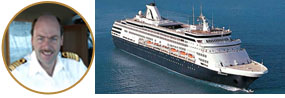
June 6, At sea.

From Piraeus to Venice the ship has to sail around the Peloponessos. The big land mass located south of Athens. Not only the Veendam has to do that but every ship that is too wide or has too much draft for going through the Corinth Canal. Not only Venice – Piraeus traffic but basically all the traffic between the East Med., Turkey, the Black Sea and the West Mediterranean. As a result the shipping lane at the south point of the Peloponessos can be very busy. All traffic tries to go through a 5 mile wide strait called the Steno Elafonisou located between the Peloponessos and the island Nissos
Kithiron. Going around this island is also possible but it is a 5 mile longer journey. The issue with going through this strait is that you have to make an almost 90 degree course change around the top of Kihiron and because the island blocks the view, you can not see what comes around the corner. Thus a situation where the captain has to be on the bridge.

The officer of the watch keeps doing his job, but I am there for extra oversight and a second opinion if needed. The traffic in the strait is not regulated, so basically it is a free for all. Most ships do the sensible thing. West bound traffic hugs the North side of the strait and East bound traffic hugs the South side. However there is always one there, who does something different. Thus we have to be very vigilant.

A great help nowadays it the AIS system. Automated Indentification System. Each commercial ship over 300 gross tons has a little transmitter on board that transmits information about the course and speed of the ship, what sort of ship it is and where it is going to. This shows up as an icon on the bridge radar and by clicking on the icon we can read all the information on the screen. It helps greatly in a situation as in the Steno Elafonisou, where the island blocks the radar waves from detecting ships on the other side. Course and speed are automatically entered into the AIS but some other info is not.

Information such as the destination, the sort of ship, plus the sort of activity where it is engaged in (sailing, underway, dredging, at anchor etc.etc) has to be entered by hand and that gives sometimes the most peculiar read outs. Ships traveling at 20 knots, as still being listed “at anchor”, or as “afloat”, or having arrived in a port 14 days ago but is still going there. One ship had entered as a port of destination, “going home”. No doubt great for the people on board but useless for the rest of the world. Or a local ferry, who had entered going from Island X to Island Y, “twice a day”.

With a cruise ship doing a regular cruise and running on a fixed schedule, there are some strange coincidences as well. Thus we met for the 3rd time, going through the strait, the MSC Armonia. Everytime around midnight and everytime on an opposite course. We are doing 10 day cruises, so she must be doing something similar but on an opposite cycle.

This time the traffic behaved itself and we could sail through at full speed and where out at the other side within an hour. I just made it to bed by midnight.

5 June, Pireaus.

On request of the local authorities I arrived somewhat earlier than intended as I was advised that this would help beating the ferries going in and out. Upon arriving we found out that during the night port control must have changed their mind as we had to wait for 45 minutes. Not only me, but also the Westerdam, the Splendour of the Seas, the Costa Romantica and a few cargo ships. We never figured out exactly what was going on and what logic lay all of this but eventually we were allowed in and were docked on time for the tours to leave.

Tuesday must have been an off-day for the ferries, as all the docks were full and there was very little traffic going in and out during the day. We docked this time at the old passenger terminal; it also looks old from the outside and it is in dire need of maintenance. We fitted in with 30 feet to spare, fore and aft. Already docked next to us was the Sky Wonder who had an overnight stay and was disembarking passengers. The luggage offloading there necessitated the ship to be very far aft, almost sticking out, leaving a rather small hole for the Veendam to creep into. Just outside the pier, there were a number of ferries docked, who had used their anchor chains to keep their bow in position. As I had the pass by quite closely to them, to slide into the dock basin, I was a bit worried about my propellers coming close to those chains. So we entered the dock by using one propeller (the starboard one) and keep the port one on stop.

The Veendam is a diesel electric ship, which means that 5 engines generate electricity that is transferred to two electric motors that turn the propellers. Those are pitch propellers, which means that the propellers turn all the time and that we change the vane setting of the propeller blades to go faster or slower. More or less scoop, more or less speed. In the same way that you dig a spoon in a tub of ice cream, a deeper scoop, gives more ice cream on the spoon. Stopping the propeller, means two options. Put the blades in neutral, this reduces the draft of the ship (a phenomena called squat) or completely stopping the electric motor, so that the propeller itself comes to a complete standstill.

I spend the day going over the charts for our next cruise. Venice to Copenhagen. This charter cruise will be finished in two days and that will also be the end of the Mediterranean period for the Veendam.

4 June, Mykonos

Mykonos is one of the major tourist attractions among the Greek islands. The little white village was sought after by celebrities in the mid of the last century and later the regular crowds followed. That meant that more and more restaurants opened and also that the night life started to buzz. Since the 70’s it has been an important day destination for cruise ships as well. Now with the cruise industry booming there is a regular traffic jam of cruise ships, especially on mid week days. Mykonos has 5200 inhabitants and today eight cruise ships (not counting the 30 ferry calls) brought another 10000 guests to the little town. Luckily not all ships came in at the same time. The Veendam was first assigned to the anchorage but was able to shift to the dock after the Emerald Princess (3200 guests who only had a morning stop) pulled out at 14.00 hrs. The Veendam stayed until midnight as the ladies wanted to sample the Mykonos night life.

You might wonder what or who decides where a ship goes. This depends on a number of factors. First of all the cruise company makes a booking, normally two years in advance. The earlier you are, the better chance you have to get in. Then it comes to docking or anchoring (when both options are available) If a ship uses the port as a turn over port (e.g. disembarking and embarking guests) that ship will dock at the passenger terminal. For a normal day call it might be assigned to another dock. If the ship is on a normal day call, then the assigned location depends on the following factors:
1. Length of available dock
2. Number of guests on board
3. Arrival and departure time
4. Frequency of calling. (a 7 day ship takes precedence over a 10 day ship)
5. Draft of the ship and the ships length.
6. Harbor fees (some ports go on tonnage, some on ships length, some on number of guests on board)
7. What does not fit in will have to anchor.

Based on the above criteria the harbor master, especially in a busy port, will decide 24 hours before the arrival where the ship will go. If there is only one cruise ship calling during the day, then it will get the prime spot in the harbor. Take as an example Rhodos. During our last two calls, we were the only ones, so we had the best spot in port. Last call there were 5 early arriving cruise ships who occupied every inch of available dock. One dock was 300 meters and took two smaller ships. One dock was 240 meters and that took the Veendam of 220 meters. One dock was 200 meters and that took the Grand Voyager of 180 meters. Etc. etc.

In a town as Dubrovnik where there is only one dock, the ship with the most guests will dock. For all our calls the Veendam was docking as we were the biggest, except last call when we were bumped by the Carnival Freedom. 3500 guests against the Veendam’s 1000. Not pleasant for us, but it make sense to have only 1000 an guests using tenders instead of 3500.

For Mykonos, it worked as follows. The Emerald Princess, being the biggest ship, got the dock. When it left, the space was given to the Veendam as this was the ship spending the longest time in port. After we had docked, there was a little bit of pier left and thus they had the Perla coming alongside was well, as their gangway fitted just on the pier, while the bow stuck out by 60 meters into open waters. Tomorrow in Piraeus, we will see something similar happening as there are 5 cruise ships expected. One will have the terminal as it is the change over port and the Veendam will get a dock, where it just fits in. The other side of the pasenger terminal will go to a ship with the most guests on board, that still fits alongside. the other (longer ships) will docked further out.

3 June, Kusidasi

Upon arrival the whole port of kusidasi was confused. In one of my previous blogs I explained how well organized the port was, and they are. So everything is planned to go smoothly and then suddenly another cruise ship arrived that was not planned in the sequence arranged the day before. I do not know whether the cruise ship company forgot the book the arrival or something else happened but suddenly the Perla of Louis Cruise Lines showed up. For them it must have been a regular call as there were people with suitcases waiting on the dockside to board, but it was not known to the pilot and port control.

Thus my pilot time of 0600 had to be pushed back with 20 minutes, not a big deal for me, but it got the pilot in a real tizzy. On top of that the captain of the Perla decided to swing on arrival, docking with the stern in and that took another 10 minutes. In the mean time I was told to come closer and closer, and by the time the pilot was on the bridge, the Veendam was almost poking its nose between the piers. The pilot is not needed for the docking sequence but he is very handy to have on the bridge to talk to the locals on the dock side. My grasp of the Turkish language is limited to one word, namely Korfezi. That means Gulf in Turkish and I only know that one as it is printed in the chart when we approach. Kusidasi Korfezi, the Gulf of Kusidasi.

Today was a quiet day for the port, only four ships, the Sky Wonder, the Veendam, the Perla (in the morning) and the Ruby (in the afternoon). The last two are owned by Lois Cruise Lines of Cyprus. This company operates mainly older tonnage and names their cruiseships after precious stones. Thus there is the Emerald (1957 ex Santa Rosa), the Ruby (1974 ex Ocean Countess), the Perla (Southward 1971), the Sea Diamond (sunk), the Topaz (1960, ex Empress of Britain), the Sapphire (ex Italia 1967) and the Coral (ex Cunard Adventurer 1971). The latter is not exactly a precious stone, although black coral is extremely expensive as well. Apart from that they have other ships that are chartered out or they act as a manning agency for other companies.

Most of these ships are operating in the Mediteranean, except for the Topaz, who is currently sailing as the “Peace boat” in charter for a Japanese company and going around the world. As far as I understand the peace boat idea is that by going around the world, the company tries to improve worldwide relations. This by stimulating the interaction between the guests on board (mainly Japanese) and the local population in the various ports of call. This “peace boat company” does that every year and for the last few years they have used the old Topaz for this purpose. The topaz was originally built as an North Atlantic Liner for Canadian Pacific and sailed between England and Eastern Canada. It is one of the few steamships left in the cruising trade. (The Emerald is another one)

For a ship lover as me, the ports in the Med are great as there is a continious coming and going of ships. Also most of the docks are lined up in such a way that the ships are docked with at least one side of the ship exposed to the sun, so that you can take a photo from another dock opposite.

02 june, Rhodos

Rhodos was a busy port today. Six cruise ships were scheduled to dock and with some ferry and cargo traffic arriving as well, it was a puzzle for the harbormaster to fit all the ships in. As there is not so much docking space availablein the port, the ships are allocated a dock in such a way that there is the least wasted quay length. This was unfortunate for us because we ended up at the far breakwater. Instead of crossing the road and being in the old town as was normally the case, it was now a good 20 minute walk from the ship, around the cargo docks, to the town. There was a shuttle bus service in operation for those could not walk that distance.

Pilotage is compulsory for every ship that visits Rhodos unless it has a Greek flag. There is also only one pilot in Rhodos who does the cruise ships and he was a busy man, hopping from one ship to the other in the course of 2 hours. He was so excited about all these ships in a row, that he dropped his walkie talkie in the water when boarding us. It was the 3rd one in one year and he was not looking forward to go home and tell his wife. Domestics also seem to apply to the life of a Rhodos pilot.

By the time we were docked, we had about 30 feet clearance at the stern and about the same at the bow. In front of us was a little coaster docked, whose top of the mast did not even reach to our bow railing. When we arrived everybody on board there was still sleeping and I wonder what the captains reaction was when the woke up and saw an enourmous blue bow approx. 15 feet away from his bridge.

Holland America Line ships are very distinctive with their blue hulls. They have this color on purpose. The color is called Holland America Caribbean blue and is mixed by the paint company to an unique specification for Holland America. In the old days the Holland America Line ships were black hulled. Then in 1951 it was decided to go to Dove-grey as the ships were also doing more and more cruises and the black hulls did nothing to help the temperatures inside the ship while in the tropics. When the company decided in 1971 to go cruising only, they looked for a way to stand out from the crowd. As all the new cruise ships were white, and the other ones still had their North Atlantic colors like as Cunard, HAL opted for blue. It would cost about 10% extra in air conditioning power as blue does not reflect the sunlight as well as white, but we did look different. NCL did something similar in 1979 with the Norway. All their ships were white, except the Norway(ex France) who was painted light blue. A number of years later Premier Cruise Lines, came up with a similar idea and painted their ships red. The “Big Red Boat” ships.

Here in Rhodos we stood out again, with all five other cruise ships being white and one big blue boat, us, in the middle. The only other ship that had a bit of fancy coloring was a local ferry whose hull was light blue with the company name in big red letters on the side. Not that it bothered our guests as again we had a beautiful day and everybody was off the ship exploring the sights of ancient Rhodos.

1 June, Santonni.

Beautiful day today; with a nearly cloudless sky and a gentle breeze to keep the temperature pleasant. As the tours did not leave that early, I arrived somewhat later as well and sailed in, on slow speed, around the centre volcano cone just after sunrise. The pattern of the call was first stopping at O’Athinios where we disembarked everybody who was on the morning tours and then we moved slowly towards the anchorage at Fira. Today the Veendam was the largest ship in town and thus we where assigned the anchorage. The Grand Voyager (800 guests) and the Insignia (750 guests) had to float for the day. O’Athinios is also the ferry port for the island. A steep road leads down from the mountain top to this little village and 4 to 5 ferries call in each day to take care of the motorized inter island traffic.

However with a maximum of 3000 guests visiting it was a lot better than last time, when we had over 5000 going ashore and when there were long lines for the cable car. This time it was a smooth and no line operation. Most of the ladies are not early risers and that helped to reduce the congestion as well. We saw that the sunken Sea Diamond was still there, with the oil boom still in position. According to the agent the authorities were still deliberating about how to deal with the issue and not much had happened since the disaster. The Anti Pollution Boat (A boat that skims oil slicks from the water) was around and we called it upon arriving at the anchorage. From the bridge high above the water (83 feet), we had a good view and saw several oil sheens around the ship. In the course of the morning these were all “skimmed away”. The the oil boom around the wreck area (the wreck itself lays approx. 550 feet below water) is there to contain the oil that comes to the surface but the wind pushes the oil sometimes over the boom into the bay.

Anchoring is a special trick here. Basically we are sailing in a volcano with high walls, a deep crater and in the middle of the crater a cone. Depths are up to a 1000 feet. Between the centre cone, which sticks approx. 100 feet above water and the Fira side is another small cone, located about 75 feet under water. That is where we anchor. I position the Veendam exactly above the cone top and then watch the echo sounder. The moment the depth after getting less, increases again, we let go the anchor and then drape the chain as much as possible over the shallow area. The bottom here is volcanic rubble that provides a real good holding ground and makes it a very safe anchorage. As there is only one such spot available, only one ship can anchor and that right is given to the ship that carries the most guests.

Smaller ships (less then 400 feet) can also dock on mooring buoys. Right under the cliff there are a number of heavy buoys that can be used to hook up bow and stern lines omitting the need for an anchor. These buoys are most of the time reserved for small cruise ships, cargo ships and big yachts.

We stayed until 10 pm. and as the night was cloudless, it was a beautiful moonlit departure. The lights of the little villages were twinkling on the top and the pale moon illuminated the cliffs towering high above us

31 May, at Sea.

As Bari radio promised yesterday, it was a gorgeous day and the ship was buzzing with very happy ladies. The wind had turned to the North West and thus became a following wind which caused just a nice gentle breeze to blow over the decks. As this is a charter cruise, the ships daily life is dictated by the wishes of the charterer. Olivia charters approximately 5 Hal ships a year and have as a result a great experience with the Holland America operation. That makes the integration of our shipboard routines, into their program very easy. The biggest challenge this cruise is apart from the special entertainment that came on board, the items needed for the culinary demonstrations. Our show lounge was not designed to have a full kitchen setup on the stage and that means creative thinking with all the mobile cooking gadgets that we have on board. Luckily with induction cooking there is no need for open flames anymore which makes things a lot easier.

For our Guest Relations manager, this cruise is a little bit easier compared with others. Personally I find this the most difficult job on board. Meeting day in day out with guests who think they have to complain about something and quite often hold the GRM personally responsible. Sitting there, and then having to endure an un-reasonable tantrum with a polite demeanor is not easy. Genuine issues are quickly resolved, it are the not so genuine ones that make it difficult. Always facing complaints, seldom getting a compliment. I do wonder how you can do a job like that day after day with a happy smile on the face. This cruise all cabin assignments and other issues pass through the charterer’s representatives first and only come to the shipside if we have to do something with it, or if we are able to assist. So for one cruise the GRM has a little bit less pressure to live under.

Last night was a very good evening for the GRM. I did my introduction speech and although each officer got a warm welcome from the audience, the applause rose to a great crescendo when the GRM stepped onto the stage. Her being a lady helped greatly ofcourse in being appreciated. Where there is normally a polite clapping of hands, now there was cheering and whistling.

Staying with the GRM duties, one of the major jobs is, the tracking lost luggage and calming down guests who can not understand why it takes so long to get it on board. With a ship it is not easy at all. A hotel does not move and if a flight is delayed the suitcase will still arrive at the hotel abeit a few hours later. For a ship that does not work. If a flight is delayed, the ship might have already departed, so the luggage has to be redirected to yet another port quite often in another country. Here in Europe things are even more complicated by the fact, whether a country is inside the Common Market or not. It is much more complicated, custom wise, to get a suitcase from Venice to Dubrovnik (300 miles) then a suit case from Venice to Athens (600 miles). This because of the fact that Croatia is (not yet) part of the European Common Market)

Every cruise there is luggage lost, most often because the labels have falling off, or because the guest made a tight connection at an airport but the luggage did not. With the ship moving from port to port, it is not always an option to send the luggage to the next port because of the chance that it might miss the ship if a flight gets delayed. Quite often the luggage is send two ports ahead to make certain that it will get on board the ship, by having it there before the ship arrives. One item that is extremely important for your luggage, is to have your name and final destination outside but also inside of your suitcase. Un-identified luggage is opened up at the airport and an address inside does greatly help to speed up the process of tracing the owner.

30 May, Dubrovnik.

We were scheduled to tender in Dubrovnik in the Gruz town, as the old town anchorage was occupied by two cruise ships and the dock by the Carnival Freedom. As the tender ride would be a long one, I arrived a little early to give as much time as possible for the guests to enjoy the port. I was not a happy person when I came around the corner and found that my assigned anchorage was occupied by one of the ships assigned to downtown. It turned out that there was some swell there and this particular ship could not keep a lee for its boats so it shifted. As a result I had to anchor further out and that increased the tender distance even more.

However nothing could be done about it, so I was glad that I decided to arrival ahead of schedule. The other ship left at 1600 hrs. and then I raised the anchor and moved in closer, reducing the tender distance by 5 minutes. The weather was off and on rain and sunshine. The rain came with wind gusts and that meant that I had to keep the engines going to help to control the ships swing as there was not much room to move about. Local television found the arrival of a 1000 ladies of sufficient interest to dispatch a camera team to film the tender dock. My 2nd officer who was supervising the shore side tender procedures was totally startled when he suddenly became the focus of the tv team as being the most senior officer present. Consequently he had to endure an interview in Croatian English. As a result he was world famous in Croatia for 5 minutes on the six o’clock news.

During the day the weather started to improve steadily and that means that by tomorrow we will have our normal sunny weather back again. As the weather here can change very very quickly I try to listen as much as possible to weather forecasts given on the VHF radio apart from checking the internet websites every morning and evening. A very good station is Bari radio here in the Adriatic. (Bari is a town on the East coast of Italy, about halfway down) It was funny to hear, at 08.30 the announcement started with a “Gale warning, rain and wind” and 10 minutes later the new weather forecast only mentioned sunny periods and light winds. Things had apparently improved rapidly in the South Adriatic in a very short period of time. All the better for us.

29 May, Venice.

After a night with rainy weather we arrived at 05.30 at the Venice pilot station where the weather improved rapidly. By the time we docked the rain clouds had receded to the horizon and the sun started to come out. Getting into the berth was a tight operation as we had on one side the Carnival Freedom and on the other side the Sky Wonder. The rest of the day turned out very to be nice, so good that the sail away party in the afternoon could be held on the outside deck.

The Sky Wonder is a most peculiar ship as it is a steam ship. The last cruise ship that was built with steam propulsion. The ship was constructed as the Fairsky for Sitmar cruises in the 1983. The owner of Sitmar at that time, Boris Vlasov, was a strong believer in steam even when all the other ships were motorized to reduce fuel consumption. His calculation was based on the idea that a steam plant requires less maintenance and will thus offset, in the long run, the cost of the extra fuel needed to attain the same speed. When the ship entered service the cruise industry kept a close eye on the performance of the Fairsky, often comparing the ship with the Nieuw Amsterdam and Noordam of Holland America Line. The N-ships had very slow running motor engines which were very fuel efficient. When the oil prices started to rise in the late 80’s the concept of the Fairsky did not work anymore and thus she was the last cruise ship built with a steam plant. The ship remained highly successful and after Sitmar was taken over by Princess, she became the Sky Princess. Since about a year she is owned by the Spanish operator Pullmantur.

We have one more cruise to go and then the ship will leave for Baltic, by means of a 14 day European Capitals cruise. From a point of logistics it is not so easy to provision a ship that is on the move and therefore we prefer to do this in the home port or turn around port. For the Mediterranean this is Venice and for the Baltic it will be Copenhagen. Stocking up for a regular cruise and for the coming 14 days after that takes a bit of doing and today was a very busy day for the provisions master as truck after truck arrived. Every item had to be checked off and frozen and chilled supplies to be directly packed away into the cold rooms. However all was loaded on time and the process will be repeated again 10 days from now.

We are now starting a charter cruise. Olivia’s Mediterranean Culinary Adventure cruise. Olivia’s is an organization for and by women. Ladies who prefer their own company to those of others. Thus we have a 1000 of them on board and great fun it is. Olivia’ charters each year 3 to 5 cruises with a Holland America and they love the company. My crew likes these cruises too. The atmosphere on board is really upbeat and a great time is had by all. This cruise they have brought on board a number of celebrity chefs who will do special cooking demonstrations during the cruise, hence the name Culinary Adventure cruise. It is a regular East Mediterranean cruise with a little twist as we will swap the port of Katakolon with the port of Mykonos.

« Older posts Newer posts »