Well the wind did not die off and the frontal system did not diffuse or move away. Instead the flow around Cabot San Vincent only got stronger and whipped up a nice South Westerly swell. What made things worse was that the wind shifted about 2 points more to the South and was thus running in line with the approach course to Portimao. Approaching with the swell in the stern is never pleasant because when you start slowing down the swells tend to overtake the ship and then it feels as if you get a kick in the……. every few minutes when a wave hits the underside of the stern. However it turned out that that was the least of my troubles. Continue reading
Page 201 of 241
As mentioned yesterday we arrived with glorious sunshine but an hour later dark clouds started to gather on the horizon. That had not been planned at all in the forecast. However the weather does not always follow the predictions. The weather front that created the overcast weather before we arrived in Lisbon, stalled and tilted a little bit instead of moving north and deposited a rather large amount of rain over Lisbon in the course of the afternoon of the first day. Then it remained drizzly during our over overnight stay. Only today the weather started to improve with sunny periods. Continue reading
 Captain Albert Schoonderbeek
Well the wind did not die off and the frontal system did not diffuse or move away. Instead the flow around Cabot San Vincent only got stronger and whipped up a nice South Westerly swell. What made things worse was that the wind shifted about 2 points more to the South and was thus running in line with the approach course to Portimao. Approaching with the swell in the stern is never pleasant because when you start slowing down the swells tend to overtake the ship and then it feels as if you get a kick in the……. every few minutes when a wave hits the underside of the stern. However it turned out that that was the least of my troubles.
With a wind force 6 blowing we approached the pilot station with an excited pilot on the VHF telling us not to come closer than 2 miles. He was coming out with the pilot boat and he did not have a very comfortable ride as the pilot boat was small and the waves, still building up, were large. I had to put the Prinsendam almost perpendicular on the wind and waves to make a good lee for his boat to come alongside and for him to step on board. By looking at the waves crashing into the breakwater I was already becoming convinced that sailing into port was not going to be a wise thing to do and the pilot quickly confirmed that. The strong wind was blowing straight into the port making it nearly impossible with a high ship as the Prinsendam to stay in the narrow channel. To make matters worse, the swell running into the harbour entrance reduced the depth at entrance by two meters every time a trough was coming through. The minimum depth there was 8 meters, minus 2 meters swell is six and our draft is 7, so we were at least a meter short with every wave trough rolling in. To top things off, there is a river flowing through the port and due to the hard rains yesterday this produced a strong flow through the entrance channel. Our pilot was not a happy chappy when he had to announce that according to him it was not a good idea to go in. (Also the shop keepers normally do not like it when pilots advise cancellations.)
I did not think it was a good idea either and thus we aborted the approach. As the weather was not going to improve until well into the afternoon, it did not have any use to hang around with the ship, so I disembarked the pilot and turned away from the port. After a port cancellation my first thoughts always are; is there something else I can offer the guests. Sometimes there is another port nearby, or you can arrive earlier in the next port if the schedule allows it but in this case it was not easy. Cadiz berth had been booked for tomorrow and a container ship was currently docked there. There is no other port near Portimao that could have taken the Prinsendam. Portimao is the biggest port in the area and even that is a tight squeeze for the Prinsendam.
During the night the swells from this weather front high up the North Atlantic reached us. A very long swell with a clocked time, from crest to crest, of about 12 seconds. The ships stabilizers could easily cope with this and thus the movement of the Prinsendam was minimal. The weather forecast for today was very good, with sunny skies and temperatures in the mid to high sixties although it turned out that that forecast had to be corrected later in the day. Continue reading
Captain Albert Schoonderbeek
As mentioned yesterday we arrived with glorious sunshine but an hour later dark clouds started to gather on the horizon. That had not been planned at all in the forecast. However the weather does not always follow the predictions. The weather front that created the overcast weather before we arrived in Lisbon, stalled and tilted a little bit instead of moving north and deposited a rather large amount of rain over Lisbon in the course of the afternoon of the first day. Then it remained drizzly during our over overnight stay. Only today the weather started to improve with sunny periods.
Apart from the pilots being involved in getting the ship into port there is also the VTS or the vessel traffic systems. These are watched over by traffic control centres in the Lisbon area. This starts already quite far out in the open sea. Near Cabo San Vicente (South West point of Portugal and Europe) and in front of the Lisbon coast VTS systems have been put in place to regulate the traffic. When you look in the chart you see imaginary highways keeping Northbound and Southbound traffic apart. It reduces the chance of collisions between ships and it also reduces the change of environmental disasters as it keeps the tankers away from the coast.
When approaching Lisbon with its estuary of the Rio Tejo; we have to call in at certain points to let the control station (called ROC control here) know, who we are, what we are doing and where we are going. When we sail up the river we switch over the VHF to Lisbon Port Control which controls the whole river area and the port itself. The idea is that port control comes back with information that will help plan a safer passage up and down the river. In the weekend the port is not so busy and so it is relatively quiet with the information offered. During the week days port control normally has a lot to advise and also helps with calling other ships if there is an issue arising. Also they are normally aware when something is going to happen in the port, especially with navy exercises.
This was the last full day of our crossing and un-expectedly we came under the influence of some bad weather all the way to the North. A rather heavy system with lots of wind is moving towards the United Kingdom and that pushed a minor system, near the Gulf of Biscay, a bit further down. As a result the wave field generated by that minor system made it all the way down to our area and thus we had a Prinsendam that moved a little bit more than in the past few days. Still for an ocean crossing, not much movement at all. Later in the day the sun even came out and that was not predicted either. Continue reading
Captain Albert Schoonderbeek
During the night the swells from this weather front high up the North Atlantic reached us. A very long swell with a clocked time, from crest to crest, of about 12 seconds. The ships stabilizers could easily cope with this and thus the movement of the Prinsendam was minimal. The weather forecast for today was very good, with sunny skies and temperatures in the mid to high sixties although it turned out that that forecast had to be corrected later in the day.
I was aiming for a noon time pilot station time, which was on the early side but most of the time the river Tejo is full of sailing boats during the weekend, plus numerous fishing boats and then it is slow going. They always tend to be just where we want to be as well, and not all Sunday Sailors have any gumption of where they should be. That is out of the way of commercial traffic. I had also planned to swing on arrival, so we would be able to shoot straight out after departure tomorrow. A starboard side docking was making sense anyway as the tide was flooding and it is preferred to dock with the bow into the tide as it is easier to control the ship that way. As the Rio Tejo has a large estuary entrance which gets narrower and narrower ,like a funnel, when coming closer to the bridge, there is a considerable current on the river and along the docks. So with the pilots blessing, we were going to dock sb side alongside.
The pilot station of Lisbon is not at the entrance of the river, but about 10 miles upstream near Belem tower. That means that we sail ourselves those ten miles up and down the river until we get to the pilot station. There is the option to pick up the pilot before you enter the river but then you have to go to Cascais first, just to the North of the river mouth, that costs at least an extra hour and I have never seen the necessity of it.
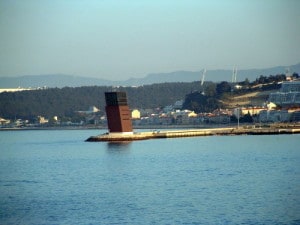
The new “Belem Tower” of the pilots.
As the weather forecast had predicted, it was an overcast day with rain showers in the distance, but it remained dry where the ship was and that was in port today. After 6 very good days at sea. The Great circle that we had been travelling on came to an end just under the West point of the island Sao Migual (St Michael) on which Punta Delgada is located. A Great Circle line with a bit of a hic-up in it due to our deviation towards to Bermuda. Just West and South of the Azores is a bank, called the Alice Bank. This is basically an Azores island, a mountain top like the other islands, but one which did not make it to the surface. According to the chart there are a few shallow spots there, so we had to make certain that our course went just under it. From there it was one straight line to the pilot station. Continue reading
Captain Albert Schoonderbeek
This was the last full day of our crossing and un-expectedly we came under the influence of some bad weather all the way to the North. A rather heavy system with lots of wind is moving towards the United Kingdom and that pushed a minor system, near the Gulf of Biscay, a bit further down. As a result the wave field generated by that minor system made it all the way down to our area and thus we had a Prinsendam that moved a little bit more than in the past few days. Still for an ocean crossing, not much movement at all. Later in the day the sun even came out and that was not predicted either.
I have been writing about waves and wave fields during this crossing. So the question should be answered what is a wave is and how do we measure it. On the bridge, for our observations, we eye ball it. A junior navigator has a sample book available with photos that indicate wave heights and that can be used to compare with what is out there. With a little bit of help from a senior officer it is then fairly quickly becoming routine to observe correctly what the wave heights are. Satellites can do the same nowadays with infra red beams which are extremely accurate in measuring the exact height. So are experienced sailors and we do it by just looking out of the window. The height of a wave is measured from its lowest point, the trough, to it highest point, the crest.
Now waves are never the same height. The wind blowing over them changes the height, another wave pattern might interfere and cancel much of the achieved height out etc. etc. Thus for measuring the average wave height we use the significant wave height. That is also the wave height indicated on the chart I attached a few days ago. The definition of the Significant Wave Height: is the average height (trough to crest) of the one-third highest waves valid for the indicated 12 hour period. This means that you can come across waves of double the height, or a nearly smooth patch of sea, where two waves have cancelled each other out. However for the prediction of what the ship will encounter in the near future, the significant wave height on the wave chart suffices.
Captain Albert Schoonderbeek
As the weather forecast had predicted, it was an overcast day with rain showers in the distance, but it remained dry where the ship was and that was in port today. After 6 very good days at sea. The Great circle that we had been travelling on came to an end just under the West point of the island Sao Migual (St Michael) on which Punta Delgada is located. A Great Circle line with a bit of a hic-up in it due to our deviation towards to Bermuda. Just West and South of the Azores is a bank, called the Alice Bank. This is basically an Azores island, a mountain top like the other islands, but one which did not make it to the surface. According to the chart there are a few shallow spots there, so we had to make certain that our course went just under it. From there it was one straight line to the pilot station.
The Azores are, although in the Eastern part of the North Atlantic, still 740 miles way from the European (Portuguese) mainland. After their discovery in 1427 they have been part of Portugal. Due to its strategic location, as a sort of gate keeper for Europe, it has always played an important part in connecting the Western and the Eastern hemisphere. For the cruise ships it is very often a stop during the bi annual migration of the ships from the Caribbean Sea to Europe. Although since the European cruise market has started to develop rapidly, more and more ships are calling here all year around.
In the past, read before the 1990’s, the Azores where mostly called at by sailing yachts on the way across the Atlantic and cargo ships. Several tugboat companies had tugboats stationed here for call out, if ships would get into problems on the North Atlantic. Very famous is Café Sport in Horta; that for years was the home base of the tugboats of Smit International, the world famous Dutch salvage company. This café became such a Dutch stronghold that even the Portuguese owner spoke Dutch (and was an avid fan of Feijenoord the soccer club of Rotterdam). Punta Delgada had in those days less of a connection with sailing, as it was located further to the South.
Captain Albert
© 2026 – Captain Albert's Website and Blog –
Theme by Anders Noren — Up ↑