In most cities things quiet down during the night, but Istanbul, together with New York and Hong Kong never seems to slow down. I was expected that the traffic on the river would come to a standstill during the night, apart from the thru traffic in the Bosporus but not at all. Maybe the total count of the local ferries went down but the river looked as busy at 11 pm in the evening as it had been at 3 pm. yesterday when we arrived. The big-a-boate- mentioned yesterday arrived indeed and thus there were three cruise ships in port today. Ranging from the very big Costa liner with 2500 via the Prinsendam of 800 to the very small Minerva with less than 300 guests on board. Continue reading
Page 198 of 241
 Captain Albert Schoonderbeek
The Dardanelles are of course in Turkey but to get there you have to sail through the Greek islands. Some of those islands are much closer to Turkey than they are to Greece. On the west of an island it might be 10 miles away from the nearest other Greek island but less then a mile away from the Turkish mainland coast. As there is sometimes a bit of friction between Greece and Turkey, just think about the Cyprus issue, it is amazing to see how much the two countries are intertwined as far as their border is concerned and how well it all works. At least for us. Thus we made our way towards the Dardanelles by sailing around several Greek islands to get here.
To make the schedule to Istanbul on time, I had to go through the Dardanelles fairly early otherwise I would have been late in Istanbul. However by doing the first leg a bit slower and by going after the passage full out, the ship could pass the entrance at sunrise and do the complete passage at daylight. The guests will be able to see the passage on the way down at a more decent time but the early birds had the option for an early morning view as well now. Pilotage is not compulsory for every ship that goes through but for certain ships it is and for others it is highly recommend by the authorities who are very eager to have as few collisions and other mayhem as possible. I always take a pilot at the Dardanelles not because I am not capable of doing it myself but because the Dutch law requires it.
The Dardanelles are of course in Turkey but to get there you have to sail through the Greek islands. Some of those islands are much closer to Turkey than they are to Greece. On the west of an island it might be 10 miles away from the nearest other Greek island but less then a mile away from the Turkish mainland coast. As there is sometimes a bit of friction between Greece and Turkey, just think about the Cyprus issue, it is amazing to see how much the two countries are intertwined as far as their border is concerned and how well it all works. At least for us. Thus we made our way towards the Dardanelles by sailing around several Greek islands to get here. Continue reading
Captain Albert Schoonderbeek
Today we visited the first Turkish port of our cruise. After Kusadasi; Istanbul, Trabzon and Sinop will follow. Kusadasi is the port of entry for the tours to Ephesus; known from the Biblical days of the apostle Paul. Apart from that main attraction, the area has several other things on offer, not the least the good shopping that is available in the town, with the emphasis on leather. A number of years ago they built two new finger piers here and since then the calls by cruise ships have more than quadrupled. There are days when all piers are full and occasionally a ship might even have to anchor. The town it takes its name from a little island to the West of the port. Translated Kusadasi means Bird Island. Nowadays this island is connected by a causeway with the main land so that the castle on it is much easier to get to so it is not really an island anymore. Since last year the promenade in front of the port even boosts a Dutch Restaurant, with real Dutch coffee so Kusadasi is really getting there.
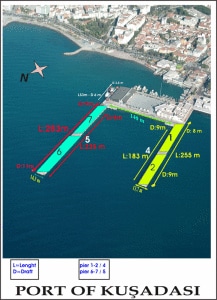
Overview from when the piers were built. On the concrete area at the end of the piers, the cruise terminal was built. Photo courtesy Kusadasi Port Authority/from my port database.
Today we visited the first Turkish port of our cruise. After Kusadasi; Istanbul, Trabzon and Sinop will follow. Kusadasi is the port of entry for the tours to Ephesus; known from the Biblical days of the apostle Paul. Apart from that main attraction, the area has several other things on offer, not the least the good shopping that is available in the town, with the emphasis on leather. A number of years ago they built two new finger piers here and since then the calls by cruise ships have more than quadrupled. There are days when all piers are full and occasionally a ship might even have to anchor. The town it takes its name from is a little island to the West of the port. Translated Kusadasi means Bird Island. Nowadays this island is connected by a causeway with the main land so that the castle on it is much easier to get to, so it is not really an island anymore. Since last year the promenade in front of the port even boosts a Dutch Restaurant, with real Dutch coffee so Kusadasi is really getting there. Continue reading
When I approach Santorini with the ship I always have to remind myself that, no we are not crazy and yes in this case it is normal to sail into a Volcano crater. It is big enough and there is plenty of water but still it is a bit strange to do so. However it is an impressive experience when you sail around the central volcano cone towards the East shore where the most important villages are located. There are two entrances to the area, one from the South West and one from the North West. As we were coming from the Lower West we used the SW entrance as it was the shorter route. Continue reading
Captain Albert Schoonderbeek
When I approach Santorini with the ship I always have to remind myself that, no we are not crazy and yes in this case it is normal to sail into a Volcano crater. It is big enough and there is plenty of water but still it is a bit strange to do so. However it is an impressive experience when you sail around the central volcano cone towards the East shore where the most important villages are located. There are two entrances to the area, one from the South West and one from the North West. As we were coming from the Lower West we used the SW entrance as it was the shorter route.
The routine is for most cruise ships the same; first you go to O’Athinios to disembark the overland tour and then you slowly sail to Skala Fira where the tender docks for access to Thira which sits on top of the Cliff. As mentioned yesterday, the Prinsendam would have to drift all day, as a warship was at the anchorage. So I was intrigued to find out what sort of warship that would be. When we came around the corner we saw that it was a USCG cutter, taking on bunkers and doing some R&R.
Confusion reigned as they identified themselves as warship 917, while we could clearly see it’s was a USCG boat. Maybe the department of Transport was starting their own navy or something. However 917 rang a bell, I remembered that number from something and thought it could not be. But it was. The 917 was the same USCG cutter Boutwell that had played a very significant role in the sea rescue of the guests of the first Prinsendam in October 1980 when it caught fire in the Gulf of Alaska. It was thus a bit strange to see the Boutwell here in the Mediterranean and to have it meeting up with the 2nd Prinsendam. I joined the company a year later but I remember that there was a great feeling of gratitude among everybody for the work of the crew of the Boutwell during that operation.
Captain Albert Schoonderbeek
It was busy during the night when sailed around the south point of the Peloponnesus. I counted 75 ships on the radar at one given time in a radius of 24 miles. They all behaved as they should but we had a little excitement when 3 miles ahead of us a little German coaster suddenly flipped on all his red lights. Five seconds later a very German accent came on the VHF announcing that he was not under command (e.g. could not control his ship) as there was air in the fuel lines to the main engine. Main engines do not like that very much so his engine had stopped operating. While they were solving that issue, the little coaster was drifting help less right in the middle of the shipping lane.
We had been in the process of overtaking that ship and to avoid any problems and excitement on his side we changed course a bit more to starboard and over took him at a safe distance. Shortly after our passing the red lights went out and we saw him making speed again. Once through the channel we made a wide turn to the North, a very wide turn to stay away from all the south coming traffic and then headed towards Navplion.
This town is located at the top end of Argolikos Kolpos or the bay of Argolikos. Argolis is the county or area where Navplion is located. Just to the north at the other side of the mountain is Corinth with the Corinth Canal. Unfortunately the canal is not wide enough for the Prinsendam otherwise we could have gone around the north side instead of the South side of the Peloponnesus. Apart from a few fishermen the bay was empty and without delay we dropped the hook as close as we could to the breakwater of Navplion. I wanted to go closer, but there was the proverbial fishing buoy right on the anchor spot. As you never know what is exactly hooked up to the end, and you do not want to foul the anchor, I had to stay a bit further out. By 9 am. A fishing boat came out to check if his buoy was still there and after a bit of argument between the occupants it was decided to remove the buoy with its cage located at the other end of the line. It seemed that we were not trusted to leave the buoy alone.
It was busy during the night when sailed around the south point of the Peloponnesus. I counted 75 ships on the radar at one given time in a radius of 24 miles. They all behaved as they should but we had a little excitement when 3 miles ahead of us a little German coaster suddenly flipped on all his red lights. Five seconds later a very German accent came on the VHF announcing that he was not under command (e.g. could not control his ship) as there was air in the fuel lines to the main engine. Main engines do not like that very much so his engine had stopped operating. While they were solving that issue, the little coaster was drifting help less right in the middle of the shipping lane. Continue reading
With a flat calm sea and the sun rising over the horizon we arrived at 07.00 at the pilot station of Katakolon. Ahead of us was the MSC Musica which was scheduled to dock at the outer breakwater. This is a 90.000 ton ship and carries 2500 lower beds and over 3000 when full. That spoiled it a little bit, as Katakolon is a little bit too small to take such an invasion. However she was only going to stay to until 2 pm. and thus our guests had the town all to themselves during the afternoon. The good news was that we, being the smaller ship, could dock at the downtown pier and that meant less then a 1000 feet to walk to the town with it’s shops and tavernas. Katakolon is a very nice place to go to. Continue reading
Captain Albert
© 2026 – Captain Albert's Website and Blog –
Theme by Anders Noren — Up ↑