Even with going very slow and steering courses far away from the mainland to keep the casino open, the Prinsendam can only go as slow as the minimum engine speed dictates. Scrabster is not that far away from Portree and thus with all the extra time on our hands now we did not have to go very fast. With the Prinsendam you bring more engines on line (we have four main ones) if you have to go faster and if you have to go very slow, we run on one engine. With the port cancellation even that one engine was too fast. The wobbly weather outside made floating not an option, so I decided for an early arrival. Drop the anchor early in the morning and then start the ship up leisurely around 6 am, so that all the tenders would be in position and waiting for the guests to invade the Isle of Skye. Continue reading
Page 192 of 241
With nearly wind still weather we sailed out of Leith and I had high hopes for Scrabster. The weather had been brilliant over there for the last week with little or no wind or rain. For our day in port NW 4 was expected but the harbor master advised that the cliffs would shelter us from most of it. Thus full of happy thoughts we set course for Scrabster, next to Thursoe at the edge of the Northern mainland of Scotland. By 9 pm. the ship started to pitch a little bit and the wind started to increase. Well it is normal that it blows here so a bit of wind was to be expected and also a northerly swell rolling in from far away. The Coastal stations were indicating nothing out of the ordinary, a bit of rough weather but no gale warnings. However by 10 pm. we had wind force 8 blowing with deepening waves. Thus the Prinsendam became quite lively. That remained so for the remainder of the night until about 4 am. when we came in the lee of the islands again. Continue reading
I received my wake up call at 23.30 and by 00.30 we had the pilot onboard at the sea buoy in the Firth of Forth. With the following tide we sailed towards the lock chamber that gives access to the Leith docks. The pilot explained what the idea was to arrive with the flood tide. Apart from having more water under the keel it would also be easier to line up for the chamber as with the ebb flowing there are some adverse currents just outside the lock. Well I am all against adverse currents and thus full in favor of this approach. It was wind still on the water but we had overcast skies as rain was predicted later on. Supposedly less than in Newcastle but “less rain” is a relative observation here. As with a lot of rain being the norm, less rain can still be a substantial amount. Continue reading
With the slow speed that we had to make to get here, it will come as no surprise that we were on time at the pilot station, exactly on time. We had aimed for 0600 pilot and at 0600 the pilot stepped onto the pilot ladder. Newcastle is a very straight forward port; all the docks and wharves are located around and on the river itself. No branching off, or difficult canals, just sail in and you will pass by where you need to go to. It is not really Newcastle at all where we docked. The area with this name is located more to the West but we cannot get there as the river is too shallow and there are fixed bridges over it. So we dock more to the East, where a number of once small hamlets have expanded and are now glued together in what they call Newcastle Metro. Two of these are called North Shields and South Shields. They are separated by the river and we docked at the North Shields side. Continue reading
If there had not been the tide issue with Greenwich and the long sail out, then we could have made our next port in one night. However we had the tide and also we are supposed to have at least one day at sea during a cruise and thus we spent a day going very slow on the North Sea. The weather was very changeable today, with sunny spots and rainy weather and it is impossible to say when it will get dry again. There is very little wind in the system now laying over England so the rain clouds do not move very fast. Going North meant that we were quickly out of the shipping lanes and we did not see much traffic at all, except the oil rigs. Continue reading
Due to the tidal situation our departure was set for 11.am. So by 10 am we started with the opposite procedure as on our arrival; taking way the bunker barge, letting go the lines from the buoys, hooking up the tugboats and then moving away from the Greenwich pier area. It was a sunny day so perfect weather for scenic cruising down the river. As we left by 11 am. The sun was already sufficiently to the South so that it did not shine in to our eyes while going Eastwards down the river and thus it was very nice to see London from the decks or from the private balcony’s. A lot of guests stayed put on their balconies while London and it suburbs moved by. Continue reading
It is normally not the case that two of my blog entries are linked by the minute to each other but while yesterday’s one ended at midnight; this one is starting 00.01 after midnight. Just before midnight we approached the buoy location of Greenwich which would be our home for two nights and the day in the middle. Not a dock, not an anchorage but six buoys to keep the ship in location. The pilots called it going INTO THE TIER. While we were coming up the anchorage we needed the high water to pass certain places, here at Greenwich is a dip in the Thames bottom where we can happily float even on the low tide. To get away from the Tier we will need high water again. A bit like sitting in a bathtub with the ship. Continue reading
Today we continued our leisurely ride towards the pilot station at the Thames estuary. Our arrival time being dictated by the start of the flood, going up the river. There is one spot in the river that is very shallow and the pilots time the transit of the ship in such a way that we are riding the “wave inbound” over that spot. Although most people equate London with shows, shopping and fashion; it is also a big industrial area and that means that there is a considerable amount of shipping going to and from the port. In the old days it was a major port, where most of the products to and from the Empire were processed. The old London docks were very extensive and always teeming with shipping. That all changed with the arrival of the Box boats. For their draft the river was too shallow and to avoid loosing time ports were sought that where closer to the sea and did not have locks closing off the docking area’s. Thus Felixstowe opposite Harwich is now the biggest English port for containers. As a result most of the old docking areas have been abandoned by the shipping company’s and taken over by developers for housing and offices. Canary Wharf is one such an example. Continue reading
After we disembarked the pilot at 03.30 in the morning, we were out of the Oslo fjord entrance by 4 am. Then we started crossing the Skagerrak which is the body of water between the top of Denmark and the lower end of Norway. I had plotted a course straight through the middle so that we would avoid all the traffic going towards Scandinavia and also the traffic rounding the top of Denmark going into the Kattegat and the Oresund. Only later we came close to the western shore of Denmark but then we were past most of the traffic. I never believe to look for traffic hotspots if you can avoid them. Today we did not have much traffic of concern, apart from one Chinese car carrier who progressed through the sea with erratic speed bursts. Must have been doing engine tests or something. It got my Officer in the 8 – 12 watch highly excited as it changed his CPA (closed point of approach) on the radar plot from 2.5 miles to 0.5 miles every so often. Continue reading
For the guests the cruise schedule for the day in Oslo was prefect. A mid morning arrival and a midnight departure. Thus no need to get up very early in the morning to see the Oslo fjord and also having the chance to see the same fjord by night. (Well, by dusk, as it never got really dark) Thus I approached the pilot station at the beginning of the Oslofjord at 0600 hrs. and then sailed with the sedate speed of 16 knots up the fjord towards Oslo. The first part are wide open waters and not that impressive and navigationally not that challenging. However the pilot was concerned about the ferries crossing the Fjord from East to West and vice versa and did not want to race through. Fine by me as long as I was docked on time, at 10 am. all would be well with the world. Continue reading
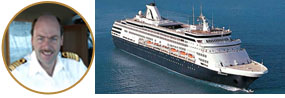
Captain Albert
© 2026 – Captain Albert's Website and Blog –
Theme by Anders Noren — Up ↑