To get to Bilbao we had to go back East again, from where we came yesterday, the direction of Bordeaux. Only this time we hugged the coast line of Basque country at about 10 miles off shore, instead of being fully in the open. We had following winds and following seas and with the Prinsendam on full sea speed we had a nice and quiet ride. In the area where Bilbao is located, the coast dents in a little bit, so by early morning we had to change to a southeasterly course. Now the wind started to fall away and the swells subsided to about 12 feet. Hence we could slow down a little bit, while still keeping the ship steady and we did not have to enter the port too early. In the end we started the approach about an hour early and were docked at 09.15 instead of 10 am. Continue reading
Page 173 of 241
We started out very wobbly, due to high waves on shallow water but during the night when we entered very deep water, the swell became less pronounced and the ride became normal. That was good, as entering A Coruna, the same thing would happen again, although it is more a problem when going out, than when going in when you have following waves. Going in, you ride with the waves as a sort of surfboard, instead of bouncing against it when outbound. There in the South part of the Bay of Biscay everything is relative and where in other parts of the world 15 feet is considered an issue, here it is “no problem”. Also the swell was from the right direction, so once in the bay, it was nice and calm to embark the pilot. This time we were docking at the Muelle de Trasatlanticos and that is the best berth as it is protected from the reflected swell in the bay. When a North westerly swell runs into the bay of A Coruna and it is high enough; then it bounces off the rocks in the South East corner of the bay and doubles back into the port. Today the waves were not high enough to do so and also more from the WNW than from the NNW. Continue reading
It remained overcast for the whole day and that gave a very pleasant temperature for going out. Most crew, if not on Import Manning, took the chance to go ashore in the evening, as we stayed the whole night. We can only arrive and leave with high tide and that was 0800 in the morning. Import manning is a system that we have onboard to ensure that there is always sufficient crew staying onboard to respond to an emergency. Normally this is 25% while docked and 33% while at anchor. For key functions it is 50%. In my case, the chief officer can only go ashore if I am not going and if there is an issue expected such as inclement weather, then we both had have stay onboard. For larger departments, such as the dining room is not necessary that all 80 dining staff stay onboard, 20 or 30 are normally enough to cover the emergency functions. Then the supervisor makes a schedule and that is entered in the security computer. If a crew member wants to go ashore but he/she is on import manning, the ID card when presented at the gangway for scanning out is blocked and the security teams sends the crewmember back into the ship. Thus most crew arranges with their supervisor in which ports they want to go off and the schedule is made up accordingly. With an overnight stay it works out most of the time that everybody gets a chance to go ashore, either in the afternoon, early evening or late evening. Continue reading
With dark skies and intense lighting in the distance over the land we arrived at the pilot station. It has been very warm in the Bordeaux area in the last few days and now with the air cooling down we were entertained with extensive “light shows” somewhere inland. It lasted until day break and then it somehow suddenly stopped. With the pilot onboard we proceeded up the estuary of the La Garonne” and as the flood current was just starting to run, we made almost 20 knots with the engines on maneuvering and that meant close to 4 knots of current running with us. Once we were entering the river itself we had to slow down to avoid squat but still with 12 knots of engine speed, we made 15 knots over the ground. That really helps with the fuel consumption as the current basically provided the power of one engine free of charge. By sunrise we were a good 3rd distance up the river but for sightseeing it only gets interesting when you are about half way; when the river banks come closer. Continue reading
This is a less usual port for cruise ships to call at and those that are calling are those which are on the more “off the beaten track” such as the Prinsendam. Also the port entrance is really too small for the large cruise ships and thus the port is limited in what it can attract. However the Prinsendam called here for the 2nd time in her career with a morning stop. As mentioned yesterday, the entry into the port is dictated by the amount of current that flows through the entrance and thus it is a bit difficult to schedule. Our official departure was set for 1400 hrs. but the Harbour masters office decreed a 1300 departure as the current was expected to be very strong as it is around spring tide at the moment. Thus a 1 pm departure it was and I cannot say that I disagreed with them. The entrance is very narrow, about 180 meters wide of which 60 meters the pilot feels really comfortable with. With a big ship, that is only twice the ships width. So apart from the current it is also not advisable to go here on a windy day. The course angle as a result of wind drift would make the transit very precarious.
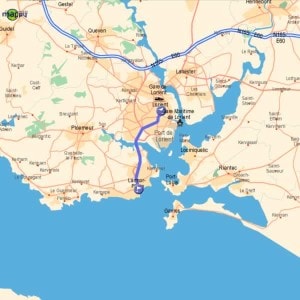 Lorient is an eastuary port with the tide going all the way through the harbour and up the connecting river.
However today it was nearly wind still and we arrived at the end of the flood tide so the transit was not much of an issue. When you enter the port, you see a large Fort, Port Louis, on the starboard side which we pass at a distance of about 300 feet. Built to protect the natural port and the hinterland it is quite an impressive construction. Next comes, on the other side of the bay, a large U-boat dock from the 2nd world war. After St. Nazaire, Lorient was one of the major submarine ports for the Germans during the Battle of the Atlantic. A big brownish concrete complex that still looks as if only recently built. I am quite amazed that the Germans were capable of constructing such large facilities in such short time periods, as WWII lasted only about four years in France. Lorient is a real cargo port and the reason we are here is for the tours into Brittany. Therefore there is no real passenger terminal, more a warehouse that is a combination of all sorts and by the time we had swung around, we had a great view of a scrap yard. Here a Dutch coaster was loading scrap for Turkey, but as it was Sunday, there was no movement. That was good, as metal scrap is very noisy when it gets grappled up and thrown into a steel cargo hold.
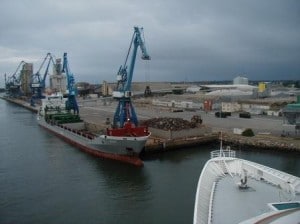 Exciting view from the bridge.
As the bay has an estuary form, there is a lot of water flowing in and out, hence the strong currents at the entrance and during our call the Prinsendam descended almost 14 feet while alongside. It gives you great respect of the water mass and its strength that comes churning through the entrance of the port. Thus when we pulled away from the dock I had the bridge team ready and focused on what was coming. Especially as we had one extra issue to contend with: Sunday sailors. It is a great sailing area, plus the Tour de France for sailboats was going on and thus everything that could float was out there, professionals, and those who would better be at home in port, all happily mixed up. And yes, there was one, right in the middle of the channel, trying with a small engine to get his sailboat out to open waters against the upcoming flood. It took a lot of horn blasts and some intense gesticulating from fellow sailors to get the guy out of the way. He finally went after looking behind him and seeing the Prinsendam bearing down upon him with great speed. There is water enough outside the fairway for small draft vessels, but if you do not know what you are doing, then staying between those buoys makes life a lot easier…………. until the big boys come along and shatter your tranquility.
For the guests it is all very interesting, the tours in the port, the sail away and then the sightseeing between the islands while the ship dodges sail boats. Normally I hand over the Conn of the ship to the Officer of the Watch quite quickly but this time I kept navigating myself for nearly an hour and a half, as the sail boats kept coming, and there were reefs and shallows nearby. Not much room for mistakes. It is part of good seamanship that you do not handover the watch, e.g. the Conn, until there is a safe and controllable situation at hand, with no imminent issues going on that will require instant action of the officer coming on duty. He/she should be able to relax and tune in before starting to do things him/herself.
Tomorrow we are in Bordeaux and that arrival is also dictated by the current. You go upriver with the flood and arrive at high water and you leave at high water and go down river with the flood. That means being at the pilot station at 3 am. for a 9 am. docking. So I will up and about by 2 am. tomorrow morning for the approach.
In accordance with the rules of the road we followed the Vessel Traffic Separation scheme. We crossed the North Sea over the English side and picked up the Southbound Traffic lane towards the North Atlantic Ocean. We were going full speed as it is a tight schedule to Lorient in France and that meant that we were overtaking ship after ship. Around 6 am we passed Dover and were hoping for a glimpse of the White Cliffs but it was not to be as at that time a white cloud descended over the Prinsendam and its surrounding area. The good weather was finally catching up with us and producing fog. Luckily it was not that early and thus we did not wake up the guests in the suites too early. Having a suite is the best thing you can have on a ship but you have to take in consideration the fact, that what the captain gets, the suite owner gets as well.
There is more movement as you are higher up and when the captain starts blowing the horn, right above your head, the suite occupant will have to enjoy it as well. I knew it was going to be a nice day again, so it was just a matter of time before the rising sun would be strong enough to burn off the fog and return to good visibility. In the end it took until 11.00hrs and then the world was wide open again. Continue reading
Due to our delayed departure from the Kieler Kanal, I really had to crank the Prinsendam up to warp speed in order to make Ijmuiden pilot station on time. Luckily the tide on the river Elbe was with us and that gave a bonus of 5 miles, due to the velocity of the current during the two hour transit. Later in the night when ebb turned to flood, we had the current against us but by then we were out in open waters and there the current is less strong. A river estuary is as a funnel and when the water gets pushed more and more into the narrow part and the only way it can deal with the volume is to start flowing faster and faster and go higher and higher. Sometimes a nuisance, sometimes a help, as it was this time. Thus we raced westwards above the Dutch Wadden Islands and then turned South near Texel, heading for Amsterdam. We just made it to the pilot station at the agreed time with about 10 minutes to spare. Continue reading
The challenge with the southbound passage is that we have to start early in the morning, in order to have enough time left to get to Amsterdam on time. That meant being in the Holtenau Locks, at the East side, at 5 am in the morning to start the transit. To get to the Locks we need the Kieler Bay pilot and thus we had to pick him up even earlier. So by 3 am I was gazing at the Kieler Lighthouse while we were approaching it. The pilots have accommodation in the base of this lighthouse which stands in the middle of the approaches to the bay as a sort of traffic cop, while ships pass around it from several sides. We were exactly there at 4 am and then cranked the ship up again to full maneuvering speed to be in front of the locks before 5 am. There our first delay started as the lock chamber was still full with 3 cargo ships who only came slowly spilling out of it. Hence we were only inside by 05.15 hrs. The Kieler Bay pilot left us here, replaced by the Kieler Kanal Pilot with two helmsmen. Then we proceeded with the grand speed of 7 knots into the canal. This side of the canal is the narrowest part, and still comes closest to the way it was constructed back in 1895. On either side there is a lot of expensive Real Estate to look at, some from the 19th century and some from the late 20th century. So the guests who were up and about early, had numerous interesting things to look at apart from the canal . Continue reading
After so many port days in a row; Warnemunde, Tallinn, St. Petersburg, Helsinki and Stockholm, finally a sea day for everybody to catch their breath. The funny thing is that most (not everybody) guests like to book the cruise that offers the most ports, as it offers the best value for money. However when they then make the cruise, a great sigh of relief goes up when there is finally a sea day coming. Sightseeing is hard work, especially in Europe, where each country has its distinct culture and the impressions are overwhelming. By the time you are on day 10, you cannot remember anymore which ruin you did on day one. So today was a day to relax; at least nobody was going ashore. As we only had a few sea days this cruise, we had to cram the 2nd half of all our standard Holland America activities into this sea day. We had the mariners luncheon (two sittings as the whole ship is a mariner here), Walk the Cure on deck and numerous other things, including lectures, get togethers, cruise staff activities etc etc. Cruising is hard work, especially on this cruise where there are so few sea days. Continue reading
There are two ways to get into the Swedish Archipelago and from there to Stockholm. Either via the North Entrance or via the South Entrance. The North entrance is always used by ships coming from the Bothnic Gulf. I did the same last year when we came from Vaasa in North West Finland. Also the ferry’s that run a night schedule will use this entrance and some of them do not even go to Stockholm as just inside the entrance is a ferry terminal. The South entrance has two issues, it is day light restricted for over 200 meter ships and some of the very large ships, including cruise ships cannot use it at all, due to a 90o turn near the entrance. Also those ships have to use the North Entrance. However if you come from the East from the mid of the Baltic Sea as we did, then the South entrance is much closer and easier to reach. Hence us going that way and in order to comply with the day light rule, I arrived at the pilot station at Sunrise. It was perfectly timed, the moment the pilot boat came alongside the sun rose as a fiery ball above the horizon. Ahead of us we could not see any horizon or any islands as there was dense visibility due to fog. Continue reading
Captain Albert
© 2026 – Captain Albert's Website and Blog –
Theme by Anders Noren — Up ↑