As forecast last night it was indeed not such good weather today. With a wind force 7 blowing from the south West, there were white caps everywhere and with the Prinsendam going against it with the speed of a wind force three, it was very breezy on the bow. Still in the Baltic it is only the wind that is a real issue. As land is never far way, the wind cannot build up a long running ocean swell and thus what you see is only choppy seas. That means that the ship does not move at all and the guests can enjoy a peaceful day onboard. A day that is much needed after having done Tallin, St. Petersburg, Helsinki and Stockholm all in a row. Intensive ports for sightseeing and thus a restful day at sea to recharge the batteries for three more ports is a good thing. Another positive thing is that we can combine this sea day with the fact that today is a Sunday. We cannot always schedule the cruises in such a way that we can spend Sundays at sea, but if we can do it, it is better. On Sunday’s most shops are closed and a lot of other local services are not available and it is the ship that get the complaints. Thus a day at sea makes everybody happy. Continue reading
Page 169 of 241
My normal pilot time here is 0400 hrs as that brings me to the dock just before 0800 our official arrival time. However the entrance that we use to gain access to the Stockholm Archipelago is a day light restricted one, at least for the Prinsendam. This is the South entrance which is called Sandhamn after a little town nearby. The problem here is a narrow entrance, followed by a 90 degree turn and ending with a narrow thoroughfare again. So very large cruise ships such as our Eurodam are not allowed at all and have to take the North entrance. Smaller ships as the Prinsendam with a length of up to 200 meters are only allowed during daylight hours and only small ships are allowed through at anytime. Taking the North entrance, means making a lot more miles to get there, as it is a fair distance above the south entrance. I have only used that entrance once, when we came from Vaasa in Finland last year. Our normal routine when coming from Helsinki is to use the south entrance. Continue reading
The day started the right way with me not having to get up as early as during previous calls. When it is high summer we normally have the Lapland tour by airplane and that means that I have to be docked by 06.00 for a timely tour departure. Today there was no tour, and I could arrive at the civilized time of “somewhere before 8 am” as 08.00 hours was our docking time. So instead of getting out of bed at 3 am for a 0400 pilot, I could get out of bed at 5 am for a 06.00 pilot. What a luxury. It takes about an hour to get into the port but I try to go in a little bit earlier, as traffic can delay the transit and then suddenly you are too late instead of being on time. Plus the regular speed from St. Petersburg is such that I can continue on the same speed setting all the way into the port and thus save more money on fuel by docking early. The dock fees are per call and not per hour and thus makes no difference. Although the days are getting shorter it was daylight by the time we approached the pilot station. Normally I do not mind day or night for going in or out of port but Helsinki is different. Continue reading
A standard item during this two day stay is that all the cruise ships are bunkering fuel. Russia is among the cheaper suppliers of HFO and MGO (Heavy fuel Oil and Marine Gas Oil) and thus everybody stocks up. The difference per ton, might only be $ 10 but on loading 1400 tons it is $ 14,000 and if you make several calls it soon mounts up. My challenge is always to have the agent find out the exact time the bunker barge will arrive at the ship, so we can start without delay. A second uncertainty is the pump capacity of the barge that is chartered by the supplier. This varies from call to call. We now have bunker days where not more then 80 tons an hour was pumped, but also the occasional highlight of a barge with 150 tons pump capacity. With a low pump volume it can take all night before the full load is in the tanks. Something I forever try to prevent as it can inconvenience the guests sleeping near the barge and so I hope to get the fuelling started at 8 am and then (hopefully) get finished by sunset. My efforts are normally in vain and the barge pops up whenever it wants. This time we were in luck. The barge arrived at noon time, had a reasonable pump capacity and was gone by midnight. Quick work for Russian standards. Continue reading
We did make up our lost time and with only being 30 minutes later, I was now in a time slot of sailing in after the Costa Atlantica instead of ahead of her. So the cruise ship parade could continue to sail into the port without too much of an upset. The Alexander von Humboldt was leading the way, followed by the Costa Atlantica, followed by the Prinsendam, followed by the Costa Magica. All 15 minutes apart. In port was already the Jewel of the Seas, Silver Whisper and the Crystal Symphony. Tomorrow there will be even more ships in. The Jewel of the Seas leaves today and will be replaced tomorrow by the MSC Poesia. Then there is the Minerva, the Astoria and the Kristina Regina coming in. So each day there will be roughly 8000 cruise passengers ashore in St. Petersburg. The small ships all dock in the cargo port or up the Neva River at the Lieutenant Smith embankment. We were assigned again to the new cruise port, the Marine Façade, which is now 2/3 completed and also the ferry corner is in operation. That leaves two more berths (1 & 2) to be completed during the coming winter. As the season is coming to an end, we sailed by the Kronstadt naval base in the dark but on the way out, tomorrow evening, it will be daylight and then everybody can have a good look. Continue reading
The wind was still blowing un-abated when we started to make our approach to Tallinn. From all sides the cruise ships were converging on the city and thus we had in alphabetical order: Alexander von Humboldt, Costa Atlantica, Empress, Minerva, and the Prinsendam. A port full of cruise ships, while not counting the numerous cruise ferries that call during the day at Tallinn. We were sailing into the port behind the Costa Atlantica which had the pilot 30 minutes earlier and was scheduled for the new cruise pier while we were docking in the old port. With the wind blowing strongly I was glad that I had ordered a tugboat for arrival, to keep the stern under control while the wind was setting us towards the dock. Then I saw my tugboat going to the Costa ship instead of coming to us. Both the pilot and I uttered some very unhappy words, which were then repeated by the pilot into the VHF. As my “Estonian language knowledge” is near zero, I could not follow the conversation but port control was quite agitated. Continue reading
Today is the sea day needed to get from the Kieler Kanal to Tallinn. The wind that started to be noticeable when we left the last locks, hit us in full force when we exited the Kieler Fjorden (official name of the large bay at which end the port of Kiel is located). As it was an easterly wind it also meant that we were heading straight into it. Wind force 7, occasionally 8 during the might, meant that the relative wind at the bow was hurricane force as we were heading into it with the comparable speed of a wind force 5. Luckily it is difficult for the wind to build up swell as the Baltic is not a real open water. Thus we had a steady ride while going east. The Baltic is more or less made up of 3 parts. The lower Baltic under Sweden, the middle part from Bornholm to Gotland and then the Eastern part that ends at the Gulf of Finland. The later part is the sea area bordered by Finland to the North, Estonia to the South and Russia to the West. Due to this layout, the ship travelled most of the day on a North Easterly heading, working itself up from the Lower Baltic to the upper part, by keeping the island of Bornholm on the starboard side and the island of Gotland on the port side. Continue reading
With the Elbe pilot on board at 06.30 in the morning we sailed up the river Elbe. I was a bit concerned about the weather as we had wind force six blowing in the open waters and the estuary and the weather forecast was not good either. However the further we sailed up the river the better it looked. The frontal system coming from the East was indeed going slower as forecast and the updated weather forecast indicated that it would not reach Kiel before 8 pm in the evening. If nothing was going to hamper our transit we should be in open waters by that time. So the weather cleared and cleared and by the time that we arrived at the 2nd pilot station, the sun was shining and it was nearly wind still. That was what we needed for the Canal passage. The 2nd pilot is only onboard for a short stretch, from the Elbe River bank into the first locks. As there is a current running of 3 to 4 knots in front of the canal entrance, you have to steer under an angle into the lock approach and that takes some good local knowledge of the river. As the current’s strength varies with the ebb and the flood and also from moment to moment and location to location, hence a special pilot. By 10 am we were in the locks and then this pilot left us and the canal pilot with two helmsmen joined. Continue reading
Last time I was caught on arrival by a tanker going extremely slow out of the locks, causing me to arrive just too late at the dock. So this time I brought my ETA forward to include some leeway for slow tankers and other issues that might delay a timely arrival. Good thing that I did as once again there was a tanker in the locks and we had to kill about 40 minutes. This time the tanker was not slow it was just that the lock schedule for him was not in synch with our arrival time. Still I had built in sufficient spare time now and we were docked at 0700 hrs. as scheduled. We were docking at the Cruise Terminal and according to the pilot we were the last ship to do so before Sail Amsterdam was starting at the end of the coming week. The Eurodam scheduled for the 19th has been banned to a cargo pier somewhere far away from town as the cruise terminal will be full with square riggers and other sailing ships. We already saw a number of them slowly making their way down the coast under Norway and no doubt we will see more of them tomorrow when we go through the Kieler Kanal. Continue reading
Today is Friday the 13th, which scares a lot of people as it is supposed to a bad luck day. For us it turned into a good day, as yet again, on our final day of the cruise we had sunny weather with just a gentle breeze from the South West. That created a brisk wind on the deck as we were sailing against it but as we are only travelling at 16 knots, it was just a brisk breeze, not a storm. When we go to Tilbury, our first day is a port day, so the guests can wind down slowly. Amsterdam is a one day change over day and that means that today is the last sea day, where guests have to pack but still want to enjoy all what the ship has to offer. The Hotel department really pulls out the stops for a good farewell to the guests and that makes for a crowded program. Continue reading
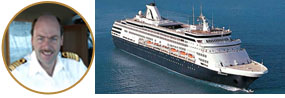
Captain Albert
© 2026 – Captain Albert's Website and Blog –
Theme by Anders Noren — Up ↑