The big question mark with the Amazon is always the current as that is dependent to a great degree on the rain fall. In the past months there has been a real drought in the Amazon basin resulting in very low water levels. Only in the last 14 days the rain in the Andes has really started to come through and currently the river is rising by about 3 inches a day. That will ensure that we will have enough water to make the journey up and down the river. However it does not help with figuring out have much current there might be running while we are on the river. That is something we will only find out when we get there. From the moment we enter the river, she will dictate how our cruise will progress and if we will be able to keep the schedule and call at each port, the way we hope to do. That makes the cruise so fascinating and that is why I call this an expedition instead of a normal cruise. Continue reading
Page 164 of 241
Devil’s Island is part of a group of three Islands called the Iles du Salut. It consists of Ile du Diable (Devils Island), Ile Saint Joseph and Ile Royale. It lies just (six miles) off the coast of French Guyana, opposite the town of Kourou, where they launch all the European Space Rockets. As a matter of fact you can see the installation tower with the naked eye, when you have the sun behind you. In the grey and dim past, France assigned the main land over here as a prison centre. I understand that the more severe cases were sent to the islands, from where it was difficult to escape due to the strong currents and the sharks. The current can indeed be very strong; we had nearly 4 knots against us, when we approached. The islands are located on the edge of the continental shelf of South America and the area is extremely shallow. Deep water is 30 feet, so that gives an idea. The cruise ships call at Isle Royale, as the South side of the island is the only place where there is enough shelter from the Ocean swell and the NE or SE winds that normally blow here. This means that in order to get there you have to keep the islands first on the portside and then sail around the south point of Saint Joseph to get to the leeward anchorage under Ile Royale. The average depth close to the island is about 9 to 10 meters, with not much room to deviate. Continue reading
The further south we sail, the further behind we leave the wave fields. Although the swells are not that high, they still make the ship move a bit and I am just puzzled about how much swell there still is. Normally by this time it has come down to a low running swell of about 4 to 5 feet maximum but there is still 8 to 9 feet out there. That means that we will have at least a little ripple of swell still running while we anchor at Devil’s Island tomorrow. Only ships with less then 6 meter draft can anchor far enough in, to sit in completely sheltered waters. That is however a worry for tomorrow. Today we are at sea and apart from the occasional rain cloud it is a sunny day. The navigators sail around the rain clouds as much as they can but they do not always succeed as sometime the rain clouds are interlinked into a continuous band miles and miles wide. The good thing is, is that the rain is warm; the bad thing is that the rain is wet. But then life is never completely perfect. Continue reading
I had decided to arrive bright and early to see if I could get in ahead of the other cruise ships. If you are first, then you cannot be held up by somebody ahead of you. As I could not find out from the agent what the exact pilot time was of the other ships, I just went for 0600, hoping that my colleagues would not be early risers. For the ships operation it does not make that much of a difference, to arrive early, as the sailors start with deck washing at 0500 anyway and the bridge watches are on double, with the officers for the rest of the day on flexible hours. Also in this case I could save more fuel by being docked early than by going slower at sea. So all around a sound plan and the only one who had to get up earlier was me and as I am supposed to serve the greater good that is not really a consideration. By 04:30 we were called by the pilot that the sequence of arrival would be Prinsendam at 06:00, the Braemar at 06:30 and the Emerald Princess at 07:00. The plan had worked as hoped for and the Navigation Officer happily confirmed that we would be there at 06:00. Continue reading
There are various ways of entering the Caribbean Sea from the North as most of the islands are separated by passages that are deep enough for the transit of any sort of traffic. Some have a bump in the way here and there but you normally can sail around those. Of course when planning the voyage, you try to use that passage that is the closest to the straight line that forms the shortest route between two points. (Remember that only on East or West Ocean Crossings, with long distances a curved line or Great Circle is shorter as it follows the curvature of the Earth) In our case the passage that we needed was the Virgin Passage located between the East side of Puerto Rico and the West side of St. Thomas. Continue reading
Today we had our 2nd day at sea and whilst the sun was shining in all its glory, the North Atlantic Ocean gave us an exhibition in disturbed wave patterns. The storm, that we more or less bypassed during our crossing, spread out its wave field more and more while going across the North Atlantic. Yet another depression of Cape Hatteras ensured that this wave field spread like an oil film all over the mid and southern part of the North Atlantic. That meant that the field became more and more diffused while time was going by, but it lingered on and thus had the chance to mix with newly generated waves. Waves created by another wind pattern. The area we are sailing in today is partly under the influence of the Trade winds, winds blowing from the East, which create waves coming from the East. These were mixing with the old swells from this North Atlantic storm and the result was a disturbed North Atlantic Ocean. Continue reading
To get to the East Caribbean Sea there are basically two ways to go. Going north and keeping the Bahamas to the right or going south and keeping the Bahamas to the left. Both routes have their advantages and disadvantages and it is the decision of the captain to say which one it will be. The Bahamas which stretch all the way from the North of Florida to the top of the Dominican Republic block any other way possible, unless you are a light drafted speed boat. Going north into the Atlantic Ocean is the shortest route; it is the least sheltered (for the first day) but as the adverse current is less you can go slower and provide a more stable ride. The South route via Old Bahama channel is longer by about 60 miles, it is more sheltered for the first day (as the Bahama reefs catch the swell) but have a strong adverse current and that means that when you leave the shelter of the reefs at the 2nd day, you really have to plough into the waves to keep the schedule. After consulting the weather charts which indicated that here would be some swell (left over from some bad North Atlantic weather further North) but it would be constant all the way until we entered the Caribbean Sea. Thus the decision was to go for a more constant motion of the ocean instead of a very wobbly last day and a half when the Prinsendam, coming out of old Bahama channel, would have to remain on full speed to make up those extra miles. Miles lost to the longer distance and that adverse current. Continue reading
By 3 am we were crossing the Straits of Florida and battling a 3.5 knot strong Gulf Stream current. Because we were heading South West and the current was pushing us north, we had to steer drift. That means if the actual, direct, course is 245o then you have to steer more to the South to compensate for it. Maybe 240o, or even lower. Also the slower you go, the more the current will set you to the North and thus the more of a drift angle you will have to steer. We were doing 17 knots and we had a drift angle of 12o most of the time. That is quite considerable. On the radar it looked like we were aiming for Miami with the bow but being set towards Fort Lauderdale with the rest of the ship. We had an agreed pilot time of 0600 as per Harbour masters orders but then the planners realized that we would have to pass the Navigator of the Seas, to get to our dock. By switching the pilot times of the two ships around that would not be necessary and would create a much safer situation. Thus our pilot time became 05.45 and that of the Navigator of the Seas 06.00. Going in ahead of us was the Allure of the Seas which carries more guests than the Navigator and the Prinsendam together……….. and the Navigator is part of the class that in the past was the biggest in the world. All went well and by 0645 we were safely docked, awaiting what the day was going to bring us. Continue reading
Today we were on our last leg of our North Atlantic Crossing. By 8 pm tonight we will be entering the North East Providence Channel which connects to the North West Providence Channel. Whoever dreamt up those names was not very imaginative as it is basically the same stretch of water. Still it is the only gap through the Northern part of the Bahamas and it forms the shortest route to the coast of Florida and thus we are going there. As mentioned before this gap results in traffic conversing upon it and after five days of seeing barely anything, the navigators had to remember again that the Rules of the Road were there for a reason. We had now firmly the top rim of the North Equatorial current going with us and that gave us about a knot of extra speed. A little bit of free help from Mother Nature for the chief engineer’s fuel budget. It was a beautiful and sunny day with an almost flat calm sea. The stormy day from before was already quickly fading into memory. Continue reading
With the stormy day fading into memory we sailed today through the North Atlantic Ocean with sunshine, smooth seas and only a low rippling swell from the North West. We are now south of the 30o Latitude North and that means that we are in near tropical waters. This area is normally reasonably quiet as long as it is out of the hurricane season. CNN just announced that the season is over and thus it must be. So as long as Cape Hatteras is sending its depressions eastwards this area is relatively quiet as just to the south the regular trade winds are blowing. Today there was hardly anything blowing with just a gentle breeze touching the top of the waves. This has the pleasant result that the guests can enjoy two glorious sea days before they disembark in Fort Lauderdale. Apart from have the option of a very full daily program, the outside of the ship is becoming more and more interesting as well. In the past few days there was not much to see at all, apart form the occasional seabird. Now ships are appearing on the horizon again as we are coming closer to the normal shipping lanes. Continue reading
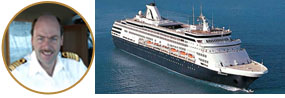
Captain Albert
© 2026 – Captain Albert's Website and Blog –
Theme by Anders Noren — Up ↑