The crossing of the Gulfo de Tehantepec was indeed un-eventful and we arrived with wind still weather and sunny skies at the pilot station. As predicted it was going to be a hot day. Not a warm day, a hot day. The pilot was nicely on time; as a matter of fact he was out early, sitting in his boat watching the sharks play in the water. It seems that the entrance to the bay is an excellent hunting ground for sharks and we saw many fin tips coming above water. It is a pity that I cannot announce it to the guests as it is simply too difficult to see the fins in the long rolling swell. I counted at least 8 of them, fairly close together, about a mile off shore. With the pilot on board and after his confirmation that it would remain great weather today, I decided to dock nose in, on the west side of the pier. We are busy with changing the wires of the lifeboats and it is better that we do that with the boat above open water. The boat has to go up and down to see if the new wire has been adjusted for the right length and that is something you do not like to do above the pier. By 11 am we were happily docked giving the authorities ample time to clear the ship as our official time for docking was noon time. However it is better to arrive early than just to linger at sea. Puerto Chiapas to Hualtalco is a 2 engine run at about 70% engine output. If I let them run on 80% I hardly use anymore fuel but I arrive an hour earlier. When docked in port, I can then switch off that second engine and save in that hour more fuel than by running 70% at sea. One engine keeps running as it provides the AC and Electricity for the ship. Plus an hour extra in port is always appreciated. If not by the guests, then certainly by the crew.
Page 141 of 241
With a certain amount of apprehension in my heart we approached the pilot station. The pilot was as chirpy as ever, trying to sell a perfect day with perfect sailing circumstances when we contacted him. When we came closer the thing that I had hoped for and needed was indeed happening. The swell was more to the south and ran against the South breakwater and not into the port. We were in business. There was not a great deal of water under the keel but 9 feet was sufficient to go in. The pilot happily announced that there was funding to dredge the port to 12.5 meters instead of 10.5 and that would make things easier for the future. A good thing for the port and based on that NCL has now also decided to start calling at Puerto Chiapas with their big ships and I think they have even more draft than our Vista Class which until now were the largest ones going in. As a matter of fact during our next call in October we will have to share with an NCL ship. This is not a problem as the port has two very nice berths. I just have to make sure I come in first as I have to dock in the back at berth 2. The bigger ship gets the cruise terminal of course as we are only a little one. Continue reading
As we are staying longer during this call, compared to our regular Trans canal schedule on the southbound cruises, I did not have to arrive that early. The fly tours to the Mayan ruins had ample time to return so a take off at sunrise was not necessary. That made it all a lot more decent for everybody and meant that I did not have to get up at 02.45 in the morning for a 04.00 pilot but at 05.45 for a 07.00 pilot. Much more civilized. Port Control was awake, the pilot was on time and the swell was running onto the breakwater and not into the fairway. Things were perfect and by 08.00 we were happily docked at the cruise terminal. Life in port was busy with at least 5 bulk carriers waiting at the anchorage and a large tanker at the gas oil fuel berth. The first time ever that I have seen a large ship docked there. I saw no loading/unloading activity going on and the pilot could not exactly explain what the ship was doing there. “They were doing things there” was the helpful information received. So I made sure I kept my Statendam well clear of the tanker, so I would not disturb whatever “things” they were doing. Continue reading
We had a scheduled 10 am arrival and thus we arrived at 09:00 at the pilot station. Corinto is reached via a long narrow channel leading through shallow waters and then located behind a natural boundary of islands. It offers a nice sheltered harbor but is difficult to get to as there can be a large swell running in the outer channel, and once in the inner channel there is a lot of current from constantly changing directions. I had not been here since my cadet ship in 1979 so I had to prepare myself carefully with all these variables. Input from other captains had warned me that the pilots were not used to highly maneuverable and low draft cruise ships as they were only dealing with heavy tankers, bulk carriers and container ships. So they tended to be a bit heavy handed with ships that only need a gentle touch. I had decided to sail the ship in myself and “pump” the pilot (as far as the language barrier allowed) for all local information that I needed. We did swerve and yawned on the following ground swell in the channel as expected, but with two rudders that was controllable. All worked out well and at 10 am we were safely docked. Guests were going ashore and we had 40 children from a local school coming on board for a day out. Continue reading
This place never fails to amaze as it looks like that the authorities have no concept of guest service. Last time we had to tender while a berth became available at 09:00. This time we arrived and the whole dock was free. Not a ship alongside but I still had to go to anchor. That was not looking good as a long low swell was running into the bay causing high waves to crash onto the breakwater and onto the Beach. So we stopped the ship and let it settle to see how much swell there would be running along the tender platforms. It was about two feet and that is way too much. Just imagine stepping in a moving elevator that you have to catch when it moves constantly two feet past the threshold. So I moved further up the anchorage where according to port control, the local experts, it was better. It was not. Coming closer to the shallows the swell only built up more. Thus I had to make the unpleasant announcement; cancel! It is too dangerous; I cannot guarantee your safety on the tender service. So the tenders where pulled back inside again and I turned the bow to open sea. Just when I was about to give a kick ahead to get to a better location while waiting for clearance, port control called, inviting us to come alongside. I wonder why the sudden change of mind; …………… anyway, 20 minutes later I was alongside the dock. Continue reading
It was a glorious wind still day while we sailed under the coast of Costa Rica and then into Golfo Dulce. Wind still and clear skies. It was so wind still that even the wavelets that normally show with windforce 0 or wind force 1 had a hard time forming. Without wind, there is less turbulence above the rain forest and that means that the hot and damp air that is rising from the rain forest does not mix very much with cooler air and that reduces the chances of rain. Cooler air is not cold air, it is just cooler in comparison. The difference might only be 2 or 3o but that is still sufficient for rain clouds to form as the water turns from vapor into rain drops. When entering Golfo Dulce we saw some rain clouds hanging far inland over the mountains but they stayed where they were and we had a dry day. Golfo Dulce is part of Costa Rica and that means that we had to get cleared when coming in. Continue reading
Bright (at least us on the bridge, the weather was overcast) and early we arrived at the sea buoy of Cristobal for an entry into the break waters at 05.00 as scheduled. We were told to wait as Cristobal Signal Station had a traffic muddle on their hands. Three ships coming with the convoy; and the local dredger (the Charles Darwin) was enlivening it all by slipping in and out inbetween to dump the spoils from dredging in the fairway. They do that every two hours or so when the hold gets full, and they hate to wait for other traffic as that costs money. The dredger has been there all season already as he is busy with deepening the approach channel for when the new locks are ready. Last time he was sitting right in our way when we came in but this time he was on the East Side outside the channel. Still he was part of the holdup and in the end we were inside at 05.15.
Luckily as we were the first in the southbound day convoy, pennant S 10Z, we did not have to wait for the convoy, we lead the convoy this time. So with a speed of 6 knots we trundled along to the first locks, so we could go in as soon as the 06.00 shift change had been completed. Continue reading
And so the good ship Statendam sailed towards Panama for the final crossing of the season. The weather was as the previous weeks, following winds, strong trade winds, and following swells. This caused the corkscrew motion again that we always have on this stretch and which will last until tomorrow morning 3am when we come under the lee of the Panamanian coast. Luckily the guests have been on board for a few days already and they are used by now to a moving ship; It should not cause too much of an issue. The stabilizers are working overtime (most appropriate on Labor Day I suppose) but they can only counteract the rolling part of this motion. The sudden tilt that occurs when the following swell lifts up the stern is something we just have to live with. Continue reading
Life would be boring if everything always went as predicted. This morning we found out that what was predicted does not always happen. The Island Princess kept up the speed and stayed ahead of us and arrived at 06:00 at the pilot station. Whatever happened to their 10 am we will never know. Not much of an issue as the port authorities changed the docks around and now put the IP on cruise terminal B and us behind her on C., as she was already sailing at 12.30 while we were staying the whole day. So I could keep my planned pilot time for 07:00 hrs and be docked at 08:00 as required. It worked out even better for us this way as now we were at the terminal closest to the town and that saved the guests another half a mile of walking. The 3rd ship on the schedule never showed up and when the IP left at 1 pm (having to wait for late guests) we had the town to ourselves. Most of the larger shops were open until 1 pm and there several activities going on in the city that could be watched by our guests. Our pilot was involved in kite fighting on the beach and was not very happy that he had all day duty and would have to sail us out at 18:00 hrs. It was a great day for the Queens Birthday celebrations as there was no rain and the wind was not too strong. Continue reading
By 23:00 we entered the Windward Passage and from there sailed into the Caribbean Sea. Losing our lee from Haiti by 06:00 in the morning we got 35 knots full on the port beam. The good thing is that in this area the wind is always blowing from the East and the Trade wind and the swell that it generates is as a result full on the beam. With our stabilizers in operation it means that the ship is very steady as it can compensate for the roll that might be caused by this swell. The bad thing is that 35 knots is a lot of wind. A wind like this, that has been sustaining the swell for a few days is also enhancing the current and that is not good. As a result we suffered for most of the day a current of more than 2 knots against us and over a 24 hour period that is 48 miles which we have to make up by sailing faster. Not good for the fuel consumption and it means also more wind on deck. Therefore again I kept the doors to the bow closed; but after Aruba and until Cabo San Lucas they should be open all the time during the day. They are being kept closed nowadays during the night to avoid guests falling over the threshold and to avoid the navigators getting blinded by somebody using a camera with flashlight. Taking pictures of the moon is a very popular pastime on the bow but when the moon is above the bridge then the navigators get the full flash and that does not help with their night vision. We will be aiming for 07:00 pilot tomorrow morning. Continue reading
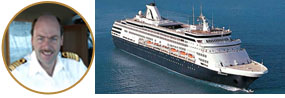
Captain Albert
© 2026 – Captain Albert's Website and Blog –
Theme by Anders Noren — Up ↑