- Captain Albert's Website and Blog -

Ocean Liner History and Stories from the Sea, Past and Present. With an In Depth focus on Holland America Line

Page 113 of 241

12 July 2014; Victoria, British Columbia.

I had some connectivity issues, so there are three posts in a row

As expected the white clouds did decend on us as soon as the ship came closer to the Strait of Juan de Fuca. Here the combination of warm – sun heated – land and the cold water of the Northern Pacific being pushed into the Strait created an ideal temperature balance, or disbalance, depending on your point of view, to change the view around the ship into a small white world. Around sunrise the whistle started to blare and keep doing so until near mid day the sun finally burned the fog away.

As the Strait is a very busy area, serving the Whole Vancouver Area, but also the ports around the Puget Sound such as Seattle and Tacoma, there is constant stream of ships going both ways.  To make sure that they are all behaving themselves, The Traffic Management Stations were established. Further on the Strait has been divided in an outbound lane and an inbound lane. Outbound is on the Canadian Side and Inbound on the American side.  Since the 1970’s these systems have been introduced in all traffic hotspots and bottle necks in the world.

In the Strait they serve three important purposes;  A. creating some order in the way ships enter and exit the Strait near the Pacific. B. In the Strait set clear boundaries to keep fishermen away from the large ships, which sometimes can hardly see them C: create a system that makes it possible for Ships to safely split to various routes once approaching the Puget Sound. The latter resulted in several Round – and- about systems where ships are forced to follow a counter clockwise course and thus always safely pass behind another ship, instead of trying to cut across and run into a dangerous situation.

Ships like to sail in straight lines to save time and fuel and not every mariner is a “prudent” mariner as the law requires and hence the implementation of the VSS system, or Vessel Separation System.    This system forces ships to sail safe courses and you are only allowed to be a little bit creative in following the standard tracks, if there is absolutely no other traffic around.

This meant that the Amsterdam first sailed to the end of the Strait of Juan de Fuca and then made a 90 turn to the north. By that time the low clouds had been burned away and the guests had a beautiful sunny approach to Victoria.  This was by 16.30 in the afternoon and apart from seeing other cruise ships approaching (who also have to comply with the Jones Act before going to Seattle) wildlife gave quite a show as well.  A 100 feet from the ship a Humpback whale found the time to loudly applaud our presence with half jumps out of the water and beating the surface with its flipper.

There was a stiff breeze blowing to the North, and that meant that the ship had to go nearly broadside onto it to create a good lee for the pilot boat. With a strong ebbing tide running against the wind, the water looked a places as if a washing machine had gone wild, with white crested eddies.  Of course with the wind pushing against the Hull and the funnel and grabbing onto the balconies, it causes the ship to list, so if you do not know what is going one, it all looks very peculiar. The ships is turning away from the port and starts to heel.  But safetly first for the pilot and nice sailing second.
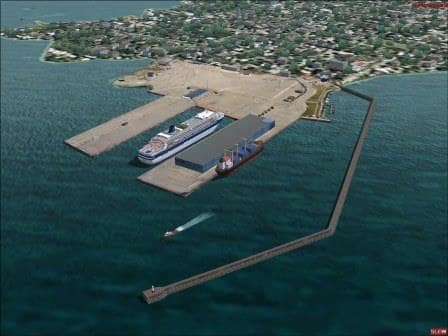
The ms Amsterdam docked this time where in this artist impression we can see the cargo ship.

The ms Amsterdam docked where in this artist impression we can see the cargo ship. Victoria – Ogden Point.

The harbor of Victoria is located NE to SW and laying in a sheltered curve. So a true southerly wind it not much of a problem for a safe docking. Victoria is issue if a wind is blowing from the SE, as that brings it perpendicular onto the ship.  Today while there was a strong wind outside, it was fairly calm near the dock.

I did not go ashore for the evening call although there is a very nice 2nd hand book shop in the main area of the town, but it has the tendency to close at 6 pm.  So I spent my time trying to figure out which Elevators on this ship are running on Emergency power. There is always one in each elevator bank, but which one varies from ship to ship.

Departure is set for midnight, with a 6 am arrival in Seattle. That means a quick dash through the Pudget Sound and with the sunny weather that we had all afternoon, I would not be amazed if the clouds come down again. So I will make it an early night and catch some sleep in case the whistle starts again.
11 July 2014, At Sea.

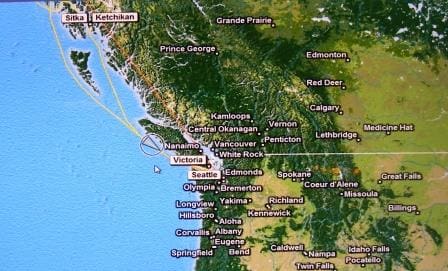
Because the ms Amsterdam does the Sitka to Seattle run it has the option to go either inside Vancouver Island or to sail around it and re-enter the Inside Passage via Strait Juan de Fuca. Going inside Vancouver Island is the route that we all know very well. Sailing through Johnstone Strait and Seymour Narrows and ending up in Vancouver. It is sheltered and provides great scenery. The only disadvantage is that it takes much longer. The ship has to slow down for Seymour Narrows, for picking up pilots and there are several speed restrictions on the way such when passing Campbell River and the stretch to Victoria south of Vancouver. Because the ship sails straight from Seattle to Alaska which are all American ports, it has to call at one foreign port during the voyage. This in order to comply with the Passenger Service Act of 1886; although most people are more familiar with a similar act which is also applicable, the Jones Act.

The latter comes into play when you try to transport and land passengers while travelling between two American ports. Ships sailing from Vancouver do not have this issue as they start and end their cruise in Canada and thus according to American law start and end the cruise in a foreign port. Hence that you go through American Customs and immigration in the Vancouver terminal to make it all a bit easier. With the Seattle run that does not work and to comply with the rules it means that you have to call at Victoria, which we will do tomorrow evening. Victoria is located at the South East point of Vancouver Island and that makes taking the outside route around Vancouver Island a real good alternative. It only brings the dilemma that as a cruise guest you have to make a decision between visiting Victoria or seeing more of the Inside Passage. This also changes the whole schedule for having pilots on board.

Running the outside route. Just before entering the Strait of Juan de Fuca

Running the outside route of Vancouver Island. Before entering the Strait of Juan de Fuca

For this Seattle run it means that the American Pilot can be disembarked right outside Sitka, where pilotage water stops. Then the ship remains outside pilotage waters all the way to the Victoria – Sea buoy. Strait Juan de Fuca is wide enough to be considered open waters and that means for Canada that the inland water way pilotage starts at Victoria and for the USA at Port Angeles. To make sure that we as sailors do not do anything naughty, there is Radar and VHF coverage in the Strait to monitor all traffic moving in and out.

The border between Canada and the USA runs right through the middle of the Strait and thus this monitoring has also been nicely divided. Ships approaching or leaving Strait Juan de Fuca, report to Tofino traffic. This is a Radar/Radio Traffic monitoring station located on the northern – Canadian – shores of Strait Juan de Fuca and they keep an eye on who is coming in and going out. Once inside the Strait there is the moment that you switch you’re reporting over to Seattle Traffic. They keep an eye on all the traffic going all the way to the Seattle/Tacoma area or until you change course to the north and head for Canada. If you turn south, then you pick up a pilot at Port Angeles to visit any of the ports in the Puget Sound area. If you turn north towards Canada then you are transferred to Victoria Traffic and proceed to the pilot station there to obtain a pilot for any Canadian port, all the way up to Prince Rupert if needed.

When I first came on the coast here in 1979, I read an article in the National Geographic about how they checked & followed the traffic in Seattle. This was before good Radar coverage, AIS and real time satellite etc. The article showed photos of USCG men actually moving little models over a large size chart of the area. Intrigued about this, I managed to visit them during my cadet year and it was most interesting to see how it went and with the models how well they were able to predict if things were “hotting up” or not. Now that is all gone and the Control Station can see the whole area on radar screens and digital charts and follow the ships moving in real-time over the screens. That makes it even safer. The main challenge is now how to communicate developing situations to the crew on the bridge of the ships. Some crews, especially from China and Korea, speak highly original forms of English, and the well-meant advice from “Traffic” is not always understood or implemented the way it is intended.

So tomorrow evening we are in Victoria, which is, I think, the most British of all the City’s in Canada. The weather should be good, but as the sun shone in Ketchikan, it normally means that you have to pay for it. Thus the Captain might be looking for quite some time tomorrow at a very small world due to very low hanging clouds.

10 July 2014; Sitka, Alaska.

I had not been to Sitka for a number of years as the number of Holland America ships calling there decreased a number of years ago and since then with the increase of the fleet the other Alaskan routes gained more prominence. There was the defining moment in the relation between Sitka and the cruise company’s when Sitka declared a head tax of $ 50 per visiting guests. This resulted in a sort of attempt to kill the Golden Goose. At is was an anchor port, it was already a complicated place to visit and by now charging the guests more money for it, was just too much. Some companies withdrew all the cruise ships while other, including Holland America greatly reduced their presence. It took a while but eventually the head tax was repelled. But even if a company wants to return straight away it takes at least 2 years before this happens. 2 years is normally the time it takes before a new route and schedule makes it through the decision making process and back into the cruise brochure. Holland America is now present with 2 ships, the Oosterdam and the Amsterdam.

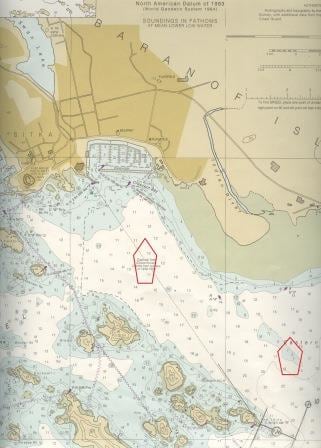
This is anchorage 1 and 2. The numbers 3 and 4 are even further away from Sitka tender harbour

This is anchorage 1 and 2. The numbers 3 and 4 are even further away from Sitka tender harbour

There are four anchorages and also a regular dock located outside the city. If you dock there, then a shuttle bus system brings you to downtown Sitka. There are three regular anchorages and with regular I mean, that you can swing around freely on the anchor; whichever way wind or tide is pushing you. Then there is anchorage nbr 1, or inner anchorage. Here a regular seized ship cannot swing around at anchor, as the area with deep water is too small. That meant that only small cruise ships, or those with a stern anchor could go there and the stern anchor kept the ship from swinging around, and onto the rocks. Since the ships have Azipods, this has changed. As described in one of my earlier blogs, an Azipod is a sort of outboard engine – in the form of a pod- which hangs under the ship. It is designed and built to operate 24 hours a day. As a result it is used by keeping the ship in position and stop it from swinging around the anchor. If the weather is not too windy, large ships will now anchor at the inner anchorage.

The Amsterdam has Azipods, it was a beautiful day today and thus she occupied the inner anchorage. That reduced the tender distance and time greatly and that is good for the guests. In the heyday of Sitka, before the ill-fated Head Tax four ships could be at anchor in the bay and the one at anchorage nbr 4 would be looking at a 30 minute tender ride from the ship to the dock. Today the Amsterdam was the only ship in Sitka. Also the out of town dock was not in use. The ship arrived at 09.30 with an official scheduled stay from 10.00 to 1700 hrs.

I walked from the Hotel and could take the first tender back to the ship, coming on board while the guests were starting to assemble in the showlounge for the tender ticket procedure. The ship is on a charter cruise, chartered by Inspiration Cruises & Tours. The main difference of one of these sort of cruises is that instead having a headliner show, there is Michael W. Smith who gives a religious service. To make attendance for everybody possible, the guests have been divided in a RED and a BLUE group, as well as for the services as for dining. For the rest the Holland America entertainment offerings remain the same.

The Amsterdam makes seven day cruises from Seattle – via Tracy Arm – Juneau – Sitka – Victoria – Seattle. So I will be on board for 2 cruises and the tail end of the current one. If the weather holds out for the practical sessions then I should be able to deliver the same program as just done on the Volendam. Tomorrow the ship is in Ketchikan for a morning call. Arriving at 0700 hrs. and departing at 1300 hrs. then it is a fast run to get to Victoria for an evening call, two days from now. The weather for today and tomorrow is Alaska at its best and we are expecting a very sunny day in Ketchikan and that should please everybody.

09 July 2014; Sitka, Alaska.

Yesterday I left the Volendam after completing all the support that I could give. All but one of the trainees’s passed their exams and a whole pile of instructions, training power points and checklists were left behind to help the ship make a successful transition from a two alarm ship to a three alarm ship. Then came the journey from Vancouver via Seattle and Ketchikan to Sitka Alaska. For a reason unknown to me Alaska airlines maintains a Vancouver service with small planes and most of them are Turbo Props. It was interesting to see propellers warming up instead of hearing the whine of Turbines. The flight to Sitka is a sort of bus service with several stops. Most of the time a flight has a start and a final single destination. Everybody gets on and at the end everybody gets off. Not in this case, this was a flight from Seattle to Juneau with a stop at Ketchikan (20 minutes) and then Sitka (20 minutes) before flying to the final destination Juneau.

Alaskan people are very friendly, maybe because a lot know each other courtesy of the towns not being that big, and thus it normally does not take long before you are talking to your neighbor. First there was the interesting scene at Seattle airport of a group of men meeting up and going for a few days fishing together in Alaska. They came from various parts of the USA and I was not able to figure out what their connection was. But the plan was to go fishing, and having a good drink at the same time also scored high on the list of priorities. All seem to be glad to be gone from the daily scrutiny of “higher management” to whom they were all faithfully betrothed. The buddies were as excited about their coming adventure as a group of school boys.

In the plane I suddenly sat next to a colleague from the office, how that works I do not know. 200+ seats on the plane and the only 2 Holland America Line people on board end up next to each other. That gave us the chance for a good moan about all that could be better in the world. He left in Ketchikan for a visit to the Oosterdam and that meant that the Lady in the 3rd seat suddenly sat next to me as she moved inwards to give her outer seat to a rather large gentleman who joined in Ketchikan.

Now I got involved with what can only be described as the Great American Melting Pot. She was from Uzbekistan and had emigrated a long time ago to the USA. There she met a German and both became American and he ended up as a Doctor for the USCG. First on ships and he is now finishing his career for the USCG in Juneau shore side. As she cannot stand Alaska in the winter, she escapes to Seattle and is now studying law. He is close to retirement and then wants to settle for a while in Spain while she wants Italy, so they will probably end up in San Francisco as that is the only place they both can agree on as being nice. I always find it amazing to find out how diverse the background of most Americans is. Who says travelling is boring??

Things did not stop there as the big gentleman suddenly found out that he was in the wrong seat and his place was taken by a 54 year old grandmother who was flying from Ketchikan to Sitka to see her grandson play Base Ball. I had come across this before, where parents/ grandparents were hopping all over the state to see their children/grandchildren play in these (school) competitions. You can’t not drive here as there are no connecting roads and thus you go by air. That led all three of us to contemplate how much money Alaska Airlines must be making just on these family movements for these youngster tournaments. By 6 pm I had arrived in Sitka and 20 minutes later I was ensconced in the Westmark Hotel, which chain is owned by Holland America and thus the room fee remained in house. It just went from one pocket to the other, courtesy of me.

My exciting day did not end there, as opposite the hotel is a Chinese eatery. The Chinese-Japanese-Vietnamese – BBQ Restaurant to be precise. I had  never seen  those three names in combination with the letters BBQ so that had to be checked out. It was a good, simple and cheap (for Alaskan standards) restaurant but I never figured out the relation between the food and the BBQ.

While occupying myself with the local news flyer which is irreverently called “The Sitka Soup”. (www.Sitkasoup.com) a gentleman started talking to me announcing the fact that he was in Sitka for a mortar and concrete conference. Now I had never thought that Sitka would be THE town in the world where concrete makers would flock to, to discuss their latest mixing technology, but here he was. It seemed to be a very important occasion as well. Unless that was an excuse to go fishing with some buddies from the same background and this was the way to deceive “higher management” at home. I will have to ask the agent tomorrow if Sitka is indeed a major player in the Alaskan Concrete business. The Hotel is right opposite the fishing harbor of Sitka, so I can just roll my suitcase across the street and start my 17 day Amsterdam adventure.

06 and 07 July; Glacier Bay and Ketchikan, Alaska.

Today a combined blog over two days. My time on the Volendam is coming to an end and in Vancouver I will transfer to the Amsterdam. So things are slowly “heating up” for the lack of a better word, a lot of instructions and practical training, plus the administration of 36 crew who are in training for their Lifeboat Assistant certificate.  Glacier Bay was a great day for the guests and Ketchikan was a great day for me, as it rained – summer rain – and that meant very little wind and so the lifeboat could go down for training.

It is a peculiar thing that guests care less (read – officially complain) about the rain when Ketchikan is the last port compared to when it is the first port. North bound (Ketchikan is most likely the first port of call) sightseeing is high on the agenda for everybody. It is time to experience the last frontier. Southbound the guests have already seen a lot of Alaska so shopping becomes a focal point. Walking around somewhere in Idaho with an Alaska Windbreaker suddenly becomes are very cool thing to do. And then rain does not matter that much anymore.

Today it drizzled for most of the day, but that did not stop anybody and Ketchikan commerce was having a great day. All berths occupied and a possible total of 11,000 potential shoppers ashore around noon time.  Even if only one in 10 buys a T-shirt, then that is still a lot of T shirts. Not counting fridge magnets and other trinkets. Some shops sell the really nice stuff, such as sculpted eagles and dolphins or killer whales and by looking at the prices, even if they would sell just one piece a day; they would have a very good day.

I was a bit shocked when I walked ashore in Ketchikan to find out that the Post Cards are disappearing. In the last 30 years I have been diligently collecting the local postcards that show port scenery. A great way of keeping up with the changing face of a town and the changing face of the cruise industry. Normally new cards are issued every year and the ships in port photographed. Thus I have the ships/ port scenes that were common in the 70’s, 80’s, 90’s, up to now.  Running ashore to get the new batch for 2014 was going to be a quickie.  It was not.  A lot of shops did not have them anymore and the very few who did, were selling off last year’s stuff or from even before. Modern Media I suspected and when I talked to a shop manager that knew me from years gone by, the answer was yes. Hardly anybody buys postcards anymore, let alone send them home. You post on Facebook or send a selfie to your grandfather somewhere in Kentucky.  The lady also told me, as her sister was working at the local post office, the sending of postcards had gone down since 2010 by about 80% in Ketchikan. Wasn’t that the year the Smart Phone was invented??

I came home with only four postcards. Also from previous years but somehow I had not seen them before. I could not even find a 5th, to get the discount of 5 for one dollar. I will have to start keeping an eye out if this is a worldwide phenomenon or typically of the North American market. I just wonder, do Chinese send postcards??

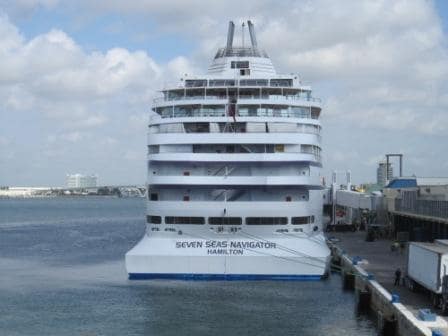
Docked behind us was the Seven Seas Navigator. Sailing for Regency/Seven Seas. I had not seen that ship before in real life although knew about her.  When Seven Seas started out, they bought a navy hull that was lingering on in a Russian Navy shipyard in St. Petersburg. Before the collapse of the Soviet Union the plan had been to build a new ship with antennas on the top, with one of it functions being to track submarines. The Soviet Union fell apart and the soviet military machine came more or less to a grinding halt.  So the Akademik Nikolay Pilyugin was sitting there half-finished in St. Petersburg. The hull was then bought by the originals sponsors of Regency, V- ships and the Carlson Group (who own Radisson) it was towed to the Marriott yard in Italy and finished as a 170 meter long, all outside Suite, Cruise ship for 490 guests.

Increase the water surface on which the ships rests and you improve stability.

Increase the water surface on which the ship rests and you improve stability.

When you build a cruise ship on a cargo or navy hull, you get stability problems as cruise ships are top heavy compared to cargo ships with their cargo low in the hull near or under the water line. To alleviate that stability problem, you have to widen the ship’s hull, creating more buoyancy for the same hull size. At the aft end it is called a duck foot as it does resemble that to a certain extent. Add more buoyancy on the sides and you call it sponsoons. The Seven Seas Navigator has a stylized combination of both, which makes it look at little bit odd, compared to the regular cruise ship boxes next to here. I was glad that I could have a good look at her.

Tomorrow we will be sailing through the Interior Passage and the weather for the afternoon looks good, so the guests should have a great afternoon. The Tide is at the perfect time of 21.30 and that means that the run to and through Seymour Narrows will be in day light. What can be a better ending to the cruise? I will be examining the Lifeboat Assistant trainee’s, so I will not see much of it, but then I have been there before.


05 July 2014; Skagway, Alaska.

My cabin is located right behind the Crows nest, just behind the bridge area. A great place to be, except when it is foggy. It is right under the whistle. And while the ship was in the middle of Lynn Canal, the clouds came down and it all changed into a very small world. Of course the bridge had to announce that to everybody by switching on the whistle. One long blast every 2 minute because of reduced visibility. I had hoped for another hour of sleep. Still every cloud has a silver lining, even if it is a very low hanging one I knew that there would be no wind during the day. It needs quite a bit of sunshine to get that Lynn Canal wind going and today there would not be enough of it.

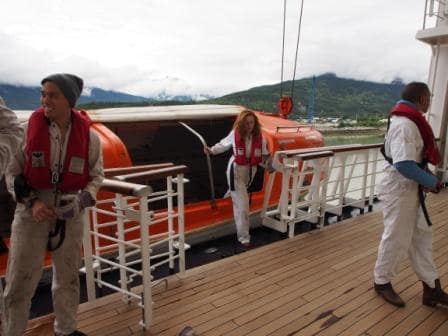
So the good people who had been studying hard in how to handle a lifeboat were getting their practical today. Every group is different in behavior mood and attitude, and thus you approach each group differently when trying to get the best out of them. Having the entertainment department in a lifeboat is a totally different experience. An entertainer simply looks differently at the world than other crew. If they didn’t then they could not be entertainers, let alone good ones. Today’s group was made up from the Show – Cast, the singers and dancers who provide 3 different shows a cruise and if they were doing this ashore, that would be it. But on a ship, safety comes before guest satisfaction or any job you have to do, so today they were in the lifeboat. In real life they are communicators in the boat. Their function will be to explain to the guests step by step what is going on and to try to keep up morale.

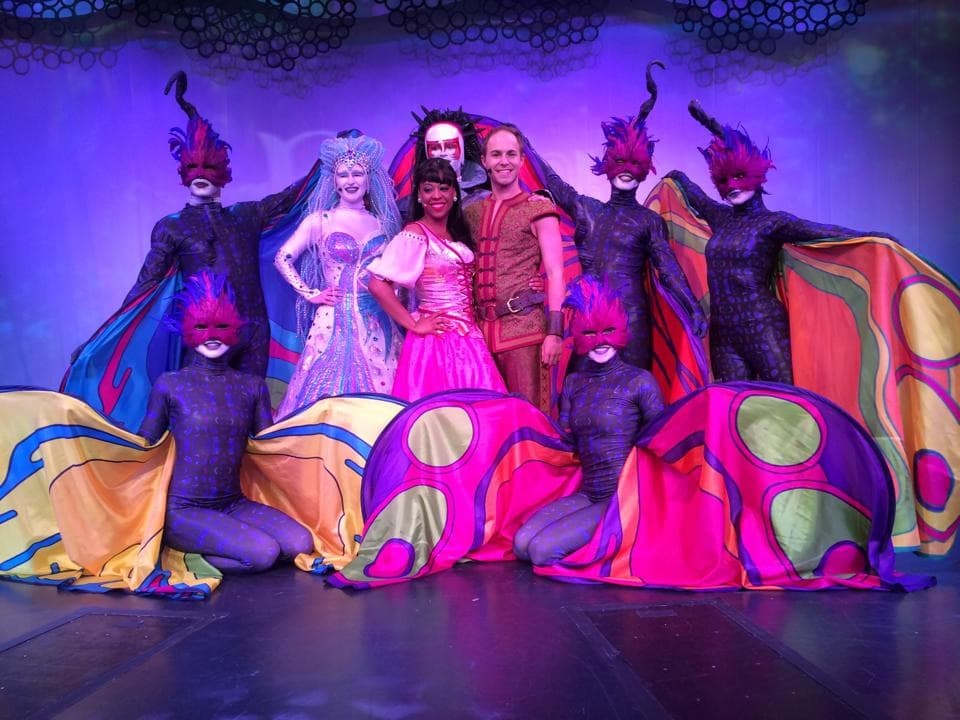
The current cast of the volendam

The current cast of the volendam


Being creative people means that their lives are full of exuberance and emotion. Life has to be exciting.  They know that their function will be critical in saving the lives of 150 people in their boat and that is an exciting thing, so it could all be approached from the top of the world perspective. We were going on an adventure. None of them had ever steered a lifeboat so it was an exciting thing to look forward to.

A lifeboat does not offer the same glamour as the stage of the ms Volendam (Photo courtesy 3rd officer Amy MacDonald)

A lifeboat does not offer the same glamour as the stage of the ms Volendam (Photo courtesy 3rd officer Amy MacDonald)

The only down part was, it was not glamorous. Once put into coveralls, gloves, helmet and lifejacket it looked more like a mining operation than anything else. But the weather was nice, overcast, no wind, a nice temperature and under the guidance of a 3rd officer, Lifeboat nbr 4 motored around Skagway harbor. Carefully avoiding the boats from the Pacific Princess docked behind us and who were doing the same thing. Princess is also part of Carnival and they are going through the same changes as we are.

An hour and a half later the excitement was all over but we did not run into anything and we knew how to start, stop, go ahead, go astern, make a portside turn, made a starboard turn and how to get the boat back to the ship again. Then it was back to the class room, as they also have to do 2 computer based training courses, before the final exams coming Tuesday.  For the remainder of the day, there were two more practical classes for two other groups.

The last one was quite interesting, because when we were sailing around a tourist ferry and the Matanuska of the Alaskan Highway came in. With the orange roof we were visible from far away and I knew that they would be wondering what we were doing and getting worried. So the best thing was, while they were still at a good distance, was to get out of their approach as quickly as possible and as far as possible. I am ranting once in a while about six pack navigators in small boats, so I did not want to be held for one as well.  So the groups got an extra lesson in collision avoidance. Stay well out of the way, and keep your bow on a heading that makes for divergent courses, so the other ship does not get confused.

Tomorrow we are in Glacier Bay. Based on the weather today, Glacier Bay should be mainly overcast and wind still. But you never know what it really is going to be on the other side of the mountains with the ice cap being so close.  We will be at Bartlett Cove at 0700 in the morning and then steam up the bay to the glaciers.

I will be finalizing training material for most of the day, so when I leave on July 9th to transfer to the Amsterdam the ship will have all the training materials it needs, power point presentations, checklists and instruction sheets, to implement the new alarm system successfully.

04 July 2014; Juneau, Alaska.

In a way it is a pity that we did not arrive early in the morning, as the locals normally have a nice parade for the 4th of July. Many a year did the HAL ships participate as the agent normally organized a Flat Bed truck for that purpose. Quite often the ship won the first prize as well, which is not so amazing as we are a sort of floating circus, cum entertainment vehicle rolled into one. We do have the resources to put up a good show. There were years when my ship was in port on the right days and if it was nice weather then we managed to get the complete Band on the truck plus all the dancing girls. The amazing thing is that the HAL ships always participated and the other cruise lines did not. I never understood why.

Today would have been interesting if all the ships would have participated. Apart from the Volendam, the Pacific Princess (or baby Princess as they seem to call it) and the Disney Wonder were in port. I do not know about Princess, but Disney should have been able to put up something nice. Even if they only would have been able to roll out Mickey Mouse and Cinderella. Success guaranteed.

There are also fireworks but these are the night before. Of those I have seen only one and that was momentous, although for the wrong reason. I do not know how they do it now, but in 1984 they put a barge in the middle of the harbor. Safe against any fall out and a good view all around guaranteed. As City Juneau is on one side of the harbor and the town of Douglas on the other side, this setup worked very well. So all of us on board the Noordam (III), sitting at anchor at the North side of the harbor, had the prime view. The fireworks lasted for about 20 minutes and then everything felt silent, a few seconds only, before the Grand Finale was to occur.

Then the Grand Finale came:…………….. everything on the barge exploded sideways. What was supposed to go up in the air as the final treat, did not go up in the air, but went sideways with an almighty bang. Luckily the barge was from steel, the firework experts coordinated it all from the attached tugboat, so there was no damage and no casualties. I do not know about the locals but the guests on board did not really notice it, they thought that the town of Juneau started the 4th. Of July with a big bang. This time they did.

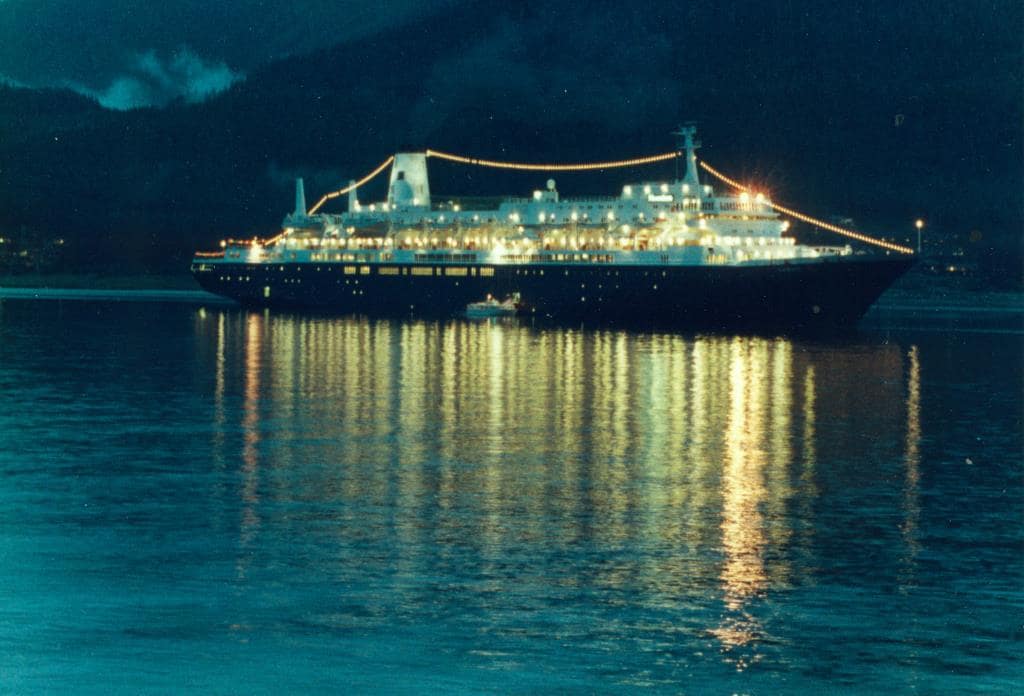
Sweet Memories The ms Noordam (IV) at anchor in Juneau harbour in 1994. (Photo courtesy Anton Janssen. On board Ships Photographer)

Sweet Memories The ms Noordam (Ill) at anchor in Juneau harbour in 1994. (Photo courtesy Anton Janssen. On board Ships Photographer)

But the Volendam had a 1 pm arrival and that it did, just before 1 pm. The gangway was in and everybody streamed ashore. For the gangway security a 1 pm arrival is the most awkward time as everybody has gone to lunch early and is ready to go by 1 pm. Unfortunately 1400 guests do not fit through the break door all in one go, so it takes awhile. That means that Security really has to urge everybody on otherwise the wait in the staircases will be too long. Today they had the extra challenge that it was raining and that meant that everybody wanted to stop on the gangway threshold to put up their umbrella.

This time I did not mind that it was raining, as part of the roll out of this 3 alarm system that I am on board for to support, we are running training classes for lifeboat handlers. In summer time the rule of thumb in Juneau is no wind when it rains. So today we had rain and thus no wind. Wind makes waves and that makes the return of the lifeboats to be picked up again a lot more difficult. The boats have to be hooked into the falls, and if the boat is going up and down then that is not so easy. Especially not if you have a training class in the boat. So a flat calm sea is appreciated.

We are having these practical classes today, tomorrow in Skagway and then in Ketchikan. Today we had Dining room and supervisors. Tomorrow we have the Cast and dining room and then in Ketchikan, kitchen and Stage Personnel. I am looking forward to tomorrow as with a boatful of dancers, there will not be a dull moment. The weather forecast for tomorrow is very low hanging clouds in the morning, which is also a sort of rain and that means that there will also be no wind. Exactly what I need.

03 July 2014; Canadian Inside Passage.

With the pedal to the metal the Volendam raced up the coast towards Seymour Narrows, to catch the early evening tide. This stretch of water which separates Vancouver Island from the mainland is called Georgia Strait. Named after an English King from the days of the British Empire. It has wide open waters and as it is just off Vancouver the banks and islands along the shore line are inhabited. Some with Holiday homes but some live there permanently with both active and retired people. Beautiful area to live in, as long as you do not mind the long trek to Vancouver.  As a result there is a lot of water sport activity, varying from professional sailors to six-pack navigators for a one-off afternoon. Being a Wednesday ship means that there is a lot less activity than on a Saturday or a Sunday afternoon.  A blessing in disguise for Captain, Pilot and Navigators.

We as cruise ship people like nice weather as it is good for the guests but sometimes we hope for a little, just a small one, bit of thunderstorm around 4 pm. to clear the sea before we depart.  As it takes the worry away of having to focus on whether a boat is going to do nothing, going to do the right thing or going to do the wrong thing. We prefer of course that all boats do the right thing all the time, and that is to follow the Collision Regulations Rules for everything that floats. However it is not always the case. Some boaters do not even know the Rules and some have completely forgotten them after their 2nd or 3rd six pack of Dutch courage.

If boaters do not know exactly what to do then we prefer in general that they do nothing at all and we as the professionals will sail around them. The danger is always when they start doing the un-expected thing, such as crossing the bow of a large ship, right at the last moment. I have never understood the thinking behind this. A ship that is 800 feet long, comes charging by at 20 knots, so the time it takes to cross behind it instead of crossing the bow, does not make for much of a delay. I once put a stop watch on it.  After a speed boat had crossed our bow, I clocked the time from the moment the bow passed its wake until the moment the stern passed the wake again and it was less than 90 seconds. Not much in the scheme of things. But they are out there……………. and we find them on a regular basis.

Getting through the Narrows early, helps with making it on time to Juneau, and having a bit of plus in the hand always helps.  Also in this case, although the weather forecast had predicted that it would be calm all the way, there was a strong adverse wind blowing in Queen Charlotte Sound which whipped up the waves and made the ship move. Not much, but enough for a large Chinese contingent on board to be convinced that we were in a real storm. Photo and video camera’s all over the place trying to catch each white cap on the waves for posterity.

One can see that cruising is becoming popular worldwide. The guests on board our ships were always  99% American or Canadian in the past, that percentage is now going down to 70 or 80% and on some cruises even more.  Europeans are getting into it and so are our friends from down under. Then with the Far East becoming more and more mainstream in politics and economics, large numbers of guests are coming from those areas as well.

As a result cruise companies are now starting to cater for these area’s and Royal Caribbean and Costa offer Chinese only cruises from the main ports in China. Star Cruises from Singapore has been doing that for a long long time, but their emphasis has always been on the gambling angle, and less on the pure – part of it.

Holland America is making it’self available to that clientele as well and while I was in the office, I came across a HAL brochure in Chinese. Until now I had never seen one before and I will have find out if there were any published in the previous years.  Something to get used to, seeing a photo of a cabin steward happily smiling towards a Caucasian couple and that all surrounded by Chinese characters, no doubt extolling the virtues of a cruise in the East Mediterranean.

Tomorrow we are in Juneau and it will be 4th. of July. That means that there is normally a Parade and that means they block off the roads. I remember running a tender service all the way up to the small boat harbor to get the tours back some years ago, as the tour busses could not get back to down town. Luckily we are arriving in the early afternoon and thus the parade should be finished by then.


02 July 2014: Vancouver; Canada.

After the beautiful weather of yesterday, Vancouver did not let us down either. By the time the ship docked at Canada Place, the sun was out and indeed it became a nice warm day.  Especially on a day like this it is great to be on the West Side of Canada Place as this is the side where the regular promenade is located. The ships bridge wing is normally right on the top of the kiddie’s pirate ship right in the middle of the promenade and the Officer of the Watch can see the world go by right in front of him/her.

On board the ship we call Vancouver day – Change Over Day – as the guests from the past cruise are leaving and new guests are boarding. Normally all guests are off by 09.30 hrs. and the new guests are coming on board any time after 11.30 hrs.  In between the Hotel part of the ship has to be turned around and made ready for the new cruise.

The most hectic department during this day is Housekeeping. All cabins have to be changed, all luggage off and all luggage on. Although the other departments are busy as well, such as the provision master with the loading and the engineers with spare parts, repairs and fueling, it is the Housekeeping department who has the smallest window to accomplish all the work.

One of the items that needs attention and is often not thought of, are medicines. Nearly all guests have medicines with them and quite a few have medicines that need to be kept refrigerated. Only the suites have fridges and that means that the other cabins have to be supplied with a small fridge. As a result we have most of the morning a bell-boy running around with a trolley picking the fridges from last cruise and delivering new ones to the cabins for the coming cruise. A small but vital operation.

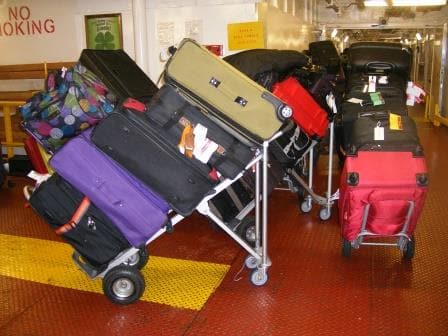
The luggage trolleys are specially designed for ships use. Height and width prevent damage to the ships corridors and the small wheels at the back, too heavy lifting for the handlers

The luggage trolleys are specially designed for ships use. Height and width prevent damage to the ships corridors and the small wheels at the back, too heavy lifting for the handlers.

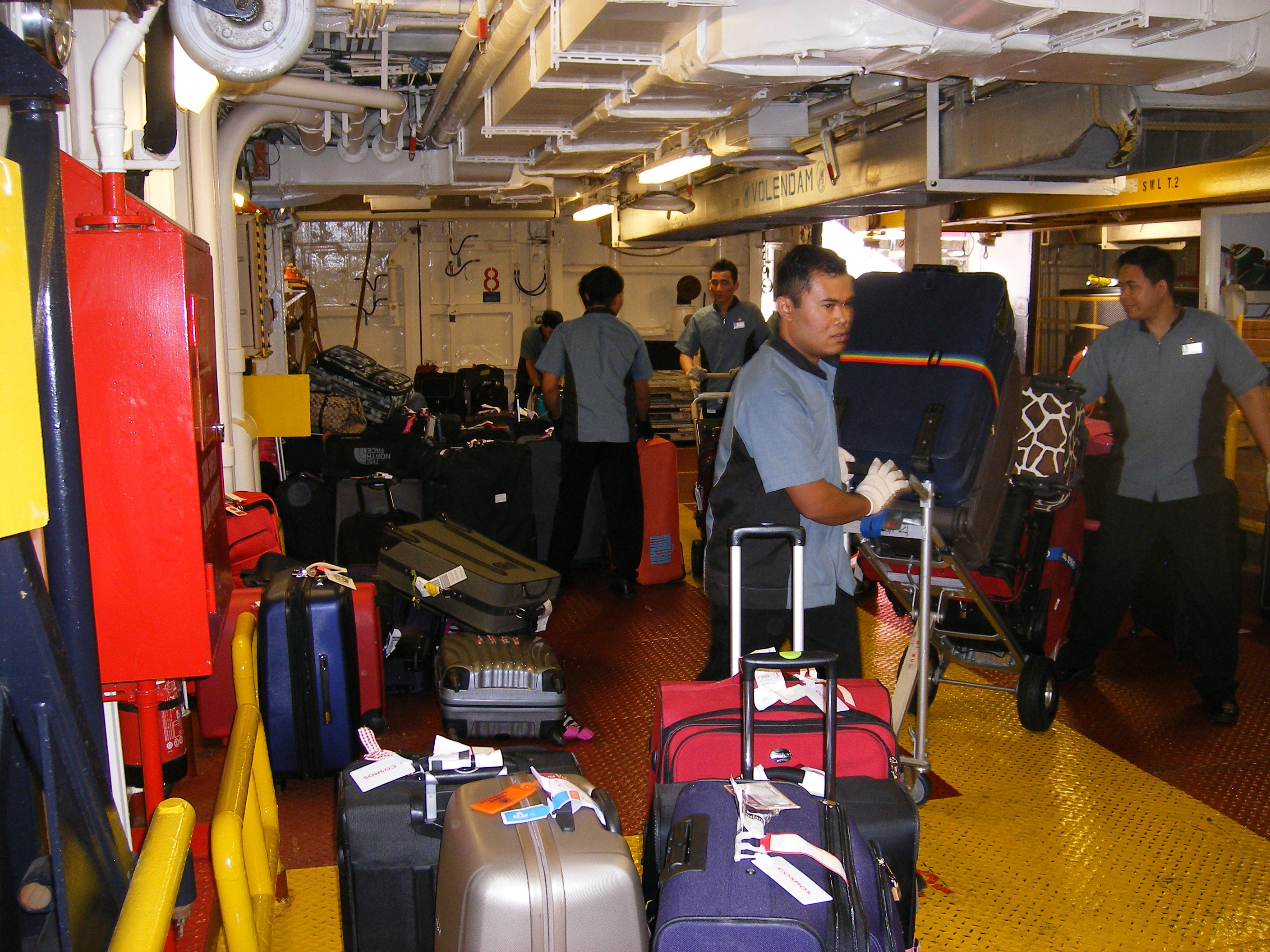
The bulk of the work is dealing with luggage. Everything is brought down during the night to the marshalling area and is off loaded as soon as the ship is docked. This off loading is done by local longshoremen who, when finished, continue with loading provisions. As soon as the first luggage bins with luggage have been filled on the shore side they will start loading those again. Not always bins are used, in Vancouver most of the time they use a conveyor belt as it is faster and easier to handle.  In the meantime guests are going through CBP – American Immigration. That is done in Vancouver as the Alaskan ports do not have the facilities and the manpower. It helps us as well, as it will not disturb the cruise that we are going to make.

Luggage being gathered as it come into the ship by conveyor belt

Luggage being gathered as it come into the ship by conveyor belt

So while the guests are being checked, stamped and finger printed, the first luggage arrives on board. Here the people from Housekeeping are already waiting with trolleys. Those go in one of the guest elevators (which for this purpose has received a padded inner wall to protect the cage) and then it is taken up to the deck required. From there the Cabin Steward takes over and will deliver the suitcase to your cabin. This makes it possible that if you arrived early at the terminal, by the time that you come on board, your luggage is already in the cabin.

Occasionally there are delays in delivery. This can happen when the luggage label has been ripped off during the handling or if people have the same name and they have not written the cabin number on the label. Then there can be an issue with luggage coming directly from the airport, unaccompanied. We do not know what happens in the airport of departure or in the airport of arrival and the truck only loads what the airport gives. Sometimes a Taxi has to be dispatched to pick up one or two pieces, forgotten or late arrived. Then we are talking lost luggage and that is another story. We have people in Seattle office who have a constant headache because of trying to deal with this and also the agents in the various ports do their best to solve “the cause of the lost bag”. Most of the time that piece of luggage will make it to the ship in the next port. One just has to hope that the next port is not after a 10 day Pacific Ocean crossing.

Today the Volendam left in a hurry. Seymour Narrows slack tide is around 21.45 and the ship can just make that with full speed. If we would go for the later tide, then it would jeopardize a timely arrival in Juneau, as the cruise schedule to get there on time is on the tight side.


01 July 2014; Canadian Inside Passage.

Today is the last day of the cruise and the weather forecast responded to the requirements of the sightseeing schedule. The moment the ship entered the Inside passage near Pine Island (that is close to the NW point of Vancouver Island) the sun came out and stayed out until sun set. That meant that the ship went through Seymour’s Narrows in full daylight with the sun shining on the Eastern Bank and that is the Mainland side.  It is not often that you get a view that good and I almost thought: for this we could charge a lot of money.  Luckily the guests appreciated it all and every window seat was occupied with happy guests gazing at the Canadian Inside Passage at its best.

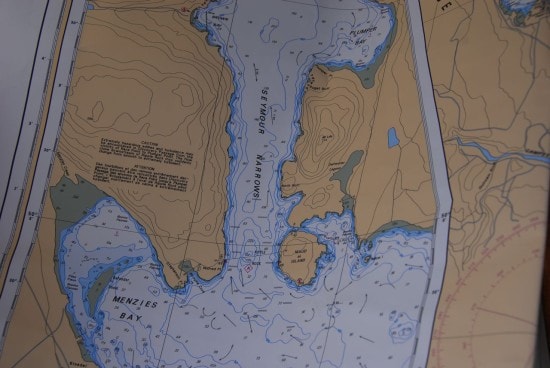
Seymour Narrows, bottleneck of the Alaska Cruises

Seymour Narrows, bottleneck of the Alaska Cruises

The ship went in with the following tide and that meant that the ship was “flushed” through the three narrow passages along the route, Blackney Passage, Race Passage and Seymour Narrows itself. On average there was 4 knots of current running with the ship in some areas. When you have four knots it does not mean that the ship goes 4 knots faster. It all depends how much grip the water has on the hull of the ship and that depends again on the fact of how wide the passage is. Yes in Blackney Passage there was 4 knots but as soon as the ship was out of it and entered Johnstone Strait which is much wider, it dropped down again to a knot or so. Still it helps with reducing the fuel consumption and if the ship is able to sail with one engine less for a day, then that means $ 12,000 saved.

The Volendam has 5 motor engines, all 12 cylinders which produce just short of 60,000 HP. Most of that power goes to two Electric motors and that gives the ship a speed of 24 knots maximum. But then everything that is available in power is directed to the Electric motors. Normal maximum cruising speed is about 22 knots and that leaves then enough power for running the whole hotel operation. When the first ship, the Statendam came out in 1992 with this diesel – electric configuration, the crew tried to let the engine – configuration run by itself as that was the way the ship was designed. However it was soon found out that if usage went up just one Watt over the maximum, automatically another engine would start. So the cook switching on his grill would cause another engine to come on line. Not very fuel sufficient. Plan A was that when the kitchen started working, the bridge took a little bit back in speed (read power consumption) and when the kitchen was completely on line, tried to nudge back up again to maximum output on the same engine configuration. That output was mostly around 86%, on whatever engine configuration that was in use.

But fuel got more expensive and then it was figured out that the most economical speed for our Sulzer diesel engines as 70%. We have fuel curves from various tests that show that output/versus fuel is at its best around that percentage. Since that time we do not have to worry anymore about the kitchen as now the startup limit for the next engine lays far above that 70%. Still it was funny to see the Officer of the Watch take speed/power back in the morning, to anticipate the cooks starting up all the galley equipment at the same time. You could plan for that as shipboard routine is nearly always the same. In the same way that the OOW starts to recognize standard fire alarms. At 06.30 hrs. you can expect a fire alarm as that is the moment, the bread toaster in the crew mess is switched on and while it is heating up it burns off the residual of the night before.

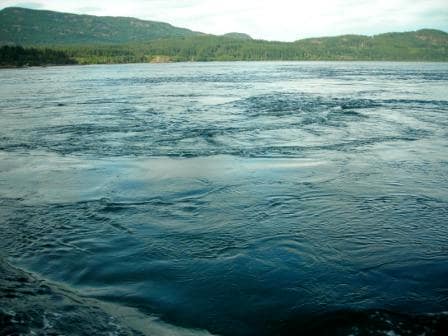
Even at slack tide the waters at Seymour Narrows are still restless,... one of those Eddies.

Even at slack tide the waters at Seymour Narrows are still restless,… one of those Eddies.

So we sailed through Seymour Narrows, just before slack tide. The B.C pilots are normally comfortable with a window of 3 knots flood to – slack – to 3 knots ebb.  Slack is the easiest time to go through as with zero knots current you have the most time to make the zig zag course in the fairway. Although the current is zero, it does not mean that the water is quiet. There is still turmoil in the form of eddies, as the current is changing and it does not change everywhere at the same time. When you go through such an Eddy, it is strong enough to make the ship list. The more current there is, the less eddies as the water is now flushing straight through. As a result the pilots are forever having arguments among themselves about what the optimum moment is for going through. I normally put the stabilizers out and that takes care of any wobble that those eddies might cause.

Tomorrow we are in Vancouver and it promises to be a great day if a bit breezy. Temperatures up to 25oC are expected, so the guests on this cruise should be very grateful for the great cruise that they have had.


« Older posts Newer posts »