Today we have a sea day as we are on our way to Santorini. The distance is 550 miles and that we cannot cover in one night so we are having a relaxing day at sea. And this time I can say this as the daily program does not feature any wild activities. One can be mentally and physically exercised if one wishes so but it is all spaced out and doable. The earliest activity was a remembrance service of ANZAC day this morning at sunrise and although the ship is small there was a good number of veterans on board to attend. As the crowd on board is very international it was amazing to see that the attendee’s also represented the whole scala of “Allied Forces” who were active in the wars and not just the Australians and New Zealanders for whom this remembrance days is specially meant. It was a real “Brother and Sister in Arms” gathering at sunrise. While this morning was the remembrance part this afternoon the ship will organize a get together for some reminiscing with a good glass of wine in hand. Continue reading
Category: Mediterranean (page 3 of 4)
After a slow sail from Ashdod to Haifa we arrived at the pilot station at 06.30 and sailed in shortly afterwards. Haifa is located against a curved mountain ridge which tapers off towards the sea. The top of the ridge is called Mount Carmel. The mountain is well known from biblical days as the location where the Prophet Elijah challenged the local competition to settle the problem of who was the true God.
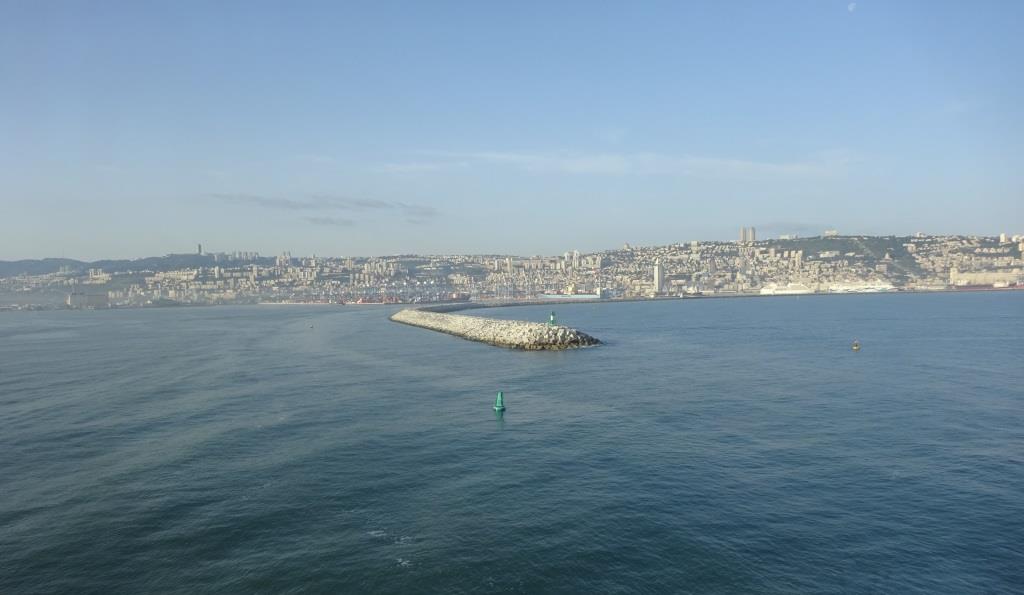
The port of Haifa as seen from the pilot station. Haifa is mostly located against the Northerly ridge of Mount Carmel.
Thus we sailed from Dubai Westwards towards Sir Bani Yas Island. This is an island which looks as if it is a sort of knob that has broken off from a protruding piece of land sticking up into the lower part of the open sea. And that sea is in our case the Persian Gulf with Africa to the South and Saudi Arabia to the North. Bani Yas is part of the United Arab Emirates and shelters a number of important refineries. So this morning while the ship approached it was surround by fishing boats but also by tankers, going in, going out, or being at anchor. As mentioned yesterday there are a lot of shallow areas and the port authorities are putting a lot of effort in to ensure that nothing goes wrong with these tankers. A tanker running aground and spilling oil would be a catastrophe that no authority wants to deal with. Thus the routes through the reefs and shallows are dictated by the port authorities and the only thing the captain can do is follow the dotted line and ensure not to deviate from it. Deviation would mean a very hefty fine and some very upset people on the other side of the VHF. Continue reading
Sailing into St. Johns Antigua is bit more complicated than sailing into Charlotte Amalie where the water is deeper and there is more room to swing. St. Johns lies deep in a natural bay but it is a very shallow bay. Almost so shallow that by the time you dock, there is hardly any water left under the keel. Regular dredging is taking place and they were doing so today as well; using the soil for shoring up the shore.
Coming from deep sea the ship approaches the pilot station and at once the depth gets a lot less. But still good progress can be made with 10 to 15 feet under the keel. Still the speed into port is then regular between 10 and 12 knots. You can try to go faster but the ship simply will not do it as the displaced water needs the time to flow away from under the keel. Then when coming to the dock the water depth is reduced to 5 feet or less at some places and then the ship becomes really sluggish in handling. Again because the water which is pushed away by the ship needs time to flow under and around the hull. Increasing power on the bow thrusters and Azipods does not help very much because of this delay. If you give too much power and the water starts flowing then you might overshoot (or bump into the pier) and have to counter act again. The lecturer at my Maritime Academy always said; it is like a very small man dancing with a very big lady, you have to guide, you cannot force, as then you lose control when the lady starts to sway over the dance floor.
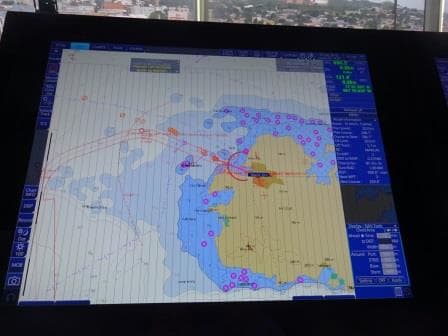
White is deep water and the bluer it gets the more shallow it is. This shot of the electronic charts shows the departure route for this evening.
Thus the docking took some time today; the ship had to be inched forward slowly but steadily as the heritage pier where we docked ends up straight into the town center and thus you do not want to overshoot. Guests on deck could see the sand billowing in the water all around the ship indicating that there was not much clearance left under the keel. This evening when we sail out, we will have the same thing again, it will be a slow maneuver in the basin. First because the basin is not much longer than the length of the ship, and secondly during the 180 turn all that water on the port side that is being pushed away has to flow to the starboard side to fill the void.
St. Johns has two finger piers and can accommodate 4 mega ships if needed. Today we only had the Regal Princess in with us but together we brought just short of 6000 guests ashore so enough for the shopkeepers to be happy. The Regal Princess is much bigger than us but does not have that much more draft as the ship is wider. If you need stability for a box of a certain size, you need a certain amount of weight inside. Think about a tin can in your bath tub. No water inside and it can easily fall over. Fill it up and it sinks. Fill it so that it is level with the outside water level and it nicely bobs up and down in the tub. The same principle goes for the ships. They higher they go, the less weight there is in the lower part. So they can fall over. If you put more ballast in the bottom, they will become stable but the draft increases. If you make the ship wider, you can put the same amount of ballast in but divided over a larger area and the draft will not increase. That is one of the reasons why large ships such as the Oasis of the Seas do not fall over while they are much higher than other big cruise ships.
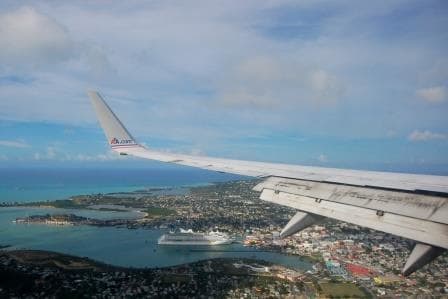
Rat Island is to the far left. We used to dock there with the ss Rotterdam who with 32 feet draft could not get to downtown.
If a ship has too much draft and you still want to go to St. Johns it can dock at Rat Island at the beginning of the bay but that is a long trek into town for the guests. This hardly happens anymore and now it is mainly a cargo terminal. Containerships dock here and today there was a Japanese Car Carrier, no doubt delivering new Japanese cars.
Tonight we will make the hop to St. Lucia and we will feel the same movement as last night. Nice and steady ship and then each time when it came out of the lee of one of the islands, the light swaying of the ship on the ocean waves until it came in the lee again of the next islands. We will pass Guadeloupe, Martinique and Montserrat so will gently roll several times. Tomorrow we will be in Castries St. Lucia where they are forecasting rain again, which we have hardly seen since San Juan and so we will just wait and see. Temperatures will be the same again 84oC / 29oC.
 Captain Albert Schoonderbeek
Sometimes the best is saved for last and this was certainly the case this time. With the cruise slowly coming to an end, the transits of today were a big highlight of the cruise. We had sun shine all day and the thus all the sights were clearly visible, as the cruise schedule had been planned in such a way that both transits would be made during day light. For somebody who would follow the ship from a distance it would look rather strange. On departure from Sevastopol we went full ahead crossing the Black Sea. Then for the transit of the Bosporus we went slow with an average speed of 14 knots and then we cranked the Prinsendam up again to full ahead for the crossing of the Sea of Marmara; and then we went down again to 14 knots for the Dardanelles. Once clear of the strait we continued with a speed with 18 knots for an early arrival in Piraeus. To a cargo ship captain this would never make sense.
At the decent time of 08.15 we arrived at Turkili lighthouse at the North entrance of the Bosporus to pick up the pilot. Contrary to the Dardanelles, Pilotage is compulsory here for all ships and with the many ships passing, each day around 150, pilot boats were racing hither and dither to service the ships coming by. About 75 ships were at anchor waiting for a transit but as we are a passenger ship, the scheduling of all the transits is arranged around our arrival time. There is only one sort of ship more important and that is a gas tanker. Then they close the strait down for all traffic.
Captain Albert Schoonderbeek
After our midnight exit from the Bosporus we entered the Black Sea on an easterly course. We hugged the Turkish coast for the whole day as our next port of call Trabzon is located in Turkey in the South East corner of the black sea. Thus we followed the coast in a more or less straight line and depending on the contours of the coast it was sometimes closer and some times further away. It also gave us the chance to find out if the Black Seas was really black. Well it is not, it is more brownish. However the people who named it found the waters black so they called it the Black Sea. The Romans spoke about the friendly sea because of its fertile waters.
Captain Albert Schoonderbeek
In most cities things quiet down during the night, but Istanbul, together with New York and Hong Kong never seems to slow down. I was expected that the traffic on the river would come to a standstill during the night, apart from the thru traffic in the Bosporus but not at all. Maybe the total count of the local ferries went down but the river looked as busy at 11 pm in the evening as it had been at 3 pm. yesterday when we arrived. The big-a-boate mentioned yesterday arrived indeed and thus there were three cruise ships in port today. Ranging from the very big Costa liner with 2,500 via the Prinsendam of 800 to the very small Minerva with less than 300 guests on board.
Apart from the fact that Istanbul is safe to explore on foot by your self, it is a great port for shore excursions. The Ottoman Empire and the Roman Empire before have left such a rich heritage that even a week of intensive sightseeing would not even scratch the surface. Most of our guests were indeed up and away on shore excursions although quite a few were tempted by the souks and the good shopping that is available. For the shopping, it is not only the guests who take advantage of Istanbul, so does the crew. Officially or privately. If you are looking for something that is made in Turkey, either because it originates here or if it is made here under license, the prices are good to very good. If it has been made outside Turkey then the prices can be very high due to import taxes and then it is better to steer clear.
Captain Albert Schoonderbeek
The Dardanelles are of course in Turkey but to get there you have to sail through the Greek islands. Some of those islands are much closer to Turkey than they are to Greece. On the west of an island it might be 10 miles away from the nearest other Greek island but less then a mile away from the Turkish mainland coast. As there is sometimes a bit of friction between Greece and Turkey, just think about the Cyprus issue, it is amazing to see how much the two countries are intertwined as far as their border is concerned and how well it all works. At least for us. Thus we made our way towards the Dardanelles by sailing around several Greek islands to get here.
To make the schedule to Istanbul on time, I had to go through the Dardanelles fairly early otherwise I would have been late in Istanbul. However by doing the first leg a bit slower and by going after the passage full out, the ship could pass the entrance at sunrise and do the complete passage at daylight. The guests will be able to see the passage on the way down at a more decent time but the early birds had the option for an early morning view as well now. Pilotage is not compulsory for every ship that goes through but for certain ships it is and for others it is highly recommend by the authorities who are very eager to have as few collisions and other mayhem as possible. I always take a pilot at the Dardanelles not because I am not capable of doing it myself but because the Dutch law requires it.
Captain Albert Schoonderbeek
Today we visited the first Turkish port of our cruise. After Kusadasi; Istanbul, Trabzon and Sinop will follow. Kusadasi is the port of entry for the tours to Ephesus; known from the Biblical days of the apostle Paul. Apart from that main attraction, the area has several other things on offer, not the least the good shopping that is available in the town, with the emphasis on leather. A number of years ago they built two new finger piers here and since then the calls by cruise ships have more than quadrupled. There are days when all piers are full and occasionally a ship might even have to anchor. The town it takes its name from a little island to the West of the port. Translated Kusadasi means Bird Island. Nowadays this island is connected by a causeway with the main land so that the castle on it is much easier to get to so it is not really an island anymore. Since last year the promenade in front of the port even boosts a Dutch Restaurant, with real Dutch coffee so Kusadasi is really getting there.
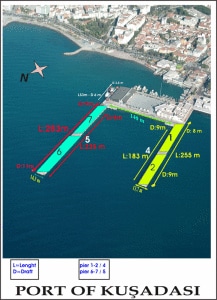
Overview from when the piers were built. On the concrete area at the end of the piers, the cruise terminal was built. Photo courtesy Kusadasi Port Authority/from my port database.
Captain Albert Schoonderbeek
When I approach Santorini with the ship I always have to remind myself that, no we are not crazy and yes in this case it is normal to sail into a Volcano crater. It is big enough and there is plenty of water but still it is a bit strange to do so. However it is an impressive experience when you sail around the central volcano cone towards the East shore where the most important villages are located. There are two entrances to the area, one from the South West and one from the North West. As we were coming from the Lower West we used the SW entrance as it was the shorter route.
The routine is for most cruise ships the same; first you go to O’Athinios to disembark the overland tour and then you slowly sail to Skala Fira where the tender docks for access to Thira which sits on top of the Cliff. As mentioned yesterday, the Prinsendam would have to drift all day, as a warship was at the anchorage. So I was intrigued to find out what sort of warship that would be. When we came around the corner we saw that it was a USCG cutter, taking on bunkers and doing some R&R.
Confusion reigned as they identified themselves as warship 917, while we could clearly see it’s was a USCG boat. Maybe the department of Transport was starting their own navy or something. However 917 rang a bell, I remembered that number from something and thought it could not be. But it was. The 917 was the same USCG cutter Boutwell that had played a very significant role in the sea rescue of the guests of the first Prinsendam in October 1980 when it caught fire in the Gulf of Alaska. It was thus a bit strange to see the Boutwell here in the Mediterranean and to have it meeting up with the 2nd Prinsendam. I joined the company a year later but I remember that there was a great feeling of gratitude among everybody for the work of the crew of the Boutwell during that operation.
Captain Albert
© 2026 – Captain Albert's Website and Blog –
Theme by Anders Noren — Up ↑