With a 05.00 pilot time, I poked my nose through the bridge door at 4 am and saw that the weather looked very good. As the Firth of Forth basically runs West to East, it can be a big blow hole that funnels the wind up to a high Beaufort rate, which makes it a very unpleasant place. In the archives you can find a blog describing the cancellation of Leith due to wind force 11 in September 2009 and with those winds the Firth is not a good place to be. However today looked good and we happily progressed towards the pilot station. Edinburgh does not have a port itself but there are three options: Leith to the East where you dock, South Queensferry in the middle where you have to anchor and Rosyth to the West where you dock as well. We were destined for Rosyth, West of the bridges. Leith is closer to town but it is tide dependent, as you need high water to get over the bar in front of the locks. Rosyth is an all day port; the only hurdle is the clearance under the bridges when going there. It means that you can arrive and leave whenever the cruise schedule says it is best, instead of arriving at an awkward time and having to leave at an even more in-convenient time, dictated by the tides. Nothing of that today we went straight for the dock. Continue reading
Category: Captain’s Log (page 63 of 128)
During the January 2010 dry dock, the ms Prinsendam received a new GMDSS system (emergency telecommunication system for the bridge) and a new steering system, gyro compass and auto pilot. Normally, the old systems are recycled for scrap. As the Prinsendam would be calling at Vlissingen, the Netherlands, during the summer season, the idea came up to donate these items to the local Maritime Academy.
During the next six months the bridge team collected and kept all the old charts, nautical books and other related items that would be of use for nautical students. On 20 July 2010, the ms Prinsendam visited Vlissingen and all that was collected was handed over to the lecturers of the Maritime Academy.
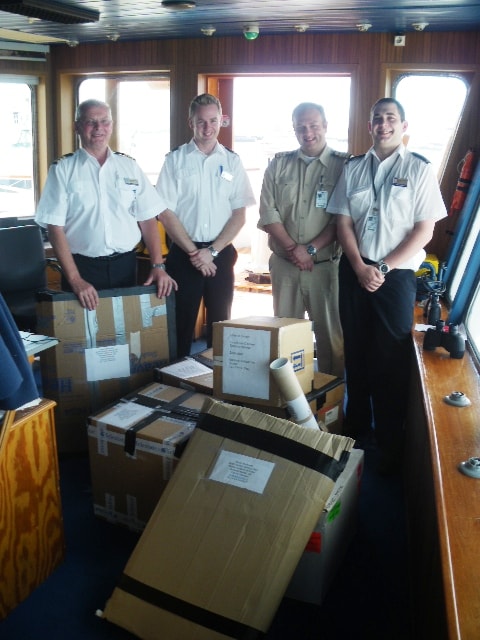
Recycle team, from left: S.E.H. Officer Willem van Woerkom, for environmental and compliance; 2nd Officer Navigation Simon Allcock; 1st Officer Joris Poriau, a graduate from the Maritime Academy Michiel de Ruyter of Vlissingen, and 4th Officer Adam Gardner, assistant navigation officer.
Today we really started our voyage heading north; by following the East coast of England. We are not going that fast as explained yesterday, and with very calm weather in the North Sea it was perfect cruising. Not much sunshine but that was good, at least for me, as it keeps that hazy stuff away. We had good visibility and thus the oil and gas platforms were clearly visible as our route went straight through the area. The platforms are grouped in clusters and you have to stay away from those but there are open shipping lanes in between for ships to criss cross the North Sea. I assume that the oil company’s would like to put a few platforms there was well but the chance of collisions would become too great, as commercial traffic also needs to use the sea. When ships do come too close to platforms, there is normally a Guard ship on duty that comes racing out to tell the perpetrator to change course. That sometimes results in loud arguments over the VHF, as not all ships agree with that policy. Continue reading
Today was the first day of our new cruise and as we stayed in the same place as yesterday it gave a bit of an unusual feeling. Normally, as soon as everybody is onboard, we race out to open sea and head for our first port. Now we were already there, which made for a nice and much easier pace. Change over days are always extremely busy for the crew but now it was split out in three days; giving some room for R & R in between. The weather forecast had been indicating heavy showers during the early morning and although it rained quite a bit in the distance, Tilbury stayed dry and not much later the sun came through on top of that. So it turned into a beautiful day. As it was not that warm, we looked at very clear skies with very good visibility and that was great for our sightseeing effort during sail away. Although sailing down the Thames can hardly be called picturesque, there is of course a lot of history in and around the river, so there is enough to see and enjoy. Our travel guru Frank is from the London area, so it was a home game for him this time. Continue reading
With the Prinsendam parked in the right location, we had the perfect setup for a smooth disembarkation process, followed later by an embarkation process that worked the same, just the other way. The luggage went off via deck four, here on the Prinsendam it’s called Boogie Plaza and the guests went off on deck 5 out of the main staircase. The suitcase off loading continues normally all night, in dribs and drabs. In the past, Housekeeping would start at 1 am and then bring everything down in one go to the assembly area. That had as a result the corridors were blocked with luggage and that would of course be dangerous in the case there was an emergency during that time. Now since a number of years we do it differently and housekeeping is using roving teams who continuously go through the corridors and pick up the luggage. The first luggage already appears in the corridors in late afternoon, when guests have packed their first suitcases with non-essentials. The rest then follows later, just before going to bed. Here in Tilbury it has been arranged that the shore side starts moving suitcases into the terminal by 10 pm. and that means that there is no rush in lining up the suitcases for the guests to be collected later. Essential is of course that the suitcases are correctly labeled and that remains an issue at times. Continue reading
So by 1 am in the morning, I was on the bridge in order to arrive an hour later at 1 am. at the NE Spit Pilot station for the Thames. The 1 and 1 worked out this way as we also had to give a time change of one hour back to get in synch with English time. The nice thing was that it was a beautiful night with nearly wind still weather when we sailed towards the pilot station. That pilot boarding area is located just above Ramsgate (where the pilot base is) and just under the fairway leading up the Thames estuary. While heading that way we listened out on the VHF and enjoyed all the conversations in various languages between the ships in the Dover Strait. There is always somebody who muddles things up for somebody else and it is quite funny to listen to a Russian telling a Greek what he thinks about the others seafaring capabilities. Also Traffic Control has the occasional issues to get a message across of what a certain ship has to do and when. Not always is the result that they want to achieve and quite often the party on the receiving end does something totally un-expected. That is why I never sail through this area with the watertight doors open………you never know what might happen next. Continue reading
From Vlissingen it was exactly 40 miles from pilot station to pilot station. Even for four hours that was a very slow speed run. However it gave me three hours of sleep before the Belgium pilot came onboard. So within 24 hours we came to the same pilot station twice, as Zeebrugge and Vlissingen are approached from the same side. Zeebrugge is the gateway port to Brugge (Bruges) and Gent (Ghent) and the place is not that spectacular. There are a few good fish restaurants but it has not the attraction of Brugge as a complete medieval city. Also the port is fairly new. The older part of the port is behind a lock, so there is no tidal influence and is now used mainly by car carriers and pleasure craft. What they did next was fill in the land between the old port and the sea barrier. From there they extended even further outward with a big container terminal. As a result Zeebrugge is the fastest growing port in Europe and specializes in Ro-Ro activities with the container business a good second. The cruise business, although appreciated, is not that big on the agenda although they do try to get as many cruise ships in as possible. Antwerp and Rotterdam are big competitors and in the future they might have to cope with Vlissingen as well. Continue reading
As indicated yesterday, this was a maiden call for the ms Prinsendam and also she was the first Holland America Line cruise ship ever visit to the port. It was not the first HAL visit ever, as that was done by the Edam of 1921 which was built here at the “De Schelde” ship yard in 1921. Thus after an 88 year hiatus we were back again. For the port itself it was a very important occasion as well, as Vlissingen (or Flushing in the English language) wants to become a cruise port and compete with Amsterdam, Rotterdam; and Antwerp and Zeebrugge across the border to the South. It has a number of factors really in its favor but it is a cargo port so it will need a cruise terminal to be really in league with the other ports. That gives a situation of catch 22. No cruise terminal, no cruise ships, but if you do not get cruise ships, there will be no money invested in a cruise terminal. Hence the decision of Holland America to help break the deadlock and send the “elegant Explorer” to help things moving forward. Hence our sudden appearance in this South West corner of the Netherlands. Continue reading
Last evening I had an interesting evening in relation to my Hal history hobby. I had the privilege to meet the great grandson of the 2nd captain of the company Capt. E. Deddes who was the first master of the ss Maas (2nd ship of the company) and of the P.C Caland, both ships that stood at the basis of the success of the Holland America Line. It turned out that his aunt had written a biography about this captain and I will get a chance in September to get a copy of that book. That all ties in with a little project that I am working on during my leave periods and that is to compile a listing of all the HAL captains that have ever served with the company. Eventually the listing with photos and biography’s will appear on this blog. 2nd event of the evening was dinner with the chairman of ss Rotterdam preservation society (Stichting Behoud Stoomschip Rotterdam) Mr. Klaas Krijnen and his better half. He and his society have been the coordinating force behind the conception of the project and the final arrival of the ship in Rotterdam. Something to have a lot of respect for as it was not an easy journey. Now the society is focusing on restoring more and more original details to the ship and creating ideas for the use of non utilized spaces onboard. In 2007 I was able to help out a little bit by transporting the top of the ships mast from Ketchikan, Alaska to Europe. The mast is now standing near the entrance to the ship. Continue reading
Le Havre is located in a recessed arc of the French Normandy coast. To get here from the Channel Islands, the ship sails past Cherbourg and then straight east towards the pilot station. That pilot station is about 8 miles away from the port entrance itself as in front of the port lays an extended sand bank. Thus there is the need for a long fairway that leads into the port. The area is prone to continues silting. Sand deposited by the currents in the Dover channel (or in this case let us use the French version: Pas de Calais), and as the current runs out of momentum due to the arched coast, the silt has a chance to settle down. Thus dredging takes place 24 hours a day 365 days a year, in the fairway and in the port itself. Due to the long approach channel to the port the ship had to arrive fairly early to ensure a timely docking. Early this morning was 06.00 and with the pilot onboard it took 45 minutes to get to the port itself. Swinging around in the turning basin and backing towards the dock another 40 minutes, the old port is compact with some locks and some ferry berths. Around the old port, they have built a new and much larger port which stretches for miles past the town itself. However we were docking in the old port, just outside the locks of the inner harbour. Continue reading
Captain Albert
© 2026 – Captain Albert's Website and Blog –
Theme by Anders Noren — Up ↑